Asylum Seekers: Offshore, Off Course

Civil Society, Europe, Featured, Headlines, Human Rights, IPS UN: Inside the Glasshouse, TerraViva United Nations
Opinion

Europe’s push to shift asylum procedures to third countries risks outsourcing not only refugees, but also its moral and political responsibility.

VIENNA, Austria, Dec 16 2025 (IPS) – The debate on reforming the European asylum system has gained significant momentum following the agreement reached by EU interior ministers last week. Alongside questions of solidarity and distribution, the possibility of establishing ‘return hubs’ outside the EU was at the heart of the meeting.


Outsourcing asylum procedures – or at least those concerning rejected asylum seekers – has long been a desire of many heads of state and government, and the European Commission now aims to make this possible by creating the necessary legal foundations, for example by scrapping the so-called connection criterion. In future, rejected asylum seekers would therefore no longer need to demonstrate a personal link to the third country to which they are transferred.

Previously, such links included earlier stays or family members living there. Yet the EU remains a long way from concrete implementation.

One reason is the high cost of such outsourcing projects. According to the UK’s National Audit Office, the British Rwanda deal cost the equivalent of more than €800 million, with limited effect: only four asylum seekers were relocated over two years.

Under Prime Minister Keir Starmer, the plan was shelved for good due to excessive costs and minimal benefit. And despite the heated migration debate in the United Kingdom, a revival appears unlikely. Denmark faced a similar situation with its own Rwanda plans, which the country put on hold in 2023 due to unfeasibility. And then there is the much-cited Italy–Albania agreement, whose original idea – conducting asylum procedures under Italian law on Albanian soil – was never implemented.

Practical implementation remains doubtful

What third countries gain from allowing such outsourcing on their territory is obvious: money, and even more importantly, political capital. Speaking on a panel at the ‘Time to Decide Europe’ conference organised by the Vienna-based ERSTE Foundation, Albania’s Prime Minister and Socialist Edi Rama stated openly that his small country of just under three million people must join any alliance willing to take it in.

This includes – and above all – the EU. For Albania, which is an EU candidate country, it therefore makes sense to appear accommodating to a not insignificant member state with which it is also historically closely connected, and to help solve its unpopular ‘migration question’, at least to the extent that refugees arriving in Italy do receive protection, but, in practice, ‘not in my backyard’.

So far, however, this principle has not been put into action due to objections raised by Italian courts. That is also why – and to put the costly asylum camps built in the Albanian towns of Shëngjin and Gjadër (construction and operations are believed to have already cost hundreds of millions of euros) to some use – the European Commission created the option of return hubs, which were formally adopted last week at the meeting of EU ministers.

Italy can therefore repurpose the facilities originally intended for asylum procedures as deportation centres for asylum seekers who were already on Italian territory and whose applications have been legally rejected. Here too, the number of cases remains limited, and it is unclear on what legal basis those transferred there could be held for extended periods to prevent them from re-entering the EU via Montenegro and Bosnia. De facto detention, however, would present yet another legal complication, even if the connection criterion and other EU-law barriers are removed.

Anyone striving for ‘fair burden-sharing’ would have to redistribute towards Europe, not away from it.

There is, therefore, still a long way to go before any concrete return hubs become reality. Not only because, in the usual trilogue process, the European Parliament must also give its approval — and some MEPs, including Birgit Sippel of the Socialists and Democrats group, have already announced their opposition.

But even if a parliamentary majority can be secured, the practical implementation remains doubtful: where are the trustworthy and willing third countries; how can infrastructure be built there; how can respect for human rights standards be monitored and enforced from Europe (which proves difficult even within an EU member state such as Hungary); and how should looming legal disputes be handled?

Among the countries mentioned so far are several that themselves regularly appear among the places of origin of refugees arriving in Europe. Alongside Rwanda, the East African state of Uganda is frequently cited; it already hosts the largest number of refugees from other parts of Africa, especially from Sudan, South Sudan, Burundi and the Democratic Republic of Congo. Like Rwanda, it lies directly next to regional conflict zones; the protection rate for Ugandan nationals in European host countries stands at around 60 per cent.

The country is considered authoritarian — and precisely for that reason, it has an interest in striking an outsourcing deal with EU member states, such as the one it has already concluded with the Netherlands. Such an agreement implicitly acknowledges and legitimises the Ugandan government.

The notorious EU–Turkey Statement of 2016 demonstrated how refugees accommodated in third countries can repeatedly be used as leverage in foreign policy disputes, for example when Prime Minister Erdoğan had them bussed to the Greek border to put pressure on the EU. EU strategists may euphemistically call this ‘migration diplomacy’, but for the layperson, it is simply blackmail.

The example of Uganda illustrates not only how Europe, through deals with third countries, outsources not just refugees but also bargaining power and control; it also reflects the fundamental imbalance in a one-sided debate on externalisation.

Already today, 71 per cent of all refugees find protection in developing and emerging countries, with 66 per cent hosted in neighbouring countries in the Global South or the Middle East and North Africa. Anyone striving for ‘fair burden-sharing’ would therefore have to redistribute towards Europe, not away from it.

Europe’s answer cannot, under any circumstances, be to emulate the Trump administration by resorting to ever-tougher asylum policies.

This leads to the fundamental questions that EU policymakers appear increasingly unwilling to ask, let alone answer: How does Europe want to position itself in future with regard to global refugee protection? How will people in need of protection from persecution – whose numbers are rising in an ever more unstable world – gain access to that protection?

How can the liberal post-war order be preserved, including and especially the Geneva Conventions, which were created in response to the lessons of the two World Wars and the Shoah? How should Europe position itself vis-à-vis an increasingly illiberal, in parts authoritarian United States, which now tends to view Europe more as an adversary than a partner?

A confident response to the new US national security strategy – which claims that migration threatens Europe with ‘civilisational erasure’ – must lie in emphasising Europe’s civilisational achievements since 1945. These include, above all, the prohibition of torture enshrined in Article 3 of the European Convention on Human Rights: it applies absolutely, and therefore also to asylum seekers who are obliged to leave and who may not be deported to countries where they risk inhuman treatment. This is precisely where the line between civilisation and barbarism lies.

Furthermore, a united Europe that wants to stand its ground against attacks from former allies must recognise societal diversity as one of its strengths, and acknowledge the indispensable contribution that migrants – from guest workers and refugees to highly skilled expats – have made to Europe’s reconstruction and prosperity.

Europe’s answer cannot, under any circumstances, be to emulate the Trump administration by resorting to ever-tougher asylum policies that effectively validate the American assessment.

For that would indeed amount to an obliteration — an obliteration of the founding idea of a united, open and liberal Europe which, let us not forget, received the Nobel Peace Prize in 2012 and stands for a rules-based order that has ensured decades of peace as well as economic prosperity. In short: for the very life that we are fortunate enough to enjoy day after day, in diversity, security and freedom.

Dr Judith Kohlenberger heads the FORM research institute at WU Vienna and is affiliated with the Austrian Institute for International Affairs, the Jacques Delors Centre Berlin and the Einstein Centre Digital Future. Her book Das Fluchtparadox (The Flight Paradox) was named Austrian Science Book of the Year in 2023 and nominated for the German Non-Fiction Prize. Her most recent publication is Migrationspanik (Migration Panic) (2025).

Source: International Politics and Society (IPS), Brussels, Belgium

IPS UN Bureau

  Source

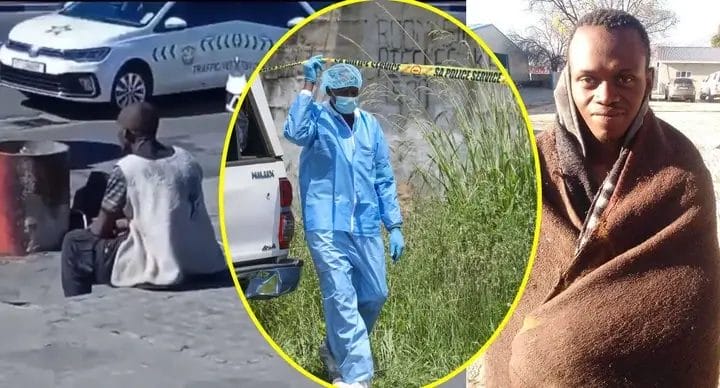
RSA serial killer Zwelinjani Mbola walks around town with body parts of a man he brutally murdered

..’He cut off private parts and arms’: Ceres man walks around town with body parts of man he brutally killed…

WESTERN CAPE-(MaraviPost)-The tranquil town of Ceres, nestled in the Western Cape, has been shattered by a gruesome crime that defies comprehension.

Zwelinjani Mbola, a 22-year-old man, has been arrested and charged with the murder and desecration of Peter Joubert, 43.

The allegations against Mbola are chilling: he is accused of not only killing Joubert but also mutilating his body, severing his arms and private parts, and then brazenly parading around town with some of the human remains.

The horrifying discovery was made on Sunday morning, when municipal law enforcement officers received a disturbing report.

According to a statement released by the Witzenberg Municipality, officers were alerted to a man walking in town, openly displaying what appeared to be human remains.

“Municipal Law Enforcement officers were alerted to a man walking in town with what appeared to be human remains in his possession,” the municipality stated. “Officers immediately responded and notified the South African Police Services (SAPS).”

The officers’ swift response led to the apprehension of Mbola, who was subsequently taken into custody by the SAPS.

A full investigation was immediately launched, leading to the discovery of the remainder of Joubert’s body at a second location pointed out by the alleged perpetrator.

Adding to the horror, reports from local residents suggest that Mbola was allegedly sitting in front of a liquor store, basking in the sun, with Joubert’s severed limbs displayed before him.

One witness even claimed that Mbola was holding one of Joubert’s ears in his hand.

This shocking scene was witnessed by a member of the community who, horrified by what they saw, immediately alerted the authorities.

The Witzenberg Municipality has expressed its profound shock and condemnation of the brutal crime.

“Witzenberg Municipality is deeply saddened and shocked by this brutal crime against one of their local residents,” the municipality stated, adding that Joubert’s body was found under a bridge and that the suspect was apprehended by Municipal Law Enforcement officers and subsequently arrested by the South African Police Service (SAPS).

“This senseless and horrific act has left our community reeling,” the municipality continued. “We are absolutely appalled by this level of violence. Our heartfelt condolences go out to the victim’s family during this devastating time.”

The case has now moved to the courts, with Mbola appearing in the Ceres Magistrate’s Court on Tuesday. Eric Ntabazalila, Regional Communications for the National Prosecuting Authority (NPA), confirmed Mbola’s appearance and the charges he faces.

“Zwelinjani Mbola, 22, appeared at the Ceres Magistrate’s Court this morning charged with murder and violation of a corpse,” Ntabazalila explained. “The State alleges that on December 7, the accused murdered Peter Joubert by cutting and dismembering his body with a sharp object. The State alleges that the accused physically violated the deceased’s body by cutting off his arms and private parts.”

The NPA spokesperson also stated that the case has been postponed until December 17 for bail information and a possible referral to a district surgeon for mental assessment. “His case has been postponed until 17 December 2025 for bail information and a possible referral to a district surgeon for mental assessment,” Ntabazalila added.

As the legal proceedings unfold, the focus remains on the victim, Peter “Piet” Joubert. Those who knew him describe him as a kind and gentle soul who did not deserve such a brutal end.

Anneke Jansen van Wielies, a relative of Joubert, described him as “a people person, someone with a beautiful personality who crept into everyone’s hearts.” She revealed that Joubert had lived with her in Wolseley for four years before moving to Ceres.

“He and I grew up together in Sutherland. Piet was not a person who got angry easily. On the contrary, he was always the one who wanted to keep the peace between our cousins,” Jansen van Wielies said. She also addressed rumours circulating about Joubert’s living situation, stating, “Then I also want to mention, since the public thinks that he had no place to go, he comes from and lived in a good house and worked for his money.”

Joubert was a long-time employee at Ina’s Carwash in Ceres. Ina Mouton, the owner of the carwash, shared a heartfelt tribute on Facebook, urging people to remember Joubert for the beautiful person he was.

“His name has come and gone, but now he has finally gone to our Father’s house. Pieter was like a child in our house, there he lay and relaxed in a warm bubble bath for the first time that I later had to call him to hear if he was still alright,” Mouton wrote. “Ate with us and watched TV and slept safely in a warm bed. Where Pieter could help, he didn’t think twice.” She further added that Joubert was her “left and right hand.”

The details emerging from the investigation paint a gruesome picture of the crime scene. According to a source close to the investigation, Joubert’s body was desecrated in a horrific manner. Both of his forearms were severed, his stomach area was cut open, and some of his organs were removed. His genitals and testicles were also cut off.

While the motive for the murder remains under investigation, rumours are circulating within the Ceres community that Mbola may be suffering from mental health issues.

Some residents believe that Joubert was simply in the wrong place at the wrong time.

Source: celebgossip.co.za


Discover more from The Maravi Post

Subscribe to get the latest posts sent to your email.

The Maravi Post

Social media influencer Onjezani Kenani names CDEDI chief Namiwa as most second 2025 Personality of the Year

LILONGWE-(MaraviPost)-One of the country’s social media Influencers Onjezani Kenani has name Centre for Democracy and Economic Development Initiative (CDEDI) Executive Director Sylvester Namiwa as the 2025 most second personality of the year.

Writing on his Facebook page, Kenani lauds Namiwa for bravery show up in many circumstances during entire President Lazarus Chakwera’s regime against poor governance tendencies.

Kenani therefore narrates why Namiwa is the second personality of the year…..

Six or seven years ago, when Sylvester Namiwa quit working for President Peter Mutharika’s State House to launch the Centre for Democracy and Economic Development Initiatives (CDEDI), few believed in his efforts. Here was a young man strongly linked to the administration of the time, suddenly claiming to start fighting for the rights of the common man.

But Namiwa was undeterred. Over the years, he has remained relentless in his efforts to hold public officials accountable.

There is no office he has not written to, no infraction he has not challenged, no doubt he has failed to express loudly, sometimes even at the expense of being ridiculed.

For example, when he recently confronted Khato Civils for the latter to explain to the public what, exactly, was going on in the Salima-Lilongwe Project, Namiwa was surrounded by a team of articulate experts, who denigrated his curiosity without appearing to denigrate him.

Yet, even in that particular effort, he spoke for many who were in the dark about what was going on, and his courage shone through.

But it was in June 2025 when Namiwa’s boldness and determination caught national attention. At the time, there were anxieties as to whether elections were going to be truly free and fair. And if there is anything we Malawians are most proud of, it’s the integrity of our national elections.

And so, to ensure the government of the day did not tamper with our most cherished ritual, Namiwa led demonstrations in the streets of Lilongwe.

Secretly, the Malawi Congress Party, then in power, had vowed to never let demonstrations take place on Malawian soil on its watch.

MCP knew very well what demonstrations could do, after all it rode the wave of the 2019-2020 demonstrations to win power.

The party, therefore, went so far as to train and arm scores of thugs with panga knives. As MCP got drunk on power, it unleashed those thugs with impunity, without any regard or fear of the law.

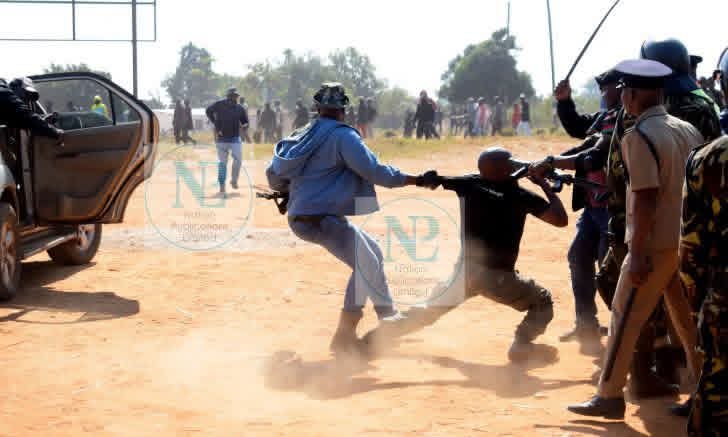
That doomed day in June, the thugs came out for Namiwa in droves. Even as the army and the police watched, they hacked and flogged Namiwa to within an inch of his life.

The brutality drew widespread condemnation. How could the Malawi Defence Force (MDF) and the police, which are supposed to be apolitical, join thieves in harming an unarmed activist who merely wanted to exercise his freedom of expression?

Yes, MDF and the police took part in assaulting Namiwa through their inaction. They created a conducive environment for thuggery to thrive. The nation was appalled.

Indeed, even after we tossed MCP out of power, it remains one of the major highlights of the year on the political scene.

Mr. Namiwa demonstrated utmost bravery and sent a message , not only to MCP but to anyone else who will come into power, that you can silence some of the people some of the time, but you can never silence all of the people all of the time. Even in our darkest hours as a nation, there will always be someone ready to stand up without fear.

In June, Mr. Namiwa could have, like most of us, chosen the comfort zone, staying at home and whining quietly from the comfort of his living room about what needed to change.

Or, like the Human Rights Defenders Coalition, which, in 2019 and 2020 led the demonstrations that brought MCP to power, he could have chosen to sell his soul to the devil. But no, he went out in the streets and led protests to amplify what was broken in our society.

For this reason, this page recognizes Mr. Sylvester Namiwa as the second most outstanding personality of the year 2025 in the fight for good governance.


Discover more from The Maravi Post

Subscribe to get the latest posts sent to your email.

The Maravi Post

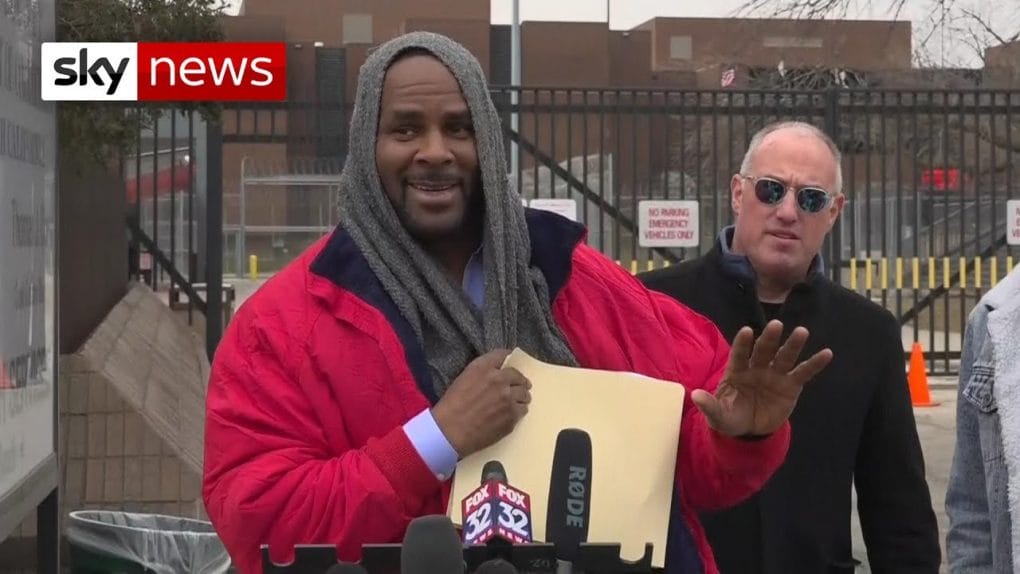
US singer US singer R. Kelly freed from jail after US$161,000 child support paid

NEW YORK-(MaraviPost)-US singer R. Kelly has been released from a Chicago jail following the payment of $161,000 in overdue child support.

The amount cleared his outstanding debts, allowing the controversial artist to regain his freedom after spending time behind bars.

Kelly’s release has sparked reactions across social media, with fans expressing relief and critics questioning the justice system’s handling of the case.

Sources close to the situation revealed that the payment came from an anonymous benefactor, though details about the transaction remain private.

Legal experts noted that such payments are often part of negotiated arrangements to expedite release in child support cases, highlighting the complexity of enforcement measures.

The singer, who has faced multiple legal challenges over the years, remains a polarizing figure in the music industry and public discourse.

Observers have raised concerns about accountability and fairness, noting that many ordinary citizens cannot secure early release in similar circumstances.

R. Kelly’s team has not yet commented publicly on the details surrounding the payment or the person responsible for covering the debt.

Meanwhile, authorities confirmed that his release was lawful and in line with court directives following the settlement of his financial obligations.

The case continues to attract widespread attention, as the public remains divided between sympathy for the artist’s personal struggles and criticism over his past legal and personal controversies.


Discover more from The Maravi Post

Subscribe to get the latest posts sent to your email.

The Maravi Post

Who is exactly this person, Richard Chimwendo Banda attempted to kill?

….MCP Secretary General Richard Chimwendo Banda Arrested Over 2022 Abduction Case….

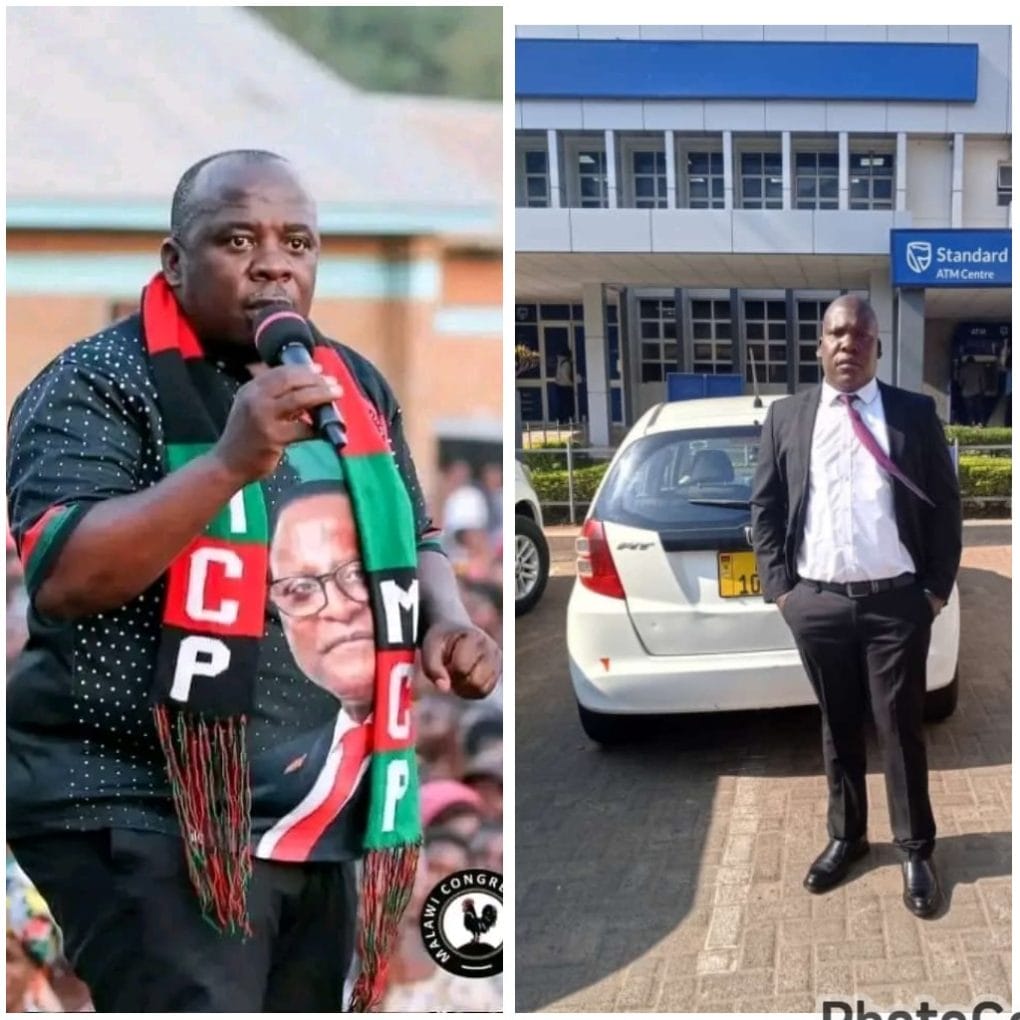
LILONGWE-(MaraviPost)-Malawi Congress Party (MCP) Secretary General and former Minister of Local Government, Richard Chimwendo Banda, has been arrested by police in Area 30, Lilongwe.

Chimwendo Banda, who is also the Member of Parliament for Dowa East, handed himself over to police on Friday afternoon after a warrant for his arrest was issued on Thursday.

According to police sources, he was tipped off that officers were preparing to execute the warrant, prompting him to present himself voluntarily.

Following his arrest, Chimwendo Banda was transferred from Area 30 Police Station to Kanengo Police Station for further processing.

Police say the arrest is linked to an attempted murder case involving Frank Chiwanda, which allegedly occurred in Madisi, Dowa District, in 2022.

Who is Frank Chiwanda?

Frank Chiwanda is a former Malawi Congress Party member who previously defected to the MCP from the Democratic Progressive Party (DPP). During his time in the MCP, Chiwanda was known for being outspoken and openly critical of President Lazarus Chakwera’s leadership style.

His criticism reportedly led to disciplinary action, culminating in his expulsion from the MCP.

The 2022 Alleged Abduction

In February 2022, Chiwanda was allegedly abducted in Madisi, where he claims he was placed in a sack by unknown assailants. According to Chiwanda, during the ordeal he overheard his abductors saying they had been sent by Richard Chimwendo Banda.

He was later abandoned near the Bua River, where he was discovered by passers-by and rushed to hospital for treatment.

Chiwanda subsequently reported the incident to Madisi Police, triggering investigations that have now led to Chimwendo Banda’s arrest.

Charges

Police have confirmed that Chimwendo Banda is being held on allegations of attempted murder, an offence contrary to provisions of the Malawi Penal Code.

Police investigations are ongoing, and he is expected to be formally charged and appear in court in due course.


Discover more from The Maravi Post

Subscribe to get the latest posts sent to your email.

The Maravi Post

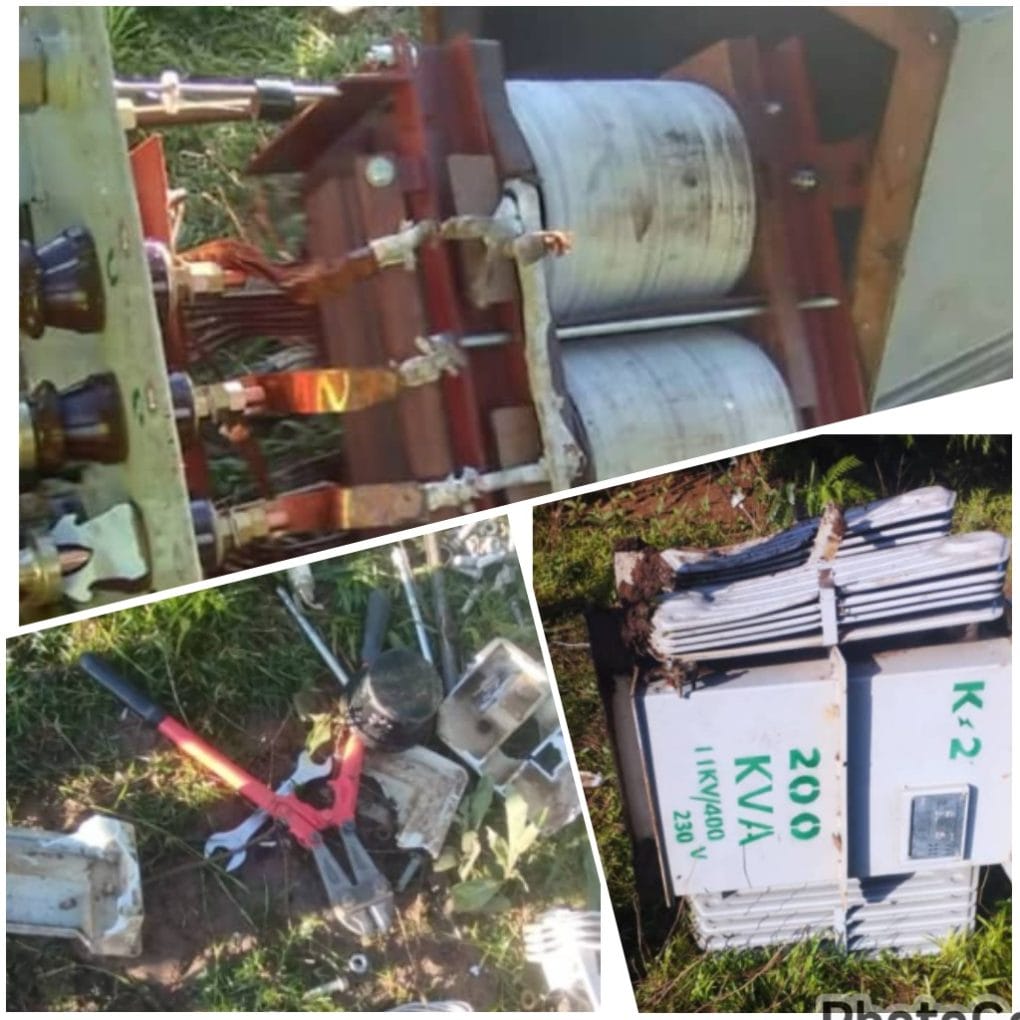
Lilongwe Mob stones suspect to death, another severely wounded ufor vandalising ESCOM transformer

BLANTYRE-(MaraviPost)-Malawi Police in Lilongwe have condemned the mob justice that led to the stoning to death of one suspect and the severe wounding of another after they were found vandalising an ESCOM transformer.

According to Lilongwe Police Spokesperson Inspector Hestings Chigalu,the incident occurred at Mbalame Primary School in Traditional Authority Chadza, Lilongwe, in the early hours of Friday, December 12, 2025

The deceased has been identified as Amon Maliko, 35 years old, while the surviving suspect is Million Gideon,aged 21.

Preliminary investigations indicate that at around 03:00 hours, villagers around Mbalame Primary School were awakened by a loud sound, suspected to be a falling object.
Upon checking, some villagers discovered two individuals dismantling a transformer that had already been taken down.

The community mobilised and attempted to apprehend the suspects, who initially fled.

However, residents from neighbouring villages, alerted by the commotion, joined the pursuit and eventually caught the two.

Villagers from Mbalame, who initially claimed they were taking the suspects to police, instead took them back to the vandalism scene where they began assaulting them.

Police officers rushed to the scene upon receiving a report and managed to rescue Gideon, who was taken for medical treatment.

Maliko, however, was pronounced dead upon arrival at Maluwa Health Centre.

Maliko hailed from Kadambe Village, Traditional Authority Chadza, while Gideon comes from Chazwe Village, Traditional Authority (T.A) Mazengera, both in Lilongwe District.

Police strongly warn communities against mob justice, emphasizing that such acts are criminal and hinder lawful prosecution of offenders.


Discover more from The Maravi Post

Subscribe to get the latest posts sent to your email.

The Maravi Post