Dorothy in Yellow during previous court session on corruption charges
LILONGWE-(MaraviPost)-About eleven months have passed since High Court Judge Patrick Chirwa, sitting as Chief Resident Magistrate ruled that former Malawi Energy Regulatory Authority (MERA) Chief Executive Officer Collins Magalasi, businesswoman Dorothy Shonga, and two other suspects have a case to answer in a high-profile corruption case.
The four were arrested in 2020 on allegations of abusing their positions to manipulate MERA’s Internal Procurement and Disposal Committee (IPDC) into awarding a lucrative MK186 million contract to Vink Enterprise, a company owned by Shonga.
The deal, which sparked a major scandal, raised concerns about procurement irregularities within MERA.
Delivering his ruling in March 2025, Judge Chirwa stated that the prosecution had presented sufficient evidence to warrant the accused defending themselves in court. The ruling effectively dismisses any possibility of an immediate acquittal and sets the stage for the defence to present its arguments.
“This court has carefully examined the evidence submitted by the State, and it is clear that the accused have questions to answer regarding their involvement in the contract awarding process,” Chirwa said.
The case revolves around allegations that Magalasi, in collaboration with Shonga and the other accused, bypassed standard procurement procedures to unlawfully benefit Vink Enterprise.
The Anti-Corruption Bureau (ACB), which led the investigation, has argued that the deal was tailored to favour Shonga’s company at the expense of transparency and fairness.
Following the ruling, legal experts say the accused had the opportunity to challenge the evidence and present their defence.
If found guilty, they could face severe penalties, including imprisonment and financial restitution.
The case attracted significant public attention, as it underscores ongoing efforts to combat corruption in Malawi.
Civil society organizations and governance watchdogs welcomed the court’s decision, urging authorities to ensure that justice is served without bias.
But now with eleven months after the ruling was made in March 2025, the case has never seen a day in the court.
Both ACB and Judiciary public relations office are yet to give reasons why the case has stalled for a year.
Why could such a high profile case stall like that after the suspects were found a case to answer? Who is sitting on the case
BLANTYRE-(MaraviPost)-The Public Service Pension Trust Fund (PSPTF), under the oversight of the governing Democratic Progressive Party (DPP) government, has acquired Amaryllis Hotel for a staggering K147 billion, nearly three times its original valuation of K47 billion, raising serious concerns about the prudence of the transaction with MK90 billion already paid towards the purchase.
The hotel, already struggling and failing to make profits, now sits at the center of controversy over the management of public servants’ retirement savings.
The acquisition received legal approval from Attorney General Frank Farouk Mbeta, who also represents Amaryllis Hotel a glaring conflict of interest critics describe as part of his long history of controversial legal interventions.
In a letter dated 28 December 2025 to the Malawi Law Society, Mbeta presented the findings of investigations into allegations surrounding the sale, stating that independent due diligence by FDH Bank Plc, Continental Asset Management Limited, and EMJ Advisory Public Accountants confirmed the transaction was viable.
He concluded that there was no evidence of corruption, abuse of office, or undue pressure on the Board, though he advised careful risk management.
Earlier, the Anti-Corruption Bureau (ACB) had issued a restriction notice in November 2025, temporarily halting the sale pending investigations.
By 18 December 2025, the ACB issued a letter clearing the transaction, stating that no fraudulent activities were found, effectively lifting the restriction quietly before the end of the year.
However, the Registrar of Financial Institutions at the Reserve Bank of Malawi sent a stern letter on 6 January 2026, warning that the transaction could expose pension fund members to undue financial risk.
The letter cautioned that the purchase could breach investment limits under the Financial Services Directive, cause liquidity mismatches, and increase concentration risk, putting systemically important pension assets in jeopardy.
The Registrar recommended that the Board reconsider the decision or provide clear safeguards for members’ funds.
Adding to the controversy is Frank Mbeta’s legal track record. While he has never been convicted, he has faced multiple allegations, arrests, and injunctions.
In 2015, the ACB sought to arrest him over bribery involving K2 million to an MRA employee, but a court injunction blocked the arrest.
He was also implicated in “judge-shopping” and judicial manipulation (2016–2017), and was mentioned in the Thomson Mpinganjira bribery trial (2019–2020), where testimony suggested he may have been involved in attempts to influence judges.
In February 2026, he further attracted criticism for approving a K51 million payout and a Toyota Fortuner to a politically aligned former Malawi Housing Corporation (MHC) lawyer, fueling accusations of favoritism and misuse of public funds.
Civil society organizations, including the Centre for Democracy and Economic Development Initiatives (CDEDI), have called for Mbeta’s resignation, citing the long-standing “shadow of allegations” undermining public trust.
As the PSPTF moves forward with the hotel acquisition, the clash between Mbeta’s clearance, the ACB’s quiet approval, and the Reserve Bank’s caution leaves Malawians asking whether pension funds are being safeguarded or gambled away for political and personal interests.
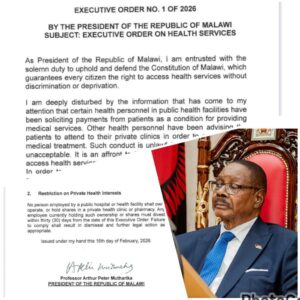
LILONGWE-(MaraviPost)-President Peter Mutharika has directed that all medical personnel working in public health institutions must not own or hold shares in any private hospital.
According to the directive, any public health worker who currently owns or has shares in a private hospital must dispose of that ownership within 30 days from February 17, 2026.
The order states that failure to comply with the directive will result in dismissal from government employment. In addition, those who do not adhere to the instruction may also face prosecution.
The move appears aimed at addressing potential conflicts of interest within the health sector, where public officers may have private business interests in healthcare facilities.
Further details on how the directive will be implemented are yet to be made public.
This is one quality of insightful and listening leadership being displayed by Mutharika.
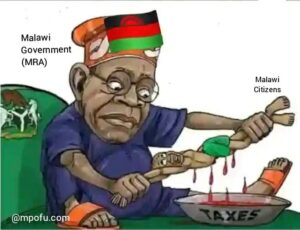
Malawi stands at a critical economic crossroads, grappling with the legacy of staggering debt and fiscal instability inherited from previous administrations, particularly the Malawi Congress Party (MCP).
The current Democratic Progressive Party (DPP) government, under the leadership of Professor Arthur Peter Mutharika, is facing tough but necessary decisions to restore fiscal discipline and chart a sustainable path forward.
The recent introduction of the Electronic Invoicing System (EIS), alongside proposals for new taxes such as the inheritance tax and adjustments to fuel prices, represents a strategic effort to mobilize domestic revenue, reduce dependency on external borrowing, and ultimately secure Malawi’s economic future.
Yet, these moves have been met with resistance and protests, particularly from small-scale traders, who understandably feel the pinch of rising costs and regulatory changes.
It is imperative for Malawians to view these measures in the broader context of national recovery and long-term prosperity.
For decades, Malawi’s economic challenges have been deepened by unsustainable borrowing practices, much of which occurred under MCP leadership. The current national debt, now in the trillions, is a heavy burden that threatens the country’s ability to fund critical services and infrastructure.
This debt crisis cannot be overstated: it was the reckless fiscal management and opaque dealings of many MCP officials that have left Malawi shackled by creditors.
Numerous former MCP ministers have been implicated in accumulating personal wealth through dubious means, often at the expense of the nation’s treasury.
Their legacy is one of mismanagement, corruption, and economic policies that prioritized short-term gains over sustainable development.
In stark contrast, the DPP government’s approach under Professor Mutharika is one of fiscal responsibility and transparency. The introduction of the Electronic Invoicing System is a testament to this commitment.
By replacing the outdated Electronic Fiscal Devices with a more robust and real-time tax invoicing system, the Malawi Revenue Authority (MRA) aims to curb tax evasion, broaden the tax base, and ensure that all businesses, regardless of size, contribute their fair share to national development.
While small-scale traders raise valid concerns about the immediate impact on their operations, it is important to recognize that the EIS will foster a more equitable business environment and improve government revenue collection, which in turn can support public services and infrastructure that benefit all Malawians.
Critics, particularly from the MCP, have attempted to frame these reforms as punitive or overly burdensome. However, this narrative ignores the stark reality that Malawi simply cannot afford to continue down the path of borrowing without accountability.
The DPP’s fiscal measures are not designed to stifle business but to create a sustainable economic ecosystem where government resources are available to support growth and development.
The resistance to these reforms is more reflective of the MCP’s historical reluctance to embrace transparency and fiscal discipline, rather than any genuine concern for the welfare of traders.
Moreover, the increase in fuel prices, while difficult for many households and businesses, is a reflection of global economic realities and the need for Malawi to align its domestic prices with international market trends.
Subsidizing fuel or delaying price adjustments would only deepen fiscal deficits and increase reliance on foreign loans, worsening the debt situation.
The DPP government’s decision to adjust fuel prices is therefore a necessary step to maintain macroeconomic stability.
Malawians must also be reminded of the dangers of returning to MCP rule. The party’s track record is marked by economic mismanagement, corruption scandals, and a failure to deliver meaningful development.
Their insatiable appetite for borrowing without accountability led to the current debt crisis, which the country is now struggling to overcome. Voting for MCP in the future would risk reversing the progress made under the DPP and plunging Malawi back into financial chaos.
The DPP’s governance under Professor Mutharika embodies a vision of disciplined management, structural reforms, and a commitment to fighting corruption.
It is also crucial to highlight that the DPP government is not acting in isolation.
The introduction of new taxes, such as the inheritance tax, is aligned with international best practices in revenue mobilization.
These policies aim to ensure that wealthier segments of society contribute fairly to national development, helping reduce inequality and broaden the tax base beyond the small-scale traders who often bear a disproportionate burden. This approach promotes social justice and fiscal sustainability.
The protests by traders, while understandable on a human level, must be balanced against the broader national interest.
The government has pledged to engage with stakeholders and provide feedback as it implements these reforms, demonstrating a willingness to listen and adapt where necessary. However, the ultimate goal must remain clear: to build a Malawi that is economically stable, self-reliant, and capable of investing in the future of its people.
The DPP government’s domestic revenue mobilization efforts are not only justified but essential.
The introduction of the Electronic Invoicing System, the adjustment of fuel prices, and the proposal of new taxes are all strategic moves designed to reduce Malawi’s dependency on unsustainable borrowing, improve transparency, and create a more equitable tax system.
These reforms are a direct response to the economic turmoil left by the MCP’s mismanagement and corruption.
Malawians should support these measures, recognizing that they are building blocks for a stronger, more prosperous nation.
The choice is clear: continue on the path of fiscal irresponsibility and debt under MCP leadership or embrace the disciplined, reform-oriented approach of the DPP government under Professor Arthur Peter Mutharika. The future of Malawi depends on this decision.
By Dr. Tinevimbo S. Moyo, Harare, Zimbabwean political economist and Director of the Southern Africa Governance and Trade Initiative
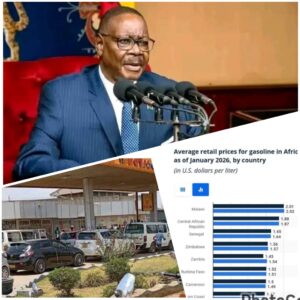
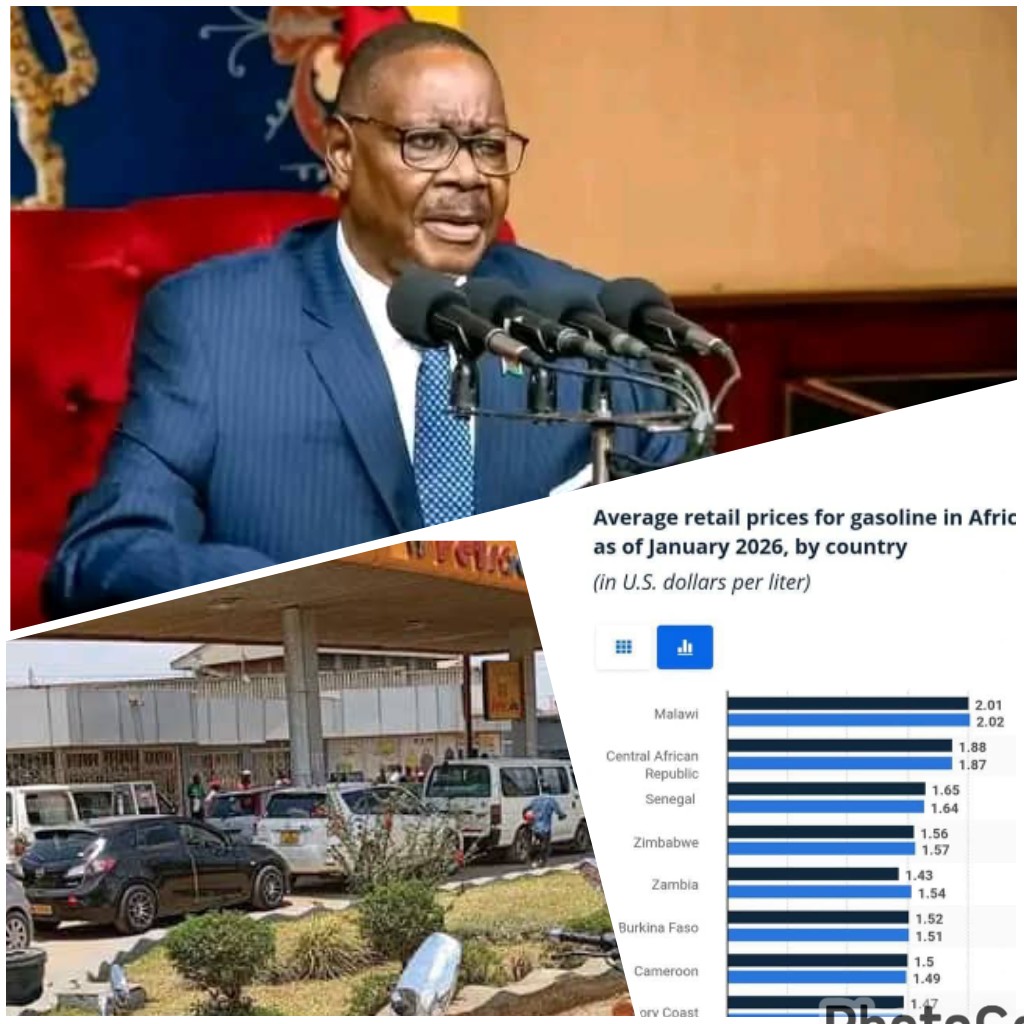
In a decisive move that underscores his administration’s commitment to economic realism, President Professor Arthur Peter Mutharika has endorsed the Malawi Energy Regulatory Authority’s (MERA) immediate adjustments to fuel and electricity prices.
This bold step, announced just hours ago, marks a critical inflection point for Malawi’s economy and represents the very kind of firm, corrective act that was conspicuously absent under the previous administration of President Lazarus Chakwera.
The decision, effective from January 20, 2026, sees the reinstatement of the Automatic Pricing Mechanism (APM) for petrol and diesel, with increases of approximately 41%, and the implementation of the long-delayed third tranche of the electricity base tariff.
This is not merely a price change; it is a fundamental policy reversal. It directly addresses the artificial pricing regime—a legacy of the Chakwera era—that brought the nation to the brink of energy collapse.
Where the previous administration hesitated and allowed critical levies to fail, President Mutharika has acted with the urgency the situation demands.
Upon his return to office following a decisive electoral mandate in September 2025, President Mutharika inherited an energy sector in silent crisis.
The fixed pricing model maintained by his predecessor had drained strategic reserves, encouraged rampant smuggling, and starved the Road Fund and Rural Electrification Programme (MAREP) of billions in Kwacha.
The action is the first, essential surgical cut to remove that tumour of unsustainable policy.
What President Mutharika has done, his predecessor demonstrably could not—or would not—do over five years, is prioritize the long-term health of the nation over short-term political comfort.
The Chakwera administration was defined by a paralysis in the face of difficult choices, allowing infrastructure to decay and supply chains to fracture while offering only promises.
President Mutharika has replaced promises with a painful but precise prescription for recovery.
The swiftness of this decision following his return to State House sends a powerful signal to citizens, investors, and international partners.
It signals that the era of avoidance is over. By allowing prices to reflect true costs, the President has:
Restored Market Integrity: Ensuring fuel importers can operate viably and supply can be sustained.
Restored Fiscal Linkages: Reconnecting every litre of fuel sold to the funding of roads and rural electricity projects from today forward.
Restored Policy Credibility: Demonstrating that Malawi, under his leadership, will adhere to transparent, rules-based economic governance.
The timing is pivotal. This decision, made today, prevents the continued haemorrhaging of foreign exchange and stabilizes the foundation upon which all other economic activity depends. It is a classic act of political courage: spending hard-earned political capital immediately upon entering office to secure the nation’s future, rather than delaying the inevitable until a crisis becomes unmanageable.
For the ordinary Malawian feeling the weight of this adjustment today, the pain is real and immediate. But so too was the pain of empty pumps, impassable roads, and stalled development—a chronic pain the previous government failed to cure.
President Mutharika’s choice today is to administer a sharp, transformative pain that leads to recovery, rather than prolonging a debilitating decline.
In his victory speech, President Mutharika promised a return to decisive and responsible governance.
The announcement from MERA this afternoon is that promise in action.
It is a clear statement that under his leadership, difficult truths will be confronted head-on, not deferred.
For a nation weary of false stability and hidden decay, today’s difficult news may well be remembered as the day Malawi began its honest journey back to solid ground.
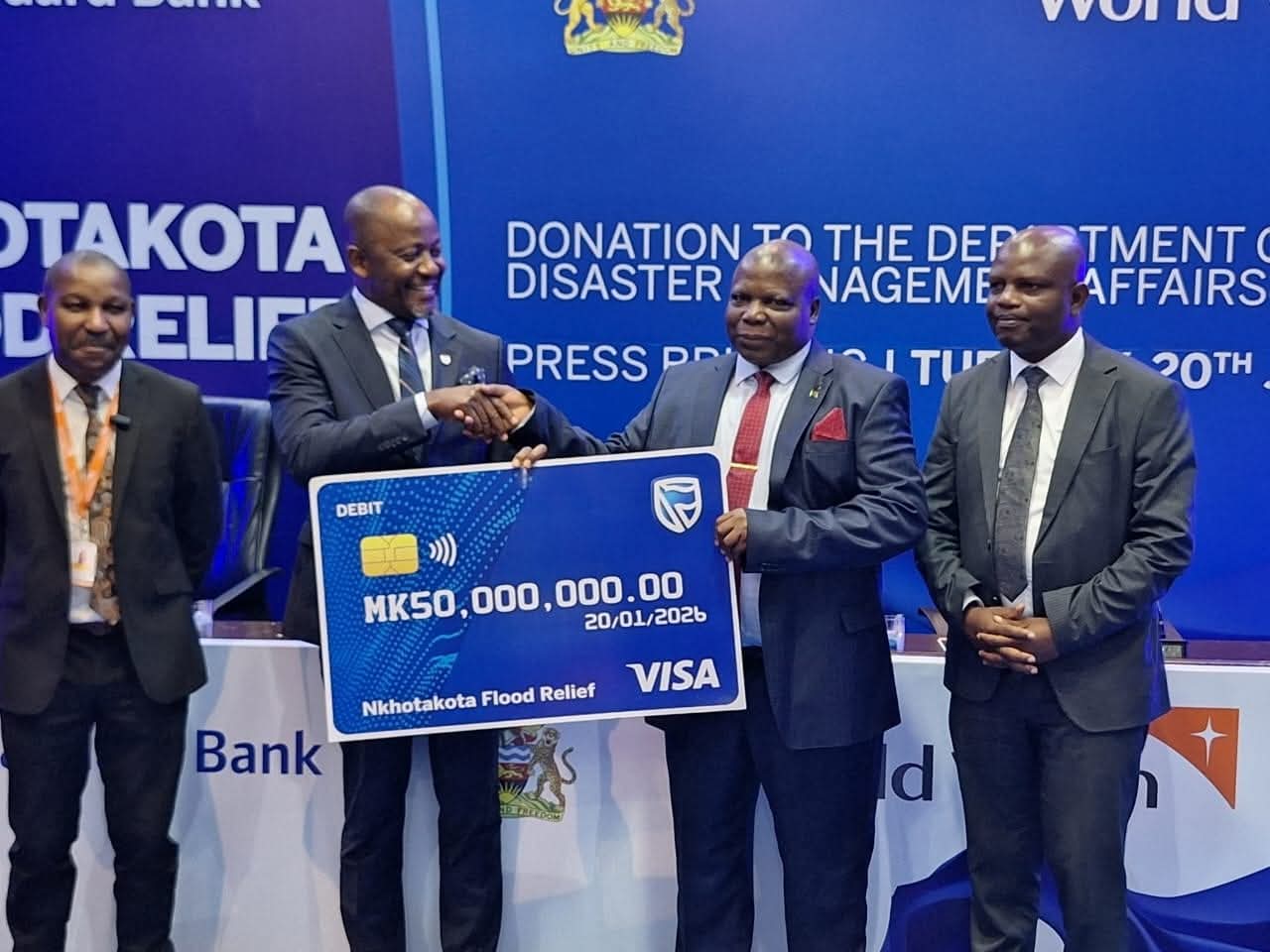
LILONGWE-(MaraviPost)-Standard Bank Plc has donated MK50 Million for relief efforts to affected communities of Nkhotakota in central Malawi.
This is in response to the aftermath of recent national flood disasters.
Handing over the donation, Standard Bank Chief Executive Phillip Madinga said the donation aims to complement government’s efforts in addressing the immediate needs of the victims.
“Today’s donation of Mk50 million speaks directly to our purpose of Driving Malawi’s Growth. To us, growth is not only measured by financial outcomes or economic indicators.
“True growth is reflected in the strength of our communities and in how we care for one another when life turns difficult,” he said.
According to the Department of Disaster Management Affairs (DODMA), Nkhotakota has recorded 12 deaths,37 injuries and two missing persons.
The department adds that more than 10,912 households have been affected in the district.
The department adds that the donation by Standard Bank Plc supports a camp in T/A Kanyenda Dwangwa area that is catering for approximately 3,000 displaced people.
Many people are living in camps.
Madinga said the donation reiterates Standard Bank’s long-term commitment to responding to the country’s complex disasters.
Notable disasters include the call for Hunger Relief last year, relief from effects of Cyclones Ana, Idai and Freddy; and the COVID-19 Pandemic.
In December, the bank contributed K200 Million in response to President Peter Mutharika’s declaration of disaster on hunger.
“As a bank, we also recognize that these disasters are closely linked to the growing realities of climate change. Standard Bank is a founding signatory to the United Nations Principles for Responsible Banking, aligning our operations with the UN Sustainable Development Goals and the Paris Agreement.
“These commitments compel us not only to respond to crises, but to actively support efforts that protect our environment and safeguard future generations. We therefore pledge to continue playing our part in collaborative initiatives aimed at building resilience and preventing the recurrence of such tragedies,” said the Chief Executive.
Chief Secretary in the office of President and Cabinet Dr. Justin Saidi thanked Standard Bank for its long history of assisting in times of disaster.
“Today’s donation will greatly assist in meeting the needs of victims living in camps and those outside. It’s pleasing to note that Standard Bank is always moving together with us on this journey. Their generous donation of MWK50 million is a true sign of solidarity,” he said.
Standard Bank has partnered World Vision International and DODMA in the Office of President and Cabinet for the relief response.
“There are families who lost all they had worked for, and their loved ones and are in dire need. We express deep gratitude to Standard Bank for their donation, and responding to the call ,” said Charles Chimombo, WVI Director of Programs.
Through this donation, Standard Bank Plc reaffirms its commitment to standing with communities in times of need and working alongside Government, humanitarian partners and stakeholders to support recovery and long‑term resilience.
The Bank remains dedicated to driving inclusive growth, strengthening community wellbeing and contributing meaningfully to national development, particularly in the face of increasing climate‑related challenges.