New Zealand: Māori Rights in the Firing Line

Asia-Pacific, Civil Society, Economy & Trade, Education, Environment, Featured, Headlines, Health, Human Rights, Indigenous Rights, TerraViva United Nations

Opinion

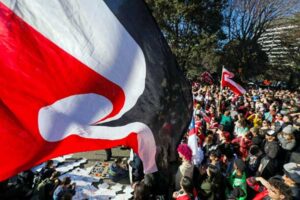
Credit: Dave Lintott / AFP via Getty Images

LONDON, Sep 2 2024 (IPS) – A New Zealand bill that would roll back Indigenous rights is unlikely to pass – but it’s emblematic of a growing climate of hostility from governing politicians. A recent survey shows that almost half of New Zealanders believe racial tensions have worsened under the right-wing government in power since December 2023.


The Treaty Principles Bill reinterprets the principles of the 1840 Treaty of Waitangi. New Zealand’s founding text, this agreement between the British government and Indigenous Māori chiefs established British governorship over the islands in return for recognition of Māori ownership of land and other property.

The treaty was controversial from the start: its English and Māori versions differ in crucial clauses on sovereignty. Māori people lost much of their land, suffering the same marginalisation as Indigenous people in other places settled by Europeans. As a result, Māori people live with higher levels of poverty, unemployment and crime, and lower education and health standards, than the rest of the population.

From the 1950s, Māori people began to organise and demand their treaty rights. This led to the 1975 Treaty of Waitangi Act, which defined a set of principles derived from the treaty and established the Waitangi Tribunal to determine breaches of the principles and recommend remedies.

In recent years, right-wing politicians have criticised the tribunal, claiming it’s overstepping its mandate – most recently because it held a hearing that concluded the bill breaches treaty principles.

Change in direction

The bill resulted from a coalition agreement forged after the 2023 election. The centre-right National party came first and went into government with two parties to its right: the free-market and libertarian Act party and the nationalist and populist NZ First party. Act demanded the bill as a condition of joining the coalition.

The election was unusually toxic by New Zealand standards. Candidates were subjected to racial abuse and physical violence. A group of Māori leaders complained about unusually high levels of racism. Both Act and NZ First targeted Māori rights, promising to reverse Labour’s progressive policies, including experiments in ‘co-governance’: collaborative decision-making between government and Māori representatives. Act and NZ First characterised such arrangements as conferring racial privilege on Māori people, at odds with universal human rights.

NZ First leader Winston Peters – who’s long opposed what he characterises as special treatment for Māori people despite being Māori himself – pledged to remove Māori-language names from government buildings and withdraw New Zealand’s support for the UN Declaration on the Rights of Indigenous Peoples. He’s compared co-governance to apartheid and Nazi racial theory. He’s now New Zealand’s deputy prime minister.

New Zealand, though far from Europe and North America, has shown it isn’t immune from the same right-wing populist politics that seek to blame a visible minority for all a country’s problems. In the northern hemisphere the main targets are migrants and religious minorities; in New Zealand, it’s Indigenous people.

Bonfire of policies

If the bill did succeed, it would preclude any interpretation of the treaty as a partnership between the state and Māori people. It would impose a rigid understanding that all New Zealanders have the same rights and responsibilities, inhibiting measures to expand Māori rights. And without special attention, the economic, social and political exclusion of Māori people will only worsen.

The problems go beyond the bill. In February, the government abolished the Māori Health Authority, established in 2022 to tackle health inequalities. In July, a government directive ordered Pharmac, the agency that funds medicines, to stop taking treaty principles into account when making funding decisions. This is part of a broader attack on treaty principles, which the government has pledged to remove from most legislation.

Government departments have been ordered to prioritise their English-language names and communicate primarily in English, unless they’re specifically focused on Māori people. The government has pledged to review the school curriculum – revised last year to place more emphasis on Māori people – and university affirmative action programmes. It’s ceased work on He Puapua, its strategy to implement the UN Declaration.

The government has cut funding for most of its initiatives for Māori people. In all, over a dozen changes are planned, including in environmental management, health and housing.

What’s bad for Māori people is also bad for the climate. The intimate role the environment plays in Māori culture often puts them on the frontline of combating climate change. This year a Māori activist won a ruling allowing him to take seven companies to court over their greenhouse gas emissions, based in part on their impact on places of customary, cultural and spiritual significance to Māori people..

But the new government has cut funding for many projects aimed at meeting New Zealand’s Paris Agreement commitments. It plans to double mineral exports and introduce a law to fast-track large development projects, without having to navigate environmental safeguards. The draft law contains no provisions about treaty principles. Māori people will be disproportionately affected by any weakening of environmental standards.

Out in numbers

This is all shaping up to be a huge setback for Māori rights that can only fuel and normalise racism – but campaigners aren’t taking it quietly. The threat to rights has galvanised and united Māori campaigners.

Civil society groups are taking to the courts to try to halt the changes. And people are protesting in numbers. In December, when parliament met for the first time since the election, thousands gathered outside to condemn anti-Māori policies. At the swearing-in ceremony, Te Pāti Māori politicians broke with convention by dedicating their oaths to the Treaty of Waitangi and future generations.

That same month, 12 people were arrested following a protest in which they defaced an exhibition on the treaty at the national museum. Protesters accused the exhibition of lying about the treaty’s English version.

On 6 February, Waitangi Day, over a thousand people marched to the site where the treaty was agreed, calling for the bill to be rejected. At the official ceremony, people heckled Peters and Act leader Peter Seymour when they spoke.

Most recently, Māori people had a chance to show their discontent at a ceremony held in August to commemorate the coronation of the Māori King. Although normally all major party leaders attend, Seymour wasn’t invited, and a Māori leader told Prime Minister Christopher Luxon that the government had ‘turned its back on Māori’. The Māori King also called a rare national meeting in January, and the turnout – 10,000 people – further showed the extent of concern.

Wasted potential

At the same time, the Māori population is growing quickly – it recently passed the million mark – and is youthful. Compared to previous generations, people are more likely to embrace their Māori identity, culture and language. Māori people are showing their resilience, and activism has never been stronger. But this growing momentum has hit a political roadblock that threatens to throttle its potential – all for the sake of short-term political gain.

New Zealand’s positive international reputation is on the line – but it doesn’t have to be this way. The government should start acting like a responsible partner under the Treaty of Waitangi. It must abide by the treaty principles, as developed and elaborated over time, and stop scapegoating Māori people.

Andrew Firmin is CIVICUS Editor-in-Chief, co-director and writer for CIVICUS Lens and co-author of the State of Civil Society Report.

  Source

VIETNAM: ‘Human Rights Conditions Will Likely Worsen as the Country Descends into a Police State’

Asia-Pacific, Civil Society, Crime & Justice, Environment, Featured, Global Geopolitics, Headlines, Human Rights, Labour, TerraViva United Nations

Aug 29 2024 (IPS) –  
CIVICUS discusses recent leadership changes in Vietnam with David Tran, coordinator of the Alliance for Vietnam’s Democracy, a civil society platform that promotes democracy in Vietnam and the region through international cooperation and the strengthening of local civil society.


On 3 August, President Tô Lâm was confirmed as General Secretary of the Communist Party, Vietnam’s top position, following the death of long-serving General Secretary Nguyễn Phú Trọng. Lâm, who has been president since May, is known for leading an aggressive anti-corruption campaign that has seen many officials jailed and others forced to resign. He will continue as president while assuming the duties of general secretary, potentially enabling him to consolidate power ahead of the 2026 party congress, which will choose Vietnam’s top leaders for the next five years. Civil society fears the regime could become even more autocratic and repressive if Lâm retains both positions.

David Tran

What’s Vietnam’s political system like, and what’s the likely impact of the recent leadership change?

Vietnam is an authoritarian one-party state led by the Vietnamese Communist Party (VCP). There are four key positions of authority: the president, who is the ceremonial head of state, the prime minister, who heads the government, the chair of the National Assembly, the unicameral legislature, and the most powerful, the general secretary of the VCP.

Although the president is elected by the National Assembly, this body is overwhelmingly made up of VCP members, who usually approve all incumbents unopposed. On 3 August, following the death of the last VCP general secretary, Nguyễn Phú Trọng, Tô Lâm was confirmed as the new VCP leader.

This appointment is particularly significant because it puts a lot of power in the hands of one person. His dual role gives Tô Lâm considerable influence over the state and party, as well as greater control over the public security apparatus. While he appears set to continue the policies of his predecessor, there are several cracks beneath the surface. His power is likely to be challenged by several VCP members who’ve been forced into retirement by his ‘anticorruption’ campaign, effectively an initiative to eliminate competing factions. We can expect this infighting to continue and intensify.

What does Tô Lâm’s rise mean from a human rights perspective?

Tô Lâm has had a long career, including stints as minister of public security and a member of the politburo. The key role he played in the previous general secretary’s ‘anticorruption’ campaign saw him elected president in May, after his investigations into several high-profile politicians and businesspeople led to the resignation of his predecessor and other top officials.

The accumulation of power in the hands of the architect of a purge is unlikely to lead to improvements in civic space or human rights. Tô Lâm has been closely associated with the worsening human rights situation, as the Formosa and the Trinh Xuan Thanh cases clearly illustrate.

In April 2016, the Formosa company caused an environmental disaster when it discharged heavily polluted waste off Vietnam’s central coast. This caused widespread damage in at least four provinces and sparked protests. Instead of prosecuting Formosa, Tô Lâm, then minister of public security and in charge of the environmental police, suppressed peaceful protests and had 220 people sentenced to a total of 133 years in prison, not including probation after release. He said he was protecting Formosa from what he called ‘hostile forces’ – essentially anyone who criticised the company.

The second case involves Trinh Xuan Thanh, a former vice chair of Hau Giang Province, who fled to Germany in 2016 after being accused of ‘deliberately violating state regulations, causing serious consequences’. He was abducted on German soil by the Vietnamese secret service, which is under the Ministry of Public Security, and returned to Vietnam. Tô Lâm was directly involved in this operation, which Germany condemned as a ‘scandalous violation’ of its sovereignty and a ‘gross breach of international law’.

Given Tô Lâm’s track record, we expect human rights conditions to worsen under his leadership as Vietnam descends into a police state where human rights and the rule of law are ignored. The already limited space for civil society in Vietnam has shrunk under his watch, and we expect this trend to continue.

What are the challenges facing civil society in Vietnam?

Tô Lâm’s rise to power has been marked by his consistent efforts to stifle dissent. Under his leadership, the authorities, particularly the Ministry of Public Security, have increasingly tightened their grip on civil society organisations (CSOs). They have implemented new decrees that overregulate the registration and management of foreign CSOs and applied stricter rules to domestic organisations.

They have also weaponised tax laws and the criminal code to target civil society leaders, charging them with offences such as tax evasion and ‘abuse of democratic freedoms’. This has led to the imprisonment of prominent activists, including environmental and labour rights advocates.

Independent CSOs are subject to strict surveillance, with some being dismantled or forced to reorganise to conform to the authorities. This was exacerbated by the COVID-19 pandemic, which the authorities used as a pretext to impose further restrictions on civil society under the guise of public health measures.

Despite this repressive environment, some social service CSOs and philanthropic groups continue to operate and strive to make a positive impact. But their independence is severely restricted as they and their activists are constantly targeted.

What international support does Vietnam’s civil society need?

Human rights organisations and international bodies have raised concerns about the shrinking space for civil society in Vietnam. They have called for respect for freedoms of assembly, association and expression and urged the authorities to ease restrictions. While these statements are important, they must be accompanied by trade sanctions and other enforcement mechanisms. Words alone are not enough.

Unfortunately, human rights in Vietnam are also falling victim to geopolitics. As tensions with China escalate, the USA is increasingly seeing Vietnam as a counterweight to China. In this context, human rights and civic space are often sidelined, if not ignored altogether. We believe that a democratic Vietnam would be the best partner and ally in promoting a peaceful, open and stable Indo-Pacific region.

Even if Tô Lâm has a long way to go before he reaches a position comparable to Xi Jinping’s in China, consolidation of power is a general trend we’re seeing among the region’s communist states. Oddly enough, given how these two leaders came to power, it could be a sign that pressure for human rights and civic space, both domestically and internationally, is working. If the authorities feel compelled to respond by consolidating power and positioning figures like Tô Lâm to counter these movements, there is still hope we are on the right track.

Civic space in Vietnam is rated ‘closed’ by the CIVICUS Monitor.

Get in touch with the Alliance for Vietnam’s Democracy through its webpage or Facebook page.

  Source

Bangladesh Students, Community Moves to Protect Minorities Following Fall of Hasina Government

Active Citizens, Asia-Pacific, Civil Society, Crime & Justice, Featured, Freedom of Expression, Headlines, Human Rights, Humanitarian Emergencies, Religion, TerraViva United Nations

Active Citizens

Students and youth groups in Bangladesh stand guard outside temples and churches to protect those from vandalism during unrest after the Awami League government ouster. Credit: Rafiqul Islam/IPS

Students and youth groups in Bangladesh stand guard outside temples and churches to protect those from vandalism during unrest after the Awami League government ouster. Credit: Rafiqul Islam/IPS

DHAKA, Aug 28 2024 (IPS) – Immediately after the fall of the Sheikh Hasina government on August 5, 2024, following weeks of deadly demonstrations staged by students, people carried out attacks on the houses and temples of the Hindu community in Dacope of Khulna, about 225 kilometres from Dhaka. They particularly attacked and vandalized the houses of minorities believed to be involved in the politics of the ousted Awami League government.


At least 11 Hindu houses in Dacope were attacked and vandalized, with attackers claiming these were acts of political revenge.

But, in Dacope, local Muslim and Hindu students and the community soon joined together to guard the houses and temples of the minorities so that they would no longer be victimized due to the political changeover.

Beginning in mid-June 2024, peaceful student protests in Bangladesh turned violent, resulting in hundreds of people killed, including at least 32 children, and thousands injured. The protests were the result of the reinstatement of a quota system for the distribution of civil service positions.

The government resigned in response to the protests, and a civilian interim government took its place.

In other areas too, attacks were carried out on the offices of the Awami League (AL) and residences and establishments of the AL leaders and temples, churches and houses of minority communities across Bangladesh during unrest.

Nur Nabin Robin, a resident of Chattogram City, said many people from minority communities, including Hindus, Buddhist and ethnic people, live in the port city in harmony.

But when the Sheikh Hasina government fell on August 5, people of the minority communities began to feel insecure in Chattogram since attacks on minorities were reportedly being carried out in different parts of the country, he said.

“So, we patrolled in the city for two to three nights in groups and guarded the temples and houses of the minorities so that none could attack them. We also asked them to call us via mobile phone if they can sense any clue of attack on them,” Robin told IPS.

Their concerns were exacerbated because most police stations across the country ceased operating after the fall of the previous government.

General students and even madrasa students came forward to protect the houses and places of worship as the leaders of the Anti-Discrimination Student Movement asked supporters to guard temples and churches, responding to concerns voiced over reports of attacks on minority groups.

Jasim Uddin, a resident of Kuliarchar in Kishoreganj, told IPS that after the fall of Sheikh Hasina’s government, mobs torched and vandalized houses of many AL leaders in his locality, but members of the Hindu community remained safe during the political turmoil as local people voluntarily safeguarded their temples and properties.

While national monuments and government buildings in the capital, Dhaka, were looted, there were no reports of attacks on temples or churches there during the recent political turmoil.

In Dhaka, Muslim students were found guarding the Dhakeshwari National Temple, a Hindu place of worship. A Muslim was spotted offering prayers in front of Dhakeswari temple so nobody would attack the temple.

Professor Muhammad Yunus, Chief Adviser to the interim government of Bangladesh, visited Dhakeshwari National Temple on August 13, 2024, to express his solidarity with the Hindu community. During his visit, he called upon the minorities to keep patience and remain united.

Yunus condemned the attacks on minority communities in the country as “heinous.”

Religious harmony is the long tradition of Banglalees, while people from different religions—Islam, Hindu, Buddhist, Christian—have been living together from generation to generation.

“Over 90 percent people in Bangladesh do not believe in communalism. Attacks were carried out on minorities due to political reason or gaining personal interest. Those who carried out looting and vandalism were not involved in the student movement,” adviser to interim government Syeda Rizwana Hasan told a function recently in Dhaka.

She said madrasa students had safeguarded temples in many places of Bangladesh, which showed an example of the country’s religious harmony.

Barrister Sara Hossain, the honorary executive director of the Bangladesh Legal Aid and Services Trust (BLAST), said once miscreants carry out any attack on minorities, all should protect them.

CONCERN REMAINS

Following the fall of the Sheikh Hasina government, there was chaos across the country, with law enforcement officials retreating in many places for fear of retaliation.

According to a report of the Office of the High Commissioner for Human Rights (OHCHR) of the United Nations released on August 16, 2024, attacks were conducted against minorities, including Hindus, especially in the days immediately after the change of government.

The OHCHR report recognized the role of the student organizations and other ordinary people who were forming groups to protect the minorities.

It details some of the attacks against minorities, including Hindus, especially in the days immediately after the change of government. On August 5 and 6, Hindu houses and properties were reportedly attacked, vandalized and looted in 27 districts. A number of places of worship were also damaged, including an ISKCON temple in Meherpur, Khulna division, which was vandalized and set on fire.

On August 5 and 6, Hindu houses and properties were reportedly attacked, vandalized and looted in 27 districts, while many temples were also damaged, including an ISKCON temple in Meherpur, Khulna division, which was vandalized and set on fire.

The Bangladesh Hindu Buddhist Christian Unity Council (BHBCUC) claimed that around 200-300 Hindu homes and businesses were vandalized since August 5 last while 15-20 Hindu temples were damaged.

IPS UN Bureau Report

  Source

Rohingya Refugees Must Not Be Forgotten

Asia-Pacific, Civil Society, Crime & Justice, Education, Education Cannot Wait. Future of Education is here, Food Security and Nutrition, Gender Violence, Health, Human Rights, Migration & Refugees, Sustainable Development Goals

Education Cannot Wait Executive Director Yasmine Sherif Statement on the 7-Year Anniversary of the Rohingya Crisis

A Rohingya refugee, Jannat is back in school and dreams of being a doctor. Credit: Save The Children Bangladesh/Rubina Hoque Alee

NEW YORK, Aug 26 2024 – Seven years ago, a brutal campaign of violence, rape and terror against the Rohingya people ignited in Myanmar’s Rakhine State. Villages were burned to the ground, families were murdered, massive human rights violations were reported, and around 700,000 people – half of them children – fled their homes to seek refuge in Bangladesh.


Today, Bangladesh’s Cox’s Bazar hosts the largest refugee camp in the world with close to a million children, women and men living in makeshift settlements. The crisis is an abomination for humanity. And while the Government of Bangladesh and other strategic partners are supporting the response, the resources are severely strained and access to essential services is scarce.

As the global fund for education in emergencies and protracted crises within the United Nations, Education Cannot Wait (ECW), along with its strategic donor partners, government, UN agencies and civil society, has supported holistic education opportunities for both Rohingya and host community children in Bangladesh since November 2017. The more than US$50 million in funding, delivered through a consortium of partners – including government counterparts, PLAN International, Save the Children, UNESCO, UNHCR, UNICEF and other local partners – has reached over 325,000 girls and boys with quality education. Over the years, the programmes have provided learning materials for close to 190,000 children, financial support to over 1,700 teachers, and rehabilitated over 1,400 classrooms and temporary learning spaces.

In response to the COVID-19 pandemic, fires in the refugee camp and other pressing emergencies, the programming in Bangladesh was quickly adapted, and over 100,000 girls and boys were able to take part in remote education programmes during the height of the pandemic.

For refugee girls like Jannat, these investments mean nutritious school meals, integrated learning opportunities, catch-up classes, and security and solace in a world gone mad.

We must not forget Jannat and the hundreds of thousands of Rohingya girls like her that only yearn to learn in safety and freedom. Our investment in their education is an investment in peace, enlightenment and security across the region. Above all, it is an investment in the Rohingya people’s rights and other persecuted groups that face human rights abuses and attacks the world over.

Despite strong support from donors – as shown in this powerful joint statement by Japan, Norway, Sweden, Switzerland and the United States following their visit to the refugee camps in Cox’s Bazar in May of this year – the Rohingya crisis is fast-becoming a forgotten crisis.

The Rohingya Humanitarian Crisis Joint Response Plan 2024 calls for a total of US$852 million in funding, including US$68 million for education. To date, only US$287 million has been mobilized toward the plan. More concerning still, only 12.8% has been mobilized towards the education response, according to OCHA’s Financial Tracking Service. What we need to realize is that our investments in education are investments in health, food security and skills development. Taken together with other actions, it forms a cornerstone upon which all the other Sustainable Development Goals can be achieved.

As we commemorate seven years of persecution and attack, we must demand that perpetrators are held accountable for human rights violations, we must establish conditions conducive for a safe return of the Rohingya to their native lands, and we must enforce the rule of law and expect humanity for the people whose lives have been ripped apart by this brutal crisis.

Join ECW and our partners in urgently mobilizing additional resources to provide Rohingya girls and boys – and other children caught in emergencies and protracted crises worldwide – with the promise of a quality education. They deserve no less.

IPS UN Bureau

  Source

Things Can Only Get Better for Bangladesh

Asia-Pacific, Civil Society, Crime & Justice, Democracy, Economy & Trade, Headlines, Religion, TerraViva United Nations

Opinion

ROME, Aug 23 2024 (IPS) – The student movement in Bangladesh demanding reform of the quota system for public jobs was the straw that broke the camel’s back. The Awami League (AL) government led by Sheikh Hasina, in power continuously since 2008, collapsed on 5th August 2024. With Sheikh Hasina fleeing to India and leaving the country in disarray, her authoritarian rule of 15 years just melted away.


Saifullah Syed

Prior to this sudden and dramatic turn of events, during her rule, the country was mired by institutional and financial corruption, crony capitalism, authoritarian administration, and forced disappearance of opponents. In addition, the AL government of Sheikh Hasina monopolised all lucrative appointments and commercial privileges for people belonging to her party, banning political discourse and dissent.

She developed the personality cult of her father, Sheikh Mujibur Rahman, who led the country to independence in 1971 and who was brutally murdered on 15th of August 1975. The personality cult was so perverse that liberation of the country was attributed to Sheikh Mujib alone and all the other stalwarts of the liberation war and her party were ignored. Everything of significance happening in the country was attributed to his wisdom and foresight alone and were often named after him. Every Institution, including schools across the country and embassies around the world were obliged to host a “Mujib corner” to display his photo, and books about him only.

Yet, no political party, including the leading opposition Bangladesh National Party (BNP) succeeded in mobilising an uprising against Hasina’s regime. This was partly due her ability to project AL and her government as the sole guarantor of independence, sovereignty and secularism. Everyone else was cast as a supporter of anti-liberation forces, being communal, and accused of being motivated to turn the country into a hotbed of Islamic extremism. BNP was also accused of committing crimes and corruption when it was in power.

The founder of BNP is linked to the cruel murder of Sheikh Mujib and the members of her family, and the current leader of BNP is accused of masterminding the grenade attack aimed at killing Sheikh Hasina at an AL rally on 21st August 2004. Hasina survived the attack, but it killed 24 people and injured about 200.

Why did the student movement succeed ?

Like most historical events there are several factors, but the ultimate ones were that (i) the students were willing to die and (ii) the Military displayed patriotism and wisdom by refusing to kill. The students came from all walks of life, transcending party lines and economic background. Hence, attempts to cast them as anti-liberation did not succeed. The army refused to kill to protect a despotic ruler. Bangladeshis have always overthrown dictatorial rulers.

Why the students were ready to die and the army refused to kill are important issues for analysis but the critical question right now is: what next and where do we go from here ?

What Next for Bangladesh ?

The students have shown support for the formation of an interim government with leading intellectuals, scholars and elite liberal professionals and civil society actors under the leadership of Dr Younus, the founder of the Grameen Bank and a Nobel Laureate. These people were previously silenced and harassed during Hasina’s 15 year rule.

Many people remain sceptical, however. Many fear collapse of law and order and communal disturbances in the short run, which may lead to the emergence of another dictatorial rule. Neighbouring India, which supported Hasina’s government, is concerned about the rights of minorities in Bangladesh, although they showed scant concern for the minorities in India in the recent past.

Political and geo-political analysts are busy analysing the geo-political implications and the role of key players in mobilising the students to overthrow Hasina. This is raising questions about who engineered the Regime Change.

Fortunately for Bangladesh and the Bangladeshis, things can get only better. None of the short-term concerns have materialised. No major collapse of law and order nor oppression of minorities have taken place, barring a few localised incidents. Regarding the long run, things can only get better: it is extremely unlikely that another leader can emerge with reasons to substantiate a “moral right to rule”, disdain political discourse and project a personality cult – the basic ingredients of a dictatorial regime.

Hasina embodied several factors which were intrinsically associated with who she was. It is unlikely that anyone else with a similar background will emerge again. She started as a champion of democracy by seeking to overthrow the military rule that followed the murder of her father, then as a champion of justice by seeking justice for the killing of her father. Over time, however, she became a despot and a vengeful leader. Even if AL manages to regroup and come to power, it will be obliged to have a pluralistic attitude and not identify with Sheikh Mujib alone. All the stalwarts of the party have to be recognised, as only by recognising the forgotten popular figures of the party can it re-emerge.

Regarding the wider geo-political play by bigger powers, it may be important but cannot take away the fact that the majority of people are in favour of the change and are happy about it. It could be similar to gaining independence in 1971. India helped Bangladesh to gain independence because of its own geo-political strategic objective, but it has not reduced the taste of independence. If Bangladeshis’ desire coincides with the objective of others’ then so be it. It is win-win for both.

Eventually, Bangladesh will emerge with robust basic requirements for the protection of the institutions to safeguard democracy, such as independent judiciaries, a functioning parliamentary system with effective opposition parties, vibrant media and civil society organisations. It will become a country that will recognise the collective conscience of the leading citizens and intellectuals and establish good governance and social justice. The economy may go through some fluctuations due to troubles in the financial sector and export market, but a robust agriculture sector, vibrant domestic real estate market and remittances will keep it afloat.

The author is a former UN official who was Chief of Policy Assistance Branch for Asia and the Pacific of the United Nations Food and Agriculture Organization (FAO).

  Source

Kazakhstan Takes Lead in Global Push for Nuclear Disarmament Amid Heightened Tensions

Armed Conflicts, Asia-Pacific, Civil Society, Conferences, Global, Global Geopolitics, Headlines, Health, Nuclear Disarmament, Nuclear Energy – Nuclear Weapons

Opinion

Central Downtown Astana with Bayterek tower. Credit: Wikimedia Commons

TOKYO/ASTANA, Aug 19 2024 (IPS) – In a world increasingly shadowed by the threat of nuclear conflict, Kazakhstan is stepping up its efforts in the global disarmament movement. On August 27-28, 2024, in collaboration with the United Nations Office for Disarmament Affairs (UNODA), Kazakhstan will host a critical workshop in Astana. This gathering, the first of its kind in five years, is set to reinvigorate the five existing Nuclear-Weapon-Free Zones (NWFZs) and enhance cooperation and consultation among them.


This initiative aligns with UN Secretary-General António Guterres’s Agenda for Disarmament, particularly Action 5, which emphasizes the strengthening of NWFZs through enhanced collaboration between zones, urging nuclear-armed states to respect relevant treaties, and supporting the establishment of new zones, such as in the Middle East. This effort reflects the global community’s ongoing push to reduce the nuclear threat and foster regional and global peace.

Kazakhstan’s Historical Commitment to Disarmament

Kazakhstan’s vision for a nuclear-free world is deeply rooted in its leadership in global disarmament efforts. This vision is not just aspirational; it is grounded in the country’s lived experience of the devastating impact of nuclear weapons. The Semipalatinsk Test Site in northeastern Kazakhstan, often referred to as “the Polygon,” was the site of 456 nuclear tests conducted by the Soviet Union between 1949 and 1989. These tests exposed over 1.5 million people to radiation, resulting in severe health consequences, including cancer and birth defects, as well as environmental degradation.

Kazakhstan’s dedication to disarmament is further highlighted by its initiative to establish August 29 as the International Day against Nuclear Tests, recognized by the United Nations. This date commemorates both the first Soviet nuclear test at Semipalatinsk in 1949 and the closure of the site in 1991, serving as a reminder of the horrors of nuclear testing and a call to action for the global community.

The Role of NWFZs in Global Security

NWFZs are critical components of the global nuclear non-proliferation and disarmament architecture. There are five established NWFZs, created through treaties: Treaty of Tlatelolco (Latin America and the Caribbean), Treaty of Rarotonga (South Pacific), Treaty of Bangkok (Southeast Asia), Treaty of Pelindaba (Africa), Treaty of Semey (Central Asia) In addition, Mongolia’s unique status as a self-declared nuclear-weapon-free state, recognized through a United Nations General Assembly resolution, exemplifies a national commitment to nuclear non-proliferation.

These zones prohibit the presence of nuclear weapons within their territories, reinforced by international verification and control systems. NWFZs play a crucial role in maintaining regional stability, reducing the risk of nuclear conflict, and promoting global disarmament.

Astana Workshop: A Critical Gathering for Disarmament

The upcoming workshop in Astana is a critical opportunity for states-parties to the five NWFZ treaties, alongside representatives from international organizations, to engage in vital discussions aimed at overcoming the challenges facing these zones. This gathering is particularly timely, given the escalating geopolitical tensions in regions where nuclear capabilities remain central to national security.

A key focus of the workshop will be on enhancing cooperation among the NWFZs, as outlined in the Secretary-General’s Agenda for Disarmament. This includes facilitating consultation between the zones and encouraging nuclear-armed states to adhere to the protocols of these treaties. The workshop builds on the 2019 seminar titled “Cooperation Among Nuclear-Weapon-Free Zones and Mongolia,” co-organized by UNODA and Kazakhstan in Nur-Sultan(Astana), which produced key recommendations aimed at revitalizing cooperation among NWFZs.

Participants will discuss strategies to advance the objectives of NWFZs, with an emphasis on strengthening security benefits for member states and fostering more robust consultation mechanisms. The workshop will also address the challenges posed by the reluctance of certain nuclear-armed states, particularly the United States, to ratify protocols related to several NWFZ treaties. Despite being a party to the Nuclear Non-Proliferation Treaty (NPT), the U.S. has yet to ratify protocols to treaties covering the South Pacific (Treaty of Rarotonga), Africa (Treaty of Pelindaba), and Central Asia. This reluctance has impeded the full realization of the security benefits these zones could offer.

Kazakhstan’s Leadership in the Treaty on the Prohibition of Nuclear Weapons (TPNW)

Kazakhstan’s role in nuclear disarmament extends beyond NWFZs to include leadership in the Treaty on the Prohibition of Nuclear Weapons (TPNW). In March 2025, Kazakhstan will host the 3rd Meeting of State Parties to the TPNW at the United Nations, further solidifying its position as a champion of nuclear disarmament.

Kazakhstan has been a vocal advocate of the TPNW and has actively pushed for the creation of an international fund to support victims of nuclear testing and remediate environments affected by nuclear activities, in line with Articles 6 and 7 of the treaty.

The Vienna Action Plan, developed during the First Meeting of States Parties to the TPNW(1MSP), outlines actions for implementing these articles, including exploring the feasibility of an international trust fund and encouraging affected states parties to assess the impacts of nuclear weapons use and testing and to develop national plans for implementation.

At the Second Meeting of States Parties (2MSP), co-chaired by Kazakhstan and Kiribati, progress was made, but challenges remain. The informal working group on victim assistance, environmental remediation, and international cooperation presented a report, and its mandate was renewed, with the goal of submitting recommendations for the establishment of an international trust fund at the 3rd Meeting of States Parties (3MSP). Kazakhstan’s leadership in this area underscores its commitment to addressing the humanitarian impacts of nuclear weapons, drawing from its own experience with the devastating consequences of nuclear testing at Semipalatinsk.

Civil Society’s Crucial Role

As a part of the two day event, Soka Gakkai International (SGI) from Japan and the Center for International Security and Policy (CISP) will hold a side event in the evening of September 28 to screen the documentary “I Want to Live On: The Untold Stories of the Polygon,” highlighting the survivors of nuclear testing at Semipalatinsk. This documentary, produced by CISP with SGI’s support, was first shown at the UN during the second meeting of state parties to the TPNW in 2023. This side event is part of a broader initiative by SGI and Kazakhstan, which have co-organized several events focusing on the humanitarian consequences of nuclear weapons at UN, Vienna, and Astana in recent years.

Also coinciding with the Astana workshop, the International Campaign to Abolish Nuclear Weapons (ICAN) will hold a conference convening civil society organizations and activists including Hibakusha from some countries. This confluence of governmental and civil society efforts in Astana marks a significant moment in the global disarmament movement. While diplomats and state representatives discuss policy and cooperation during the official workshop, the parallel activities organized by civil society will amplify the humanitarian message and emphasize the urgent need for a world free of nuclear weapons.

As global tensions rise, the Astana workshop represents a beacon of hope, a critical moment in the global journey toward disarmament. Through cooperation, dialogue, and a shared commitment to peace, the dream of a world free of nuclear weapons remains within reach. Kazakhstan, with the support of the international community, is at the forefront of this vital effort.

INPS Japan/IPS UN Bureau

  Source



