The Spectre of Migration: A conversation with Hammoud Gallego

Civil Society, Climate Change, Economy & Trade, Energy, Global, Green Economy, Headlines, Human Rights, Inequality, Latin America & the Caribbean, Migration & Refugees, TerraViva United Nations

Opinion

Antonio Berni, Unemployed, 1934

STOCKHOLM, Sweden, Feb 1 2024 (IPS) – Karl Marx’s Manifesto of the Communist Party begins with the now worn-out phrase: “A spectre is haunting Europe – the spectre of communism. All the powers of old Europe have entered into a holy alliance to exorcise this spectre”. Nowadays the word “communism” could easily be substituted by “migration”. All over Europe, politicians claim that Europe is being destroyed by migrants. In country after country, ghosts of yesterday are awakened. Parliaments include xenophobic politicians who might be considered as inheritors of demagogs who once dragged Europeans into hate and bloodbaths.


Populists have successfully convinced voters that the greatest threat to their nations is neither inequality, nor climate change, but immigration. Politicized storytellers have found that fear of “the other” can be a means to gain power. Nevertheless, such a fear does not concern any “other” – respected professionals who move to another country are usually not labelled as “migrants”, neither are wealthy businessmen who acquire new passports as easily as they move their money around the world.

To obtain some insights to the often all overshadowing phenomenon of international migration, Jan Lundius recently met with Dr Omar Hammoud Gallego, a fellow at the London School of Economics and Political Science.
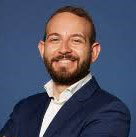
Omar Hammoud Gallego

IPS: Your research deals with migration, as well as civil society’s connection with international organisations. How did this interest develop?

Hammoud Gallego: Like many of my colleagues and friends, I am the son of migrants. My parents came from different parts of the world and met, married and established themselves in a third country. However, this was not the main reason for me to focus on migration in my research. In 2015, while working for UNHCR in Colombia, where I was engaged in supporting internally displaced Colombians, I soon found out that there was a lack of serious, in-depth research about migration within Latin America. I began to read about regional migration and decided eventually to pursue a PhD on this topic.

IPS: Was it the specific situation in Colombia that made you shift your main interest from internal to regional migration?

Hammoud Gallego: Yes, over the last few years Colombia has received a huge influx of migrants and refugees from Venezuela (although they are recognised as refugees only in a handful of countries). A phenomenon that has not abided. More than 7,7 million migrants and refugees have left Venezuela as a result of political turmoil, socio-economic instability and an ongoing humanitarian crisis, roughly a quarter of the country’s population. While democratic backsliding in the country began with Hugo Chávez, the situation worsened considerably during the presidency of his successor since 2013, Nicolás Maduro. Most refugees, more than 6,5 million, are hosted in Latin American and Caribbean countries; close to three million in Colombia, one and a half million in Peru, and close to half a million in both Chile and Ecuador.

IPS: And the cause of this exodus is mainly political?

Hammoud Gallego: To a certain degree – yes. The Venezuelan government inept and corrupt handling of the economy and plummeting oil prices caused the output of PDVSA (the national oil company) to decrease substantially, leading to lower revenues for the government. As it happens with many countries with vast oil reserves, Venezuela developed into a rentier state, receiving most of its income through the export of oil. Since 2013, the country’s economy has suffered greatly. In 2018, the inflation was more than 63,000 percent compared with the previous year, while nearly 90 percent of the population lives in poverty. Furthermore, estimates by the UN and Human Rights Watch indicate that under Maduro’s administration close to 20,000 people have been subject to alleged extrajudicial killings.

IPS: Is the current situation in Venezuela still excruciating?

Hammoud Gallego: Yes, and the current geopolitical landscape seems to have favoured Maduro’s regime rather than debilitated him. The country is Russia’s most important trading and military ally in South America. Due to the energy crisis linked to Russia’s criminal invasion of Ukraine, the US government in October last year lifted sanctions on the Venezuelan oil and mining sector, which had been in place since early 2019. In spite of this influx of money and support, the situation continues to be severe and so far, few Venezuelans are returning to their country of origin. Many are instead making their way to the Darien Gap, through Panama and from there continue north until they reach the United States. Elections in Venezuela are scheduled for this year, but it is hard to know if Maduro will allow them to take place fairly and transparently.

IPS: How is UNHCR handling the Venezuelan refugee crisis?

Hammoud Gallego: The UNHCR is one of the few UN agencies which depends almost entirely on voluntary contributions. Every year UNHCR funding shifts depending on the outcome of its Global Appeal, the process in which it asks governments and some private donors to contribute to the support of refugees. In 2023, about 74 percent of these funds came from 10 donors only, with much of the funding earmarked for specific crises and only 15% of it consisted of multi-year funds. Commitments are constantly shifting and crises around the world compete for limited resources. For example, when a refugee crisis erupted due to war in Ukraine it meant that less funding was dedicated to Latin American countries hosting Venezuelan refugees, as well as UNHCR commitments in other parts of the world. However, there are many NGOs across the region that also make a concrete difference in the lives of many refugees. For instance, the NGO VeneActiva, which was founded and is led by Venezuelan migrant women and operates in Peru, is one of the best examples in the Latin American region of how civil society can step in and provide the support refugees need. Its digital platform contains key information that helps Venezuelan nationals to restart their lives in Peru. The NGO provides a variety of services, including psychological support and advice on how to regularise one’s migratory status.

IPS: You are currently living in the UK, a country where migration, like in other European nations, is high up on the political agenda. Can you provide us with some insights about how the migration issue is dealt with in the UK?

Hammoud Gallego: Over the last few years, the Conservative government in the UK has been facing a dilemma of its own making. The Brexit decision was supposed to lead to a decrease in immigration, and instead the opposite seems now to have been the case. Still, the lack of enough immigrants to fill in positions in the public sector, particularly in education, and health, and to take on seasonal work in agriculture and construction, has limited economic growth in the country. The health sector was exceptionally hard hit by both Covid and Brexit.

IPS: How is the governing political party affected by the migration issue?

Hammoud Gallego: Since 2010 the UK has had a Conservative-led government, with Conservative party leaders making migration a prime electoral issue. However, according to the latest polling data, it is estimated that 46 percent of voters would vote for the Labour Party in a general election, compared with 22 percent voting for the Conservative Party. Understandably, conservative politicians are worried about losing votes to the far right, and specifically to the Reform Party, and are trying to out-do the far-right by adopting absurd measures to deter the arrival of asylum seekers. One such scheme is the recent Rwanda asylum plan.

IPS: Could you elaborate on whether the Rwanda plan is a feasible project, or not, and why some Conservative politicians actually proposed such a solution for asylum seekers.

Hammoud Gallego: It is a proposal that foresees that some of the asylum seekers who arrive to the UK irregularly will be relocated to Rwanda for processing. Those successful in claiming asylum would remain in Rwanda. It is an absurd proposal based on two wrong assumptions. The first, is that most asylum seekers will know about the scheme. The reality is that the information most of them get, comes from unofficial sources, oftentimes from the smugglers that organise their journeys. Second, even if they knew about the scheme, it is unlikely that it will deter them. For most of them, the choice of a country depends on several factors: the language they speak, the network they have, etc… Also, on their way to the UK asylum seekers have often taken several risks, and suffered greatly, so the minimal risk of being sent to Rwanda will be seen as an acceptable risk for most of them. The reality is that what this plan will only push individuals not to apply for asylum once in the UK, and in many cases simply live in the country with an irregular status, akin to the reality of many Mexican and Central Americans in the US.

IPS: How do you view the future for asylum seekers and so called “economic” migrants?

Hammoud Gallego: It looks bad. I believe that climate change will exacerbate conflicts in many regions of the world, thus forcing people to move. Such challenge needs urgently to be dealt with, both internationally and locally, and it might already be too late. Investments in green energy are far too limited, viable resettlement programs are not in place, leaving asylum seekers no option but to embark on dangerous journeys. Also, one of the main myths surrounding economic migration is that as countries become wealthier, people will have less incentives to leave. The reality is that the poorest individuals in the Global South have always been the ones least likely to travel, as they lack the means to do that. The poor cannot afford to move. As countries become wealthier, the middle classes will seek to travel and migrate more.

IPS: What can be done for migrants who are already in place in Europe, and elsewhere?

Hammoud Gallego: Well thought-through integration policies forcefully implemented and sensible migration policies would be a good place to start. There are many examples of how integration can be conducted successfully. Nations like the UK are to a certain degree proof of this, with a prime minister of Indian origin, and the Mayor of London and First Minister of Scotland both sons of Pakistani immigrants. Considering sudden refugee crises, the way European countries responded to the Ukrainian crisis shows the way forward: let refugees move wherever best suits them, and you will avoid a humanitarian catastrophe. However, politics in Europe seems to be going in the opposite direction. In Germany, Sweden, Hungary, Italy, the Netherlands and many other European nations anti-migration and nationalistic forces are gaining strength, not the least among young people who mistrust ageing and unrepresentative traditional parties. If everyone who voted in the election had been aged under 35, Geert Wilders’ Dutch Party for Freedom (PVV) might have won even more votes. In last year’s French presidential runoff, Marine le Pen won 39 percent of votes from people aged 18-24 and 49 percent of those aged 25-34, le Pen’s deputy is the 28 years old Jordan Bardella. Giorgia Meloni’s ruling Brothers of Italy was the preferred party among people under 35 years of age. I assume that the likely win of Donald Trump in the next US elections will boost European anti-migration politics.

IPS: What can immediately be done to address the issue of migrants and asylum seekers already in Europe, and maybe elsewhere as well?

Hammoud Gallego: If governments across Europe were to pursue sensible and evidence-based migration policies instead of replicating far-right talking points, it would be a start. Principled opposition politicians could, instead of focusing exclusively on migration to attract votes, focus more on those aspects of migration policies that might be improved, without resorting to a xenophobic rhetoric that normalises a polarising political discourse. Integration and inclusion are key for people coming to Europe. Integration is both a right and a duty, meaning that every member of a society has to adapt to and respect fundamental human rights, including democracy, the rule of law, freedom of speech and religion, as well as the rights to equality and non-discrimination.
Considering that migration has become a highly politicised issue it has been proposed that long-term immigrants ought to be given the right to vote, thus making their support more appealing to politicians and decision makers. A few countries, such as Chile and New Zealand, are allowing all residents to vote, hoping this would decrease polarisation and marginalisation, whether this will happen remains to be seen. Under all circumstances it would be desirable if we could live in a world where migrants were considered as fellow human beings, rather than as scapegoats for governments’ ineptitudes.

IPS UN Bureau

  Source

New Era: Unlocking Africa’s Agriculture Potential Through CGIAR TAAT Model

Africa, Biodiversity, Civil Society, Climate Change, COP28, Development & Aid, Editors’ Choice, Featured, Food and Agriculture, Food Security and Nutrition, Food Sustainability, Headlines, Human Rights, Humanitarian Emergencies, Population, Poverty & SDGs, Sustainable Development Goals, TerraViva United Nations, Trade & Investment

Food and Agriculture

Transforming food systems is key to solving food insecurity on the African continent. A powerful and unified effort is needed to ensure food systems are transformed to be robust enough to support the population. Credit: Joyce Chimbi/IPS

Transforming food systems is key to solving food insecurity on the African continent. A powerful and unified effort is needed to ensure food systems are transformed to be robust enough to support the population. Credit: Joyce Chimbi/IPS

NAIROBI, Jan 16 2024 (IPS) – As hunger and food insecurity deepen, Africa is confronting an unprecedented food crisis. Estimates show that nearly 282 million people on the continent, or 20 percent of the population, are undernourished. Numerous challenges across the African continent threaten the race to achieve food security; research and innovative strategies are urgently needed to transform current systems as they are inadequate to address the food crisis.


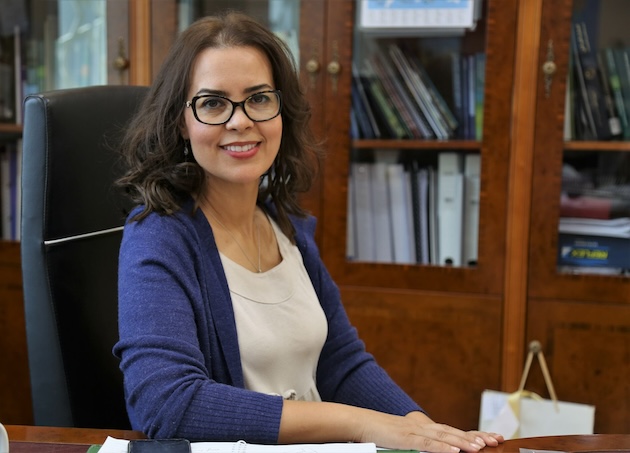
Transforming food systems is key. A powerful and unified effort is needed to equip food systems to advance human and planetary health to their full potential. This was the message as CGIAR entered a new era under the leadership of Dr Ismahane Elouafi, the Executive Managing Director. Named one of the most influential Africans of 2023, she continues to stress the need to use science and innovation to unlock Africa’s potential to meet its food needs.

Dr Ismahane Elouafi, the CGIAR’s newly appointed Executive Managing Director. Credit: FAO

Dr Ismahane Elouafi, the CGIAR’s newly appointed Executive Managing Director. Credit: FAO

During her inaugural field visit to an IITA center in Ibadan, Nigeria, alongside Dr Simeon Ehui, IITA’s Director General and CGIAR Regional Director for Continental Africa, she oversaw extensive discussions on transforming food systems and leveraging science and technology.

“At COP28 in Dubai, UAE, there was high-level recognition and a wonderful spotlight on science and innovation. CGIAR has an opportunity to represent science and innovation at large, representing the whole community at large. We can cut down poverty and stop malnutrition, and we have the tools—we just need to bring them to the farmers,” she said.

CGIAR continues to create linkages between agricultural and tech stakeholders, emphasizing digital innovation for agricultural development. CGIAR-IITA explores leveraging ICTs to tackle agricultural challenges, boost productivity, ensure sustainability, and enhance food security, featuring presentations, discussions, workshops, and networking across sectors.

There was a significant focus on the CGIAR TAAT model as a tool to use technology to address Africa’s worsening food crisis. TAAT Technologies for African Agricultural Transformation (TAAT) is a key flagship programme of the African Development Bank’s Feed Africa strategy for 2016 to 2025.

“We have the technology, and all hands are on deck to ensure that no one sleeps hungry. There are severe food insecurities on the continent today, deepening rural poverty and malnutrition. We have the capacity to achieve food security,” Ehui emphasized.

IITA’s Dr Kenton Dashiell spoke about TAAT in the context of strategic discussions around policy and government engagement. Emphasizing the need for the government, private sector, and other key stakeholders to create effective and efficient food systems transformation paths. As a major continent-wide initiative designed to boost agricultural productivity across the continent by rapidly delivering proven technologies to millions of farmers, TAAT can deliver a food-secure continent.

Elouafi stressed the need to ensure that technology is in the hands of farmers. in line with TAAT, which aims to double crop, livestock, and fish productivity by expanding access to productivity-increasing technologies to more than 40 million smallholder farmers across Africa by 2025. In addition, TAAT seeks to generate an additional 120 million metric tons.

IITA’s Bernard Vanlauwe spoke about sustainable intensification with the aim of increasing production and improving the livelihoods of smallholder farmers in sub-Saharan Africa. Farmers are increasingly dealing with higher temperatures and shorter rainy seasons, affecting the production of staple foods such as maize. Further stressing the need for improved crop varieties to meet Africa’s pressing food insecurities.

Elouafi stressed that the needs are great, in particular, eliminating extreme poverty, ending hunger and malnutrition, turning Africa into a net food exporter, and positioning Africa at the top of the agricultural value chains. She emphasized the need to leverage progress made thus far, building on the commitments of Dakar 1, the 1st Summit of the World’s Regions on Food Security held in Dakar in January 2010, where representatives and associations of regional governments from the five continents noted that the commitments made at the World Food Summit in 2002 had had little effect and that the food crisis had only worsened.

Elouafi said the UN Food System Summit in 2021 and the 2023 Dakar 2 Summit, with an emphasis on building sustainable food systems and aligning government resources, development partners, and private sector financing to unleash Africa’s food production potential, were important meetings to build on. The commitments made at these high-level meetings had already created a pathway towards ending hunger, food insecurity, and malnutrition and transforming food systems to meet the most pressing food needs today.

It is estimated that Africa’s agricultural output could increase from USD 280 billion per year to USD 1 trillion by 2030. The visit and ensuing discussions highlighted how investing in raising agricultural productivity, supporting infrastructure, and climate-smart agricultural systems, with private sector investments, government support, and resources from multinational financial institutions, all along the food value chain, can help turn Africa into a breadbasket for the world. Private sector actors will be particularly urged to commit to the development of critical value chains.

IPS UN Bureau Report

  Source

Amidst a Horrendous 2023, Civil Society is Fighting Back Society

Armed Conflicts, Biodiversity, Civil Society, Climate Change, Climate Change Justice, COP28, Economy & Trade, Education, Environment, Featured, Global, Green Economy, Headlines, Health, Human Rights, TerraViva United Nations

Opinion

TORONTO, Canada, Dec 22 2023 (IPS) – The year 2023 has brought so much tragedy, with incomprehensible loss of lives, whether from wars or devastating ‘natural’ disasters, while our planet has seen yet more records broken as our climate catastrophe worsens.

And so as the clock ticks towards the (mostly western) New Year, readers are traditionally subjected by media outlets like ours to the ‘yearender’ – usually a roundup of main events over the previous 12 months, one horror often overshadowed by the next.


Farhana Haque Rahman

So forgive us if for 2023 IPS takes a somewhat different approach, highlighting how humanity can do better, and how the big depressing picture should not obscure the myriad small but positive steps being taken out there.

COP28, the global climate conference held this month in Dubai, could neatly fit the ‘big depressing’ category. Hosted by a petrostate with nearly 100,000 people registered to attend, many of them lobbyists for fossil fuels and other polluters, it would be natural to address its outcomes with scepticism.

However, while Yamide Dagnet, Director for Climate Justice at the Open Society Foundations, described COP28 as “imperfect”, she said it also marked “an important and unprecedented step forward in our ‘course correction’ for a just transition towards resilient and greener economies.”

UN climate chief Simon Stiell acknowledged shortcomings in the compromise resolutions on fossil fuels and the level of funding for the Loss and Damages Fund. But the outcome, he said, was also the “beginning of the end” for the fossil fuel era.

Imperfect as it was and still based on old structures, COP28 hinted at the possible: a planetary approach to governance where common interests spanning climate, biodiversity and the whole health of Earth outweigh and supersede the current dominant global system of rule by nation states.

As we have tragically witnessed in 2023, the existing system – as vividly reflected in the repetitive stalemate among the five veto-bearing members of the UN Security Council – is failing to find resolution to the major conflicts of this year, Russia-Ukraine and Israel-Gaza. Not to mention older and half-forgotten conflicts in places like Myanmar (18.6 million people in need of humanitarian aid) and in eastern Democratic Republic of Congo (seven million displaced).

The unrestrained destruction of Gaza and the disproportionate killings of over 17,000, (now the death toll is “at least 20,000 people” according to Palestinian officials) mostly civilians– in retaliation for 1,200 killings by Hamas and 120 hostages in captivity– have left the Palestinians in a state of deep isolation and weighed down by a feeling of being deserted by the world at large.

The United Nations and the international community have remained helpless– with UN resolutions having no impact– while American pleas for restrained aerial bombings continue to be ignored by the Israelis in an act of defiance, wrote IPS senior journalist Thalif Deen.

The hegemony of the nation-state system is surely not going to disappear soon but – without wanting to sound too idealistic — its foundations are being chipped away by civil society where interdependence prevails over the divide and rule of the existing order. And so for a few examples encountered in our reporting:

CIVICUS Lens, standing for social justice and rooted in the global south, offers analysis of major events from a civil society perspective, such as its report on the security crisis gripping Haiti casting doubt over the viability of an international plan to dispatch a Kenya-led police contingent.

Education Cannot Wait, a global fund for education in emergencies and protracted crises, lobbied at COP28 for a $150 million appeal to support school-aged children facing climate shocks, such as the devastating drought in Somalia and Ethiopia, and floods in Pakistan where many of the 26,000 schools hit in 2022 remain closed.

Leprosy, an ancient but curable disease, had been pegged back in terms of new case numbers but the onset of the COVID-19 pandemic in 2020 made it harder for patients to get treatment and for new cases to be reported. Groups such as the Sasakawa Health Foundation are redoubling efforts to promote early detection and treatment.

With 80 percent of the world’s poorest living closer to the epicenters of climate-induced disasters, civil society is hammering at the doors of global institutions to address the challenges of adaptation and mitigation.

Lobbying on the sidelines of COP28 in Dubai was activist Joshua Amponsem, co-director of the Youth Climate Justice Fund who questioned why weather-resilient housing was not yet a reality in Mozambique’s coastal regions despite the increasing ferocity of tropical cyclones.

“My key message is really simple. The clock is ticking for food security in Africa,” Dr Simeon Ehui told IPS as the newly appointed Director General of the International Institute of Tropical Agriculture which works with partners across sub-Saharan Africa to tackle hunger, poverty and natural resource degradation.

Dr Alvaro Lario, President of the International Fund for Agricultural Development (IFAD), which has received record-breaking pledges in support of its largest ever replenishment, warns that under current trends 575 million people will still be living in extreme poverty in 2030.

“Hunger remains a political issue, mostly caused by poverty, inequality, conflict, corruption and overall lack of access to food and resources. In a world of plenty, which produces enough food to feed everyone, how can there be hundreds of millions going hungry?” he asked.

Empowering communities in a bid to protect and rejuvenate the ecosystems of Pacific communities is the aim of the Unlocking Blue Pacific Prosperity conservation effort launched at COP28 by Palau’s President Surangel Whipps who noted that the world was not on track to meet any of the 17 sustainable development goals or climate goals by 2030.

A scientist with a life-long career studying coral reefs, David Obura was appointed this year as the new chair of IPBES, the Intergovernmental Science-Policy Platform on Biodiversity and Ecosystem Services (IPBES).

We really have reached planetary limits and I think interest in oceans is rising because we have very dramatically reached the limits of land,” says Dr Obura, “What the world needs to understand is how strongly nature and natural systems, even when highly altered such as agricultural systems, support people and economies very tangibly. It’s the same with the ocean.”

An ocean-first approach to the fight against climate change is also the pillar of a Dalhousie University research program, Transforming Climate Action, launched last May and funded by the Canadian government. Traditional knowledges of Indigenous People will be a focus.

As Max Roser, an economist making academic research accessible to all, reminds us: for more people to devote their energy to making progress tackling large global problems, we should ensure that more people know that it is possible.

Focusing on the efforts of civil society and projecting hope amidst all the heartbreak of 2023 might come across as futile and wasted, but in its coverage IPS will continue to highlight efforts and successes, big and small, that deserve to be celebrated.

Farhana Haque Rahman is the Executive Director of IPS Inter Press Service Noram and Senior Vice President of IPS; she served as the elected Director General of IPS from 2015 to 2019. A journalist and communications expert who lived and worked in Africa, Asia, Europe and North America, she is a former senior official of the United Nations Food and Agriculture Organization FAO and the International Fund for Agricultural Development IFAD.

IPS UN Bureau

  Source

‘Imperfect COP28’ Gives Direction For Managed, Equitable Move From Fossil Fuels

Active Citizens, Civil Society, Climate Action, Climate Change, Climate Change Finance, Climate Change Justice, COP28, Development & Aid, Editors’ Choice, Environment, Featured, Global, Headlines, Humanitarian Emergencies, Sustainable Development Goals, TerraViva United Nations

COP28

Celebrating the end COP28 which ended with an agreement to transition away from fossil fuels. Credit: UNFCCC

Celebrating the end of COP28, which ended with an agreement to transition away from fossil fuels. Credit: UNFCCC

DUBAI, Dec 14 2023 (IPS) – While the outcomes of COP28 are being hotly debated in both the scientific and social justice arenas, the climate conference has taken an unprecedented step forward toward a just transition, says Yamide Dagnet, Director for Climate Justice at the Open Society Foundations.


Making some preliminary remarks a day after the climate conference ended, she said: “COP28 ends like it started: imperfect, yet an important and unprecedented step forward in our “course correction” for a just transition towards resilient and greener economies.”

The UN decision acknowledged the need for the decline of coal, oil, and gas for the first time in an agreement that talks about transitioning out of fossil fuels. It will also be known for operationalizing the Loss and Damages Fund, even if the funding falls far below the requirements for climate-stressed countries and communities.

UN Climate Change Executive Secretary Simon Stiell acknowledged these contractions in his final speech.

“While we didn’t turn the page on the fossil fuel era in Dubai, this outcome is the beginning of the end,” Stiell said.

He also noted that climate finance, which he said was a great enabler of climate action, fell short of the trillions needed to support developing countries with clean energy transitions and adaptation efforts.

He urged ordinary people everywhere to not relent in their demands for a climate-just world.

“In the crucial years ahead, your voices and determination will be more important than ever. I urge you never to relent. We are still in this race. We will be with you every single step of the way.”

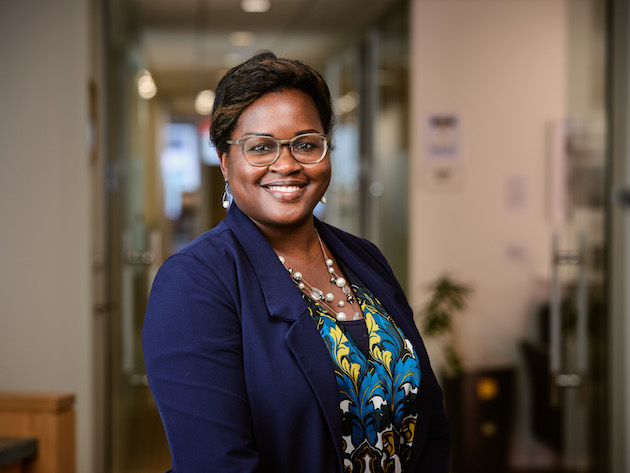
Yamide Dagnet, Director for Climate Justice at Open Society Foundations. Credit: TJ Kirkpatrick, Open Society Foundations

Yamide Dagnet, Director for Climate Justice at Open Society Foundations. Credit: TJ Kirkpatrick, Open Society Foundations

Dagnet believes that COP28 is the start of a new era in climate justice.

“This is not an end; rather, just the beginning of an implementation journey that we know is hard but can be so positively transformative, and just if we manage to mobilize, in an equitable manner, all hands-on deck. A climate-just journey and outcome require vigilance, creativity, and accountability; stronger solidarity and engagement at all levels; promoting human rights; and shared prosperity for all,” she says.

This COP, Danget says, laid bare the issues with the Paris Agreement, especially with the just transition.

“More specifically, this COP exposed all the contradictions and challenges faced when implementing the promises of the Paris Agreement, especially a managed, equitable transition away from fossil fuels and the sustained mobilization, alignment, and access to financial flows domestically and internationally to decarbonize and build resilience,” Dagnet says. ”

While some signals got clearer with more substantive commitments, challenges remain, however, in how the just and equitable transition is sequenced.

“Inclusive processes matter to foster shared prosperity and benefits throughout the journey, together with adequate safeguards to minimize unintended adverse impacts of climate-related measures and technologies and to protect frontline and marginalized communities.

“Similarly, the just operationalization and continued capitalization of the Loss and Damage Fund will require vigilance, effective guidance, and mechanisms to make sure commensurate funding is actually mobilized and reaches the communities that need it the most in a timely manner. Adequate mobilization of finance for adaptation by the donor community is also essential to tackle losses and damages with dignity. We are happy that a dozen of them committed to join OSF efforts in this regard.”

IPS UN Bureau Report

  Source

What Is the Cost of Phasing Out Fossil Fuels in Latin America?

Civil Society, Climate Action, Climate Change, Climate Change Finance, Conferences, COP28, Development & Aid, Editors’ Choice, Energy, Environment, Featured, Global, Global Governance, Headlines, Integration and Development Brazilian-style, IPS UN: Inside the Glasshouse, Latin America & the Caribbean, Projects, Regional Categories, Sustainable Development Goals, TerraViva United Nations

Climate Change

Colombian President Gustavo Petro presented his environmental plans at COP28 in Dubai and added his country to the small group of nations that support the negotiation of a binding treaty to prevent the proliferation of fossil fuels, despite his country being an oil producer. CREDIT: Emilio Godoy / IPS

Colombian President Gustavo Petro presented his environmental plans at COP28 in Dubai and added his country to the small group of nations that support the negotiation of a binding treaty to prevent the proliferation of fossil fuels, despite his country being an oil producer. CREDIT: Emilio Godoy / IPS

DUBAI, Dec 12 2023 (IPS) – One of the most heated debates at the annual climate summit coming to a conclusion in this United Arab Emirates city revolved around the phrasing of the final declaration, regarding the “phase-out” or “phase-down” of fossil fuels within a given time frame.


This is an essential calculation on the decommissioning of refineries, pipelines, power plants and other infrastructure that, in some cases, have been in operation for years, as discussed at the 28th Conference of the Parties (COP28) to the United Nations Framework Convention on Climate Change (UNFCCC).

Experts who talked to IPS at the summit agreed on the magnitude of the bill, which for some Latin American nations could be unaffordable.

“Financial support will be needed. There must be a differentiated approach, differentiated timing, and developed countries must come up with the resources.” — Fernanda Carvalho

Fernanda Carvalho of Brazil, global leader for Energy and Climate Policy at the non-governmental World Wildlife Fund (WWF), referred to the amount without specifying a figure.

“Financial support will be needed. There must be a differentiated approach, differentiated timing, and developed countries must come up with the resources,” the expert, who was present at COP28, held at Expo City on the outskirts of Dubai, told IPS.

COP28 engaged in an acrimonious debate between phase-out and phase-down, with a definite date, of oil, gas and coal, which has already anticipated a disappointing end in Dubai, that in line with the tradition at these summits extended its negotiations one more day, to conclude on Wednesday, Dec. 13.

The “phase-down” concept has been in the climate-energy jargon for years, but it really took off at the 2021 COP26 in the Scottish city of Glasgow, whose Climate Pact alludes to the reduction of coal still being produced and the elimination of inefficient fossil fuel subsidies.

Throughout the climate summits since 1995, developing countries have insisted on differentiated measures for them, in accordance with their own situation, the need for financing from developed nations and the transfer of technology, especially energy alternatives.

Enrique Maurtúa of Argentina, senior diplomacy advisor to the Independent Global Stocktake (iGST) – an umbrella data and advocacy initiative – said they hoped for a political signal to determine regulations or market measures regarding a phase-down or phase-out.

“If a target date is not set, there is no signal. If you set a phase-out for 2050, that is a pathway for the transition. With a deadline, the market can react. And then each country must evaluate its specific context,” the expert told IPS in the COP28 Green Zone, which hosted civil society organizations at the summit.

Available scientific knowledge indicates that the majority of proven hydrocarbon reserves must remain unextracted by 2030 to keep the planetary temperature rise below 2 degrees Celsius, the threshold agreed in the 2015 Paris Climate Change Agreement to avoid massive disasters.

On Sunday, Dec. 10 the non-governmental Climate Action Network (CAN) delivered at COP28 a dishonorable mention to the United States for its role in Israel's carnage in Gaza, in the traditional Fossil of the Day award for “doing the most to achieve the least” in terms of progress on climate change at the summits. CREDIT: Emilio Godoy / IPS

On Sunday, Dec. 10 the non-governmental Climate Action Network (CAN) delivered at COP28 a dishonorable mention to the United States for its role in Israel’s carnage in Gaza, in the traditional Fossil of the Day award for “doing the most to achieve the least” in terms of progress on climate change at the summits. CREDIT: Emilio Godoy / IPS

Failed attempts

In the Latin American region there are unsuccessful precedents of fossil fuel phase-outs.

In 2007, the then president of Ecuador, Rafael Correa (2007-2017), launched the Yasuní-Ishpingo Tambococha Tiputini initiative, which sought the care of the Yasuní National Park in the Ecuadorian Amazon rainforest, in exchange for funds from governments, foundations, companies and individuals of about 3.6 billion dollars by 2024 to leave the oil in the ground.

The aim was to leave 846 million barrels of oil untouched underground. But a special fund created by Ecuador and the United Nations Environment Fund only raised 13 million dollars, according to the Ecuadorian government. So Correa decided to cancel the initiative in 2013, at a time when renewable energies had not yet really taken off.

In a referendum held in August, Ecuadorians decided to halt oil extraction in a block in Yasuní that would provide 57,000 barrels per day in 2022 – the same result sought by Correa, but without foreign funds.

The result of the referendum is to be implemented within a year, although the position of the government of the current president, banana tycoon Daniel Noboa, who took office on Nov. 23, is still unclear.

Meanwhile, in Colombia, President Gustavo Petro has put the brakes on new oil and coal exploration contracts, a promise from his 2022 election campaign.

In addition, the president announced on Dec. 2 in Dubai that his country was joining nine other nations that are promoting the formal initiation of the negotiation of a Fossil Fuel Non-Proliferation Treaty.

Colombia will thus become the first Latin American nation and the largest oil and coal producer to join the initiative that first emerged in 2015 when several Pacific Island leaders and NGOs raised the urgent need for an international mechanism to phase out fossil fuels.

For the undertaking of a just energy transition to cleaner fuels, Petro estimates an initial bill of 14 billion dollars, to come from governments of the developed North, multilateral organizations and international funds.

The latest summit of hope for the climate kicked off on Nov. 30 in this Arab city under the slogan “Unite. Act. Deliver” – the least successful in the history of COPs since the first one, held in Berlin in 1995.

The hopes included commitments and voluntary declarations on renewable energy and energy efficiency; agriculture, food and climate; health and climate; climate finance; refrigeration; and just transitions with a gender focus.

In addition, there were financial pledges of some 86 billion dollars, without specifying whether it is all new money, to be allocated to these issues.

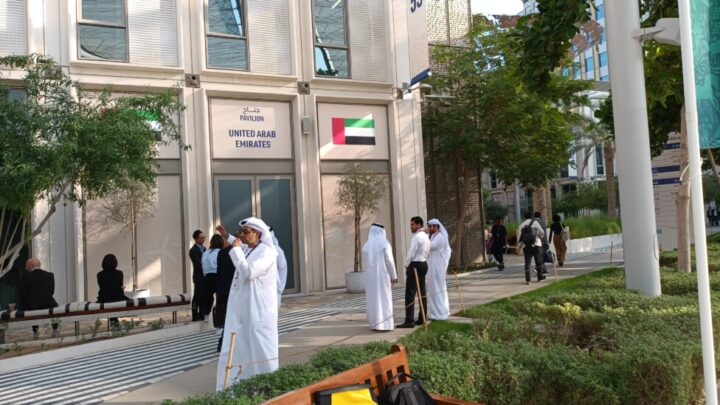
Like many countries, the host of COP28, the United Arab Emirates, has had a pavilion in the so-called Green Zone, which hosts non-governmental organizations, companies and other institutions. The Emirati government bet a lot on the climate summit to deliver results, but without directly targeting the fossil fuels on which its economy depends. CREDIT: Emilio Godoy / IPS

Like many countries, the host of COP28, the United Arab Emirates, has had a pavilion in the so-called Green Zone, which hosts non-governmental organizations, companies and other institutions. The Emirati government bet a lot on the climate summit to deliver results, but without directly targeting the fossil fuels on which its economy depends. CREDIT: Emilio Godoy / IPS

Billions

Given the production and exploration plans of the main hydrocarbon producing countries in the region, the magnitude of the challenge in the medium and long term is enormous.

In October, Brazil, the largest economy in the region and the 11th largest in the world, extracted 3.543 billion barrels of oil and 152 million cubic meters (m3) of gas per day.

This represented approximately two percent of the domestic economy that month.

Mexico, the region’s second largest economy, extracted 1.64 million barrels and 4.971 billion m3 of gas per day in October, equivalent to 52 million dollars in revenues.

Meanwhile, Colombia produced 780,487 barrels of oil in the first eight months of 2023 and 1,568 cubic feet per day of gas, equivalent to 12 percent of public revenues.

“We have to think about decarbonization measures. We want Latin America to be a clean energy powerhouse,” said Carvalho.

As of September, Brazil’s state-owned oil giant Petrobras was working on obtaining 9.571 billion barrels of oil equivalent, according to the Global Oil & Gas Exit List produced by the German non-governmental organization Urgewald.

This represents an excess of 94 percent above the limit set by the 2015 Paris Agreement to keep global warming below two degrees Celsius.

Meanwhile, Mexico’s state-owned oil company Pemex is producing 1.444 billion barrels of oil equivalent, 56 percent above the threshold set by the Paris Agreement.

Finally, the public company Ecopetrol, mostly owned by the Colombian state, is working to obtain 447 million barrels, 98 percent above the Paris Agreement limit, according to Urgewald.

In addition, the cost of action against the climate crisis is far from affordable for any Latin American nation.

For example, Mexico estimated that the implementation of 35 measures, including in the power, gas and oil generation sector, would cost 137 billion dollars in 2030, but the benefits would total 295 billion dollars.

But Maurtúa says the budget question is only relative. “There is a lot of public money with which many things can be done,” complemented by international resources, he argued.


Climate Justice is the Responsibility of the Wealthier Nations, Says Bangladesh Climate Envoy

Asia-Pacific, Climate Action, Climate Change, Climate Change Finance, Climate Change Justice, Conferences, COP28, Editors’ Choice, Environment, Featured, Food Security and Nutrition, Headlines, Humanitarian Emergencies, Sustainable Development Goals, TerraViva United Nations

COP28

Five fishers pray for a benevolent sea in Dublar, Bangladesh. Credit: Rodney Dekker/Climate Visuals

Five fishers pray for a benevolent sea in Dublar, Bangladesh. Credit: Rodney Dekker/Climate Visuals

DUBAI, Dec 11 2023 (IPS) – Wealthier nations must deliver the finances so developing countries can adapt—the time for excuses is over, says Saber Hossain Chowdhury, Bangladesh’s Special Envoy for Climate Change in the Prime Minister’s Office.


In a wide-ranging exclusive interview with IPS, Chowdhury said climate change was at the forefront of Bangladesh’s focus, as one in seven people faces displacement due to climate impacts. With this in mind, the country was focused on building resilience and ensuring resources were directed toward the most marginalized.

“The biggest challenge we will have is the melting of the glaciers in the Himalayas because it means flooding in the short term and sea level rise in the long term. We will lose about one-third of our agriculture GDP between now and 2050, and we can lose up to 9 percent of our GDP by 2100,” Chowdhury said.

“For us, it is not just one sector of our economy; it is an existential challenge for Bangladesh.”

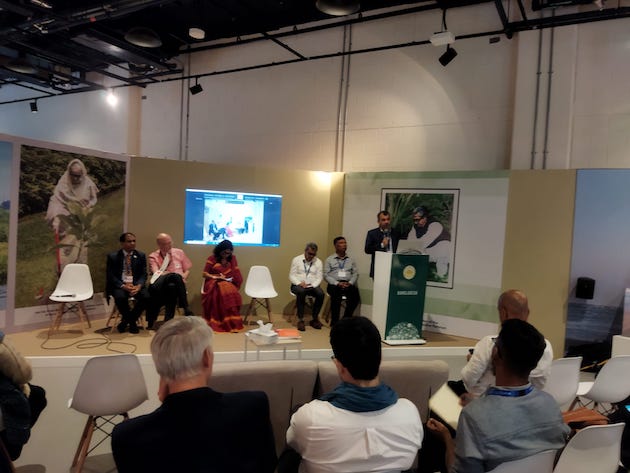
Saber Hossain Chowdhury, Special Envoy for Climate Change, Prime Minister’s Office Bangladesh, addresses an event on climate change at Bangladesh pavilion at COP28 in Dubai. Credit: Umar Manzoor Shah/IPS

Saber Hossain Chowdhury, Special Envoy for Climate Change, Prime Minister’s Office Bangladesh, addresses an event on climate change at the Bangladesh Pavilion at COP28 in Dubai. Credit: Umar Manzoor Shah/IPS

Here are edited excerpts from the interview:

IPS: In terms of climate change and the government’s actions, where is Bangladesh?

Chowdhury: Bangladesh is giving most importance to the Global Stocktake because it has two dimensions—one is looking back and the other is looking forward. We all know how bad things are when we look back because we know we are nowhere near where we are supposed to be.

But what do we do with that knowledge? How do we move forward across the board in terms of mitigation, adaptation, funding, loss and damage, and, of course, the global goals? And one of the points we are stressing is the continual interconnectedness between mitigation, adaptation, and loss and damage.

The more effective our mitigation in terms of keeping temperatures in check, the more manageable the adaptation becomes, and the more manageable the adaptation becomes, the lesser the burden that we pass on the loss and damage.  And it is meaningless to talk about adaptation without the context of mitigation. Because of the rise in temperature to 1.5°C (the threshold to which world leaders pledged to try to limit global warming), there will be a certain level of adaptation that you can do, but if the temperatures are close to 3°C, as it is now said the temperature is likely to rise to, then all adaptation will become loss and damage because there are limits to adaptation and there are limits to resilience.

IPS: What are your views on the ongoing COP 28?

Chowdhury: We got off to a great start. The fact that the Loss and Damage Fund was agreed upon on the first day. In terms of context, we only had this in the agenda last year and it was approved and within a year, the funds have started coming in.  That was a huge positive. We know that funds are nowhere near what the needs are. But it is a good start and we are hoping that the same spirit will be seen in other challenges such as mitigation, adaptation, funding, etc.

Also, I believe the presidency has tried to be very inclusive. But at the end of the day, it depends on global solidarity. If members of the conference come together, then we will have the deal we need. Let me say that this COP is a hugely important COP because we don’t have the luxury of tradeoffs.  We have to deliver across the board, and mitigation (to keep to the Paris Agreements) of 1.5°C is an absolute must, and if we go beyond that, I think we have lost the game. To what extent we can mitigate will then determine what our adaptation requirements are. The better we manage adaptation, the lesser the burden will be on loss and damage.  It is a litmus test. Bangladesh being at ground zero for climate change impact, this is a hugely important event for us.

IPS: Bangladesh is often termed a ‘victim of climate change’ across the globe. Why is that?

Chowdhury: One in seven people in Bangladesh will face displacement because of climate change, and that adds up to about 13–14 million people. We have a huge food security problem because we are losing agricultural land due to sea level rise.  The biggest challenge we will have is the melting of the glaciers in the Himalayas, which means flooding in the short term and sea level rise in the long term. We will lose about one-third of our agriculture GDP between now and 2050, and we can lose up to 9 percent of our GDP by 2100. For us, it is not just one sector of our economy; it is an existential challenge for Bangladesh.

IPS: What do you believe is the responsibility of wealthier nations towards Bangladesh?

Chowdhury: Climate justice is all about wealthier nations. They must deliver the finance so that we can adapt; they must rein in the emissions. They need to act as per science and not have any excuses. It is now or never because the window of action is closing very fast. If we don’t get it right in COP 28, whatever we do in subsequent COPs may well be too little, too late. We have to reduce emissions by 43 percent by 2030. We must reduce emissions by 60 percent by 2035, then we can get to net zero. With that, you also must have tripled the amount of renewable energy and doubled your energy efficiency. So, it has to be a package of responses. It is for the wealthier nations to mitigate, to provide funds for loss and damage as well as for adaptation.

IPS: How responsive do you find these developed nations to the climate crisis?

Chowdhury: Responses must be taken at two levels: one is making pledges, and the other is delivering on pledges. There is no point saying we will do this and then, as in the past, not do it. Pledges are the first step, and therefore everybody has to realize that this is the question of global solidarity.  It is not the question of Bangladesh and the developed world. What is happening in Bangladesh today will also happen in those countries that we call developed. Greenland will become greener again because the ice is going to melt. They will also face sea level rise. So it is not the question of “if,” it is the question of when.

IPS: Bangladesh has advanced warning systems for the climate. Please tell us about it.

Chowdhury: We have what we refer to as an ‘early warning system’ If you look at the cyclone that hit Bangladesh in the early 1970s, up to a million people died because of it. But now, when the cyclone hits Bangladesh, the number of deaths is in single digits. The reason for that is that through an early warning system, we can evacuate people to cyclone shelters. That has saved lives, and Bangladesh is a model for that.

Our honorable Prime Minister has this program where we are building cyclone shelters all around the coast of Bangladesh so that people can be evacuated there. We cannot stop a storm or a hurricane from coming, but we can prepare ourselves so that the loss of lives is minimal, and that is what Bangladesh has achieved. Also, the early warning system is very basic, and it is community-based.

IPS: What is Bangladesh doing about the agrarian crisis?

Chowdhury: Bangladesh has a huge success story in terms of food production. From a deficit nation, we are now a surplus nation, but climate change threatens that.  This is something we look at in terms of food security, so all of the advances and progress that we have made over the years are now at risk because climate change is impacting this sector.

IPS: What is the role of NGOs in terms of tackling climate change and offering support to governments?

Chowdhury: NGOs need to have partnerships with governments where they can take those ideas and scale them up. That is the reason that NGOs need to have a very close relationship with the government. The whole issue is not how much money I have spent; it is what impact I have generated through spending that money.

But the message at the end of the day is that whatever money is spent must be spent on those who are most marginalized. So how do we get funds for the people who are most in need? I think that must be an overriding issue. This is a learning process, and we are all on the learning curve. When we go back to Bangladesh, we need to have a brainstorming session with NGOs and CSOs and find out what is working, how we can make their job easier, and how we can make the collaboration a win-win between various ministries, government departments, and NGOs.
IPS UN Bureau Report