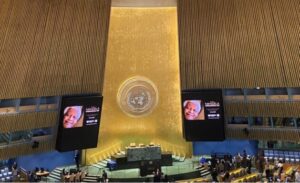
Price and Power of Freedom: Celebrating Nelson Mandela International Day

Active Citizens, Civil Society, Democracy, Editors’ Choice, Featured, Headlines, Human Rights, Humanitarian Emergencies, Inequality, International Justice, Sustainable Development Goals, TerraViva United Nations

Human Rights

For to be free is not merely to cast off one’s chains, but to live in a way that respects and enhances the freedom of others. – Nelson Mandela
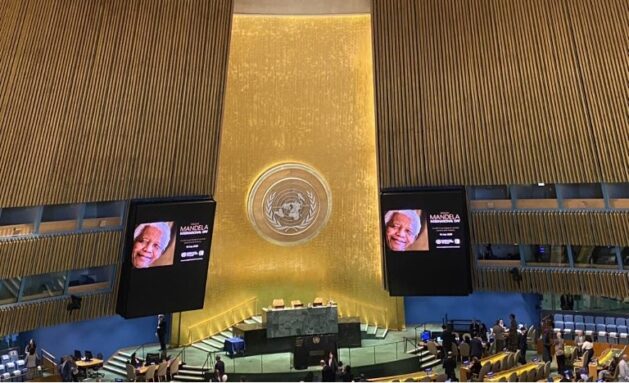
The General Assembly’s Plenary meeting on Nelson Mandela International Day. Credit: Jennifer Xin-Tsu Lin Levine/IPS

The General Assembly’s Plenary meeting on Nelson Mandela International Day. Credit: Jennifer Xin-Tsu Lin Levine/IPS

UNITED NATIONS, Jul 18 2025 (IPS) – The United Nations celebrated Nelson Mandela International Day in honor of the activist and politician’s lifelong commitment to peace and democracy.


At the 16th celebration of Nelson Mandela International Day, delegates, representatives and visitors alike reflected on the impact of South Africa’s first black president and leader in a fully representative democratic election.

The activist and politician, who spent 27 years in prison, was a staunch freedom fighter—arguing that freedom was not only an individual mission but also a collective responsibility and communal effort.

These principles were enshrined in the Nelson Mandela Rules, officially called the United Nations Standard Minimum Rules for the Treatment of Prisoners, a document protecting humane treatment of individuals without liberty. The document emphasizes respect for human dignity, prohibits torture and promotes fair and just conditions.

Although the Nelson Mandela Rules are “soft law” and not legally binding, the General Assembly has adopted them as universally agreed minimum standards. Many countries have incorporated the rules into domestic law, but many others have violated conditions of healthcare, solitary confinement and ethical working rights. Delegates and various speakers agreed that there was still much work to be done.

Nelson Mandela International Day, established in 2009 by the United Nations General Assembly and officially celebrated in 2010 on July 18th (President Mandela’s birthday), is a holiday encouraging all citizens around the world to engage positively in their communities.
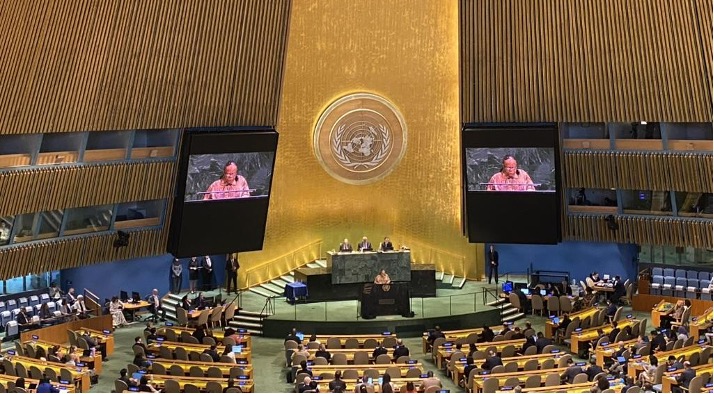
Dr. Naledi Pandor, chair of the Nelson Mandela Foundation, addresses the UN General Assembly Plenary on Nelson Mandela International Day. Credit: Jennifer Xin-Tsu Lin Levin/IPS

Dr. Naledi Pandor, chair of the Nelson Mandela Foundation, addresses the UN General Assembly Plenary on Nelson Mandela International Day. Credit: Jennifer Xin-Tsu Lin Levin/IPS

From annual volunteer events to the annual Mandela Prize, awarded to two laureates each year who have profoundly impacted their communities by serving humanity, speakers, including the award recipients, the Secretary-General and the chair of the Nelson Mandela Foundation, all reflected on Mandela’s legacy on their own lives and on the UN.

In Secretary-General António Guterres’ remarks to the General Assembly at their plenary meeting, he said, “Power is not a personal possession to be harbored. Power is about lifting others up; it’s about what we can achieve with one another and for one another. Power is about people.” He echoed Mandela’s belief in collective grassroots action to deliver power to the powerless, encouraging member states to bring these principles into practice.

Dr. Naledi Pandor, chair of the Nelson Mandela Foundation, similarly called for action against injustice and inequality. She recalled how the United Nations aided South Africa in ending apartheid as it “stood against apartheid domination, not through arms but through bringing its undeniable moral weight into combat against injustice. That boldness, that courage is needed more and more today.”
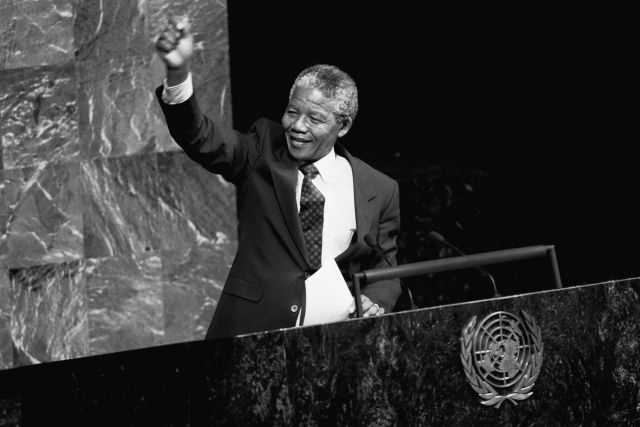
Nelson Mandela, then Deputy President of the African National Congress of South Africa, raises his fist in the air while addressing the Special Committee Against Apartheid in the General Assembly Hall, June 22, 1990. Global alliance CIVICUS commemorated Mandela Day with a reminder that many rights defenders are jailed and intimidated. Credit: UN Photo/Pernaca Sudhakaran

Nelson Mandela, then Deputy President of the African National Congress of South Africa, raises his fist in the air while addressing the Special Committee Against Apartheid in the General Assembly Hall, June 22, 1990. Credit: UN Photo/Pernaca Sudhakaran

Pandor went on to recall Mandela’s political views beyond South Africa—his demand for global equity extended to all, and reflecting on how he might feel about the current state of the world, she quoted his 1990 speech to the UN Special Committee Against Apartheid.

Mandela said, “We also take this opportunity to extend warm greetings to all others who fight for their liberation and their human rights, including the peoples of Palestine and Western Sahara. We commend their struggles to you, convinced that we are all moved by the fact that freedom is indivisible, convinced that the denial of the rights of one diminishes the freedom of others.”

Mandela was a strong supporter of Palestine, often comparing its struggle with South Africa’s. South Africa, even after his death, maintained close ties to Palestine and brought the case of genocide against Israel to the International Court of Justice (ICJ) in 2024.

The 2025 Nelson Mandela laureates, Brenda Reynolds of Saulteaux First Nation and Canada and Kennedy Odede of Kenya, both spoke about how Mandela inspired their respective work. Reynolds, a social worker by trade, led the establishment of a national, culturally grounded mental health initiative for survivors of Indian residential schools.

Reynolds described her work with survivors as an example of Mandela’s notion of moving forward from resentment towards progress—as people found peace with their experiences, they were able to recover and lift up their communities from oppression. She described this as a process of peacebuilding within people, saying, “peace begins with individuals, and from there, you can find peace within your family and within your communities.”

Odede, who founded Kenya’s largest grassroots movement, Shining Hope For Communities (SHOFCO), to empower struggling urban communities, shared how Mandela’s words and experience with struggle inspired him to build within his own life. He found creative ways to organize communities around simple things like soccer, providing hope to people in dire situations.

The representative for The Gambia, who spoke on behalf of the African states, called upon the UN to adhere to Mandela’s principles, particularly on poverty as a man-made horror that can and must be removed by actions of human beings. The representative warned of extreme poverty on the rise, centering the “developing countries and middle-income countries” suffering the most “with unemployment rates beyond records.”

He said, “It is time for solidarity, partnerships and genuine actions where they are most needed,” asserting that poverty and underdevelopment were huge perpetuators of racism, therefore continuing a vicious cycle that oppressed people.

The representative argued, “rising inequity and progressive discrimination are not inevitable; they are a result of decades of policies and dynamics emanating from colonialism, appetite, and discrimination.” Criticizing these practices as misaligned with the UN charter, he pushed the UN to renew their commitment to progressing social development by redistributing wealth.

As the world commemorates Nelson Mandela’s enduring legacy, the message resonating from this year’s observance is clear: his vision of freedom—rooted in dignity, justice and collective responsibility—demands more than remembrance; it requires action. From prison reform to poverty alleviation to indigenous healing to grassroots empowerment, Mandela’s ideals continue to challenge the global community to uphold humanity over power and compassion over indifference. In honoring his life, the UN and its member states are reminded that freedom is not static—it is a continual struggle, a shared pursuit and a moral obligation.

IPS UN Bureau Report

  Source

Bangladesh’s Democratic Promise Hangs in the Balance

Active Citizens, Asia-Pacific, Civil Society, Crime & Justice, Democracy, Economy & Trade, Featured, Headlines, Human Rights, Inequality, Labour, Press Freedom, TerraViva United Nations

Opinion

Credit: Abdul Goni/Reuters via Gallo Images

MONTEVIDEO, Uruguay, Jul 7 2025 (IPS) – When Bangladesh’s streets erupted in protest in mid-2024, few could have predicted how swiftly Sheikh Hasina’s regime would crumble. The ousting of the prime minister last August, after years of mounting authoritarianism and growing discontent, was heralded as a historic opportunity for democratic renewal. Almost a year on, the question remains whether Bangladesh is genuinely evolving towards democracy, or if one form of repression is replacing another.


The interim government, led by Nobel laureate Muhammad Yunus, confronts enormous challenges in delivering meaningful change. While it has taken significant steps – releasing political prisoners, initiating constitutional reforms, signing international human rights treaties and pursuing accountability for past violations – persistent abuses, political exclusion and economic instability continue to cast long shadows over the transition. The coming months will prove decisive in determining whether Bangladesh can truly break from its authoritarian past.

From electoral fraud to revolution

The roots of Bangladesh’s current upheaval trace back to the deeply flawed general election of 7 January 2024. The vote, which saw Hasina’s Awami League (AL) secure a fourth consecutive term, was widely dismissed as a foregone conclusion. The main opposition Bangladesh Nationalist Party boycotted the election in protest at the government’s refusal to reinstate a neutral caretaker system.

The government unleashed an intense crackdown ahead of the vote. It imprisoned thousands of opposition activists and weaponised the criminal justice system to silence dissent, leading to deaths in police custody and enforced disappearances. This repression extended to civil society, with human rights activists and journalists facing harassment, arbitrary detention and violence. The government sponsored fake opposition candidates to create an illusion of competition, resulting in plummeting voter turnout and a crisis of legitimacy.

When opposition rallies occurred, they were met with overwhelming force. On 28 October 2023, police responded to a major opposition protest in Dhaka with rubber bullets, teargas and stun grenades, resulting in at least 16 deaths, with thousands injured and detained.

The situation deteriorated further after the election. In June 2024, the reinstatement of a controversial quota system for public sector jobs triggered mass student-led protests that would ultimately topple Hasina’s government. These protests rapidly evolved into a broader revolt against entrenched corruption, economic inequality and political impunity.

The government’s response was systematically brutal. According to a United Nations fact-finding report, between July and August security forces killed as many as 1,400 people, including many children, often shooting protesters at point-blank range. They denied the injured medical care and intimidated hospital staff. The scale of violence eventually led the military to refuse further involvement, forcing Hasina to resign and flee Bangladesh.

Reform efforts amid political discord

The interim government identified three core priorities: institutional reforms, trials of perpetrators of political violence and elections. Its initial months brought significant progress. The government released detained protesters and human rights defenders, signed the International Convention for the Protection of All Persons from Enforced Disappearances and established a commission of inquiry into enforced disappearances.

This commission documented around 1,700 complaints and found evidence of systematic use of enforced disappearances to target political opponents and activists, with direct complicity by Hasina and senior officials. In October, the Bangladesh International Crimes Tribunal issued arrest warrants for Hasina and 44 others for massacres during the 2024 protests, although the tribunal has a troubled history and retains the death penalty, contrary to international norms.

The Constitution Reform Commission has proposed expanding fundamental rights, with a bicameral parliament and term limits for top offices. However, the process has been undermined by the exclusion of major political players – most notably the AL – and minority groups.

Political tensions escalated as the interim government faced mounting pressure to set a general election date. Opposition parties accused it of deliberate stalling. The army chief publicly demanded elections by the end of 2025, while student groups sought postponement until reforms and justice were secured. After initial uncertainty, the government announced the election would occur in April 2026.

The most dramatic escalation came in May, when the interim government banned all AL activities under the Anti-Terrorism Act following renewed protests. The Election Commission subsequently suspended the AL’s registration, effectively barring it from future elections and fundamentally altering Bangladesh’s political landscape.

Economic challenges compound these political difficulties. Bangladesh remains fragile after devastating floods in 2024, while the banking sector faces stress from surging non-performing loans. Inflation continues outpacing wage growth and economic austerity measures agreed with the International Monetary Fund have sparked fresh protests.

Authoritarian patterns persist

Despite promises of change, old patterns of repression prove stubborn. Human rights groups document ongoing security forces abuses, including arbitrary arrests of opposition supporters and journalists, denial of due process and continued lack of accountability for past crimes. In the first two months of 2025 alone, over 1,000 police cases were filed against tens of thousands of people, mainly AL members or perceived supporters. A February crackdown on Hasina’s supporters led to over 1,300 arrests.

Press freedom remains severely threatened. In November, the interim government revoked the accreditation of 167 journalists. Around 140 journalists viewed as aligned with the previous regime have faced charges, with 25 accused of crimes against humanity, forcing many into hiding. Attacks on media outlets continue, including vandalism of newspaper offices.

The draft Cyber Protection Ordinance, intended to replace the repressive Cyber Security Act, has drawn criticism for retaining vague provisions criminalising defamation and ‘hurting religious sentiments’ while granting authorities sweeping powers for warrantless searches. Rights groups warn this law could stifle dissent in the run-up to elections.

Uncertain path forward

Bangladesh’s journey demonstrates that democratic transitions are inherently difficult, nonlinear and deeply contested processes. Democracy isn’t a guaranteed outcome, but the chances improve when political leaders are genuinely committed to reform and inclusive dialogue, and political players, civil society and the public practise sustained vigilance.

While the interim government has achieved steps unthinkable under the previous regime, the persistence of arbitrary arrests, attacks on journalists and the exclusion of key political players suggests authoritarianism’s shadow still looms large.

The upcoming general election will provide a crucial test of whether Bangladesh can finally turn the page on authoritarianism. The answer lies in whether Bangladeshis across government, civil society and beyond are able to build something genuinely new. The stakes are high in a country where many have already sacrificed much for the promise of democratic freedom.

Inés M. Pousadela is CIVICUS Senior Research Specialist, co-director and writer for CIVICUS Lens and co-author of the State of Civil Society Report.

For interviews or more information, please contact research@civicus.org

  Source

Democracy under Attack: Why the World Needs a New UN Special Rapporteur

Active Citizens, Armed Conflicts, Civil Society, Crime & Justice, Democracy, Featured, Global, Headlines, Human Trafficking, Press Freedom, TerraViva United Nations

Opinion

Cover photo by OHCHR

BRUSSELS, Belgium / MONTEVIDEO, Uruguay, Jul 2 2025 (IPS) – When tanks rolled through Myanmar’s streets in 2021, civil society groups worldwide sounded the alarm. When Viktor Orbán systematically dismantled Hungary’s free press, democracy activists demanded international action. And as authoritarianism returns to Tanzania ahead of elections, it’s once again civil society calling for democratic freedoms to be respected.


Around the world, authoritarian populists have learned to maintain democratic language and rituals while gutting democracy’s substance. They hold fraudulent elections with no real opposition and crack down on civil society when it tries to uphold democratic freedoms. As a result, more than 70 per cent of the world’s population lives in countries where civic space is routinely repressed.

In response, over 175 civil society organisations and 500 activists have united behind a demand to help improve respect for democratic freedoms, calling on the UN to establish a Special Rapporteur on Democracy.

The proposal isn’t coming from diplomatic corridors or academia; it’s a grassroots call from the frontlines of a global democratic struggle. Democracy defenders who face harassment, imprisonment and violence have identified a gap in international oversight that emboldens authoritarians and lets down those fighting for democratic rights when they most need support.

Critical blind spots

While the UN investigates everything from torture to toxic waste through specialised rapporteurs, democracy – supposedly a core UN principle – receives no systematic international oversight. This is a blind spot civil society wants to change.

Today’s threats to democracy are often more subtle than outright coups and blatant election rigging. Repressive leaders have mastered the art of legal authoritarianism, using constitutional amendments to extend term limits, judicial re-engineering to capture courts and media laws to silence critics, all while maintaining a facade of democratic governance.

In countries from Belarus to Venezuela, elections have been turned into elaborate ceremonies emptied of competition. Even established democracies face growing challenges, with foreign influence and disinformation campaigns documented across dozens of recent elections, often amplified by AI that creates deepfakes faster than fact-checkers can debunk them.

The rise of right-wing populism across Europe and in the USA shows how easily democratic processes can elevate leaders who systematically undermine democratic institutions from within, weaponising the law to concentrate executive authority, criminalise opposition and restrict civic space.

These evolving threats expose fundamental gaps in how the international community monitors and responds to democratic regression. The proposed UN Special Rapporteur on Democracy would help fill this gap: unlike current mandates that focus on specific rights, this role would examine how democratic systems function as a whole.

Existing UN Special Rapporteurs have recognised the urgent need for dedicated democracy oversight, with the Special Rapporteurs on freedom of peaceful assembly and of association, freedom of opinion and expression, and the independence of judges and lawyers highlighting how democratic backsliding undermines the rights they’re mandated to protect.

A democracy rapporteur could investigate the full spectrum of threats that escape international attention: how electoral systems become compromised through legal manipulation, how parliamentary oversight gets systematically weakened while maintaining constitutional appearances, how judicial independence is eroded through seemingly legitimate reforms, and how meaningful participation beyond elections gets stifled through bureaucratic restrictions.

Crucially, the mandate could document not just obvious authoritarian crackdowns but the subtler forms of democratic erosion that often escape international notice until democratic institutions are compromised, offering early warnings about gradual processes that transform vibrant democracies into hollow shells.

Legal foundations

The proposal builds on solid legal foundations. Article 21 of the Universal Declaration of Human Rights establishes that ‘public authority must derive from the will of the people’, while article 25 of the International Covenant on Civil and Political Rights recognises every citizen’s right to participate in public affairs and vote in free, fair and clean periodic elections.

Regional mechanisms provide valuable precedents. The Inter-American Democratic Charter explicitly states that ‘the peoples of the Americas have a right to democracy and their governments have an obligation to promote and defend it’. Building on this, Guatemala has recently requested an advisory opinion to clarify whether democracy constitutes a fundamental human right and what tangible obligations this imposes on states.

These foundations provide an actionable definition of democracy that respects diverse democratic models while upholding universal principles, sidestepping cultural relativist arguments that some authoritarian governments use to avoid accountability.

Momentum building

The proposal has generated remarkable momentum. On the 75th anniversary of the Universal Declaration of Human Rights, a broad coalition of civil society groups and think tanks published a joint statement calling for the appointment of a UN Special Rapporteur on Democracy.

Civil society leadership reflects widespread frustration among democracy activists who work under increasingly dangerous conditions and demand better institutional responses. Budget-conscious states should find this proposal attractive given the remarkable cost-effectiveness of the UN mandates system. Following standard UN practice, the new position would be unpaid, relying on voluntary funding from supportive states.

During its recent 58th session, the UN Human Rights Council adopted a resolution on human rights, democracy and the rule of law, conferring multilateral legitimacy on governments that want to support stronger democracy oversight. The window for action is open, but it won’t stay open indefinitely.

A test for international institutions

No single initiative will reverse global democratic decline. But this new role would enable systematic documentation, trend spotting and the sustained international attention democracy defenders desperately need. The rapporteur could investigate not just obvious authoritarian crackdowns but early signs of subtler democratic erosion, while highlighting innovations and good practices that others could adapt.

The debate over a UN Special Rapporteur on Democracy offers a test of whether international institutions can adapt to contemporary challenges or will remain trapped in outdated approaches while democracy crumbles. Creating this mandate would communicate that the international community takes democratic governance seriously enough to monitor it systematically – a signal that matters to democracy activists who need international support and serves as a warning to authoritarian leaders who thrive when nobody is watching.

With hundreds of civil society groups leading this charge from the frontlines of democratic struggle, the question isn’t whether this oversight is needed, but whether the UN will act before it’s too late.

Samuel King is a researcher with the Horizon Europe-funded research project ENSURED: Shaping Cooperation for a World in Transition at CIVICUS: World Alliance for Citizen Participation, and Inés M. Pousadela is CIVICUS Senior Research Specialist, writer at CIVICUS Lens and co-author of the State of Civil Society Report.

For interviews or more information, please contact research@civicus.org

  Source

Poland’s Democratic Deadlock

Civil Society, Democracy, Economy & Trade, Europe, Featured, Gender, Headlines, Human Rights, Migration & Refugees, Press Freedom, TerraViva United Nations

Opinion

Credit: Kacper Pempel/Reuters via Gallo Images

MONTEVIDEO, Uruguay, Jun 25 2025 (IPS) – Poland’s embattled Prime Minister Donald Tusk emerged bruised but still standing after his government survived a parliamentary vote of confidence on 11 June. He’d called the vote, which he won by 243 to 210, just days after the presidential candidate of his Civic Platform (PO) party suffered an unexpected defeat.


Karol Nawrocki, an independent nationalist conservative backed by the former ruling Law and Justice Party (PiS) defeated liberal pro-European Union (EU) Warsaw Mayor Rafał Trzaskowski in a nail-biting presidential runoff. The result offers a broader test of Poland’s democratic resilience that could have implications across the EU.

The electoral blow

Nawrocki’s path to victory was anything but predictable. The 42-year-old former president of Poland’s Institute of National Remembrance had never held elected office before emerging as PiS’s chosen candidate. Yet his populist message resonated with frustrated voters.

Economic grievances provided fertile ground for nationalist appeals. Despite Poland’s relatively low unemployment, youth unemployment of over 10 per cent is an understandable source of anxiety for younger voters. Increasingly, they’re reacting by rejecting mainstream political offerings.

This helped cause the fragmented results of the 18 May first round. Trzaskowski won only 31.36 per cent of the vote and Nawrocki took 29.54 per cent. The combined vote share of right-wing candidates – Nawrocki and far-right politicians Grzegorz Braun and Sławomir Mentzen – exceeded polling expectations. Braun and Mentzen took over 21 per cent between them, thanks to the support of many young voters.

The 1 June runoff saw Nawrocki win 50.89 per cent to Trzaskowski’s 49.11 per cent, a margin of under two percentage points. Nawrocki took 64 per cent of the rural vote while Trzaskowski commanded 67 per cent in urban centres – an established geographic divide that reflects an enduring ideological division between a conservative, nationalist Poland and its liberal, cosmopolitan counterpart.

Election interference

Disinformation is helping fuel polarisation. The election campaign unfolded against a backdrop of foreign interference concerns that echoed troubling developments across the region – particularly in Romania, where the Supreme Court cancelled the 2024 presidential election due to evidence of Russian interference.

Just days before the first round, Poland’s Research and Academic Computer Network discovered evidence of potentially foreign-funded Facebook ads targeting all major candidates. According to an investigation by fact-checking organisation Demagog, TikTok was flooded with disinformation, particularly but not exclusively against Trzaskowski. The platform’s algorithm displayed far-right content twice as often as centrist or left-wing content to new users, with pro-Nawrocki videos appearing four times more frequently than pro-Trzaskowski content. Over 1,200 fake accounts systematically attacked Trzaskowski, while another 1,200 promoted Nawrocki.

The influence operation extended beyond individual character assassination to sowing distrust in the democratic process and sharing broader far-right narratives. Fake accounts systematically promoted anti-Ukrainian sentiment and anti-immigration conspiracy theories.

Donald Trump also gave Nawrocki an unprecedented level of support: he received him at the White House just before the election and sent his Homeland Security Secretary to campaign for him in Poland as she attended the Conservative Political Action Conference (CPAC). This year, CPAC, a US conservative platform, held two international events, in Hungary and Poland. The Polish one, timed to coincide with the runoff, offered a clear indication of how the nationalist far right has become internationalised.

Institutional paralysis

The viability of Tusk’s ideologically diverse coalition and his own political future have been called into question by the result. With critics in the Civic Coalition blaming the election defeat on the government’s communication failures and Tusk’s personal unpopularity, the confidence vote became a key test.

But even though Tusk has survived the confidence vote, it will be a tall order to implement the reforms needed to restore the democratic institutions that came under strain during the PiS administration. In eight years in power, PiS dismantled judicial independence, made public media its propaganda mouthpiece and undermined women’s rights by introducing one of Europe’s harshest anti-abortion laws. The new government’s attempts to reckon with this legacy had already been hampered by outgoing President Andrzej Duda, who used his veto power to block key reforms. Nawrocki will continue that, leaving Tusk unable to realise his promises to Polish voters and the EU.

The European Commission had counted on Tusk completing promised judicial reforms as it unlocked billions in pandemic recovery funds frozen over rule-of-law concerns during PiS rule. With progress now unlikely, the Commission faces the difficult decision of whether to maintain its funding even if the government’s unable to deliver promised changes.

Beyond the EU, Nawrocki’s foreign policy positions threaten to complicate Poland’s previously staunch backing of Ukraine. Although supportive of continued aid, Nawrocki has pledged to block any prospects of Ukraine joining NATO and prioritise Polish interests over refugee support.

High stakes

The razor-thin margin of victory in the presidential election, combined with record turnout of 72.8 per cent, tells a complex story of a divided society. While high participation suggests robust civic engagement, the deep polarisation reflected in the results reveals faultlines that extend far beyond conventional political disagreements.

The outcome offers further evidence that, when economic grievances aren’t addressed, institutional trust is allowed to erode and information environments are left vulnerable to manipulation, opportunistic politicians will exploit social divisions and anti-establishment anger.

For Poland, the coming years will test whether democratic institutions can withstand the pressures of sustained political deadlock. Poland faces potential institutional paralysis that could further erode public trust in democratic governance. Poland’s institutions will need to try to demonstrate their continuing effectiveness, and civil society and independent media will need to maintain their credibility, to help protect and nurture democratic values.

Inés M. Pousadela is CIVICUS Senior Research Specialist, co-director and writer for CIVICUS Lens and co-author of the State of Civil Society Report.

For interviews or more information, please contact research@civicus.org

  Source

Portugal: No Longer an Exception to Europe’s Far-right Rise

Civil Society, Crime & Justice, Democracy, Development & Aid, Economy & Trade, Europe, Featured, Financial Crisis, Gender, Headlines, LGBTQ, Migration & Refugees, TerraViva United Nations

Opinion

Credit: Zed Jameson/Anadolu via Getty Images

MONTEVIDEO, Uruguay, Jun 5 2025 (IPS) – For decades, Portugal stood as a beacon of democratic stability in an increasingly unsettled Europe. While neighbours grappled with political fragmentation and the rise of far-right movements, Portugal maintained its two-party system, a testament to the enduring legacy of the 1974 Carnation Revolution that peacefully transitioned the country from dictatorship to democracy. It was long believed that Portugal’s extensive pre-revolution experience of repressive right-wing rule had effectively inoculated it against far-right politics, but that assumption is now demonstrable outdated. An era of exceptionalism ended on 18 May, when the far-right Chega party secured 22.8 per cent of the vote and 60 parliamentary seats, becoming the country’s main opposition force.


This represents more than an electoral upset; it marks the collapse of five decades of democratic consensus and Portugal’s reluctant entry into the European mainstream of political polarisation. Chega could hold the balance of power. The centre-right Democratic Alliance, led by Prime Minister Luís Montenegro, won the most parliamentary seats, but fell far short of the 116 needed for a majority. Meanwhile, the Socialist Party, which governed from 2015 to 2024, suffered its worst defeat since the 1980s, relegated to third place by a party that’s only six years old.

Chega’s meteoric rise from just 1.3 per cent of the vote and one seat in 2019 to its role as today’s main opposition demonstrates how quickly political landscapes can shift when mainstream parties fail to address people’s fundamental concerns. The roots of the transformation lie in a toxic combination of economic pressure and political failure that has systematically eroded public confidence in the political establishment.

Portugal has endured three elections in under four years, a sign of its novel state of chronic instability. The immediate trigger for the latest election was the collapse of Montenegro’s government following a confidence vote, with opposition parties citing concerns over potential conflicts of interest involving his family business. This followed the previous Socialist government’s fall in November 2023 amid corruption investigations, creating a recurring cycle of scandal, government crisis and electoral upheaval.

The political turmoil unfolds against a backdrop of mounting social challenges that mainstream parties have failed to adequately address. Despite its economy growing by 1.9 per cent in 2024, well above the European Union average, Portugal faces a severe housing crisis that has become the defining issue for many voters, particularly those from younger generations. Portugal now has the worst housing access rates of all 38 OECD countries, with house prices more than doubling over the past decade.

In Lisbon, rents have jumped by 65 per cent since 2015, making the capital the world’s third least financially viable city due to its punishing combination of soaring housing costs and traditionally low wages. This crisis, driven by tourism, foreign investment and short-term rentals, has pushed property ownership beyond most people’s reach, creating widespread frustration with governments perceived as ineffective or indifferent to everyday struggles.

Immigration has provided another flashpoint. The number of legal migrants tripled from under half a million in 2018 to over 1.5 million in 2025. This rapid demographic change has fuelled populist narratives about uncontrolled migration and its alleged impact on housing and employment markets. It was precisely these grievances that Chega, led by former TV commentator André Ventura, expertly exploited.

As an outsider party untainted by association with the cycle of scandals and governmental collapses, Chega positioned itself as the defender of ‘western civilisation’ and channelled anti-establishment anger into electoral success. It combines promises to combat corruption and limit immigration with a defence of what it characterises as traditional Portuguese values, including through extreme criminal justice policies such as chemical castration for repeat sexual offenders.

Despite Ventura’s insistence that Chega simply advocates equal treatment without ‘special privileges’, the party’s ranks include white supremacists and admirers of former dictator António Salazar. Its openly racist approach to immigration and hostility towards women, LGBTQI+ people, Muslims and Roma people reflects a familiar far-right playbook that has proven successful across Europe. Chega has cultivated significant connections with Marine Le Pen’s National Rally in France, Germany’s Alternative for Germany, and Spain’s Vox party, and Ventura was among the European far-right leaders invited to Donald Trump’s inauguration.

Montenegro has so far refused to work with Chega, which he has publicly characterised as demagogic, racist and xenophobic – a rejection that may have inadvertently strengthened Chega’s anti-establishment credentials. However, the arithmetic of Portugal’s fractured parliament suggests that any significant policy initiatives will require either Socialist abstention or, more controversially, Chega support, creating new opportunities for far-right influence, particularly on criminal justice and immigration policies.

Portugal’s experience offers sobering evidence that far-right influence should no longer be viewed as a passing fad but rather as an established feature of contemporary European politics. The speed of the shift offers a stark reminder that no democracy is immune to the populist pressures reshaping the continent.

The question now is whether Portugal’s institutions can adapt to govern effectively in this new fractured landscape while preserving democratic values. Portugal’s civil society has an increasingly vital part to play in holding newly influential far-right politicians to account and offering collective responses to populist challenges.

Inés M. Pousadela is CIVICUS Senior Research Specialist, co-director and writer for CIVICUS Lens and co-author of the State of Civil Society Report.

For interviews or more information, please contact research@civicus.org

  Source

‘Our Weak and Corrupt Institutions Acted Too Late to Address Manipulation That Destabilised Democracy’

Civil Society, Crime & Justice, Democracy, Europe, Featured, Headlines, Human Rights, TerraViva United Nations

May 14 2025 (IPS) –  
CIVICUS discusses Romania’s presidential election with Anda Serban, Executive Director of Resource Center for Public Participation (CERE), a civil society organisation (CSO) that focuses on public participation and transparency in decision-making processes.


Romania has experienced a dramatic shift in its political landscape following the presidential election rerun held on 4 May. The Constitutional Court ordered a new election after it annulled the December 2024 vote and disqualified far-right frontrunner Călin Georgescu due to electoral violations and alleged foreign interference. A new far-right candidate, George Simion, took first place in the first round of the rerun election, sending further shockwaves through Romania’s political establishment. A runoff vote between Simion and centrist Bucharest Mayor Nicușor Dan is scheduled for 18 May.

Anda Serban

What factors led to the decision to annul the first election?

Romania’s weak and corrupt institutions acted too late to address manipulation that destabilised our democracy. The court pointed to three main reasons for annulment: foreign interference in political campaigns, authorities failing to act on available information and the risky, short-sighted strategies employed by political parties seeking to undermine their opponents.

Judges found that illegal digital campaigning, foreign interference and campaign finance violations compromised the integrity of the election and decided a full rerun was necessary. Unlike other countries facing similar challenges, Romania’s response has been notably inadequate. While France, Moldova and the USA have tackled similar problems and some steps have been taken at the European level, Romania took far too long to act. In typical Romanian political and bureaucratic fashion, once information came out, politicians did nothing right away. Instead of following clear steps to act quickly, officials waited and tried to see how they could use it to their advantage.

How did this affect public trust in Romania’s democratic institutions?

This crisis exists within a broader context of eroding democratic norms. Trust was already low before the annulment, and with good reason. The government increasingly uses emergency ordinances to legislate, Bucharest’s city hall opens less than three per cent of its proposals for public debate and local authorities systematically ignore civic input. This comes on top of a poorly managed pandemic and a war in Ukraine across our border, with the aggressor’s voice amplified in social media.

Authorities have done nothing to reverse this trend. On the contrary, they have increasingly tried to restrict civic space and human rights. So when the election was suddenly annulled, it became the spark that ignited an already volatile situation. This ongoing institutional failure has had a profound impact on the credibility of the entire electoral process.

The aftermath of the court’s decision further damaged public confidence. Distrust intensified because authorities acted too slowly and inadequately. No senior official was held accountable. Without a public, transparent review, many people didn’t see this annulment as a real defence of democracy.

What role have established political parties played in the crisis?

The current situation stems partly from cynical political calculations by mainstream parties. The Social Democratic Party (PSD) and the National Liberal Party believed they could ride the wave of far-right and sovereigntist sentiment, represented by Georgescu, without serious consequences. They’ve maintained power for over 35 years. They assumed they could face him in a runoff and easily defeat him. But his support proved much stronger than they expected.

This miscalculation has now transformed the political landscape. Georgescu’s disqualification turned him into an anti-system symbol, despite being an insider and having held public jobs. Every candidate tried to claim the anti-system role, some more aggressively than others.

The resulting polarisation is unprecedented. Some Georgescu backers hoped to repeat a situation similar to the attack on the US Capitol on 6 January 2021. We’ve seen some insurrectionary slogans, such as ‘second round back’, fuelled by both real supporters and bots seeking to erode trust in the process.

Who were the leading candidates in the rerun first round?

Although the ballot looked very different from December, the ideological spectrum remained largely conservative. Most candidates appealed to the same pool of Christian-Orthodox voters. The biggest dividing line was foreign policy: some were pro-European Union (EU), others pro-USA, particularly pro-Trump, and a few pushed anti-Ukrainian, pro-Russian narratives.

The race effectively narrowed to five significant contenders. George Simion of the Alliance of Union of Romanians (AUR) emerged as Georgescu’s political heir. No one was able to fully capture Georgescu’s support base, but Simion came closest by copying his style and behaviour. He skipped all three official presidential debates, in one case staging a dramatic walkout with supporters, just as Georgescu did in 2024. While this showed a lack of respect for voters, Simion may have felt he had nothing to gain and only votes to lose. This strategy won him first place with 40.96 per cent of the vote.

Simion and AUR represent a clear threat to Romania’s European orientation. They are conservative on family and immigration, oppose human rights advances and are pro-Russian in foreign policy. The EU is under pressure from many fronts, and Simion’s rise adds to that strain.

The other candidates positioned themselves within this disrupted landscape. Bucharest’s mayor, Nicușor Dan, ran as an independent with the Save Romania Union’s support. He cast himself as the ‘lone wolf’ anti-system figure. During his mayoral term, he built coalitions in the city council for reforms. He received 20.99 per cent of the vote and will now compete with Simion in the runoff.

The three other candidates were Elena Lasconi, Crin Antonescu and Victor Ponta. Lasconi maintained that she should have been the rightful challenger to Georgescu in the previous runoff. She targeted Dan’s voters, accusing him of ‘stealing’ them. Antonescu, in contrast, represented continuity with the governing coalition. He relied on his rhetorical skills to fill the ‘calm statesman’ role Georgescu once sought. He showed a lot of pragmatism, expressing willingness to form any coalition – even with the far right – to stay in power. And Ponta emerged as a troubling surprise. He staged a political comeback with provocative proposals, adopting a Romanian version of Trump’s ‘Make America Great Again’ discourse.

How has disinformation shaped the electoral environment?

Online disinformation is moving at a scale we’ve never seen. In every election, parties try to shape the agenda, but when legions of bots flood social media to do it too, the rules change. Even if all parties use such tactics, it ends up being a matter of who has most resources to spread disinformation.

Media manipulation isn’t new, but its scale is unprecedented. We are constantly analysing campaign visuals and debating images of one candidate shared by another, while armies of trolls are flooding social media with copy-pasted comments on political and non-political posts alike.

Fortunately, civil society is fighting back against these information threats. CSOs are working with teachers to incorporate media literacy in schools, running workshops that equip young people to spot fake news and operating fact-checking services to debunk viral lies. As part of the NGOs for Citizens coalition, CERE launched an offline civic forum focused on TikTok’s role in this campaign to give voters the tools they need to navigate this flood of disinformation.

What are the prospects for the runoff?

Dan now battles for the support of first-round non-voters. Even if he manages to secure most of the votes received by all the other candidates, his electoral prospects appear limited unless he can attract a significant influx of new supporters. The key questions are how many of the 38 per cent who rejected Simeon Dan can persuade to participate and support him, and how effectively an anti-Simeon campaign can mobilise those who previously abstained.

A particularly notable development involves the PSD, Romania’s largest party, which has withdrawn from government and declared neutrality in the runoff, endorsing neither candidate. One optimistic interpretation suggests Dan asked political parties to keep a distance, believing them responsible for the substantial anti-system vote, and perhaps PSD agreed. We must also consider that anti-PSD sentiment has persisted for over a decade, particularly among diaspora voters, making the impact of its potential endorsement uncertain. More likely, however, a weakened PSD is simply distancing itself from the turmoil it helped create, hoping to return strengthened in eight to 10 months. Meanwhile, its loyal voting base now lacks direction, raising questions about whether they will gravitate toward Dan or Simion.

What remains unquestionably clear is that Romania’s continued alignment with Europe hinges entirely on achieving substantial voter participation in this pivotal runoff election.

GET IN TOUCH
Website
Facebook

SEE ALSO
Romania: ‘People saw this election as an opportunity for change and expressed their dissatisfaction with the status quo’ CIVICUS Lens | Interview with Luliana Lliescu 28.Dec.2024
Romania: Protests erupt after court annuls presidential elections results CIVICUS Monitor 10.Jan.2025
Romania: Protests in Bucharest over election irregularities; government workers go on strike CIVICUS Monitor 30.Jul.2024

  Source



