Treated Wastewater Is a Growing Source of Irrigation in Chile’s Arid North

Active Citizens, Civil Society, Climate Action, Climate Change, Combating Desertification and Drought, Development & Aid, Economy & Trade, Editors’ Choice, Environment, Featured, Food and Agriculture, Green Economy, Headlines, Integration and Development Brazilian-style, Latin America & the Caribbean, Projects, Regional Categories, Sustainable Development Goals, Water & Sanitation

Water & Sanitation

Alfalfa farmer Dionisio Antiquera stands in front of one of the wastewater treatment ponds at the modernized plant in Cerrillos de Tamaya, a rural community in the Coquimbo region of northern Chile. The thousands of liters captured from the sewers are converted into clear liquid ready for reuse in local small-scale agriculture. CREDIT : Orlando Milesi / IPS

Alfalfa farmer Dionisio Antiquera stands in front of one of the wastewater treatment ponds at the modernized plant in Cerrillos de Tamaya, a rural community in the Coquimbo region of northern Chile. The thousands of liters captured from the sewers are converted into clear liquid ready for reuse in local small-scale agriculture. CREDIT : Orlando Milesi / IPS

COQUIMBO, Chile , Sep 18 2023 (IPS) – The reuse of treated wastewater in vulnerable rural areas of Chile’s arid north is emerging as a new resource for the inhabitants of this long, narrow South American country.


The Coquimbo region, just south of the Atacama Desert, one of the driest in the world, is suffering from a severe drought that has lasted 15 years.

According to data from the Meteorological Directorate, a regional station located in the Andes Mountains measured 30.3 millimeters (mm) of rain per square meter this year as of Sept. 10, compared to 213 mm in all of 2022.

“Rural localities today are already reusing wastewater or gray water. This is going to happen, with or without us, with or without a law. The need for water is so great that the communities are accepting the use of treated wastewater.” — Gerardo Díaz

At another station, in the coastal area, during the same period in 2023, rainfall stood at 10.5 mm compared to the usual level of 83.2 mm.

Faced with this persistent level of drought, vulnerable rural localities in Coquimbo, mostly dedicated to small-scale agriculture, are emerging as a new example of solutions that can be replicated in the country to alleviate water shortages.

The aim is to not waste the water that runs down the drains but to accumulate it in tanks, treat it and then use it to irrigate everything from alfalfa fields to native plants and trees in parks and streets in the localities involved. It is a response to drought and the expansion of the desert.

“We were able to implement five wastewater treatment projects and reuse 9.5 liters per second, which is, according to a comparative value, the consumption of 2,700 people for a year or the water used to irrigate 60 hectares of olive trees,” said Gerardo Díaz, sustainability manager of the non-governmental Fundación Chile.

These five projects, promoted by the Fundación Chile as part of its Water Scenarios 2030 initiative, are financed by the regional government of Coquimbo, which contributed the equivalent of 312,000 dollars. Of this total, 73 percent is dedicated to enabling reuse systems, for which plants in need of upgrading but not reconstruction have been selected.

The common objective of these projects, which together benefit some 6,500 people, is the reuse of wastewater for productive purposes, the replacement of drinking water or the recharge of aquifers.

Díaz told IPS that the amount of reuse obtained is significant because previously this water was discharged into a stream, canal or river where it was perhaps captured downstream.
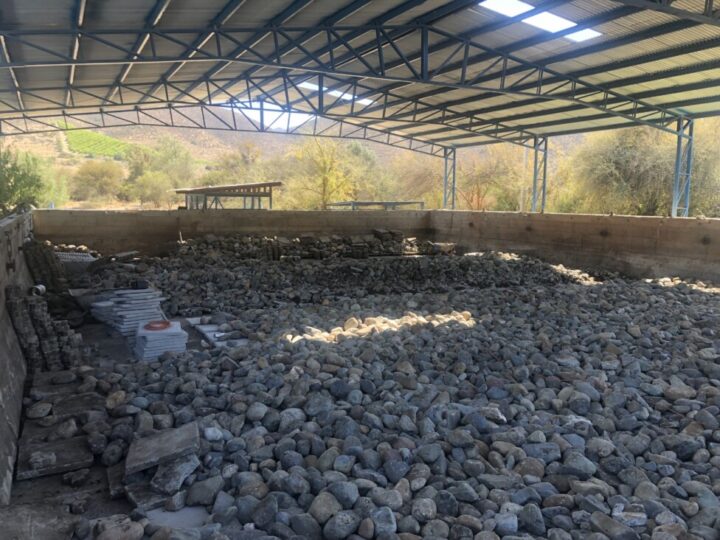
The Huatulame treatment plant in the rural municipality of Monte Patria in northern Chile is being completely repaired with the support of the local municipality. Waterproof plastic sheeting and boulders have been installed, and in the final stage sawdust and earthworms will be incorporated before receiving wastewater from local households for reuse. CREDIT: Orlando Milesi / IPS

The Huatulame treatment plant in the rural municipality of Monte Patria in northern Chile is being completely repaired with the support of the local municipality. Waterproof plastic sheeting and rocks have been installed, and in the final stage sawdust and earthworms will be incorporated before receiving wastewater from local households for reuse. CREDIT: Orlando Milesi / IPS

A successful pilot experience

In Coquimbo, which has a regional population of some 780,000 people, there are 71 water treatment plants, most of which use activated sludge and almost all of which are linked to the Rural Drinking Water Program (APR) of the state Hydraulic Works Directorate.

Activated sludge systems are biological wastewater treatment processes using microorganisms, which are very sensitive in their operation and maintenance and rural sectors do not have the capacity to maintain them.

“Most of these treatment plants are not operating or are operating inefficiently,” Diaz acknowledged.

But one of the plants, once reconditioned, has served as a model for others since 2018. Its creation allowed Dionisio Antiquera, a 52-year-old agricultural technician, to save his alfalfa crop.

“We have had a water deficit for years. This recycled water really helps us grow our crops on our eight hectares of land,” he said in the middle of his alfalfa field in Cerrillos de Tamaya, one of the Coquimbo municipalities that IPS toured for several days to observe five wastewater reuse projects.
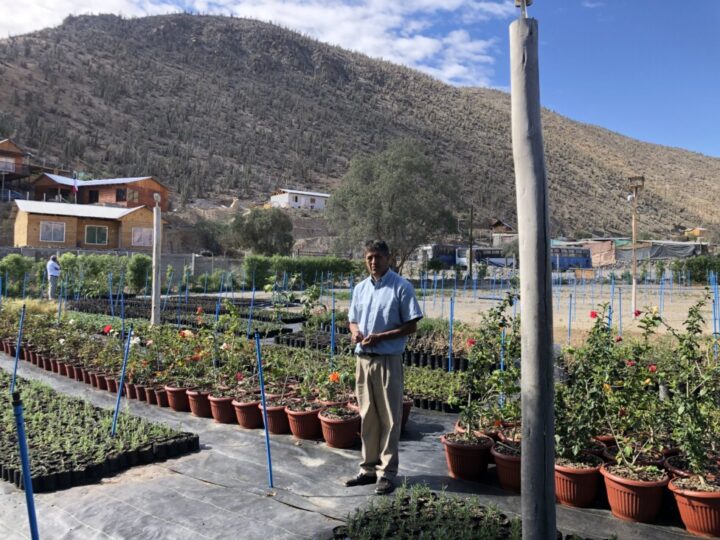
Raúl Ángel Flores stands in his nursery, where the plants and trees are irrigated with recycled water from the Punta Azul project in the town of Villa Puclaro, in Chile's Coquimbo region. All profits from the town's wastewater treatment are reinvested in its maintenance. CREDIT: Orlando Milesi / IPS

Raúl Ángel Flores stands in his nursery, where the plants and trees are irrigated with recycled water from the Punta Azul project in the town of Villa Puclaro, in Chile’s Coquimbo region. All profits from the town’s wastewater treatment are reinvested in its maintenance. CREDIT: Orlando Milesi / IPS

He explained that using just reused water he was able to produce six normal alfalfa harvests per year with a yield per hectare of 100 25-kg bales.

“That’s 4500 to 4800 bales in the annual production season,” he said proudly.

These bales are easily sold in the region because they are cheaper than those of other farmers.

The water he uses comes from an APR plant that has 1065 users, 650 of whom provide water, including Antiquera.

On one side of his alfalfa field is a plant that accumulates the sludge that is dehydrated in pools and drying courts, and on the other side, the water is chlorinated and runs into another pond in its natural state.

“This water works well for alfalfa. It is hard water that has about 1400 parts per million of salt. Then it goes through a reverse osmosis process that removes the salt and the water is suitable for human consumption,” the farmer explained.

In Chile, treated wastewater is not considered fresh water or water that can be used directly by people, and its reuse is only indirect.

Antiquera sold half a hectare to the government to install the plant and in exchange uses the water obtained and contributes 20 percent to the local APR.

He recently extended his alfalfa field to another seven hectares, thanks to his success with treated water.
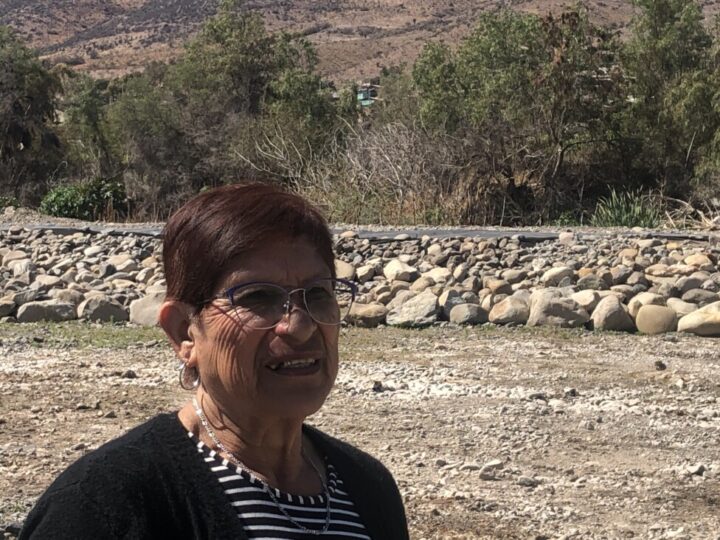
Deysy Cortés, president of a rural drinking water system in Huatulame, stands in front of the dry riverbed of the town of the same name. Today there is no water in the river, where local residents swam and summer vacationers camped on its banks 15 years ago. CREDIT: Orlando Milesi / IPSDeysy Cortés, president of a rural drinking water system in Huatulame, stands in front of the dry riverbed of the town of the same name. Today there is no water in the river, where local residents swam and summer vacationers camped on its banks 15 years ago. CREDIT: Orlando Milesi / IPS

Deysy Cortés, president of a rural drinking water system in Huatulame, stands in front of the dry riverbed of the town of the same name. Today there is no water in the river, where local residents swam and summer vacationers camped on its banks 15 years ago. CREDIT: Orlando Milesi / IPS

Flowers and trees also benefit

In Villa Puclaro, in the Coquimbo municipality of Vicuña, Raúl Ángel Flores, 55, has an ornamental plant nursery.

“I’ve done really well. My nursery has grown with just reuse water….. I have more than 40,000 ornamental, fruit, native and cactus plants. I deliver to retailers in Vicuña and Coquimbo,” a port city in the region, he told IPS.

The nursery is 850 square meters in size, and has an accumulation pond and pumps to pump the water. He has now rented a 2,500-meter plot of land to expand it.

Flores explained to IPS that he manages the nursery together with his wife, Carolina Cáceres, and despite the fact that they have two daughters and a senior citizen in their care, “we make a living just selling the plants…I even hired an assistant,” he added.

In the southern hemisphere summer he uses between 4,000 and 5,000 liters of water a day for irrigation.

“I have water to spare. Here it could be reused for anything,” he said.

Joining the project made it possible for Flores to make efficient use of water with a business model that in this case incorporates a fee for the water to the plant management, which is equivalent to 62 cents per cubic meter used.
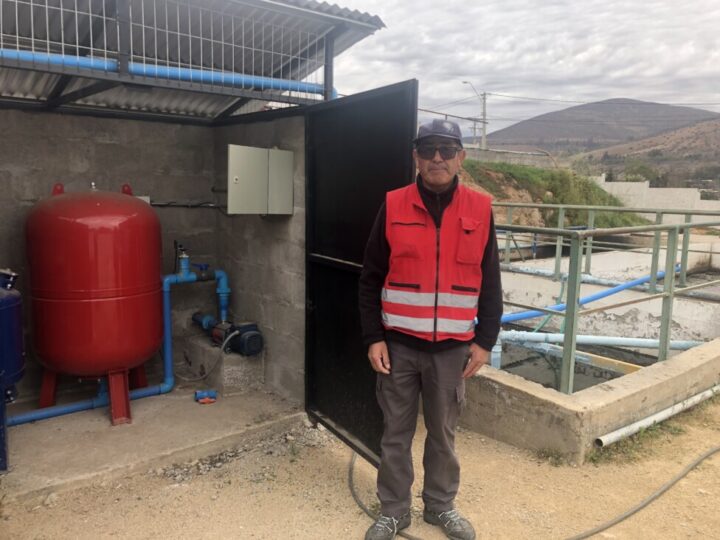
 Arnoldo Olivares operates the water treatment and recycling plant in Plan de Hornos, northern Chile. The plant's infrastructure and operation have been upgraded, and it can now deliver water to rural residents to irrigate trees and plants, instead of using potable water. CREDIT: Orlando Milesi / IPS

Arnoldo Olivares operates the water treatment and recycling plant in Plan de Hornos, northern Chile. The plant’s infrastructure and operation have been upgraded, and it can now deliver water to rural residents to irrigate trees and plants, instead of using potable water. CREDIT: Orlando Milesi / IPS

Eliminating odors, and creating new gardens

In the community of Huatulame, in the municipality of Monte Patria, Fundación Chile built an artificial surface wetland to put an end to the bad odors caused by effluents from a deficient waste-eater earthworm vermifilter treatment plant.

“This wetland has brought us peace because the odors have been eliminated. For the past year people have been able to walk along the banks of the old riverbed,” Deysy Cortés, 72, president of the APR, told IPS.

The municipality of Monte Patria is financing the repair of the plant with the equivalent of 100,000 dollars.

“The sprinklers will be changed, the filtering system will be replaced, and sawdust and worms will be added. It will be up and running in a couple of months,” explained agronomist Jorge Núñez, a consultant for Fundación Chile.

As in other renovated plants, safe infiltration of wastewater is ensured while the project simultaneously promotes the protection of nearby wells to provide water to the villagers.
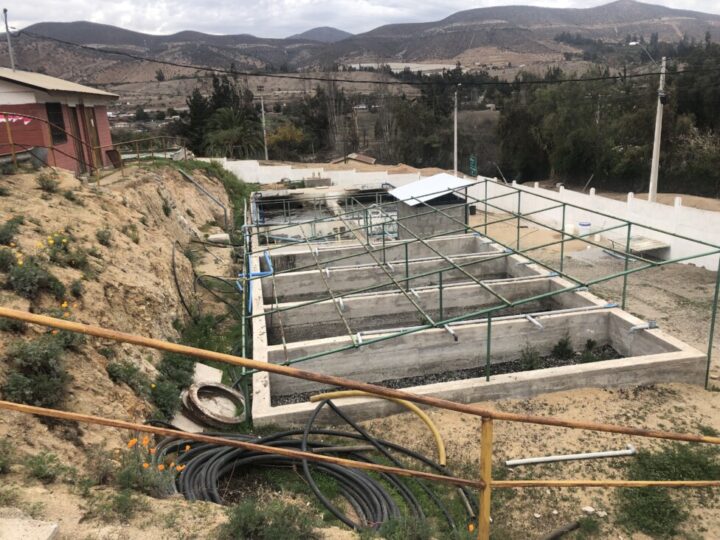
The Huatulame treatment plant in the rural municipality of Monte Patria in northern Chile is being completely repaired with the support of the local municipality. Waterproof plastic sheeting and boulders have been installed, and in the final stage sawdust and earthworms will be incorporated before receiving wastewater from local households for reuse. CREDIT: Orlando Milesi / IPS

The Huatulame treatment plant in the rural municipality of Monte Patria in northern Chile is being completely repaired with the support of the local municipality. Waterproof plastic sheeting and boulders have been installed, and in the final stage sawdust and earthworms will be incorporated before receiving wastewater from local households for reuse. CREDIT: Orlando Milesi / IPS

Cortés warned of serious difficulties if no more rain falls in the rest of 2023, despite the relief provided by the plant for irrigation.

“I foresee a very difficult future if it doesn’t rain. We will go back to what we experienced in 2019 when in every house there were bottles filled with water and a little jug to bathe once a week,” she said.

During a recent crisis, the local APR paid 2500 dollars to bring in water from four 20,000-liter tanker trucks.

In Plan de Hornos, a town in the municipality of Illapel, irrigation technology was installed using reused water instead of drinking water to create a green space for the community to enjoy.

The project included water taps in people’s homes for residents to water trees and flowers.

Arnoldo Olivares, 59, is in charge of the plant, which has 160 members.

“I run both systems,” he told IPS. “I pour drinking water into the pond. After passing through the houses, the water goes into the drainage system, where there is a procedure to reclaim and treat it.”

“This water was lost before, and now we reuse it to irrigate the saplings. We used to work manually, now it is automated. It’s a tremendous change, we’re really happy,” he said.

Antiquera the alfalfa farmer is happy with his success in Cerrillos de Tamaya, but warns that in his area 150 to 160 mm of rainfall per year is normal and so far only 25 mm have fallen in 2023.

“The water crisis forces us to find alternatives and to be 100 percent efficient. Not a drop of water can be wasted. They have forecast very high temperatures for the upcoming (southern hemisphere) summer, which means that plants will require more water in order to thrive,” he said.

Díaz, the sustainability manager of Fundación Chile, said the Coquimbo projects are fully replicable in other water-stressed areas of Chile if a collaborative model is used.

He noted that “in Chile there is no law for the reuse of treated wastewater. There is only a gray water law that was passed years ago, but there are no regulations to implement it.”

He explained, however, that due to the drought, “rural localities today are already reusing wastewater or gray water. This is going to happen, with or without us, with or without a law. The need for water is so great that the communities are accepting the use of treated wastewater.”

The governor of Coquimbo, Krist Naranjo, argued that “a broader vision is needed to value water resources that are essential for life, especially in the context of global climate change.”

“We’re working on different initiatives with different executors, but the essential thing is to value the reuse of graywater recycling,” she told IPS from La Serena, the regional capital.

  Source

Halfway to 2030: Our 5 Asks at the SDG Summit

Civil Society, Crime & Justice, Development & Aid, Environment, Global, Headlines, Human Rights, Inequality, Poverty & SDGs, Press Freedom, Sustainable Development Goals, TerraViva United Nations

Opinion

A protest for women’s rights in Puebla, Mexico. Credit: Melania Torres/Forus

NEW YORK, Sep 15 2023 (IPS) – At the UN SDG Summit in New York, the Forus global civil society network is calling for decisive action on SDG implementation. Clearly, as we hit the midpoint towards the “finish line” of the Agenda 2030, progress is stagnating.


The 2023 Special Edition of the SDG Progress Report emphasized that we’re falling short in implementing the SDGs. In April this year, UN Secretary General Antonio Guterres deplored that “Progress on more than 50 per cent of targets of the SDGs is weak and insufficient; on 30 per cent, it has stalled or gone into reverse,” disproportionately impacting the world’s poorest and most vulnerable.

As we approach the halfway mark of the 2030 Agenda, we urge world leaders at the UN General Assembly to address the precarious state of SDG implementation. Here’s our 5 asks.

Walk the talk with clear implementation plans and benchmarks for the realization of the Sustainable Development Goals.

“In Guatemala, there are two worlds, one for a small group that benefits from this macroeconomic stability, this weakness of democracy, this co-optation of state institutions, and a large majority of the population that faces poverty and inequality,” says Alejandro Aguirre Batres, Executive Director of CONGCOOP, the national platform of NGOs in Guatemala that recently published an alternative report on the implementation of the SDGs in the country.

Human rights activists in Cartagena, Colombia from the Coalition of Human Rights in Development at the Finance in Common Summit. Credit: Sebastian Barros/Forus

Governments must make specific national implementation plans to advance the Sustainable Development Goals, with clear benchmarks on when to achieve the targets set in 2015. Following the SDG Summit, we call on the United Nations and its partners to ensure that the “National Commitments to SDG Transformation” called for by the Secretary-General are adequately compiled and tracked, including by providing a transparent and inclusive platform for showcasing these commitments, helping to ensure adequate implementation, follow-up and accountability. All efforts and commitments must focus on breaching the increassing gap in inequalities, healing polarisation and restoring socio-environmental rights at the core of Agenda 2030 implementation as no form of development should come at the cost of environmental degradation and injustice.

Presenting a viewpoint from Asia, Jyotsna Mohan Singh, representing the Asia Development Alliance, emphasizes that while the SDGs look good on paper, their real-world implementation remains far from satisfactory. She explains, “Governments should develop a policy coherence for sustainable development roadmap with timebound targets,” adding that it’s all about creating spaces grounded in equity where civil society and other stakeholders can join discussions and connect with local communities.

In regions like the Sahel, stretching 5,000 kilometers below the Sahara Desert from the Atlantic to the Red Sea, challenges like conflict, political instability, extreme poverty, and food insecurity affect nearly 26 million people. Yet, this region is teeming with opportunities, boasting abundant resources and a young population, including 50% young women and girls. As civil society leader Mavalow Christelle Kalhoule, Forus Chair and President of SPONG, the Burkina Faso NGO network, puts it, “What unfolds in the Sahel and in so many other forgotten communities ripples across the globe, impacting us all even if we choose to look away. Implementing the Sustainable Development Goals is vital to unlock a different future. But for global change to truly happen, we need countries to come together, we need solidarity, horizontal spaces, and for world leaders to start listening and acting accordingly.”

Commit to the protection of civic space and human rights.

“Although the state of Pakistan has ratified many global instruments, including the International Covenant on Civil and Political Rights and the SDGs, the irony is that none of them have been transformed into local policies and regulatory frameworks. Unfortunately, civil rights advocates and organizations have either transformed themselves into humanitarian organizations or practiced self-censorship to avoid state atrocities. Pakistan is failing to achieve SDGs due to disengagement with civil society and other stakeholders. Ironically, the government is unable to provide reliable data on any of their own priority indicators to measure progress towards the implementation of SDGs, particularly on rights-based indicators,” says Zia ur Rehman, National Convener of the Pakistan Development Alliance. Their newly published Pakistan Civic Space Monitor reveals a generally restricted civic space, including restraints on freedom of speech, assembly, information, rule of law, governance, and public participation, with further deterioration. This rings true for 92% of Forus members – comprising national and regional civil society networks in over 124 countries – who consider the protection of civic space and human rights a top priority.

Fridays for Future activists during a Climate March in Brussels, Belgium. Credit: Both Nomads/Forus

Indeed, over the past decade, thousands of civil society organizations have faced increasing challenges due to restrictions on their formation and activities. Nine out of 10 people now live in countries where civil liberties are severely restricted, including freedoms of association, peaceful assembly, and expression, according to the CIVICUS Monitor. Forus reports confirm that civil society deals with increasing restrictions, involving extra-legal actions, misinformation and disinformation about their work both online and offline. Research also highlights the insufficiency of current institutional mechanisms to ensure an enabling environment for civil society, including addressing impunity for attacks on civil society and human right defenders, implementing supportive laws and regulations, and facilitating effective and inclusive policy dialogue. A recent ARTICLE 19 report highlights the inadequate integration of crucial elements like freedom of expression and access to information into SDGs, hampering progress. Journalist killings increased in 2022. Additionally, monitoring access to information mainly focuses on having a legal framework, ignoring its quality and adoption. Strengthening these rights is vital for advancing all SDGs. The growing number of human rights defenders being killed every year – at least 401 in 26 countries were murdered for their peaceful work in 2022 – is another worrying trend that needs to be reversed as the protection and promotion of human rights is the cornerstone of achieving sustainable development. Without human rights we will just move backwards.

Strengthen and Catalyze Robust Financing for the SDGs.

From the recent Summit for a new global financing pact to the Finance in Common initiative, it’s clear that the focus this year has been on increasing investment. But we need quality not just quantity, as expressed in a join civil society declaration aimed at public development banks signed by over 100 civil society organisations from 50+ countries. While we welcome UN Secretary General Antonio Guterres’s call for a SDG Stimulus, we remind Governments, International Financial Institutions, public development banks and donors that more efforts must be done to scale up investments for the realization of the SDGs at all levels, including through additional support for civil society and by involving communities in all “development talks”. The role of the private sector and financial institutions in the implementation of the 2030 Agenda must be talked about openly. It is important to include in all development projects being carried out specific budgets for actions linked to the implementation of the 2030 Agenda. Discussions about financial reforms that are being repeatedly undertaken by several countries cannot happen behind close doors and in non-inclusive forums such as the G7 and G20. Instead, they should be open, inclusive, and transparent, involving a broader spectrum of protagonists, including civil society, to ensure fairness and sustainability in shaping global financial policies.

“The SDGs are severely off track as we reach the critical half-way point of Agenda 2030. We need a renewed global ambition on financial commitments to make progress on the SDGs. Reforms of global financial architecture are a crucial part of this to ensure we have a fairer, more effective, inclusive and transparent system supporting lower-income countries that are at the forefront of the global climate, debt, poverty, food, and humanitarian crises. It’s not about a lack of finance, it is about political will and getting our priorities right,” says Sandra Martinsone, Policy Manager – Sustainable Economic Development at Bond UK.

Mobilize Transformative Commitments for SDG16+.

Recognizing the vital role of SDG16+ as a critical enabler for the entire 2030 Agenda, governments should come to the SDG Summit with targeted, integrated, focused and transformative commitments to accelerate action on SDG16+. As developed in the #SDG16Now collective campaign, this includes domestic policies and resources, legal reforms and initiatives to advance SDG16+ at the international, national and local levels, as well as ambitious global commitments to strengthen multilateralism and international resolve to promote peace, justice, the rule of law, inclusion and institution-building. Additionally, governments must use key moments – such as the 2024 High-Level Political Forum and the Summit of the Future – to advance implementation and delivery of the SDGs through similar commitments to action, and ensure adequate follow-up to these commitments going forward.

Ensure civil society participation and listen to communities, reinvigorate commitments to SDG17.

The 2030 Agenda overall cannot be achieved without building on the role of civil society and fostering a true global partnership. Every year at the fringes of the UN General Assembly, initiatives such as the Global People’s Assembly bring to the ears of world leaders the voices of communities historically marginalised. Governments need to reinvigorate engagement towards SDG17 to trengthen the means of implementing sustainable development goals and revitalising global partnerships for sustainable development. It’s high time we move away from conducting discussions about the future of development in closed-door settings. Tokenistic participation of civil society, where their involvement is merely symbolic or superficial, undermines the core principles of nclusivity, hurting genuine progress and meaningful collaboration. A more inclusive approach must be embraced that actively involves civil society and communities. Let’s #UNmute their voices and perspectives by bringing about reforms to current participation mechanisms, and giving them a real platform to be heard.

In 2015 every government in the world agreed as a global community on what we want for our comon future for people and planet. So many efforts and work went on to reach such an agreement. Now is the time for governments and world leaders to walk the walk and prioritize people and the planet, delivering the 2030 Agenda, essential to secure our shared future. It is time for world leaders to act decisively and uphold their commitments to the SDGs.

IPS UN Bureau

  Source

Youth Rally for Peace Through Climate Justice at the UN

Climate Action, Climate Change, Climate Change Justice, Environment, Global, Headlines, IPS UN: Inside the Glasshouse, TerraViva United Nations, Youth Thought Leaders

Climate Change Justice

Youth rally at the UN for climate justice. Credit: Abigail Van Neely/IPS

Youth rally at the UN for climate justice. Credit: Abigail Van Neely/IPS

UNITED NATIONS, Sep 15 2023 (IPS) – “What do we want? Climate justice! When do we want it? Now!” youth chanted in an unusually lively conference at the United Nations Headquarters.


Earlier on Thursday morning (September 14), almost 500 young people had streamed into the room to a DJ’s upbeat soundtrack. Spirits were high despite the more somber rallying cry of this year’s International Day of Peace youth event: the planet is on fire. Many speakers focused on the idea that there cannot be peace without climate justice.

“We cannot begin to talk about peace without talking about the climate crisis,” environmental justice advocate Saad Amer said after leading the crowd in the kind of chants more likely heard at a protest. Fossil fuel disputes spark wars that disproportionately affect people of color, Amer explained. Youth must take charge to “re-write destiny.”

To 21-year-old Mexican climate justice activist Xiye Bastida, “Peace is the ability to drink clean air and clean water.” Bastida, a member of the Otomi-Toltec indigenous community, spoke of her community’s traditional commitment to living in harmony with the earth. Now, indigenous people are being displaced as regenerative practices are forgotten. Bastida called for a world free of extreme weather and exploitation. The climate crisis reflects a broken system, she said, but peace is the bravery to imagine a better world.

Young people are “creating a youth movement for climate action, seeking racial justice, and promoting gender equality,” the Under-Secretary-General for Global Communications, Melissa Fleming, told the audience. In a recorded statement, Secretary-General Antonio Guterres reiterated that youth action has power. Still, only four governments have concrete plans to include young people in policymaking, Youth Envoy Jayathma Wickramanyake noted.

As she lived through brutal conflicts in her home country of Sri Lanka, Wickramanayake said she wondered why people around her continued to fight. Today, she told other young activists that the root causes of conflict always run deep – from inequality to poverty. She stressed that peace cannot be differentiated from development.

The event occurs days before the Sustainable Development Goal (SDG) Summit, a critical opportunity for world leaders to address failures to implement the goals so far.

“Next week there will be an important breakthrough in creating the conditions to rescue the sustainable development goals. I’m very hopeful that the SDG summit will indeed represent a quantum leap in the response to the dramatic failures that we have witnessed,” Guterres said during a news conference.

Meanwhile, youth are left with memories of their chants: “The oceans are rising, and so are we!” “We are unstoppable – another world is possible!”

IPS UN Bureau Report

  Source

Toothless Global Financial Architecture Fuelling Africa’s Climate Crisis

Africa, Biodiversity, Climate Action, Climate Change, Climate Change Finance, Climate Change Justice, Conferences, Editors’ Choice, Environment, Featured, Food and Agriculture, Headlines, Humanitarian Emergencies, Sustainable Development Goals, TerraViva United Nations

Climate Change Justice

Africa needs approximately USD 579.2 billion in adaptation finance over the period 2020 to 2030, and yet the current adaptation flows are five to 10 times below estimated needs.
 

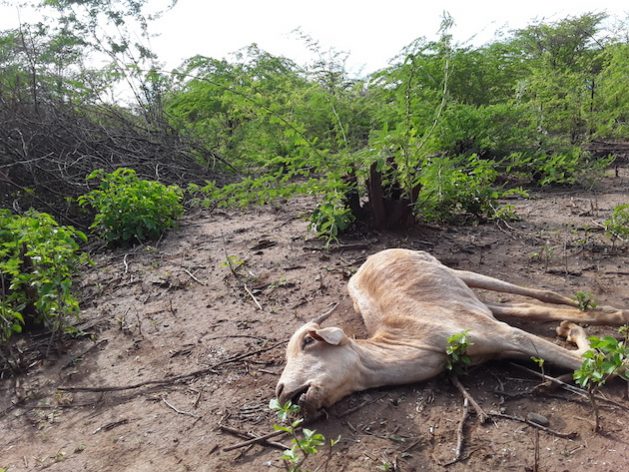
This goat died of starvation while surrounded by an inedible invasive plant. Lives hang in the balance as Kenya’s dryland is ravaged by a severe prolonged drought. Credit: Joyce Chimbi/IPS

This goat died of starvation while surrounded by an inedible invasive plant. Lives hang in the balance as Kenya’s dryland is ravaged by a severe prolonged drought. Credit: Joyce Chimbi/IPS

NAIROBI, Sep 5 2023 (IPS) – As thousands convene in Kenya’s capital, Nairobi, for the Africa Climate Summit, the first time the African Union has summoned its leaders to solely discuss climate change under the theme ‘Driving Green Growth and Climate Finance Solutions for Africa and the World’, the backdrop is a country on the frontlines of a climate crisis.


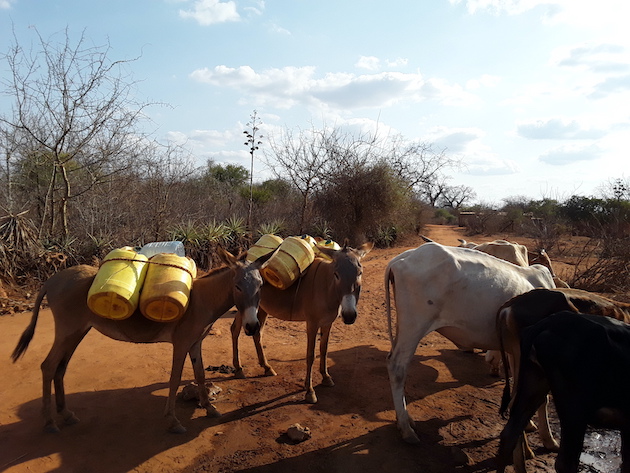
The severe, sharp effects of climate change are piercing the very heart of an economy propped up by rainfed agriculture and tourism – sectors highly susceptible to climate change. After five consecutive failed rainy seasons, more than 6.4 million people in Kenya, among them 602,000 refugees, need humanitarian assistance – representing a 35 per cent increase from 2022.

It is the highest number of people in need of aid in more than ten years, says Ann Rose Achieng, a Nairobi-based climate activist. She tells IPS that Kenya is hurtling full speed towards a national disaster in food security as “at least 677,900 children and 138,800 pregnant and breastfeeding women in Kenya’s arid and semi-arid regions alone are facing acute malnutrition. Nearly 70 per cent of our wildlife was lost in the last 30 years.”

Despite Kenya contributing less than 0.1 per cent of the global greenhouse gas emissions per year, the country’s pursuit of a low carbon and resilient green development pathway produced a most ambitious Nationally Determined Contribution (NDC) to cut greenhouse gasses by 32 per cent by 2030 in line with the Paris Agreement.

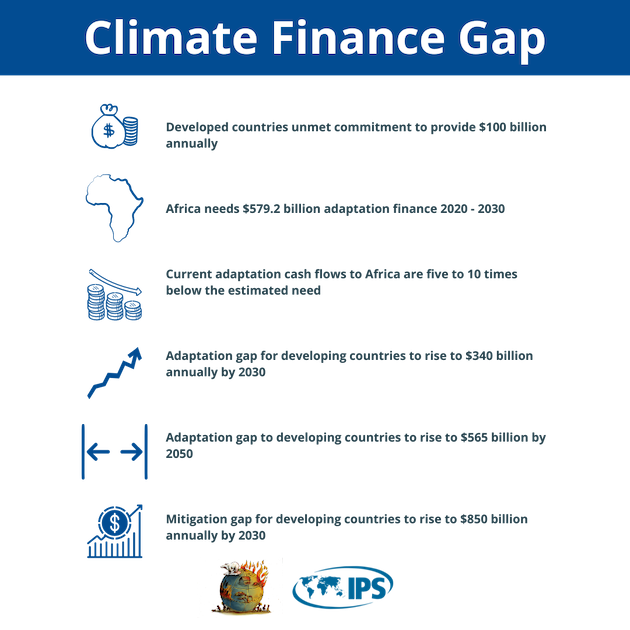
But as is the case across Africa, there are no funds to actualise these lofty ambitions. Africa needs approximately USD 579.2 billion in adaptation finance over the period 2020 to 2030, and yet the current adaptation flows to the continent are five to ten times below estimated needs. Globally, the estimated gap for adaptation in developing countries is expected to rise to USD 340 billion per year by 2030 and up to USD 565 billion by 2050, while the mitigation gap is at USD 850 billion per year by 2030.

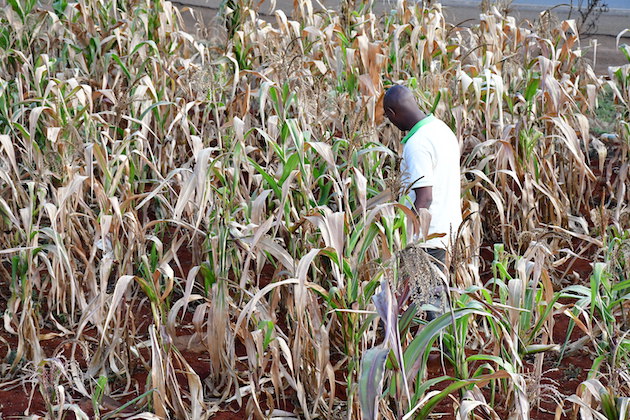
After five consecutive failed rainy seasons, food insecurity is expected to escalate as maize crop has failed to flourish due to erratic weather patterns. Credit: Joyce Chimbi/IPS

After five consecutive failed rainy seasons, food insecurity is expected to escalate as maize crop has failed to flourish due to erratic weather patterns. Credit: Joyce Chimbi/IPS

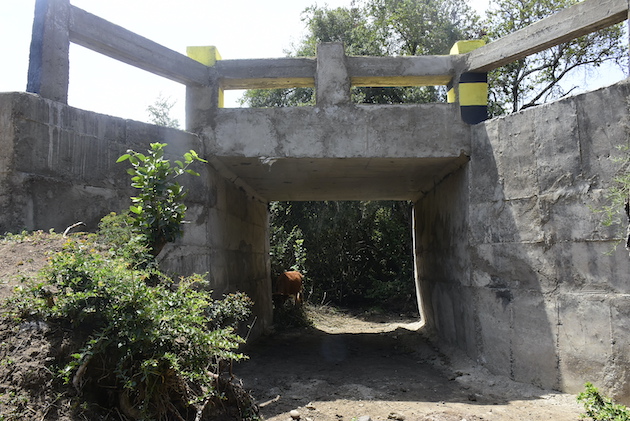
As dams and rivers dry up, Kenya will continue to be on the frontlines of a climate crisis unless climate change adaptation and mitigation efforts are escalated. Credit: Joyce Chimbi/IPS

As dams and rivers dry up, Kenya will continue to be on the frontlines of a climate crisis unless climate change adaptation and mitigation efforts are escalated. Credit: Joyce Chimbi/IPS

Frederick Kwame Kumah, Vice President of Global Leadership African Wildlife Foundation, tells IPS a big part of the problem is Africa’s burgeoning gross public debt which increased from 36 per cent of Gross Domestic Product (GDP) to 71.4 per cent of GDP between 2010 and 2020 – a drag on its development progress and a disincentive for climate finance flows.

“There is a concern that climate finance, if and when provided, will be used to first service Africa’s debt burden. The first step to addressing Africa’s Climate Finance must be action towards debt relief for Africa. Freeing up debt servicing arrangements will release resources for continued development and climate finance purposes,” Kumah explains.

He says there is an urgent need to challenge the existing unfair paradigm for financing by developing countries. It is very expensive for developing countries to borrow for development purposes. Africa must then leverage its natural capital towards seeking innovative financing mechanisms such as green bonds and carbon credits to address its development and climate change challenges.

Nearly half, 23 out of 47 counties in Kenya, are classified as arid and semi-arid. Livelihoods are at risk as pastoralists are unable to cope with drastic weather changes. Credit: Joyce Chimbi/IPS

Nearly half, 23 out of 47 counties in Kenya, are classified as arid and semi-arid. Livelihoods are at risk as pastoralists are unable to cope with drastic weather changes. Credit: Joyce Chimbi/IPS

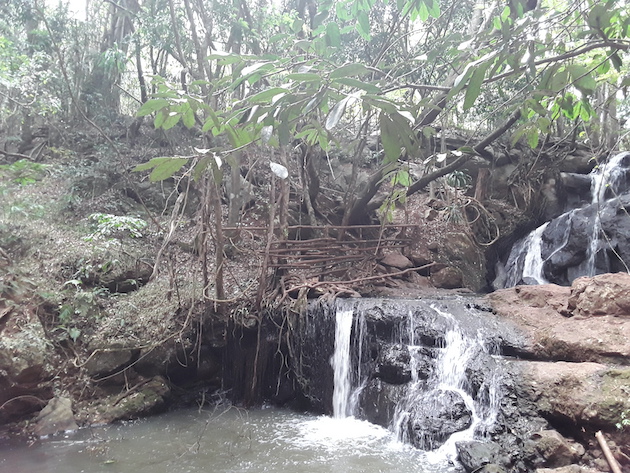
This waterfall is on the verge of drying up. Kenya's economy is heavily dependent on tourism and agriculture. The two sectors are highly susceptible to climate change. Credit: Joyce Chimbi/IPS

This waterfall is on the verge of drying up. Kenya’s economy is heavily dependent on tourism and agriculture. The two sectors are highly susceptible to climate change. Credit: Joyce Chimbi/IPS

“Climate finance was, as expected, a key part of COP27. It is a grave concern for Africa that developed countries’ commitment to provide $100 billion annually has yet to be met, even though the need for finance is becoming increasingly obvious. In COP27, we noted that new climate finance pledges were more limited than expected. Countries such as those in Africa are still waiting for previous pledges to be fulfilled,” says Luther Bois Anukur, Regional Director, IUCN (International Union for Conservation of Nature).

Meanwhile, Anukur tells IPS negotiations on important agenda items, most notably the new finance target for 2025, stalled. In COP27, Parties concentrated on procedural issues – deferring important decisions about the amount, timeframe, sources, and accountability mechanisms that may be relevant to a new finance goal in the future. African countries and many other vulnerable countries are in the fight for our lives, and sadly they are losing.

Anukur stresses that Africa’s natural resources are depleted, eroded, and biodiversity lost due to extreme effects of climate change leading to loss of lives and ecosystem services and damage to infrastructure at an alarming rate. Yet climate finance pledges have not materialised. The Africa Climate Summit should be the platform for Africa and developing partners to address existing finance gaps with clear programmatic and project approaches.

Africa must use the Summit to assess and prepare their position for the COP28 in the United Arab Emirates towards strengthening partnerships for the delivery of desired climate finance. Kumah adds that the principle of equal but differentiated responsibilities of nations must be adhered to for climate justice and to enable developing countries, who are least responsible for the effects of climate, to have much-needed resources to cope and adapt to biodiversity loss and climate change.

“In that respect, the creation of a dedicated funding mechanism to address loss and damage and another for adaptation and mitigation to redress historical and continued inequities in contributions towards biodiversity loss and climate change. We must rethink how private investments can be reshaped and harnessed for the benefit of biodiversity and climate action,” Kumah expounds.

“Private investments can be scaled through green bonds, carbon markets, sustainable agricultural, forestry and other productive sector supply chains.  Transformative financing architecture is necessary at the domestic and international levels to bring the private and public sectors together to secure the critical backbone of Africa’s natural infrastructure.”

Climate finance gap. Graphic: Joyce Chimbi & Cecilia Russell

Climate finance gap. Graphic: Joyce Chimbi & Cecilia Russell

While developing countries submitted revised and ambitious National Adaptation Plans and NDCs as requested, Anukur says complicated processes to access financing for their climate actions persist. Stressing the need for reforming the international financial architecture, starting with multilateral development banks.

“The 2023 Summit for New Global Financing Pact held in Paris committed to a coalition of 16 philanthropic organizations to mobilize investment and support UN’s SDG priorities by unlocking new investment for climate action in low- and middle-income countries while reducing poverty and inequality,” Anukur observes.

Civil society organizations and activists such as Achieng have expressed concerns that such announcements are insufficient considering the scale of the challenges facing planet Earth. The Summit will have failed if the global financial architecture is not overhauled in line with the needs of the African continent, she says.

Anukur says the Summit must therefore propel Africa to new heights of climate financing to help reduce Africa’s vulnerability to climate change and increase its resilience and adaptive capacity in line with the Global Goal on Adaptation. Ultimately expressing optimism that the opportunity to unlock the potential of climate financing – breaking the shackles of debt and building a climate-resilient and prosperous Africa is, at last, in sight.

IPS UN Bureau Report


Civil Society Organizations Unite to Urge Public Development Banks to Change the Way Development Is Done

Biodiversity, Civil Society, Climate Change, Development & Aid, Economy & Trade, Energy, Environment, Green Economy, Headlines, Human Rights, Latin America & the Caribbean, TerraViva United Nations

Opinion

CARTAGENA, Colombia, Sep 4 2023 (IPS) – In the midst of a complex web of crises, spanning climate change, biodiversity depletion, constraints on civic space and mounting debt burdens, civil society organizations and human rights defenders from over 50 countries have united their voices to call for immediate and impactful action from Public Development Banks (PDBs).


The global coalition’s message is clear: when it comes to financing for development, principles of rights, justice, sustainability, transparency, accountability and dignity for all cannot remain mere slogans. They must form the core of all projects undertaken by all Public Development Banks.

The Finance in Common Summit has become a pivotal platform for Public Development Banks from around the world. The fact that this year’s summit is taking place in Cartagena, Colombia, the deadliest country in the world in 2022 for human rights, envrionmental and indigenous activists, development banks must acknowledge and integrate the protection of human rights into their projects.

“Development banks are advocating to play an even bigger role in the global economy. But are they truly fit for this purpose? Unfortunately, the stories of communities around the world show us that development banks are failing to address the root causes of the very problems they claim to solve. We need to hold them accountable for this,” says Ivahanna Larrosa, Regional Coordinator for Latin America at the Coalition for Human Rights in Development.

“When PDB projects cause harm to people and the environment, PDBs must remedy these harms. All PDBs should implement an effective accountability mechanism to address concerns with projects and should commit to preventing and fully remediating any harm to communities,” adds Stephanie Amoako, Senior Policy Associate at Accountability Counsel.

The ongoing crises demand a transformation in the quality of financing and a power shift to include the voices of communities. The existing financial architecture not only impedes governments’ ability to safeguard both their citizens and the environment but also contributes to the escalating issue of chronic indebtedness. Policy-based lending and conditionalities enforced by International Financial Institutions have steered countries toward privatization of essential services, reduced social spending and preferential treatment for the private sector. This burdens the population with higher taxes, inflation, and weakened social safety nets.

“The same multinational companies that have polluted and violated human rights in Latin America are now obtaining financing from development banks for energy transition projects. Another example is the development of the green hydrogen industry in Chile, which carries a very high environmental and social risk,” says Maia Seeger, director of the Chilean civil society organization Sustentarse.

Addressing these issues requires a comprehensive and sustainable transformation of the financial architecture as well as holistic reforms and synergies with civil society and communities. Environmental and neo-colonial debts need to be a thing of the past and equitable reforms the thing of the present.

Global civil society, in response to these challenges, demands bold and decisive actions in a collective declaration signed by over 100 organisations. The demands are the result of a 4-year process in which a coalition of civil society organisations has come together to call on all PDBs at the Finance in Common Summit to embrace tangible actions that genuinely prioritize and protect people.

Just last month we have seen that change is possible when communities are involved, as the people of Ecuador voted to ban oil drilling in one of the most biodiverse places on the planet, the Yasuní National Park in the Amazon rainforest.

“The global financial system needs not just a rethink but a surgical operation, and that requires bold action. Governments and institutions such as the Public Development Banks must cancel the debt of the countries that require it and put in place concrete and immediate measures to put an end to public financing of fossil fuels, to have financing based on subsidies so as not to fall into the debt trap once again. It is time for the rich countries, the biggest polluters and creditors, to offer real solutions to the multiple crises we are currently experiencing,” says Gaïa Febvre, International Policy Coordinator at Réseau Action climat France.

“Public and Multilateral Development Banks must divest from funding false climate solutions and projects that harm forests, biodiversity and communities. Instead, they should redirect finance to support gender just, rights based and ecosystems approaches that contribute to transformative changes leading to real solutions that address climate change, loss of biodiversity and create sustainable livelihoods for Indigenous Peoples, women in all their diversities and local communities. Public funds must support community governed agroecological practices, small scale farming and traditional animal rearing practices instead of large scale agri-business which perpetuates highly polluting and emitting industrial agriculture and unsustainable livestock production, the root cause for deforestation and food insecurity,” adds Souparna Lahiri, Senior Climate and Biodiversity Policy Advisor at the Global Forest Coalition (GFC).

The call to action emphasizes that achieving the Sustainable Development Goals (SDGs), effective climate action aligned with the Paris Agreement and successful implementation of the Kunming-Montreal Global Biodiversity Framework require Public Development Banks to pivot from a top-down profit-driven approach to one that prioritizes community-led involvement and human rights-based approaches.

“It is important that civil society participation be strengthened at the Finance in Common Summit (FICS). In previous years, civil society has been sidelined. Clearly, there is still some room for improvement for civil society participation to become truly meaningful. The lack of civil society representative on the opening panel this year is just one example of that. PDBs should promote and support an enabling environment for civil society and systematically incorporate civic space, human rights and gender analysis. This year, we are working towards ensuring that civil society voices, including those from communities are heard at the FICS. In collaboration with the FICS Secretariat, Forus seeks to establish a formal mechanism between civil society and PDBs and to ensure that civil society is recognised as an official engagement group,” says Marianne Buenaventura Goldman, Project Coordinator, Finance for Development at the global civil society network Forus.

IPS UN Bureau

  Source

Biodiversity Credits: Solution or Empty Promise for Latin America?

Biodiversity, Civil Society, Climate Action, Climate Change, Climate Change Finance, Conservation, Development & Aid, Economy & Trade, Editors’ Choice, Environment, Green Economy, Headlines, Latin America & the Caribbean, Natural Resources, Regional Categories, Sustainable Development Goals, TerraViva United Nations

Climate Change Finance

In the Bosque de Niebla, located in the department of Antioquia in northwestern Colombia, biodiversity bonds have emerged to push for protection of the ecosystem from threats such as deforestation and rising temperatures. But these instruments are still very green in Latin America. CREDIT: Courtesy of Terraso - Unlike offsets for environmental damage due to infrastructure projects, biodiversity credits are an economic instrument that can be used to finance actions that result in measurable positive outcomes through the issuance and sale of biodiversity units

In the Bosque de Niebla, located in the department of Antioquia in northwestern Colombia, biodiversity bonds have emerged to push for protection of the ecosystem from threats such as deforestation and rising temperatures. But these instruments are still very green in Latin America. CREDIT: Courtesy of Terraso

MEXICO CITY, Aug 28 2023 (IPS) – Located in northwestern Colombia, the Bosque de Niebla is home to 154 species of plants, 120 bird species, 21 species of mammals, 16 water springs and five hectares of wetlands.


Forming part of the Cuchilla Jardín-Támesis Integrated Management District in the department of Antioquia, the ecosystem provides water and climate regulation to the entire northwestern region of the country.

“Not all ecosystem services are the same, it has to be a very judicious system. And there have to be local regulations, from green taxonomies (classification of activities) to regulations. Therein lies the dilemma of where the sector has to go.” — Lía González

For this reason, an innovative financing scheme, biodiversity bonds, seeks to strengthen the protection of this area for 30 years, in the face of threats such as deforestation, drought and rising temperatures due to the climate crisis.

Private Colombian investor Terraso and Spanish carbon offset seller ClimateTrade, a climate solutions company that utilizes blockchain technology to facilitate large-scale decarbonization efforts through innovation, created voluntary biodiversity bonds for the Bosque de Niebla in May 2022.

The aim is to care for 340 hectares registered as a habitat bank by the Ministry of Environment and Sustainable Development of Colombia, one of the 10 most biologically diverse countries in the world.

Habitat banks are areas where conservation initiatives are aggregated and ecosystem preservation, enhancement or restoration actions are implemented to generate quantifiable biodiversity gains.

Each biodiversity credit represents 10 square meters of threatened, conserved or restored land. Technical, financial and legal guarantees will sustain the project for at least 30 years. Each bond, worth 30 dollars, corresponds to 30 years of conservation and/or restoration.

But the scheme raises concerns about the commercialization of wildlife and the pursuit of profit over ecological benefits.

Patricia Balvanera, an academic at the Institute for Research on Ecosystems and Sustainability of the public National Autonomous University of Mexico, said the financial market approach does not address the full spectrum of environmental, cultural and social issues, which can cloud the vision of the integral importance of nature.

“Other non-integrated values have to do with social, ethical principles that have developed around nature. We have bought ourselves an image as a factory of resources at the service of people and we have discarded the role of nature and society through a relationship of care and reciprocity,” she told IPS from the northern Mexican city of San Luis Potosí.

The expert is co-author of the study “Diverse values of nature for sustainability”, published on Aug. 9, which addresses a more holistic view of care.

Unlike offsets for environmental damage due to infrastructure projects, biodiversity credits are an economic instrument that can be used to finance actions that result in measurable positive outcomes through the issuance and sale of biodiversity units.

The buyers of biodiversity bonds gain in reputational aspects, by promoting the restoration and protection of ecosystems, and obtain funds by reselling the bonds, as it is a voluntary market.

These are different from carbon credits, where companies and individuals can buy the reduced emissions credits in what is known as the voluntary carbon market, to offset their polluting emissions: each one represents the elimination of one metric ton of carbon from the atmosphere.

For the carbon dioxide equivalent trapped and stored in ecosystems such as forests, project owners can issue certificates for sale in national and international markets to national and international corporations and individuals who want to reduce their polluting emissions.

Mangroves, such as these in the municipality of Paraíso in the southeastern Mexican state of Tabasco, are candidates for biodiversity bonds because of the services they provide and the need to protect them, like other ecosystems. But these credits still need international standards, verification and monitoring guidelines, as well as tangible results. CREDIT: Emilio Godoy / IPS - Unlike offsets for environmental damage due to infrastructure projects, biodiversity credits are an economic instrument that can be used to finance actions that result in measurable positive outcomes through the issuance and sale of biodiversity units

Mangroves, such as these in the municipality of Paraíso in the southeastern Mexican state of Tabasco, are candidates for biodiversity bonds because of the services they provide and the need to protect them, like other ecosystems. But these credits still need international standards, verification and monitoring guidelines, as well as tangible results. CREDIT: Emilio Godoy / IPS

On hold

In Honduras, a project similar to the Colombian one is advancing in Cusuco National Park, in the northwestern department of Cortés.

In the 22,200-hectare forest, decreed in 1987, the international alliance of environmental organizations rePlanet seeks the conservation of 1,883 hectares in 25 years in the face of threats such as deforestation and the risk to 24 species.

The project could issue bonds this year.

Lía González, director for Latin America of the Belgian social impact investment firm Incofin, said the instrument involves several challenges, such as monetization, assigning value to the blocks of land, the creation of standards for measurement, verification, monitoring and issuance, as well as the involvement of the communities.

“Not all ecosystem services are the same, it has to be a very judicious system. And there have to be local regulations, from green taxonomies (classification of activities) to regulations. Therein lies the dilemma of where the sector has to go,” she told IPS from Bogotá.

The executive stressed that the scheme should avoid the carbon credits model and learn from its mistakes, such as inaccurate calculation of carbon sequestration and violations of community rights.

In 2022, Incofin’s portfolio covered 111 clients in 14 Latin American countries for a total of 400 million dollars in segments such as sustainable agriculture and microfinance. In Colombia, it supported eight clients and totaled 44.3 million dollars.

The company focuses on medium-term investments, so that beneficiaries have an additional source of income within the area being protected or restored.

So far, so-called green bonds have fallen short in financing for the conservation of natural wealth and sustainable land use, according to a 2020 report by the Luxembourg Green Exchange and the Global Landscapes Forum, entitled: “How can Green Bonds catalyse investments in biodiversity and sustainable land-use projects?”

Colombia and Honduras are the countries that have moved forward with these instruments, because they have regulations and several financial instruments related to biodiversity, although bonds are still a rarity.

In this regard, the Organisation for Economic Co-operation and Development (OECD), which groups the world’s 38 most developed economies, noted in its 2021 report “Tracking Economic Instruments and Finance for Biodiversity” that, despite the progress made, the substantial potential depends on increasing the use and ambition of biodiversity-relevant economic instruments.

In its Sixth National Biodiversity Report 2020, Honduras recognized the need to improve the monetary and non-monetary valuation of environmental services.

Financing schemes are essential to the development of the United Nations Decade on Ecosystem Restoration 2021-2030, adopted by the U.N. General Assembly in 2019, which seeks to prevent, halt and reverse the degradation of terrestrial and marine ecosystems, to eradicate poverty, combat climate change and prevent the mass extinction of species.

Moving towards a take-off?

In order for it to be successful, the mechanism requires integrity of the projects and the inclusion of all stakeholders, according to the World Economic Forum, dedicated to multinational business lobbying.

The Colombian Bosque de Niebla initiative has already placed 62,063 credits and has 61,773 available.

The investor Terraso has seven other habitat banks in various areas of Colombia that could generate more bonds.

Balvanera warned of perverse incentives that could undermine protection.

“If we think about financial schemes, the link should not only be transactional. There must be involvement of different stakeholders who collectively identify the mechanism that promotes conservation, respects the vision of care and maintains the livelihoods of the inhabitants of these areas,” she said.

The academic argued that “this generates a circular system that connects forest protection, water care, food production and sustainable consumption.”

For her part, González was open to analyzing these investments.

“Water could be a viable focus for climate resilience and its impact on the region’s climate. We are interested in learning about monetization and that additional sources of income can benefit protection processes, so that it is complementary to what we do,” she said.

Last December, the 15th Conference of the Parties (COP15) to the Convention on Biological Diversity (CBD) adopted the Kunming-Montreal Global Biodiversity Framework, which includes cumulative biodiversity funding of at least 200 billion dollars by 2030 from public and private sources.

One of its goals is to encourage innovative schemes such as payment for environmental services, green bonds, offsets, biodiversity credits and benefit-sharing mechanisms that include environmental and social safeguards.

To meet these objectives, the 196 States Parties to the CBD created the Global Biodiversity Framework Fund, which is managed by the Global Environment Facility and whose governing council was approved in June in Brazil.

In addition, the agreement includes the complete or partial restoration of at least 30 percent of degraded terrestrial and marine ecosystems by 2030, as well as the reduction of the loss of areas of high biological importance to almost zero.

  Source