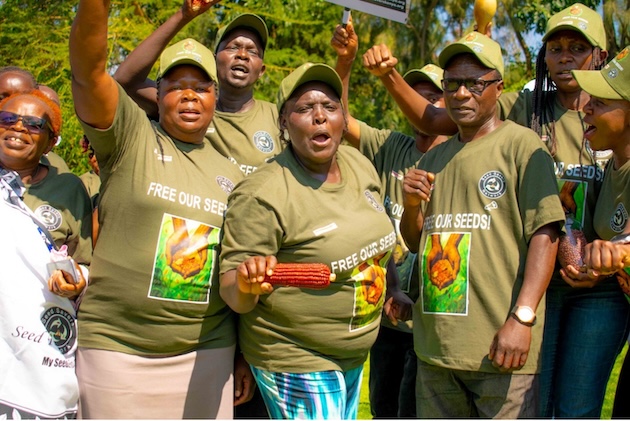
Farmers celebrate in Gilgil town in Kenya, after a court ruling that decriminalized the sharing of indigenous seeds. Credit: Jackson Okata/IPS
NAIROBI, Dec 18 2025 (IPS) – For years, smallholder farmers across Kenya have been engaged in a legal battle with the government over a law that criminalizes the practice of saving, sharing and exchanging indigenous seeds.
In 2022, a group of 15 Kenyan smallholder farmers petitioned the country’s High Court, seeking to compel the government to review sections of a law that bans the sharing and exchange of uncertified and unregistered seeds.
Kenya’s government enacted the law in 2012 to develop, promote, and regulate a modern and competitive seed industry, but farmers are calling for its review.
The informal farmer-managed seed system allows farmers to store a portion of their seeds after harvesting, which guarantees them seeds for the next planting season.
Victory for Farmers
In a decisive victory for food sovereignty and climate justice, the High Court on November 27, 2025, ruled in favor of smallholder farmers, declaring punitive sections of the Seed and Plant Varieties Act unconstitutional.
The judgment effectively decriminalizes the age-old practice of saving, sharing, and exchanging indigenous seeds, affirming that Farmer-Managed Seed Systems (FMSS) are a protected right, not a criminal activity.
Under the punitive law, farmers faced jail terms of up to two years and a fine of 1 million shillings (about 7,800 USD) for selling or exchanging unregistered seeds.
Farmer rights defenders had argued that the law gave control of the country’s food system to multinational corporations.
In her judgment, Justice Rhoda Rutto declared unconstitutional sections of the Act that gave seed inspectors sweeping powers to raid seed banks and seize seeds meant for the next harvest, made it illegal for farmers to process or sell seeds unless they were registered seed merchants, gave extensive proprietary rights to plant breeders and none to farmers, and made it illegal for farmers to save or share seeds from their harvest without prior knowledge of seed proprietors.
Samuel Wathome, a smallholder farmer who was a petitioner in the case, says that “just like his grandmother did, he can now freely save seeds for his grandchildren without fear of police or prison.”
According to Elizabeth Atieno, a Food Campaigner at Greenpeace Africa, the court ruling affirmed the long-known tradition of seed sovereignty.
“The court ruling removed shackles from Kenya’s farmers. This is not just a legal win; it is a victory for our culture, our resilience, and our future,” Atieno told IPS.
She added, “By validating indigenous seeds, the court has struck a blow against the corporate capture of our food system. We can finally say that in Kenya, feeding your community with climate-resilient, locally adapted seeds is no longer a crime.”
Protecting Biodiversity
According to Gideon Muya, Programs Officer, Biodiversity and Biosafety Association of Kenya, the judgment is a shield for the country’s biodiversity.
“Indigenous seeds are the library of life because they hold the genetic diversity we need to withstand droughts, pests, and a changing climate. The court has recognized that you cannot patent nature’s heritage. We have reclaimed the right to choose what we plant and what we eat, free from the coercion of commercial seed monopolies,” Muya told IPS.
Claire Nasike, an agroecologist, noted that the judgment indicates that the seed is life, and it is sovereign, and whoever controls it influences the lifeline of a generation.
Nasike observes that the ruling is a big boost for biodiversity, climate resilience and food sovereignty since indigenous seeds tend to be well adapted to local conditions like soil types, rainfall patterns, pests and disease traits that are often lost in uniform, certified commercial seeds.
“By enabling farmers to save, exchange and diversify their seed stock, communities can preserve genetic diversity, a key buffer against climate shocks like droughts and pests, as well as a safeguard for long-term food security.”
In the midst of the COP30 climate talks, consensus will depend on recognizing that climate action and protecting livelihoods must advance together.
Delegates met at the Global Climate-Smart Agriculture Conference in Brasília before the COP30 climate talks. Credit: 2025Clim-Eat/Flickr
BELÉM, Brazil, Nov 20 2025 (IPS) – The language of agricultural sustainability changes like the seasons—from “climate-smart” to “regenerative,” “agroecological,” and “nature-positive.” Each term reflects good intentions, but the growing list risks duplication, confusion and delays.
The recent CSA Conference in Brasília gathered leaders from policy, science and finance ahead of COP30 to focus not on buzzwords but on the shared foundations of sustainable food systems, which is all the more important in the Grave New World. For all the various theories of change, many share the same principles of soil health, crop innovation, inclusive finance and resilient livestock production.
In the midst of the COP30 climate talks, consensus will depend on recognizing that climate action and protecting livelihoods must advance together. Leaders must challenge themselves to measure success not only in emissions reduced, but also in the quality of life sustained by a thriving and resilient rural economy. With Brazil’s COP presidency determined to accelerate agreements into action, the challenge now is to accept and advance context-specific approaches in pursuit of a shared goal.
At present, fragmentation continues to divide institutions, donors, NGOs and producers, with competing ideologies slowing progress toward sustainability at the speed and scale required. For example, while a vast number of organizations are currently backing the concept of regenerative agriculture, others tread the paths of sustainable intensification or climate-smart agriculture. But some of the practices, such as agroforestry, could fall under each of these concepts.
And the Koronivia Joint Work on Agriculture (KJWA), established prior to COP26, has been succeeded by Sharm el-Sheikh Joint Work on the Implementation of Climate Action on Agriculture and Food Security and yet farmers are still waiting for clear national strategies to emerge from years of workshops and working papers. While the principles underpinning these joint work programs are sound, they have not generated action at the speed needed.
On the other hand, the six CSA Conference themes—from soil health and crop innovation to finance and policy—offer a fundamental framework around which there is already much agreement and can deliver results under whichever buzzword it is categorized. The themes also reflect the priorities of Brazil’s Action Agenda and ABC+ Plan, highlighting practical areas of consensus.
Brazil’s experience offers tangible examples of how shared priorities can move from discussion to delivery. The ABC+ Plan (2020–2030) forms the backbone of the country’s low-carbon agriculture strategy, integrating sustainable practices like no-till farming, pasture recovery and biological nitrogen fixation into a coherent national framework. It represents a direct contribution to the COP30’s Action Agenda’s agricultural pillar, transforming abstract goals on soil health and productivity into measurable outcomes.
Building on this, Brazil’s RENOVAGRO is the financing arm that enables the implementation of the ABC+ Plan, demonstrating how public policy can activate private investment to move all Action Agenda ambitions forward together. By tying credit eligibility to verified adoption of low-carbon practices, the program allows farmers to commit to transitions that would otherwise be out of reach. This realizes the ABC+ Plan’s policy objectives and shows that progress depends not necessarily on new ideas, but on acting decisively on the systems that already work.
At COP30, the challenge is not to settle on the right language but to sustain the right actions—whatever this might look like according to local circumstances and resources. Progress depends on scaling what we already agree on: sound policies, accessible finance that doesn’t exclude vulnerable populations and resilient food systems that keep production within environmental limits. The next phase must prioritize implementation over invention.
Leaders have an opportunity to move from promises to performance. The task ahead is to scale what already works—not to define new concepts, but to deliver proven solutions faster.
Brazil’s example shows that integration works better than focusing on the continued search for a universal solution. There is no single path forward, only a combination of context-specific approaches bound by diplomatic agreement and sustainable financing.
By focusing on fundamentals, we can avoid the paralysis of competing definitions and begin to act collectively by applying the policies and practices we know work in ways that fit local realities.
Ana Maria Loboguerrero, Director, Adaptive and Equitable Food Systems at Gates Foundation Dhanush Dinesh, Chief Climate Catalyst at Clim-Eat
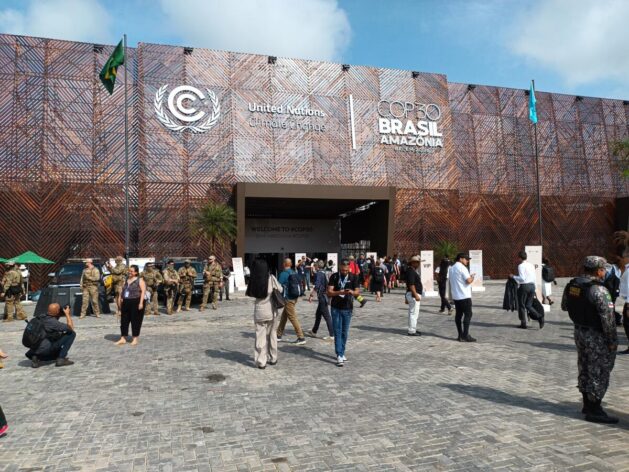
Entrance to the Hangar Convention Center of the Amazonia in the northeastern Brazilian city of Belém. The climate summit, which began on November 10 and is due to conclude on Friday the 21st, is debating issues such as the phase-out of fossil fuels and adaptation goals. Credit: Emilio Godoy / IPS
BELÉM, Brazil, Nov 20 2025 (IPS) – The heat in the Hangar Convention Center of the Amazonia, in the northeastern Brazilian city of Belém, has reached the negotiation rooms of the climate summit. Over the past 72 hours, one of the most delicate and significant discussions of this climate meeting has been taking place: the path to progressively abandon the production and use of coal, gas, and oil.
In recent hours, a global coalition of rich and developing countries, led by Colombia, has doubled down on pushing for a fossil fuel phase-out roadmap, while major producer countries resist it.
“The plan must have differentiated commitments, the elimination of fossil fuel subsidies, and the reform of the international financial system, because foreign debt payments are punishing us,” Colombian Environment Minister Irene Vélez explained to IPS.
For the official, the 30th United Nations Conference of the Parties (COP30) on climate change must result in a roadmap. “People are mobilizing, demanding climate action; we have to start now,” she urged.
In Belém, the gateway to the planet’s largest rainforest, it is no longer just about reducing emissions but about transforming the foundation of the energy system, thus acquiring a moral, political, and scientific urgency. What was initially meant to be the “Amazon COP” has mutated into the “end-of-the-fossil-era-COP,” but the roadmap to achieve it is a toss-up.
“The plan must have differentiated commitments, the elimination of fossil fuel subsidies, and the reform of the international financial system, because external debt payments are punishing us” –Irene Vélez.
Two years after the world agreed at COP28, held in 2023 in Dubai, to move away from fossil fuels, Belém is the moment of truth, upon which the effort to keep global warming below the 1.5° Celsius limit largely depends—a goal considered vital to avoid devastating and inevitable effects on ecosystems and human life.
Thus, the discussion among the 197 parties to the United Nations climate convention has shifted from the “what” to the “how,” and especially to the “when,” questions that have turned potential coordinates into a geopolitical labyrinth.
In that vein, a coalition of over 80 countries emerged on Tuesday the 18th to push the roadmap, including Colombia, Chile, Guatemala, and Panama among the Latin American countries.
One challenge for the roadmap advocates is that the issue is not explicitly part of the main agenda, a resource that the Brazilian presidency of COP30 could use to shirk responsibility on the matter.
The issue appears on the thematic menu of COP30, which started on the 10th and is scheduled to conclude on the 21st, and whose official objectives include approving the Global Goal on Adaptation to climate change and securing sufficient funds for that adaptation.
Approximately 40,000 people are attending this climate summit, including government representatives, multilateral agencies, academia, and civil society organizations.
An unprecedented indigenous presence is also in attendance, with about 900 delegates from native peoples, drawn by the ancestral call of the Amazon, a symbol of the menu of solutions to the climate catastrophe and simultaneously a victim of its causes.
Also present and very active in Belém are about 1,600 lobbyists from the hydrocarbon industry, 12% more than at the 2024 COP, according to the international coalition Kick Big Polluters Out.
The clamor from civil society demands an institutional structure with governance, clear criteria, measurable objectives, and justice mechanisms.
“The roadmap has become a difficult issue to ignore; it is already at the center of these negotiations, and no country can ignore it. The breadth of support is surprising, with rich and poor countries, producers and non-producers, indicating that an agreement is about to fall,” Antonio Hill, Just Transitions advisor for the non-governmental and international Natural Resource Governance Institute, told IPS.
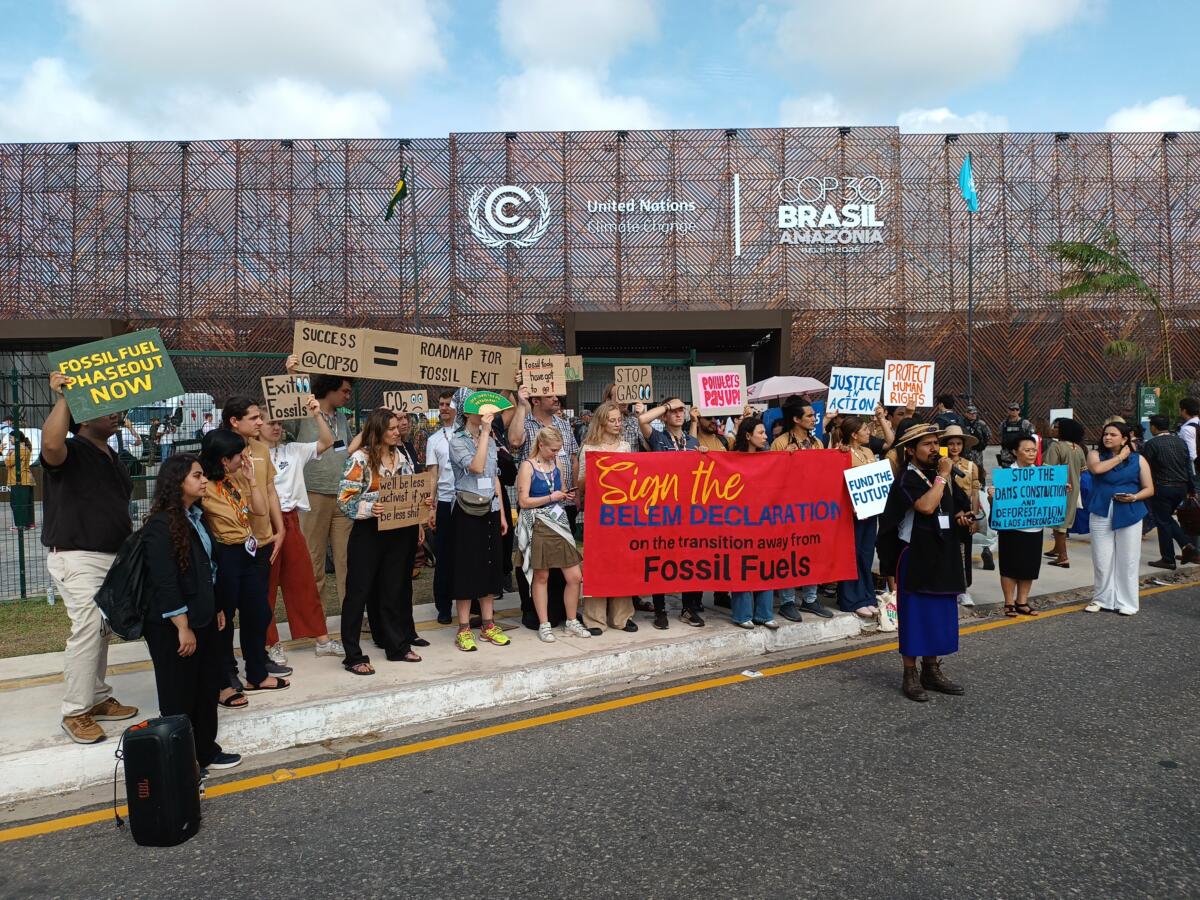
Activists protest on Wednesday the 19th against fossil fuel exploitation at the entrance to the venue of the Belém climate summit, in the Amazonian northeast of Brazil. Credit: Emilio Godoy / IPS
Poisoned
The push for the roadmap comes from the Fossil Fuel Non-Proliferation Treaty, promoted by civil society organizations, strongly adopted by Colombia, and which so far has the support of 18 nations, but no hydrocarbon-producing Latin American country, such as Argentina, Brazil, Ecuador, Mexico, or Venezuela.
Colombia, despite also being a producer and exporter of fossil fuels, has presented its Roadmap for a Just Energy Transition, with which it seeks to replace income from coal and oil with investments in tourism and renewable energy.
Colombia’s 2022-2052 National Energy Plan projects long-term reductions in fossil fuel production. The country announced US$14.5 billion for the energy transition to less polluting forms of energy production.
But for the rest of the region, the duality between maintaining fossil fuels and promoting renewable energies persists.
A prime example of this duality is the COP30 host country itself, Brazil. While the host President, Luiz Inácio Lula da Silva, and his Minister of Environment and Climate Change, Marina Silva, have insisted on the need to abandon fossil fuels, the government is promoting expansive oil and gas extraction plans.
In fact, just weeks before the opening of COP30, the state-owned oil group Petrobras received a permit for oil exploration in the Atlantic, just kilometers from the mouth of the Amazon River.
But Lula and his team committed that this summit in the heart of the Amazon would be “the COP of truth” and “the COP of implementation,” and the issue of fossil fuels has become central to the negotiations, which Lula joined on Wednesday the 19th to give a push to the talks and the outcomes.
In their Nationally Determined Contributions (NDCs)—the set of mitigation and adaptation policies countries must present to comply with the Paris Agreement on climate change signed in 2015 at COP21—Argentina, Brazil, Mexico, or Chile avoid mentioning a managed phase-out of fossil fuels.
Simply put, they argue they cannot let go of the old vine before grasping the new one. This stance also involves a delicate aspect, as nations like Ecuador depend on revenues from hydrocarbon exploitation.
Therefore, the Global South has insisted on its demand for funding from rich nations, due to their contribution to the climate disaster through fossil fuel exploitation since the 17th century.
The result of the presented policies is alarming: although many countries have increased their emission reduction targets on paper, they lack details on phasing out production. The only existing roadmap is the growing extractive one.
In fact, the Global Stocktake of the Paris Agreement process, originating from COP28, demanded that countries take measures to move towards a fossil-free era.
The argument is unequivocal: various estimates indicate that fossil fuels contribute 86% of greenhouse gas emissions, the cause of global warming.
But a key point is where to start. For Uitoto indigenous leader Fanny Kuiru Castro, the new general coordinator of the Coordinator of Indigenous Organizations of the Amazon Basin –which brings together the more than 350 native peoples of the eight countries sharing the biome–, the starting point must precisely be at-risk regions like the Amazon.
“It is a priority. If there isn’t a clear signal that we must proceed gradually, it means the summit has failed and does not want to adopt that commitment. We will have another 30 years of speeches,” she told IPS, alluding to that number of summits without substantial results.
In the Amazon, oil blocks threaten 31 million hectares or 12% of the total area, mining threatens 9.8 million, and timber concessions threaten 2.4 million.
And in that direction, a major obstacle arises: how to finance the phase-out. The roadmap has a direct link to the financial goals aimed at the Global South, with a demand for US$1.2 trillion in funding for climate action starting in 2035.
“Can the COP deliver the financial backing that countries need to reinvent their economies in time to guarantee just and inclusive development?” Hill questioned.
The atmosphere in Belém is of a different urgency compared to Dubai or Baku, where COP29 was held a year ago. The roadmap to a world free of fossil fuel smoke remains a blurry map, drawn freehand on ground that is heating up far too quickly.
In Belém, humanity is deciding whether to brake gradually or to accelerate, with the air conditioning on and a full tank.
As climate leaders gather in the Amazon, the world’s green transformation is speaking with a southern accent—powered by markets, technology, and a new economic logic.
Belém—30th Conference of the Parties (COP30). Credit: Antônio Scorza/COP30
OSLO, Norway, Nov 11 2025 (IPS) – When world leaders now gather in Belém, Brazil for the UN climate conference, expectations will be modest. Few believe the meeting will produce any breakthroughs. The United States is retreating from climate engagement. Europe is distracted. The UN is struggling to keep relevant in the 21st century.
But step outside the negotiation tents, and a different story unfolds—one of quiet revolutions, technological leaps, and a new geography of leadership. The green transformation of the world is no longer being designed in Western capitals. It is being built, at scale, in the Global South.
Ten years ago, anyone seeking inspiration on climate policy went to Brussels, Berlin or Paris. Today, you go to Beijing, Delhi or Jakarta. The center of gravity has shifted. China and India are now the twin engines of the global green economy, with Brazil, Vietnam and Indonesia closely behind.
Erik Solheim
This is not about rhetoric; it is about results. China accounts for roughly 60 percent of global capacity in solar, wind, and hydropower manufacturing. It dominates in electric vehicles, batteries, and high-speed rail. China’s 93 GW installation of solar in May 2025 is a historic high and exceeds the monthly or short‐term installation levels of any other country to date.
China has made the green transition its biggest business opportunity, turning green action into jobs, prosperity and global leadership. China is now making more money from exporting green technology than America makes from exporting fossil fuels.
India, too, is reshaping what green development looks like. I was in Andhra Pradesh last month, when I visited a wonderful six-gigawatt integrated energy park—solar, wind, and pumped storage. It delivers round-the-clock clean power. There is nothing like that in the West. In another state, Tamil Nadu, an ecotourism circuit is protecting mangroves and marine ecosystems while creating local jobs in tourism. The western state of Gujarat, long a laboratory for industrial innovation, has committed to 100 gigawatts of renewables by 2030, with the captains of Indian business – Adani and Reliance – driving large-scale solar and wind investments with the state government.
These are not pilot projects. They are national strategies. And they are succeeding because the economics have flipped.
The cost of solar power has fallen by over 90 percent in the last decade, largely thanks to the intense competition between Chinese solar companies. Battery storage is now competitive with fossil fuels. What was once an environmental aspiration has become a financial inevitability. In Indian Gujarat, solar-plus-storage projects are already cheaper than coal. Switching to clean energy is no longer a cost—it is a saving.
That is why climate action today is driven not by diplomacy, but by economics. The question is no longer if countries will go green, but who will own the technologies and industries that make it possible.
Europe, long the moral voice of the climate agenda, now risks losing the industrial race. After years of blocking imports from developing countries on grounds of “inferior” green quality, it now complains that Chinese electric vehicles are too good— too cheap and too efficient. Europe cannot have it both ways. The world cannot build a green transition behind protectionist walls. The markets must open to the best technologies, wherever they are made.
President Luiz Inácio Lula da Silva of Brazil understands this new reality. That is why he chose Belém, deep in the Amazon, as the site for climate talks. The location itself is a statement: the future of climate policy lies in protecting the rainforests and empowering the people who live within them.
Forests are not just carbon sinks; they are living economies. When I was Norway’s environment minister, we partnered with Brazil and Indonesia to reward them for reducing deforestation. Later, Guyana joined our effort—a small South American nation where nearly the entire population is of Indian or African origin.
Guyana has since turned conservation into currency. Under its jurisdictional REDD+ programme, the country now sells verified carbon credits through the global aviation market known as CORSIA. In the third quarter of this year, these credits traded at USD 22.55 per tonne of CO₂ equivalent, with around one million credits sold through a procurement event led by IATA and Mercuria.
The proceeds go directly to forest communities—building schools, improving digital access, and funding small enterprises. It is proof that the carbon market can deliver real value when tied to real lives. You cannot protect nature against the will of local people. You can only protect it with them. Last year in Guyana, I watched children play soccer and cricket beneath the jungle canopy—a glimpse of life thriving in harmony with the forest, not at its expense.
That, ultimately, is what Belém should represent: not another round of procedural debates, but a vision for linking markets, nature and livelihoods.
The Global South has also sidestepped one of the West’s greatest political failures: climate denial. In India, there is no major political party—or public figure, cricket star or Bollywood artist—questioning the reality of climate change. Leaders may differ on ideology, but not on this. Across Asia, from China to Indonesia, climate action unites rather than divides. Because here, ecology and economy move together.
Prime Minister Narendra Modi of India puts it simply: by going green, we also go prosperous. President Xi Jinping of China and President Lula of Brazil share that same message—a vision that draws people in, instead of lecturing them. It is this integration of growth and sustainability that explains why the Global South is moving faster than most of the developed world.
None of this means diplomacy is irrelevant. The UN still matters. But its institutions must evolve to reflect the realities of the 21st century. The Security Council, frozen in 1945, still excludes India and Africa from permanent membership. Without reform, multilateralism risks losing its meaning.
Yet, while negotiations stall, transformation continues. From solar parks in Gujarat to high-speed rail across China, from mangrove tourism in Tamil Nadu to carbon markets in Guyana—climate leadership is happening in real economies, not in press releases.
Belém will not deliver a grand agreement. But it doesn’t need to. The world is already moving—faster than our diplomats.
The story of Belem will not be written in communiqués, but in kilowatts, credits, and communities.
The real climate leaders are no longer in Washington or Brussels.
They are in Beijing, Delhi, São Paulo, and Georgetown.
The future of climate action is already here.
It just speaks with a southern accent.
The author is the former Executive Director of the United Nations Environment Programme and Norway’s Minister for Environment and International Development.
As climate leaders gather in the Amazon, the world’s green transformation is speaking with a southern accent—powered by markets, technology, and a new economic logic.
Belém—30th Conference of the Parties (COP30). Credit: Antônio Scorza/COP30
OSLO, Norway, Nov 11 2025 (IPS) – When world leaders now gather in Belém, Brazil for the UN climate conference, expectations will be modest. Few believe the meeting will produce any breakthroughs. The United States is retreating from climate engagement. Europe is distracted. The UN is struggling to keep relevant in the 21st century.
But step outside the negotiation tents, and a different story unfolds—one of quiet revolutions, technological leaps, and a new geography of leadership. The green transformation of the world is no longer being designed in Western capitals. It is being built, at scale, in the Global South.
Ten years ago, anyone seeking inspiration on climate policy went to Brussels, Berlin or Paris. Today, you go to Beijing, Delhi or Jakarta. The center of gravity has shifted. China and India are now the twin engines of the global green economy, with Brazil, Vietnam and Indonesia closely behind.
Erik Solheim
This is not about rhetoric; it is about results. China accounts for roughly 60 percent of global capacity in solar, wind, and hydropower manufacturing. It dominates in electric vehicles, batteries, and high-speed rail. China’s 93 GW installation of solar in May 2025 is a historic high and exceeds the monthly or short‐term installation levels of any other country to date.
China has made the green transition its biggest business opportunity, turning green action into jobs, prosperity and global leadership. China is now making more money from exporting green technology than America makes from exporting fossil fuels.
India, too, is reshaping what green development looks like. I was in Andhra Pradesh last month, when I visited a wonderful six-gigawatt integrated energy park—solar, wind, and pumped storage. It delivers round-the-clock clean power. There is nothing like that in the West. In another state, Tamil Nadu, an ecotourism circuit is protecting mangroves and marine ecosystems while creating local jobs in tourism. The western state of Gujarat, long a laboratory for industrial innovation, has committed to 100 gigawatts of renewables by 2030, with the captains of Indian business – Adani and Reliance – driving large-scale solar and wind investments with the state government.
These are not pilot projects. They are national strategies. And they are succeeding because the economics have flipped.
The cost of solar power has fallen by over 90 percent in the last decade, largely thanks to the intense competition between Chinese solar companies. Battery storage is now competitive with fossil fuels. What was once an environmental aspiration has become a financial inevitability. In Indian Gujarat, solar-plus-storage projects are already cheaper than coal. Switching to clean energy is no longer a cost—it is a saving.
That is why climate action today is driven not by diplomacy, but by economics. The question is no longer if countries will go green, but who will own the technologies and industries that make it possible.
Europe, long the moral voice of the climate agenda, now risks losing the industrial race. After years of blocking imports from developing countries on grounds of “inferior” green quality, it now complains that Chinese electric vehicles are too good— too cheap and too efficient. Europe cannot have it both ways. The world cannot build a green transition behind protectionist walls. The markets must open to the best technologies, wherever they are made.
President Luiz Inácio Lula da Silva of Brazil understands this new reality. That is why he chose Belém, deep in the Amazon, as the site for climate talks. The location itself is a statement: the future of climate policy lies in protecting the rainforests and empowering the people who live within them.
Forests are not just carbon sinks; they are living economies. When I was Norway’s environment minister, we partnered with Brazil and Indonesia to reward them for reducing deforestation. Later, Guyana joined our effort—a small South American nation where nearly the entire population is of Indian or African origin.
Guyana has since turned conservation into currency. Under its jurisdictional REDD+ programme, the country now sells verified carbon credits through the global aviation market known as CORSIA. In the third quarter of this year, these credits traded at USD 22.55 per tonne of CO₂ equivalent, with around one million credits sold through a procurement event led by IATA and Mercuria.
The proceeds go directly to forest communities—building schools, improving digital access, and funding small enterprises. It is proof that the carbon market can deliver real value when tied to real lives. You cannot protect nature against the will of local people. You can only protect it with them. Last year in Guyana, I watched children play soccer and cricket beneath the jungle canopy—a glimpse of life thriving in harmony with the forest, not at its expense.
That, ultimately, is what Belém should represent: not another round of procedural debates, but a vision for linking markets, nature and livelihoods.
The Global South has also sidestepped one of the West’s greatest political failures: climate denial. In India, there is no major political party—or public figure, cricket star or Bollywood artist—questioning the reality of climate change. Leaders may differ on ideology, but not on this. Across Asia, from China to Indonesia, climate action unites rather than divides. Because here, ecology and economy move together.
Prime Minister Narendra Modi of India puts it simply: by going green, we also go prosperous. President Xi Jinping of China and President Lula of Brazil share that same message—a vision that draws people in, instead of lecturing them. It is this integration of growth and sustainability that explains why the Global South is moving faster than most of the developed world.
None of this means diplomacy is irrelevant. The UN still matters. But its institutions must evolve to reflect the realities of the 21st century. The Security Council, frozen in 1945, still excludes India and Africa from permanent membership. Without reform, multilateralism risks losing its meaning.
Yet, while negotiations stall, transformation continues. From solar parks in Gujarat to high-speed rail across China, from mangrove tourism in Tamil Nadu to carbon markets in Guyana—climate leadership is happening in real economies, not in press releases.
Belém will not deliver a grand agreement. But it doesn’t need to. The world is already moving—faster than our diplomats.
The story of Belem will not be written in communiqués, but in kilowatts, credits, and communities.
The real climate leaders are no longer in Washington or Brussels.
They are in Beijing, Delhi, São Paulo, and Georgetown.
The future of climate action is already here.
It just speaks with a southern accent.
The author is the former Executive Director of the United Nations Environment Programme and Norway’s Minister for Environment and International Development.
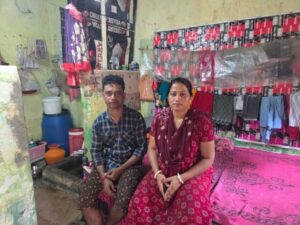
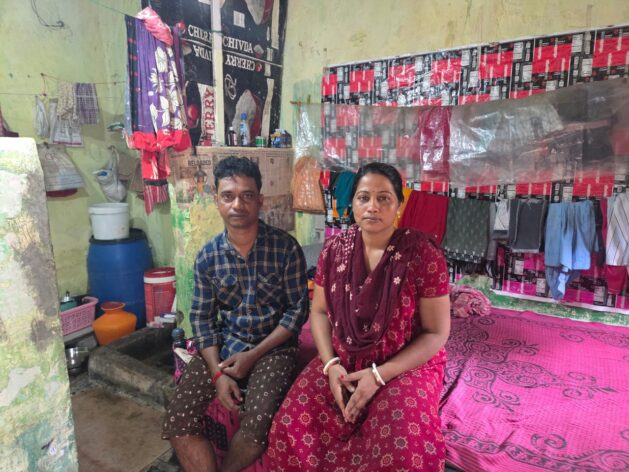
Bapi Mondal and his wife Shanti in Bangalore. Climate change has forced the couple from their traditional livelihoods in the Sundarbans. Credit: Diwash Gahatraj/IPS
BANGALORE & PAKHIRALAY, India, Oct 15 2025 (IPS) – Bapi Mondal’s morning routine in Bangalore is a world away from his ancestral village, Pakhiralay, in the Sundarbans, West Bengal. He wakes before dawn, navigates heavy traffic, and spends eight long hours molding plastic battery casings. It’s not the life his honey-gathering forefathers knew, but factors like extreme storms, rising seas, and deadly soil salinity forced the 40-year-old to abandon centuries of family tradition and travel miles away to work in a concrete suburban factory.
Bapi still remembers his traditional skills—walking through a mangrove forest to find a tree with a honeycomb, mending boats and fishing nets, and singing and acting in the traditional plays. His 19-year-old son, Subhodeep—working alongside in the factory—has lost the heritage.
Bapi’s home, the Sundarbans—the world’s largest mangrove forest—is on the frontlines of climate change, and local livelihoods are taking the hit. In this watery maze where land and sea meet, villagers who once relied on fishing, honey collection and farming are now grappling with rising tides, saltier water, and more frequent storms. For many, life is becoming a struggle to hold on to centuries-old ways.
Sea levels in the Sundarbans are rising nearly twice the global rate, flooding villages and forcing families out. Saltwater ruins rice fields and ponds, making farming and fishing harder. Mawalis, the honey gatherers, also struggle as climate change disrupts flowering and damages mangroves, reducing wild bee populations.
A fisherman in the Sundarbans. Credit: Diwash Gahatraj/IPS
The crisis doesn’t end with the water. Salinity, once held at bay by freshwater flows, is climbing year after year, disrupting both fishing and farming. Pollution, ill-managed embankments, and overexploitation of resources add to the challenge. As incomes shrink and lands disappear, thousands leave for nearby cities, hoping for work but often finding only life in urban slums.
City life is unforgiving for migrants like Mondal. He spends eight grueling hours on his feet, molding battery casings six days a week in harsh factory conditions. At the end of each day, he returns to a small one-room apartment. He shares this space with his wife Shanti and son, Subhodeep. The family struggles financially. Bapi earns ₹19,000 per month (about USD 215)—barely enough to get by. Despite the hardships, he says the work is still his choice.
“A hard choice, but a choice,” he explains.
Morning rush is hectic for the Mondal family. He points to the wall clock and asks his wife to pack lunch quickly. “All three of us work in different factories in the area,” Mondal says. “We all have to reach work by 8 am.”
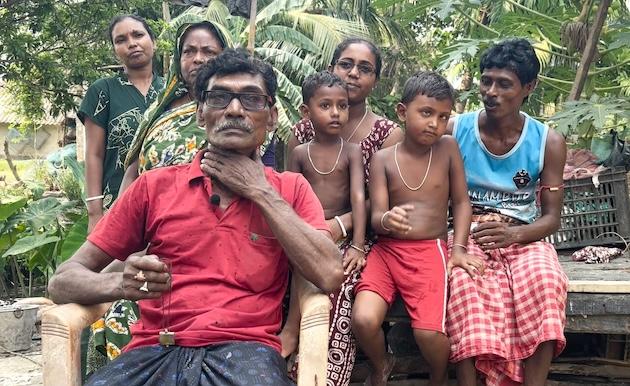
Gopal Mondal and his family in the Sundarbans. Gopal still ventures into the forests to collect wild honey. Credit: Diwash Gahatraj/IPS
Shanti, Bapi’s wife, spends her days at a garment factory pressing clothes with a hot iron. She works eight-hour shifts with just one weekly break, earning ₹15,000 per month (about USD 169). Their 19-year-old son, Subhodeep, has also joined his father at the plastic factory. All three now work in Bommasandra, Bangalore’s industrial belt, pooling their wages to survive.
The migration has split their family apart.
“We have an 11-year-old daughter who lives with my in-laws in the Sundarbans,” Shanti explains. The cost of city life forced them to leave their youngest child behind. “It breaks my heart to be apart from my daughter, but we want her to have a good education and life—that’s why we sacrifice,” says Shanti. Her daughter attends school back in the village.
Her job gave her economic independence and a voice in family decisions, like building their new house. Bapi’s family, rooted in the village for centuries, were Mawalis, honey gatherers who knew the forest through knowledge passed down generations.
Still Rooted
Bapi’s father, Gopal Mondal, still ventures into the dangerous forests of Sunderbans. He risks tiger attacks and deadly cyclones to collect wild honey. But the forest that once fed families is now failing them.
Climate change has disrupted everything. Cyclones strike more often and with greater force. The natural flowering cycle has gone haywire. Fish populations in the waters have crashed.
“The honey harvest keeps shrinking and prices keep falling,” Gopal explains.
As Gopal tried to hold on to tradition, his son Bapi could no longer see a future in the same waters and forests.
“The forest no longer provides enough honey or fish,” Bapi shares. The rhythms his ancestors lived by for centuries suddenly made no sense. Faced with shrinking opportunities, Bapi tried other work back home. Besides going to the jungle for honey with his father during the season (April-May), he operated a van gaari—a battery-powered three-wheeler with a wooden platform for passengers. But even that barely paid enough to survive. “There was a time when I struggled to buy a saree for my wife,” he recalls. Migration was the only choice left.
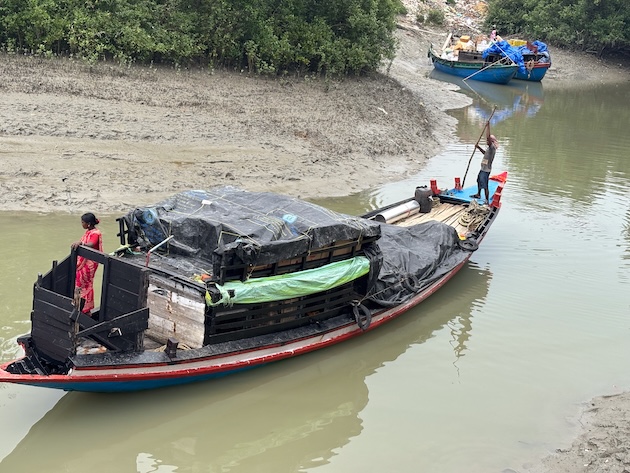
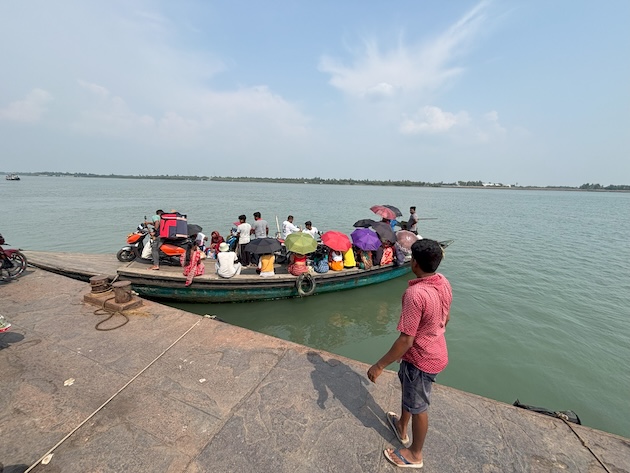
A boat ferries passengers in Sundarbans. Credit: Diwash Gahatraj/IPS
From Forests to Factories
Apart from forced migration, climate change erodes memory, identity, and ancestral knowledge. Leaving the Sundarbans has cost the family more than a homeland.
Bapi still carries traditional skills—navigating treacherous waters by boat and collecting honey deep in the forest.
“I know how to catch shrimp and crabs from the river and sea,” he says. “My father and uncles taught me these skills when I was young.”
His wife, Shanti, nods, adding that she was an expert crab and shrimp collector back in the Sundarbans. “I think I still have it in me,” she says with quiet pride.
But the chain of knowledge is breaking. “I could not pass on that wisdom to my son,” Bapi admits with regret.
Subhodeep represents this lost generation. He finished tenth grade and left his village to join his parents in Bangalore. He has not learned the skills that defined his family for generations. “I have never entered the forest to collect honey or fish back in the village,” Subhodeep explains. “My parents were against it.”
Bon bibi temple in Pakhiralay village. Along with losing traditional livelihoods, religion and cultural life are also in jeopardy. Credit: Diwash Gahatraj/IPS
The irony is stark. Bapi’s parents encouraged him to learn these ancestral skills. But when environmental collapse made these traditions dangerous and unprofitable, Bapi chose to shield his son from them.
For the Mondals, the forest has become too dangerous and unreliable.
“Going to collect honey or catch fish is very unpredictable now,” Bapi explains. Catch volumes have fallen, and tiger attacks have grown. Bapi’s family knows the risk; his grandfather was killed while gathering honey in the forest.
Years earlier, a tiger also attacked Gopal Mondal. He was luckier—he escaped alive but still carries scars on his hand.
These brutal realities shaped Bapi’s decision about his son’s future. “I don’t want my next generation to have such a risky occupation,” he says. The choice is clear. Families can either cling to dangerous traditions that no longer pay enough to survive or abandon their ancestral practices for safer work in distant cities.
Are there other reasons behind the changes in the Sundarbans?
“We can’t just blame climate change and ignore human activities making things worse,” says Professor Tuhin Ghosh of Jadavpur University’s School of Oceanographic Studies. Human activity and climate change create a deadly combination.
People cleared mangroves for farms and fish ponds and built embankments that blocked tidal flows. The result is salt contamination, poisoned soil and water, vanishing species, and a broken landscape.
Uninhabitable Home
About 4.5 million people live across the Sundarbans region in Bangladesh and India. A recent survey reveals the massive scale of climate migration: nearly 59% of households have at least one family member who has moved away for work.
Some studies report 60,000 people migrated from parts of the Sundarbans by 2018. But household surveys show much higher rates because they measure affected families, not just individuals.
These local figures reflect a much bigger crisis. Across Bangladesh, weather-related disasters displaced 7.1 million people in 2022 alone, showing how climate change drives mass movement.
On the Indian side in West Bengal, researchers document large seasonal and permanent migration flows to cities and other states. Families routinely send members to work elsewhere, though official counts are scarce.
Loss Beyond Dollars
Over the past two decades, the Sundarbans has been hit by cyclones made stronger by climate change. They uprooted thousands and caused millions in losses. But beyond disaster relief and migration, a quieter crisis unfolds: the erosion of centuries-old ecological wisdom, culture, and tradition.
Gopal Mondal, in his early sixties, sits outside his modest home in Pakhiralay. When asked about protective equipment for his dangerous work collecting honey in the Sundarbans forest, he holds up a small amulet—a tabeej.
“This and my prayers to Bon Bibi are my protection,” says Mondal, who leads a team of honey collectors into the mangrove forests. “They shield us from storms and babu (tigers).”
The elderly collector recites mantras passed down through generations—teachings from his father or cousins, though he cannot recall exactly who taught him.
“The whole community worships Bon Bibi,” he explains simply
For Sundarbans communities like Mondal’s, Bon Bibi—the “Lady of the Forest”—is a guardian of the mangroves. For centuries, fishermen, honey collectors, and wood gatherers have sought her protection in tiger territory and cyclone-prone waters. Her worship is more than faith; it reflects the people’s bond with a dangerous yet life-sustaining environment, offering both comfort and identity where safety tools are scarce.
When asked about traditional knowledge slipping away from his family, Mondal’s weathered face shows a faint smile.
“Earlier, every fisherman’s family had someone —a son or grandson—who knew how to repair torn nets or mend boats,” he explains. “But in my family, things are slowly changing. My grandsons and sons live too far away, and their visits home are too short to learn these skills.”
The honey collector pauses, watching the distant mangroves. “The younger generation shows very little interest in our profession,” he adds quietly.
Climate migration expert M. Zakir Hossain Khan of Change Initiative, a Bangladesh-based think tank focused on solving critical global challenges, warns that climate-driven displacement from the Sundarbans is destroying centuries-old ways of life that depend entirely on deep knowledge of the forest and rivers.
Fishermen carry rare knowledge of tides, breeding cycles, and mangrove routes, passed down through years of practice. With youth leaving for city jobs, few inherit it. Honey gatherers know how to find hives, protect bees, and survive in tiger territory. As young people turn away, honey collection is fading from the Sundarbans.
A Vanishing Heritage
This generational shift reflects a broader transformation across the Sundarbans. Traditional skills that once defined coastal communities—net weaving, boat building, reading weather patterns, and forest navigation—are disappearing as young people migrate to cities primarily for employment and a few for education.
“Similarly, mangrove-based handicrafts and boat-making using leaves, bamboo, and mangrove wood to make mats, roofing materials, and small boats demand both ecological understanding and artisanal skill, which are now rarely passed down,” comments Khan from Change Initiative.
He adds that herbal medicine and spiritual rituals practiced by local healers using plants like sundari bark and hental are also at risk, as migration and urbanization erode the cultural setting that sustains them.
Culture at Crossroads
Ghosh, who has spent over 30 years working in the Sundarbans, points to a troubling pattern.
“Migration is killing our folk arts,” he says. “Bonbibi stories, jatra pala theater, fishermen’s songs—they’re all disappearing. The people who used to perform during festivals are getting old. And there’s no one to replace them.”
The Sundarbans face a cultural crisis. Traditional performances that once brought villages together during religious festivals now struggle to find performers. Young people who might have learned these arts from their elders are instead leaving for cities for a better life
Once central to life in the Sundarbans, folk traditions like Jatra Pala, Bonbibi tales, and fishermen’s songs now fade with their aging performers. With few young apprentices, a rich cultural heritage risks disappearing—leaving behind a region not just economically changed, but culturally empty.
Note: This story was produced with support from Internews’ Earth Journalism Network