South Korea’s Women Fire Back

Civil Society, Featured, Gender, Gender Violence, Global, Headlines, Human Rights, IPS UN: Inside the Glasshouse, Poverty & SDGs, TerraViva United Nations, Women’s Health
Opinion

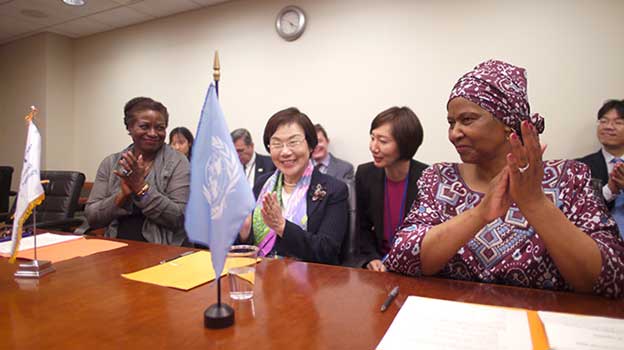
UNFPA Executive Director Dr. Natalia Kanem, KOICA President Lee Mikyung and UN Women Executive Director Phumzile Mlambo-Ngcuka (from left) launched a partnership in 2018 that Ms. Lee characterized as “a key foundation and platform for solidarity and collective engagement for gender equality.” The new tripartite agreement– between UNFPA, the Korea International Cooperation Agency (KOICA) and UN Women—has combined the strengths of the three partners to improve the lives of women and girls and accelerate the achievement of gender equality, as expressed in Sustainable Development Goal (SDG) 5.
Credit: UNFPA/Tara Milutis

SEOUL, South Korea, Sep 1 2021 (IPS) – A strong movement of feminism is sweeping South Korea. While women feel empowered to stand their ground, the men are retaliating.

When South Korean archer An San won two gold medals in just two days during the recent Tokyo Olympics, the response the 20-year-old received at home was a mixed. Some men were angered and said her medals should be taken away. Why? Because her short hair was a sign that she was a ‘man-hating’ feminist.


As bizarre and surreal as it may sound, the attack on An is a bleak reminder of the deep-rooted gender stereotypes in the economically advanced, yet deeply sexist South Korea – and the enormous pressure on women and girls to look and act ‘feminine’. It’s also another episode of the escalating culture war between the country’s increasingly outspoken feminists – and antifeminists seeking to silence their voices.

Lowest in the ranks

South Korea is the world’s 10th largest economy, a tech giant that is home to Samsung, the world’s largest smartphone maker, and a cultural powerhouse whose K-pop stars like BTS enjoy global followings. But despite all the economic and technological advances, the deep-seated patriarchy and gender discrimination remained little changed.

South Korea is ranked at the 102nd in the world in terms of gender parity, according to the World Economic Forum. The gender pay gap in the country is the widest among the advanced economies of the OECD member nations.

It has consistently ranked as the worst place to be a working woman in the Economist magazine’s Glass Ceiling Index. Women account for 19 per cent of parliamentary seats, almost on par with North Korea.

Hawon Jung

Women are under enormous pressure to look perfect at all times and all costs – as shown in the country’s reputation as the world’s capital of plastic surgery. On the busy streets of Seoul, it’s not difficult to find plastic surgery adverts screaming ‘being pretty is everything!’ and rail-thin K-pop starlets presented as role models for teenage girls and young women. The stars’ extreme diet regimens are widely shared on social media and avidly followed by many.

Typical beauty ideals in South Korea for women include pale yet glowing skin, a youthful ‘babyface’, long and luminous hair, wide eyes, a thin nose, and pin-thin body (nearly 17 per cent of South Korean women in their 20s are underweight, compared to less than 5 per cent for their male counterparts, according to a study in 2019).

The pressure begins early: more than 40 per cent of female elementary school students wear makeup, and the number goes up to over 70 per cent for middle schoolers.

Escape the Corset

But women started to fight back. A powerful wave of feminist movement has taken the country by storm in recent years, allowing many women to speak up against sexual discrimination, assault, and objectification like never before.

Since 2018, women have rallied together to bring down many sexual predators, including a popular presidential contender, in one of the most successful cases of #MeToo in Asia.

Tens of thousands took to the streets for months in 2018 to call for tougher crackdown on the so-called ‘spycam porn’ crimes that secretly film women in public space from workplaces to public toilets and share the footage on the internet.

They successfully campaigned to end the abortion ban. The so-called ‘Escape the Corset’ movement was part of that awakening, meant to defy the pressure to follow the rigid beauty ideals.

Women and girls who joined the campaign cut their hair short, destroyed their makeup, refused to wear tight, revealing, or uncomfortable clothes to instead opt for something more comfortable and practical. Since then, short hair has become something of a political statement among many young feminists.

The wave of awakening, however, has also drawn a strong pushback by men who thought – like many around the world – that the women had gone too far, and many labelled feminists as ‘man haters’ who should be punished.

More than 40 per cent of female elementary school students wear makeup, and the number goes up to over 70 per cent for middle schoolers.

The backlash has reached a fever pitch since May when members of many online forums popular among men started to cry ‘misandry’ over a adds that use an image of a pinching finger, a universal gesture to indicate something small.

Online crusade

In a campaign likened by many as a McCarthyian witch-hunt, they claimed whoever created the image must be feminists and out to ridicule the size of their genitals. Despite having no possibility of any political plot, many of the accused companies and government institutions – including the national police agency and the defense ministry – bent down quickly, apologized for hurting the men’s feelings and removed the images from their posters.

These online mobs even enjoyed political backing; Lee Jun-Seok, a young member of the rightwing People’s Power Party, rose to prominence by amplifying the conspiracy theory over the ‘misandrist’ finger gesture, and eventually became the leader of the party in July.

Feeling supported by a powerful politician and emboldened by groveling apologies from companies and the government, the online mobs moved on to their next target—the star Olympian whose appearance didn’t fit into their ideal of traditional femininity.

‘Why did you cut your hair?’ An was asked on her social media, to which she replied, ‘’coz it’s convenient’. The answer was not enough.

A campaign to extract an apology from An for being a feminist began, with some even demanding that the Korea Archery Association take away the gold medals from the ‘man hater’.

But women fought back again. Lawmakers, activists, entertainers, and thousands of ordinary women rallied behind An, many sharing the photos of their short hair on social media as a show of support.

And as the cyber-bullying targeting An raged on, many women across the country watched as An won yet another gold – becoming the first archer in Olympic history to win three golds at a single Game.

Hawon Jung is a journalist and former Seoul correspondent for the AFP news agency. She is the author of ‘Flowers of Fire,’ a book about South Korea’s #MeToo campaign.

Source: International Politics and Society (IPS), published by the Global and European Policy Unit of the Friedrich-Ebert-Stiftung, Hiroshimastrasse 28, D-10785 Berlin.
  Source

Beware UN Food Systems Summit Trojan Horse

Civil Society, Development & Aid, Economy & Trade, Environment, Financial Crisis, Food & Agriculture, Food Security and Nutrition, Food Sustainability, Global, Green Economy, Headlines, Inequity, Poverty & SDGs, Sustainability, TerraViva United Nations

Opinion

KUALA LUMPUR, Malaysia, Jul 26 2021 (IPS) – Undoubtedly, the world needs to reform existing food systems to better serve humanity and sustainable development. But the United Nations World Food Systems Summit (UNFSS) must be consistent with UN-led multilateralism.

For the first time ever, the World Economic Forum (WEF), a partnership of some of the world’s most powerful corporations, is partnering the UN in launching the Summit, now scheduled for September, with its ‘Pre-Summit’ beginning today.


Jomo Kwame Sundaram

Food insecurity is primarily due to inequalities and deprivations as victims lack the means to obtain the food they need. The UN should not serve those who cynically use hunger, starvation and deprivation to advance private commercial interests.

UN-led multilateralism threatened
The collapse of the Soviet Union, the end of the Cold War and seemingly unchallenged US dominance in the 1990s posed new threats to UN-led multilateralism. The World Trade Organization was set up in 1995 outside the UN system. Later, ‘recalcitrant’ Secretary-General (SG) Boutros-Ghali was blocked from a second term.

The four UN Development Decades from the 1960s ended with the lofty, Secretariat-drafted Millennium Declaration, bypassing Member State involvement. The Millennium Development Goals (MDGs) were then elaborated by the UN Development Programme with scant Member State consultation.

Growing corporate sway in the UN system got a big boost with the UN Global Compact. Such influences have affected governance of UN agencies, now better known as the World Health Organization struggles to contain the pandemic.

Difficult negotiations followed growing developing country disappointment with the MDGs, not delivering on climate finance as promised in 2009, and failure to better address the 2008 global financial crisis and its aftermath.

Hence, the negotiated Sustainable Development Goals (SDGs) compromise enjoys greater legitimacy than the MDGs. However, achieving Agenda 2030 was undermined from the outset as rich countries blocked needed funding at the third UN Financing for Development summit in mid-2015.

Summit bypasses UN processes
In the last dozen years after the 2008 world food price spike, the UN Committee on World Food Security (CFS) has become an inclusive forum for civil society and corporate interests to debate how best to advance food security. Unsurprisingly, CFS has long addressed food systems.

CFS’s High-Level Panel of Experts (HLPE) is widely acknowledged as competent, having prepared balanced and comprehensive reports on matters of current and likely future concern. In the UN system, CFS is now seen as a ‘multistakeholder’ engagement model for emulation. Yet, the Summit bypassed CFS from the outset.

Nominally answering to the UNSG, Summit processes have been largely set by a small, largely unaccountable coterie. UNFSS organisers initially moved ahead without representative stakeholder participation until his intervention led to some consultative processes.

Mainly funded by the WEF and some major partners, they remain mindful of who pays the piper. Hence, they mainly promote supposedly ‘game-changing’, ‘scalable’ and investment-inducing solutions claiming to offer technological fixes.

Agroecology innovation
An HLPE report has approvingly considered agroecology or ‘nature-based solutions’. Many scientists have been working with food producers for decades to increase food productivity, output, diversity and resilience through better agroecological practices, thus cutting costs and enhancing sustainability.

The evidence is unambiguous that agroecology has delivered far better results than ‘Green Revolution’ innovations. A survey of almost 300 large ecological agriculture projects in more than fifty poor countries reported rising farmer incomes due to lower costs and a 79% average productivity increase.

This contrasts with the record of the Alliance for a Green Revolution in Africa (AGRA) launched in 2006. With funding from the Gates and Rockefeller Foundations, it promised to double yields and incomes for 30 million smallholder farm households by 2020. Despite much government spending, yields hardly rose as rural poverty grew.

Agroecological innovations have proved effective against infestations. Thus, safer, more effective biopesticides that do not kill useful insects and microbes, and non-toxic alternatives to agrochemical pesticides have been created.

The UN Food and Agriculture Organization (FAO) hosted its first International Agroecology Symposium in 2014, before committing to ‘Scaling Up Agroecology’. But for Kip Tom, President Trump’s representative, FAO was no longer “science-based”.

Demonising agroecology
The Gates Foundation has been funding the Cornell Alliance for Science, ostensibly to “depolarize the GMO debates” by providing training in “advanced agricultural biotechnology communications”. Why traditional agricultural practices can’t transform African agriculture is only one instance of such sponsored propaganda masquerading as science.

Well-resourced lobbyists are using the UNFSS to secure support and legitimacy for commercial agendas. With abundant means, their advocacy routinely invokes ‘public-private partnerships’ and ‘science, technology and innovation’ rhetoric.

Forced to be more inclusive, Summit organisers are now using ‘solution clusters’ for advocacy. They then build broad ‘multi-stakeholder’ coalitions to advance purported solutions with the UNFSS mark of approval.

With strong and growing evidence of agroecology’s progress and potential, propaganda against it has grown in recent years. Agroecology advocates are caricatured as ‘Luddite eco-imperialists’, ‘Keeping Africa on the Brink of Starvation’, and condemning farmers to ‘poverty, malnutrition and death’.

A public relations consultant has accused agroecology advocates of being “the face of a ‘green’ neocolonialism” “idealizing peasant labour and retrograde subsistence farming” and denying “the Green Revolution’s successes”.

Agroecology solutions are the main, if not only ones consistent with the UN’s overarching commitment to sustainable development. But the propagandists portray them as uninformed barriers to agricultural and social progress. Such deliberate deceptions block needed food system reforms.

UN Special Rapporteur on the Right to Food Michael Fakhri alerted UNFSS Special Envoy Agnes Kalibata that agroecology is being dismissed as backward when it should be central to the Summit. Concurrently President of AGRA, with its particular commitment to needed food system reform, she is in an impossible position.

Best Summit money can buy?
Investing in the Summit is securing legitimacy and more resources from governments, the UN system, private philanthropy and others to further their commercial agendas. Meanwhile, many are working in good faith to make the most of the UN Summit.

Nevertheless, it is setting a dangerous precedent for the UN system. It has rashly opened a back door, allowing corporate-led ‘multi-stakeholderism’ to undermine well-tested, inclusive ‘multi-stakeholder’ arrangements developed over decades under multilateral Member State oversight.

UNFSS Science Days on 8 and 9 July indicated the Summit is being used to push for a new food science panel. This will undercut the HLPE, and ultimately, the CFS. Hence, the UNFSS seems like a Trojan Horse to advance particular corporate interests, inadvertently undermining what UN-led multilateralism has come to mean.

As both CFS and HLPE are successful UN institutions, the Summit will inevitably undermine its own achievements. Hence, for many Member States and civil society, UNFSS represents a step backward, rather than forward.

  Source

Stopping Marine Plastic Pollution: A Key IUCN Congress Goal

Civil Society, Climate Change, Conferences, Economy & Trade, Environment, Featured, Global, Headlines, Health, Natural Resources, Poverty & SDGs, Sustainability, TerraViva United Nations, Water & Sanitation

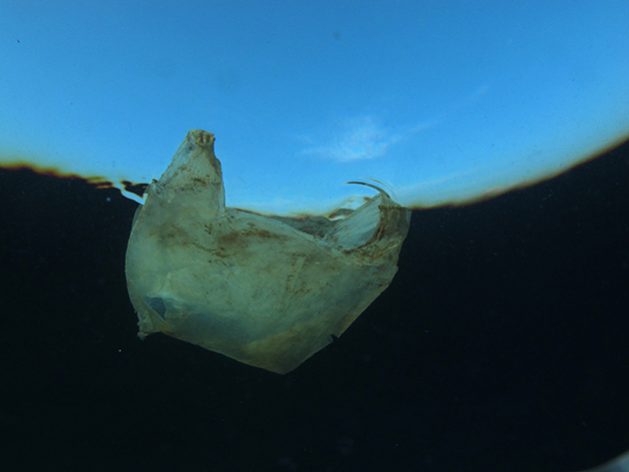
Plastic bags may remain intact for years in the marine environment. Plastic products certified to be industrially compostable are no solution for littering, as they do not degrade efficiently in the environment and continue to pose a threat to wildlife as they break down. Credit: Eleonora de Sabata / Clean Sea LIFE

St David’s, Wales, Jul 1 2021 (IPS) – Documented images of albatross chicks and marine turtles dying slow deaths from eating plastic bags and other waste are being seared into our consciences. And yet our mass pollution of Earth’s seas and oceans, fuelled by single-use plastics and throw-away consumerism, just gets worse.


Plastic debris is estimated to kill more than a million seabirds, 100,000 marine mammals and countless sea turtles every year. Plastics, with all their benefits and promises, have revolutionised societies and economies since their development in the 1950s, but now some 8 million tonnes end up in the oceans every year.

Waste plastic, making up to 80% of all marine debris from surface waters to deep-sea sediments, breaks down into micro-plastics which enter the digestive systems of sea and land animals and humans. Invisible plastic is in the water we drink, the salt we eat and the air we breathe. Experts are still working out the long-term impacts, such as cancer and impaired reproductive systems.

The fishing industry, nautical activities and aquaculture also leave a massive legacy in terms of ocean waste, poisoning and ensnaring sea life.

Hasna Moudud heads a small NGO in Bangladesh, working to protect coastal areas where vast rivers pour into the Indian Ocean, providing livelihoods and food for millions.

Her NGO, Coastal Area Resource Development and Management Association (Cardma), plants coastal trees, protects olive ridley sea turtles in a conservation hatchery in the Bay of Bengal, and helps women in cottage industries, using cane grass to make mats instead of plastic.

“Oceans are always neglected,” she tells IPS. “Small NGOs like myself take risks to save whatever we can of the fragile ecosystem that is left for our future generations.”

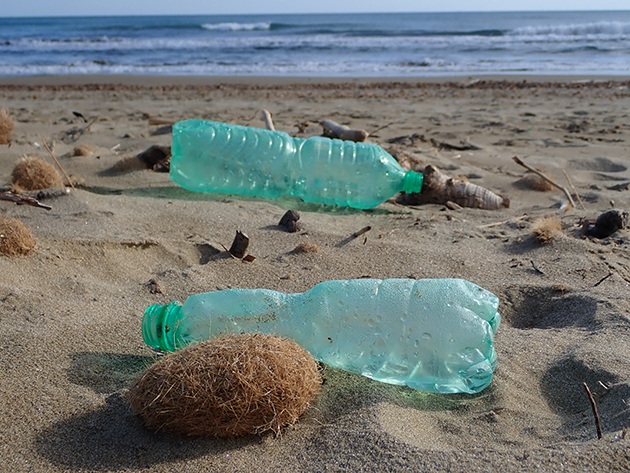
Plastic bottles and bottle caps are among the most frequent items found along Mediterranean shores. Credit: Eleonora de Sabata / Clean Sea LIFE

But to combine her NGO’s efforts with those of others, Moudud says she is “praying” to attend the IUCN World Conservation Congress 2020 in Marseille this September where government, civil society and indigenous peoples’ organisations from around the world will join discussions to set priorities and drive conservation and sustainable development action.

Meeting every four years – with this Congress delayed by the Covid pandemic – member organisations of the International Union for Conservation of Nature, vote on major issues to shape humanity’s response to the planet’s conservation crises. This particular Congress in Marseille is offering both in-person and virtual participation options, allowing those unable to make the trip to Marseille for the full Congress the opportunity to join discussions and provide their feedback.

Moudud’s NGO is a co-sponsor of Congress Motion 022: “Stopping the global plastic pollution crisis in marine environments by 2030.”

The broad resolution goes to the heart of the waste plastics issue. It notes that global production is due to increase by 40% over the next 15 years from current levels of around 300 million tonnes and that the world’s “predominant throwaway model” means that over 75% of the plastics ever produced to date are waste, “notably because the price of plastic on the market does not represent all of the costs of its lifecycle to nature or society”.

Recalling previous international efforts to set goals for ending marine plastic litter, the motion calls on the international community to reach a wide-ranging global agreement to combat marine plastic pollution. This would entail, among other measures, eliminating unnecessary plastic production, in particular single-use plastic waste; recycling and proper prevention of leakage into the environment; and public awareness campaigns.

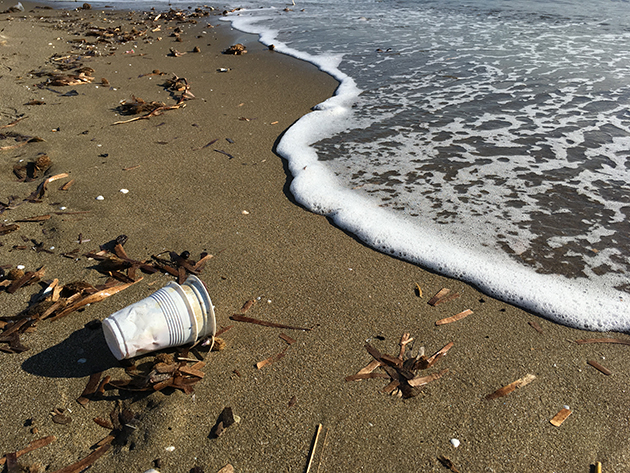
Sunlight, salt and pounding waves grind marine litter down to plastic grains. Credit: Eleonora de Sabata / Clean Sea LIFE

Activists say previous international efforts to curb plastic pollution have been toothless. Moudud is among many who want mandatory and enforceable measures, accusing big business of what she calls “manipulative practices through sponsorship and malpractice without helping build the natural world”.

“No one is looking or holding the polluters responsible,” she says, calling for a toughening up of the resolution. “I am deeply involved in everything IUCN does to help save the natural world and sustainable living.”

Steve Trott, project manager for IUCN-member Watamu Marine Association which is tackling plastic pollution in their Marine Protected Area in Kenya, says Motion 022 clearly sets out the threats posed by plastic waste to marine and coastal environments, economies and human health and well-being.

“Watamu Marine Association and EcoWorld Recycling based on the Kenya coast embrace the IUCN call for action,” Trott told IPS.

Pushing circular economy initiatives, their NGO has created dynamic plastic value chains through partnerships between the hotels industry and local communities, sponsoring beach clean-ups and collecting plastic waste for recycling. This provides a second source of income for community waste collectors while local artists are also up-cycling plastic waste.

Reflecting one of the main themes of IUCN’s membership structure bringing together civil society and indigenous peoples and government authorities, Trott says Watamu is following a “win-win model which can be replicated and up-scaled, sending out an ‘Act Local, Think Global’ message to inspire others”. He hopes to attend the Congress in Marseille if all goes well.

Single Use items are littering the world’s oceans. Credit: Eleonora de Sabata / Clean Sea LIFE

The Plastic Waste Makers index, a study by Australia’s Minderoo Foundation, identifies 20 companies producing more than half of all single-use plastic waste in the world. Some are state-owned and multinational corporations, whose plastic production is financed by major banks. The report notes that nearly 98% of single-use plastic is made from what is called virgin fossil fuels — plastic created without any recycled materials.

Single-use plastics explain why fossil fuel companies are ramping up their production as their two main markets of transport and electricity generation are being decarbonised. By 2050 plastic is expected to account for 5%-10% of global greenhouse gas emissions.

Humankind possesses unprecedented levels of knowledge but also the accompanying responsibility, knowing that oceans are in the poorest health since humans started exploiting them.

Single use plastics – and the estimated 130 million tonnes that are dumped each year around the world – have dominated studies and discussions on waste. Plastic bottles, food containers and wrappers, and single-use bags are the four most widespread items polluting the seas.

One element woven into similar narratives of how to tackle the world’s burning environmental issues – such as carbon emissions, species loss, and plastic waste – is the potential fix offered by technology. Motion 022 refers to the need for more investment in environmentally sound plastic waste collection, recycling and disposal systems as well as forms of recovery.

A study led by biologist Nikoleta Bellou at the Helmholtz-Zentrum Hereon institute focuses on inventive sea-cleaning solutions to date, including floating drones. But her paper suggests that it could take about a century to remove just 5% of plastics currently in the oceans using clean-up devices because plastic production and waste are accumulating so fast.

Activists welcome IUCN’s intervention on plastic waste pollution and the strong mandate a successful and unanimous motion can convey to governments and international institutions. But they also caution against taking too narrow an approach towards tackling marine pollution at the September 3-11 Congress.

Eleonora de Sabata, spokesperson for the Clean Sea Life project, co-funded by the European Union’s LIFE programme, told IPS that the narrative needs to shift away from single-use plastic to single-use everything. “Technology” has come up with so-called ‘bio’ plastics as a replacement for some plastics but only to create a whole suite of problems of their own.

“It’s the throwaway culture that creates problems, whether plastic or not. Green washing and sloppy leadership are filling our world of single use,” she argues. Washing our consciences by simply substituting single-use plastics with other single-use items, such as supposedly biodegradable bags and cutlery, are not the answer.


Weaponizing Science in Global Food Policy

Civil Society, Food & Agriculture, Food Security and Nutrition, Food Sustainability, Global, Green Economy, Headlines, Human Rights, Indigenous Rights, Poverty & SDGs, TerraViva United Nations, Trade & Investment

Opinion

SANTA CRUZ, California, Jun 25 2021 (IPS) – In July, the United Nations will convene “Science Days”, a high-profile event in preparation for the UN Food Systems Summit later this year. Over the course of two days, the world will be treated to a parade of Zoom sessions aimed at “highlighting the centrality of science, technology and innovation for food systems transformation.”


Maywa Montenegro

Nobody disputes the need for urgent action to transform the food system. But the UNFSS has been criticized by human rights experts for its top-down and non-transparent organization. Indigenous peoples, peasants, and civil society groups around the world know their hard-won rights are under attack. Many are protesting the summit’s legitimacy and organizing counter-mobilizations.

Scientists are also contesting a summit because of its selective embrace of science, as seen in a boycott letter signed by nearly 300 academics, from Brazil to Italy to Japan.

Through the Summit, “science” has been weaponized by powerful actors not only to promote a technology-driven approach to food systems, but also to fragment global food security governance and create institutions more amenable to the demands of agribusiness.

Recipe for Elite Global Governance

The UNFSS was announced in 2019 by the UN Secretary General as part of the Decade of Action to achieve the Sustainable Development Goals by 2030. The announcement came just after the UN signed a strategic partnership with the World Economic Forum. It also elicited outcry from social movements when Agnes Kalibata, President of the Alliance for a Green Revolution in Africa, was chosen to lead the forum — a powerful signal of UNFSS allegiances.

The “multi-stakeholder” structure of the summit has raised concerns from observers who recognize the privatization of multilateral public governance it presages. While Kalibata describes the UNFSS as an inclusive “peoples’ summit,” more than 500 smallholder and peasant organizations signed a letter criticizing the summit’s multi-stakeholder platforms: “Instead of drawing from the innovative governance experiences that the UN system has to offer, the UN-WEF partnership is helping to establishing “stakeholder capitalism” as a governance model for the entire planet.”

Matthew Canfield

Through one lens, multistakeholderism looks like a set of “inclusive” practices: the summit has five Action Tracks (e.g. “Ensuring Access to Safe and Nutritious Food for All” and “Boosting Nature Positive Production at Sufficient Scale”), an endless number of “dialogues,” and an elaborate online forum where anyone can participate.

However, this profusion of spaces obscures the fact that the UNFSS has no built-in structures of accountability. This is particularly troublesome because, as UN special rapporteurs have observed, the summit’s process was pre-determined by a small set of actors: “The private sector, organizations serving the private sector (notably the World Economic Forum), scientists, and economists initiated the process. The table was set with their perspectives, knowledge, interests and biases.”

The scientific ideas shaping those parameters, then, should invite our curiosity and concern. What kinds of science are included — and excluded? What are the implications for the future of global food system governance?

Defining Science as Investment-Friendly Innovation

A new Scientific Group of the UNFSS, created to support a “science- and evidence-based summit,” provides some clues. In theory, the Scientific Group works to “ensure the robustness, breadth and independence of the science that underpins the summit and its outcomes.” In practice, the Group’s practices impoverish the scientific base on which the summit is meant to make policies.

Unlike existing global science advisory panels where experts are nominated through an inclusive and democratic process, the Scientific Group is handpicking experts amenable to “game-changing” solutions — access to gene-edited seeds, digital and data-driven technologies, and global commodity markets.

Alastair Iles

As a result, key areas of expertise, such as agroecology, Indigenous knowledge, and human rights are being excluded while industry and investor-friendly viewpoints are promoted as visionary.

While the Scientific Group appears at first to be diverse in terms of disciplines and geographies, it in fact reflects a set of overlapping, elite networks. Partners include well-worn institutional champions of the Green Revolution (the CGIAR), the central nervous system for “free trade” policy globally (the World Trade Organization), and a powerful consortium of wealthy nation-states (the Organisation for Economic Cooperation and Development), among others.

By drawing on these networks, the Scientific Group is serving as a gatekeeper for determining the meaning and boundaries of “science.” An analysis of its publications reveals critical flaws stemming from the Scientific Group’s narrow approach to scientific expertise. These include:

    • Science, technology, and innovation are uprooted from their political-economic and social conditions. As a result, structural drivers that produce hunger even as they generate wealth (e.g. for Bill Gates) are eclipsed in favor of boosting productivity with a twist of sustainability.
    • Biotechnology, Big Data, and global value chains are offered as the solution to all agronomic problems and the crisis of overfishing.
    • Multicultural “digital” inclusion is redeployed to promote Black, Brown, and Indigenous incorporation into an imperial model of Science, Technology, and Innovation. This ignores the rich knowledge these communities already hold — and obscures that Indigenous and agroecological knowledge cannot survive without land.

Science can and should play a role in global food governance. But far from the current UNFSS model, science can support in all its complexity and breadth, alongside many other expertises with equal rights to shape the future of food.

Maywa Montenegro works as an assistant professor of Environmental Studies at the University of California, Santa Cruz, specializing in politics of knowledge, biotechnology, and agroecology.

Matthew Canfield is an assistant professor of Law and Society & Law and Development at Leiden Law School specializing in human rights and global food governance.

Alastair Iles works as an associate professor at the University of California, Berkeley, researching agroecology policies and sustainability transitions.

  Source

Water Harvesting Strengthens Food Security in Central America

Active Citizens, Civil Society, Combating Desertification and Drought, Development & Aid, Editors’ Choice, Environment, Food & Agriculture, Headlines, Latin America & the Caribbean, Poverty & SDGs, Regional Categories, TerraViva United Nations, Water & Sanitation

Water & Sanitation

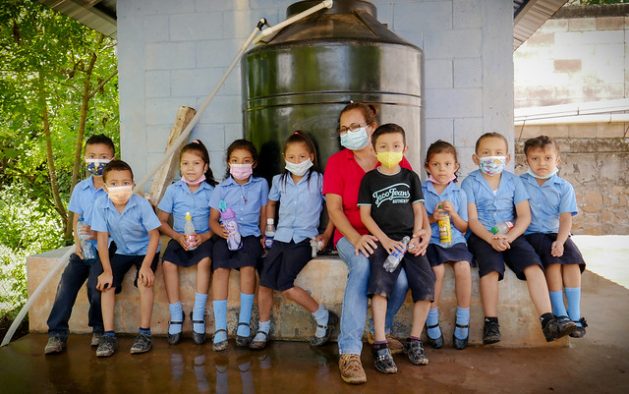
Angélica María Posada, a teacher and school principal in the village of El Guarumal, in eastern El Salvador, poses with primary school students in front of the school where they use purified water collected from rainfall, as part of a project promoted by FAO and Mexican cooperation funds. The initiative is being implemented in the countries of the Central American Dry Corridor. CREDIT: Edgardo Ayala/IPS

Angélica María Posada, a teacher and school principal in the village of El Guarumal, in eastern El Salvador, poses with primary school students in front of the school where they use purified water collected from rainfall, as part of a project promoted by FAO and Mexican cooperation funds. The initiative is being implemented in the countries of the Central American Dry Corridor. CREDIT: Edgardo Ayala/IPS

SENSEMBRA, El Salvador , Jun 23 2021 (IPS) – At the school in El Guarumal, a remote village in eastern El Salvador, the children no longer have to walk several kilometers along winding paths to fetch water from wells; they now “harvest” it from the rain that falls on the roofs of their classrooms.


“The water is not only for the children and us teachers, but for the whole community,” school principal Angelica Maria Posada told IPS, sitting with some of her young students at the foot of the tank that supplies them with purified water.

The village is located in the municipality of Sensembra, in the eastern department of Morazán, where it forms part of the so-called Central American Dry Corridor, a semi-arid belt that covers 35 percent of Central America and is home to some 11 million people, mostly engaged in subsistence agriculture.

In the Corridor, 1,600 kilometers long, water is always scarce and food production is a challenge, with more than five million people at risk of food insecurity.

In El Guarumal, a dozen peasant families have dug ponds or small reservoirs and use the rainwater collected to irrigate their home gardens and raise tilapia fish as a way to combat drought and produce food.

“We are all very proud of this initiative, because we are the only school in the country that has a (rainwater harvesting) system like this.” — Angélica María Posada

This effort, called the Rainwater Harvesting System (RHS), has not only been made in El Salvador.

Similar initiatives have been promoted in five other Central American countries as part of the Mesoamerica Hunger Free programme, implemented since 2015 by the United Nations Food and Agriculture Organisation (FAO) and financed by the Mexican Agency for International Development Cooperation (Amexcid).

The aim of the RHS was to create the conditions for poor, rural communities in the Dry Corridor to strengthen food security by harvesting water to irrigate their crops and raise fish.

In Guatemala, work has been done to strengthen an ancestral agroforestry system inherited from the Chortí people, called Koxur Rum, which conserves more moisture in the soil and thus improves the production of corn and beans, staples of the Central American diet.

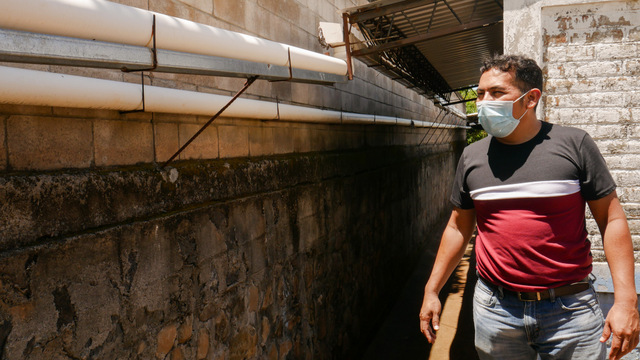
José Evelio Chicas, a teacher at the school in the village of El Guarumal, in El Salvador's eastern department of Morazán, supervises the PVC pipes that carry rainwater collected from the school's roof to an underground tank, from where it is pumped to a filtering and purification station. The initiative is part of a water harvesting project in the Central American Dry Corridor. CREDIT: Edgardo Ayala/IPS

José Evelio Chicas, a teacher at the school in the village of El Guarumal, in El Salvador’s eastern department of Morazán, supervises the PVC pipes that carry rainwater collected from the school’s roof to an underground tank, from where it is pumped to a filtering and purification station. The initiative is part of a water harvesting project in the Central American Dry Corridor. CREDIT: Edgardo Ayala/IPS

“The best structure for conserving water is the soil, and that is where we have to work,” Baltazar Moscoso, national coordinator of Mesoamerica Hunger Free, told IPS by telephone from Guatemala City.

Healthy schools in El Salvador

The principal of the El Guarumal school, where 47 girls, 32 boys and several adolescents study, said that since the water collection and purification system has been in place, gastrointestinal ailments have been significantly reduced.

“The children no longer complain about stomachaches, like they used to,” said Posada, 47, a divorced mother of three children: two girls and one boy.

She added, “The water is 100 percent safe.”

Before it is purified, the rainwater that falls on the tin roof is collected by gutters and channeled into an underground tank with a capacity of 105,000 litres.

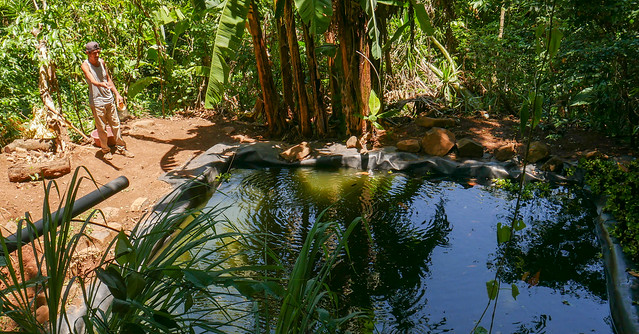
Farmer Cristino Martínez feeds the tilapia he raises in the pond dug next to his house in the village of El Guarumal in eastern El Salvador. A dozen ponds like this one were created in the village to help poor rural families produce food in the Central American Dry Corridor. CREDIT: Edgardo Ayala/IPS

Farmer Cristino Martínez feeds the tilapia he raises in the pond dug next to his house in the village of El Guarumal in eastern El Salvador. A dozen ponds like this one were created in the village to help poor rural families produce food in the Central American Dry Corridor. CREDIT: Edgardo Ayala/IPS

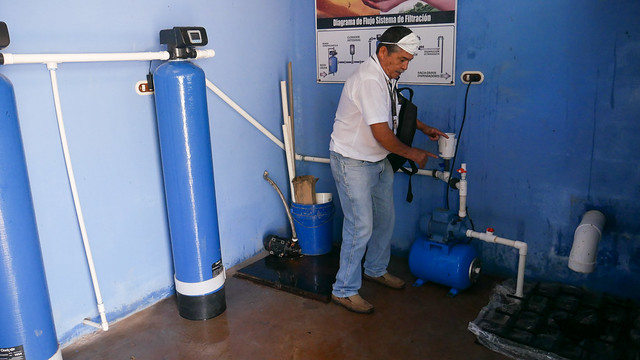
It is then pumped to a station where it is filtered and purified, before flowing into the tank which supplies students, teachers and the community.

The school reopened for in-person classes in March, following the shutdown declared by the government in 2020 to curb the spread of the COVID-19 pandemic.

“We are all very proud of this initiative, because we are the only school in the country that has a system like this,” added the principal.

There are 40 families living in El Guarumal, but a total of 150 families benefit from the system installed in the town, because people from other communities also come to get water.

A similar system was installed in 2017 in Cerrito Colorado, a village in the municipality of San Isidro, Choluteca department in southern Honduras, which benefits 80 families, including those from the neighbouring communities of Jicarito and Obrajito.

Rainwater is filtered and purified in a room adjacent to the classrooms of the school in the village of El Guarumal, in the eastern department of Morazán, El Salvador. Gastrointestinal ailments were reduced with the implementation of this project executed by FAO and financed by Mexican cooperation funds. CREDIT: Edgardo Ayala/IPS

Rainwater is filtered and purified in a room adjacent to the classrooms of the school in the village of El Guarumal, in the eastern department of Morazán, El Salvador. Gastrointestinal ailments were reduced with the implementation of this project executed by FAO and financed by Mexican cooperation funds. CREDIT: Edgardo Ayala/IPS

Vegetable gardens and tilapias boost food security

About 20 minutes from the school in El Guarumal, following a narrow dirt road that winds along the mountainside, you reach the house of Cristino Martínez, who grows tomatoes and raises tilapia in the pond dug next to his home.

The ponds are pits dug in the ground and lined with a polyethylene geomembrane, a waterproof synthetic material. They hold up to 25,000 litres of rainwater.

“The pond has served me well, I have used it for both the tilapia and watering tomatoes, beans and chayote (Sechium edule),” Martínez told IPS, standing at the edge of the pond, while tossing food to the fish.

The cost of the school’s water harvesting system and the 12 ponds totaled 77,000 dollars.

Martínez has not bothered to keep a precise record of how many tilapias he raises, because he does not sell them, he said. The fish feed his large family of 13: he and his wife and their 11 children (seven girls and four boys).

And from time to time he receives guests in his adobe house.

“My sisters come from San Salvador and tell me: ‘Cristino, we want to eat some tilapia,’ and my daughters throw the nets and start catching fish,” said the 50-year-old farmer.

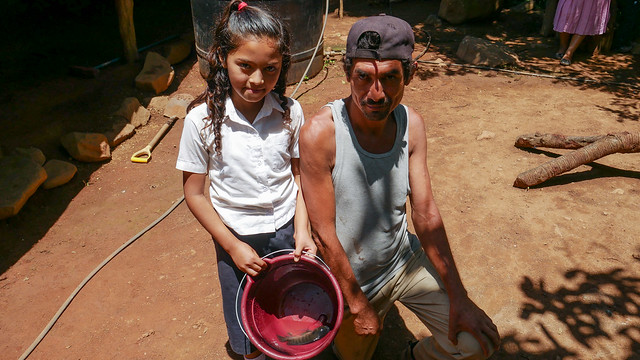
Cristino Martínez and one of his daughters show the tilapia they have just caught in the family pond they have dug in the backyard of their home in the village of El Guarumal in the eastern department of Morazán, El Salvador. The large peasant family raises fish for their own consumption and not for sale. CREDIT: Edgardo Ayala/IPS

Cristino Martínez and one of his daughters show the tilapia they have just caught in the family pond they have dug in the backyard of their home in the village of El Guarumal in the eastern department of Morazán, El Salvador. The large peasant family raises fish for their own consumption and not for sale. CREDIT: Edgardo Ayala/IPS

According to FAO estimates, the ponds can provide about 500 fishes two to three times a year.

The ponds are built on the highest part of each farm, and the drip irrigation system uses gravity to water the crops or orchards planted on the slopes.

Tomatoes are Martínez’s main crop. He has 100 seedlings planted, and manages to produce good harvests, marketing his produce in the local community.

“The pond helps me in the summer to water the vegetables I grow downhill,” another beneficiary of the programme, Santos Henríquez, also a native of El Guarumal, told IPS.

Henríquez’s 1.5-hectare plot is one of the most diversified: in addition to tilapias, corn and a type of bean locally called “ejote”, he grows cucumbers, chili peppers, tomatoes, cabbage and various types of fruit, such as mangoes, oranges and lemons.

“We grow a little bit of everything,” Henríquez, 48, said proudly. He sells the surplus produce in the village or at Sensembra.

However, some beneficiary families have underutilised the ponds. They were initially enthusiastic about the effort, but began to let things slide when the project ended in 2018.

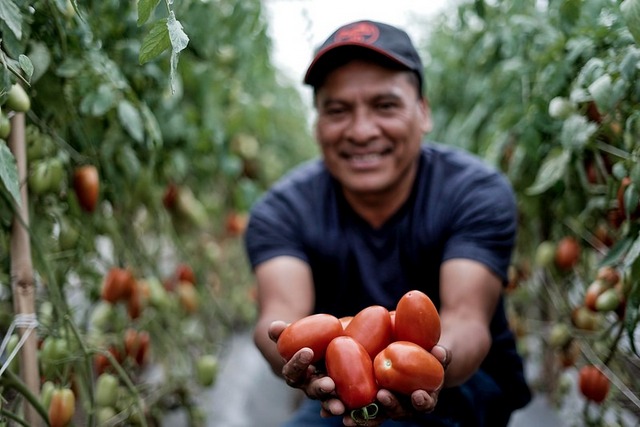
A farmer proudly displays some of the tomatoes he has grown in the region known as Mancomunidad Copán Chortí in eastern Guatemala, which includes the municipalities of Camotán, Jocotán, Olopa and San Juan Ermita, in the department of Chiquimula. Water harvesting initiatives have been implemented in the area to improve agricultural production in this region, which is part of the so-called Central American Dry Corridor. The initiative is supported by FAO and Mexican cooperation funds. CREDIT: FAO Guatemala

A farmer proudly displays some of the tomatoes he has grown in the region known as Mancomunidad Copán Chortí in eastern Guatemala, which includes the municipalities of Camotán, Jocotán, Olopa and San Juan Ermita, in the department of Chiquimula. Water harvesting initiatives have been implemented in the area to improve agricultural production in this region, which is part of the so-called Central American Dry Corridor. The initiative is supported by FAO and Mexican cooperation funds. CREDIT: FAO Guatemala

An ageold Chorti technique in Guatemala

In Guatemala, meanwhile, some villages and communities are betting on an agroforestry technique from their ancestral culture: Koxur Rum, which means “wet land” in the language of the Chortí indigenous people, who also live in parts of El Salvador and Honduras.

The system allows corn and bean crops to retain more moisture with the rains by combining them with furrows of shrubs or trees such as madre de cacao or quickstick (Gliricidia sepium), a tree species that helps fix nitrogen in the soil.

By pruning the trees regularly, leaves and crop stubble cover and protect the soil, thereby better retaining moisture and nutrients.

“Quickstick sprouts quickly and gives abundant foliage to incorporate into the soil,” farmer Rigoberto Suchite told IPS in a telephone interview from the village of Minas Abajo, in the municipality of San Juan Ermita, Chiquimula department in eastern Guatemala, also located in the Central American Dry Corridor.

Suchite said the system was revived in his region in 2000, but with the FAO and Amexcid project, it has become more technical.

As part of the programme, some 150 families have received two 1,500-litre tanks and a drip irrigation system, he added.

“Now we are expanding it even more because it has given us good results, it has improved the soil and boosted production,” said Suchite, 55.

In the dry season, farmers collect water from nearby springs in tanks and, using gravity, irrigate their home gardens.

“Many families are managing to have a surplus of vegetables and with the sales, they buy other necessary food,” Suchite said.

The programme is scheduled to end in Guatemala in 2021, and local communities must assume the lessons learned in order to move forward.

  Source

Time to End Generational Injustice with a ‘Global Blue New Deal’ to Protect Oceans

Active Citizens, Biodiversity, Climate Change, Economy & Trade, Education, Environment, Global, Green Economy, Headlines, Labour, Poverty & SDGs, TerraViva United Nations, Water & Sanitation

Opinion

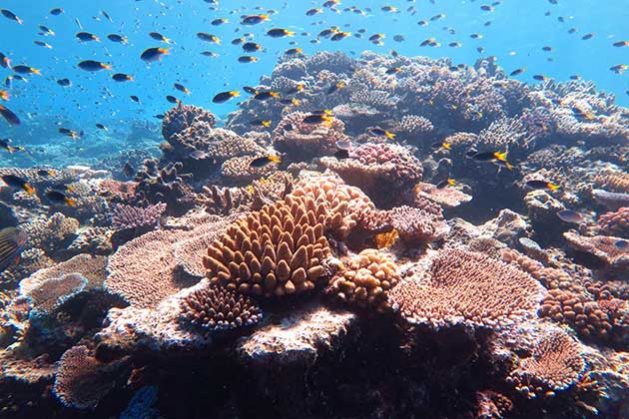
Credit: Australian Institute of Marine Science

PARIS, Jun 8 2021 (IPS) – Increasingly, youth are rising up to declare that they’ve had enough of the cyclical exploitation of the environment that jeopardizes their own future.


Youth activism through the Global Climate Strikes and Fridays For Future protests have helped spur revolutionary policy frameworks, like the Green New Deal championed by U.S. Congresswoman Alexandria Ocasio-Cortez.

International organizations and sovereign governments have now interpreted the Green New Deal into frameworks and policies of their own; it’s clear that environmental policy led by youth has energized the discussion on global decarbonization and the social impacts of climate change.

However, the Green New Deal only mentioned the ocean once. We need to insert more Blue into the green transition.

Earth’s vast oceans are humanity’s single most important climate regulation tool. As governments coalesce around plans to quite literally save our species, we must recognize that there is no future without understanding the role the ocean has to play.

Beyond human life support, the ocean economy contributes to ecosystem services, jobs, and cultural services valued at USD 3-6 trillion, with fisheries and aquaculture alone contributing USD 100 billion per year and 250+ million jobs.

Our ocean, however, is overfished, polluted with plastic, and exploited for non-renewable resources like minerals and fossil fuels. This perpetuates a cycle of generational injustice and leaves youth to inherit an increasingly degraded environment with less and less time to restore it. Not only is this detrimental to progress at large, but our most vulnerable global communities, who contribute the least to global emissions, will feel the effects of our degraded environment the most severely.

Youth not only need to be proactive advocates for the SDGs, we need to hold the global community accountable to commitments they have made between nations and to youth as the greatest stakeholders in the future health of our environment.

Creating the “Global Blue New Deal”

In 2019, the Sustainable Ocean Alliance distributed surveys across its network to identify the key youth policy priorities for a healthy ocean and just future. We received 100+ responses from 38 countries in 5 languages.

Over the past year, SOA’s Youth Policy Advisory Council synthesized these into a youth-led, crowdsourced ocean policy framework: the Global Blue New Deal.

The first public draft of our Global Blue New Deal is being launched now, at the dawn of the UN’s Decade of Ocean Science for Sustainable Development, which aims to gather global ocean stakeholders behind a common framework to deliver “the ocean we need for the future we want.”

Youth want to contribute to the success of the Ocean Decade and call on the international community to recognize our policy suggestions as part of the solutions our planet needs.

The vision of the Global Blue New Deal is to “outline an ocean policy framework that integrates crowdsourced youth priorities that will be proposed to governments on international, national, and local scales for implementation.”

It is organized under four pillars, each containing specific ocean policy solutions.

In brief:

Pillar 1
Carbon Neutrality: Transition to a Zero Carbon Future

    1. End offshore drilling and invest in renewable ocean energy
    2. Decarbonize the shipping industry
    3. Reduce land-based marine pollution
    4. Transition to a circular economy
    5. Strengthen legislation and enforcement against ocean contamination

Pillar 2
Preserve Biodiversity: Apply Nature-based Solutions to Promote Healthy Ecosystems and Climate Resilience

    1. Support the global movement to protect 30% of the world’s ocean by 2030
    2. Enforce against non-compliance in Marine Protected Areas (MPAs)
    3. Establish a global moratorium against deep-sea mining
    4. Transition from “gray” manmade infrastructure like culverts and seawalls to nature-based blue carbon infrastructure including the restoration of wetlands, mangroves and marshes

Pillar 3:
Sustainable Seafood: Match Increasing Global Demand Sustainably

    1. Encourage sustainable governance of capture fisheries
    2. Enforce against illegal, unreported, and unregulated fishing
    3. Eliminate capacity-enhancing fisheries subsidies
    4. Provide a sustainable path for aquaculture
    5. Fund research and development of plant-based and cell-cultured seafood

Pillar 4:
Stakeholder Engagement: Include Local Communities in Natural Ocean Resource Management

    1. Ensure the sustainability of coastal ecotourism
    2. Promote ocean research and innovation, with a goal of mapping 100% of the global seafloor by 2030.
    3. Emphasize ocean literacy and capacity building
    4. Build stakeholder participation in ocean governance

We invite like-minded youths, scientists, policymakers, and other ocean stakeholders to visit https://www.soalliance.org/soablog/youth-led-blue-new-deal and help as we finalize the Global Blue New Deal ocean policy framework during our public comment period throughout July.

Each generation has inherited an increasingly degraded ocean environment with the poorest, most vulnerable communities feeling the impacts the most severely. This is our opportunity to rewrite the long history of compromising our ocean.

Mark Haver and Marina Porto are Chair and Co-Chair respectively of the Youth Policy Advisory Council of the Sustainable Ocean Alliance, the world’s largest youth-led network of ocean allies.

  Source