Climate Change Exacerbated Flash Floods in Bangladesh

Asia-Pacific, Civil Society, Climate Change, Education, Environment, Food and Agriculture, Headlines, Health, TerraViva United Nations, Water & Sanitation

Bangladesh Feni Flood August 2024. People wading through the flood waters, in search of shelter in Feni. Credit: UNICEF/Sultan Mahmud Mukut

UNITED NATIONS, Sep 6 2024 (IPS) – Since late August, severe flash floods and monsoons plaguing Bangladesh have affected nearly 6 million people. Bangladeshi officials have declared the floods to be the country’s worst climate disaster in recent memory. These recent floods follow the wake of Cyclone Remal, which devastated Bangladesh and West Bengal earlier this year.


Floods have caused widespread destruction in Bangladesh, with the Feni, Cumilla, Laxipur, Chattogram, and Noakhali districts among those hit hardest. The United Nations Children’s Fund (UNICEF) has stated that 71 people have been reported dead. The floods have decimated villages, with thousands of homes having been destroyed or submerged underwater, causing widespread internal displacement.

“So far, a reported 500,000 people have been displaced in more than 3,400 evacuation shelters”, Stéphane Dujarric, Spokesman for the UN Secretary-General, said during a press briefing held on September 4 at the headquarters in New York.

“We, along with our humanitarian partners, are mobilized and supporting the government-led flood response,” Dujarric said. “We are also helping with local efforts to help the most vulnerable people and communities impacted by these floods.”

Displacement shelters in Bangladesh have become overcrowded due to the sheer amount of civilians that were displaced from their communities. According to an August 30 report from the United Nations Inter-Cluster Coordination Group (ICCG), this has heightened protection concerns for affected women and girls.

Floods have also damaged critical infrastructure in Bangladesh, greatly impeding relief efforts by humanitarian organizations. Farah Kabir, Country Director of ActionAid Bangladesh stated “The disruption of roads and communication has further escalated their plight, making it difficult for them to reach safety and essential resources. The UN reports that certain areas are entirely inaccessible to aid workers due to the extent of the high water levels.

According to the ICCG report, in Noakhali, approximately 50 percent of the flood-affected areas are considered “unreachable” by local authorities and aid personnel. The floods have also caused significant power outages, aggravating these challenges in accessibility.

This has taken a significant toll on nationwide education. Floods have ravaged educational facilities across the nation and have made countless roads and passages inaccessible, making schooling for children extremely difficult. According to Dujarric, over 7000 schools are now closed due to flooding, which has impacted 1.7 million children and young people.

Water sanitation systems have been severely compromised with the swelling of dirty water filling the streets. Without access to emergency medical supplies, the risk of contracting waterborne diseases has risen significantly.

Kabir added, “The collapse of the sanitation system in many areas has heightened the public health crisis”.

Last week, In one instance last week, Bangladesh’s Directorate of General Health Services (Dte. GHS) reported that over a period of 24 hours since the flooding began, 5000 people had been hospitalized, reporting cases of diarrhea, skin infections and snake bites. UNICEF is currently on the frontlines of this disaster, distributing 3.6 million water purification tablets to prevent the spread of illnesses.

Additionally, the livelihoods of millions have been impacted by the floods. Agriculture, specifically, has been hit the hardest. According to Bangladesh’s agriculture ministry, the floods have resulted in a loss of 282 million US dollars due to crop damage, impacting over 1.3 million farmers. This is significantly detrimental as the agricultural sector employs roughly 42 percent of Bangladesh’s workforce.

Dujarric added that the floods have caused 156 million US dollars worth of losses in livestock and fisheries. This has devastated Bangladesh’s economy as well as greatly exacerbated levels of food insecurity nationwide.

“With supplies disrupted, thousands of families are still stranded in shelters without any food,” said Simone Parchment, the World Food Programme (WFP) Representative in Bangladesh, in a press release issued on August 30. “Our focus is on delivering emergency assistance to the people who have been displaced and lack the means to cook for themselves.”

Hundreds of thousands of people are facing risks of starvation and malnutrition as aid workers scramble to distribute dry food to shelters. WFP is currently in the process of delivering fortified biscuits to 60,000 families in areas that have been hit the hardest.

The UN’s Acting Relief Emergency Coordinator, Joyce Msuya, has allocated 4 million dollars from the UN’s Central Emergency Response Fund (CERF). In addition, UNICEF is on the frontlines of this disaster, providing over 338,000 people with live-saving supplies. However, current efforts are not enough to mitigate this disaster. UNICEF has requested over 35 million dollars from donors in order to provide all families affected with medical assistance.

It is also imperative to tackle the climate crisis, as Bangladesh is one of the world’s most climate-sensitive nations. A 2015 report by the World Bank Institute stated that approximately 3.5 million people in Bangladesh are affected by annual river flooding, an issue that is only worsened by the climate crisis.

Deputy Representative of UNICEF Bangladesh Emma Brigham remarked that the devastation caused by the floods in the eastern regions of Bangladesh are “a tragic reminder of the relentless impact of extreme weather events and the climate crisis”, particularly for children. “Far too many children have lost loved ones, their homes, schools, and now are completely destitute,” she said.

IPS UN Bureau Report

  Source

Water Stories: The Well Seven Families and 400 Buffaloes Rely On

Active Citizens, Asia-Pacific, Civil Society, Development & Aid, Editors’ Choice, Environment, Featured, Gender, Headlines, Health, Human Rights, Inequality, Natural Resources, Population, Sustainable Development Goals, TerraViva United Nations, Water & Sanitation, Women & Economy

Water & Sanitation

Women in Khardariya village in Dang fetching water from a community well. Credit: Tanka Dhakal/IPS

Women in Khardariya village in Dang fetching water from a community well. Credit: Tanka Dhakal/IPS

KATHMANDU, Aug 7 2024 (IPS) – In the rural village of Khardariya in the Dang district of Nepal, access to clean water is a major issue. Villagers depend on one poorly managed well for drinking water, cleaning, and feeding livestock.


Anjana Yadav stood near the well while a neighbor walked toward it to fetch a bucket of water.

“At least seven families and over 400 buffaloes rely on this well; this is the water that sustains the buffaloes, and we drink it too,” she said. “In summer, the water level goes down, and we suffer more,” Anjana told IPS.

According to government data, only 27 percent of the country’s population has access to pure drinking water. However, the government’s aim is to increase the number of people using safe drinking water to at least 90 percent by 2030, in line with Sustainable Development Goals. But villages like Khardariya are still struggling to access enough water, let alone pure water.

“This water is not drinkable, but we don’t have any other option,” Niramala Yadava (Anjana’s daughter) says while showing the logged water around the well, “We know this water is not safe, but we’re forced to drink it, use it for cleaning, and even in the kitchen. We also have to manage for livestock too.”

Khardariya is one example where access to water is a major problem, and there are other areas where people are facing the same situation. The Department of Water Supply and Sewerage Management claims that 80 percent of people have access to drinking water, but it’s not safe as per standards. Most of them still depend on surface water sources like rivers, ponds, and these sources are not necessarily safe to drink. And often time this water led to health consequences to the community where clean drinking water is not available.

Everyday Struggle

According to the World Health Organization’s Global Health Estimates (WHO GHE), one of the largest declines in the number of deaths is from diarrheal diseases, with global deaths falling from 2.6 million in 2000 to 1.5 million in 2019. But in Nepal even though cases are in decreasing trend, water related diseases are still a major concern, GHE data shows from 2000 to 2019 above 140 thousands of diarrheal cases are recorded per year.

Diarrheal diseases are one of the top ten causes of death in Nepal. According to data from the Institute for Health Metrics and Evaluation (IHME), diarrheal diseases ranked seventh in 2009 and ninth in 2019 in the list of top ten causes of death.

As Anjana Yadav in Dang, Sarita Rana Magar in Solukhumbu is struggling to get drinking water from the spring sourced tap, but it is not certain that the water is clean as per government standards. “We don’t have enough access to drinking water; even to get a couple of buckets of water is hard these days,” Magar says while waiting for her turn to fill water from the community tap in Lausasa village in the Khumbu region, where mountains stand right near her village. “It takes 25-30 minutes to fill one bucket (40-liter bucket) of water, and I need at least three buckets of water every day,” Magar said while keeping her bucket under the running tap.

Problem is Not Prioritizing

Even though the Government of Nepal claims that safe drinking water is a priority issue, the facts do not align with this assertion. In recent years, the budget for safe drinking water has been decreasing while the need is growing.

Madhu Timalsina, Senior Divisional Engineer at the Ministry of Water Supply, says that the government is not keen to expand basic drinking water safety.

“According to the data we have, 73 percent of the population lacks access to safe drinking water. The target is to reach 90 percent of the population with access to safe drinking water by 2030,” Timalsina says. “We don’t have the resources to sustain ongoing programs, and meeting the goal is far from achievable at this point. Water is not a priority for the government. We need resources.”

According to the Ministry, at a time when the demand for safe drinking water is increasing, the budget is shrinking. In the current fiscal year, the Ministry received over 28 billion Nepali rupees (about USD 208 million) as their budget, which was 42 billion (USD 313 million) in the previous fiscal year.

“It seems like in the coming year, it will decrease to 22-23 billion,” Timalsina said, “We have not been able to initiate new programs in recent years due to the lack of budget. Everything is ready, but we lack the resources.”

The Federation of Drinking Water and Sanitation Users Nepal (FDWSUN), which advocates for access to safe and contamination-free water for all, believes that the government is not taking the water issue seriously. “We have been continuously trying to create pressure, but the government is not willing to listen,” said Durga Chapagain, Senior Vice President of the FDWSUN, “The majority of users are still drinking water from open sources, and there is no budget allocated for drinking water projects.”

If the government truly intends to increase access to safe drinking water for up to 90 percent of the population by 2030, the budget should be allocated accordingly, according to Timalsina.

“To meet the target, we need to cover an additional 63 percent of the population within 6 years. The target is set, but we can’t achieve anything without the budget,” he explains. “We lack the resources to meet our needs, which is the primary limitation. Additionally, our springs are drying up, and water scarcity is becoming a major issue. Unfortunately, without resources, it’s not possible to do anything.”

IPS UN Bureau Report
  Source

Rainy Chiloé, in Southern Chile, Faces Drinking Water Crisis

Biodiversity, Civil Society, Conservation, Development & Aid, Economy & Trade, Editors’ Choice, Energy, Environment, Featured, Food and Agriculture, Headlines, Integration and Development Brazilian-style, Latin America & the Caribbean, Natural Resources, Projects, Regional Categories, TerraViva United Nations, Water & Sanitation

Water & Sanitation

Residents of the municipality of Castro, in Chiloé, an archipelago in southern Chile, demonstrate in the streets of their city, in front of the Gamboa Bridge, expressing their fear of threats to the water supply that they attribute to the lack of protection of peatlands, which are key to supplying water for the island's rivers. CREDIT: Courtesy of Chiloé en defensa del Agua

Residents of the municipality of Castro, in Chiloé, an archipelago in southern Chile, demonstrate in the streets of their city, in front of the Gamboa Bridge, expressing their fear of threats to the water supply that they attribute to the lack of protection of peatlands, which are key to supplying water for the island’s rivers. CREDIT: Courtesy of Chiloé en defensa del Agua

SANTIAGO, May 2 2024 (IPS) – The drinking water supply in the southern island of Chiloé, one of Chile’s rainiest areas, is threatened by damage to its peatlands, affected by sales of peat and by a series of electricity projects, especially wind farms.


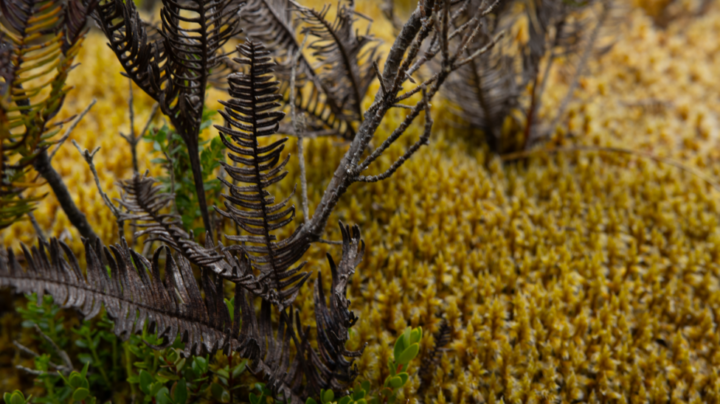
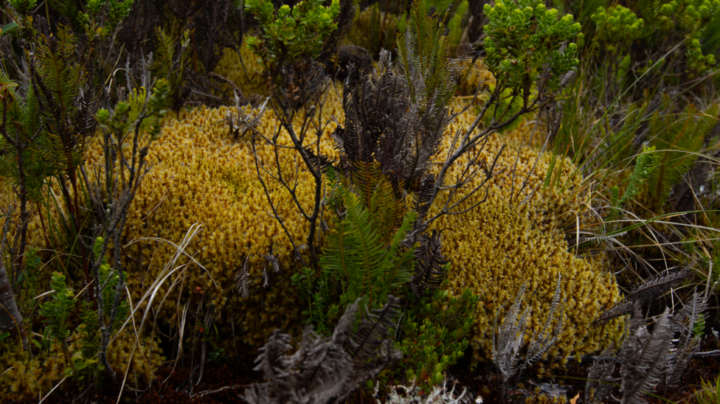
The peat bog (Moss sphagnum magellanicum) known as “pompon” in Chile absorbs and retains a great deal of water, releasing it drop by drop when there is no rain. In southern Chile there are about 3.1 million hectares of peatlands.

“We condemn the fact that the extraction of peat is permitted in Chiloé when there is no scientifically proven way for peat to be reproduced or planted…. there is no evidence of how it can regenerate.” ¨– Daniela Gumucio

Peat is a mixture of plant debris or dead organic matter, in varying degrees of decomposition, neither mineral nor fossilized, that has accumulated under waterlogged conditions.

The pompon is the main source of water for the short rivers in Chiloé, an archipelago of 9181 square kilometers and 168,000 inhabitants, located 1200 kilometers south of Santiago. The local population makes a living from agriculture, livestock, forestry, fishing and tourism, in that order.

“We don’t have glaciers, or thaws. Our water system is totally different from that of the entire continent and the rest of Chile. Since we don’t have glaciers or snow, our rivers function on the basis of rain and peat bogs that retain water and in times of scarcity release it,” Daniela Gumucio told IPS by telephone.

The 36-year-old history and geography teacher said that the Chiloé community is concerned about the supply of drinking water for consumption and for small family subsistence farming.

Gumucio is a leader of the National Association of Rural and Indigenous Women (Anamuri) and chairs the Environmental Committee of Chonchi, the municipality where she lives in the center of the island.

This long narrow South American country, which stretches between the Andes Mountains and the Pacific Ocean, has 19.5 million inhabitants and is facing one of the worst droughts in its history.

It’s strange to talk about water scarcity in Chiloé because it has a rainy climate. In 2011 more than 3000 millimeters of water fell there, but since 2015 rainfall began to decline.

In 2015 rainfall totaled 2483 millimeters, but by 2023 the amount had dropped to 1598 and so far this year only 316, according to data from the Quellón station reported to IPS by the Chilean Meteorological Directorate.

The forecast for April, May, and June 2024 is that below-normal rainfall will continue.

A water emergency was declared in the region in January and the residents of nine municipalities are supplied by water trucks.

To supply water to the inhabitants of the 10 municipalities of Chiloé, the State spent 1.12 million dollars to hire water trucks between 2019 and 2024. In Ancud alone, one of the municipalities, the expenditure was 345,000 dollars in that period.

A close-up shot of a peat bog in a watershed on the island of Chiloé, which has the ability to absorb water 10 times its weight. Because of this property, those who extract it today, without any oversight, dry it, crush it and pack it in sacks to sell it to traders who export it or sell it in local gardening shops. CREDIT: Courtesy of Gaspar Espinoza

A close-up shot of a peat bog in a watershed on the island of Chiloé, which has the ability to absorb water 10 times its weight. Because of this property, those who extract it today, without any oversight, dry it, crush it and pack it in sacks to sell it to traders who export it or sell it in local gardening shops. CREDIT: Courtesy of Gaspar Espinoza

Alert among social activists

The concern among the people of Chiloé over their water supply comes from the major boost for wind energy projects installed on the peat bogs and new legislation that prohibits the extraction of peat, but opens the doors to its use by those who present sustainable management plans.

Several energy projects are located in the Piuchén mountain range, in the west of Chiloé, where peat bogs are abundant.

“They want to extend a high voltage line from Castro to Chonchi. And there are two very large wind farm projects. But to install the turbines they have to dynamite the peat bog. This is a direct attack on our water resource and on our ways of obtaining water,” Gumucio said.

In 2020, the French company Engie bought three wind farms in Chiloé for 77 million dollars: San Pedro 1 and San Pedro 2, with a total of 31 wind turbines that will produce 101 megawatts (MW), and a third wind farm that will produce an additional 151 MW.

In addition, 18 kilometers of lines will be installed to carry energy to a substation in Gamboa Alto, in the municipality of Castro, and from there to the national power grid.

Another 92 turbines are included in the Tabla Ruca project, between the municipalities of Chonchi and Quellón.

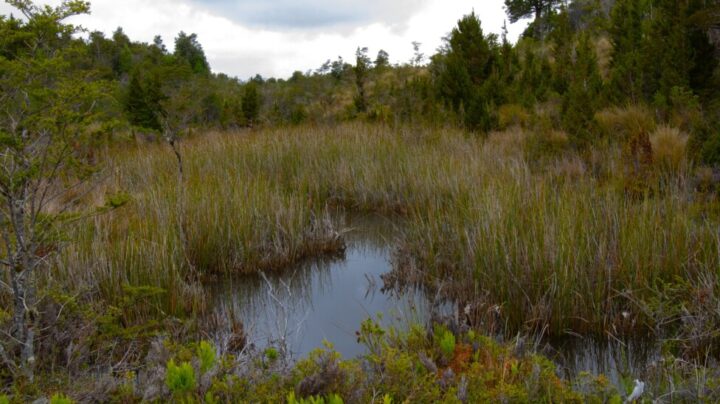
Peat bogs accumulate and retain rainwater in the wetlands of Chiloé and release it drop by drop to river beds in times of drought. CREDIT: Courtesy of Gaspar Espinoza

Peat bogs accumulate and retain rainwater in the wetlands of Chiloé and release it drop by drop to river beds in times of drought. CREDIT: Courtesy of Gaspar Espinoza

Engie describes its initiatives as part of the transition to a world with zero net greenhouse gas emissions, thanks to the production of clean or green energy.

Leaders of 14 social and community organizations expressed their concerns in meetings with regional authorities, but to no avail. Now they have informed their communities and called on the region’s authorities to protect their main water source.

Local residents marched in protest on Mar. 22 in Ancud and demonstrated on Apr. 22 in Puente Gamboa, in Castro, the main municipality of the archipelago.

Thanks to peatlands, the rivers of Chiloé do not dry up. The peat bogs accumulate rainwater on the surface, horizontally, and begin to release it slowly when rainfall is scarce.

For the same reason, peat is dup up and sold for gardening. In 2019 Chile exported 4600 tons of peat.

The wind energy projects are set up in areas of raised peat bogs, known as ombrotophic, located at the origin of the hydrographic basins.

“We have had a good response in the municipal council of Chonchi, where the mayor and councilors publicly expressed their opposition to approving these projects,” said Gumucio.

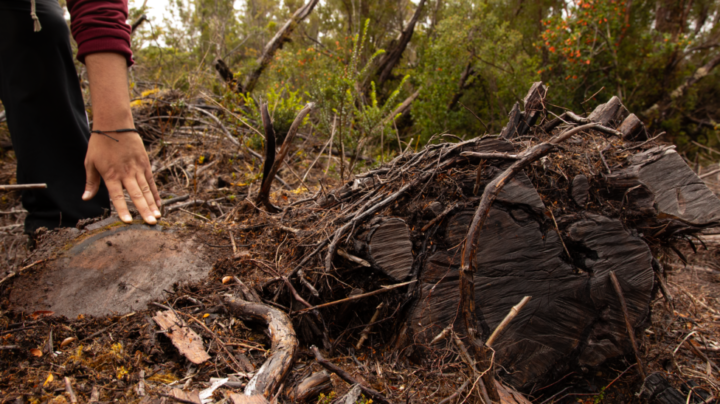
Dozens of trees have been felled in Chiloé to install wind turbines and make way for high-voltage towers that will transmit green energy to Chile's national power grid, without benefiting the inhabitants of the Chiloé archipelago. CREDIT: Courtesy of Gaspar Espinoza

Dozens of trees have been felled in Chiloé to install wind turbines and make way for high-voltage towers that will transmit green energy to Chile’s national power grid, without benefiting the inhabitants of the Chiloé archipelago. CREDIT: Courtesy of Gaspar Espinoza

The other threat to peatlands

The second threat to the Chiloé peat bogs comes from Law 21.660 on environmental protection of peatlands, published in Chile’s Official Gazette on Apr. 10.

This law prohibits the extraction of peat in the entire territory, but also establishes rules to authorize its use if sustainable management plans are presented and approved by the Agricultural and Livestock Service, depending on a favorable report from the new Biodiversity and Protected Areas Service.

The peatland management plan aims to avoid the permanent alteration of its structure and functions.

Those requesting permits must prove that they have the necessary skills to monitor the regeneration process of the vegetation layer and comply with the harvesting methodology outlined for sustainable use.

But local residents doubt the government’s oversight and enforcement capacity

Dozens of trees have been felled in Chiloé to install wind turbines and make way for high-voltage towers that will transmit green energy to Chile's national power grid, without benefiting the inhabitants of the Chiloé archipelago. CREDIT: Courtesy of Gaspar Espinoza

Dozens of trees have been felled in Chiloé to install wind turbines and make way for high-voltage towers that will transmit green energy to Chile’s national power grid, without benefiting the inhabitants of the Chiloé archipelago. CREDIT: Courtesy of Gaspar Espinoza

“We condemn the fact that the extraction of peat is permitted in Chiloé when there is no scientifically proven way for peat to be reproduced or planted…. there is no evidence of how it can regenerate,” said Gumucio.

The activist does not believe that sustainable management is viable and complained that the government did not accept a petition for the law to not be applied in Chiloé.

“We have a different water system and if this law is to be implemented, it should be on the mainland where there are other sources of water,” she said.

But according to Gumucio, everything seems to be aligned to deepen the water crisis in Chiloé.

“The logging of the forest, the extraction of peat, and the installation of energy projects all contribute to the drying up of our aquifers and basins. And in that sense, there is tremendous neglect by the State, which is not looking after our welfare and our right to have water,” she argued.

Peatland is part of the vegetation of the island of Chiloé, but is threatened by unsupervised exploitation, which the authorities hope to curb with a recently approved law, whose regulations are to be ready within the next two years. CREDIT: Courtesy of Gaspar Espinoza

Peatland is part of the vegetation of the island of Chiloé, but is threatened by unsupervised exploitation, which the authorities hope to curb with a recently approved law, whose regulations are to be ready within the next two years. CREDIT: Courtesy of Gaspar Espinoza

Scientists express their view

Six scientists from various Chilean universities issued a public statement asserting that the new law is a step in the right direction to protect Chile’s peatlands.

In their statement, scientists Carolina León, Jorge Pérez Quezada, Roy Mackenzie, María Paz Martínez, Pablo Marquet and Verónica Delgado emphasize that the new law “will require the presentation of a sustainable management plan” to exploit peat that is currently extracted without any controls.

They add that management plans must now be approved by the competent authorities and that those who extract peat will be asked to “ensure that the structure and functions of the peatlands are not permanently modified.”

They also say that the regulations of the law, which are to be issued within two years, “must establish the form of peat harvesting and post-harvest monitoring of the peat bog to protect the regeneration of the plant, something that has not been taken into consideration until now.”

They point out that the new law will improve oversight because it allows monitoring of intermediaries and exporters who could be fined if they do not comply with the legislation.

“While it is true that there is concern among certain communities and environmental groups, we believe that these concerns can be taken into account during the discussion of the regulations,” they say.

The scientists reiterate, however, that “peatlands are key ecosystems for mitigating the national and planetary climate and biodiversity crisis” and admit that “significant challenges remain to protect them, although this is a big step in the right direction.”

  Source

Solar Energy Gives Important Boost to Small-scale Farmers in Chile

Active Citizens, Civil Society, Climate Action, Climate Change, Development & Aid, Economy & Trade, Editors’ Choice, Energy, Environment, Featured, Food and Agriculture, Headlines, Integration and Development Brazilian-style, Latin America & the Caribbean, Population, Projects, Regional Categories, Water & Sanitation

Energy

Myriam Miller and Freddy Vargas stand next to one of the three greenhouses on their farm, where tomatoes are growing, anticipating an optimal harvest this year. The couple uses no chemical fertilizers to ensure the healthy development of thousands of plants on their farm in Mostazal, a municipality in central Chile. CREDIT: Orlando Milesi / IPS

Myriam Miller and Freddy Vargas stand next to one of the three greenhouses on their farm, where tomatoes are growing, anticipating an optimal harvest this year. The couple uses no chemical fertilizers to ensure the healthy development of thousands of plants on their farm in Mostazal, a municipality in central Chile. CREDIT: Orlando Milesi / IPS

MOSTAZAL, Chile , Feb 2 2024 (IPS) – The installation of photovoltaic panels to use solar energy to irrigate small farms is expanding quickly in Chile because it lowers costs and optimizes the use of scarce water resources.


This long, narrow South American country that stretches from the northern Atacama Desert to the southern Patagonia region and from the Andes Mountains to the Pacific Ocean is extremely rich in renewable energies, especially solar and wind power.

“Solar panels have made an immensely important contribution to our energy expenditure. Without them we would consume a lot of electricity.” — Myriam Miller

Last year, 36.6 percent of Chile’s electricity mix was made up of Non-Conventional Renewable Energies (NCREs), whose generation in May 2023 totaled 2392 gigawatt hours (GWh), including 1190 GWh of solar power.

This boom in the development of alternative energies has been mainly led by large companies that have installed solar panels throughout the country, including the desert. The phenomenon has also reached small farmers throughout this South American country who use solar energy.

In family farming, solar energy converted into electricity is installed with the help of resources from the government’s Agricultural Development Institute (Indap), which promotes sustainable production of healthy food among small farmers, incorporating new irrigation techniques.

In 2020 alone, the last year for which the institute provides data, Indap promoted 206 new irrigation projects that incorporated NCREs with an investment of more than 2.1 million dollars.

That year, of the projects financed and implemented, 182 formed part of the Intra-predial Irrigation Program, 17 of the Minor Works Irrigation Program and seven of the Associative Irrigation Program. The investment includes solar panels for irrigation systems.

Within this framework, 2025 photovoltaic panels with an installed capacity of 668 kilowatts were installed, producing 1002 megawatt hours and preventing the emission of 234 tons of carbon dioxide.

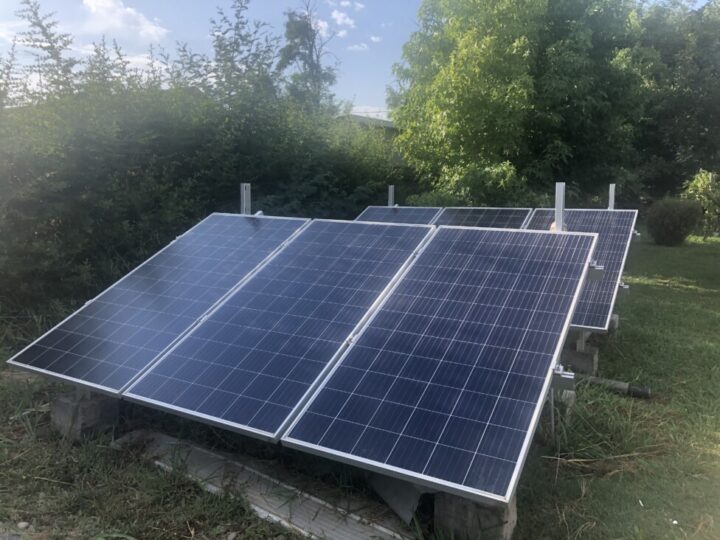
The six solar panels installed on the small farm of Myriam Miller and Freddy Vargas, in the municipality of Mostazal, south of Santiago, Chile, allow them to pump water to their three greenhouses with thousands of tomato plants and to their vegetable garden. They also drastically reduced their electric energy expenditure. CREDIT: Orlando Milesi / IPS

The six solar panels installed on the small farm of Myriam Miller and Freddy Vargas, in the municipality of Mostazal, south of Santiago, Chile, allow them to pump water to their three greenhouses with thousands of tomato plants and to their vegetable garden. They also drastically reduced their electric energy expenditure. CREDIT: Orlando Milesi / IPS

An experience in Mostazal

“Solar panels have made an immensely important contribution to our energy expenditure. Without them we would consume a lot of electricity,” 50-year-old farmer Myriam Miller told IPS at her farm in the municipality of Mostazal, 66 km south of Santiago, where some 54,000 people live in different communities.

Miller has half a hectare of land, with a small portion set aside for three greenhouses with nearly 1,500 tomato plants. Other tomato plants grow in rows outdoors, including heirloom varieties whose seeds she works to preserve, such as oxheart and pink tomatoes.

Indap provided 7780 dollars in financing to install the solar panels on her land. Meanwhile, she and her husband, Freddy Vargas, 51, who run their farm together, contributed 10 percent of the total cost.

In 2023, Miller and Vargas built a third greenhouse to increase their production, which they sell on their own land.

“We’re producing around 8,000 kilos of tomatoes per season. This year we will exceed that goal. We’re happy because we’re moving ahead little by little and improving our production year,” Miller said as she picked tomatoes.

On the land next to the tomato plants, the couple grows vegetables, mainly lettuce, some 7,000 heads a year. They also have fruit trees.

Vargas told IPS that they needed electricity to irrigate the greenhouses because “it’s not easy to do it by hand.”

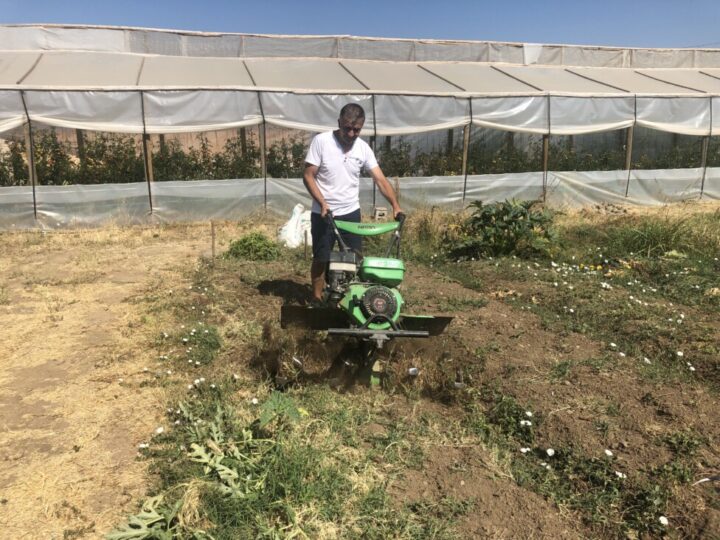
Freddy Vargas turns the soil on his farm in the municipality of Mostazal, south of Santiago, Chile. Lettuce is his star vegetable, with thousands of heads sold on the farm. The farmer plans to buy a mini-tractor to alleviate the work of plowing the land. CREDIT: Orlando Milesi / IPS

Freddy Vargas turns the soil on his farm in the municipality of Mostazal, south of Santiago, Chile. Lettuce is his star vegetable, with thousands of heads sold on the farm. The farmer plans to buy a mini-tractor to alleviate the work of plowing the land. CREDIT: Orlando Milesi / IPS

The farm has two wells that hold about 30,000 liters of water that arrives once a week from a dam located two kilometers away. This is the water they use to power the pumps to irrigate the greenhouses.

“We have water rights and Indap provided us with solar panels and tools to automate irrigation. They gave us four panels and we made an additional investment, with our own funds, and installed six,” Vargas explained.

The couple consumes between 250 and 300 kilowatts per month and the surplus energy they generate is injected into the household grid.

“We don’t have storage batteries, which are more expensive. Every month the electric company sends us a bill detailing the total we have injected into the grid and what we have consumed. They calculate it and we pay the difference,” Vargas said.

The average savings in the cost of consumption is 80 percent.

“I haven’t paid anything in the (southern hemisphere) summer for years. In the winter I spend 30,000 to 40,000 pesos (between 33 and 44 dollars) but I only pay between 5,000 and 10,000 pesos a month (5.5 to 11 dollars) thanks to the energy I generate,” the farmer said.

Above and beyond the savings, Miller stressed the “personal growth and social contribution we make with our products that go to households that need healthier food. We feel good about contributing to the environment.”

“We have a network, still small, of agroecological producers. There is a lack of information among the public about what people eat,” she added.

Their tomatoes are highly prized. “People come to buy them because of their flavor and because they are very juicy. Once people taste them, they come back and recommend them by word of mouth,” Miller said.

She is optimistic and believes that in the municipalities of Mostazal and nearby Codegua, young people are more and more interested in contributing to the planet, producing their own food and selling the surplus.

“We just need a little support and more interest in youth projects in agriculture to raise awareness that just as we take care of the land, it also gives to us,” she said.

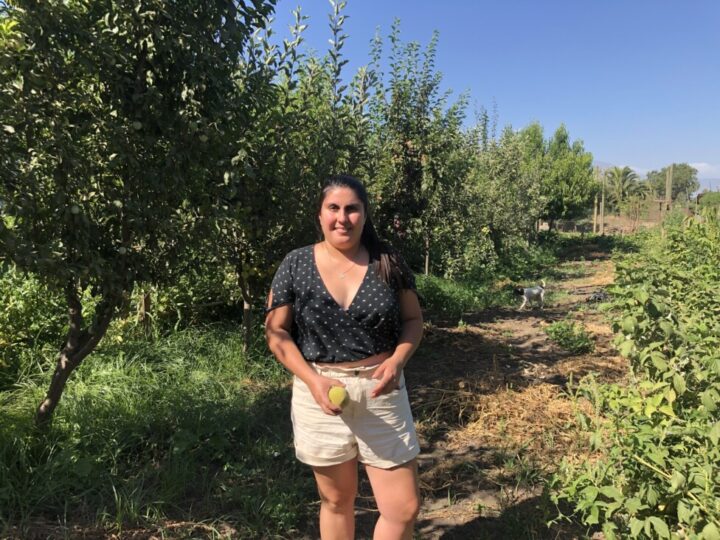
Valentina Martínez stands on her father's small plot of land in the municipality of María Pinto, north of Santiago, Chile. The fruit trees provide the shade needed to keep the planted vegetables from being scorched by the strong southern hemisphere summer sun in central Chile. CREDIT: Orlando Milesi / IPS

Valentina Martínez stands on her father’s small plot of land in the municipality of María Pinto, north of Santiago, Chile. The fruit trees provide the shade needed to keep the planted vegetables from being scorched by the strong southern hemisphere summer sun in central Chile. CREDIT: Orlando Milesi / IPS

A pesticide-free new generation

Valentina Martínez, 32, is an environmental engineer. Together with her father, Simón, 75, they work as small farmers in the municipality of María Pinto, 60 kilometers north of Santiago. She has a 0.45 hectare plot and her father has a 0.35 hectare plot.

Both have just obtained funding from the Transition to Sustainable Agriculture (TAS) project, which operates within Indap, and they are excited about production without chemical fertilizers and are trying to meet the goal of securing another larger loan that would enable them to build a greenhouse and expand fruit and vegetable production on the two farms.

“It’s a two-year program. In the first year you apply and they give you an incentive of 450,000 pesos (500 dollars) focused on buying technology. I’ve invested in plants, fruit trees, worms, and containers for making preserves,” Valentina told IPS.

In the second year, depending on the results of the first year, they will apply for a fund of 3900 dollars for each plot, to invest in their production.

“This year my father and I will apply for solar panels to improve irrigation,” said Valentina, who is currently dedicated to producing seedlings.

“My father liked the idea of producing without agrochemicals to combat pests,” she said about Simón, who has a fruit tree orchard and also grows vegetables.

In María Pinto there are 380 small farmers on the census, but the real number is estimated at about 500. Another 300 are medium-sized farmers.

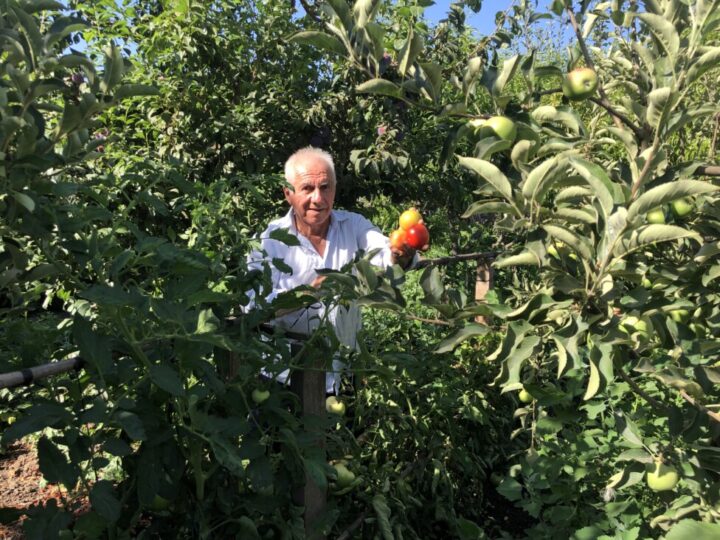
Simón Martínez, 75, proudly shows some of the citrus fruits harvested on his farm where he practices agroecology and does not use agrochemicals. He and his daughter Valentina won a contest to continue improving the sustainability of their farming practices on their adjoining plots, located outside the Chilean town of María Pinto. CREDIT: Orlando Milesi / IPS

Simón Martínez, 75, proudly shows some of the citrus fruits harvested on his farm where he practices agroecology and does not use agrochemicals. He and his daughter Valentina won a contest to continue improving the sustainability of their farming practices on their adjoining plots, located outside the Chilean town of María Pinto. CREDIT: Orlando Milesi / IPS

The rest of the area is monopolized by large agricultural companies dedicated to monocultures for export. Most of them have citrus, avocado, cherry and peach trees, as well as some walnut trees, and they all make intensive use of chemical fertilizers.

Chile exports mainly copper, followed by iron. But it also stands out for its sales of fish, cellulose pulp and fruit. In 2023, it exported 2.3 million tons of fruit, produced by large farms and bringing in 5.04 billion dollars. Agriculture represents 4.3 percent of the country’s GDP.

Family farming consists of some 260,000 small farms, which account for 98 percent of the country’s farms, according to the government’s Office of Agrarian Studies and Policies (Odepa).

Family farms produce 40 percent of annual crops and 22 percent of total agricultural production, which is key to feeding the country’s 19.7 million people.

Valentina is excited about TAS and the meetings she has had with other young farmers.

“It’s fun. We’re all on the same page and interested in what each other is doing. We start in December and January and it lasts all year. The young people are learning about sustainable agriculture and that there are more projects to apply for,” she explained.

She said that 15 young people in María Pinto have projects with pistachio trees, fruit trees, greenhouse gardens, outdoor gardens, animal husbandry and orchards. They are all different and receive group and individual training.

The training is provided by Indap and the Local Development Program (Prodesal), its regional representatives and the Foundation for the Promotion and Development of Women (Prodemu).

“The idea is that more people can learn about and realize the benefits of sustainable agriculture for their own health and for their land, which in a few years will be impossible due to the spraying of monocultures,” Valentina said.

It targets large entrepreneurs who produce avocado and broccoli in up to four harvests a year, both water-intensive crops, even on high hillsides.

“We need to come together, do things properly and recruit more people to create a legal group to reach other places and be able to organize projects. When you exist as an organization, you can also reach other places and say I am no longer one person, we are 15, we are 20, 100 and we need this,” she said.

  Source

How to Defend the Environment and Survive in the Attempt, as a Woman in Mexico

Active Citizens, Biodiversity, Civil Society, Climate Action, Conservation, Crime & Justice, Editors’ Choice, Environment, Featured, Gender, Headlines, Human Rights, Latin America & the Caribbean, Regional Categories, TerraViva United Nations, Water & Sanitation, Women & Climate Change

Human Rights

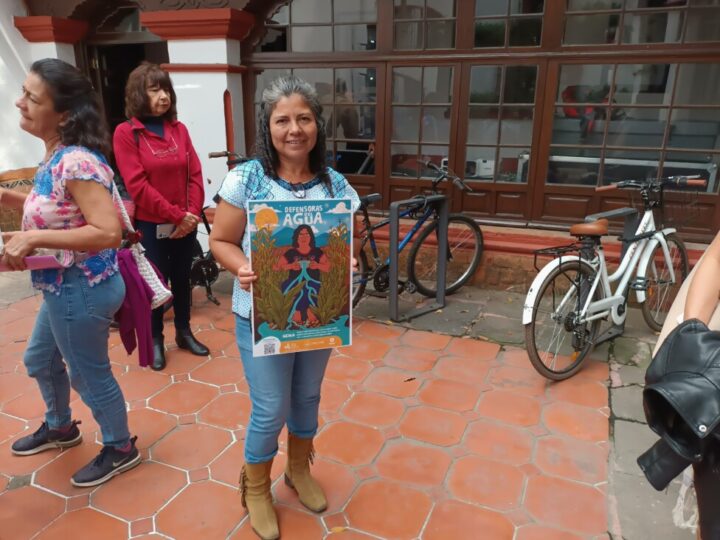
Dozens of women environmentalists participated in Mexico City in the launch of the Voices of Life campaign by eight non-governmental organizations on Oct. 12, 2023, which brings together hundreds of activists in five of the country's 32 states. CREDIT: Emilio Godoy / IPS

Dozens of women environmentalists participated in Mexico City in the launch of the Voices of Life campaign by eight non-governmental organizations on Oct. 12, 2023, which brings together hundreds of activists in five of the country’s 32 states. CREDIT: Emilio Godoy / IPS

MEXICO CITY, Oct 24 2023 (IPS) – The defense of the right to water led Gema Pacheco to become involved in environmental struggles in the southern Mexican state of Oaxaca, an area threatened by drought, land degradation, megaprojects, mining and deforestation.


Care “means first and foremost to value the place where we live, that the environment in which we grow up is part of our life and on which our existence depends,” said Pacheco, deputy municipal agent of San Matías Chilazoa, in the municipality of Ejutla de Crespo, some 355 kilometers south of Mexico City.

“We are in the phase of seeing how the Escazú Agreement will be applied. The most important thing is effective implementation. It is something new and it will not be ready overnight.” — Gisselle García

A biologist by profession, the activist is a member of the Local Committee for the Care and Defense of Water in San Matías Chilazoa, which belongs to the Coordinating Committee of Peoples United for the Care and Defense of Water (Copuda).

The local population is dedicated to growing corn, beans and chickpeas, an activity hampered by the scarcity of water in a country that has been suffering from a severe drought over the past year.

To deal with the phenomenon, the community created three water reservoirs and infiltration wells to feed the water table.

“Women’s participation has been restricted, there are few women in leadership positions. The main challenge is acceptance. There is little participation, because they see it as a waste of time and it is very demanding,” lamented Pacheco.

In November 2021, the 16 communities of Copuda obtained the right to manage the water resources in their territories, thus receiving water concessions.

But women activists like Pacheco face multiple threats for protecting their livelihoods and culture in a country where such activities can pose a lethal risk.

For this reason, eight organizations from five Mexican states launched the Voices of Life campaign on Oct. 12, involving hundreds of habitat protectors, some of whom came to the Mexican capital for the event, where IPS interviewed several of them.

Involvement in the defense of water led Gema Pacheco to become an environmental activist, participating in the Voices of Life campaign in Mexico, which seeks to bring visibility and respect to this high-risk activity in Mexico. CREDIT: Emilio Godoy / IPS

Involvement in the defense of water led Gema Pacheco to become an environmental activist, participating in the Voices of Life campaign in Mexico, which seeks to bring visibility and respect to this high-risk activity in Mexico. CREDIT: Emilio Godoy / IPS

The initiative seeks to promote the right to a healthy environment, facilitate environmental information, protect and recognize people and organizations that defend the environment, as well as learn how to use information and communication technologies.

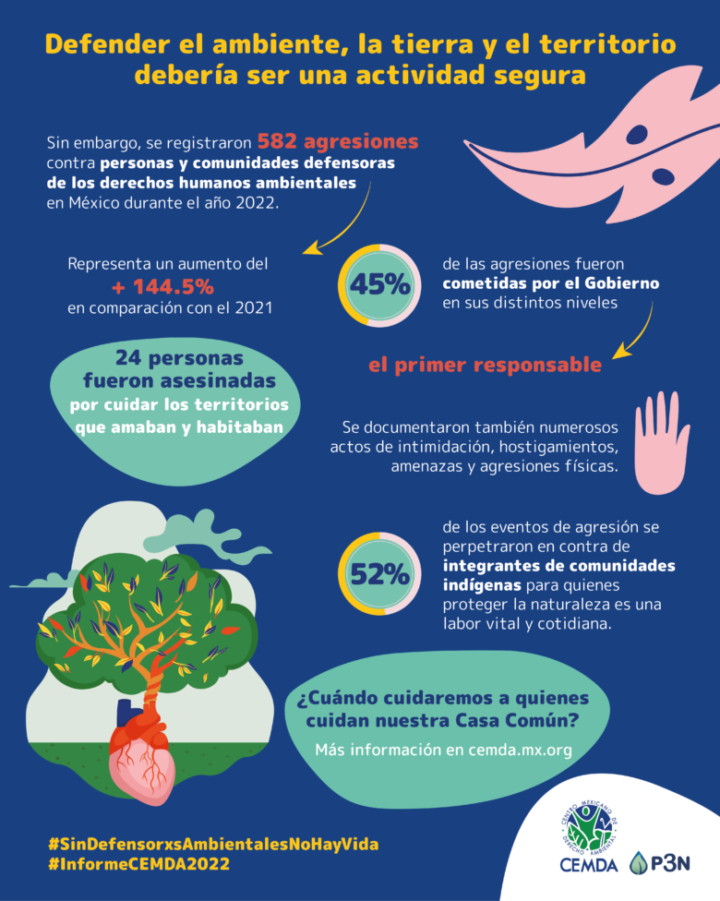
In 2022, Mexico ranked number three in Latin America in terms of murders of environmental activists, with 31 killed (four women and 16 indigenous people), behind Colombia (60) and Brazil (34), out of a global total of 177, according to the London-based non-governmental organization Global Witness.

A year earlier, this Latin American country of almost 129 million inhabitants ranked first on the planet, with 54 killings, so 2022 reflected an improvement.

“The situation in Mexico remains dire for defenders, and non-fatal attacks, including intimidation, threats, forced displacement, harassment and criminalization, continued to greatly complicate their work,” the report says.

The outlook remains serious for activists, as the non-governmental Mexican Center for Environmental Law (Cemda) documented 582 attacks in 2022, more than double the number in 2021. Oaxaca, Mexico City and the northern state of Chihuahua reported the highest number of attacks.

Urban problems

The south of Mexico City is home to the largest area of conservation land, but faces growing threats, such as deforestation, urbanization and irregular settlements.

Protected land defines the areas preserved by the public administration to ensure the survival of the land and its biodiversity.

Social anthropologist Tania Lopez said another risk has now emerged, in the form of the new General Land Use Planning Program 2020-2035 for the Mexican capital, which has a population of more than eight million people, although Greater Mexico City is home to more than 20 million.

“There was no public consultation of the plan based on a vision of development from the perspective of native peoples. In addition, it encourages real estate speculation, changes in land use and invasions,” said López, a member of the non-governmental organization Sembradoras Xochimilpas, part of the Voices of Life campaign.

Mexico is one of the most dangerous countries in the world for environmental defenders. In 2022, 31 activists were murdered, the third highest number in the region behind Colombia and Brazil. CREDIT: Cemda

Mexico is one of the most dangerous countries in the world for environmental defenders. In 2022, 31 activists were murdered, the third highest number in the region behind Colombia and Brazil. CREDIT: Cemda

Apart from the failure to carry out mandatory consultation processes, activists point out irregularities in the governmental Planning Institute and its technical and citizen advisory councils, because they are not included as members.

The conservation land, which provides clean air, water, agricultural production and protection of flora and fauna, totals some 87,000 hectares, more than half of Mexico City.

The plan stipulates conservation of rural and urban land. But critics of the program point out that the former would lose some 30,000 hectares, destined for rural housing.

The capital’s legislature is debating the program, which should have been ready by 2020.

Gisselle García, a lawyer with the non-governmental Interamerican Association for Environmental Defense, said attacks on women activists occur within a patriarchal culture that limits the existence of safe spaces for women’s participation in the defense of rights.

“It’s an entire system, which reflects the legal structure. If a woman files a civil or criminal complaint, she is not heard,” she told IPS, describing the special gender-based handicaps faced by women environmental defenders.

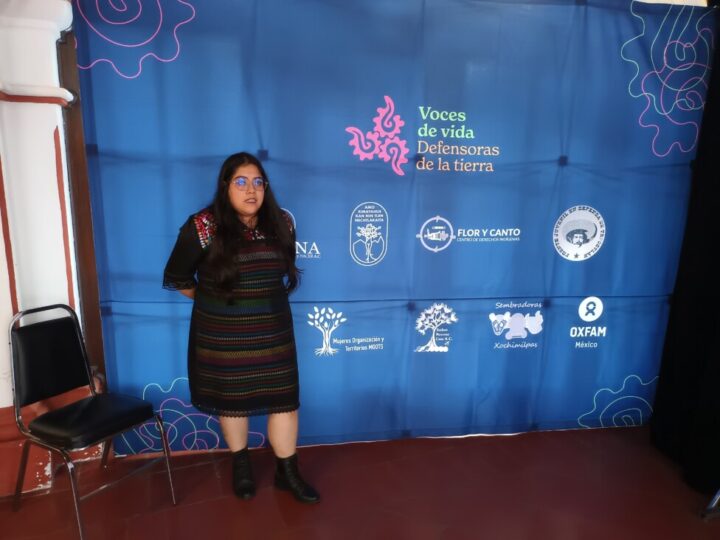
Social anthropologist Tania López is one of the members of the Voices of Life campaign, launched by eight non-governmental organizations on Oct. 12, 2023 to highlight the work of women environmental defenders in Mexico. CREDIT: Emilio Godoy / IPS

Social anthropologist Tania López is one of the members of the Voices of Life campaign, launched by eight non-governmental organizations on Oct. 12, 2023 to highlight the work of women environmental defenders in Mexico. CREDIT: Emilio Godoy / IPS

Still just an empty promise

This risky situation comes in the midst of preparations for the implementation of the Regional Agreement on Access to Information, Public Participation and Justice in Environmental Matters in Latin America and the Caribbean, known as the Escazú Agreement, an unprecedented treaty that aims to mitigate threats to defenders of the environment, in force since April 2021.

Article 9 of the Agreement stipulates the obligation to ensure a safe and enabling environment for the exercise of environmental defense, to take protective or preventive measures prior to an attack, and to take response actions.

The treaty, which takes its name from the Costa Rican city where it was signed, guarantees access to environmental information and justice, as well as public participation in environmental decision-making, to protect activists.

The Escazú Agreement has so far been signed by 24 Latin American and Caribbean countries, 15 of which have ratified it as well.

But its implementation is proceeding at the same slow pace as environmental protection in countries such as Mexico, where there are still no legislative changes to ensure its enforcement.

In August, the seven-person Committee to Support the Implementation of and Compliance with the Escazú Agreement took office. This is a non-contentious, consultative subsidiary body of the Conference of the Parties to the agreement to promote and support its implementation.

Meanwhile, in Mexico, the Escazú National Group, made up of government and civil society representatives, was formed in June to implement the treaty.

During the annual regional Second Forum of Human Rights Defenders, held Sept. 26-28 in Panama, participants called on the region’s governments to strengthen protection and ensure a safe and enabling environment for environmental protectors, particularly women.

While the Mexican women defenders who gathered in Mexico City valued the Escazú Agreement, they also stressed the importance of its dissemination and, even more so, its proper implementation.

Activists Pacheco and Lopez agreed on the need for national outreach, especially to stakeholders.

“We need more information to get out, a lot of work needs to be done, more people need to know about it,” said Pacheco.

The parties to the treaty are currently discussing a draft action plan that would cover 2024 to 2030.

The document calls for the generation of greater knowledge, awareness and dissemination of information on the situation, rights and role of individuals, groups and organizations that defend human rights in environmental matters, as well as on the existing instruments and mechanisms for prevention, protection and response.

It also seeks recognition of the work and contribution of individuals, groups and organizations that defend human rights, capacity building, support for national implementation and cooperation, as well as a follow-up and review scheme for the regional plan.

García the attorney said the regional treaty is just one more tool, however important it may be.

“We are in the phase of seeing how the Escazú Agreement will be applied. The most important thing is effective implementation. It is something new and it will not be ready overnight,” she said.

As it gains strength, the women defenders talk about how the treaty can help them in their work. “If they attack me, what do I do? Pull out the agreement and show it to them so they know they must respect me?” one of the women who are part of the Voices of Life campaign asked her fellow activists.

  Source

Innovative Family Farm in Cuba Uses Mix of Clean Energies

Active Citizens, Civil Society, Climate Action, Development & Aid, Editors’ Choice, Energy, Environment, Food and Agriculture, Headlines, Innovation, Integration and Development Brazilian-style, Latin America & the Caribbean, Projects, Regional Categories, Water & Sanitation

Energy

Artist and farmer Chavely Casimiro and her daughter Leah Amanda Díaz feed one of the biodigesters at Finca del Medio, a farm in central Cuba. The biodigester produces about seven meters of biogas per day, enough energy for cooking, baking and dehydrating food. CREDIT: Jorge Luis Baños / IPS

Artist and farmer Chavely Casimiro and her daughter Leah Amanda Díaz feed one of the biodigesters at Finca del Medio, a farm in central Cuba. The biodigester produces about seven meters of biogas per day, enough energy for cooking, baking and dehydrating food. CREDIT: Jorge Luis Baños / IPS

TAGUASCO, Cuba, Oct 2 2023 (IPS) – Combining technologies and innovations to take advantage of solar, wind, hydro and biomass potential has made the Finca del Medio farm an example in Cuba in the use of clean energies, which are the basis of its agroecological and environmental sanitation practices.


Renewable energy sources are used in many everyday processes such as electricity generation, lighting, water supply, irrigation and water heating, as well as in cooking, dehydrating, drying, baking and refrigeration of foodstuffs.

“We started out with windmills on artesian wells and hydraulic rams to pump water. That gave us an awareness of the amount of energy we needed and of how to expand its use,” said farmer José Antonio Casimiro, 65, owner of this agroecological family farm located in the center of this long Caribbean island nation.

“More incentives, better policies and financial support are needed so that farming families have sufficient energy for their work and can improve the comfort of their homes and quality of life.” — José Antonio Casimiro

The farmer expressed his appreciation of the help of his son, 41, also named Antonio Casimiro, in the installation of the two mills at Finca del Medio, during the days in which IPS visited the farm and shared in activities with the family.

“There was no one to assemble or repair them. We both had to study a great deal, and we learned to do a lot of construction things as we went along and perfected the techniques,” said Casimiro junior, referring to the equipment that is now inactive, but is capable of extracting some 4,000 liters of water daily from the water table.

When rainfall is abundant and the volume of the 55,000-cubic-meter-capacity reservoir rises, the hydraulic ram comes to life. The device diverts about 20,000 liters of water to a 45,000-liter tank, 400 meters away and 18 meters above the level of the reservoir.

“The only energy the rams use is the water pressure itself. Placing it on the highest part of the land makes it easier to use the slope for gravity irrigation, or to fill the animals’ water troughs,” explained Chavely Casimiro, 28, the youngest daughter of José Antonio and Mileidy Rodríguez, also 65.

An artist who also inherited the family’s “farming gene”, Chavely highlighted some twenty innovations made by her father to the hydraulic ram, in order to optimize water collection.

Other inventions speed up the assembly and disassembly of the windmills for maintenance, or in the event of tropical cyclones.

“We have been replacing the water supply with solar panels, which are more efficient. They can be removed faster (than the windmill blades) if a hurricane is coming. You can incorporate batteries and store the energy,” said Casimiro.

“Let’s say a windmill costs about 2,000 dollars. With that amount you can buy four 350-watt panels. That would be more than a kilowatt hour (kWh) of power. You buy a couple of batteries for 250 dollars each, and with that amount of kWh you can pump the equivalent of the water of about 10 windmills,” he said.

But the farmer said the windmills are more important than the energy they generate. “It would be nice if every farm had at least one windmill. For me it is very symbolic to see them pumping up water,” he said.

Lorenzo Díaz, the husband of Chavely Casimiro, uses a solar oven to cook food. In the background can be seen a windmill and a solar heater, other technologies that take advantage of the potential for renewable energies on the Finca del Medio farm in central Cuba. CREDIT: Jorge Luis Baños / IPS

Lorenzo Díaz, the husband of Chavely Casimiro, uses a solar oven to cook food. In the background can be seen a windmill and a solar heater, other technologies that take advantage of the potential for renewable energies on the Finca del Medio farm in central Cuba. CREDIT: Jorge Luis Baños / IPS

Innovations

Located in the municipality of Taguasco, in the central province of Sancti Spíritus, some 350 kilometers east of Havana, Finca del Medio follows a family farm model including permaculture, agroecology and agricultural production based on the use of clean energy.

In 1993, Casimiro and Rodríguez with their children Leidy and José Antonio – a year later, Chavely was born – decided to settle on the 13-hectare farm of their paternal grandparents, with the aim of reversing its deterioration and soil erosion and installing perimeter fences.

The erosion of the land was due to the fact that in the past the farm was dedicated to the cultivation of tobacco, which depleted the soil, and later it had fallen into abandonment, as well as the house.

The older daughter is the only one who does not live and work on the farm, although she does spend time there, and a total of ten family members live there, including four grandchildren. All the adults either work on the farm or help out with different tasks.

With the help of technological innovations adapted to the local ecosystem, and empirical and scientific knowledge, the family has become self-sufficient in rice, beans, tubers, vegetables, milk, eggs, honey, meat, fish and more than 30 varieties of fruit. The only basic foodstuffs not produced on the farm are sugar and salt.

They sell all surplus production, including cow’s milk, for which they have specific contracts, and they are also promoting agrotourism, for which they are making further improvements to the facilities.

At Finca del Medio, a system of channels and ditches allows the infiltration of rainwater, reduces erosion of the topsoil and conserves as much water as possible for subsequent irrigation.

These innovations also benefit neighboring communities by mitigating flooding and replenishing the water table, which has brought water back to formerly dry wells.

The construction of the house is also an offshoot of technological solutions to the scarcity of resources such as steel, which led to the design of dome-shaped roofs made of mud bricks and cement.

The design aids in rainwater harvesting, improves hurricane protection, and boosts ventilation, creating cooler spaces, which reduces the need for air conditioning equipment and bolsters savings.

Along with food production, the new generations and members of the Casimiro-Rodriguez family engage in educational activities to raise awareness about good agricultural and environmental practices.

Students from nearby schools come to the farm to learn about these practices, as well as specialists in agroecology and people from different parts of the world, interested in sharing the experience. Meanwhile, several members of the family have traveled abroad to give workshops on agroecology and permaculture.

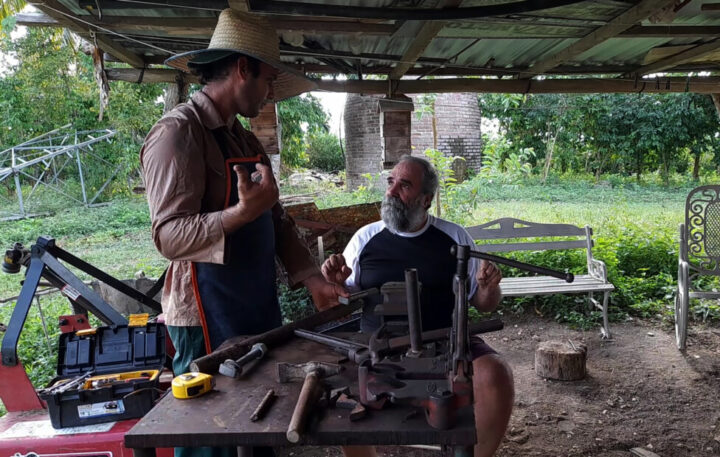
Farmers José Antonio Casimiro and his son of the same name talk in the mechanical workshop at their Finca del Medio farm. Both have come up with innovations for the use of windmills, the hydraulic ram and biodigesters, as well as agricultural tools. CREDIT: Jorge Luis Baños / IPS

Farmers José Antonio Casimiro (R) and his son of the same name talk in the mechanical workshop at their Finca del Medio farm. Both have come up with innovations for the use of windmills, the hydraulic ram and biodigesters, as well as agricultural tools. CREDIT: Jorge Luis Baños / IPS

Solar and biogas potential

On one of the side roofs of the house are 28 photovoltaic panels that provide about eight kWh, connected to batteries. The stored energy covers the household’s needs during power outages that affect the island due to fuel shortages and breakdowns and problems in maintenance of its aging thermoelectric plants.

In addition, the household has three solar water heaters with a capacity of 380 liters.

Next to the kitchen, two fixed-dome biodigesters produce another renewable fuel, biogas, composed mainly of methane and carbon dioxide from the anaerobic decomposition of animal manure, crop waste and “even sewage from the house, which we channel so that the waste does not contaminate the environment,” said Casimiro.

Due to the current shortage of manure as the number of cows has been reduced, only one of the biodigesters is now operational, producing about seven meters of biogas per day, sufficient for cooking, baking and dehydration of foodstuffs.

The innovative family devised a mechanism to extract – without emptying the pond of water or stopping biogas production – from the bottom the solids used as biofertilizers, as well as hundreds of liters of effluent for fertigation (a combination of organic fertilizers and water) of the crops, by gravity.

The installation of the biodigesters, the solar panels and one of the solar heaters was supported by the Swiss Agency for Development and Cooperation (Cosude) and the Indio Hatuey Experimental Station of Pastures and Forages through its Biomass-Cuba project, Casimiro said.

He also expressed gratitude for the link with other scientific institutions such as the Integrated Center for Appropriate Technologies, based in the central province of Camagüey, which is focused on offering solutions to the needs of water supply and environmental sanitation, and played an essential role in the installation of the hydraulic ram.

The farmer said the farm produces the equivalent of about 20 kWh from the combination of renewable energies, and if only conventional electricity were used, the cost would be around 83 dollars a month.

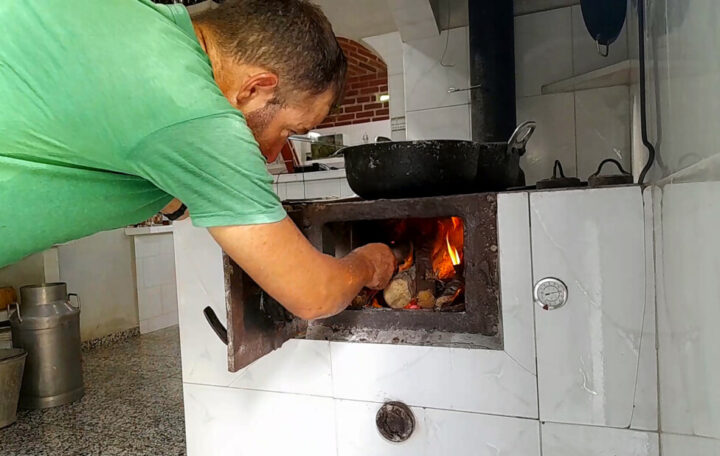
Lorenzo Díaz feeds firewood into an innovative stove that allows the Finca del Medio farm to efficiently cook food, dehydrate or dry fruits and spices, heat water and preserve meat, among other functions. CREDIT: Jorge Luis Baños / IPS

Lorenzo Díaz feeds firewood into an innovative stove that allows the Finca del Medio farm to efficiently cook food, dehydrate or dry fruits and spices, heat water and preserve meat, among other functions. CREDIT: Jorge Luis Baños / IPS

Efficient stove

In the large, functional kitchen, the stove covered with white tiles and a chimney has been remodeled 16 times to make it more efficient and turn it into another source of pride at the farm.

Fueled by firewood, coconut shells and other waste, “the stove makes it possible to cook food, dehydrate fruits and spices, heat water and preserve meat, among other tasks,” Rodríguez told IPS as she listed some of the advantages of this other offshoot of the family’s ingenuity that helps her as a skilled cook and pastry chef.

She pointed out that by extracting all the smoke, “the design makes better use of the heat, which will be used in a sauna” being built next to the kitchen, for the enjoyment of the family and potential tourists.

Casimiro is in favor of incorporating clean energy into agricultural processes, but he said that “more incentives, better policies and financial support are needed so that farming families have sufficient energy for their work and can improve the comfort of their homes and quality of life.”

Since 2014, Cuba has had a policy for the development of renewable energy sources and their efficient use.

A substantial modification of the national energy mix, which is highly dependent on the import of fossil fuels and hit by cyclical energy deficits, is a matter of national security

However, regulations with certain customs exemptions and other incentives to increase the production of solar, wind, biomass and hydroelectric energies in this Caribbean island nation still seem insufficient in view of the high prices of these technologies, the domestic economic crisis and the meager purchasing power of most Cuban families.

Clean sources account for only five percent of the island’s electricity generation, a scenario that the government wants to radically transform, with an ambitious goal of a 37 percent proportion by 2030, which is increasingly difficult to achieve.

  Source