The Multiplicity of Zanele Muholi

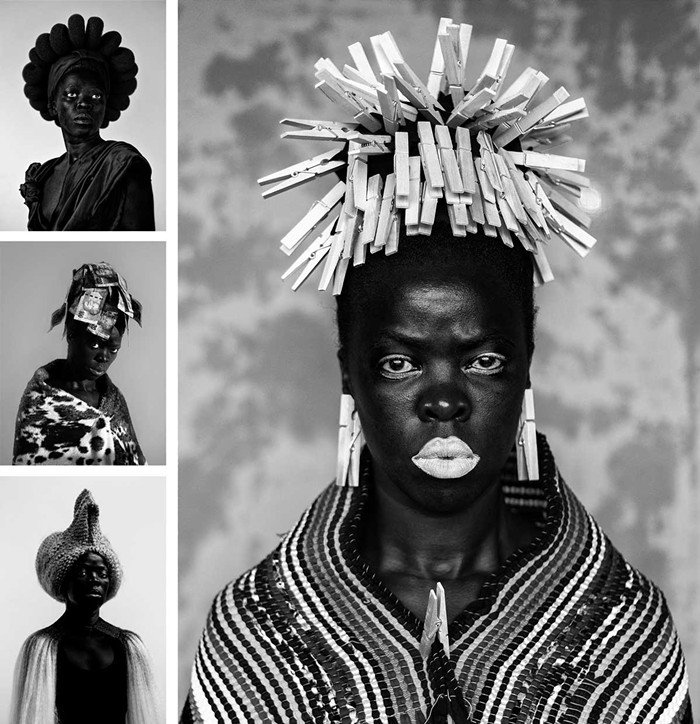
Each photograph contains only one subject: Muholi. The self-portraits were taken over a three-year period. All photos courtesy of Zanele Muholi and Seattle Art Museum

The exhibition is dimly lit. And it’s supposed to be—it’s part of what makes it great. When I walked through the press preview, someone requested that the lights in the galleries be turned up. Our guide politely declined. The South African photographer and “visual activist” Zanele Muholi, whose “self-portraits captured with a camera” compose the show, had come through just that morning to tweak the lighting the way they liked it, sure of how they’d like to be seen.

Somnyama Ngonyama, Hail the Dark Lioness consists of around 75 black-and-white self-portraits that spill out of Seattle Art Museum’s Jacob Lawrence and Gwendolyn Knight Gallery and into the hallway and gallery that abut it. The walls are painted black, charcoal gray, and white, providing no bright contrast of any sort. Eight of Muholi’s portraits are blown up to the size of walls, almost physically involving the viewer in the composition; the others range in size, the smallest being the size of a large hand.

Each photograph contains only one subject: Muholi. The portraits were taken over a three-year period from 2014 to 2016 as Muholi traveled the world, giving guest lectures and participating in residencies in places like Oslo, Norway; Richmond, Virginia; and Mayotte, a French territory off the east coast of Africa.

“They are taken in various places wherever I wake up, so a sense of space is connected to my realities as I respond to many things I have encountered,” the artist told me. “This is my own way of undoing many things, including racism, but I use my own body as a subject of my own art.”

Muholi’s work is powerful because it recognizes the multiplicity of blackness and of self. It’s a reminder that to be black—as a condition, as a culture—is a complex state of being that’s often reduced to a single thing and, therefore, misread. Muholi’s personal ties to their queer and black community back in South Africa only deepen the ways in which their self-portraits can be read. Aesthetically, the work is both editorial and DIY, serious and playful.

The child of a Zulu mother and a Malawian father, Muholi was born in Umlazi, South Africa, in 1972. Muholi was a baby when their father died, and their mother worked as a maid to provide for the family. After completing an advanced photography course at Market Photo Workshop in Newtown, Johannesburg, Muholi had their first solo exhibition at Johannesburg Art Gallery in 2006.

In 2002, they cofounded and worked as a community-relations officer for the Forum for the Empowerment of Women, a black lesbian organization based in Gauteng, South Africa. They also reported and photographed for the blog Behind the Mask, which focused on gay and lesbian issues in the African continent.

This work set the stage for one of Muholi’s most discussed projects, their ongoing series Faces and Phases that began in 2006, for which Muholi photographs black lesbian, transgender, and intersex South Africans from their own community. The portraits came at a time when queer black South Africans were experiencing a wave of hate crimes and murders.

That series—which now includes more than 250 portraits—features queer couples and trans, lesbian, and genderqueer individuals presenting themselves to the camera, looking directly into the lens. It is, in part, a visual archive that does not play into any stereotypes or fears about this community, but rather respects and validates this community’s existence. These people whom Muholi photographs and works with are collaborators who accompany Muholi wherever they go.

Muholi’s work in Somnyama Ngonyama flows along a similar vein. “This [show] is on race, specifically responding to a number of events that are taking place in South Africa and beyond. There’s a lot of ongoing racism that is taking place and we hardly have the opportunity to respond as art practitioners or creatives to speak to such atrocities, violent racism, and displacement of our people,” the artist told me. “I’m not talking about myself only, but I’m talking about many other people whose voices are there but not heard.”

Most of the self-portraits in the exhibition at Seattle Art Museum feature Muholi looking directly at the camera, engaging the viewer. In the pictures, their skin appears uniformly darker than in real life, the whites of their eyes whiter, a result of them cranking up the contrast postproduction. They emphasized to me that there is no artificiality of any kind in their photographs, using only available light and spaces.

Eschewing high-quality materials, Muholi searched for discarded, mundane, cheap materials in each of the locations they traveled to, and then manipulated those findings to transform them into something greater than the sum of their parts. Often, these “un-African” materials were fashioned to resemble or recall something African, something that reminded Muholi of home. Rubber bicycle tires become a head wrap and dress; wooden clothespins become an elaborate headpiece; steel wool becomes a crown in tribute to their mother, Bester.

Whether using markers, wooden chopsticks, cheap dream catchers, power strips, vacuum tubes, blown up rubber gloves, scissors, chairs, hair buns from H&M, or actual money, Muholi embodies many different characters and selves. It’s more than just playing dress up, but rather an intended confusion for the viewer, each different character—lion, jester, king, queen, nurse, prisoner, lover—calling into question what we see when we see each other.

This embodiment challenges the presumed audience about their assumptions—here in Seattle, that audience is mostly white people—and about their own visual archive of black people. In the photograph Ntozakhe II, Parktown, 2016, Muholi is fashioned after the Statue of Liberty. Are black people in the United States truly free? If the Statue of Liberty were black, would our concepts of freedom and justice be different? In another wall-size photograph, Bhekisisa, Sakouli beach, Mayotte, 2016, Muholi’s body lies almost hidden among the rocks on a beach of Mayotte. To a viewer, what could that evoke? Refugees? As a critic, I’m keenly aware that I bring myself and my history to whatever I look at. Muholi is asking me to dissect and strip away that stuff.

When I mentioned Cindy Sherman—a white American artist known for her movie-like photographs in which she inhabits different characters—Muholi grinned. They get that comparison a lot. “Cindy cannot connect to our reality—not ever, not tomorrow,” the artist said, referring to the black community.
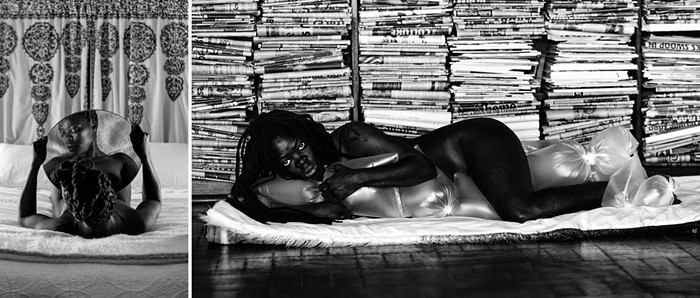
Each different character—lion, jester, queen, nurse, prisoner, lover—calls into question what we see when we see each other.

For comparison and context, they offered that black American visual artist Renee Cox is a better reference point. How we think about what an artist does requires an attentiveness, a willingness to look beyond our own ways of thinking, the connections we make, our own perception of the canon.

At the opening reception for the exhibition, I stood in the drink line behind an aloof-looking older white man who was making conversation with a younger black acquaintance about the show. He leaned in, familiarly, conspiratorially, referencing the photos: “They’re frightening, though, aren’t they?”

His acquaintance gave a humorless chuckle before grabbing a drink and slipping back into the crowd.

Frightening. My brain wrestled with the word as I watched the man sip his drink unbothered and wander back into the celebration. My thoughts drifted back to earlier in the day when a white woman asked Muholi if their portrait Julile I, Parktown, Johannesburg, 2016 was a reference to Édouard Manet’s Olympia. In the picture, Muholi is lying, naked, in front of tall stacks of newspapers while a length of plastic pads wraps around their leg.

Muholi was quick to correct the woman: No, no, this photo was taken days before an operation they were to have that would take tumors out of their uterus. This self-portrait was about the state of panic they were in surrounding whether or not they’d survive the surgery. Manet was not on their mind.

In no portrait does Muholi give a smile. The photos are not meant to appease in that sense. But that does not mean that there is a lack of emotion in the show. Rather, there’s an abundance of emotion.

“There are images that are super ugly,” the artist told me. “There are images that will make the next person feel like, ‘Wow!’ There are other images where you’re like, ‘Why do we have to look at this?’ It is through those images in which I want other people to find their own responses.”

That made me wonder about the responses I’d witnessed. Could it be that Muholi’s blackness was read as something to be feared, and their pain was read as beauty? The white woman referencing Manet misread the pain of Muholi’s photograph and saw beauty. The white man looked at Muholi’s willingness to present their body—their culture, their history, their sexuality, their many selves—and saw something frightening, perhaps his own fear. Maybe he saw that he didn’t know what he didn’t know.
Source

Biased Media Downplays Biden’s Lies as Mere ‘Gaffes’

I have heard the word “gaffe” used more in the last 2 months than in the previous 40 years of my life. If you want to better understand how the media controls our perspective, Google the word “gaffe.” You will see several pictures of Joe Biden. Now, Google the word “liar.” You will see several pictures of Donald Trump.

One politician misrepresents a story and he is called a stone cold liar, while the other politician misrepresents a story and it’s brushed off as a gaffe.

Come on America, we can’t be this shallow.

While Google proudly displays dozens of pages of stories and posts categorizing President Trump as the “Liar in Chief,” it should be very alarming to all Americans that they allow such one sided stories to make it into the media. In the last couple of weeks, Joe Biden has lied during a heartfelt story of him pinning a Silver Star on a Navy hero, even emphasizing his false statement on, “My word as a Biden.” He literally took pieces from several serious moments and combined them in order to win political points and tap into the emotions of potential voters. Sick in my opinion.

To make matters worse, on multiple occasions Joe Biden has falsely stated that he was the Vice President when he met with the kids of Parkland following the horrible school shooting. Ok, he’s making a habit of blending stories and timelines to tap into the hearts of voters.

As a Parkland Resident, I would like to agree with the liberal media and call this mix up a “gaffe.” I just cannot deny the reality that Mr. Biden told this story on more than one occasion and continued to use it as a way to get political points following the recent horrific mass shootings across America. If this had been President Trump, the media would have made him out as nothing less than Satan.

Joe’s word as a Biden unfortunately flip-flops with the weather as he continued to show that he values votes over morality. After years of showing strong Christian values when it comes to opposing our government funding of abortions, his truth has again changed in an effort for votes within his farther left leaning Democratic Party.

The scariest part of all of this is the fact that former VP Joe Biden has been given a “gaffe” pass for supporting and establishing some of the most oppressive legislation in U.S. history: segregation and mass incarceration.

Joe Biden’s history of segregation includes supporting a measure sponsored by Senator Robert Byrd (D-W.Va.), a former Klansman who had held the floor for more than 14 hours in a filibuster against the 1964 civil rights bill that prohibited the use of federal funds to transport students beyond the school closest to their homes and that passed into law in 1976.

In an attempt to raise her own political profile, Harris’ recent efforts to call out Biden were no match when facing the reality that Obama, Hillary and Bill Clinton, Biden and others were strong supporters of the former KKK leader Byrd and other systematic racist colleagues. Imagine if President Trump was adamantly supporting a KKK leader, imagine.

President Trump’s decades-old messy battle with the Central Park Five has opened racist wounds for anti-Trumpers. This angered me as a black man who fights for the rights of the wrongfully incarcerated, though it’s still tough for me to compare this to systematic racist agenda of literally locking up millions of people for nonviolent crimes. Ironically, the so-called Liar in Chief has full-feature movies about his accusations of racism, while Joe Biden’s institutionalized racist policies have been brushed to the side and were even disregarded by Barack Obama, the first half-black President of the United States of America. Where’s the movie that shows the years of lobbying and campaigning that it took for Joe Biden to help lock up millions of black men or the efforts he put into pushing policies that prolonged the racial integration of American public schools and communities. If you’re having trouble accepting these harsh realities, read my deep explanation of the “loving your oppressor syndrome,” it may bring some clarity.

It’s scary to accept the fact that Joe Biden has growing black voter support even while being a pioneer of the mass incarceration of black men. Imagine a black person reading this article, citing the references and still voting for Joe Biden. You may have seen many black influencers who remain on the “plantation” calling out African American Trump supporters. These people are very similar to the chiefs in Africa who sold their poor tribal residents to the British and American settlers. I guess I’ll keep allowing truth and policy to be my treatment for mental illness.

President Trump is called racist for calling NFL Players “S.O.B’s” for not standing for the national anthem. Joe Biden is voted Vice President and is highly favored by blacks in America despite emphatically stating “Lock those S.O.B’s Up,” during the passing of his mandatory minimum sentences of 1994 Crime Bill which incarcerated well over 3 million black men for nonviolent crimes. I guess it’s the tale of two S.O.B.’s. One worked to disproportionately lock black people up and the other has worked to reverse this same legislation in order to set us free.

Hopefully “facts” will supersede our determination of a “lie” or a “gaffe.”

Jack Brewer possesses a unique combination of expertise in the fields of global economic development, sports, and finance through his roles as a successful entrepreneur, executive producer, news contributor, and humanitarian. Currently serving as the CEO and Portfolio Manager of The Brewer Group, Inc. as well as the Founder and Executive Director of The Jack Brewer Foundation (JBF Worldwide), active Shriner and Ambassador and National Spokesperson for the National Association of Police Athletic/ Activities Leagues, Inc. Other key roles include regular contributor to CNBC, Fox Business, and The American City Business Journals, Ambassador for Peace and Sport for the International Federation for Peace and Sustainable Development at the United Nations, Senior Advisor to former H.E. President Joyce Banda of the Republic of Malawi, and three time National Football League (NFL) Team Captain for the Minnesota Vikings, Philadelphia Eagles, and New York Giants. To read more of his reports — Click Here Now.

Source

Chakwera’s Hurry to Destruction

BY MZATI NKOLOKOSA

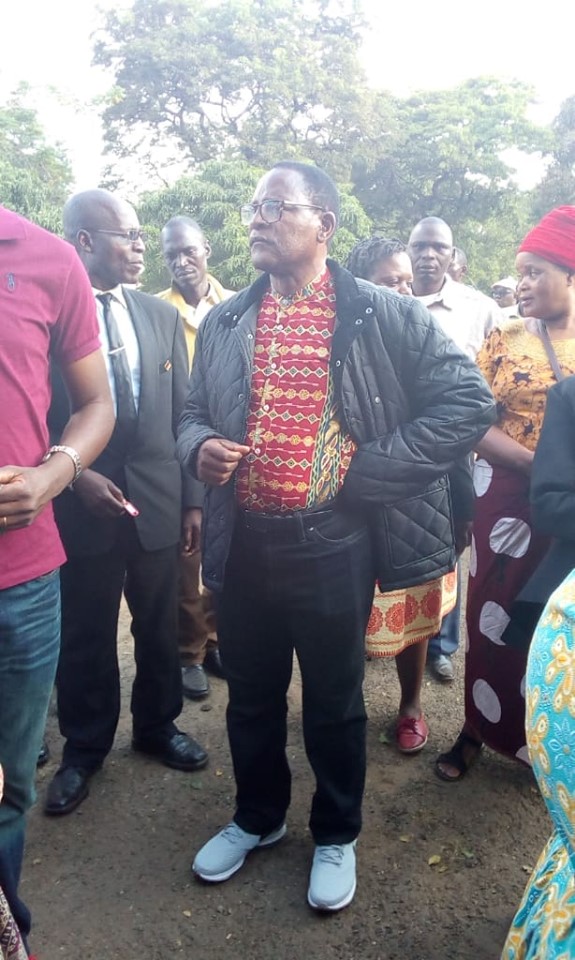
Chakwera: He lost an election, yet he claims victory

The use of Tipp Ex in the 2019 elections was first reported at Chinsapo in Lilongwe on the night of 21 May.

A DPP monitor noted the correctional fluid on one of the centre’s result tabulation tables.  Immediately, the monitor alerted members of DPP Monitors Whatsapp group. They agreed to stay awake and alert all night.   
Some minutes after the Whatsapp alert, three DPP monitors at a centre in Dowa, outside Kamuzu International Airport, noticed Tipp Ex and queried attempts to change figures.  MCP monitors became angry and were about to beat up the three DPP monitors when they ran away to the airport for safety. They never returned to the centre. They called a friend from town to pick them up from the airport.

There are such stories of violence against DPP and UTM monitors in some parts of the country. But there is also good news: MEC officers remained vigilant and MCP’s plan of tampering with results in favour of Lazarus Chakwera, collapsed.

MEC chairperson Jane Ansah’s question, “who gave you Tipp ex?” has not been understood up to now. It is a reflective question for all of us because Ansah is aware Tipp-Ex was introduced by the MCP and her question was meant to help us to think deeply about MCP’s hidden agenda. In addition, her question was meant to inspire journalists to investigate Tipp Ex in the election.

Tipp Ex failed. MCP did not rig the election because MEC systems were tight and staff tabulated results professionally. MEC’s professionalism annoyed MCP so much that the party started drama to damage the elections that were managed professionally, according to party monitors and electoral institutions, both local and foreign. MCP’s demand for Ansah to resign is the work of Chakwera. He is as such. He loves being what he is not.
It is not the first time for Chakwera to behave so. The story of his life shows a man who does what he preaches against or a man who preaches against what he does.

In 2018, the Ministry of Finance disbursed K4 billion development fund to all parliamentarians. Chakwera and his MCP approved the allocation in Parliament on Thursday, 1 March, 2018, and received an amount allocated to each MP. The same Chakwera sent his boy Timothy Mtambo, a well-known MCP functionary, who trades under human rights activism, to organise demonstrations against the development funding. Chakwera joined the demonstrations against funding that he supported, approved and received.  

Chakwera portrays himself as an angel sent from heaven but he is not. Instead, he is a troubled human being ready to shed blood to quench his hunger for power. He has failed to take MCP to victory twice and the next move was for him to resign to pave way for someone else. Instead, Chakwera is clinging to MCP’s presidency, searching for a third term via the court. It is funny, isn’t it? How Chakwera is managing to fool MCP for him to remain the party’s president.

This is a Chakwera who, during a press briefing on 2 November 2018, called Mutharika a “pathological liar.” Yet in reality, Chakwera is that “pathological liar.” He has, for example, been referring to present demonstrations as peaceful yet allowing people from his area to terrorise motorists on Kasiya Road. Some motorists had to pay up to K20,000 to buy their way.

Chakwera is requiring MCP MPs to ferry hundreds of people armed with pangas from rural areas of central region to the capital for demonstrations, a story that journalists have chosen to ignore. This is a Chakwera who asked MEC to release results less than 24 hours after voting closed, saying he had won and “I am the commander-in-chief” of the armed forces. And within 48 hours, the same Chakwera obtained an injunction restraining MEC from announcing results of the presidential poll.  

This is a Chakwera who failed to make an alliance with UTM and lost the election. Now he is fooling his supporters with a post-election alliance with UTM. Doing what he preached against and preaching against what he is doing. And his supporters have fallen for the childish tactic.   This is a Chakwera who, two months before elections, was planning disturbing the elections. Yet he poses as if he did not have such an evil plan with Mtambo.
He is a Malawian but speaks with an African-American tongue. He lost an election, yet he claims victory.
This Chakwera, always wanting what he is not.

Source

Woman healed from Fibroid for 10yrs after climbed Prophet TB Joshua’s SCOAN altar

LAGOS-(MaraviPost)-Real Prophets are still  living in this modern generation that God’s children are being healed and freed from bondage of affliction.

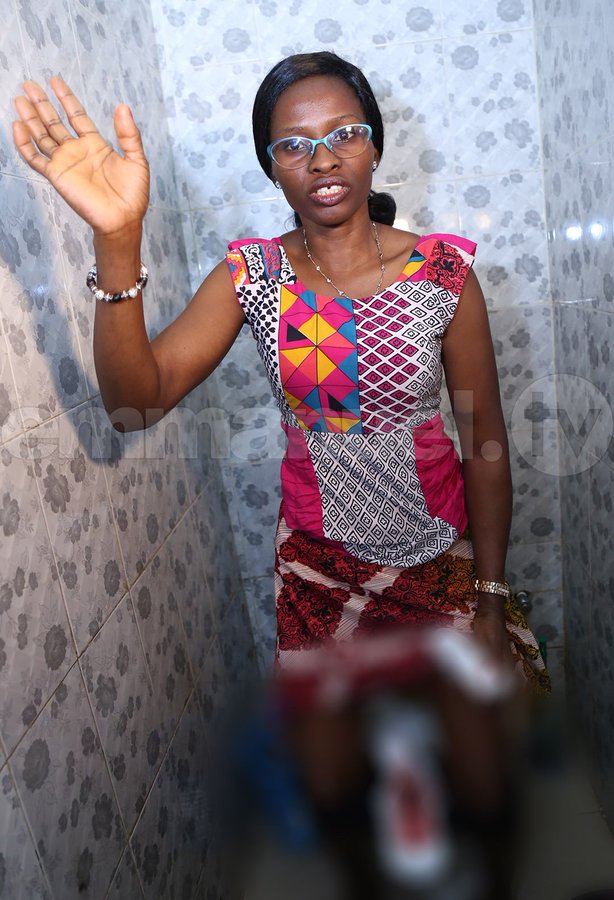
On last Sunday a woman identified as Favour Akowe testified after coming to Prophet TB.Joshua’s Synagogue Church of All Nation (SCOAN) Altar with the burden of fibroid for 10 years.

By faith, she climbed The SCOAN Altar and took the Living Water.

Immediately she felt something burst within her and when she rushed to the toilet, behold the fibroid had burst!

Monitored also on SCOAN’s Emmanuel TV, Akowe told the gathering that she was healed from the diseases that had been tormenting her for years.

She confessed that God is still living in Prophet TB. Joshua in the modern generation.

“I have visited many hospitals across but nothing worked. Once, the man of God, TB Joshua prophesied that I had Fibroid for years, I acknowledged that God is indeed living.

“The moment I climbed at SCOAN’s altar, the scourage of the the disease left me immediately and that was my healing. I dint believe that will be be healed,” she confessed.

Akowe added, “TB Joshua’s SCOAN is the living church that God is using it to serve his children. Despite that was healed from the disease, the church offered me a good reception with provision of food and shelter”.

What are fibroids?

Fibroids are abnormal growths that develop in or on a woman’s uterus. Sometimes these tumors become quite large and cause severe abdominal pain and heavy periods. In other cases, they cause no signs or symptoms at all. The growths are typically benign, or noncancerous. The cause of fibroids is unknown.

Fibroids are also known by the following names:

  • leiomyomas
  • myomas
  • uterine myomas
  • fibromas

According to the National Institutes of Health (NIH), about up to 80 percent of women have them by the age of 50. However, most women don’t have any symptoms and may never know they have fibroids.

The type of fibroid a woman develops depends on its location in or on the uterus.

Intramural fibroids

Intramural fibroids are the most common type of fibroid. These types appear within the muscular wall of the uterus. Intramural fibroids may grow larger and can stretch your womb.

Subserosal fibroids

Subserosal fibroids form on the outside of your uterus, which is called the serosa. They may grow large enough to make your womb appear bigger on one side.

Pedunculated fibroids

Subserosal tumors can develop a stem, a slender base that supports the tumor. When they do, they’re known as pedunculated fibroids.

Submucosal fibroids

These types of tumors develop in the middle muscle layer, or myometrium, of your uterus. Submucosal tumors aren’t as common as the other types.

What causes fibroids?

It’s unclear why fibroids develop, but several factors may influence their formation.

Hormones

Estrogen and progesterone are the hormones produced by the ovaries. They cause the uterine lining to regenerate during each menstrual cycle and may stimulate the growth of fibroids.

Family history

Fibroids may run in the family. If your mother, sister, or grandmother has a history of this condition, you may develop it as well.

Pregnancy

Pregnancy increases the production of estrogen and progesterone in your body. Fibroids may develop and grow rapidly while you’re pregnant.

Women are at greater risk for developing fibroids if they have one or more of the following risk factors:

  • pregnancy
  • a family history of fibroids
  • age of 30 or older
  • African-American
  • a high body weight

What are the symptoms of fibroids?

Your symptoms will depend on the number of tumors you have as well as their location and size. For instance, submucosal fibroids may cause heavy menstrual bleeding and trouble conceiving.

If your tumor is very small or you’re going through menopause, you may not have any symptoms. Fibroids may shrink during and after menopause. This is because women undergoing menopause are experiencing a drop in their levels of estrogen and progesterone, hormones that stimulate fibroid growth.

Symptoms of fibroids may include:

Source on fibroids:  https://www.healthline.com/health/uterine-fibroids

This publication was in one week fact finding mission to the church in Lagos, Nigeria to have a true reflection on how God is working in Prophet T.B Joshua.

:

Source

The language debate in Namibia and the case for Namlish

The 2nd August 2019 edition of the New Era newspaper carried two very interesting opinion pieces. One piece was written by Lawrence Kamwi and the other was written by Professor Jairos Kangira. Kamwi’s piece was titled “African togetherness is a character-reclaiming exercise” and that of Kangira was titled “Swahili: A punishment to turn learners into polygots.”

The two opinion pieces were about the same thing – the language debate in Namibia and in Africa in general. Both pieces opened up a debate about the need to construct a national identity through a common language; which national identity is currently very fluid and fragile in Namibia.  Language is central to the construction of a common national identity; and Swahili in Tanzania and, to some extent, Chi Nyanja in Zambia and Chichewa in Malawi are cases in point.

Professor Kangira argued that because of cost implications and other challenges, the introduction of Swahili in Namibia would not be a realistic option at this point in time – much as the Government intention is noble. In what seemed to be a response to Professor Kangira’s piece, Tjirera and Harris eloquently weighed in on that debate, by making a strong case for Swahili (The Namibian, 23rd August 2019).  For now, I do not want to enter that debate. 

Although Kamwi’s piece was very educative, his argument was, however, deconstructive in the sense that it bemoaned the usage of a European language in an African context without offering a viable alternative. He quoted extensively from Ngungi wa Thiongo to make his point that “…language, any language, has a dual character; it is both a means of communication and a carrier of culture”. 

Kamwi went on to quote Ngungi again that: “…the choice of language and the use to which it is put is central to a people’s definition of themselves in relation to their natural and social environment, indeed in relation to the entire universe.” I fully agree with Kamwi because the dichotomy between the previously disadvantaged African languages and the colonial languages in Africa hinges on those two quotes from Ngungi. Language is central to the Pan Afrikan debate about self-definition and self-identification.

Kamwi also clinically zeroed in on the debate between Kenya’s Ngungi wa Thgiongo and Nigeria’s Chinua Achebe. The bone of contention between these two celebrated African men of letters is whether African writers should use a European language in their writings or their mother tongue.  Ngungi argues that as part of the decolonisation of the mind, Africans should write in their own languages; whereas Chinua argues that the language of the coloniser has become part of our social reality and we should “Afrikanise” it.  Chinua also argues that writing in your own African language can be very restrictive when it comes to sharing your ideas with a wider audience – including with fellow Africans. In short, Chinua’s argument is that, as Africans, we should have the liberty to put in African phrases and sentence constructions in our usage of English (for example). This is how Pidgin English that is widely spoken in West Africa came about. The heading of my opinion piece that was published in the same issue of New Era, titled “Do you speak the language small” was borrowed from Pidgin English. One African literary writer once wrote “…the lady was with the moon.” As an African I could easily relate to that because in my language “… the lady being with the moon” means that she is, in Biblical terms, “…in the custom of women…” That is one example of Africanising English. 

For practical reasons we have adopted English as our official language. However, why should we fall over ourselves to prove as to who can speak better English? Whose language is it? Perhaps to put it differently, we tend to admire an African who speaks good English, but pay very little attention (if any) to someone who speaks his/her African mother tongue well. More often than not, we even tend to scorn them. That is a sign of inferiority complex; and as I have argued somewhere else “…the danger of inferiority complex is that the victim is not aware that he/she is a victim.” 

Regarding the Ngungi-Chinua debate, I tend to agree more with Chinua rather than with Ngungi. We need to remember that Pidgin English spoken in West Africa and the African-American Slang, started the same way as our Namlish. Given our ethnic identity politics which has a bearing on language, or vice versa, which African language would you introduce as an official language in Namibia? Therefore as Namibians we should embrace Namlish, which started off as a joke shortly after our independence. Namlish is alive and well and we should not be ashamed of it. I am not saying we should use it in official business communication, but what is wrong with our young people using it in everyday informal communication. Who knows, maybe by the time they become grandparents, Namlish would have taken roots. 

Consider the following typical imaginary conversation in Namlish (mainly employed by young people) that we may take for granted:  “Hella bra, hoezit? It’s nxa man, otherwise? I’ll do that now, now because the time is going! Are we together kao? Etse, jy het hoeka that shantie gepromise that you’ll kamstag do it now,now, but aaye, you think mos I’m just a laeti, just a kapana seller hapo?”  Welcome to my world in Namlish.

Staff Reporter
2019-08-30 08:08:49 17 hours ago Source

NFL Deal May Bring Positivity to Jay-Z’s Message

I have the utmost respect for law enforcement, but I don’t think I would want to be a cop in any of the major American inner cities given our current anti-cop environment. Imagine having to patrol the streets of Chicago where there are almost 8 people shot per day.

Or what about Philadelphia, where a recent mass shooting of six police officers making a drug bust resulted in officers being harassed by the locals they were there serving.

In Baltimore, where it’s common to have double-digit shootings on a weekly basis, it can’t be easy for law enforcement families to send out their loved ones to patrol the streets everyday.

Let’s not forget to mention the increase in sex trafficking and drug dealing which is leading to an overwhelming expanding organized crime culture.

It’s not surprising that some of these cities are having a very difficult time recruiting quality police officers to protect their citizens.

As the National Spokesman for the Police Athletics Leagues, my heart goes out to the good officers who wholeheartedly seek to serve American communities.

This deeply effects our young minorities the most as they are losing their Police Athletics Leagues and community centers which are so crucial to helping us fill the voids of fatherlessness and underserved families.

Allowing the Pig Culture

As a black man, I’ve had my run-ins with nasty cops who acted like pigs during routine traffic stops or minor incidents. It’s a helpless feeling that I don’t wish on anyone.

Too many bad people are allowed to wear the badge as the demand for careers as police officers in some cities grows. To think that we allow normal citizens to train for six months and then get awarded the authority to enforce laws in America is as backwards as it gets. We have to find a more comprehensive way to train and certify our law enforcement officers.

A high school diploma and making it through police academy is just not enough to hand someone the ultimate authority. When you watch most of the police shootings of unarmed black men, you typically see a “scared cop” and definitely a situation that could be avoided.

Recently, a racist and sick Michigan cop was suspended after citizens found that he was allegedly a member of the KKK. The same cop had been cleared of any wrongdoing after killing a black man years prior. The crazy thing is that they “suspended” him instead of locking him up. These stories often causes good cops to get profiled with the bad guys.

It’s time for a Trump Executive order to call for more comprehensive training of police officers as well as for federal legislation that enforces minimum sentences for police officers who shoot unarmed civilians without probable cause. These cases should be determined by a third party review board that has no ties to the city or police department.

If Jay-Z and the NFL are listening, this is how we put substance to an otherwise symbolic protest started by Colin Kaepernick. In that same breathe, we must stand up to support the vast majority of cops that are serving their communities with dignity and respect. I have had the pleasure of meeting several when working with the Police Athletics Leagues across America.

The anti-cop culture that has begun to boil over in America is dangerous. When I saw my black brothers throwing water on cops in New York, I was at a loss of words. We are creating the shallow culture that our kids and grandkids will be forced to live in. One lacking basic respect. When Colin Kaepernick decided to begin his kneeling protest of the American flag, he made a major mistake which turned off many who otherwise would strongly support him and completely agree with his stance on police brutality.

Now enter the pig socks. Not only did Kaepernick’s socks depict cops as pigs, but he wore them on multiple occasions to drive home his point. Even though I get just as upset as Colin when I see an unarmed black man shot, I could never fully support Kaepernick’s approach while beginning his protest by painting a negative wide brush on all cops.

Most sensible people will agree that overly aggressive rogue cops should actually be called something worse than a pig. This leaves no tolerance with making blanket statements on the men and women that we all call on when things go bad for us and our families. I mean, I hope that all cops won’t label all black people for the actions of the citizens of Philadelphia who were harassing them as their fellow officers were under gun fire from a drug lord.

Enter Jay-Z

It’s now been 3 years and Kaepernick hasn’t taken a snap in the NFL.

Despite being considered a cultural icon by many, his erratic arm and limited production in his last two seasons didn’t mesh well with his off-the-field distractions. Kap has recently made a plea to get back into the League which he sued — and received a settlement. How ironic.

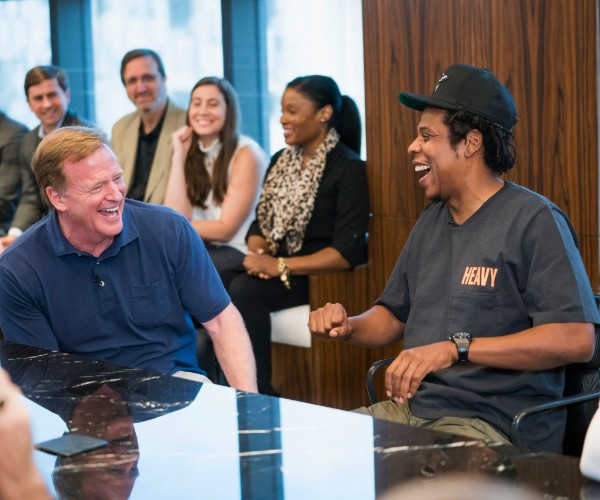
Now, Jay-Z, the hip-hop and business mogul, has switched from protesting the NFL Halftime shows in support of Colin Kaepernick, to now working for the NFL as their producer of the Super Bowl Halftime shows. You can’t make this up.

Jay-Z may be the most iconic trendsetter in Black American history. From clothes, to jewelry, to bags, to food, Jay-Z has used his music and fame to promote brands while setting trends.

The one thing that’s a little disturbing about the NFL partnership with Jay-Z is the history of anti- police rhetoric by the rap mogul. One of his most recent platinum hits includes a chorus that slanders the “Po-Po” and further pushes the anti-cop narrative to young minorities, encouraging many in our inner city streets to hate all cops.

“I hear the po-po behind me, woo, ain’t gon’ stop (rrt, skrrt)/ I see the po-po behind me, rrt, ain’t gon’ stop (skrrt, skrrt)/ I see the po-po behind me, rrt, ain’t gon’ stop (rrt, skrrt)/ I dropped the top off the Maybach, rrt, f*** these cops (rrt, rrt, rrt, rrt).”

I pray that the NFL deal with Jay-Z will be enough to wake him up and try to bring some balance and respect to the social justice conversation. Our black and brown babies need it.

It’s time to build bridges between law enforcement and the community, versus burning them down. It’s time to stand up and call out disrespectful behavior, even if it causes some of our young, lost black men to call you a sellout or boycott your music.

We are grown men Jay, let’s rebuild our fathers in Black America.

Eric Reid recently tweeted, “Jay-Z doesn’t need the NFL’s help 2 address social injustices. It was a money move 4 him & his music business.”

Now I hope that Jay Z’s perceived money move is more than that and will translate into him standing up to help influence our kids to re-establish respect for law enforcement, teachers, and their elders.

Jay has already poured a lot of resources into social issues around criminal justice. Now hopefully it’s time to end the music that promotes and normalizes activities that put our black brothers behind bars.

Jay, you have promoted and supported enough music that doesn’t feed positivity to the souls of our innocent black babies. You must stand against the satanic music of artist like 21 Savage and Drake, not standing up for him to continue poisoning our kids’ minds.

I dare anyone reading this to read the lyrics that some of these men copyright and promote to our kids, you will understand why our culture has become numb to blacks killing blacks.

Jay we need your help to bring back peace, love, and faith in God to our culture. This can be your most profound cultural trend that will define your legacy.

Jack Brewer possesses a unique combination of expertise in the fields of global economic development, sports, and finance through his roles as a successful entrepreneur, executive producer, news contributor, and humanitarian. Currently serving as the CEO and Portfolio Manager of The Brewer Group, Inc. as well as the Founder and Executive Director of The Jack Brewer Foundation (JBF Worldwide), active Shriner and Ambassador and National Spokesperson for the National Association of Police Athletic/ Activities Leagues, Inc. Other key roles include regular contributor to CNBC, Fox Business, and The American City Business Journals, Ambassador for Peace and Sport for the International Federation for Peace and Sustainable Development at the United Nations, Senior Advisor to former H.E. President Joyce Banda of the Republic of Malawi, and three time National Football League (NFL) Team Captain for the Minnesota Vikings, Philadelphia Eagles, and New York Giants. To read more of his reports — Click Here Now.

Source