9 African Podcasts That You Are Certainly Going To Enjoy

African Podcasts

With the continued rise of reliable internet, free audio programmes, popularly known as podcasts, are making a buzz on the continent.

Here are few podcasts we really think you should check out.

Chicken and Jollof Rice
African Podcasts

Get a bunch of first generation African Americans who hold both black, African, and American experiences, get them to talk about all important social issues ( like Beyonce’s album and American cop killings) then you have the Chicken and Jollof Rice show. The podcast takes “both humorous and serious slants on a bevy of topics. With the continual global experiences by many Africans, the podcast is surely a good base to get different outtakes into the global African experience.

Africa Tech Round-Up

African Podcasts

Produced in Johannesburg, South Africa,  African Tech Round-Up covers technological innovation on the continent. With a rapidly growing fan base, the podcasts which is hosted by Andile Masuku, could best be described as a mix of cool, geeky and informative. With diverse content from “Medical Drones in Rwanda” to the war between“ Uber and taxi drivers.” If you are too lazy to avoid keeping many tech tabs open in your browser, Africa Tech Round-Up is a good podcast to keep you abreast of the different innovations on the continent.

Talking heads
African Podcasts

Talking Heads podcasts aim to give a fresh approach to identify, showcase and create opportunities for African thought leaders. The show profiles some of the extraordinary Africans making a meaningful and affirmative contribution to their communities, cities, countries, the continent and the world. These individuals are also profiled through a series of short videos that highlight the African Innovations that have the potential to solve the challenges of our continent, and are already doing so. Surely a great listen if you are all about Africa’s bright future.

Loose Talk

African Podcasts

Loose Talk is a podcast hosted by three influential Nigerian arts journalists, Osagie Alonge, Steve Dede and Ayomide Tayo. In the podcast, they discuss trending topics happening all around the world; Media, Celebrities, Lifestyle, Sex, Sports, Politics, Tech, Religion, Movies, TV, Radio, Music and much more. A good show if you are between a connoisseur and critic of African pop culture.

Afropop worldwide
African Podcasts

Afropop Worldwide is an award-winning podcast dedicated to music from Africa and the African diaspora. Hosted by one of Africa’s best-loved broadcast personalities, Georges Collinet, the show is for both the curious and the connoisseur, and takes listeners to dynamic music capitals such as Dakar, Senegal; Johannesburg, South Africa; Cairo, Egypt; Havana, Cuba; Salvador de Bahia, Brazil; New York and Paris. Listeners meet the leading stars as well as emerging artists. Live concert recordings of world-class artists such as Ladysmith Black Mambazo, Cesaria Evora, Gilberto Gil, Baaba Maal, Kanda Bongo Man and others are also featured on the podcast. The podcasts vision is to increase the profile of African and African diaspora music worldwide. If you are looking to go on the biggest African music journey you have ever embarked on, Afropop Worldwide is a great place to start.

Bad Missionary podcast
African Podcasts

Gret Glyer grew up as a privileged, suburban, private-school kid in America.

Prince Inglis grew up in a rural Malawian village living on a dollar a day. They both now live in Lilongwe, Malawi and do development work together. Every week they answer your questions about life in Africa and talk about the biggest news story from both the U.S. and Malawi! An insightful and helpful show especially if you are into development work on the continent.

The  Africa Show ( formerly my African Passport)
African Podcasts

The Travel Africa Show is a weekly show on the award-winning Colourful Radio (www.colourfulradio.com). The show is produced and created by My African Passport. The show offers insights, ideas and inspiration to travel Africa every Saturday from 4pm GMT.

The hosts, Lyande Kaikai and Yolisa Segone, both have a passion for African travel, food and music. The vibrant duo share travel experiences with an aim to encourage travel to Africa. If you are interested in the people and sights this continent has to offer, The Travel Africa show can be your weekly guide.

Sound Africa
African Podcasts

Sound Africa aims to be a space for narratives that capture the dizzying complexity of the world’s second most populous continent. Trying to avoid the one dimensional coverage of the continent, Sound Africa aims to amplify the important yet ignored voices from all over the continent. “We want to help fill the gap by telling the types of stories that rarely make it onto the network news, from quirky and obscure to hard-hitting and thought-provoking. We’re not talking about glossy postcard portrayals of the continent. We’re talking about stories that capture the intricacies and multiple sides of life and society,” says the show’s editor, Rasmus Bitsch.

Knowledge Bandits
African Podcasts

The Knowledge Bandits podcast is a show that aims to interview successful and innovative entrepreneurs working in Africa. According to Arum Galadima, who produces and hosts the show, “the Knowledge Bandits philosophy is that with the right mentorship, advice, work ethic and motivation anyone can achieve a certain level of greatness. Knowledge Bandits wants to figure out what makes these entrepreneurs tick and model a blueprint of their success to show the world that entrepreneurship in Africa is alive and kicking.” If you are looking for some entrepreneurial inspiration, Knowledge Bandits is exactly what you need.
Source

Democrats Working to Deflect Attention From Their Own Racist History

My father taught me as a kid to stand up against any racist, specifically anyone who called me the “N” word. So growing up in Texas in the 80’s and 90’s, let’s just say I got into a few brawls in school.

After each altercation my Dad asked me one question, “Did you win?” From some of my earliest memories, the realities of racism and white supremacy were real in my world. Once I made it into eighth grade, the word “racism” took on a whole new meaning. I was a standout athlete, active student council member, and honor roll student.

None of that stopped me from being harassed and bullied by the “white supremacists” known as skinheads, whom I proceeded to battle with for the next few years. My friend Phillip eventually ended up shooting one of them in the neck, which lead to national media attention and heightened racial tensions across my town.

The Brewer’s have a rich history in my hometown of Grapevine, where my great grandfather was the first black man to migrate as a sharecropper in 1896. We have a small street that bears our name and my father’s long career working for the City of Grapevine Public works department as well as coaching countless kids has earned my family a lot of goodwill and demanded the respect of the white community around me growing up.

During the height of my racial issues, my father armed up and walked into the middle of a Ku Klux Klan rally in search of the group of white supremacists who had been harassing me. Just like a scene from a movie. My family went on to work with other families in my community, lobbying to change the school districts rules which had originally tolerated the systematic racism which allowed skinheads and white supremacists to wear swastikas and known skinhead attire while at school.

We stood up against systematic racism and focused our energy on changing policy, not words. The year was 1994, the same year the Democratic-led Clinton Administration was pushing the policies that led to the mass incarceration of millions of blacks in America.

Now 27 years later I am watching many in our nation normalize “white supremacy,” one of the most evil characterizations in the world. Ironically, the vast majority of those throwing out this narrative have never actually experienced white supremacy and most have turned a blind eye to policies and agendas that have defined the very term that they are normalizing.

Does Conservatism Equal Racism?

Most Americans unfortunately do not know their political history despite an abundance of access to instant information.

Democrats have been able to cover up their party’s bigoted history of fighting to keep American Blacks enslaved, to keep schools segregated, to push Jim Crow, as well as creating the policies that mass incarcerated more blacks than any country on the planet. How do you explain that the Democrats have hypnotized their supporters to truly believe that they are the symbols of racial equality in America? Let’s dive into some quick history.

In 1868, Republicans elected the first black person to represent our nation in Congress. 23 more black Republican legislators succeeded him. Yes, immediately following slavery all black U.S. congressmen and senators were Republicans.

There were no black Democrats in Congress until 1935 and for almost seven decades Republicans were the only party electing blacks to the U.S. Congress. Despite what you hear, Republicans pushed to allow blacks to have representation in our government, just as they fought to set the black slaves free, led by Abraham Lincoln and other noble Republicans.

Frederick Douglas, the legendary black abolitionist, was also a strong Republican, and was the first black man to ever receive a caucus vote for president in 1888.

As you can imagine, the conservative Frederick Douglas was very active advocating for policies that make a positive impact on blacks in America and he went on to become the U.S. Ambassador to Haiti, the world’s first free Black nation.

Given its rich history of civil rights, it’s not surprising that the Republican-led Trump Administration is the party who finally overturned the Democratic-led federal law on mass incarceration of blacks.

We can’t leave out our nation’s two largest anti-AIDS initiatives starting with PETFAR with George Bush, who has saved over 18 million blacks in Africa, and now recently the Trump Administration’s initiative which targets the end of this disease that devastates America’s Black community by 2030.

By most estimates, over 75% of the global AIDS population is black and almost 45% of all Americans with AIDS are black. These were urgently needed to combat a major health crisis for the entire black population. Let’s not forget that George Bush was seen as a racist by many liberals, including myself. I was rudely awakened from my hypnosis following one of my eye opening missions to Africa.

When you study the policies, it’s easy to understand why the Democrats have worked so hard to deflect and normalize the meaning of white supremacy and racism away from their very own evil and racist history. To understand their strategy, just follow the money.

The New Democratic Strategy

As we go into another election cycle, the race card is being played more than anytime in my 40 years on earth. Whether it’s a “white supremacy” border debate or an anti-women of color narrative, the Democratic fundraising depends on it.

Highly intelligent liberals pound their hands on the table to stand up against our president’s racially insensitive rhetoric, while ignoring and oftentimes supporting actual systematic racist policies. The worst part is that our poorly run local governments are unanimously run by Democrats, who have all colluded to focus on illegal immigration and racism claims instead of addressing the inhumane conditions in the districts and towns that they represent. Weekend after weekend dozens of blacks are shot and killed in their communities without a memorial service or a single mention to bring federal resources in to stop the carnage of their constituents. But then again, poor blacks don’t donate and they don’t get the same attention as an immigrant kid separated from their parent who enters our country illegally.

It’s sickening actually. The Democratic strategy to focus on illegal immigration is the widely accepted new strategy for the party, which has recently attempted to move away from their mass incarceration and welfare dumping strategy of the 90’s and 2000’s.

Remember, dozens of Democrats didn’t even vote for the First Step Act which has already freed and reduced the sentences for over 4,000 black men. Now, Joe Biden, the author and chief advocate for Clinton’s 1994 Crime Bill, was not only a beloved Vice President, but he now has the approval of almost 50% of blacks. It’s jaw dropping, I know. The white man who mass incarcerated blacks is now the symbol of equality and the white man who passed the policy to free and lower the sentencing for blacks is the “white supremacist.” Only in America.

Think about it, the Obama Administration at the direction of Bill and Hillary Clinton took advantage of the poorest black nation in the Western Hemisphere, which is also the first ever independent black nation in the world. Despite their money-led racist and white supremacist agenda, no major Democrat has stood up against them or called for a thorough investigation of the $14 billion pledged to Haiti. I suggest you all watch “Clinton Cash.” I just returned from Haiti this week and the realities of the largest humanitarian robbery in American history continues to take a toll on this ailing black population.

Though Obama refused to aggressively prioritize the black population in his home town of Chicago, or really any black area in America, the new Democratic strategy issued him the ultimate pass on race. It’s unacceptable that Obama left office after 8 years without reforming Clinton’s ’94 Crime Bill, never bringing major national resources to ending the war-like violence in American inner cities, and then stood idly by as the Western Hemisphere’s poorest nation was hijacked by Democratic-led greed. But at the end of the day, we must remember that Obama is just as white as he is black. And no Democrat has dared to call this out.

Loving Your Oppressor

The ability for Democrats to hypnotize their base to faithfully love their oppressor is a disturbing example of how a house slave respected and loved their slave master.

An example of a modern Democratic slave master is Virginia Governor Ralph Northam, who has numerous pictures of himself and his grad school classmates dressed in Ku Klux Klan outfits as well as other photos of them dressed in blackface. I would refuse to be in his presence if I was a black Virginia law maker. But as you probably guessed, the Democratic free pass on racism was in full effect for Governor Northman, as he is still in office and wasn’t forced to resign. In his first interview following this outrageous event, the Governor went on to refer to slaves as “indentured servants” only to have his ignorance be corrected on national television. Can you imagine if this was a Republican leader?

When I met with President Trump a few weeks back, I pleaded with him to start addressing the crisis happening in our American Black inner cities. He listened.

After bringing my American Heroes Program to work with the beautiful children of Baltimore and several other U.S. inner cities, I was disgusted. I had watched the Congressman Elijah Cummings continue the new Democratic strategy of advocating for illegal immigrants’ rights while his district was on fire with gang wars and countless shootings to go along with the filth and poverty that is suffocating his people.

Of course, Elijah Cummings has been a strong voice in the racism and white supremacist normalization in America. Congressman Cummings has focused his efforts in congress around immigration, Russia collusion, and gun control when it affects white Americans. But this should be expected, as these are the core Democratic issues that bring in the most fundraising dollars. He called the President of the United States “racist” for his comments on Baltimore, despite video tapes and a history of him saying the exact same thing about his district in the past — all but ignoring all of the black lives lost and living in third-world conditions as well as the over $14 billion which has gone into the city over the past two years. As head of the House Committee for Oversight and Reform, he has refused to investigate the Democrats for the billions stolen from Haiti following the earthquake as well as the billions put into Baltimore with no sign of major development in the most underserved areas. Yet liberals around the country stand up for these types of leaders because of his civil rights work 30 years ago. Imagine having 20 people shot in your hometown in a weekend and not making a major national address or initiative to take on the root issues. Or at least demand your Congressional colleagues call the nation to pay respect to the victims? Well, Cummings was front and center when my town of Parkland, Florida, was rocked by a school shooting. Another example of the civil rights leader mourning for white kids, while remaining silent for the black lives in his community who’s fate can’t lead to fundraising.

This is the same mentality that has enslaved and oppressed blacks for hundreds of years.

In many African Nations, black leaders are called Chiefs, not Congressman. If you study African history like me, you may be aware that these same Chiefs are the very people who captured and brokered the slaves from 1450-1800’s and proceeded to sell them to the white men from the United States and Great Britain.

This reality was front and center in 1998 when Yoweri Museveni, the president of Uganda, told an audience including then President Bill Clinton: “African chiefs were the ones waging war on each other and capturing their own people and selling them. If anyone should apologise it should be the African chiefs. We still have those traitors here even today.”

And I say American inner cities have a lot of these same realities as our brothers and sisters in Africa. Hopefully African Americans will wake up and call out the traitors amongst us in our most underserved communities. It’s no surprise the Democrats call our president a white supremacist despite him passing more legislation targeted at helping blacks than any U.S. President since Lyndon B. Johnson. They have embraced the love of the oppressor which has hypnotized their black base to maintain the long standing slave mentality manifested by the Africa Chiefs centuries ago.

Jack Brewer possesses a unique combination of expertise in the fields of global economic development, sports, and finance through his roles as a successful entrepreneur, executive producer, news contributor, and humanitarian. Currently serving as the CEO and Portfolio Manager of The Brewer Group, Inc. as well as the Founder and Executive Director of The Jack Brewer Foundation (JBF Worldwide), active Shriner and Ambassador and National Spokesperson for the National Association of Police Athletic/ Activities Leagues, Inc. Other key roles include regular contributor to CNBC, Fox Business, and The American City Business Journals, Ambassador for Peace and Sport for the International Federation for Peace and Sustainable Development at the United Nations, Senior Advisor to former H.E. President Joyce Banda of the Republic of Malawi, and three time National Football League (NFL) Team Captain for the Minnesota Vikings, Philadelphia Eagles, and New York Giants. To read more of his reports — Click Here Now.

Source

Africa: Colonialists Didn’t Fail to Root Out Africa’s Tribal Politics. They Created It.

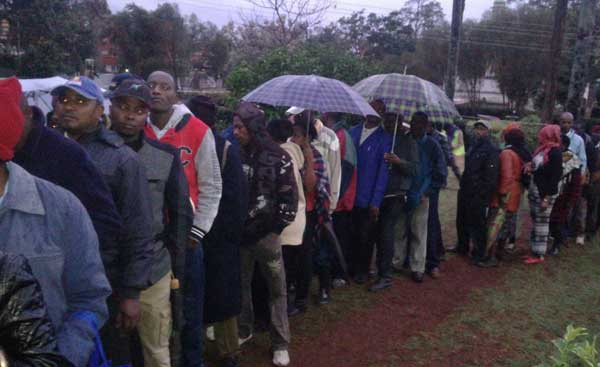
Standing in line at a Nairobi polling station to cast my ballot in Kenya’s 2017 presidential election, I struck up a conversation with fellow voters in the queue. The result was a foregone conclusion, said one of the gentlemen proudly. We had the numbers and our candidate was going to win. Everyone else agreed.

No one needed to ask which candidate we would be voting for. That was another foregone conclusion. We were speaking in Kikuyu, and the Kikuyus were voting for President Uhuru Kenyatta.

In the end, Kenyatta was indeed re-elected, winning almost the entire Kikuyu vote. His running mate did the same with the Kalenjin votes, the two men garnering over 95% in counties where their ethnic groups are the overwhelming majority. Their main challenger, Raila Odinga, got over 90% in counties where the Luo dominate.

In countries across Africa, similar patterns emerge in elections. From Kenya, to Sierra Leone, to Malawi, many votes cut heavily across ethnic or regional lines. Ethnic politics in Africa is commonplace.

This fact is often framed as a continent-wide struggle between the ancient and the modern, between Africa’s age-old tribal allegiances and its modern political institutions inherited from Europe. According to this narrative, African societies are yet to be fully reformed by modern life. When faced with elections therefore, voters continue to express old tribal solidarities rather than deciding based on ideology or policy.

This argument presents European colonialism as a civilising mission against the customary order, albeit one which failed to fully de-tribalise its subjects. The 1884 Berlin Conference, far from dividing Africa among European powers, becomes seen as a unifying exercise that brought tribes together into modern political entities. As foreign affairs commentator Jonathan Power wrote in a 2006 article for The New York Times:

“On Africa’s left it has been a common jibe that the Europeans ‘divided’ Africa. In fact they brought Africa together. Indeed – as in Nigeria, where Lord Lugard forced more than 250 ethnic groups involving today’s 130 million people into one political unit – you could argue that the colonialists went overboard in the quest for unity.”

African tribalism is contrasted with the ideal standard of Western modernity. This received narrative is deeply questionable.

Making race

To begin with, Africa is hardly the only place where ethnic or racial groups vote in blocs. In the US, for instance, African Americans have voted overwhelmingly for the Democratic Party for half a century. In the 2016 presidential election, 88% of African Americans voted for the Democratic candidate along with 65% of Hispanics and Asian Americans.

By contrast, however, these kinds of voting patterns in the West are examined differently to those in Africa. They are explained through the lens of modern political forces rather than by recourse to ancient cultural ones. Racial politics in the US, for instance, is usually tied to its modern history of racial discrimination and the ensuing struggle for civil rights.

The story goes as follows: America was a colony built on slave labour yet this fact contradicted its founding ideology that all human beings are “endowed by their creator” with an “inalienable right” to freedom. In the face of this, and with the South still deeply reliant on slavery, scientific racism stepped in claiming that black people are biologically inferior and distinct from white people. An alliance between this scientific authority and political power essentially invented biological race, codified it in law, and enforced it. In 1857, the Supreme Court, in Dred Scott v Sandford, declared that black people are “of an inferior order and altogether unfit to associate with the white race”. It declared that black people have “no rights which the white man was bound to respect”.

This history, which still reverberates today, shows politicised race in America to be a product of a deliberate political project aimed at subjugating and exploiting a social minority. The fatal flaw in the current understanding of politicised ethnicity in Africa today is the failure to recognise the same hand at work, only acting against the social majority.

Making tribe

In Africa, as in the US, the ruling powers faced the challenge of subjugating black people. Here, however, racial strategies were unsuited for the task at hand since a black majority with a united race consciousness would pose a threat to white minority control. European powers therefore turned towards a tribal strategy of creating and enforcing divisions in the majority. They entrenched the “tribe” as the basis of social, economic and political life through a policy known as indirect rule.

Before the colonial era, African ethnicities had been highly fluid and malleable phenomena. They did not exist as corporate entities. Boundaries were really shades of grey. People switched back and forth between groups. And, for the most part, no central authority enforced a shared set of laws through a monopoly of violence. As historian Terence Ranger writes in The Invention of Tradition:

“Almost all recent studies of nineteenth-century pre-colonial Africa have emphasized that far from there being a single ‘tribal’ identity, most Africans moved in and out of multiple identities, defining themselves at one moment subject to this chief, at another moment as a member of that cult, at another moment as part of this clan, and at yet another moment as an initiate in that professional guild… the boundaries of the ‘tribal’ polity and the hierarchies of authority within them did not define conceptual horizons of Africans.”

Tribe, in other words, was not an exclusive political category before the onset of colonial rule. Ethnolinguistic groups – people who shared a language and ethnicity – did not necessarily constitute a political grouping known as tribe. As the eminent scholar Mahmood Mamdani puts it in Define and Rule:

“Did tribe exist [in Africa] before colonialism? If we understand by tribe an ethnic group with a common language, it did. But tribe as an administrative entity that distinguishes between natives and non-natives and systematically discriminates in favor of the former against the latter – defining access to land and participation in local governance and rules for settling disputes according to tribal identity – certainly did not exist before colonialism.”

This messy and fluid picture was untenable to European intentions. What followed then was a process of legally defining and enforcing tribes, identities and customary laws. An alliance between scientific authority and political power, as in America, was needed for the task. What the biologist did for the racialisation project in the US, the anthropologist did for the tribalisation project in Africa.

Ethnolinguistic groups were legally defined as tribes, becoming legal and administrative categories for the first time. Disparate communities were collapsed into new creations of Shona, Yoruba, Luhya, Igbo. Even multiethnic states such as Ndebele in southern Africa were defined as a tribe, while some groups, like the Yaaku of East Africa, were simply left out and forced to integrate into adjacent demarcations.

Colonies were divided into administrative units that approximated boundaries between the defined tribes, and a “native authority” was put in charge to enforce customary law by force. Where a chief was identifiable, the British brought them into the colonial administrative structure and gave them absolute autocratic power. Where no chiefs existed, they invented them. The French, by contrast, destroyed all indigenous authorities and planted new administrative cadres but with the same function: to enforce customary law by brute force. Customary law was also a continuously creative definition; the customary was tweaked and nurtured to conform to European objectives of domination.

Far from “going overboard in their quest for unity”, Europe was very deliberate in its cultivation of divisive tribal nationalisms in Africa. Cross-group interaction and freedom of movement across “homelands” was heavily controlled. Any attempt to build cross-ethnic political movements or socioeconomic organisations was met with swift repression.

Ethnic politics post-independence

As colonial history progressed, an elite stratum emerged in each tribal enclave. This group’s basis of power was the tribal group and it helped reproduce political ethnicity. The “nationalist movements” that emerged as independence approached were not cross-tribal and grassroots, but rather coalitions of elites from their respective groups.

Upon independence in many African countries, the victorious ethnic coalition established a centralised state, creating a system of ethnic winners and losers. Colonial rule had been maintained by force, leaving behind no institutions; post-independence, the state’s only links to the collective were therefore also through sticks and carrots. The new rulers offered patronage to ethnic leaders in exchange for mobilising their group behind the ruling coalition.

Many of those left out expressed their grievances in terms of ignored ethnic interests and were suppressed by force. Under multi-party democracy, ethnic groups have had to form coalitions and vote together to install a common leader, a trend sustained and reinforced in each electoral cycle.

Kenya and certain other countries exemplify these trends to a staggering level, but not every nation in Africa met the same fate. In some places, colonisation took a different form, which did not create and emphasise tribal politics.

In mainland Tanzania, for instance, German authorities utilised the literate Swahili community along the coast to administer the colony. This led to a more unified Swahili culture across the territory and, after independence, a truly non-ethnic political movement in TANU found space to flourish. To this day, ethnic politics has never predominated in Tanzania.

Another example is Senegal. There, colonialists may have wished to impose tribal nationalisms, but ran up against the dominance of the marabouts, the religious leaders of the Sufi brotherhoods to which most of the population belong. Faced with this reality, the French authorities appeased the marabouts and drew on their support to consolidate control. This impeded the entrenchment of ethnic politics and, today, voters in Senegal do not vote along ethnic lines either.

Winners and losers

This history shows how both race politics (in the US and Europe) and ethnic politics (in Africa) are the result of politically-enforced orders. They were both the result of brutal attempts to control subjugated populations. In the West, black people were racialised. In Africa, they were tribalised.

The notion that ethnic politics are a result of “ancient” tribal affiliations in Africa that have resisted modernisation is therefore wrong-headed. It also suggests that the usual solutions put forward for fixing ethnic voting – such as increased literacy, urbanisation or voter education – are as misguided as recommending that racial politics in the US can be wiped out by “modernising” the American electorate.

The truth is that both electorates are similarly “modernised”. The problem is that this modernity created and politicised certain identities and built systems of privilege and deprivation based on those divisions. These systems affect the university-educated urban-dweller in Africa as much as it does the rural subsistence farmer. Ethnic tensions in Kenya flare up even in universities and among well-paid professionals.

In the US, race inequality and racism cannot be solved by teaching the electorate that race is a construct. Similarly, Africa cannot tackle ethnic divisions by enlightening individual minds. Rather, to tackle the problems of ethnic politics, countries where this dominates must reimagine the political system in such as a way as to dismantle ethnic privilege and deprivation and build a new system no longer based on winners and losers.

Source

The 15 best family-friendly movies on Netflix streaming now

Welcome to Small Humans, an ongoing series at Mashable that looks at how to take care of – and deal with – the kids in your life. Because Dr. Spock is nice and all, but it’s 2019 and we have the entire internet to contend with.


Jam-packed with tales of talking animals, adventures of heroes in disguise, and stories of true love, Netflix has one rockin’ collection of films perfect for family movie night. 

But with so much to choose from (and a million other things to worry about), parents can have a hard time sussing out what to cue up at any given moment. So, in honor of them and their small humans, we narrowed it down ahead of time. 

From animated classics to live-action newcomers, here are 15 of the best kid-friendly movies now streaming on Netflix — all with enough sly adult humor and tearjerking moments to take viewers of every age along for the ride. 

15. G-Force (2009)

Rated: PG

Follow me here: Guinea pigs. Fighting. Crime. 

Starring human comedian Zach Galifianakis, this Disney flick chronicles the adventures of a muddle of talking guinea pigs — yes, “muddle” — as they use their special secret agent training to fight professional bad guy Will Arnett. It’s not the best film on this list, but it is undoubtedly the silliest.

You’ll laugh. You’ll cry. You’ll have to explain why they don’t make guinea pig-sized walkie talkies. Possibly more than once.

[embedded content]

G-Force is now streaming on Netflix.

14. Hercules (1997)

Rated: G

The tale of the son of Zeus overcoming the king of the dead is one of Disney’s most iconic — and somehow also one of its most often overlooked. 

Full of unforgettable characters, unparalleled voice acting, incredible songs, and the hands down best villain to ever grace the big screen, Hercules is a classic in nearly every sense of the word. Younger viewers will be amazed by the heavenly story, while return watchers will revel in lines they thought they’d forgotten. (“I’m a damsel. I’m in distress. I can handle this. Have a nice day!”)

[embedded content]

Hercules is now streaming on Netflix

13. The Princess and the Frog (2009)

Rated: G

Loosely based on the Brothers Grimm tale of the same name, this royal adventure transports the story of a woman looking for love to 1920s New Orleans. 

Disney’s first African American princess Tiana, voiced by Tony Award winner Anika Noni Rose, begins our story as a young waitress with a knack for making beignets. But when she benevolently agrees to kiss a cursed amphibian prince, things get… complicated. 

Full of warmth and love, this instant classic is the old school Disney you first fell in love with.

[embedded content]

The Princess and the Frog is now streaming on Netflix

12. The Emperor’s New Groove (2000)

Rated: G

Uh-huh. Uh-huh. Uh-huh, uh-huh, uh-huh. 

Featuring the voice acting talents of David Spade, John Goodman, Patrick Warburton, and the incomparable Eartha Kitt, this tale of a pompous ruler transformed into a talking llama speaks for itself. Irresistibly quotable, The Emperor’s New Groove remains the source for countless memes and commands to “Pull the lever!” 

That being said, fair warning: If you live anywhere near a tight alleyway, this film does provide a fairly comprehensive guide to scaling buildings using teamwork and two walls. Stay vigilant, parents.

[embedded content]

The Emperor’s New Groove is now streaming on Netflix

11. Ralph Breaks the Internet: Wreck-It Ralph 2 (2018)

Rated: PG

Wreck-it Ralph and Vanellope Von Schweetz return in this surprisingly spot-on cyber adventure. 

After the success of Disney’s first Wreck-It adventure, it’s no wonder the studio wanted to do it all over again. And while Ralph Breaks the Internet does fall victim to a number of sequel pitfalls — including that cringe-worthy title — it manages to tell a unique story all its own.

TL;DR: Worth a watch, if only for the internet jokes.

[embedded content]

Ralph Breaks the Internet is now streaming on Netflix

10. Casper (1995)

Rated: PG

Delightful during October, but enjoyable the whole year ’round, Casper the Friendly Ghost is a classic kid movie for a reason.

Based on the cartoon from Harvey Comics, this 1995 comedy follows a paranormal expert (Bill Pullman) and his young daughter (Christina Ricci) as they struggle to uncover the secrets behind Whipstaff Manor. What they find, a kind ghost named Casper and his three vengeful uncles, is a story for the ages. 

Note: Casper is kid-friendly, but its dark themes may prove too intense for some children.

[embedded content]

Casper is now streaming on Netflix

9. Tarzan (1999)

Rated: G

Come for the talking gorillas. Stay for that Phil Collins soundtrack.

Disney’s take on the iconic tale of a young boy raised by primates is enjoyable for a lot of reasons. Voice acting by Tony Goldwyn, Minnie Driver, and Glenn Close provides soulful character amidst truly breathtaking animation. The film’s high stakes and tense feeling make it engrossing adventure for kids and parents alike. 

Note: The opening sequence of Tarzan is by far its most intense. If you’re worried it’ll be too much for your young ones, check out the first 10 minutes or so ahead of time.

[embedded content]

Tarzan is now streaming on Netflix

8. Mary Poppins Returns (2018)

Rated: PG

We took some issue with this sequel — but if your family is cataloguing those Disney live-action remakes, then it’s probably worth your time. 

Emily Blunt stars as the no-nonsense nanny, alongside musical genius Lin-Manuel Miranda and grown-up Banks children Ben Whishaw and Emily Mortimer. Filled to the brim with pastel daydreams and sugary-sweet songs, Mary Poppins Returns will have newcomers mesmerized and old fans nostalgic as ever.

[embedded content]

Mary Poppins Returns is now streaming on Netflix

7. Coco (2017)

Rated: PG

As the years go on, it’s increasingly normal for a Disney/Pixar joint to reduce us to a quavering pool of tears. Coco is a prime offender. It’s the story of Miguel (Anthony Gonzalez), a shoemaker’s son who accidentally crosses the bridge into the afterlife one Day of the Dead and desperately seeks a way home. 

It’s in this arrestingly beautiful visualization that he meets Hector (Gael García Bernal) and starts unraveling the mystery of why his family hates singing — a journey that takes him through Hector’s own history, by way of a ghostly talent show, and right to the spirit of legendary singer Ernesto de la Cruz. 

Adventures aside, Coco hits home with the importance and fragility of family, amplifying every emotion with Michael Giacchino’s gorgeous music and Miguel’s sincere belief that he can make everything right.

[embedded content]

Coco is now streaming on Netflix

6. Spy Kids (2001)

Rated: PG

It’s fascinating how 2001’s unequivocally cool Spy Kids plays to a 2019 sensibility, but even when the film borders on cheesy it’s an undeniable good time. 

Carmen and Juni Cortez must save their secret-spy parents from the evil mastermind behind the children’s show “Floop’s Fooglies,” which is at once insanely dire and extremely silly. They get Bond-level gadgets, but less murder and more microwavable pizza. 

Beyond charming young leads Alexa Vega and Daryl Sabara, Spy Kids boasts the impressive talents of Antonio Banderas, Carla Gugino, Tony Shalhoub, Alan Cumming, Danny Trejo, and even a cameo by George Clooney — all of whom are nothing but game for a romp through espionage and family struggles.

[embedded content]

Spy Kids is now streaming on Netflix

5. Cloudy with a Chance of Meatballs (2009)

Rated: PG

When the world learned that Judi and Ron Barrett’s timeless children’s book was being made into a film, many took pause. Luckily, in the deft hands of Phil Lord and Christopher Miller, the iconic story of a town with edible weather shines with newfound finesse. 

Returning to the imaginary world of Chewandswallow, Cloudy with a Chance of Meatballs chronicles the adventures of inventor Flint Lockwood (Bill Hader), his pet monkey Steve (Neil Patrick Harris), and aspiring weather woman Sam Sparks (Anna Faris). As comforting as any bowl of tomato soup, this tale will fill your day with joy. And possibly, spaghetti. 

[embedded content]

Cloudy with a Chance of Meatballs is now streaming on Netflix

4. Coraline (2009)

Rated: PG

Based on Neil Gaiman’s novel of the same name, this Academy Award-nominated film transforms childhood fantasy into a nightmarish exploration of courage and gratitude.

Coraline Jones, voiced by Dakota Fanning, has just moved to a new town with her not-so-attentive parents Mel and Charlie (Teri Hatcher and John Hodgman). Lonely and frustrated, Coraline begins exploring her new home — only to find a door hiding a secret world. 

Artfully rendered and spectacularly scripted, Coraline is a story worth visiting at any age.

Note: While rated PG, Coraline features some imagery that may not be suitable for all children.

[embedded content]

Coraline is now streaming on Netflix

3. Incredibles 2 (2018)

Rated: PG

We waited 14 years for the Parr family to return — and boy, was it worth it

Frozen in time, Violet, Dash, and Jack-Jack haven’t aged a day since the original’s 2014 release, but things sure have changed for Elastigirl and Mr. Incredible. A reflection on the trials and tribulations of family, as well as a meditation on what it means to be super, Incredibles 2 maintains the fun and flair the second time around. 

Whether you’re diving in for a rewatch or checking it out for the first time, this sequel will have your family ordering red spandex and black masks in bulk.

[embedded content]

Incredibles 2 is now streaming on Netflix

2. Lilo & Stitch (2002)

Rated: PG

Before Anna and Elsa came onto the scene, Lilo & Stitch was the sister movie of Disney. 

Set in the aftermath of an alien’s arrival on the island of Kauaʻi, this soulful sci-fi story follows sisters Nani and Lilo as they struggle to cope with the loss of their parents. When Stitch, that aforementioned extraterrestrial visitor, joins their small Hawaiian family, things get way, way worse — and then, in classic Disney fashion, better than anyone could have hoped. 

Hilarious, heartfelt, and chock full of Elvis tunes, Lilo & Stitch remains a masterful story of family, fit for viewing with your mother, daughter, sister, or pet alien.

[embedded content]

Lilo & Stitch is now streaming on Netflix

1. Spider-Man: Into the Spider-Verse (2018) 

Rated: PG

Spider-Man: Into the Spider-Verse is not only the best Spider-Man movie to ever grace our superhero-filled lives, it is also one of the most gorgeously animated movies ever made. 

The humor is spectacular. The story is endearing. The characters are lovable. Even the soundtrack is outstanding. When the world is filled with endless superhero movies, it’s nice to have a movie that isn’t a part of the rest of the massive Marvel universe — a contained story that doesn’t come with all that baggage.

[embedded content]

Spider-Man: Into the Spider-Verse is now streaming on Netflix

Kellen Beck and Proma Khosla contributed to this article.

Uploads%252fvideo uploaders%252fdistribution thumb%252fimage%252f91113%252fe478afa4 d7b4 4313 9341 0aed512c82b6.jpg%252f930x520.jpg?signature=vc2vi9n noqqqeqt6xgo428sxfc=&source=https%3a%2f%2fblueprint api production.s3.amazonaws

Source

Trump Brings Hope to Black America With Bold Measures to End AIDS

Earlier this year President Trump proposed $291 million in the FY2020 HHS budget to begin his Administration’s multi-year initiative focused on ending the HIV epidemic in America by 2030.

AIDS hasn’t been in the conversation as a current American crisis, which made the historic move even more shocking to many people. Trump has recently been blasted by the liberal media for comments that many feel are racist, despite his unprecedented effort to pass policies that target the most systematic issues facing the black community.

This reminds me of the President George W. Bush era, when many blacks including myself considered Bush a racist. As a young black man with aspirations to help change the world, I was also hypnotized by liberal media as well as Democratic politicians.

Following one of my medical mission trips to Africa in 2010, I was shamed by African world leaders who educated me about the effects of PETFAR. The President’s Emergency Plan For AIDS Relief (PEPFAR) is a United States governmental initiative founded by George W. Bush to address the global HIV/AIDS epidemic and help save the lives of those suffering from the disease.

This has been the most effective humanitarian aid policy ever to target blacks around the world, saving over 18 million lives and screening well over 50 million people. To this day I am embarrassed to think that I ever considered George W. Bush a racist. But then again, the liberal media is real.

Now a decade later we have another Republican President who has been crowned the king racist by liberals across America.

Despite his labels, President Trump used his first term to address the very disease that effects five times more blacks than whites per capita in America. President Trump’s new initiative aims to reduce new HIV infections by 75 percent in the next 5 years and by 90 percent in the next 10 years, averting more than 250,000 HIV infections in that span.

Recent data shows that our progress reducing the number of new HIV infections has plateaued, and there are new threats to the progress that has been made, the most significant being the opioid crisis: 1 in 10 new HIV infections occur among people who inject drugs. Unfortunately, one of the biggest reasons why reducing AIDS in America has hit a road block is due to the rapid growth of AIDS across black America.

As the LGBT community pursues the human rights they deserve, homosexuality is on super speed in the black community. The CDC recently reported that 50% of black gay men will contract HIV, which is chilling given the growing gay lifestyle promotion as a result of the Pride movement across American urban cities. Blacks make up 43% of those infected with HIV in America, despite only making up 12% of the population. This epidemic is real for Black America, though we don’t hear a word about it from black politicians representing the very communities in the heart of the crisis.

Fortunately our president has done his part to keep the spotlight on the fight to end HIV/AIDS, which has now reentered the conversation in the U.S. as of this year. President Donald Trump announced his ambitious plan to wipe out HIV transmission in America by 2030 and asked for an additional $291 million for his AIDS Program in his 2020 budget. Another solid example of tangible policies that President Trump continues to deliver for Black America. I was able to describe several of these polices in my recent article, “4 Ways Donald Trump has done more for African Americans than Barack Obama.” We can all agree that ending AIDS in America by 2030 is a bold and noble goal. Even if the president succeeds, stopping transmission is just one part of the puzzle. We also must help the 1.2 million Americans, over 500,000 who are black and currently living with the disease.

There just may be a very innovative healthcare solution recently developed by CytoDyn. The company is one of only a few firms to be given “fast track” approval from the FDA, meaning their new drug, Leronlimab (PRO 140) could be approved by the end of this year. Leronlimab is the first self-administered therapy for HIV that has reached late-stage clinical development. It’s a major game changer for those living with HIV, because unlike most current therapies, it doesn’t require any pills.

“We have patients who have gone 18 months without any pills,” says Dr. Nader Pourhassan, CytoDyn CEO. “Some patients had up to seven pills a day, they put all of it away, and we are very proud of those results.” Recent clinical trials have shown that Leronlimab does not negatively affect normal immune functions, but it does block the HIV co-receptor on T-cells. These trials also found that using Leronlimab can significantly reduce viral burden in people infected with HIV.

CytoDyn and Leronlimab have been garnering major buzz in the news, they’ve even been noticed by actor Charlie Sheen, who was recently diagnosed with HIV, and has applied to be a part of CytoDyn’s trials. With blacks representing nearly half of the Americans infected with HIV, I am reaching out to the company to ensure that they have an accurate representation of African Americans in their upcoming trial.

In 2017, Donald J. Trump signed the historic “Right to Try Legislation,” which amends federal law to allow certain unapproved, experimental drugs to be administered to terminally ill patients who have exhausted all approved treatment options and are unable to participate in clinical drug trials.

“People who are terminally ill should not have to go from country to country to seek a cure — I want to give them a chance right here at home,” said President Trump.

My goal is to take it a step further and push President Trump to ensure that all test trials equally include the populations who are effected the most. Starting with underserved Black America.

Jack Brewer possesses a unique combination of expertise in the fields of global economic development, sports, and finance through his roles as a successful entrepreneur, executive producer, news contributor, and humanitarian. Currently serving as the CEO and Portfolio Manager of The Brewer Group, Inc. as well as the Founder and Executive Director of The Jack Brewer Foundation (JBF Worldwide), active Shriner and Ambassador and National Spokesperson for the National Association of Police Athletic/ Activities Leagues, Inc. Other key roles include regular contributor to CNBC, Fox Business, and The American City Business Journals, Ambassador for Peace and Sport for the International Federation for Peace and Sustainable Development at the United Nations, Senior Advisor to former H.E. President Joyce Banda of the Republic of Malawi, and three time National Football League (NFL) Team Captain for the Minnesota Vikings, Philadelphia Eagles, and New York Giants. To read more of his reports — Click Here Now.

Michelle Obama meets adorable 111-year-old granddaughter of a slave

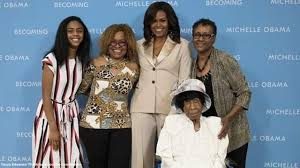
WASHINGTON-(MaraviPost)-An 111-year-old Willie Mae Hardy has survived remarkable moments and recently met Michelle Obama at her book signing.

The granddaughter of a slave’s meeting with Obama was arranged with the help of local nonprofit Mother’s Legacy Foundation – Willie Mae Hardy’s first time meeting the former first lady in person happened in May 2019.

Being one of the oldest women in the world, 111-year-old Willie Mae Hardy, has survived various remarkable moments in history and has lived through 20 presidents in America.

However, it would take her 100 years before voting for a black one. It was therefore not surprising, the joy she had when she recently met the former first lady, Michelle Obama, at a signing for her book “Becoming.” “[Obama] was really amazed at how well she looked, how healthy she looked, and how she could still articulate and talk about things,” Veronica Edwards, Hardy’s granddaughter and caregiver, said in an interview.

According to Yen.co.gh, Hardy, who was the granddaughter of a slave, was raised on a plantation in Junction City, Ga.

The oldest of seven siblings, she spent a majority of her days doing chores like picking cotton, ploughing the fields or tending to the family’s livestock.

In 1939, she relocated to Atlanta, moved to DeKalb County years later to be with her daughter and grandchildren and now lives in Kirkwood.

Her meeting with Obama was arranged with the help of local nonprofit Mother’s Legacy Foundation, which works with older residents in Kirkwood, Edwards said.

The co-founder of the Foundation, Carrie Johnson Salone, worked with Atlanta City Council member Natalyn Mosby Archibong and other community members to get Hardy free tickets to the “Becoming” book tour appearance in May.

The phenomenal aspect of Hardy’s meeting with Obama was that she “was able to talk about her background” with the former first lady, Salone said.

From her young days on a plantation in Junction City, Ga., in Talbot County to the disappearance of her cousin after he was kidnapped by the Ku Klux Klan, Hardy remembers it all.

In the 1930s, she met and married her husband Frank Hardy and nine years later, at the age of 31, with only a third-grade education, Hardy moved to Atlanta for a “better life”, alongside her husband and her only daughter Cassie Edwards.

She would remain with her husband until his death in 1979.

Hardy would also work for Atlanta families as a housekeeper until the 1980s. By then, she had moved to her Kirkwood home with her daughter who only passed away last July at the age of 93, according to AJC.

A member of the historic Butler Street Baptist Church on Ralph McGill Boulevard in northeast Atlanta, Hardy witnessed the likes of Martin Luther King Jr. during civil rights rallies held at the church.

These rallies would eventually give way to a first African American president of the United States.

“I first met Ms. Hardy in 2017 at the Annual Living Legends Cookout held in Kirkwood,” Atlanta City Council member Archibong recently said.

“Her journey from being born on a plantation to living to see the first African American become president of the United States is inspirational.”

Her opportunity to meet former first lady Michelle Obama almost did not happen, however. In the days before the meeting, she had not been “feeling her best,” Edwards said.

On the morning of the meeting, however, she started feeling better and all alert when she was reminded that she would be meeting Obama.

This May 2019, was her first time meeting the former first lady in person, although she had earlier received a birthday note from her and her husband in 2012.

In the note, the two said Hardy’s life represented “an important part of the American story.”

“As you reflect upon a lifetime of memories, we hope you are filled with tremendous pride and joy,” the former first couple added. At the moment, Hardy has seven grandchildren, 10 great-grandchildren, 30 great-great-grandchildren and four great-great-great-grandchildren.

In Kirkwood, where she currently lives, the community comprised mostly black residents in the 1960s, but today, most of her longtime neighbours are no longer there.

Even though Hardy is aware of that change, she still plans to stay in the neighbourhood with her family as her home has been a significant gathering place for relatives, friends, and neighbours over the years and she has no plans to change that.

Meanwhile, Talented Kidz season 10 winner, Nakeeyat Sam Dramani, has been granted full scholarship by the British Columbia College in Accra, to study in the school.

The seven-year-old poet, earned lots of praises for her great performances on sanitation and child rights during the competition.

: