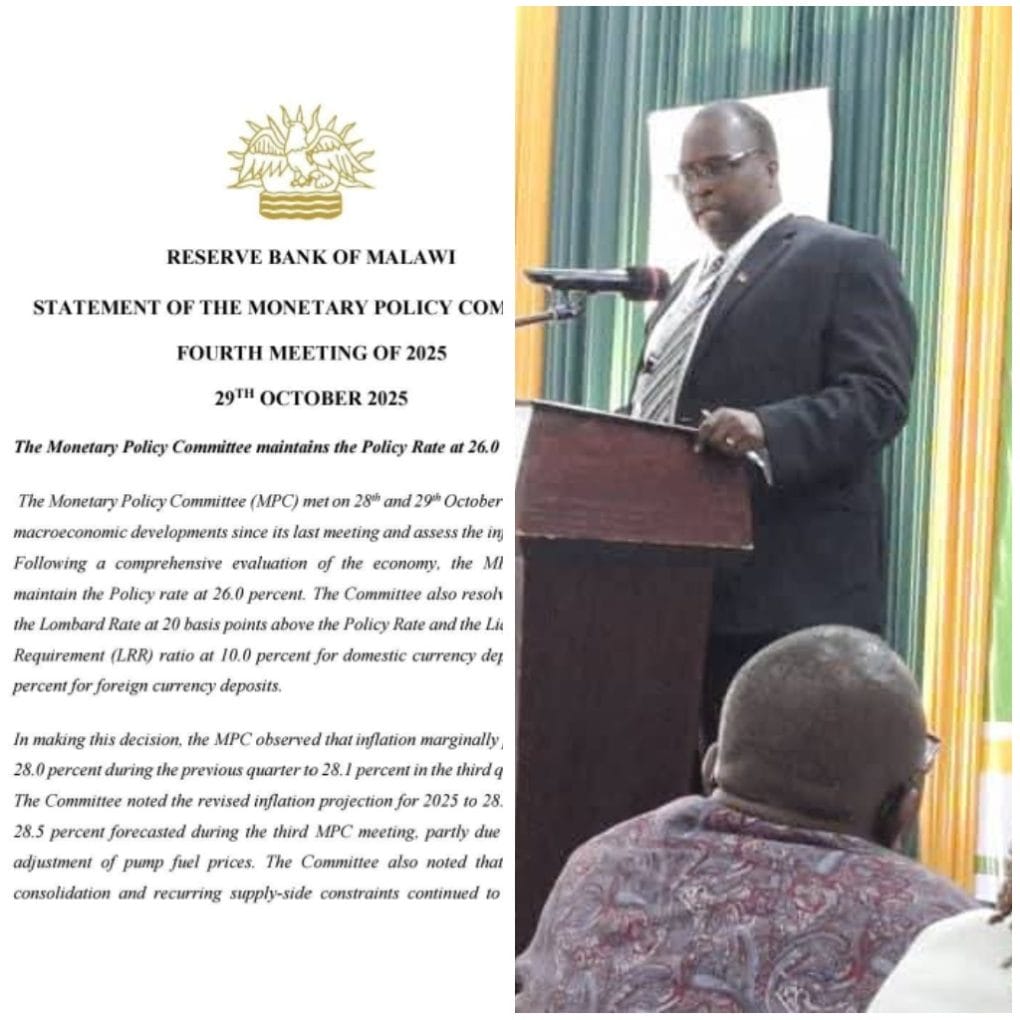
BLANTYRE-(MaraviPost)-The country’s central bank, Reserve Bank of Malawi (RBM) has maintained policy rate at 26.0 percent.
This means commercial banks will maintain interest rates.
In press statement issued on Thursday, RBM governor, Dr MacDonald Mafuta Mwale, justifies the decision following reviews on recent economic development in the country.
Dr Mwale said Bank’s Monetary Policy Committee (MPC) met on 28 and 29 October, 2025, to review recent economic developments hence the decision.
The statement however says inflation rose from 28.0 to 28.1 percent in the third quarter, with inflation projection for the year revised from 28.5 to 28.9 percent, mainly due to increase in fuel pump prices.
However, the economy is expected to grow by 2.8 percent from 1.7 percent last year.
This comes as the country’s forex base is picking barely a month after tripartite elections.
Share this:
Like this:
LikeLoading…
Discover more from The Maravi Post
Subscribe to get the latest posts sent to your email.
LILONGWE-(MaraviPost)-Former President Joyce Banda has called for stronger and more strategic investment in Malawi’s mining sector, describing it as a potential catalyst for the country’s economic transformation.
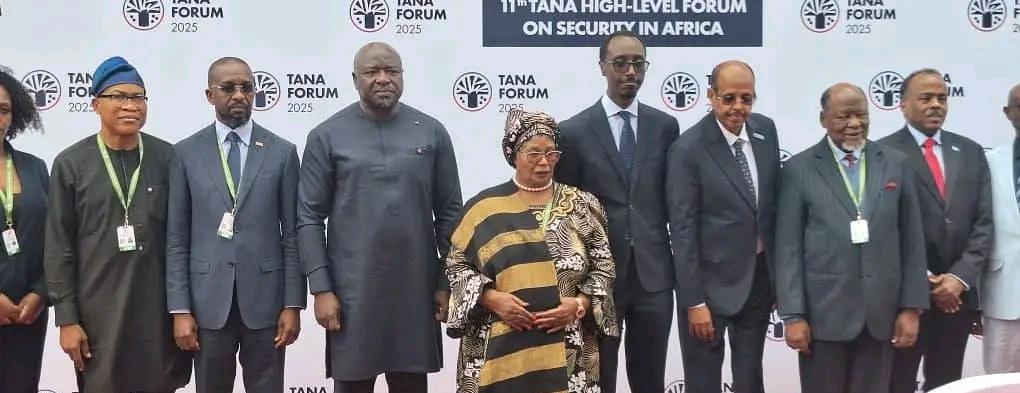
Speaking on Monday upon her arrival at Kamuzu International Airport in Lilongwe from Addis Ababa, Ethiopia, where she attended the TANA High-Level Forum on Peace and Security, Dr. Banda emphasized that Malawi must move decisively to protect and fully benefit from its mineral resources.
She noted that the global demand for Africa’s natural resources is intensifying, urging government and investors to ensure that the country’s mineral wealth particularly the rutile deposits in Kasiya, Salima District is properly managed for the benefit of Malawians.
“The world is scrambling for Africa’s resources, and Malawi must not be left behind. We need to safeguard our minerals and ensure they contribute to transforming our economy,” said Banda.
She highlighted that the continent currently faces more than 50 conflicts, many of which she said are fuelled by external interests that exploit divisions and corruption to destabilize African nations.
“The forum provided an opportunity for African leaders to reflect on homegrown solutions for peace and development,” said Banda.
The TANA Forum is a premier African platform that brings together heads of state, policymakers, and development partners to deliberate on pressing peace and security challenges affecting the continent, and to propose innovative, sustainable solutions.
Share this:
Like this:
LikeLoading…
Discover more from The Maravi Post
Subscribe to get the latest posts sent to your email.
.…From food crises and energy shortages to calls for national peace and key political developments, October 19–25, 2025, has been a week of pivotal events shaping Malawi’s social and political landscape.
Quick Overview:
•$45 Million Food Aid Secured: Malawi receives critical food assistance from the World Bank and African Development Bank to address ongoing hunger.
•Fuel Shortages Persist: Citizens face long queues and dry pumps as supply chain disruptions continue to affect transportation and daily life.
•First Lady Calls for Unity: Gertrude Mutharika urges all Malawians to join hands in promoting peace and national harmony.
•Election Data Clerks Arrested: Eight Lilongwe clerks detained, raising questions about electoral transparency and integrity.
LILONGWE-(MaraviPost)-This past week, Malawians have witnessed a series of developments that are likely to influence the nation’s social, economic, and political trajectory.
In a major relief effort, Malawi secured $45 million in food aid from the World Bank, with additional support from the African Development Bank.
The funding comes as the country struggles with ongoing food insecurity, compounded by persistent fuel shortages that have disrupted agricultural distribution and transportation.
The aid is expected to provide critical support to vulnerable communities while bolstering long-term strategies to stabilize food supply chains across the nation.
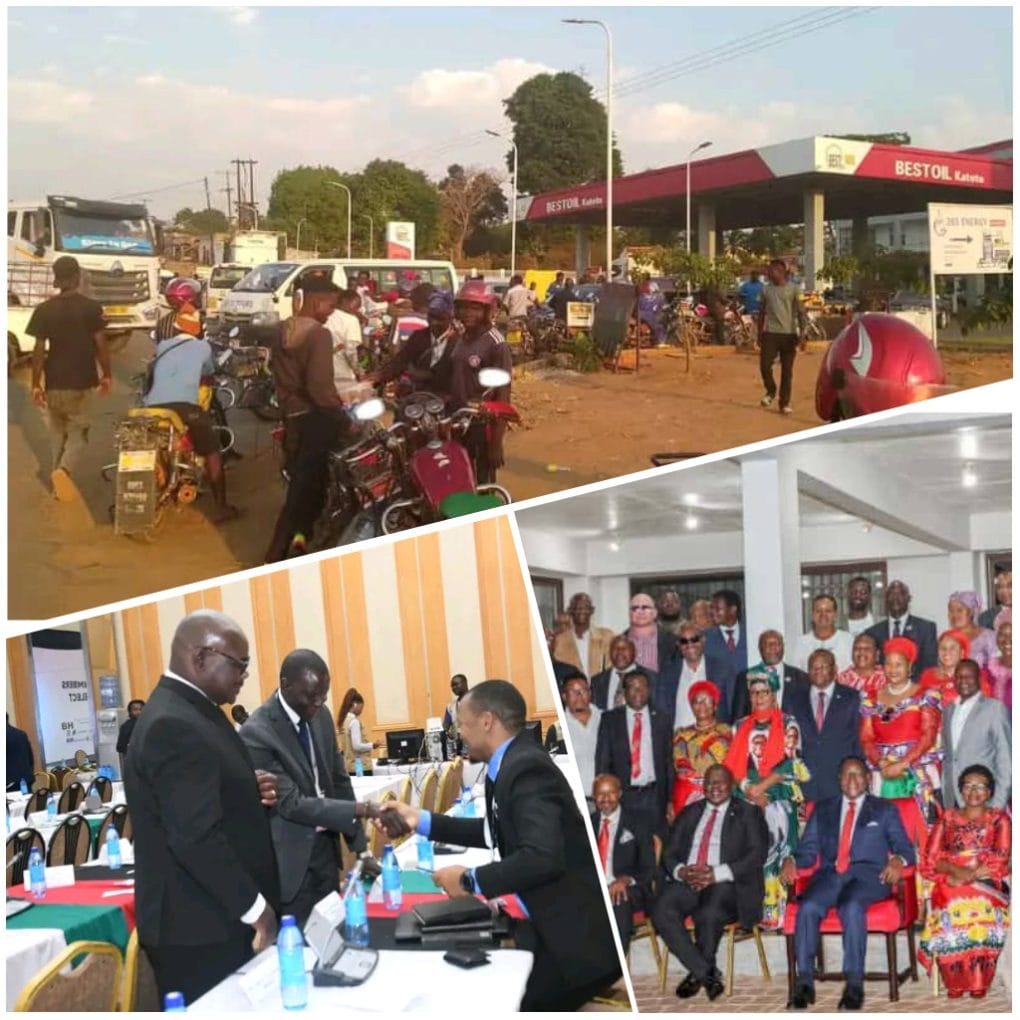
However, despite the promise of food relief, fuel shortages continued to dominate headlines, affecting daily life in cities and towns nationwide.
Many petrol stations remain dry, forcing motorists to queue for hours at the few operational pumps.
The government has attributed the crisis to supply chain challenges, while citizens continue to voice frustration over the impact on commuting, businesses, and essential services.
Amid these practical challenges, calls for national unity and peace have emerged as a unifying theme. First Lady Gertrude Mutharika took to her official Facebook page to urge all Malawians to join hands in promoting harmony across the nation.
Her message emphasized collective responsibility, love, and cooperation, resonating with many citizens who described it as a timely reminder of the importance of togetherness in difficult times.
Political developments also featured prominently this week, raising questions about governance and electoral transparency.
The arrest of eight election data clerks in Lilongwe sparked concern over possible irregularities, prompting investigations by authorities.
Details remain scarce, but the incident has heightened public awareness about the importance of accountability and integrity within Malawi’s electoral processes.
In parliamentary news, Northern region Members of Parliament rallied behind UTM’s Catherine Mzumara for the role of Deputy Speaker.
The show of regional support reflects shifting alliances within the legislative body and underscores the growing influence of regional representation in shaping parliamentary decisions.
Analysts suggest that this could have long-term implications for political dynamics and policymaking in Malawi.
From humanitarian aid to energy crises, calls for peace, electoral scrutiny, and political maneuvering, the week of October 19–25, 2025, highlights the interconnected challenges and opportunities facing Malawi today.
As the nation navigates these complex issues, citizens and policymakers alike are reminded of the importance of resilience, cooperation, and accountability in shaping a prosperous future.
Share this:
Like this:
LikeLoading…
Discover more from The Maravi Post
Subscribe to get the latest posts sent to your email.
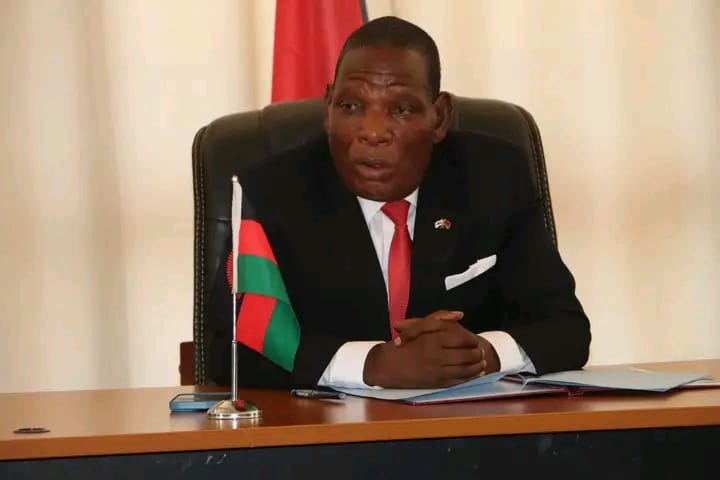
BLANTYRE-(MaraviPost)-The Minister of Finance, Economic Planning and Development, Joseph Mwanamvekha, has announced that Malawi has secured substantial international support to address the country’s economic challenges.
Speaking during a media briefing on Food Crisis Support, Mwanamvekha revealed that the World Bank has provided $45 million for emergency food assistance targeting four million Malawians.
The funding is part of a broader package of support secured during recent discussions in Washington, D.C., which aimed at stabilizing the economy and addressing challenges related to food, foreign exchange, fuel, and fertilizer supply.
The African Development Bank has also pledged additional support, further bolstering the country’s efforts to address its economic woes.
The International Monetary Fund (IMF) will visit Malawi in the first week of November to assist in efforts to stabilize the economy.
This development comes on the back of China’s debt forgiveness and grant to Malawi, with the Chinese government forgiving $20 million of Malawi’s debt and granting an additional $3 million to support the country.
According to Mwanamvekha, the government is taking steps to ensure fiscal sustainability, including cutting expenditures, reforming policies, and restructuring debt.
He assured the public that the government is confident there will be no devaluation of the local currency.
With this support, Malawi is expected to make significant strides in addressing its economic challenges and improving the lives of its citizens.
Share this:
Like this:
LikeLoading…
Discover more from The Maravi Post
Subscribe to get the latest posts sent to your email.
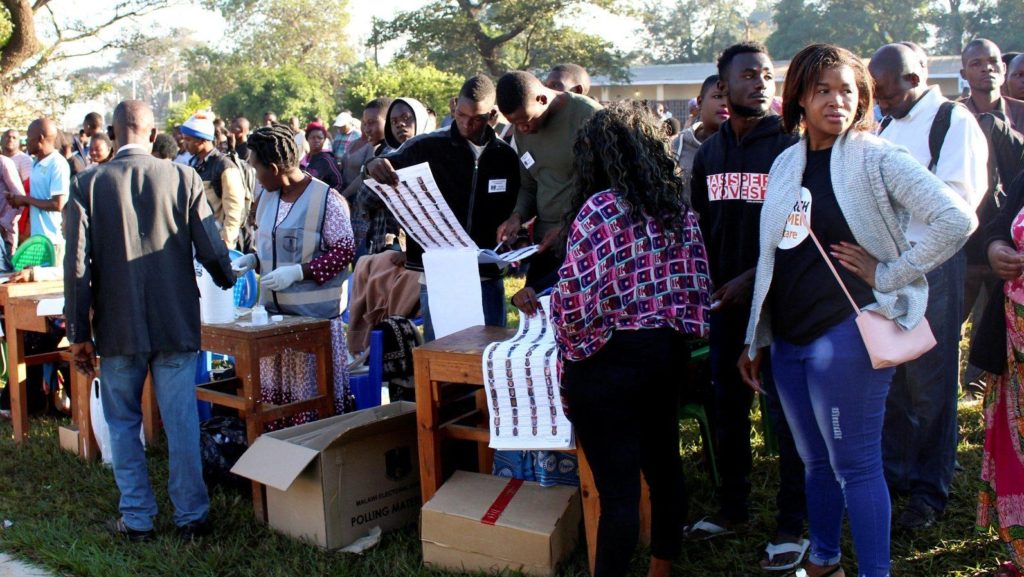
Malawi’s election results are being delayed after vote forgery claims
Written By Angella Semu
Various people on social media from various parts of Africa have applauded Malawians for the courageous fight for their freedom amid the ongoing election process.
This comes after Malawians took it to the streets following the 21st May 2019 election results that was declared not credible following several irregularities by the courts.
Among several things, Malawians have been praised for uprooting all rotting institutions and claim their much awaited freedom through the unending match of freedom for the past year.
“Malawians were cheated of Victory by Munthalika, they went into the streets fought with his police force.
“They went to court and the judiciary was not corrupt like Luke Malaba’s atrocious courts. Today they vanquished the dictatorship!,” Said one of the social media users.
In the past election, the outgoing president was declared the winner. This did not resonate well with many people who dragged the then election body led by Justice Jane Ansah to court together with the then incumbent president professor Arthur Peter Munthalika who was wrongly declared the winner of the election.
“Despite being one of the poorest country in the world, Malawi can be the next home of democracy in Africa,” said another social media user.
In the just ended elections, the unofficial results have pointed towards the opposition leader Lazarus Chakwera becoming the next president of Malawi.
Several people including Zimbabweans, Kenyans and Zambians have called upon their countries to emulate what Malawians have done and study Malawi’s institutions before engaging in the next elections.
The International Bar Association’s Human Rights Institute (IBAHRI) is deeply concerned about the recent decision in Malawi to sentence three individuals to death for killing and dismembering a person with albinism in August 2015. The IBAHRI fully supports the enjoyment of all rights by persons with albinism and recognises the challenges Malawi is facing in curbing the heinous attacks against persons with albinism. Despite this, the IBAHRI maintains that the death penalty is not the solution to preventing such odious crimes and goes against the international trend towards its abolition.
IBAHRI Co-Chair, the Hon Michael Kirby AC CMG, commented: ‘To stop the commission of crimes against human rights, penalties that violate the same fundamental rights cannot be imposed. Attacks against persons with albinism must end, but the punishment that the perpetrators should face must respect international human rights law. We exhort the Malawi government to revise this judgement.’
On Tuesday 14 August 2019, at the High Court in the Mchinji district, Central Malawi, Judge Esmey Chombo passed death sentences on three individuals: Douglas Mwale, Sophie Jere and Fontino Folosani – who were found guilty of murdering and mutilating Priscott Pepuzani, who had albinism, in August 2015. In her ruling, Judge Chombo said the death sentences would send a strong message to other would-be offenders and put an end to such malpractices.
Since 1992, Malawi has had a moratorium on the death penalty, and the mandatory death penalty for murder was eliminated in 2007. African regional standards established by the African Commission on Human and Peoples’ Rights, including General Comment No.3 on the right to life, Resolutions 42 and 136, as well as the Cotonou Declaration on the Abolition of the Death Penalty in Africa , call on State Parties to move towards the abolition of the death penalty. Nevertheless, this is not the first time in recent years that the death penalty has been imposed for this kind of crime. In May 2019, Willard Mikaele was sentenced to death for the murder of Mphatso Pensulo, another person with albinism.
In the denunciation of this recent judgement, the IBAHRI reiterates its recognition of the difficult situation for people with albinism, which is particularly worrying in Malawi and other countries of the region due to frequent ritual killings and trading of body parts. In its 2018 report ‘Waiting to disappear’ International and Regional Standards for the Protection of the Human Rights of Persons with Albinism , the IBAHRI suggests that the legal protection of the rights of persons with albinism needs to be dramatically improved.
The IBAHRI condemns all attacks against persons with albinism and the violation of their rights, but believes that the imposition of the death penalty infringes the universally guaranteed right to life and amounts to cruel, inhuman or degrading treatment or punishment, contrary to both the International Covenant on Civil and Political Rights and the Convention against Torture and Other Cruel, Inhuman or Degrading Treatment or Punishment.
IBAHRI Co-Chair, Anne Ramberg Dr jur hc, stated: ‘The death penalty is amongst the worst of human rights violations, where the right to life and the right not to be subjected to cruel, inhuman or degrading punishment are completely ignored. The decision to resort to the death penalty is incompatible with a country that supports the rule of law and good governance.’
In 2008, the IBAHRI Council passed a resolution stating: ‘the Human Rights Institute shall in the future actively promote the abolition of the death penalty’.