Over 150 NGOs Urge World Governments to Help End War Crimes in Gaza

Armed Conflicts, Civil Society, Featured, Global Governance, Headlines, Human Rights, IPS UN: Inside the Glasshouse, Middle East & North Africa, TerraViva United Nations
Credit: UNRWA

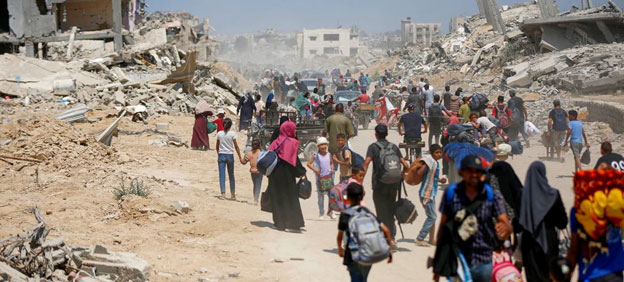
UNITED NATIONS, Oct 28 2024 (IPS) – As it continues to leave a mounting trail of death and destruction in Gaza, Israel has come under severe attack from the international community, including the United Nations and its humanitarian agencies, Western allies, the International Criminal Court (ICC) and scores of human rights experts.


During a conference in Paris, focusing on the new crisis unfolding in Lebanon, President Emmanuel Macron of France, a longtime Western ally and one of the five veto-wielding permanent members of the UN Security Council, had “sharp words for Israel reflecting the view, even among Israel’s allies, that it has used excessive force against its enemies, resulting in disproportionate casualties and destruction,” according to the New York Times October 25.

“I am not sure you can defend a civilization by sowing barbarism yourself,” Macron declared.

Meanwhile, the rising death toll in Gaza has topped over 43,000 Palestinians, mostly women and children, in retaliation for the 1,200 killed by Hamas inside Israel on October 7

And last week, over 150 civil society and non-governmental organizations (CSOs/NGOs) made a joint appeal to world governments to do “everything in their power to end this growing catastrophe and cycle of impunity. It is not only a moral imperative but a legal obligation.”

The CSOs urged all 193 UN Member States to “prevent further atrocities and ensure that those responsible for any violations of international law, including war crimes and crimes against humanity, are held accountable.”

Failure to act now risks further eroding international norms and emboldening perpetrators. The cycle of violence against civilians needs to stop, the CSOs declare.

The signatories include CIVICUS, Oxfam, United Nations Association — UK, Norwegian Refugee Council, International Civil Society Action Network (ICAN), Saferworld, and the Jewish Network for Palestine, among others.

https://www.civicus.org/index.php/media-resources/news/7372-open-call-for-a-ceasefire-in-gaza-lebanon-and-israel-and-end-to-impunity-amid-a-spiralling-humanitarian-catastrophe-and-escalating-regional-conflict

Mandeep S. Tiwana, Interim Co-Secretary General, CIVICUS, told IPS “it’s deeply unfortunate that the United States government for all its talk of human rights continues to engage in moral dualism by providing diplomatic cover to the Israeli government.”

This is happening, he pointed out, despite overwhelming evidence of the commission of war crimes, crimes against humanity and genocide by Israeli forces. “It’s fair to conclude that there’s an element of inherent racism in how the Biden administration has approached the situation in Palestine.”

In the face of a relentless assault by an occupying force, the plight of the Palestinian people matters less to America’s top diplomats than the plight of the Ukrainian people to whom the same administration has extended all sorts of moral and material support, he added

“Until Israel’s politicians and military brass are brought before an international tribunal to face justice the cycle of violence in the Middle-East will continue to repeat itself,” warned Tiwana.

Even the US, one of Israel’s closest allies, couldn’t restraint itself.

Addressing a UN Security Council meeting on October 16, Linda Thomas-Greenfield, US Ambassador to the UN, said she “watched in horror as images from central Gaza poured across my screen.”

“There were no words, simply no words, to describe what we saw. Israel has a responsibility to do everything possible to avoid civilian casualties, even if Hamas was operating near the hospital in an attempt to use civilians as human shields. We have made this clear to Israel,” she said.

“Just as we have made clear to the Israeli government at the highest levels, that it must do more to address the intolerable and catastrophic humanitarian crisis in Gaza,” the US ambassador said.

Dr. James Jennings, President of Conscience International, told IPS that “Gaza’s horror defies description”.

For Israel to bomb the enclave day and night for a full year is certainly criminal, he argued, but to impose an embargo on vital medicine and food needed by millions for survival is the absolute depth of inhumanity.

Lately it has been almost impossible to get volunteer teams of doctors and life-saving medical supplies into the enclave. Shipments of food aid are now embargoed with no explanation or reason. Besides being inhumane, it makes no military sense, unless the objective is to punish the entire population, which is a war crime, he said.

International outrage is needed to force the gates of Gaza open again, declared Dr. Jennings.

The NGO letter says: Israel’s war in Gaza, following the deadly attacks by Palestinian armed groups on 7 October 2023, is the latest and most horrific onslaught of violence in the decades-long Israeli occupation of Palestinian territory.

After a year of unfathomable killing and destruction, patterns of civilian harm by Israeli forces are spreading and escalating from Gaza to Lebanon, while rocket attacks by armed groups in Lebanon continue. We are now on the precipice of even greater devastation across the region.

Failure to act now is a choice – a choice that will fail to stop and prevent future atrocities. The UN Commission of Inquiry concluded last week that Israel has committed war crimes and the crime against humanity of extermination with relentless and deliberate attacks on medical personnel and facilities in Gaza, and called on member states to “cease aiding or assisting in the commission of violations.”

Over the last 12 months, the UN Security Council has passed four resolutions on Gaza, including one calling for a ceasefire, and the International Court of Justice (ICJ) has ordered Israel to take all measures within its power to prevent the commission of all acts within the scope of Article II of the Genocide Convention.

The ICJ also issued an Advisory Opinion that found that Israel’s occupation1 and annexation of Palestinian territory is illegal, and the UN General Assembly passed a resolution demanding that Israel end its unlawful presence in the occupied Palestinian territory (oPt) within 12 months. Despite this, none of these measures have been implemented or adhered to.

“The international community’s egregious disregard for international law and the government of Israel’s unchecked impunity in Gaza, the West Bank and now Lebanon, has set dangerous new precedents for the conduct of war,” says the letter.

For civilians in the occupied Palestinian territory and Lebanon, this has resulted in:

Many among us, says the letter, have repeatedly called for a permanent and unconditional ceasefire, hostage release, a halt to arms transfers, and de-escalation of tensions in the region, and yet the violence only appears to be intensifying.

Again, we call on all Heads of State and Governments, the UN Security Council, and actors on the ground to prioritise the preservation of human life above all else by:

    • Securing an immediate ceasefire by all parties to the conflict and an end to the indiscriminate attacks that kill civilians and
    destroy civilian infrastructure;
    • Halting the transfer of weapons, parts, and ammunition to parties to the conflict that may be used to commit violations of international humanitarian law (IHL);
    • Enabling unhindered humanitarian access for the delivery of lifesaving assistance, including food, medical supplies and fuel, and the safe movements of civilians and aid workers.
    • Ensuring the protection of civilians from further forced displacement, and the right to return for those forcibly displaced. Civilians who choose to stay or are unable to leave remain protected under international law.
    • Securing the release of all hostages and
    • Immediately activating independent international investigations into all apparent violations of international humanitarian law and war crimes committed by all parties.

Governments must do everything in their power to end this growing catastrophe and cycle of impunity. It is not only a moral imperative but a legal obligation.

All Member States must prevent further atrocities and ensure that those responsible for any violations of international law, including war crimes and crimes against humanity, are held accountable. Failure to act now risks further eroding international norms and emboldening perpetrators. The cycle of violence against civilians needs to stop.

For more on what international humanitarian law says about occupation, please see commentary by ICRC.

IPS UN Bureau Report

  Source

What do Russia and Israel Share in Common?

Armed Conflicts, Civil Society, Global Governance, Headlines, Human Rights, IPS UN: Inside the Glasshouse, Middle East & North Africa, TerraViva United Nations

Opinion

Damage caused after shelling in Mariupol, in southeastern Ukraine.Credit: UNICEF/Evegeniy Maloletka

MOSCOW, Oct 11 2024 (IPS) – Russia is pursuing, during these contemporary times, a new form of economic architecture, non-hegemonic policies and simultaneously portraying its first-class military power in the world. Russia’s development paradigm is distinctively different and largely oriented towards Global South.


While Russia stands against Western hegemony and dominance, and against NATO, Israel maintains a complex relationship between the United States characterized by deep-rooted historical ties.

But a closer examination also glaringly shows Russia and Israel have in common a depopulation agenda, Russia is demilitarizing its neighbour Ukraine, both were closely-knitted republics in the Soviet times, while Israel aims at settling on Palestine territory.

Russia referred to its war with Ukraine as a ‘special military operation’ which it began on 24th February 2022 soon after Federation Council and the State Duma approved (both houses of legislators). It has since been reviewing ‘peace initiatives’ offered by China, South Africa and many others. Brazil and India are currently pushing for a peace summit. In the case of Israel, it has completely brushed aside the ‘two-state’ resolution by the United Nations.

The United States has extended a combination of different kinds of support to Israel since its recognition after its establishment in 1948. The general perception is that throughout the 20th century, particularly during the Cold War, the United States viewed Israel as a crucial ally against common enemies such as Nazism and communism.

Furthermore, it has provided significant military aid to Israel, approximately $3.8 billion annually. Based upon these and without doubts, Israel therefore represents United States strategic interests in the region.

With the escalation of Israel war in the region, Russia has started talking about peace initiatives, in contrast to its accepting peace initiatives in the case of Ukraine. Russia has voiced concerns over potential Israeli strikes on Iranian nuclear facilities. Russia and Iran have excellent relations.

Earlier, a number of foreign media outlets reported that Israel might attack Iran’s nuclear facilities in retaliation for its earlier massive missile strike. Meanwhile, the United States has indicated that it did not support this idea.

With the conflict continuing and showing signs of disastrous consequences including in Syria, Lebanon and Iran, Russia gave a more realistic warning in early October, especially to its citizens in Israel. Latest Israeli airstrikes attack on the vicinity of Russia’s Khmeimim base in Syria necessitated Kremlin to order its estimated 1.5 million citizens to immediately leave Israel.

It further warned its people to get out before it’s too late. Something big was coming. Russia also evacuated citizens from Lebanon. The perception was that Russia was first neutral and played the double games with Israel as a means to protect its citizens, and also has little moral to advocate for peace between Israel and Palestine.

Palestine-Israeli conflict, which began in October 2023, has received global condemnations. At first, Russia has been extra-cautious talking about the Palestine-Israeli situation because of two main factors. The first is connected to its own military bombardment of Ukraine, distinctive similar to Ukraine.

South Africa has not raised genocide allegations in the Russia-Ukraine conflict, though. As the developments at the Gaza Strip show, it has taken on the genocide case triggered by a disproportionate military response or the high number of Palestinian casualties.

Then, the second point is Russia has an excellent relationship with Israel that it found it extremely difficult to publicly condemned Israel’s atrocities on Palestine. Russia and Israel have been strengthening their bilateral relations.

Both have stressed the importance of continuing active work in all areas of bilateral cooperation and the development of economic and trade, scientific, and cultural spheres, despite the ongoing crisis in the Middle East, and specifically between Palestine and Israel. Russia, at the initial stages suggested adopting measures to undertake a broad dialogue in ensuring territorial integrity and sovereignty.

Putin, as far back, on October 2023, expressed Russia’s sincere condolences to the families and friends of the Israeli victims. In addition, he warned about further escalation of violence and to avert a humanitarian catastrophe in the Gaza Strip. In particular, he informed the Israeli side of the key points of the telephone conversation with the leaders of Palestine, Egypt, Iran and Syria.

Besides warning, Russia’s principled commitment to continue its work to end the Palestinian-Israeli conflict and achieve a peaceful settlement through political and diplomatic means was reaffirmed.

It was only quite recently, in December last year, that Russian President Vladimir Putin has reiterated Russia’s principled position in rejecting and condemning terrorist in all of its manifestations, the Kremlin press service said after his phone calls with Israeli Prime Minister Benjamin Netanyahu.

“The conversation focused on the situation in the zone of the Palestinian-Israeli conflict and, in particular, on the catastrophic humanitarian situation in the Gaza Strip. Vladimir Putin reiterated the principled position of rejecting and condemning terrorism in all of its manifestations. Along with that, it is extremely important to ensure that efforts against terrorist threats do not entail such severe consequences for the civilian population,” it said.

The situation in the zone of the Palestinian-Israeli conflict was among the central topics during Putin’s talks with the Saudi Crown Prince and the Presidents of the United Arab Emirates, Iran, and Egypt earlier in December 2023. Israel declared a total blockade of the Gaza Strip and launched bombardments of the enclave and some areas in Lebanon and Syria, as well as a ground operation against Hamas in the Gaza Strip.

Late January, the Israel Defense Forces has stormed a number of cities in the West Bank in sharp escalated battles with Palestinian resistance, according several media reports including Al Jazeera. Israel has declared a complete siege of the Gaza Strip. Saudi Arabia, the United Arab Emirates (UAE), Qatar, Egypt and Jordan have also submitted settlement proposals for the Gaza Strip.

The Middle East is becoming a new arena of geopolitical confrontation. And Russian experts on the Middle-East issues have been up and offering their views since the conflicted October 7, the beginning of the conflict. The experts maintained that Russia has been actively building up its relations with countries across the Middle East in the context of resolving the Palestinian-Israeli conflict.

Middle East expert Andrey Ontikov told Izvestia newspaper that if the Europeans and Americans truly wanted to promote the idea of a two-state solution, they could put some pressure on Israel’s leadership.

“While a part of the elite is committed to the idea of establishing an independent Palestinian state, others believe that the [window of] time for this has been lost. Much will depend on the outcome of the war,” he said, adding that resolving the Palestinian issue politically would depend on both the Israelis and the Palestinians themselves, Dmitry Mariyasis, leading researcher with the Department of Israel Studies at the Russian Academy of Sciences’ Institute of Oriental Studies.

According to experts interviewed by Russia’s Izvestia newspaper, Moscow’s goal here is to find partner support in its confrontation with the West, including in Ukraine. Finding ways to reduce tensions not only between the Jewish state and radical Palestinian movement Hamas, but also in the region as a whole became a key topic of discussion at a special meeting of the United Nations Security Council (UNSC).

On 28th December 2023, Foreign Affairs Minister Sergey Lavrov praised Netanyahu for not criticizing Russia in public statements regarding the ‘special military operation’ in Ukraine. Lavrov said that Russia’s goals of “demilitarization” and “denazification” in Ukraine were similar to Israel’s stated goals of defeating Hamas and extremism in Gaza.

Excerpts from the briefing held on 12th January 2024, Foreign Ministry Spokeswoman Maria Zakharova expressed absolute regret over the massive civilian casualties in the current escalation of the Palestinian-Israeli conflict. “Russia proceeds from the unacceptability of targeted violence against civilians and the deliberate destruction of medical facilities and other civilian infrastructure.”

“Our country calls for strict compliance with international law, an immediate ceasefire in accordance with the decisions of the Security Council and the UN General Assembly,” argued Zakharova, while she closed her eyes on the consequences of the Russia-Ukraine conflict which began 24th February 2022.

In a nutshell, Russia has appreciable multifaceted relations with Israel these several years, just as it has with South Africa. But what seems to be important for the Kremlin is readiness to provide possible assistance to alleviate the suffering of civilians and de-escalate the conflict.

In the Kremlin, President Vladimir Putin’s comments on Palestine-Israeli was in addition to reaffirm its principled position on the essence to avoid such grave consequences for the civilian population while countering terrorist threats. In short, there would not be any attempt, not even the least sign in the near future, to sever decades-old relations between Israel and Russia.

Kester Kenn Klomegah focuses on current geopolitical changes, foreign relations and economic development-related questions in Africa with external countries. Most of his well-resourced articles are reprinted in several reputable foreign media.

IPS UN Bureau

  Source

Strategic Patience can Mitigate Conflict Between Israel & Iran

Armed Conflicts, Civil Society, Global Governance, Headlines, Human Rights, IPS UN: Inside the Glasshouse, Middle East & North Africa, TerraViva United Nations

Opinion

President Masoud Pezeshkian of Iran addresses the general debate of the General Assembly’s 79th session in September 2024. Credit: UN Photo/Loey Felipe

WASHINGTON DC/OXFORD, Oct 9 2024 (IPS) – How will Israel respond to Iran’s recent ballistic missiles barrage? “Strategic patience” is the best course. Israel has its hands full with Hamas and Hezbollah. Now is not the time to escalate a new major war with Iran, which could have nuclear implications.


Israeli intelligence is still chafing from its failure to preempt Hamas’ attack on October 7, which killed 1,200 Israelis. In the year since Hamas attacked, the Israeli Defense Forces (IDF) launched operations that killed 41,000 Palestinians.

Its response has been brutal yet ineffective. Israel failed to capture the Hamas leader, Yahya Sinwar or gain the release of more than 100 Israeli hostages. A humanitarian catastrophe led to the starvation and displacement of more than 2 million people.

The IDF since taken a big step to redeem its tarnished reputation by deterring Iran’s missiles strikes. The “iron dome” repelled 190 ballistic missiles fired by Iran last week. Israel repelled another attack on April 13 involving 300 missile and attack drones, which caused little damage.

Iran was embarrassed by the sequence of events, which went far beyond its failed missile attacks. I know from Javad Zarif, Iran’s former foreign minister, that Persian pride is important to Iranians. Iran faced many setbacks in the past year. President Ibrahim Raisi died in a fiery helicopter crash.

Masoud Pezeshkian, who supports engagement with the United States, gained a plurality of the popular vote and became Iran’s president. The outcome was a rebuke to Ayatollah Ali Khamenei and his theocratic regime.

No event affected Iran more than the assassination of Hassan Nasrallah, the leader of Hezbollah. Nasrallah was a friend of and served as Iran’s most steadfast proxy for more than 30 years. Nasrallah was killed in an air strike in Beirut by 2,000 pound-bunker buster bombs that devastated the Southern Beirut neighborhood of Dahiyeh.

The air strike was another indignity following Israel’s sabotage of Hezbollah pagers and walkie-talkies that killed scores of Hezbollah commanders and disabled its communications system.

Hezbollah’s mythical reputation for battlefield prowess was shattered. Hezbollah was the most significant of Iran’s proxies in Iraq, Syria, and Yemen. Nasrallah fought ISIS, defended Bashar al-Assad in Syria’s civil war, and did the regime’s dirty work around the world.

Fearing his own assassination, Khamenei was removed to a secure location. He emerged in time for Friday prayers to defend Iran’s missile strikes on Israel as “correct, logical, and lawful” and to condemn Israel’s “astonishing crimes”.

Nasrallah’s death was a big blow to the Iranian regime. Iran was further humiliated by the assassination of Ismail Haniya, a senior Hamas figure staying in an official guest house while attending Raisi’s funeral in Tehran.

Netanyahu warned that no place in the Middle East is safe from Israel’s security services. He was right. In addition, economic sanctions have taken their toll on Iranians. Sanctions relief is a distant dream as the US and G7 allies tighten the screws on Iran’s economy.

Israel-Iran relations are at a fork in the road. President Joe Biden has urged Netanyahu to consider “alternatives” to attacking Iranian nuclear sites or destroying Iran’s oil infrastructure. There is an alternative conflict escalation.

Netanyahu and Khamenei should consider a new approach now that the shadow war is out in the open. Diplomacy would require assurances from Israel that it won’t launch a first strike against Iran. In turn, Iran must guarantee that its nuclear program won’t be weaponized.

Discreet discussions with the International Atomic Energy Agency would advance safeguards, including spot inspections of Iran’s nuclear sites and the reactivation of electronic surveillance. For sure, Israel will continue operations in Gaza. Israel will hunt Sinwar until he is eliminated. It cannot countenance another October 7.

In Lebanon, Israel has succeeded in killing Nasrallah and eliminating half of Hezbollah’s 150,000 missiles. Its ground operation in Southern Lebanon cannot be open-ended. Having a failed state on Israel’s northern border would result in continued instability and risk.

Regional progress would be impossible with a new front between Israel and Iran. Strategic patience means that Israel would bide its time until there is an opportunity for diplomatic progress. Diplomacy and de-escalation are preferable to war without end.

David L. Phillips is an adjunct professor at Georgetown University’s Security Studies Program and a Visiting Research Scholar at Oxford University.

IPS UN Bureau

  Source

To Kill the Future, Zero the Past

Armed Conflicts, Civil Society, Global Governance, Headlines, Human Rights, Middle East & North Africa, TerraViva United Nations

Opinion

Credit: UNRWA

ATLANTA, Georgia, Sep 17 2024 (IPS) – Today’s weapons are capable of wiping out entire swaths of humanity, demolishing remaining shreds of culture along with them. News coverage of the one-sided Gaza campaign make it plain that’s exactly what’s happening. Destroying the past destroys the future too. The world must band together to make sure these atrocities stop.


Israel’s war crimes against Palestinian civilians in Gaza have now reached a new low, despite continuing international protests and UNESCO complaints over the destruction of culture. After nearly a year of overkill, Israeli jets continue to drop bombs on hospitals, schools, and refugees in flimsy tent camps, killing increasing numbers of people who never had anything to do with starting the war.

Four months ago on May 15, Israeli’s Minister of Defense, Yoav Gallant, reported to Prime Minister Netanyahu that “HAMAS no longer functions as a military organization.” Lately it has been clear to everybody that there are no more military objectives left in Gaza.

It can only mean that the incessant bombing of the last four months, killing scores of innocent people every week, were intended to punish Gaza by intentionally killing civilians. Despite the claim that those being bombed are terrorists, there is no evidence to support that claim. It’s an outrage. War crimes keep piling up.

Just last week, on September 10 2024, after nearly a year of incredibly destructive bombing, Israeli jets struck the flimsy tents in al-Mawasi Camp, formerly declared a safe zone by the IDF itself, killing dozens of people and leaving three craters 30 feet deep.

A day later, the UN school in Jabalia Camp used as a shelter was bombed for the umpteenth time, killing at least 18, including 6 UN/UNRWA staff members, with local people claiming up to 60 deaths. After so many months and so many innocent people killed, what could possibly account for this continuing barbarity?

Deliberately targeting civilians anywhere is illegal under international law, and especially in declared safe zones within United Nations shelters and tent camps. Such overkill is incomprehensible to most of the civilized world, but also to nearly a million Israelis who regularly protest their government’s unwillingness to accept a cease-fire.

They have been in the streets for months begging the Likud-dominated War Cabinet to stop the war and free the diminishing number of Israeli captives. Weak cautions from the US White House have had no effect.

It is difficult to see how any of this benefits Israel. Their actions have raised worldwide scorn for the government in Jerusalem that insists on continuing the war. They have only succeeded in empowering the BDS (Boycott, Divestment, and Sanctions) movement.

How can continued bombing reach any rational objective except to incite Israel’s enemies with more hatred and revenge killing extending far into the future? A military doctrine of “maximum force” can only mean killing large numbers of non-combatant women and children. These one-sided attacks will soon reach the one-year mark.

The only possible reasons for continuing Israel’s eleven-month killing spree in Gaza—since Netanyahu recently blocked a cease fire with HAMAS that might have rescued the hostages—is to decimate Palestine’s future along with its past, an important goal for the government in Jerusalem.

Targeting Palestine’s youth by bombing schools inevitably destroys their future opportunities along with the historical memory of the Palestinian people’s collective nationhood. Young people will be unable either to get jobs or reclaim their rightful heritage.

This barbaric one-sided atrocity in Gaza continues despite President Joe Biden and Democratic Candidate Kamala Harris’ words supporting two states. That formulation is now an improbable dream—far off if it ever happens. Most analysts believe it’s undo-able at this point, after hundreds of thousands of settlers have moved into the West Bank.

Humanity—meaning all of us—continues to struggle today amid an atmosphere of fear and lust for power. Bloody Gaza is at the center of a growing vortex in today’s sea of troubles.

James E. Jennings, PhD is President of Conscience International www.conscienceinternational.org and Executive Director of US Academics for Peace. Jennings has delivered humanitarian aid to Gaza’s hospitals since 1987, including during the first intifada, the al-Aqsa intifada, and Israel’s “Cast Lead” bombing attacks in 2009 and 2014.

IPS UN Bureau

  Source

The Deadly US Weapons of Civilian Destruction

Armed Conflicts, Civil Society, Democracy, Featured, Global Governance, Headlines, Human Rights, IPS UN: Inside the Glasshouse, Middle East & North Africa, Peace, TerraViva United Nations

Much of the Gaza Strip has been destroyed in the conflict. Credit: UNRWA

UNITED NATIONS, Sep 13 2024 (IPS) – As the devastating 11-month-old conflict in Gaza keeps escalating, with over 41,000 mostly civilian killings, and more than 92,000 Palestinians injured –in retaliation for the 1,200 killings inside Israel last October– the Israelis continue to defy the United States which maintains its uninterrupted flow of heavy weapons to Tel Aviv.


There are two hardcore lessons in this conflict. Perhaps Israel should realize that you cannot continue biting the hand that feeds you while the Biden administration should realize that you cannot continue to feed the mouth that bites you.

The world’s weapons of mass destruction (WMDs) are categorized mostly as nuclear, chemical, biological and radiological weapons. But the US-supplied missiles and 2,000-pound bombs dropped on Gaza are best described as weapons of civilian destruction (WCDs) which have also reduced cities to rubble.

On September 11, the New York Times ran a story on the latest killings of civilians, titled “Israel Kills Gazans as its Air Power Hits a Humanitarian Zone”

The Times quoted Trevor Ball, a former US army explosive ordnance-disposal technician, as identifying a fragment found at the most recent bombing in Gaza as “the tail section of a SPICE-2000 kit, a precision guided kit used with 2,000-pound bombs.

If Israel is accused of genocide and war crimes, where does the US fit in as the major supplier of arms that are killing all these civilians?

And, on August 13, as the civilian killings continued unabated, the Biden Administration formally notified Congress of its plan to authorize the sale of a staggering list of arms to Israel including:

An $18.8 billion sale of 50 F-15 fighter jets and related equipment;
A $774 million sale of up to 32,739 120mm tank cartridges and related equipment;
A $583 million sale of Family of Medium Tactical Vehicles (FMTV)s and related equipment;
A $102 million sale of 30 Advanced Medium Range Air-to-Air Missiles (AMRAAM) and related equipment; and, A $61 million sale of 50,000 M933A1 120mm High Explosive mortar cartridges and related equipment.

In June 2024, Reuters reported that the Administration had transferred at least 14,000 MK-84 2,000-pound bombs, 6,500 500-pound bombs, 3,000 Hellfire precision-guided air-to-ground missiles, 1,000 bunker-buster bombs, 2,600 air-dropped small-diameter bombs, and other munitions.

Dr Ramzy Baroud, a journalist and Editor of The Palestine Chronicle, told IPS “for Israel to commit its genocide against Palestinians in Gaza, it requires a large and steady supply of weapons. Most of these weapons come from the United States.”

“In fact, over 11 months of Israeli genocide and following numerous reports by international organizations, we know precisely how US bunker busters and other weapons and munitions intended for mass killings have been used,” he pointed out.

Yet, despite all of this, the US continues to give Israel all the bombs and rockets necessary to inflict most deadly violence against Palestinians, including those sheltered in displacement camps, at UN schools, at hospitals, and other areas that are intended to be ‘safe zones’.

But American support for Israel cannot be confined to that of weapon supplies, Dr Baroud said, because Washington remains Israel’s strongest backer and defender at international institutions, including the UN Security Council. This blind and unconditional support has emboldened Israel to carry on with the most despicable genocide against an innocent and besieged nation.

Even Biden’s so-called ‘ceasefire proposal’ last May was supposedly communicated on behalf of Israel, then, oddly rejected also on behalf of Israel.

There can be no other interpretation of this: the genocide of the Palestinians in Gaza is carried out jointly by Israel and the United States, said Dr Baroud, a Non-resident Senior Research Fellow at the Center for Islam and Global Affairs (CIGA). www.ramzybaroud.net

According to a Cable News Network (CNN) report early this week US Secretary of State Anthony Blinken has called for “fundamental changes” to the way Israeli forces operate in the occupied West Bank after the killing of American activist Aysenur Ezgi Eygi at a protest last week.

US President Joe Biden condemned Eygi’s killing on Wednesday. ““I am outraged and deeply saddened by the death of Aysenur Eygi,” Biden said in a statement, adding that the shooting “is totally unacceptable.”

Biden called for “full accountability” for her death after Israel “has acknowledged its responsibility.” Israel, he added, “must do more to ensure that incidents like this never happen again.”

As an old Middle East saying goes: The dogs bark but the caravan moves on.

Is this a reflection of the unrestrained power of the Israeli lobby in the US Congress, which one-time Republican US presidential candidate Pat Buchanan, called “Israeli-occupied territory”? Does this now include the White House?

Unfortunately, there will be no accountability for the killing of the American-Turkish activist, Dr Baroud pointed out. “We know this for a fact because there has never been a precedent in history in which the US has held Israel accountable for anything”.

The family of American activist Rachel Corrie, who was deliberately run over by an Israeli army bulldozer, knows exactly how frivolous the US use of language in this kind of situation can be.

The US speaks of “accountability”, “responsibility”, “full investigations”, yet ultimately accepts the Israeli narrative as the truth. More recently, the US has used similar language following the murder of Palestinian journalist Shireen Abu Akleh, before circling back to accepting the Israeli story that her killing was not deliberate and was not part of a larger policy to target civilians.

Infuriatingly, but still unsurprisingly, the US is using the above language at a time when over 41,000 Palestinians have been confirmed killed in Gaza, with thousands more missing and tens of thousands wounded, he said.

Not only no such accountability has been achieved or even called for, but the US continues to give Israel the very murder weapon so that it may continue its genocide against Palestinian civilians, said Dr Baroud.

Meanwhile, UN Secretary-General Antonio Guterres condemned the death of at least 18 people, including children, women, and six UNRWA staff, in Israeli airstrikes that hit a school serving as a shelter in Nuseirat on 11 September.

This incident raises the number of UNRWA staff killed in this conflict to 220. The IDF stated that they had targeted a command-and-control center in the compound. This incident must be independently and thoroughly investigated to ensure accountability.

The continued lack of effective protection for civilians in Gaza is unconscionable. Civilians and the infrastructure they rely on must be protected and the essential needs of civilians met. The Secretary-General calls upon all parties to refrain from using schools, shelters, or the areas around them for military purposes. All parties to the conflict have the obligation to comply with international humanitarian law at all times.

The Secretary-General also reiterated his call for an immediate ceasefire and the immediate and unconditional release of all hostages. This horrific violence must stop, he declared.

According to an October 2023 report from the US State Department’s Bureau of Political-Military Affairs, steadfast support for Israel’s security has been a cornerstone of American foreign policy for every U.S. Administration since the presidency of Harry S. Truman.

Since its founding in 1948, the United States has provided Israel with over $130 billion in bilateral assistance focused on addressing new and complex security threats, bridging Israel’s capability gaps through security assistance and cooperation, increasing interoperability through joint exercises, and helping Israel maintain its Qualitative Military Edge (QME).

This assistance has helped transform the Israel Defense Forces into “one of the world’s most capable, effective militaries and turned the Israeli military industry and technology sector into one of the largest exporters of military capabilities worldwide”.

Israel has also been designated as a U.S. Major Non-NATO Ally under U.S. law. This status provides foreign partners with certain benefits in the areas of defense trade and security cooperation and is a powerful symbol of their close relationship with the United States.

Thalif Deen, Senior Editor, UN Bureau, Inter Press Service (IPS) news agency, is a former Director, Foreign Military Markets at Defense Marketing Services; Senior Defense Analyst at Forecast International; military editor Middle East/Africa at Jane’s Information Group, USA; and one-time UN correspondent for Jane’s Defense Weekly, London.

IPS UN Bureau Report

  Source

Knowledge is Power. Gaza War Supporters Don’t Want Students to Have Both

Civil Society, Democracy, Featured, Global Governance, Headlines, Human Rights, IPS UN: Inside the Glasshouse, Middle East & North Africa, TerraViva United Nations

Opinion

Student protesters at Columbia University, New York. Credit: IPS

SAN FRANCISCO, USA, Sep 6 2024 (IPS) – With nearly 18 million students on U.S. college campuses this fall, defenders of the war on Gaza don’t want to hear any backtalk. Silence is complicity, and that’s the way Israel’s allies like it.


For them, the new academic term restarts a threat to the status quo. But for supporters of human rights, it’s a renewed opportunity to turn higher education into something more than a comfort zone.

In the United States, the extent and arrogance of the emerging collegiate repression is, quite literally, breathtaking. Every day, people are dying due to their transgression of breathing while Palestinian.

The Gaza death toll adds up to more than one Kristallnacht per day — for upwards of 333 days and counting, with no end in sight. The shattering of a society’s entire infrastructure has been horrendous.

Months ago, citing data from the Palestinian Central Bureau of Statistics, ABC News reported that “25,000 buildings have been destroyed, 32 hospitals forced out of service, and three churches, 341 mosques and 100 universities and schools destroyed.”

Not that this should disturb the tranquility of campuses in the country whose taxpayers and elected leaders make it all possible. Top college officials wax eloquent about the sanctity of higher learning and academic freedom while they suppress protests against policies that have destroyed scores of universities in Palestine.

A key rationale for quashing dissent is that anti-Israel protests make some Jewish students uncomfortable. But the purposes of college education shouldn’t include always making people feel comfortable. How comfortable should students be in a nation enabling mass murder in Gaza?

What would we say about claims that students in the North with southern accents should not have been made uncomfortable by on-campus civil rights protests and denunciations of Jim Crow in the 1950s and 1960s? Or white students from South Africa, studying in the United States, made uncomfortable by anti-apartheid protests in the 1980s?

A bedrock for the edifice of speech suppression and virtual thought-policing is the old standby of equating criticism of Israel with antisemitism. Likewise, the ideology of Zionism that tries to justify Israeli policies is supposed to get a pass no matter what — while opponents, including many Jews, are liable to be denounced as antisemites.

But polling shows that more younger Americans are supportive of Palestinians than they are of Israelis. The ongoing atrocities by the Israel “Defense” Forces in Gaza, killing a daily average of more than 100 people — mostly children and women — have galvanized many young people to take action in the United States.

“Protests rocked American campuses toward the end of the last academic year,” a front-page New York Times story reported in late August, adding: “Many administrators remain shaken by the closing weeks of the spring semester, when encampments, building occupations and clashes with the police helped lead to thousands of arrests across the country.” (Overall, the phrase “clashes with the police” served as a euphemism for police violently attacking nonviolent protesters.)

From the hazy ivory towers and corporate suites inhabited by so many college presidents and boards of trustees, Palestinian people are scarcely more than abstractions compared to far more real priorities. An understated sentence from the Times sheds a bit of light: “The strategies that are coming into public view suggest that some administrators at schools large and small have concluded that permissiveness is perilous, and that a harder line may be the best option — or perhaps just the one least likely to invite blowback from elected officials and donors who have demanded that universities take stronger action against protesters.”

Much more clarity is available from a new Mondoweiss article by activist Carrie Zaremba, a researcher with training in anthropology. “University administrators across the United States have declared an indefinite state of emergency on college campuses,” she wrote. “Schools are rolling out policies in preparation for quashing pro-Palestine student activism this fall semester, and reshaping regulations and even campuses in the process to suit this new normal.

“Many of these policies being instituted share a common formula: more militarization, more law enforcement, more criminalization, and more consolidation of institutional power. But where do these policies originate and why are they so similar across all campuses? The answer lies in the fact that they have been provided by the ‘risk and crisis management’ consulting industries, with the tacit support of trustees, Zionist advocacy groups, and federal agencies. Together, they deploy the language of safety to disguise a deeper logic of control and securitization.”

Countering such top-down moves will require intensive grassroots organizing. Sustained pushback against campus repression will be essential, to continually assert the right to speak out and protest as guaranteed by the First Amendment.

Insistence on acquiring knowledge while gaining power for progressive forces will be vital. That’s why the national Teach-In Network was launched this week by the RootsAction Education Fund (which I help lead), under the banner “Knowledge Is Power — and Our Grassroots Movements Need Both.”

The elites that were appalled by the moral uprising on college campuses against Israel’s slaughter in Gaza are now doing all they can to prevent a resurgence of that uprising. But the mass murder continues, subsidized by the U.S. government. When students insist that true knowledge and ethical action need each other, they can help make history and not just study it.

Norman Solomon is the national director of RootsAction.org and executive director of the Institute for Public Accuracy. His latest book, War Made Invisible: How America Hides the Human Toll of Its Military Machine, was published in paperback this month with a new afterword about the Gaza war.

IPS UN Bureau

  Source