



Justin Baldoni’s dad Sam is still proud of his son, despite the sexual harassment allegations plaguing the 42-year-old director … which Sam seemed to refer to as “injustice.” Sam posted a tribute for Justin’s 42nd birthday Saturday, writing, “I…
Justin Baldoni’s dad Sam is still proud of his son, despite the sexual harassment allegations plaguing the 42-year-old director … which Sam seemed to refer to as “injustice.” Sam posted a tribute for Justin’s 42nd birthday Saturday, writing, “I…


While 2025 certainly had some great TV shows, it also had a lion’s share of terrible series.
If we’re gonna talk about the best of 2025, then we naturally have to talk about the worst. Not every show is gonna be a hit, not every season 1 is an Emmy nominee. Many of them simply head to the trash — and some trash even gets a second season.
Watch With Us is rounding up the very bottom of our TV watches this year, from an ill-fated Suits spinoff to a goofy political thriller starring Robert De Niro.
We’ve picked and ranked the five worst shows that 2025 had to offer.
7 Best Ryan Murphy Shows, Ranked: From ‘American Horror Story’ to ‘Scream Queens’
If The Pitt was the best medical drama of 2025, then Pulse may have been the worst. The show follows a group of surgical and emergency residents at Maguire Hospital, a trauma center in Miami, as they all vie for the same thing: the position of Emergency Medicine Chief Resident. The residents navigate their personal and professional lives as they handle various medical crises while dealing with the fallout of a massive scandal at their place of work.
Pulse ultimately failed to charm both reviewers and audiences, and it was justifiably canceled shortly after its disappointing debut. Critics ultimately found that Pulse went all-in on tired tropes without doing enough to set it apart from the other hospital dramas like Breathless or even the 86th season of Grey’s Anatomy. If it’s just another medical procedural show, then why not watch something that actually elevates itself like The Pitt? Despite some good acting, poor plotting, annoying characters and a questionable depiction of sexual harassment made this show is one to skip.
Robert De Niro stars as George Mullen, a former United States president who is brought out of retirement by his successor to handle a very special assignment. Mullen has been assigned as head of a group investigating a massive, global cyberterrorist attack that resulted in the deaths of thousands of innocent people. You see a new prestige series starring an acting tour de force like De Niro and you think, “How could it go wrong?”
Well, when it comes to Zero Day, it can go very wrong. The political thriller executive produced by Noah Oppenheim (A House of Dynamite) ends up a totally forgettable experience — a mealy-mouthed commentary on hot-button issues that fails to deliver anything of substance. Even the additional star power of Angela Bassett, Jesse Plemons and Connie Britton can’t help poor screenwriting and middling tension.
This is not the first time that Ryan Murphy‘s name will grace this list since the highly prolific showrunner committed multiple crimes against television this year. But perhaps the less offensive to the tastes was Monster: The Ed Gein Story, although it’s really a “lesser of two evils” situation. The third installment of the Monster anthology series follows the life of notorious serial killer Ed Gein while examining his influence on pop culture and true crime.
Critics somehow managed to find more value in Monster: The Ed Gein Story than this list’s next inclusion, All’s Fair, which sports an impressive 6 percent score on Rotten Tomatoes compared to Monster’s 22 percent. The main high point of the show is the ensemble cast’s across-the-board great performances and some stellar production design as well. However, most found Monster to be a repulsive contortion of Gein’s persona while failing to meaningfully comment on pop culture — the only thing Monster: The Ed Gein Story does is indulge in the very thing it wishes to admonish.
The only reason All’s Fair isn’t number one on this list is that while the show was universally panned by critics, it received enough hate-watches from audiences to justify its continued existence — but just barely. It’s one of those Emily in Paris situations, where the car crash on the side of the road makes drivers wanna crane their necks and get a good look, even though they shouldn’t. It’s the same situation with All’s Fair, Murphy’s legal drama about an all-female law firm in Los Angeles that managed to clinch a series renewal.
A show that receives the moniker from numerous critics as being “one of the worst shows ever made” is unfortunately going to get a lot of people to watch out of curiosity for how exactly a show could be that bad. In the end, All’s Fair isn’t even a “so bad it’s good” situation because the show is too boring, too shallow and poorly written, to be entertainingly awful, all while helmed by an absolutely forgettable performance from Kim Kardashian.
The television “Flop of the Year” award goes to Suits LA, a remarkably ill-conceived spinoff of Suits predicated on the fact that people enjoyed checking out Suits when it was added to Netflix. But trying to exploit the streaming success of an older show doesn’t mean that a creatively uninspired spinoff is going to generate the same success. The creators behind Suits LA seemed not to understand what made Suits so good to begin with, and instead of trying something new and interesting, they just create the same thing a second time — but worse.
33 Must-Watch TV Shows on Hulu Right Now (December 2025)
Suits LA simply tries to transpose the narrative of Suits onto a different setting, but without any of the writing, acting or editing that made the original a great, breezy and bingeable watch. Plus, the show already had a failed spinoff with Pearson back in 2019, which was cancelled after one season and starred one of Suits’ most compelling characters. If a show with an original character couldn’t work, why did they think they could capture magic with an all-new cast playing poorly-written characters? If All’s Fair at least has hate-watch intrigue, Suits LA absolutely has nothing to justify watching it.
Subscribe to get the latest posts sent to your email.


Perla Venegas is one of 1444 female bus drivers in the surface public transport network in Santiago, Chile, which aims at gender inclusion and offers job stability and shift flexibility compatible with family life. CREDIT: Orlando Milesi / IPS
By Orlando Milesi
SANTIAGO, Jun 26 2023 (IPS)
Sexual harassment and discrimination are daily realities for women on public transport in Chile and also an obstacle for plans to expand mass transit in order to reduce pollution in several cities in this South American country.
Sexual harassment is the most visible form of discrimination against women in Chilean public transportation, in addition to insecurity due to poorly lit bus stops, inadequate buses, and more frequent trips at times when women are less likely to travel.
Personal accounts gathered by IPS also mentioned problems such as the constant theft of cell phones and the impossibility for young women to wear shorts or low-cut tops when traveling on buses or the subway, the backbone of Santiago’s public transportation system.
To address these problems, the Chilean government and the Santiago city government adopted gender strategies: they put in place special telephones to report harassers and thieves, began installing “panic buttons” and alarms at bus stops, and incorporated more women in driving and security.
“When I was younger I suffered a lot of harassment because I didn’t have the character to stand up to the harassers. Now that I am older, I am able to confront an aggressor without fear, even when he is harassing another person, whether a man or a woman. When I confront them, they run away,” Bernardita Azócar, 34, told IPS.
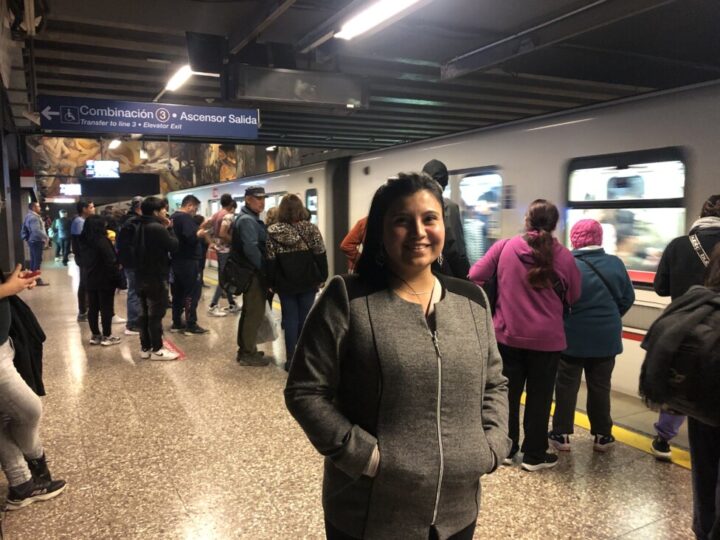
Bernardita Azócar, in a subway station in Santiago, Chile, heads to her job in a collection agency. She says she suffered sexual harassment on public transport in the capital when she was younger, but now she is more alert to any aggression and feels empowered to help others who suffer the same bad experience. CREDIT: Orlando Milesi / IPS
“It happened to me a couple of times when I was younger. They want to grope you or try to touch another girl and now I confront them. I suffer less because I’m more aware and I try not to put myself at risk,” she added during a dialogue at the University of Chile subway station in Santiago.
Azócar, who works for a collection company, said the root cause of harassment lies in education and in Chilean society.
“If you wear a miniskirt or show cleavage, society points the finger at you, as if you were provoking men and it was your fault. And I don’t think that’s why it happens. It’s abuse to be harassed in the public system…or anywhere else,” she said.
Maite, a humanities student at the Catholic University, feels that women are at a disadvantage on public transportation.
“When a woman takes a bus, she tends to sit next to the aisle to have an easier way to flee from any threat. Or she sits next to another woman so as not to travel alone. There are many things that women do that are not explicit. They are behaviors we learn, to get by on public transportation,” said the young woman who, like her friends, preferred not to give her last name.
According to Maite, “women can’t wear shorts or backpacks on the bus, or openly use a cell phone. Every time you get on the bus you have to take a lot of measures.”
Maite and four other classmates told IPS that they take a combination of buses and the subway to go to school and that none of them have suffered harassment on the bus, but they know of several cases that happened to their friends.
“If someone tries to touch me or crowd me too closely I don’t feel so safe,” said Elena, a commercial engineering student.
“A friend of mine had her cell phone stolen. I have not been harassed, but I would never go on the bus or subway in shorts even if I were dying of heat. I wear long pants because wearing shorts is a risk,” added Emilia, a psychology student.
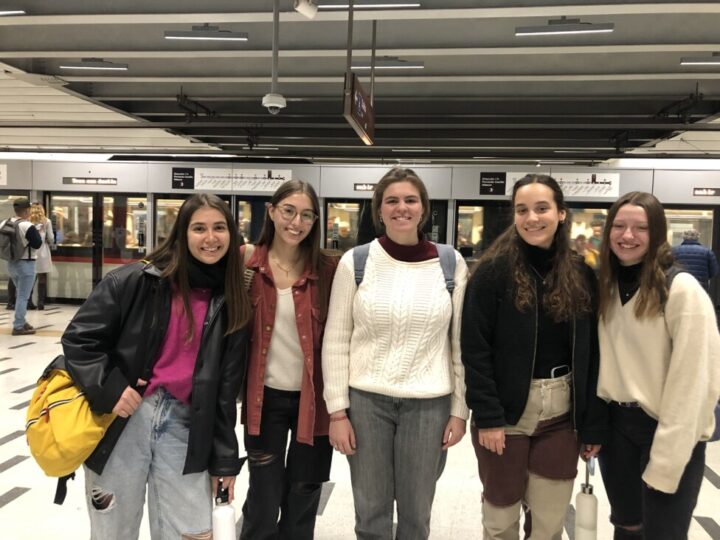
The five university students in this group lament the discrimination women suffer on Chilean public transport and recognize that they have a “code of conduct” that they personally follow to avoid problems, such as not wearing shorts or miniskirts or showing cleavage, even in summertime, although it sometimes restricts their personal freedom. CREDIT: Orlando Milesi / IPS
The joys and pitfalls of being a female bus driver
Getting more people to use buses and other public transport in Chile, a long narrow country with a population of 19.8 million, is difficult because 71 percent of households own at least one car.
The incorporation of more female bus drivers is aimed at a friendlier mass transit system.
Perla Venegas, 34, has been working as a bus driver in Santiago’s public transportation system for six years.
“I like my job and driving. The most complicated thing is dealing with cyclists, pedestrians and passengers, who are never satisfied,” she told IPS while parked waiting to pull out on the corner of Santa Rosa and Alameda, in the heart of downtown Santiago.
Her route connects downtown Santiago with the municipality of Maipú, in the western outskirts of the capital.
“I’m on a par with the male drivers, but I’m more cautious, not so aggressive and I’m a more defensive driver. I have been complimented several times, especially by elderly people,” said Venegas, who lives with her two daughters, aged 16 and 8.
“I have female colleagues who have been hit and beaten. I received a death threat from a passenger because when the route ended he wouldn’t get off. He was a homeless drug addict. It was 5:30 AM. In the end I found a carabineros (police) patrol car and I turned him in,” she said.
She added that she has had both pleasant and negative experiences and acknowledged that she is proud that her eldest daughter also wants to be a bus driver “although I would not like her to experience the hard parts.”
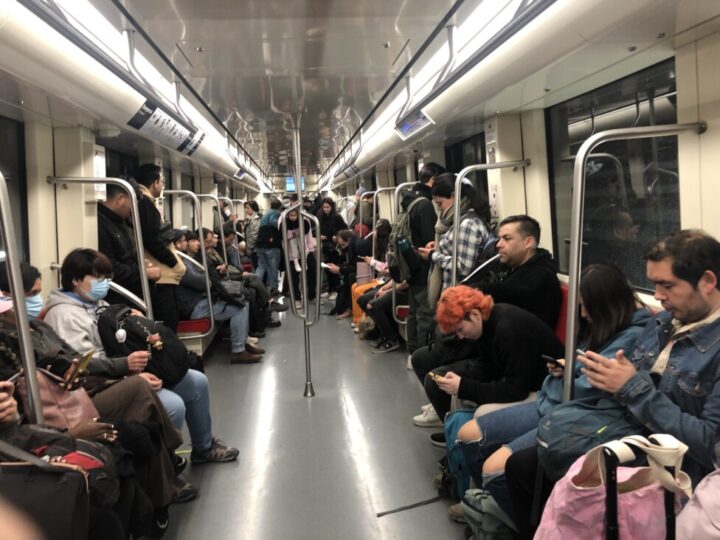
The Santiago subway is the backbone of the mass transit system in the Chilean capital. It makes it possible to reach 23 of the 32 municipalities that encompass the capital and allows passengers to combine with a bus network to reach any point of the metropolitan region. CREDIT: Orlando Milesi / IPS
Staying alert in the subway, the main means of public transport
On the Santiago subway there are 2.3 million trips on working days. Its tracks cover 140 kilometers on six lines, with 136 stations in 23 of the 32 municipalities that comprise the metropolitan area. Greater Santiago is home to 7.1 million people.
An additional 2.1 million average daily trips are made on surface public transport.
According to official statistics, during the first five months of the year there were 21 pollution episodes in Santiago above the maximum standard level and eight environmental alerts for excess fine particulate matter, so increasing the use of public transport instead of private vehicles is considered a priority for the authorities.
Paulina del Campo, the subway’s sustainability manager, told IPS that gender issues are a strategic objective in this state-owned company.
“We have taken the issue of harassment very seriously. We do not have large numbers, but we do have moments like March 2022 when the issue was raised because of situations in the streets and in universities that included public transportation,” she said.
After meetings with authorities and student leaders, the subway increased the presence of female security guards at stations in the university district.
“One of the things they said is that in a situation of harassment it is much more comfortable to ask for help from a woman than from a man,” explained Del Campo.
The company thus hired a specific group of female guards to receive and respond to complaints.
“Qualified staff respond and are trained to provide support for the victims. We can quickly activate the protocols with the carabineros police. When it happens we can intercept the train and often arrest the people (aggressors) on the spot,” said Del Campo.
In another campaign, a standard methodology designed by international foundations with expertise in harassment was adapted to the situation in Chile.
At the same time, the subway increased its female staff and the number of women in leadership positions.
“Two years ago we had a female staff of around 20 percent and now, in May, 26.5 percent of the 4,400 subway workers are women. In the area of security guards we have a staff of approximately 700 and of these 110 are women,” explained the company’s Sustainability Manager.
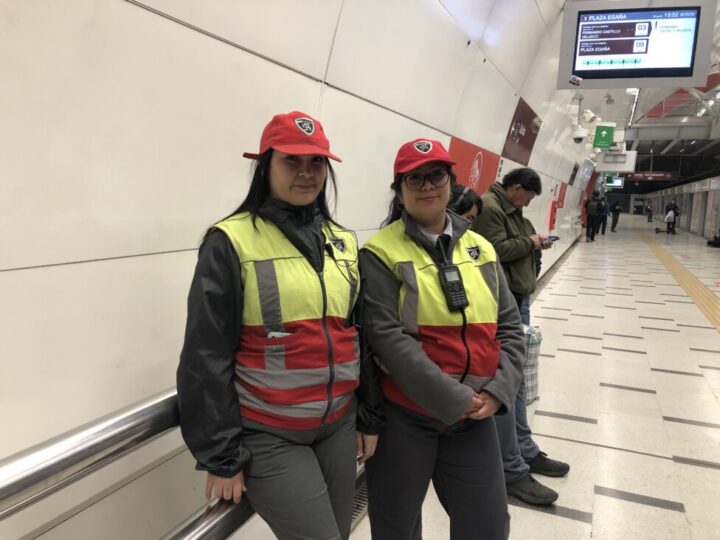
These two women are security guards at the Plaza Egaña subway station, on line 6 in Chile’s capital. The state-owned Metro company is increasing the number of women in its services as part of a gender policy that even includes the maintenance of trains. CREDIT: Orlando Milesi / IPS
Gender policies in public transportation
The Metropolitan Public Transport Directorate (DTPM) informed IPS that it aims to reduce the male-female gap in public transport.
It also plans to increase the number of women bus drivers.
The Red system, with buses running throughout Santiago, currently employs 1,444 women – only 7.6 percent of all drivers.
“Many women who have entered this field come from highly precarious and unregulated jobs, so this opportunity has allowed them greater autonomy and, on many occasions, to leave violent environments and improve their self-confidence,” the DTPM stressed in response to questions from IPS.
“This has meant an effort to train and generate conditions to keep and promote women who are part of the system,” it added.
Origin-Destination Surveys reveal that women are the main users of public transport and 65 percent of trips for the purpose of caring for the home, children or other people are made by women. They are more likely to make multidirectional trips and in the so-called off-peak hours, with little traffic.
According to the DTPM, waiting for the bus is one of the most critical moments in every trip.
“This is why we installed the panic button at bus stops and real-time information on the arrival of buses to improve the perception of security,” it explained.
The information is available through an application on cell phones, while the panic buttons began as a women’s safety pilot plan in October 2022 at stops in one of the capital’s municipalities. The plan is to extend them to a large number of stops in Santiago.






