Brazil Back on the Green Track

Credit: Mauro Pimentel/AFP via Getty Images

By Inés M. Pousadela
MONTEVIDEO, Uruguay, Jul 24 2023 (IPS)

At a meeting with European and Latin American leaders in Brussels this July, Brazil’s President Lula da Silva reiterated the bold commitment he had made in his first international speech as president-elect, when he attended the COP27 climate summit in November 2022: bringing Amazon deforestation down to zero by 2030.


Lula’s presence at COP27 was a signal to the world that Brazil was willing to become the climate champion it needs to be. Following a request by the Brazilian Forum of NGOs and Social Movements for Environment and Development, Lula offered to host the 2025 climate summit in Brazil; it has now been confirmed that COP30 will be held in Belém, gateway to the Amazon River.

At COP27 Lula also said he intended to revive and modernise the 45-year old Amazon Cooperation Treaty Organisation, a body bringing together the eight Amazonian countries – Bolivia, Brazil, Colombia, Ecuador, Guyana, Peru, Suriname and Venezuela – to take concerted steps to protect the Amazon rainforest.

Four years of regression

In his four years in office, Lula’s far-right climate-denier predecessor Jair Bolsonaro dismantled environmental protections and paralysed key environmental agencies by cutting their funding and staff. He vilified civil society, criminalised activists and discredited the media. He allowed deforestation to proceed at an astonishing pace and emboldened businesses to grab land, clear it for agriculture by starting fires and carry out illegal logging and mining.

Under Bolsonaro, already embattled Indigenous communities and activists became even more vulnerable to attacks. By encouraging environmental plunder, including on protected and Indigenous land, the government enabled violence against environmental and Indigenous peoples’ rights defenders. A blatant example was the murder of Brazilian Indigenous expert Bruno Pereira and British journalist Dom Phillips in June 2022. The two were ambushed and killed on the orders of the head of an illegal transnational fishing network. Both the material and intellectual authors of the crimes have now been charged and await trial.

Reversing the regression

Having being elected on a promise to reverse environmental destruction, the new administration has sought to restructure and resource monitoring and enforcement institutions. It strengthened the Brazilian Institute for the Environment and Renewable Natural Resources (IBAMA), the federal agency in charge of enforcing environmental policy, and the National Foundation of Indigenous Peoples (FUNAI), which for the first time is now headed by an Indigenous person, Joenia Wapichana.

Bolsonaro had transferred FUNAI to the Ministry of Agriculture, run by a leader of the congressional agribusiness caucus. Instead of protecting Indigenous land, it enabled deforestation and the expansion of agribusiness.

In contrast, Lula’s first political gestures were to create a new ministry for Indigenous peoples’ affairs, appointing Indigenous leader Sonia Guajajara to lead it, and to make Marina Silva, a leader of the environmentalist party Rede Sustentabilidade, Minister for the Environment, a position she had held between 2003 and 2008.

Lula also restored the Action Plan for the Prevention and Control of Deforestation in the Amazon, launched in 2004 and implemented until Bolsonaro took over. In February, the government set up a Permanent Inter-Ministerial Commission for the Prevention and Control of Deforestation and Fires in Brazil to coordinate actions across 19 ministries and develop zero deforestation policies.

The strategy establishes a permanent federal government presence in vulnerable areas with the aim of eliminating illegal activities, setting up bases and using intelligence and satellite imagery to track criminal activity.

The newly appointed Federal Police’s Director for the Amazon and the Environment, Humberto Freire, launched a campaign to rid protected Indigenous land of illegal miners. It appears to be paying off: in July he announced that around 90 per cent of miners operating in Yanomami territory, Brazil’s largest protected Indigenous land, had been expelled. According to police sources, there were 19 mine-related deforestation alerts in April 2023 – compared to 444 in April 2022.

But the fight isn’t over. There are still a couple of thousand miners active and the criminal enterprises employing them remain very much alive. The key task of recovering damaged land and rivers can only begin once they’re all driven away for good. And an issue that cries out for international cooperation remains unresolved: violence and environmental degradation continue unabated in Yanomami communities across the border in Venezuela, and will only increase as illegal miners jump jurisdictions.

Achieving the ambitious zero-deforestation goal will require efforts on a much bigger scale than those of the past. And such efforts will further antagonise very powerful people.

Obstacles ahead

With the environmental agenda back on track, the pace of Amazon deforestation slowed down in the first six months of 2023, falling by 34 per cent compared to the same period in 2022. However, numbers still remain high and reductions are uneven, with two states – Roraima and Tocantins – showing increases. Deforestation is also still rising in another important part of Brazil’s environment, the Cerrado, where preservation areas are few and most deforestation happens on private properties.

For the Amazon, a crucial test will come in the second half of the year, when temperatures are higher. A stronger El Niño phase, with warming waters in the Pacific Ocean, will make the weather even drier and hotter than usual, helping fires spread fast. Anticipating this, IBAMA has scaled up its recruitment of firefighters to expand brigades in Indigenous and Black communities and conduct inspections and impose fines and embargoes. To discourage people from starting fires to clear land for agriculture, the agency prevents them putting that land to agricultural use.

But in the meantime, Brazil’s Congress has gone on the offensive. In June, the Senate made radical amendments to the bill on ministries sent by Lula, diluting the powers of the Ministries of Indigenous Peoples and Environment and limiting demarcation of Indigenous lands to those already occupied by communities by 1998, when the current constitution was enacted.

Indigenous leaders have complained that many communities weren’t on their land in 1998 because they’d been expelled over the course of centuries, and particularly during the 1964-1985 military dictatorship. They denounced the new law as ‘legal genocide’ and urged the president to veto it. Civil society has taken to the streets and social media to support the government’s environmental policies.

They face a formidable enemy. A recent report by the Brazilian Intelligence Agency exposed the political connections of illegal mining companies. Two business leaders directly associated with this criminal activity are active congressional lobbyists and maintain strong links with local politicians. They also stand accused of financing an attempted insurrection on 8 January.

Against these shady elites, civil society wields the most effective weapon at its disposal, shining a light on their dealings and letting them know that Brazil and the world are watching, and will remain vigilant for as long as it takes. The stakes are too high to drop the guard.

Inés M. Pousadela is CIVICUS Senior Research Specialist, co-director and writer for CIVICUS Lens and co-author of the State of Civil Society Report.


!function(d,s,id){var js,fjs=d.getElementsByTagName(s)[0],p=/^http:/.test(d.location)?’http’:’https’;if(!d.getElementById(id)){js=d.createElement(s);js.id=id;js.src=p+’://platform.twitter.com/widgets.js’;fjs.parentNode.insertBefore(js,fjs);}}(document, ‘script’, ‘twitter-wjs’);  

Source

Forus Civil Society Network Urges that Respect for Human Rights, Climate Justice and Accountability should be at the core of the New Global Financing Pact

Indigenous activist protesting in Colombia. Credit: Sebastian Barros

By Marianne Buenaventura
PARIS, Jun 23 2023 (IPS)

As the Summit for a New Global Financing Pact unfolds in Paris on 22-23 June, Forus, a global network representing over 22,000 civil society organisations across Africa, Latin America, Asia, Europe and the Pacific, calls for the respect of human rights and for meaningful inclusion of civil society in shaping financial systems and structures.


The summit, co-hosted by India, could help find common ground on finance that drives progress at key events later in 2023 and in 2024 – the G20 summit in New Delhi, the COP28 climate talks in Dubai, and the Finance in Common summit with public development banks in Cartagena.

As part of the summit, Sarah Strack, Forus Director, is amplifying civil society’s voices at the high-level Finance in Common event in the presence of French President Emmanuel Macron and other leaders, to discuss and leverage the role of Public Development Banks in financing the SDGs, scaling up sustainable finance, and supporting inclusion. Forus has been engaging in the Finance in Common initiative since its inception in 2020 with the aim to ensure that a people-based approach to development is pursued.

“If we want to have a chance to tackle the most pressing challenges and the multiple crises of our time in a way that really puts first the interests and needs of people, then a shift of mindset and a new financial framework are absolutely necessary. It is essential that civil society plays a central role in shaping this new paradigm at every stage. Let us not forget the wealth of knowledge and leadership present at the local level. By actively engaging and collaborating with communities, we can genuinely measure our progress and honor the commitments we have made to those most in need,” says Sarah Strack.

Harsh Jaitli, CEO of the Voluntary Action Network India (VANI), is representing Forus as an official respondent in the Summit Roundtable “Power Our Planet: Act today. Save tomorrow”, co-hosted by Global Citizen and CISCO. The event seeks to rally for immediate action on economic, social, and climate justice, engaging both public and private sectors to catalyze renewable energy investment in climate-vulnerable countries to reduce energy poverty and accelerate the low-carbon transition.

Harsh Jaitli of VANI states that the New Global Financial Pact will require improved partnerships and the building of trust.

“Double standards have negatively impacted our collective capacity to deliver on effective development and climate related programmes. In some countries, multinational corporations respect human rights, fiscal and climate regulations, but in other countries decisions are made to violate them. Not only does this send the wrong message that some countries and populations are more important than others, but also jeopardizes our collective efforts to affect change. Multinational corporations should commit to respecting human rights, fiscal and climate regulations in all countries and in a consistent manner. When no strong regulations exist, this is the opportunity for multinationals to be proactive and to apply strong rules, which are coherent with their policies,”says Harsh Jaitli.

Julien Comlan Agbessi, Coordinator of the Regional Coalition of West Africa (REPAOC) emphasizes the importance of multi-stakeholder cooperation. Agbessi explains that cooperation between the private sector and the civil society organisations is possible, since the private sector could leverage hugely on the experience and outreach of civil society. “Many poverty alleviation programs and projects with significant funding implemented over the past decades have failed to deliver for communities. Transformative investments in low-income countries and climate impacted countries require putting the needs of people first,” says Julien Comlan Agbessi.

Lina Paola Lara Negrette, Coordinator of the Confederación Colombiana de ONG (Ccong), states that the New Global Financial Pact must incorporate stronger and more meaningful engagement with civil society.

“Civil society has an important role to play in ensuring the accountability and transparency of both government and private sector actors. Civil society can work closely with governments and the private sector to ensure the delivery of social and environmental needs in all investments, which includes respect of human rights”.

Olivier Bruyeron, President of the French platform of CSOs Coordination SUD, equally emphasizes the importance of partnerships with the public and private sector, “CSOs hold valuable knowledge and expertise on international solidarity needed to construct sustainable global solutions and to link them with local development” adds Olivier Bruyeron.

Marianne Buenaventura is project coordinator at Forus.

IPS UN Bureau


!function(d,s,id){var js,fjs=d.getElementsByTagName(s)[0],p=/^http:/.test(d.location)?’http’:’https’;if(!d.getElementById(id)){js=d.createElement(s);js.id=id;js.src=p+’://platform.twitter.com/widgets.js’;fjs.parentNode.insertBefore(js,fjs);}}(document, ‘script’, ‘twitter-wjs’);  

Source

Transforming Food Systems through Conscious, Mindful Practices

Climate Action, Climate Change, Development & Aid, Editors’ Choice, Environment, Featured, Food and Agriculture, Global, Headlines, Innovation, Sustainability, Sustainable Development Goals, TerraViva United Nations

Sustainability

Conscious Food Systems Alliance (CoFSA) promotes consciousness as a key evidence-based practice to support systemic change – reframing how people think about food to unlock food systems transformation, nourishing all people, and regenerating planet Earth. Pictured here a farmer in Katfoura village on the Tristao Islands in Guinea benefits from opportunities to generate income and improve community life. Credit: UN Women/Joe Saade

Conscious Food Systems Alliance (CoFSA) promotes consciousness as a key evidence-based practice to support systemic change – reframing how people think about food to unlock food systems transformation, nourishing all people, and regenerating planet Earth. Pictured here a farmer in Katfoura village on the Tristao Islands in Guinea benefits from opportunities to generate income and improve community life. Credit: UN Women/Joe Saade

NAIROBI, Jun 12 2023 (IPS) – Deep in the Egyptian desert, the SEKEM community celebrates its first wheat crop – grown to alleviate shortages and price increases caused by the war in Ukraine, and the latest crop in a 46-year history of regenerative development, which has effectively made the desert bloom. On another continent, a consumer who buys acai collected and produced by the Yawanawá in Brazil helps protect 200,000 acres of land.


Food connects people, cultures, and planet Earth. But rather than nourishing global health and well-being, food systems remain at the heart of the global community’s social and environmental crises today.

Massive investment and efforts to transform food systems and existing policy and technical solutions are not delivering the desired impact. In the face of the global food systems crises manifested in food insecurity, unsustainable agricultural practices, and climate change, re-examining the origins of ongoing crises and barriers to transformation is critical.

Reframing How People Think About Food

Against this backdrop, the Conscious Food Systems Alliance (CoFSA) promotes consciousness as a key evidence-based practice to support systemic change. The alliance is built on the premise that reframing how people think about food is the key to unlocking food systems transformation, nourishing all people, and regenerating planet Earth.

“We know our food systems are in a critical state and sit at the core of the regeneration process this world greatly needs, and we believe this can only happen with a change of mindsets and heart-sets, with different values and worldviews,” says Thomas Legrand, CoFSA Lead Technical Advisor.

Convened by UNDP, CoFSA is a movement of food, agriculture, and consciousness practitioners united around a common goal: to support people from across food and agriculture systems to cultivate the inner capacities that activate systemic change and regeneration.

The alliance aims to leverage “the power of consciousness and inner transformation, including proven approaches such as mindfulness, compassion, systems leadership, indigenous and feminine wisdoms, to support systemic change towards sustainability and human flourishing in the food and agriculture sector.”

CoFSA Challenge Fund to Support Regenerative Food System Projects

The CoFSA Challenge Fund, which is about to be launched, intends to support the development of strategic, innovative ideas and solutions to scale up and accelerate progress toward the 2030 Agenda for Sustainable Development through the transformation of food systems, which is critical to achieving the UN’s SDGs.

The Challenge Fund focuses on cultivating inner capacities for regenerative food systems. This constitutes a new field of practice that requires testing and innovation to identify, develop and nurture potentially transformative solutions.

In this first round of calls for proposals, UNDP will support approximately four pilot projects of up to USD 20,000.

[embedded content]

Conscious Food System Links Supply Chain

A conscious food system is a holistic approach to the well-being of people and ecosystems, and where there is a connection and awareness between stakeholders across the whole supply chain, says Helmy Abouleish, SEKEM’s CEO. He heads the holistic, sustainable development community established in 1977 by his father, Dr Ibrahim Abouleish, in the Egyptian desert.

According to UNDP, to transform the systems that harm people and the planet and how food is produced and consumed, “We need to look beyond the problems’ symptoms and even systems’ patterns and structures, at what fundamentally drives the systems.”

Consciousness and mental models, or regenerative mindsets and cultures, are increasingly recognized as the key to unlocking systems change in food and agriculture. To this end, CoFSA applies consciousness approaches to technical solutions to support the cultivation and consideration of inner capacities based on the premise that sustainable change comes from within.

Christine Wamsler, Professor of Sustainability Science at LUND University, emphasizes that there is “increasing scientific consensus that creating sustainable, regenerative systems do not only require a change in our external worlds. Instead, it has to go hand-in-hand with a fundamental shift in our relationships — in the way we think about ourselves, each other, and life as a whole.”

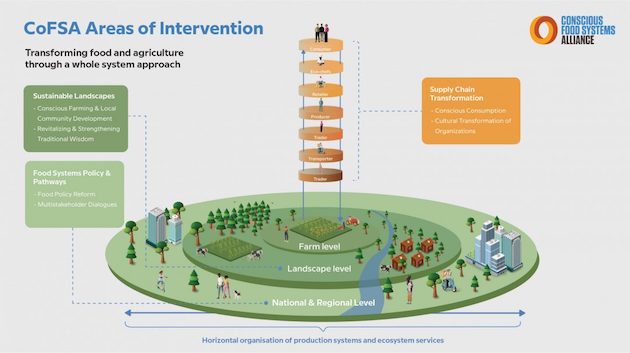
Graphic representation of the Conscious Food Systems Alliance (CoFSA) concept. Credit: UNDP/CoFSA

Graphic representation of the Conscious Food Systems Alliance (CoFSA) concept. Credit: UNDP/CoFSA

Similarly, senior lecturer at the Massachusetts Institute of Technology, Otto Scharmer, stresses, “You cannot change a system unless you change the mindsets or the consciousness of the people who are enacting that system.”

At the heart of it, mindful eating and activating transformation from the inside is a recognition that changing behavior is, at times, more about identity, emotions, and connections than data and analyses in the same way elections are campaigned and won against a backdrop of long-held beliefs and opinions.

Question Impact of Consumer Choices

“I think today, whatever you eat, however you dress, you need to ask yourself where they come from, what kind of impact they are giving back to the Mother Earth, cultural, economic, and spiritual environment,” says Tashka Yawanawá, Chief of the Yawanawá that has survived for centuries in the Brazilian rainforests.

Awareness of the people and processes in food and agriculture systems aligns with indigenous wisdom and is at the heart of the approach taken by the Yawanawá people. For instance, Tashka Yawanawá says: “When somebody drinks the acai collected and produced by the Yawanawá, they’re helping protect 200,000 acres of land.”

“They are also supporting the preservation of our language, our culture, our cultural and spiritual manifestation. Making that link gives value to where you source these products from … when you buy acai made by Yawanawá, you have an awareness that you’re supporting conscious food.”

UNDP stresses that farmers’ lives depend on being seen as human beings, not just economic agents, and says it is “Time to build safe, reflective and connecting spaces to engage in the deep conversations we need for right relationships to replace market rules.”

In the world of conscious thinking and mindful eating, everyone has a role.

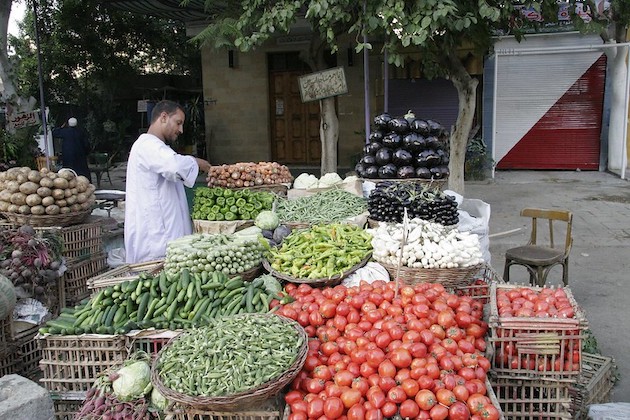
A marker trader at a vegetable stall in the village of El-Maadi near Cairo with heaps of fresh vegetables. CoFSA aims to renew lost ties between producers, the foods they grow, cooks, and consumers. Credit: Gavin Bell/Climate Visuals

A marker trader at a vegetable stall in the village of El-Maadi near Cairo with heaps of fresh vegetables. CoFSA aims to renew lost ties between producers, the foods they grow, cooks, and consumers. Credit: Gavin Bell

Teresa Corção, founder of Instituto Maniva, a non-profit in Brazil that values ​​traditional food knowledge and renews the ties lost between producers, the foods they grow, cooks, and consumers, says chefs have a critical role in listening more to the people who grow the food.

“I think we all see now more and more we need other ways of both changing ourselves and helping others change the way they think in order for us to have the right mindsets to make choices that are more sustainable,” says Andrew Bovarnick, UNDP’s Food, and Agricultural Commodity Systems, Global Head.

CoFSA is built on bringing consciousness to food systems to support the transition to a holistic, bio-regional approach and creating productive landscapes of regeneration.

That consciousness can help restore the balance in food systems between food production, conservation, and well-being, support the uptake of agroecological practices which regenerate the soil, and strengthen the capacity of food to distribute wealth and well-being in communities.

IPS UN Bureau Report

  Source

Climate Change Gets Its Day in Court

Asia-Pacific, Civil Society, Climate Action, Climate Change, Development & Aid, Environment, Featured, Global, Headlines, Human Rights, TerraViva United Nations

Opinion

Credit: Save the Children Vanuatu/Facebook

MONTEVIDEO, Uruguay, May 25 2023 (IPS) – As a matter of global justice, the climate crisis has rightfully made its way to the world’s highest court.

On 29 March 2023, the United Nations General Assembly (UNGA) unanimously adopted a resolution asking the International Court of Justice (ICJ) to issue an advisory opinion on the obligations of states on climate change. The initiative was led by the Pacific Island state of Vanuatu, one of several at risk of disappearing under rising sea levels. It was co-sponsored by 132 states and actively supported by networks of grassroots youth groups from the Pacific and around the world.


Civil society’s campaign

In 2019, a group of law students from the University of the South Pacific formed Pacific Islands Students Fighting Climate Change (PISFCC), a regional organisation with national chapters in Fiji, the Solomon Islands, Tonga and Vanuatu. PISFCC advocated with the Pacific Island Forum – the key regional body – to put the call for an ICJ opinion on its agenda. The government of Vanuatu announced it would seek this in September 2021, and Pacific civil society organisations (CSOs) formed an alliance – the Alliance for a Climate Justice Advisory Opinion – that has since grown to include CSOs and many others from around the world, including UN Special Rapporteurs and global experts.

The campaign made heavy use of social media, with people sharing their stories on the impacts of climate change and emphasising the importance of an ICJ opinion to help support calls for climate action, including climate litigation. It organised globally, sharing a toolkit used by activists around the world, and took to the streets locally. In Vanuatu, where it all started, children demonstrated in September 2022 to call attention to the impacts of climate change as their country’s single greatest development threat and express support for the call for an ICJ opinion.

In the run-up to the UNGA session that adopted the historic resolution, thousands of CSOs from around the world supported a letter calling for governments to back the vote.

[embedded content]

The ICJ’s role

The ICJ is made up of 15 judges elected by the UNGA and UN Security Council. It settles legal disputes between states and provides advisory opinions on legal questions referred to it by other parts of the UN system.

The questions posed to the ICJ aim to clarify the obligations of states under international law to protect the climate system and environment from human-induced greenhouse gas emissions. They also ask about the legal responsibilities of states that have caused significant environmental harm towards other states, particularly small islands, and towards current and future generations.

To provide its advisory opinion, the ICJ will have to interpret states’ obligations as outlined in the 1992 UN Framework Convention on Climate Change and the 2015 Paris Agreement as well as the Universal Declaration of Human Rights and a variety of international covenants and treaties. It may consider previous UNGA resolutions on climate change, such as the recent one recognising access to a clean, healthy and sustainable environment as a universal human right, and other resolutions by the UN Human Rights Council and reports by the Office of the UN High Commissioner of Human Rights and its independent human rights experts. It may also take into account decisions by UN treaty bodies and its own jurisprudence on climate and environmental matters.

Next steps

According to its statute, the ICJ can seek written statements from states or international organisations likely to have relevant information on the issue at hand. On 20 April, it communicated its decision to treat the UN and all its member states as ‘likely to be able to furnish information on the questions submitted to the Court’ and gave them six months to submit written statements, after which they will have three months to make written comments on statements made by other states or organisations.

Civil society doesn’t have any right to submit formal statements, so climate activists are urging as many people as possible to advocate towards their governments to make strong submissions that will lead to a progressive ICJ opinion. After submissions close, the ICJ is likely to take several months to deliberate, so its opinion may be expected at some point in 2024, likely towards the end of the year.

Advisory opinions aren’t binding. They don’t impose obligations on states. But they shape the global understanding of states’ obligations under international law and can motivate states to show their compliance with rising standards. An ICJ opinion could positively influence climate negotiations, pushing forward long-delayed initiatives on funding for loss and damage. It could encourage states to make more ambitious pledges to cut greenhouse gas emissions. It might also help raise awareness of the particular risks faced by small island states and provide arguments in favour of stronger climate action, helping climate advocates gain ground within governments.

A progressive advisory opinion could also help support domestic climate litigation: research shows that domestic courts are increasingly inclined to cite ICJ opinions and other sources of international law, including when it comes to determining climate issues.

The risk can’t be ruled out of a disappointing ICJ opinion merely reiterating the content of existing climate treaties without making any progress on states’ obligations. But climate activists find reasons to expect much more: many see this as a unique opportunity, brought about by their own persistent efforts, to advance climate justice and push for action that meets the scale of the crisis.

Inés M. Pousadela is CIVICUS Senior Research Specialist, co-director and writer for CIVICUS Lens and co-author of the State of Civil Society Report.

  Source

CIVICUS Report Exposes a Civil Society Under Attack

The State of Civil Society report from CIVICUS, the global civil society alliance which was officially launched on March 30, 2023, exposes the gross violations of civic space. Credit CIVICUS

The State of Civil Society report from CIVICUS, the global civil society alliance which was officially launched on March 30, 2023, exposes the gross violations of civic space. Credit CIVICUS

By Joyce Chimbi
NAIROBI, Mar 31 2023 (IPS)

As conflict and crises escalate to create human emergencies that have displaced over 100 million people worldwide, civil society’s vital role of advocating for victims and monitoring human rights cannot be over-emphasised.


The 2022 Nobel Peace Prize award to activists and organisations in Belarus, Russia and Ukraine for working to uphold human rights in the thick of conflict underpins this role.

Yet this has not stopped gross violations of civic space as exposed by the State of Civil Society report from CIVICUS, the global civil society alliance, which was officially launched on March 30, 2023.

“This year’s report is the 12th in its annual published series, and it is a critical look back on 2022. Exploring trends in civil society action, at every level and in every arena, from struggles for democracy, inclusion, and climate justice to demands for global governance reform,” said Ines Pousadela from CIVICUS.

The report particularly highlights the many ways civil society comes under attack, caught in the crossfire and or deliberately targeted. For instance, the Russian award winner, the human rights organisation Memorial, was ordered to close in the run-up to the war. The laureate from Belarus, Ales Bialiatski, received a 10-year jail sentence.

Mandeep Tiwana stressed that the repression of civic voices and actions is far from unique. In Ethiopia, “activists have been detained by the state. In Mali, the ruling military junta has banned activities of CSOs that receive funding from France, hampering humanitarian support to those affected by conflict. In Italy, civil society groups face trial for rescuing migrants at sea.”

Ines Pousadela at the launch of the CIVICUS State of Civil Society Report. Credit: Joyce Chimbi/IPS

Ines Pousadela at the launch of the CIVICUS State of Civil Society Report. Credit: Joyce Chimbi/IPS

Spanning over six chapters titled responding to conflict and crisis, mobilising for economic justice, defending democracy, advancing women’s and LGBTQI+ rights, sounding the alarm on the climate emergency and urging global governance reform, the analysis presented by the report draws from an ongoing analysis initiative, CIVICUS Lens.

On responding to conflict and crisis, Oleksandra Matviichuk from the Center for Civil Liberties in Ukraine spoke about the Russian invasion and the subsequent “unprecedented levels of war crimes against civilians such as torture and rape. And, a lack of accountability despite documented evidence of crimes against civilians.”

Bhavani Fonseka, from the Centre for Policy Alternatives, Sri Lanka, addressed the issue of mobilising for economic justice and how Sri Lanka captured the world’s attention one year ago through protests that start small in neighbourhoods and ultimately led to the President fleeing the country.

Launched in January 2022, CIVICUS Lens is directly informed by the voices of civil society affected by and responding to the major issues and challenges of the day.

Through this lens, a civil society perspective of the world as it stands in early 2023 has emerged: one plagued by conflict and crises, including democratic values and institutions, but in which civil society continues to strive to make a crucial difference in people’s lives.

On defending democracy, Amine Ghali of the Al Kawakibi Democracy Transition Center in Tunisia spoke about the challenge of removing authoritarian regimes, making significant progress in levels of democracy only for the country to regress to authoritarianism.

“It starts with the narrative that democracy is not delivering; let me have all the power so that I can deliver for you. But they do not deliver. All they do is consolidate power. A government with democratic legitimacy demolishing democracy is where we are in Tunisia,” he said.

Erika Venadero from the National Network of Diverse Youth, Mexico, spoke about the country’s journey that started in the 1960s towards egalitarian marriages. Today, same-sex marriages are provided for in the law.

On global governance reforms, Ben Donaldson from UNA-UK spoke about global governance institutional failure and the need to improve what is working and reform what is not, with a special focus on the UN Security Council.

“It is useful to talk about Ukraine and the shortcomings of the UN Security Council. A member of the UN State Council is unable to hold one of its members accountable. There are, therefore, tensions at the heart of the UN. The President of Ukraine and many others ask, what is the UN for if it cannot stop the Ukraine invasion?”

Baraka, a youthful climate activist and sustainability consultant in Uganda, spoke about ongoing efforts to stop a planned major pipeline project which will exacerbate the ongoing climate crisis, affecting lives and livelihoods.

His concerns and actions are in line with the report findings that “civil society continues to be the force sounding the alarm on the triple threat of climate change, pollution and biodiversity loss. Urging action using every tactic available, from street protest and direct action to litigation and advocacy in national and global arenas.”

But in the context of pressures on civic space and huge challenges, the report further finds that “civil society is growing, diversifying and widening its repertoire of tactics.”

Moving forward, the report highlights 10 ideas, including an urgent need for a broad-based campaign to win recognition of civil society’s vital role in conflict and crisis response as well as greater emphasis by civil society and supportive states on protecting freedom of peaceful assembly.

Additionally, the need for civil society to work with supportive states to take forward plans for UN Security Council reform and proposals to open up the UN and other international institutions to much greater public participation and scrutiny.

In all, strengthening and enhancing the membership and reach of transnational civil society networks to enable the rapid deployment of solidarity and support when rights come under attack was also strongly encouraged.

IPS UN Bureau Report


!function(d,s,id){var js,fjs=d.getElementsByTagName(s)[0],p=/^http:/.test(d.location)?’http’:’https’;if(!d.getElementById(id)){js=d.createElement(s);js.id=id;js.src=p+’://platform.twitter.com/widgets.js’;fjs.parentNode.insertBefore(js,fjs);}}(document, ‘script’, ‘twitter-wjs’);  

Source

Climate Crisis is a Child Crisis and Climate-Resilient Children, Teachers and Schools Must Become Top International Agenda

From climate change to child marriage, education is seen as the solution. ECW Director Yasmine Sherif protests early marriage with young delegates at the Education Cannot Wait Conference held in Geneva. Credit: ECW

From climate change to child marriage, education is seen as the solution. ECW Director Yasmine Sherif protests early marriage with young delegates at the Education Cannot Wait Conference held in Geneva. Credit: ECW

By Joyce Chimbi
GENEVA & NAIROBI, Feb 17 2023 (IPS)

From southern Ethiopia to northern Kenya and Somalia, the most severe drought in the last 40 years is unfolding. It is simply too hot to go to school on an empty stomach, and close to 3 million children are out of school, with an additional 4 million at risk of dropping out entirely across the Horn of Africa.


Further afield, months after unprecedented floods and landslides ravaged Pakistan, villages remain underwater, and millions of children still need lifesaving support. More recently, while children were sleeping, a most devastating earthquake intruded, and an estimated 2.5 million children in Syria and 4.6 million children in Turkey were affected.

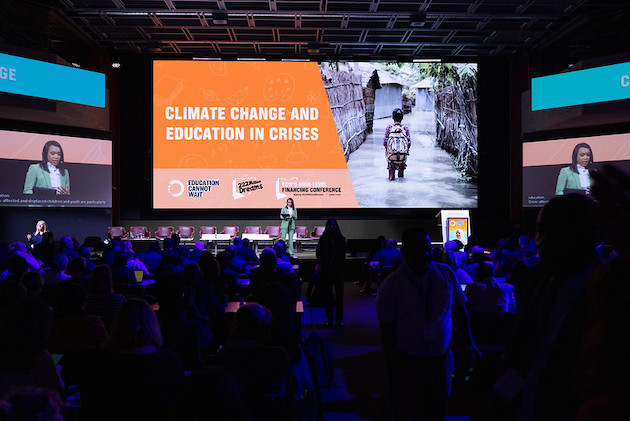
Today, child delegates from Nigeria and Colombia told the world that climate change is ruining their childhood and the world must act now, for 222 million dreams are at stake. They were speaking at the Education Cannot Wait High-Level Financing Conference held in Geneva.


Nafisa from Nigeria reminded delegates at the Education Cannot Wait High-Level Financing Conference held in Geneva that the climate emergency is a child’s rights issue. Credit: ECW

Nafisa from Nigeria reminded delegates at the Education Cannot Wait High-Level Financing Conference held in Geneva that the climate emergency is a child’s rights issue. Credit: ECW

“I am a girl champion with Save the Children and a member of the children’s parliament in Nigeria. Children are least responsible for the climate crisis, yet we bear the heaviest burden of its impact, now and in the future. Climate emergency is a child’s rights crisis, and suffering wears the face of a child,” said Nafisa.

In the spirit of listening to the most affected, most at risk, Pedro further spoke about Colombia’s vulnerability to climate change and the impact on children, and more so those in indigenous communities and those living with a disability, such as his 13-year-old cousin.

Pedro and Nafisa stressed that children must play a central role in responding to the climate crisis in every corner of the world. They said climate change affects education, and in turn, education has an important role.

This particular session was organized in partnership with the Geneva Global Hub for Education in Emergencies, Save the Children, and Plan International, in the backdrop of the first-ever High-Level Financing Conference organized in close collaboration with the Governments of Colombia, Germany, Niger, Norway, and South Sudan, ECW and Switzerland.

Birgitte Lange, CEO of Save the Children Norway, stressed that climate change is not only a threat to the future, “for the world’s 2.4 billion children, the climate crisis is a global emergency crisis today that is disrupting children and their education. Climate change contributes to, increases, and deepens the existing crisis of which children are carrying the burden.

“Last year, Save the Children held our biggest-ever dialogue, where we heard from at least 54,000 children in 41 countries around the world. They shared their thoughts on climate change and its consequences for them. Keeping children in school amidst a climate crisis is critical to the children’s well-being and their learning. Education plays a lifesaving role.”

Rana Tanveer Hussain, Federal Minister for Education and Professional Training in Pakistan, spoke of the severe impact of the floods on the country’s education system, “more than 34,000 public education institutions have been damaged or destroyed. At least 2.6 million students are affected. As many as 1 million children are at risk of dropping out of school altogether.

“During this crisis, ECW quickly came forward with great support, extending a grant of USD 5 million through the First Emergency Response Program in the floods-affected districts in September and October 2022, targeting 19,000 children thus far. In addition, ECW multiyear resilience program has also been leveraged to contribute to these great efforts. But the need is still great.”

Gregorius Yoris, a young leader representing Youth for Education in Emergencies in Indonesia, said despite children being at the forefront of the climate crisis, they have been furthest left behind in finding solutions to climate change.

Folly Bah Thibault, host and broadcast journalist, Al Jazeera and Founder and President, Elle Ira A L’Ecole Foundation Kesso Bah moderated the session on climate change in which child delegates told how children are being left furthest behind in the climate crisis. Credit: ECW

Folly Bah Thibault, broadcast journalist, Al Jazeera, and Founder and President, Elle Ira A L’Ecole Foundation Kesso Bah moderated the session on climate change in which child delegates told how children are being left furthest behind in the climate crisis. Credit: ECW

With one billion children, or nearly half of the world’s children living in countries at extremely high risk of climate change and environmental hazards, Dr Heike Kuhn, Head of Division, Education at the Federal Ministry for Economic Cooperation and Development in Germany, told participants it is time to raise climate resilient children.

“Weather-related disasters are growing, and young people are the most affected; we need three things in place: climate resilient schools, climate resilient teachers, and climate resilient students. We need climate-smart schools to stay safe when disaster strikes,” she explained.

“We must never forget about the teachers, for they must be agents of change, and teach children to use resources such as water and energy in a sustainable way. Children must also be taught how to behave during extreme weather changes such as earthquakes without leaving behind the most vulnerable children.”

As curtains fell on the landmark two-day conference, Yasmine Sherif, the Director of Education Cannot Wait, told participants, “The greatest feeling comes from the fact that all ECW’s stakeholders are here and we have raised these resources together, governments, civil society, UN agencies, private sector, Foundations.

“When I watched the panels and the engagements, I felt that everyone has that sense of ownership. Education Cannot Wait is yours. The success of this conference is a historic milestone for education in emergencies and protracted crises.”

In all, 17 donors announced pledges to ECW, including five contributions from new donors – a historic milestone for education in emergencies and protracted crises and ECW. Just over one month into the multilateral Fund’s new 2023-2026 Strategic Plan, these landmark commitments already amount to more than half of the USD 1.5 billion required to deliver on the Fund’s four-year Strategic Plan.

On the way forward, Sherif said ECW is already up and running, but with the additional USD 826 million, the Fund was getting a big leap forward toward the 20 million children and adolescents that will be supported with holistic child-centered education. This is in line with the new Strategic Plan, whose top priorities include localization, working with local organizations at grassroots levels, youths, and getting the children involved as well.

“We can no longer look at climate-induced disasters and education in silos. Conflict creates disruptions in education, so does climate-induced disasters and then the destiny of children and adolescents having to flee their home countries as refugees or forcefully displaced in-country,” she emphasized.

“Most of all, as we have seen in Afghanistan and across the globe, the right for every girl to access a quality education. And we are moving already, and that is where we are going from here. Thanks to the great contribution in the capital of humanitarian settings, we are bringing the development sector of education to those left furthest behind. Thank you, Switzerland, for hosting us.”

IPS UN Bureau Report


!function(d,s,id){var js,fjs=d.getElementsByTagName(s)[0],p=/^http:/.test(d.location)?’http’:’https’;if(!d.getElementById(id)){js=d.createElement(s);js.id=id;js.src=p+’://platform.twitter.com/widgets.js’;fjs.parentNode.insertBefore(js,fjs);}}(document, ‘script’, ‘twitter-wjs’);