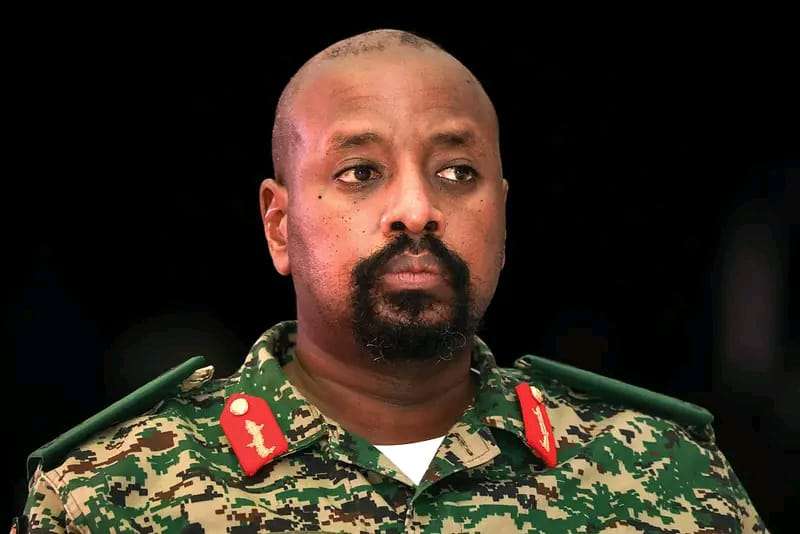
KAMPALA-(MaraviPost)-Uganda’s army chief, Muhoozi Kainerugaba, has rejected allegations that troops attacked Barbara Kyagulanyi, the wife of opposition leader Bobi Wine, during a raid on their home.
Wine said soldiers threatened his wife at gunpoint and seized documents and electronic devices, sparking widespread concern and outrage.
Barbara Kyagulanyi later alleged from hospital that officers assaulted her while demanding to know Wine’s whereabouts, adding that she was left with physical and psychological trauma.
Kainerugaba dismissed the allegations, stating that his soldiers “do not beat up women” and are only looking for her “cowardly husband”.
The incident has drawn sharp criticism from human rights groups and opposition politicians, who accuse the government of using the military to suppress dissent.
The Uganda Law Society has denounced the “ongoing wave of detentions, torture and enforced disappearance” of opposition leaders and supporters, calling for an end to violence and intimidation.
Bobi Wine, who is in hiding, has accused the government of trying to silence him and has thanked supporters for keeping him safe.
Trump’s proposed “Board of Peace” built around heads of state, including Russia, is structurally ill-suited to end the Israel–Hamas war and to govern postwar Gaza in any sustainable way.
NEW YORK, Jan 26 2026 (IPS) – At a press conference at the World Economic Forum in Davos last week, Trump unveiled his newly formed Board of Peace to end the Israel-Hamas war. During a press conference in the White House, he explained that he created the board because “The UN should have settled every one of the wars that I settled. I never went to them. I never even thought to go to them.”
He claimed that the Board of Peace will be dealing with ending the Israel-Hamas war in Gaza. He invited many heads of state to join the Board and threatened to impose heavy tariffs on the countries of those who refused. Paradoxically, he also invited Russian President Putin to join the pack.
Even a cursory review of the Board’s structure—its executive make-up, role, and responsibilities—makes it glaringly clear that he placed himself at the forefront of everything, from operations to ultimate decision-making. He basically codified US dominance, as long as he ran it.
He granted himself the authority to veto any decision he did not like, to invite or remove any board member, to approve the agenda, to designate his successor, and even dissolve the board entirely. Furthermore, he reserved a central role for himself even after leaving the presidency.
Shortcomings of the Board and its Structure
In more than one way, the creation of this board dissolves the American-built post-war international system and builds a new one with himself at the center. And while Trump is striving to consolidate authoritarian power domestically, he now wants to project himself on the international stage as if he were an Emperor, presiding over a board composed largely of heads of state. Although board members can have their say, they are nevertheless structurally subordinated to him.
No Seat for the Primary Stakeholders
The Board of Peace and the parallel Gaza Executive Board are designed to sit above a technocratic Palestinian committee, with no Palestinian political representative given a seat at the top table, despite their being primary stakeholders. Hamas is required to disarm, without specifying how, and to withdraw from administrative governance.
The Palestinian Authority is relegated to an “apolitical” managerial role, which in effect reproduces the long-standing problem of trying to impose solutions over Palestinians instead of negotiating with them. This has repeatedly undermined past peace frameworks and offers no pathway towards sustainable regional or world peace.
Conflict of Interests
The board is chaired by Trump himself, with membership effectively bought via a $1 billion “permanent seat” fee, creating apparent conflicts between profit, prestige, and peacemaking. Russia, Israel, Gulf monarchies, and others who have direct stakes in arms sales, regional influence, and energy routes, are not neutral guarantors but interested parties likely to instrumentalize Gaza for their own strategic agendas.
Colonial-Style Trusteeship
The architecture explicitly envisions international figures and heads of state supervising Gaza’s reconstruction, security, and governance, effectively turning Gaza into a protectorate administered by external powers.
Human rights advocates and regional observers are already criticizing this as a colonial-style trusteeship that denies genuine sovereignty, which is already generating local resistance, delegitimizing the arrangement, and providing ideological fuel for militant spoilers.
Israeli and Regional Objections
Israel’s leadership has publicly objected to the composition and design of the Gaza bodies. It is enraged over the role of Turkey and Qatar, forcing Netanyahu to distance himself from aspects of the plan even while joining the board under pressure from Trump.
Nevertheless, the Israeli government views key members of the Board and mechanisms as hostile or at odds with its security principles. Israel will either hinder implementation or hollow it out in practice, turning the board into an arena for intra-allied conflict rather than conflict resolution.
Great Power Rivalry Inside the Board
Ironically, the board anticipates concurrent participation by rivals such as Russia, the EU, and US-aligned states, while at the same time, Moscow is resisting US-backed peace terms in Ukraine and leveraging Middle East crises to weaken Western influence. This arrangement invites the board to become another theater of great power competition, where Russia, Hungary, Belarus, and others can obstruct or dilute measures that do not serve their broader geopolitical interests.
This is not to speak, of course, about the widespread concerns and suspicions among European leaders about Putin’s adversarial relations at the table, which is a recipe for discord and prevents concrete action.
Unclear Legal Basis
Another big hole in Trump’s Board is its framing as an alternative to, and possible replacement for, the United Nations, without any legal foundation, universal membership, or binding authority under international law.
A self-selected club by Trump of mostly invited heads of state, tied to a particular US administration and anchored in significant financial contributions, lacks the procedural legitimacy to impose security arrangements, adjudicate disputes, or credibly guarantee Palestinian rights over the long term, to which Trump pays no heed at all.
Overambitious, Under-Specified Mandate
The board’s responsibilities have already expanded from supervising a Gaza ceasefire to a broad charter “promoting stability” and “resolving global conflict,” which is ostentatious and will never come to fruition, while indicating mission creep before it even begins.
Such a variable mandate, with multiple overlapping structures (Board of Peace, Gaza Executive Board, Founding Executive Board), is almost guaranteed to generate bureaucratic turf wars, paralysis, and incoherence—particularly once crises beyond Gaza compete for attention and resources.
To be sure, this is just another of Trump’s stunts, always pretending that he is the only one who can come up with out-of-the-box ideas. Like many of his initiatives, this so-called Board of Peace one falls into the same category—transactional and reversible.
It is a grandiose idea that cannot be sustained structurally, has no enforcement capability, and relies on a contradictory algorithm to allow it to fulfill its mission, which, in any case, remains open-ended and unrealistic.
Dr. Alon Ben-Meir is a retired professor of international relations, most recently at the Center for Global Affairs at NYU. He taught courses on international negotiation and Middle Eastern studies.
UNITED NATIONS, Jan 26 2026 (IPS) – Judging by the mixed signals coming out of the White House, is the Board of Peace, a creation of President Donald Trump, eventually aimed at replacing the UN Security Council or the United Nations itself?
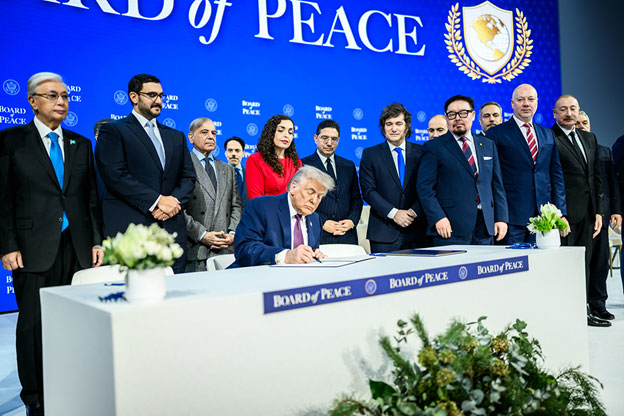
At a ceremony in Davos, Switzerland last week, Trump formally ratified the Charter of the Board — establishing it as “an official international organization”.
Trump, who will be serving as the Board’s Chairman, was joined by Founding Members* “representing countries around the world who have committed to building a secure and prosperous future for Gaza that delivers lasting peace, stability, and opportunity for its people.”
Norman Solomon, executive director, Institute for Public Accuracy and national director, RootsAction.org, told IPS President Trump’s “Board of Peace” is being designed as a kind of global alliance akin to the “coalition of the willing” that fraudulently tried to give legitimacy to the U.S.-led invasion of Iraq in 2003.
Trump, he said, is recruiting submissive governments to fall in line with his leadership for pushing the planet ever more in the direction of war for domination and plunder.
The price that members of the Orwellian-named “Board of Peace” will pay is much more than the sought amount upwards of $1 billion each. In a global gangster mode, Trump is making plans and putting up structures on imperial whim, he pointed out.
“At the same time, the methods to his madness are transparent as he seeks to create new mechanisms for U.S. domination of as much of the world as possible”.
Trump continues to push the boundaries of doublespeak that cloaks U.S. agendas for gaining economic and military leverage over other countries. The gist of the message on behalf of Uncle Sam is: “no more Mr. Nice Guy.”
Whereas Trump’s predecessors in the White House have often relied on mere doubletalk and lofty rhetoric to obscure their actual priorities and agendas, Trump has dispensed with euphemisms enough to make crystal clear that he believes the U.S. government is the light of the world that all others should fall in line behind, said Solomon, author of “War Made Invisible: How America Hides the Human Toll of Its Military Machine”
Asked about the Board of Peace, UN Spokesperson Stephane Dujarric told reporters last week: “Let’s be clear. We are committed to doing whatever we can to ensure the full implementation of Security Council Resolution 2803, which as you will recall, welcomed the creation of the Board of Peace for Gaza”.
And as you know, he said, part of that resolution and the plan put forward by President Trump talked about the UN leading on humanitarian aid delivery.
“I think we have delivered a massive amount of humanitarian aid in Gaza, as much as we’ve been able to allow. And we’ve talked about the restrictions, but you know how much more we’ve been able to do since the ceasefire. As part of that, we’ve worked very well with the US authorities, and we will continue to do so.”
The UN, Dujarric reaffirmed, remains the only international organization with universal membership. “We’ve obviously saw the announcements made in Davos. The Secretary-General’s work continues with determination to implement the mandates given to us, all underpinned by international law, by the charter of the UN. I mean, our work continues.”
Asked about the similarities between the UN logo and the logo of the Board of Peace, he said he saw no copyright or trademark infringements.
In a statement released last week, Louis Charbonneau, UN Director at Human Rights Watch (HRW) said the United States played a leading role in establishing the UN. Now, US President Donald Trump is undermining and defunding large parts of it.
For the past year, he said, the US government has taken a sledgehammer to UN programs and agencies because the Trump administration believes the institution is “anti-American” and has a “hostile agenda.”
In UN negotiations, US officials have tried to purge words like “gender,” “climate,” and “diversity” from resolutions and statements. Diplomats have described to Human Rights Watch how US officials aggressively oppose human rights language they see as “woke” or politically correct, he said.
In an apparent attempt to sideline the UN Security Council, Trump has proposed a so-called Board of Peace that he personally would preside over. Trump has reportedly offered seats on his board to leaders of abusive governments, including Belarus, China, Hungary, Israel, Russia, and Vietnam, Charbonneau pointed out.
Originally the Board of Peace was meant to oversee the administration of Gaza following over two years of onslaught and destruction by Israeli forces, with which the United States was complicit. But the board’s charter doesn’t even mention Gaza, suggesting that Trump’s ambitions for this body have expanded enormously since first conceived.
The board’s proposed charter doesn’t mention human rights. And it makes clear that Trump, as board chairman, would have supreme authority “to adopt resolutions or other directives” as he sees fit.
A seat on the Board of Peace doesn’t come cheap: there’s a US$1 billion membership fee. Some, like French President Emmanuel Macron, already turned down an offer to join. Trump responded with a threat to significantly increase tariffs on French wine and champagne.
“The UN system has its problems, but it’s better than a global Politburo. Rather than paying billions to join Trump’s board, governments should focus on strengthening the UN’s ability to uphold human rights,” he declared.
Elaborating further, Solomon said the entire “Board of Peace” project is a dangerous farce that seeks to reconstitute a unipolar world that has already largely fallen apart during this century in economic terms.
The criminality of Trump’s approach, supported by the Republican majority in Congress, is backed up by the nation’s military might. More than ever, U.S. foreign policy has very little to offer the world other than gangsterism, extortion and blackmail – along with threats of massive violence that sometimes turn into military attacks that shred all semblance of international law.
Every U.S. president in this century, as before, has disregarded actual international law and substituted the preferences of its military-industrial complex for foreign policy. Trump has taken that policy to an unabashed extreme, shamelessly adhering to George Orwell’s dystopian credo of “War Is Peace” while pushing to wreck what’s left of a constructive international order.
Incidentally, when Indonesia’s mercurial leader Sukarno decided to quit the UN and form the Conference of the New Emerging Forces (CONEFO) as an alternative, it did not last very long, as Sukarno’s successor, Suharto “resumed” Indonesia’s participation in the UN.
No lasting harm was done to the UN. And all was forgotten and forgiven.
In a further clarification, UN Deputy Spokesperson Farhan Haq told reporters the Board of Peace has been authorized by the Security Council for its work on Gaza – strictly for that. “
“We’re not talking about the wider operations or any of the aspects that have been in the media for the last several days. What we’re talking about is the work on Gaza”.
“As you know, we have welcomed the ceasefire in Gaza and measures to support it, including the Board of Peace, and we’ll continue to work with all parties on the ground to make sure that the ceasefire is upheld. That is about Gaza.”
The larger aspects, he said, are things for anyone wanting to participate in this grouping to consider. Obviously, the UN has its own Charter, its own rules, and you can do your own compare and contrast between the respective organizations.
“As you’re well aware, he pointed out, the UN has coexisted alongside any number of organizations. There are regional organizations, subregional organizations, various defence alliances around the world. Some of them, we have relationship agreements with. Some of them, we don’t.
“We would have to see in terms of details what the Board of Peace becomes as it actually is established to know what sort of relationship we would have with it,” declared Haq.
The participants* at the signing event in Geneva last week included:
• Isa bin Salman bin Hamad Al Khalifa, minister of the prime minister’s court, Bahrain • Nasser Bourita, minister of foreign affairs, Morocco • Javier Milei, president, Argentina • Nikol Pashinyan, prime minister, Armenia • Ilham Aliyev, President, Azerbaijan • Rosen Zhelyazkov, prime minister, Bulgaria • Viktor Orban, prime minister, Hungary • Prabowo Subianto, president, Indonesia • Ayman Al Safadi, minister of foreign affairs, Jordan • Kassym-Jomart Tokayev, president, Kazakhstan • Vjosa Osmani-Sadriu, president, Kosovo • Mian Muhammad Shehbaz Sharif, prime minister, Pakistan • Santiago Peña, president, Paraguay • Mohammed Bin Abdulrahman Al Thani, president, Qatar • Faisal bin Farhan Al Saud, minister of foreign affairs, Saudi Arabia • Hakan Fidan, minister of foreign affairs, Turkey • Khaldoon Khalifa Al Mubarak, special envoy to the U.S. for the UAE • Shavkat Mirziyoyev, president, Uzbekistan • Gombojavyn Zandanshatar, prime minister, Mongolia
A long list of countries, including Canada, France, Germany, Italy and other European nations, were absent from the signing, and some have specifically rejected the invitation.
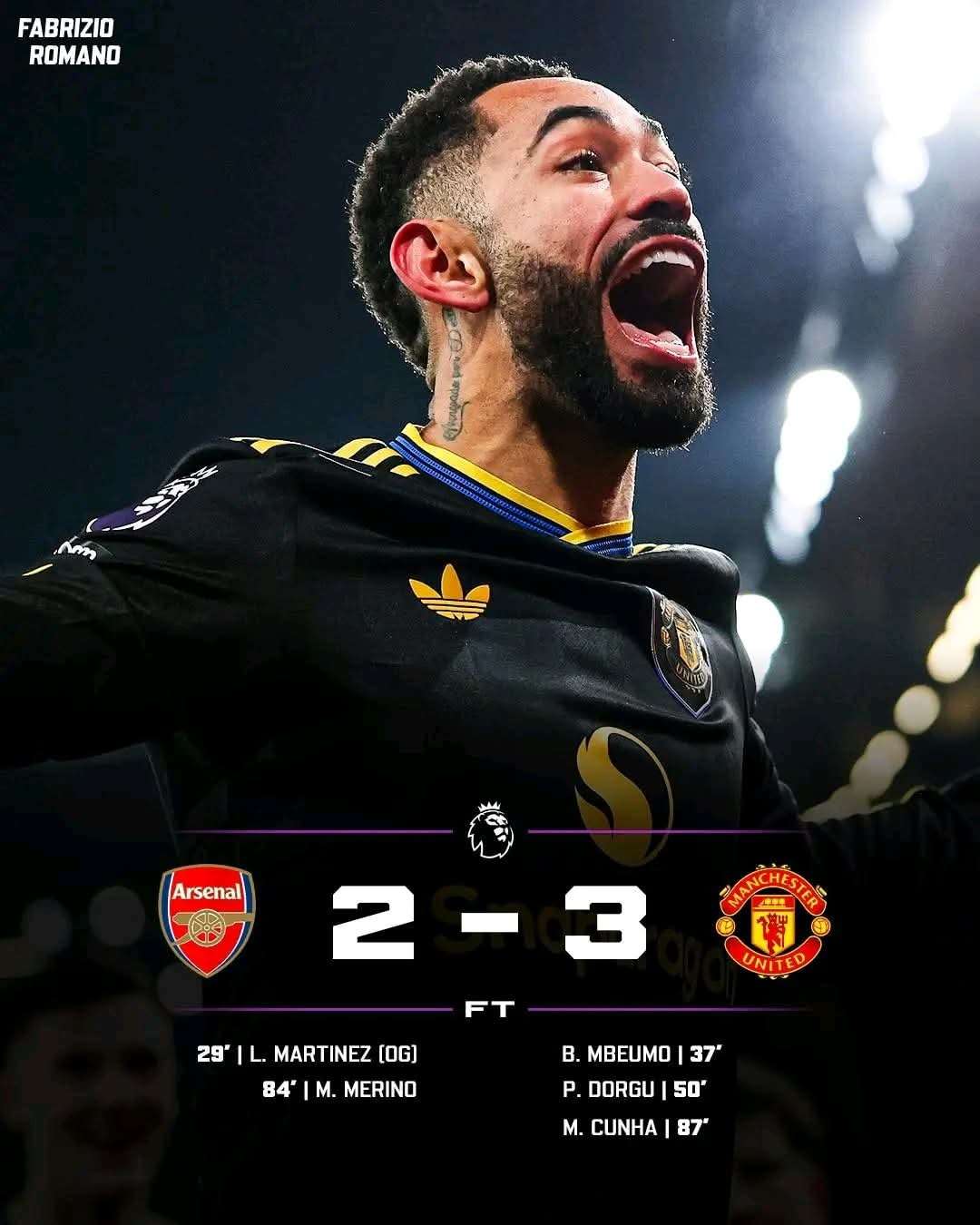
LONDON-(MaraviPost)-Manchester United exacted revenge on Arsenal on 25 January with a dramatic 3–2 Premier League victory at the Emirates Stadium, producing one of the most entertaining matches of the season between the two long time rivals.
The encounter began at a frantic pace, with both sides showing attacking intent from the opening whistle. Arsenal, backed by their home supporters, looked confident in possession and pressed high up the pitch.
Their positive start paid off midway through the first half when the hosts took the lead, putting United under early pressure and lifting the atmosphere inside the Emirates.
Before the break, United were rewarded for their persistence as they found the equaliser, ensuring the teams went into half time level and setting the stage for an intense second half.
After the restart, United emerged with renewed purpose. Their sharper movement and quicker decision making troubled Arsenal’s defence, leading to a second goal that swung momentum firmly in their favour.
Arsenal refused to give up and responded by pushing more players forward. The Gunners increased the tempo, searching desperately for a way back into the match.
Their efforts were eventually rewarded late in the game when they found an equaliser, reigniting hopes of salvaging at least a point from the contest.
With the score tied, the match became tense and open, as both teams sensed an opportunity to snatch a decisive goal in the closing minutes.
It was Manchester United who delivered the final blow. A late strike stunned the Emirates crowd and restored United’s lead at the most crucial moment.
The goal sealed a famous away victory for United, marking a rare success against Arsenal on their home turf and serving as revenge for their earlier defeat in the season.
Arsenal remains on position one with 50 points from 23 games while Manchester United is sitting on position 4 with 38 points from same number of games.
Justin Baldoni’s dad Sam is still proud of his son, despite the sexual harassment allegations plaguing the 42-year-old director … which Sam seemed to refer to as “injustice.” Sam posted a tribute for Justin’s 42nd birthday Saturday, writing, “I…
AS I travelled through out the length and breadth of Zimbabwe, I am across a new phenomenon, a class of entrepreneurs carrying various titles.
One of these was a brother by the name of Paul Tungwarara, supposedly from Manicaland, an entrepreneur of sorts. One of his titles was “Dr” apparently denoting some much learning of sorts. Yet another title was that of “advisor”, a title which I later learned referred to his role of having the ear of Mukuru.
Having Mukuru’s ear is something to be envied or admired, but that was not the end of his titles. There was yet a fourth title, associated with state contracts, supposedly having to do with environmental rehabilitation of rivers.
While rehabilitating rivers, a very necessary survival task, along the Murodzi, Hunyani and other tributaries, there is gold to be found.
The point I am trying to make is that this brother is no small brother; he is everywhere, we can call him a very bad cat indeed.
If this was not enough, I was baffled by his hitherto unknown role as a 2030 advocate, a forest in which angels would fear to cross.
After consulting some wise men, it dawned on me that to take the brother seriously, as a political actor, is to be misled by puffery.
A rhetorician.
Before Brother Masiphula Sithole died, we had planned to write a book about Zimbabwe politics and philosophy.
In African politics, as exemplified by Brother Tungwarara, rhetoric and entertainment are closely aligned.
This gift is universal in the Afro-world. As I write, January 19th of an American holiday in honor of the Reverend Martin Luther King. The holiday usually reminds Americans of one of the finest speeches of the 20th Century- I have a dream speech.
That is my point. I have a dream speech, was not just a political speech, it was entertainment par excellence, the beauty, cadence of the words and presentation and style-the wave of the hand, the gesture, the drawl of the voice-the sigh-and the provocation and the finale-all those are combined in one speech.
Now listen to this brother, Tungwarara-never mind what he is saying-that Mukuru can rule till 2030-is not a serious argument.
But that is to miss the point.
Tungwarara is not a serious brother. He says so himself.
The argument is not whether Zanu PF can extend Mukuru’s tenure to 2030 and after that to 2035.
The argument is not whether Mukuru’s tenure has been accompanied by economic growth; the Trabablas through-way is his signature achievement.
The issue is that age takes its toll-Aristotle says that even a wise king grows old and infirm. Hastings Banda, once the Ngwazi of Malawi, at 94 was infirm and fragile like a baby.
And so was our own Robert Mugabe, at 94 he became a plaything in the hands of Grace, his younger wife.
Uganda’s Yoweri Museveni, once a brilliant commander, at 84 years old, has become a laughing stock in Uganda.
Tungwarara’s argument is not a serious argument. But that does not mean that he is less formidable.
The brother’s gift lies in rhetoric and entertainment. After all, politics is partly entertainment.
“I asked the vice-president. Do you know this guy?” Supposedly a reference to Blessed Geza.
A sigh, calculated to draw attention and curiosity.
“I don’t know this guy,” the vice president replies. Again, a sigh and one can feel the tension.
The audience apparently knows the story and they fill in the gaps. Tungi does not say which of the two vice-presidents he consulted.
A trained voice shouts from the corner. “Speak, Advisor.” Now, I was not aware that the brother is an advisor.
A woman’s voice shouts from another corner. “Speak Prophet!”
So. Brother Tungi has been transformed from an advisor to a prophet.
Students of political science need to study the video renditions of Tungi’s speeches. Of course, Tungi wants Mukuru’s tenure to be extended. Such an extension is not harmful to his contracts.
But to argue that Tungi is a serious philosopher in the manner of Professor Lovemore Madhuku is to miss the point.
He is making a general point. Zanu PF is a fun party. It behooves anybody who is anybody who wants some attention to attend.
The attire is deliberate. A scandalously colorful scarf worn on an equally generous coat of many colors completes the picture of a luna park.
Tungi is what Afro-Americans call a bad cat.
He is full of smoke and stuff, and just like a cat chasing a snake, you can’t catch him nowhere.