Netumbo Nandi-Ndaitwah’s ascension to the presidency of Namibia in March 2025 marks a significant milestone not only for her country but also for the Southern African Development Community (SADC) region.
She has become the first female President of Namibia and the fourth woman in SADC history to hold the office.
This achievement is a testament to her dedication, perseverance, and leadership abilities, which have propelled her through the ranks of Namibian politics.
Nandi-Ndaitwah’s background is reminiscent of Zimbabwe’s Joice Teurairopa Mujuru, a veteran of the liberation struggle and a prominent politician.
Like Mujuru, Nandi-Ndaitwah was not a combatant but played a crucial role in the struggle for independence.
Her husband, Epaphras Denga Ndaitwah, a former commander of the Namibian Defence Force, adds to the parallels between the two leaders.
Both women have held various ministerial positions and have demonstrated strong leadership skills.
However, the similarities between Nandi-Ndaitwah and Mujuru diverge when it comes to their party dynamics.
While Mujuru fell out with her party leadership and was eventually pushed out, Nandi-Ndaitwah has maintained her position within the party structure and continued to rise through the ranks.
This strategic navigation of party politics has undoubtedly contributed to her success.
Before assuming the presidency, Nandi-Ndaitwah served as Deputy Prime Minister and later as Vice President, showcasing her versatility and ability to work within the government’s administrative framework.
Namibia’s unique system, where the President serves as both Head of State and Head of Government, and the Prime Minister acts as a presidential appointee, has provided Nandi-Ndaitwah with a distinct platform to demonstrate her leadership skills.
The Namibian President’s role as Head of State and Government, coupled with the Prime Minister’s coordinating function, underscores the significance of Nandi-Ndaitwah’s experience as Deputy Prime Minister and Vice President.
Her familiarity with the system and her ability to work within it have likely contributed to her seamless transition into the presidency.
Nandi-Ndaitwah joins an elite group of women leaders in SADC who have broken the glass ceiling to assume the highest office in their respective countries.
The other three trailblazers are Joyce Banda of Malawi, Ameenah Gurib-Fakim of Mauritius, and Samia Suluhu Hassan of Tanzania.
These women have demonstrated exceptional leadership, resilience, and determination, paving the way for future generations of female leaders.
As Namibia’s first female President, Nandi-Ndaitwah has a unique opportunity to shape the country’s future and leave a lasting legacy.
Her experience, leadership skills, and understanding of the government’s administrative framework position her well to tackle the challenges facing Namibia and drive progress in the SADC region.
Netumbo Nandi-Ndaitwah’s rise to the presidency is a testament to her hard work, dedication, and strategic leadership.
She has become an inspiration to women and girls in Namibia and across the SADC region, demonstrating that with perseverance and determination, anyone can achieve their goals and make a meaningful impact.
As she embarks on this new chapter, the region will be watching her every move, eager to see the impact she will have on Namibia and the broader SADC community.
Share this:
Like this:
LikeLoading…
Discover more from The Maravi Post
Subscribe to get the latest posts sent to your email.
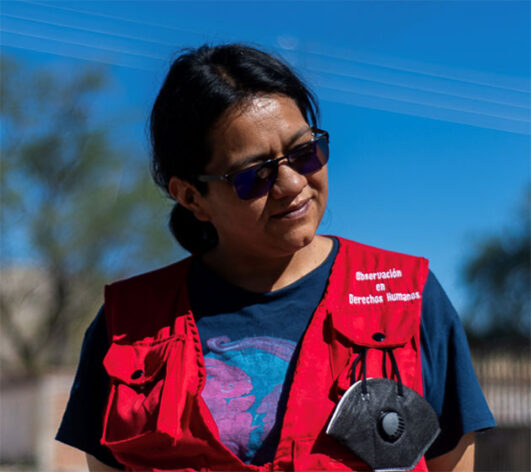
Claudia Ignacio Álvarez in San Lorenzo de Azqueltan, Jalisco, Mexico. Credit : Eber Huitzil
MICHOACÁN, Mexico , Dec 18 2025 (IPS) – My niece Roxana Valentín Cárdenas was 21 years old when she was killed. She was a Purépecha Indigenous woman from San Andrés Tziróndaro, a community on the shores of Lake Pátzcuaro in the Mexican state of Michoacán.
Roxana was killed during a peaceful march organised by another Indigenous community commemorating the recovery of their lands. Forty-six years earlier, three people had been murdered during that same land struggle. This time, the commemoration was once again met with gunfire.
Roxana was not armed and was not participating in the march. She encountered the demonstration and was struck by gunfire. Her death was deeply personal, but it took place within a broader context of long-standing violence linked to land and territory.
That violence has intensified in Michoacán recently, where the assassination of a mayor in November this year underscored how deeply insecurity has penetrated public life and how little protection exists for civilians, community leaders and local authorities alike.
Across Mexico, Indigenous people are being killed for defending land, water and forests. What governments and corporations often describe as “development” is experienced by our communities as dispossession enforced by violence – through land grabbing, water theft and the silencing of those who resist.
A way of life under threat I come from San Andrés Tziróndaro, a farming, fishing and musical community. For generations, we have cared for the lake and the surrounding forests as collective responsibilities essential to life. That way of life is now under threat.
In Michoacán, extractive pressure takes different forms. In some Indigenous territories, it is mining. In our region, it is agro-industrial production, particularly avocados and berries grown for export. Communal land intended for subsistence is leased for commercial agriculture. Water is extracted from Lake Pátzcuaro through irregularly installed pipes to irrigate agricultural fields, depriving local farmers of access.
Agrochemicals contaminate soil and water, forests are deliberately burned to enable land-use change, and ecosystems are transformed into monocultures that consume vast amounts of water. This is not development. It is extraction.
Violence as a method of enforcement When Indigenous communities resist these processes, violence follows.
Two cases illustrate this reality and remain unresolved.
José Gabriel Pelayo, a human rights defender and member of our organisation, has been forcibly disappeared for more than a year. Despite an urgent action issued by the United Nations Committee on Enforced Disappearances, progress has been blocked. Authorities have delayed access to the investigation file, and meaningful search efforts have yet to begin. His family continues to wait for answers.
Eustacio Alcalá Díaz, a defender from the Nahua community of San Juan Huitzontla, was murdered after opposing mining operations imposed on his territory without consultation. After his killing, the community was paralysed by fear, and it was no longer possible to continue human rights work safely.
Together, these cases show how violence and impunity are used to suppress community resistance.
Militarisation is not protection It is against this backdrop of escalating violence and impunity that the Mexican state has once again turned to militarisation. Thousands of soldiers are being deployed to Michoacán, and authorities point to arrests and security operations as indicators of stability.
In practice, militarisation often coincides with areas of high extractive interest. Security forces are deployed in regions targeted for mining, agro-industrial expansion or large infrastructure projects, creating conditions that allow these activities to proceed while community resistance is contained.
Indigenous people experience this not as protection, but as surveillance, intimidation and criminalisation. While companies may claim neutrality, they benefit from these security arrangements and rarely challenge the violence or displacement that accompanies them, raising serious questions about corporate complicity.
A global governance failure Indigenous territories are opened to extractive industries operating across borders, while accountability remains fragmented. Corporations divide their operations across jurisdictions, making responsibility for environmental harm and human rights abuses difficult to establish.
Voluntary corporate commitments have not prevented violence or environmental degradation. National regulations remain uneven and weakly enforced, particularly in regions affected by corruption and organised crime. This is not only a national failure. It is a failure of global governance.
International responsibility, now In this context, I have recently spent ten days in the United Kingdom with the support of Peace Brigades International (PBI), meeting with parliamentarians, officials from the Foreign, Commonwealth and Development Office, and civil society organisations.
These discussions are part of a broader international effort to ensure that governments whose companies, financial systems or diplomatic relationships are linked to extractive activities take responsibility for preventing harm and protecting those at risk.
While the UK is only one actor, its policies on corporate accountability and support for human rights defenders have consequences far beyond its borders.
Why binding international rules are necessary For years, Indigenous peoples and civil society organisations have called for a binding United Nations treaty on business and human rights. The urgency of this demand is reflected in the lives lost defending land and water and in the defenders who remain disappeared.
A binding treaty could require mandatory human rights and environmental due diligence across global supply chains, guarantee access to justice beyond national borders, and recognise the protection of human rights defenders as a legal obligation. It could make Free, Prior and Informed Consent enforceable rather than optional.
Such a treaty would not prevent development. It would ensure that development does not depend on violence, dispossession and impunity.
Defending life for everyone Indigenous peoples are not obstacles to progress. We are defending ecosystems that sustain life far beyond our territories. Indigenous women are often at the forefront of this defence, even as we face extraordinary risks.
When defenders disappear, when others are murdered, and when young women like my niece lose their lives, it is not only our communities that suffer. The world loses those protecting land, water and biodiversity during a deep ecological crisis.
Defending life and land should not come at the cost of human lives.
Claudia Ignacio Álvarez is an Indigenous Purépecha feminist, lesbian, and environmental human rights defender from San Andrés Tziróndaro, Michoacán. Through the Red Solidaria de Derechos Humanos, she supports Indigenous and rural communities defending their territories from extractive industries and organised crime. Her work has been supported by Peace Brigades International (PBI) since 2023.
David Harbour was captured on video doing some “Stranger Things” in Encinitas, California over the weekend … the actor appeared to take a man’s hat and make a run for it. The head-scratching incident appears to have gone down Saturday at a…
Share this:
Like this:
LikeLoading…
Discover more from The Maravi Post
Subscribe to get the latest posts sent to your email.
Investigation Discovery’s The Curious Case of… is coming back with a new set of episodes for season 2. While season 1 shared new insight and firsthand experiences from the people who knew most about the Natalia Grace case, the sophomore season is expected to keep viewers on the edge of their seats as the team dives into a handful of new surprising cases.
In anticipation of the show’s return, Us Weekly details what the true crime show is about, shares a glimpse into the cases that will be broken down and reveals when the new episodes will air.
Investigation Discovery Announces Season 2 of ‘The Curious Case of…’
Investigation Discovery announced that The Curious Case of … is coming back with eight new episodes in early 2026.
The new episodes promise to tackle bizarre cases filled with twists and shocking revelations as they’re told through first-hand accounts by those who know the stories best. Guided by legal analyst and expert Beth Karas, the new season will take an even deeper look into shocking crimes full of deception and obsession.
“When we launched The Curious Case of Natalia Grace, we never could have imagined how that story would take the world by storm, sparking headlines everywhere and even inspiring scripted versions on other platforms. The response was overwhelming and it quickly became ID’s highest-rated series, cementing its place as a cultural phenomenon,” said Jason Sarlanis, President of ID, said in a statement. “Knowing there were so many other ‘Curious Cases’ to tell, we expanded the franchise into an anthology that continued to captivate audiences and became our top-rated series of 2025. Now, with Season 2, we’re diving into even more stranger-than-fiction stories, each one a high-stakes puzzle full of twists, turns and unforgettable characters.”
Each episode promises to uncover deceit, greed and manipulation while proving the truth behind each mysterious case.
What Cases Will Be Discussed in ‘The Curious Case of…’ Season 2?
Following the success of season 1, the new batch of episodes will break down even more mysterious true crime cases.
The premiere episode will be called “The Curious Case Of… Death by Detox?” and will unpack the crimes of Dr. Robert O. Young after he created a platform amid the success of his pH Miracle book series.
The synopsis explained that Young’s pH Miracle book series pushed “an alkaline diet, the tentpole of which is an avocado-based green smoothie, that grows in popularity.” Young’s business quickly took off, and he found success selling books and holistic supplements. As his roster of wealthy, high-profile clients grew, his fans quickly learned that the health tips he was sharing weren’t the “miracle” cures he pitched them to be.
Other crimes that will be documented on the season will include one about a Russian woman who tried to steal the identity of a salon employee, an intense rivalry between two beauticians, a teacher who hypnotized his students that was faced with deadly consequences, a woman who committed several crimes while pretending to have cancer, a town impacted with several Tourette’s Syndrome diagnoses and a woman who took care of her late husband and sister’s corpses.
When Does ‘The Curious Case of…’ Season 2 Premiere?
Season 2 of The Curious Case of … will premiere on Monday, January 12, at 10 p.m. ET on ID, with each episode premiering weekly in the same time slot. Those who miss the live episodes will be able to stream them later on HBO Max.
Share this:
Like this:
LikeLoading…
Discover more from The Maravi Post
Subscribe to get the latest posts sent to your email.
One of Cardi’s most talked about looks came in January 2023. In a carousel of photos, the rapper’s nails were elongated with acrylics and filed into a square shape. Manicurist Jenny Bui — who has worked with Cardi for over a decade — adorned her nails with colorful rhinestones in various shapes and sizes.
In 2025, influencer Emilie Kiser gave Us major holiday inspo with her Christmas-inspired set in December. Her mani featured a clear base with red and silver gingham stripes, resembling festive wrapping paper. “When you want holiday nails, but ones that aren’t too crazy✨✨✨,” she captioned a TikTok video featuring her new claws.
Keep scrolling to see these celebrities and more wildest nail designs of all time:
Share this:
Like this:
LikeLoading…
Discover more from The Maravi Post
Subscribe to get the latest posts sent to your email.
Blueface’s mother, Karlissa Saffold Harvey, is praying that his new GF Nevaeh develops some common sense dealing with her son — after spelling his name wrong in her brand new neck tattoo!!! Nevaeh debuted the signature ink last night on IG during…
Share this:
Like this:
LikeLoading…
Discover more from The Maravi Post
Subscribe to get the latest posts sent to your email.