Will Palestinian Refugees Pay a Heavy Price for UNRWA Bungling?

Civil Society, Editors’ Choice, Featured, Global, Headlines, Human Rights, IPS UN: Inside the Glasshouse, Migration & Refugees, TerraViva United Nations
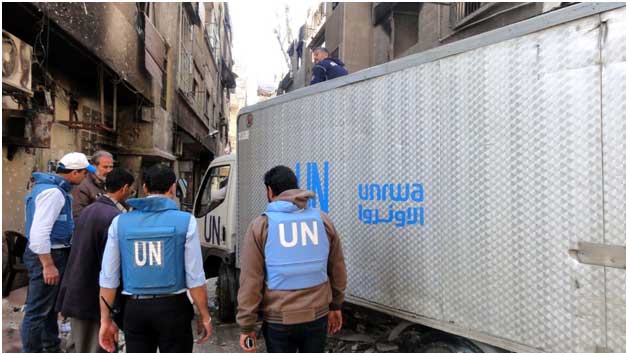
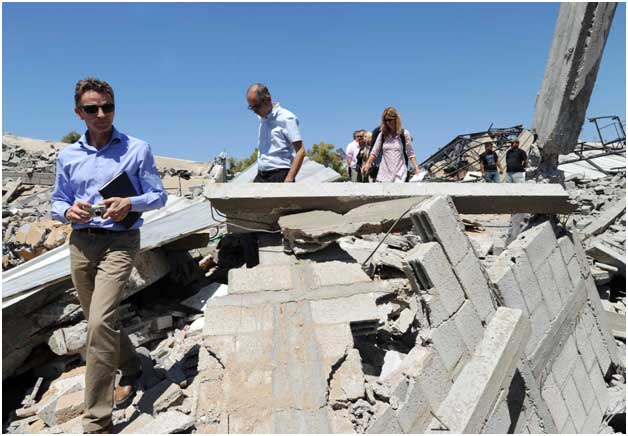
UNITED NATIONS, Aug 8 2019 (IPS) – A crisis that has threatened to undermine the future of the UN Relief and Works Agency (UNRWA) is expected to have a devastating impact—not only on the credibility of the United Nations– but also on the lives of over five million Palestinian refugees whose very survival depends on the humanitarian services provided by the beleaguered UN agency based in Amman and Gaza.


Mouin Rabbani, Senior Fellow at the Institute for Palestine Studies, told IPS: “This crisis must be resolved on an accelerated schedule in accordance with proper organisational procedures, both for its own sake, and to ensure that Palestinian refugees are not forced to pay the price of what is indisputably a political campaign led by the US and Israel to eliminate Palestinian refugees and their rights from the international agenda.”

Rabbani said one needs to look at this crisis from both an organisational and political perspective.

Viewed from an organisational perspective, he said, UNRWA Commissioner-General Pierre Krahenbuhl stands formally accused of illegitimately concentrating decision-making authority in the hands of a small circle of hand-picked associates, and using these powers to engage in extremely serious abuses of authority.

Significantly, Rabbani pointed out, these accusations have emanated from within UNRWA, and also from the Ethics Office, which claims to have “credible and corroborated” evidence, presented in a detailed report forwarded to the Office of the UN Secretary General, and has been deemed sufficiently credible to result in a formal investigation by the UN Office of Internal Oversight Services (OIOS).

While investigations are continuing, Switzerland, Belgium and the Netherlands, have suspended their contributions to UNRWA. And back in January 2018, the Trump administration decided, primarily for political reasons, to withhold $65m out of a $125m aid package earmarked for UNRWA triggering a financial crisis.

A former senior UN official, speaking on condition of anonymity, expressed alarm that some member states had rushed to suspend their vitally needed contributions to UNRWA, which would punish innocent Palestinians, tens of thousands of whose children would be tipped into further deprivation.

“To take such a drastic step on the basis of media coverage of a confidential internal report not available to member states and which they know is still being investigated by OIOS, is far too harsh, especially at a time when even the separation of a single immigrant child from his parents is rightly considered unacceptable,” he declared.
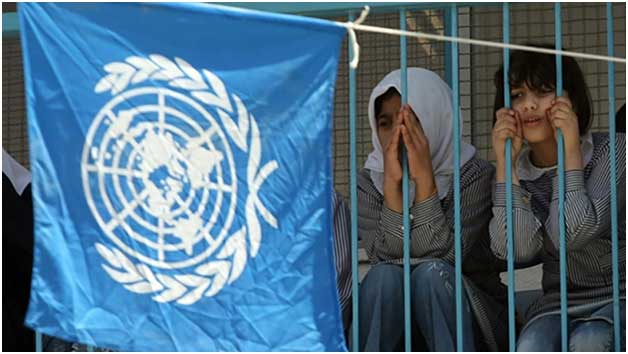
He told IPS he was concerned about the demonization of UNRWA’s senior officials on the basis only of this confidential Ethics Office report’s media accounts, which are necessarily selective but could also be erroneous, misleading or downright malicious, especially on a charged issue like Palestine and Israel.

He said the Ethics Office is a key UN unit designed to check abuses, and its reports are taken seriously.

But it does not have the mandate or the resources to conduct definitive investigations, so it gathers and presents information and evidence to OIOS for determination, he argued.

However, he emphasized that even if OIOS found serious lapses by top managers, Palestinian refugees should not be made to suffer.

He said UNRWA was struck a near-catastrophic blow when President Trump terminated the US’s $360m annual contribution. But an intense, ongoing UNRWA campaign had by last month raised over $110m from other countries.

“If UNRWA were riddled with serious dysfunction at the top, I cannot imagine that member states would be totally unaware and would have been so exceptionally supportive,” he declared.

According to UNRWA, the UN agency is funded almost entirely by voluntary contributions. The only exception is a very limited subsidy from the regular budget of the United Nations, which is used exclusively for administrative costs.

“The work of UNRWA could not be carried out without sustained contributions from state and regional governments, the European Union and other government partners, which represented 93.28 per cent of all contributions in 2018.”

In 2018, said UNRWA, 50 per cent of the Agency’s total pledges of $ 1.27 billion came from EU member states, who contributed $643 million, including through the European Commission.

The EU (including the European Commission), Germany and Saudi Arabia were the largest individual donors, contributing a cumulative 40 per cent of the Agency’s overall funding. The United Kingdom and Sweden were also among the top five donors.

Rabbani told IPS the proper thing for Krahenbuhl to do is to immediately resign if he knows these accusations to be substantiated, or, in view of the severity of the accusations, which cannot be dismissed as frivolous complaints by a hostile external party, to immediately step aside pending the conclusion of the OIOS investigation if he believes he is being falsely accused.

Should he refuse to do so, as seems to be the case, Secretary-General (SG) Guterres should exercise his responsibility and place Krahenbuhl on administrative leave with immediate effect until the matter is resolved.

“This is what would one would expect to transpire, and in fact often does, in both the public and private sectors. The removal of several of Krahenbuhl’s subordinates and appointment of an acting Deputy Director for UNRWA is an insufficient response that arguably serves only to deepen the crisis and increase the damage to both UNRWA and the UN,” he noted.

It additionally does the UN no favours, Rabbani said, that the ethics report and accusations against Krahenbuhl were communicated to the SG’s office in late 2018, and no significant action was undertaken until the report was leaked to the press over the summer.

This point is underscored by the decision of several key UNRWA funders (Belgium, The Netherlands, and Switzerland) to suspend contributions to the agency and the prospect of similar measures by other states.

From a political perspective, he said, it is vital to note that this crisis has erupted at a critical time for UNRWA. UNRWA’s very existence is under attack by the Trump administration, which hopes to leverage its campaign against the agency to liquidate the Palestine refugee question altogether.

Additionally, UNRWA’s mandate is up for renewal later this year. Many people will and in fact are raising questions about the confluence between the timing of these leaks and the intensification of the US campaign against the agency and Palestinian refugees.

The political context makes decisive action by the UN all the more urgent. CG Krahenbuhl’s mandate, which he has held since 2014, is to serve the needs of the Palestinian refugees, who are the most vulnerable sector of the embattled Palestinian people, Rabbani noted.

“This crisis, and his response to its eruption, is the ultimate test of his commitment to this mandate, and if he fails it UN senior leadership should intervene decisively and without further delay in the interests of both the UN, UNRWA, and the Palestinian refugees it serves”.

Without prejudice to the severity of the accusations being discussed, it is important to note that a) These accusations have been levelled against individuals within UNRWA rather than the agency itself; b) The UNRWA ethics report itself notes that the decision by the US to terminate contributions to UNRWA and campaign to seek the agency’s elimination, and the resultant crisis at the agency, forms the context in which these abuses of authority transpired; c) The abuses of authority and other misconduct detailed in the report are hardly unique to UNRWA, and similar and arguable more serious abuses have been documented at other UN agencies over the years; d) the accusations primarily concern expatriate senior officials (Krahenbuhl is Swiss and his former deputy an American) rather than Palestinian staff – the sole Palestinian staff member implicated has already been dismissed, Rabbani declared.

The writer can be contacted at thalifdeen@ips.org
  Source

UNRWA Faces Donor Backlash Amidst Charges of Sexual Misconduct & Nepotism

Civil Society, Editors’ Choice, Featured, Gender, Global, Headlines, Human Rights, IPS UN: Inside the Glasshouse, TerraViva United Nations

UNITED NATIONS, Aug 2 2019 (IPS) – The UN Relief and Works Agency (UNRWA), which has been undermined by a sharp cut in US contributions, has been embroiled in a scandal that threatens to jeopardize its very future.


A report from the Ethics Office has found “credible and corroborated” evidence that the senior management of UNRWA engaged in “sexual misconduct, nepotism, retaliation, discrimination and other abuses of authority, for personal gain, to suppress legitimate dissent, and to otherwise achieve their personal objectives.”

As a result, two of the donors, Switzerland and the Netherlands, have suspended payments to UNRWA, with the possibility of others to follow.

In January 2018, the Trump administration announced it was withholding $65m out of a $125m aid package earmarked for UNRWA, a veritable lifeline for more than five million registered Palestinian refugees, for nearly 70 years.

That move was prompted primarily for political reasons.

Paula Donovan and Stephen Lewis, co-directors of AIDS-Free World and its Code Blue Campaign, which seeks to end impunity for sexual abuse by UN personnel, told IPS the incriminating report was received in the Secretary-General’s office eight months ago.

“He should immediately have suspended the principals involved and replaced them with interim appointments. Had he done so, Switzerland and the Netherlands would not have suspended payment to UNRWA and the indispensable work of the agency would not have been compromised.”

“If the UNRWA story had not been broken by the media, the Secretary-General would not have acted. Alas, that’s the pattern,” they added.

Secretary-General Antonio Guterres told reporters August 1: “I have been acting quite significantly to make sure that we strengthen UNRWA and UNRWA’s capacity to deliver”.

“I’ve been appealing for the support to UNRWA to all countries of the world as I think we should distinguish what are the revelations made, or accusations made, in relation to members of the management of UNRWA, from the needs to preserve UNRWA, to support UNRWA, and to make UNRWA effective in the very important action in relation to the Palestine refugees, and I’ve been acting consistently to support that.”

As you know in the present situation, he pointed out, the deputy of UNRWA has resigned, and “so I decided that it would be important to immediately appoint a new deputy as acting deputy and, as I said, in relation to any intervention that might [be] justified, I will wait, according to due process, for the results of the inquiry and, based on the results of the inquiry, I will act accordingly.”

According to UNRWA, the UN agency is funded almost entirely by voluntary contributions.

The only exception is a very limited subsidy from the Regular Budget of the United Nations, which is used exclusively for administrative costs.

“The work of UNRWA could not be carried out without sustained contributions from state and regional governments, the European Union and other government partners, which represented 93.28 per cent of all contributions in 2018.”

In 2018, said UNRWA, 50 per cent of the Agency’s total pledges of $ 1.27 billion came from EU member states, who contributed $643 million, including through the European Commission.

The EU (including the European Commission), Germany and Saudi Arabia were the largest individual donors, contributing a cumulative 40 per cent of the Agency’s overall funding. The United Kingdom and Sweden were also among the top five donors.

The Trump administration said last August it has carefully reviewed the issue and determined that the United States will not make additional contributions to UNRWA.

“When we made a US contribution of $60 million in January, we made it clear that the United States was no longer willing to shoulder the very disproportionate share of the burden of UNRWA’s costs that we had assumed for many years,” according to the US State Department.

“Beyond the budget gap itself and failure to mobilize adequate and appropriate burden sharing, the fundamental business model and fiscal practices that have marked UNRWA for years– tied to UNRWA’s endlessly and exponentially expanding community of entitled beneficiaries– is simply unsustainable and has been in crisis mode for many years,” it continued.

“The United States will no longer commit further funding to this irredeemably flawed operation.”

UN Deputy Spokesperson Farhan Haq told reporters July 30 that Guterres believes it’s essential that UNRWA gets the support it needs and “so we will be looking to make sure that all of the countries that have been generous in donating to UNRWA will continue to be able to support that, and will look at engaging with them to see what can be done to satisfy them”.

“Clearly, this is an agency – as we have been saying in the last few years, when, as you know, it faced a financial crisis – this is an agency whose work is critical to the lives, to the health, to the education of millions of people, millions of Palestinians across the region, and they have been a vital source of stability, not just for those people but for the region itself,” he added.

Asked for a response about the charges against UNRWA, Haq said there is an ongoing investigation on the allegations contained in the report.

“Until this investigation is completed, the Secretary General is not in a position to make any further comments on this matter. As he has shown in the past, the Secretary General is committed to acting swiftly, as appropriate, upon receiving the full report. The Secretary General continues to consider the work undertaken by UNRWA as absolutely essential to Palestinian refugees,” he added.

Asked who was conducting the investigation, Haq said: “This is happening by our Office of Internal Oversight Services (OIOS). Now, I’ll leave it for you to evaluate the sufficiency of the steps that are taken once we take them; but, like I said, I’ve assured you the Secretary General is ready to take action upon receiving this… the full report”.

In a statement released August 1, Code Blue said the ethics report asserts that the alleged conduct of UNRWA’s senior leaders—Commissioner-General Pierre Krahenbuhl, Deputy Commissioner-General Sandra Mitchell, Chief of Staff Hakam Shahwan, and Senior Adviser to the Commissioner-General Maria Mohammedi—presents “an enormous risk to the reputation of the UN” and “their immediate removal should be carefully considered.”

The ethics report was leaked to the media this week. But it was completed and delivered to the UN Secretary-General in December 2018. That was eight months ago. Mitchell and Shahwan have since left the agency of their own accord. Both Krahenbuhl and Mohammedi remain in their posts, said the statement.

Code Blue also said the Secretary-General has ignored the ethics report’s recommendation that Krahenbuhl and Mohammedi be removed with “immediate” effect.

Instead, the UN has responded to the report by ordering yet another internal investigation, this time by the Office of Internal Oversight Services (OIOS), which is ongoing. In effect, the UN has taken no substantive action to address the crisis at UNRWA.

The Netherlands and Switzerland have responded to the revelations by suspending funding to UNRWA. The United Kingdom is considering such a step. It should go without saying that the work of UNRWA is too important to be sacrificed to the UN’s willingness to allow the crisis to worsen, Code Blue added.

The writer can be contacted at thalifdeen@ips.org
 

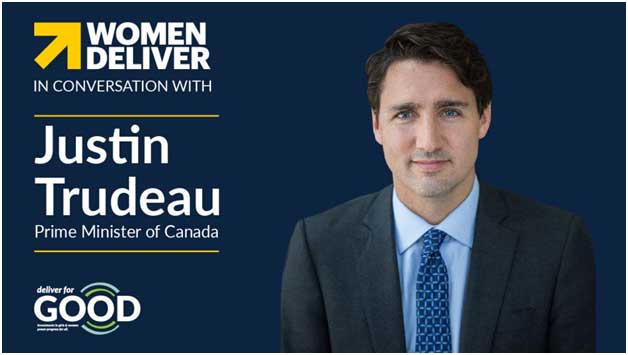
Power is a Privilege & a Responsibility: Q&A with Justin Trudeau, Prime Minister of Canada

Civil Society, Development & Aid, Editors’ Choice, Featured, Gender, Global, Global Governance, Headlines, Human Rights, IPS UN: Inside the Glasshouse, TerraViva United Nations

Opinion

In a special conversation, Katja Iversen, President/CEO of Women Deliver speaks with Justin Trudeau, Prime Minister of Canada, about Canada’s role in taking action for gender equality at home and abroad and our collective and individual responsibility to share power to build a gender equal world.

NEW YORK, Jul 29 2019 (IPS) – It’s on all of us to make gender equality a reality – which means harnessing our collective power to build a gender equal world.

By empowering girls and women, realizing sexual and reproductive health and rights, tackling gender-based violence, and confronting the combinations of sexism, misogyny, racism, and colonialism, we can take steps towards true gender equality.


Coming off the heels of the Women Deliver 2019 Conference in Vancouver, we both explore the need to use – and share – power to deliver transformative change for girls and women.

Katja Iversen: At the Women Deliver 2019 Conference we focused on power, and how it can drive – or hinder – progress and change for girls and women, and therefore for all. How will you use your power?

Justin Trudeau: Power is a privilege and a responsibility. Ultimately, the best thing you can do with power is share it. As we saw at Women Deliver, grassroots advocates and activists are creating change on the ground. Young people, like Natasha Wang Mwansa, are not just the leaders of tomorrow, but the leaders of today.

We need to amplify the work they’re doing, pass them the microphone, and make sure there’s a seat at the table for people of diverse identities and perspectives.

Katja Iversen: In the lead up to and during the Women Deliver 2019 Conference, we have seen unprecedented energy and enthusiasm for advancing gender equality. How do we take that energy and commitment and turn it into action? From world leaders and business leaders to advocates and influencers, what is your call to action to keep up the momentum?

Justin Trudeau: At Women Deliver, we announced new steps forward on everything from funding for women’s health and women’s organizations, to support for women entrepreneurs and housing commitments that will benefit women.

We announced that Canada will increase our investment to $1.4 billion to support women and girls’ health globally, positioning us as a leading donor worldwide on comprehensive sexual and reproductive health rights. $700 million of this annual investment is dedicated to sexual and reproductive health rights.

We’re focusing on the most neglected areas of this field. This is a game changer. We welcome other leaders to join us.

Globally, and here at home, we are seeing attacks on women’s rights, whether it’s undermining a woman’s fundamental right to choose, or violence against Indigenous women and girls. We can’t take our foot off the pedal, not even for a moment.

There’s simply too much at stake. We all need to work together to move forward, and to build more sustainable, more inclusive movements. It’s on all of us to make gender equality a reality.

Katja Iversen: Over the last several years we have heard more world leaders and private sector executives make public statements about the importance of gender equality. This is certainly critical, commendable, and encouraging! But we also need to see these leaders “walk the talk” and move toward action.

This is something you have emphasized throughout your administration from appointing a gender equal cabinet to developing gender-responsive federal budgets – both of which are crucial for moving policies and programs to actual impact. What impact have these actions had in Canada and around the world and what will you do next to move the needle for girls and women?

Justin Trudeau: Our government has put gender equality at the heart of everything we do. This means grappling with interlocking issues like sexism and misogyny, racism and colonialism. These challenges are complex and layered.

We won’t always get it right, but we will always keep trying. We know that it’s time to put an end to violence against all women and transgender, non-binary, and two spirit people, which is why we launched the first ever national strategy on gender-based violence.

We know that advancing gender equality hinges on economic equality, too. We will continue to demand that women and men receive equal pay for work of equal value, that everyone has a safe place to live, and that parents can share equally in both the joys and the responsibilities of raising children.

That’s why we introduced historic proactive pay equity legislation, and created more flexible parental leave options. And it’s why we launched a housing strategy where a minimum of 25% specifically supports women, girls, and their families.

There is much more work to do, and Canada is in it for the long haul. We will keep fighting for gender equality and concrete change – not just when it is popular, but always.

Katja Iversen: From driving Canada’s first Feminist International Assistance Policy to establishing the first Gender Equality Advisory Council to a G7 Presidency, you have led the way for political leadership toward gender equality – with an emphasis on improving girls’ and women’s sexual and reproductive health and rights.

Why should world leaders like you prioritize gender equality and women’s right to decide on their own bodies on international agendas and what more do you plan to do? Please provide 1-2 specific examples.

Justin Trudeau: Women don’t have to imagine not being able to access healthcare when they need it. They don’t have to imagine being denied the right to choose what’s best for their health and their future. For far too many people, that’s their reality. And that’s unacceptable.

Governments need to stand with those on the frontlines as partners and as allies. Leaders should prioritize gender equality and women’s right over their own bodies because it makes our countries, our communities, our workplaces, our governments, and our families stronger.

When women are healthy, free to make decisions about their lives, and can equally participate in our economies, we all benefit.

Katja Iversen: From the hallways of power to the main stage of global convenings, what argument have you found to be most effective in converting more people – especially decision makers – to join you as gender equality champions?
Justin Trudeau: Gender equality is not only the right thing to do, but it is also the smart thing to do. It powers our economies, and changes our communities for the better. Everyone should be able to get behind that.

Katja Iversen: You have spoken about raising your sons with an awareness of power dynamics and to act as allies of girls and women. Part of this involves a shift in mindset, from the idea that boys and men are losing power to the idea that power is shared with girls and women, to the benefit of all.

Why is it so important to you and your wife – Mme Sophie Grégoire Trudeau, a Deliver for Good Influencer – to raise your sons as young feminists, and how have you encouraged them to be effective and supportive allies for gender equality?

Justin Trudeau: Sophie and I want to help our kids grow up to be strong allies and empathetic adults, who walk through the world with openness, compassion, and a commitment to justice. That’s why raising our kids as feminists is such a priority for us.

We want our daughter, Ella-Grace, to have the same opportunities as her brothers, Hadrien and Xavier. And we want our sons to escape the pressure to be ‘a particular kind of masculine’ that can be damaging to men and to the people around them.

We want all three of them to be confident in being themselves, to stand up for what is right, and to do so with pride. We try to instill in our children the notion that everyone should be treated equally, and that there’s work left to do so that everyone shares the same rights and freedoms. We hope our children learn that they have a responsibility – and the power – to shape our world for the better.


Human Rights Watch Disappoints on Human Rights

Armed Conflicts, Civil Society, Crime & Justice, Global, Headlines, Human Rights, Migration & Refugees, Natural Resources, Peace, Press Freedom, TerraViva United Nations

Opinion

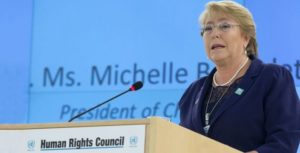
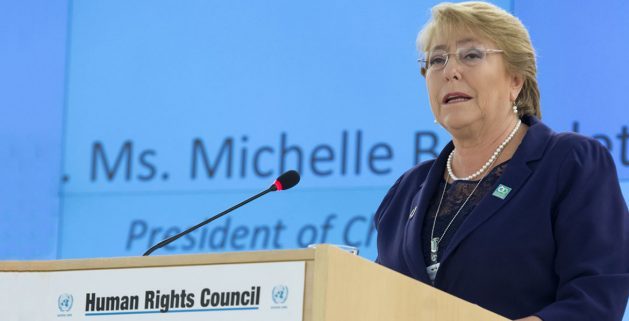
Michelle Bachelet, UN High Commissioner for Human Rights. Credit: Jean-Marc Ferré/UN Photo.

GENEVA, Jul 25 2019 (IPS) – On 22 July 2019, Kenneth Roth published an article in Publico, Lisbon, entitled: “UN Chief Guterres has disappointed on Human Rights”.


This essay lampooning Antonio Guterres is not a voice “against the tide” but very much mainstream – and demonstrably skewed. Major NGOs headquartered in rich advanced countries and enjoying generous funding from the Establishment may not always think “out of the box” and are as likely, as are the interest groups which support them, to politicize human rights and therefore to disappoint rights holders in smaller or weaker countries.

While they do contribute to exposing situations of human rights violations worldwide , they are not exempt from biases which reflect the structure of their central governing bodies or the cultural environment within which they operate. They cannot arrogate to themselves the sole legitimacy to speak in the name of the civil society of many countries , and when they claim to do so, they may disappoint rightsholders, particularly in the developing countries, whose priorities are frequently different from theirs.

Kenneth Roth’s bludgeoning of the UN Secretary General in this regard is yet another expression of grandstanding and even of a measure of arrogance. HRW’s criticism of China, Russia, Cuba, Nicaragua, Venezuela, would be more persuasive if the organisation addressed with the same intensity the egregious violations of human rights in many other countries

Sober analysis and stocktaking are necessary to determine whether and to what extent the priorities and agendas of NGOs’s like HRW are set by the overall interests of the established power-structures and multiple elites in many countries. Kenneth Roth’s article expressing disappointment at the human rights performance of Secretary General Antonio Guterres fails to identify the root causes of human rights violations.

His admonitions have little or no preventative value, and do not formulate constructive recommendations such as, for instance, the provision of advisory services and technical assistance to many countries that need it and have asked for it.

HRW’s “naming and shaming” strategy has been inconclusive at best because “naming and shaming” depends on the authority of the “namer” and the impartiality of the methodology. Kenneth Roth’s bludgeoning of the UN Secretary General in this regard is yet another expression of grandstanding and even of a measure of arrogance. HRW’s criticism of China, Russia, Cuba, Nicaragua, Venezuela, would be more persuasive if the organisation addressed with the same intensity the egregious violations of human rights in many other countries.

For instance, Mr. Roth does not mention the denial of the right of self-determination to millions of people, the retrogression in the enjoyment of economic, social and cultural rights (prohibited by the Covenant on Economic, Social and Cultural Rights), the looting of natural resources and degradation of the environment by transnational corporations and their neocolonial schemes, the impunity enjoyed by politicians who engage in aggressive wars and by paramilitaries and private security companies, the devastating human rights impact of blockades by source countries and economic sanctions on the populations of Gaza, Syria, Iran and Venezuela, which have caused and continue to cause tens of thousands of deaths.

The politicization or as we now witness with concern, the“weaponization” of human rights is taking the world on a slippery slope. When the Universal Declaration of Human Rights (UDHR)was adopted in 1948, Eleanor Roosevelt, Charles Malik, René Cassin and others spoke of human dignity and the inalienable rights of human beings, but article 29 of UDHR also reminded us that “everyone has duties to the community”.

Indeed, what is most necessary is global education in human rights, including the human right to peace, education in empathy and solidarity with others – compassion, not predatory competition in “the human rights industry” on a “holier than thou” ticket.

Meanwhile, Secretary-General Antonio Guterres should not be expected to act as a Human Rights NGO. This high office is not that of an unaccountable activist. It is neither that of a general that can blast any state at will nor is it a secretary that has to be subservient to the prevailing powers that be.

That high official must recognize the reality of the power balance that he cannot fundamentally alter but must strive with obduracy and at times courage to stretch the international community towards more compliance with the purposes and principles of the United Nations. Most importantly this means the promotion of peace through conflict-prevention, good offices, impartial mediation, disarmament and yes, human rights. When all diplomacy fails and only then may “naming and shaming” become an option. But it is a default option and a sign of diplomatic failure.

In the experience of both of us as Special Rapporteurs of the Human Rights Council, we have delivered on our mandates, not by openly challenging the authority of states or claiming to teach them lessons in human rights but by giving quiet diplomacy a chance .

This is how one of us together with another Independent Expert facilitated a lifting of the sanctions on Sudan and this is how we are again currently engaging with protagonists of other conflicts. We have succeeded in confidence-building and contributed to the release of detainees. Persevering and discrete advocacy bears fruit.

We want a SG that puts values above politics in human rights matters and this is, in our opinion, what Guterres is doing. We have a Secretary General that can speak for truth and can at least listen to the narratives of the smaller and weaker states who have no access to the world media and whose action is distorted by biased reporting.

Of course the murder of Khashoggi is a tragedy because beyond the tragic loss of a human life, it is the freedom of expression that is targeted. But Kenneth Roth does not mention the thousands of migrants whose lives end in the liquid graves of the oceans because saving them at sea is becoming a criminal offence in some « enlightened » nations.

Are there different values attached to life according to the « exploitability » of its loss for political aims? We do not think that the Secretary General should go down along this road, even if this may cause disappointment in some quarters.

We would be really concerned if the Secretary general were to follow the path of selective indignation advocated implicitly by Mr Roth, because he would lose the moral leadership that we all, people of good will, can identify with across the world. THAT would be a major disappointment.

We welcome in Antonio Guterres a Secretary General who does not hesitate to call a spade a spade, a SG who promotes peace and does not stoke conflict, who challenges unilateral economic sanctions, who supports the Right to Development1 and places the Secretariat of the United Nations in its service. We welcome a SG who, together with the new UN High Commissioner for Human Rights, Michelle Bachelet, are engaging all of humanity in the noble task – day by day – of implementing civil, cultural, economic, political and social rights in larger freedom – and in good faith.

Idriss Jazairy Special Rapporteur, UN Human Rights Council
Alfred de Zayas Former Independent Expert, UN Human Rights Council


The Precipitous Barbarisation of Our Times

Civil Society, Crime & Justice, Democracy, Education, Featured, Global, Globalisation, Headlines, Human Rights, Inequity, Migration & Refugees, TerraViva United Nations

Opinion

ROME, Jul 23 2019 (IPS) – When all is said and done, it appears that Thomas Hobbes, the 17th century English philosopher who had a dire vision of man, was not totally wrong.

From the frivolous to the serious, in just a week we have had four items of news which would not happen in a normal world. An English porn beauty with 86,000 followers on social media has put bottles of the water she bathes in on sale at 30 pounds a bottle and has sold several thousand bottles.


Roberto Savio

A survey in Brazil found out that 7% of citizens believe that the earth is flat (40 percent of American schools teach that the world was created in a week, according to the Bible, so there cannot be ancient civilisations) Another survey, this time of members of the British Tory party, who seem likely to elect Boris Johnson as prime minister (not exactly a triumph of reason) are so in favour of a “hard” Brexit that they do not care if this means the exit of Scotland and the end of the United Kingdom. Finally, in order to win election, US president Donald Trump has made racism one of his banners and, in a country of immigrants, this has given him an increase of 5 points in opinion polls.

There are so many signs of barbarisation that they would fill a book… and, as Euripides famously wrote: Whom the gods would destroy, they first make mad.

It is not a popular task, but we have to look at the reality and observe that, in the most scientifically and technologically developed period of history, we are living in times of precipitous barbarisation.

Social inequality has become the basis for the new economy. People have now lowered their expectations and are prepared to work part-time in a precarious job, where young people (according to the International Labour Organisation) can hope for a retirement pension of 600 euro a month. This has been accepted by the political system. We even have a study from Spain according to which, in the present housing market, nearly 87% of people need 90% of their salary just to rent a house.

Today, for many, a salary means survival, not a dignified life. The new economy has developed the so-called gig economy: you work to distribute food, but you are a co-entrepreneur without any of the rights of an employee, for an amount that will never allow you to marry. Children have grown accustomed to look at phenomena such as poverty or war as natural. And now politics are not based on ideas but on how you can successfully exploit the guts of the people, waving banners against immigrants (when we are witnessing a rapid fall in the birth rate) and splintering countries between ”We” who represent the people and “You” enemy of the country. The United States is the best example, where Republicans consider Democrats enemies of the United States. And this brings us to a central question: have Trump, Italy’s Matteo Salvini, Brazil’s Jair Bolsonaro and company not been elected democratically? And they are the symptom or the cause of the “populocracy” which is replacing democracy?

It is not possible to offer a sociological or historical study here. Let us just use a bite: we have gone from the Gutenberg era into a new era – the Zuckerberg era.

Those who greeted the arrival of the Internet with enthusiasm also did so because it would democratise communication and therefore bring about greater participation. The hope was to see a world where horizontal communication would replace the vertical system of information which Gutenberg made possible. Information was, in fact, a support for states and business that used it to reach citizens, who had no recourse to feedback. With Internet, people could now speak directly throughout the world and the propaganda which accompanied its arrival was not considered relevant: it is not important to know, it is important to know where to find It. Well, we have all the statistics on how Internet has affected the general level of culture and dialogue.

The attention span of people has declined dramatically. The majority of Internet users do not stay on an item more than 15 seconds. In the last five years, book volumes have been shortened by 29 pages. Today, articles longer than 650 words are not accepted by columnists’ services. The last meeting of editors of international news agencies decided to lower the level of news from the level of 22 years to that of 17 years. In Europe, the percentage of people who buy at least one book a year now stands at 22% (in the United States it is now 10.5%). According to a recent study in Italy, only 40% of the population is able to read and understand a book. In the same country, 13% of libraries have closed in the last ten years. A very popular transmission in Spain was ”59 seconds” which saw a number of people debate round a table; at the 59th seconds their microphones would disappear. Today, the dream of a TV interviewer is that the person interviewed will give a shorter answer than the question. Newspapers are for people over forty. And there is a unanimous complaint about the level of students entering the university: not all are free from mistakes of orthography and syntax. And the list could continue practically ad infinitum.

The problem of barbarisation has major relevance for political participation. The Gutenberg generations were accustomed to dialogue and discussion. Today, 83% of Internet users (80% under the age of 21), do so only in the virtual world they carved out for themselves. People of Group A gather only with people of Group A. If they come across somebody from Group B, they insult each other. Politicians have been able to adjust rapidly to the system. The best example is Trump. All US newspapers together have a circulation of 60 million copies (ten million those of quality, both conservative and progressive). Trump has 60 million followers who take Trump’s tweets as information. The do not buy newspapers, and if they watch TV it is Fox, which is Trump’s amplifier. No wonder that over 80% of Trump’s voters would vote for him again. And the media, which have lost the ability to offer analysis and cover processes, not just events, take the easy path. Let us follow famous people and make the famous more famous. Analytical journalism is disappearing. In the United States it exists thanks to grants … in every European country, there are few quality papers left, and the largest circulation goes to tabloids which spare their readers the effort of thinking. The Daily Mirror in Britain and Bild in Germany are the best examples.

Internet has made everybody a communicator. This is a fantastic achievement. But in this increasing barbarisation, people also use the Internet for transmitting false information, stories based on fantasy, without any of the quality controls that the media world used to have. And artificial intelligence has been taking over, creating many false accounts, which now interfere in the electoral process, as was proven in the last US elections. We have to add to this that the algorithms used by the owners of the Internet aim to trap the attention of users in order to keep them as much as possible. This month, El Pais published a long study entitled “The toxic effects of YouTube”, where it shows how its algorithms push the viewer to items that are of fantasy, pseudoscientific and of great attraction.

This is due to the fact that the owners have become fabulously rich by transforming citizens into consumers. They find out our identity, and they sell it to companies for their marketing, and also for elections. Those owners have unprecedented wealth, never achieved in the real world: not only in that of production, but even in the world of finance, which has become a casino with no control. The entire world of production of services and goods, man-made, is now close to a trillion dollars a day; that same day, financial flows reach 40 trillion dollars. Jeff Bezos ‘s divorce gave his wife 38 billion dollars. That is equal to the annual average income of 20,000 dollars of 19 million people. No wonder that 80 individuals now possess the same wealth as 2.3 billion people (in 2008, they were 1,200 individuals).

According to historians, greed and fear are great engines of change in history. That was also true in the Gutenberg era. But now, they have triggered a combination of both in a short period of time. After the fall of the Berlin Wall, the doctrine of liberal globalisation arrived with such strength that Margaret Thatcher (who with Ronald Reagan ushered in the new vision of individual profits and elimination of social goods) famously talked of TINA: There Is No Alternative.

The entire political system, including Social Democrats, accepted riding a system of values based on greed and unfettered competition at individual level, at state level and at international level. It took twenty years to understand that the poor have become poorer, and the rich richer, and that states have lost much of their sovereignty to multinational corporations and the world of finance. It is worth noting that, in 2009, in order to save a corrupt and inefficient financial system, the world spent 12 trillion dollars (the United States alone, 4 trillion). Since that rescue, banks have paid the impressive amount of 800 billion dollars in penalties for illicit activities.

The financial crisis of 2009 has triggered a wave of fear. Let us not forget that until 2009, there were no sovereignist, populist, xenophobic parties anywhere, except for Le Pen in France. Soon old traps such as “in name of the nation” and “the defence of religion” were resurrected by politicians able to ride fear. A new scapegoat – immigrants – was found and populocrats are now undermining democracy everywhere.

Populocracy is the new wave. Former Italian prime minister Silvio Berlusconi ushered in a new language, and that language has now been updated by Salvini, Trump and so on. Twitter, Facebook and Instagram are the new medium and now the medium is the message. The old elite had not found a new language.

The Zuckerberg era is an era of greed and fear. Zuckerberg is now attempting to create a global currency, the Libra, to be used by his 2.3 billion users. Until now, states were the only entities able to emit money, a symbol of the nation. Zuckerberg’s currency is based entirely on the Internet and will have no control or regulations. In case of a default, we will have a world crisis without precedent. In the Gutenberg era, this was not possible.

But who has made able Jeff Bezos to give 38 billion dollars to a former wife? Who has elected Trump and Salvini and company, who speak on behalf of the nation and the people, and turn those who do not agree into enemies of the nation and the people, creating an unprecedented polarisation, accompanied by an orgy of revolt against science and knowledge, which have supported the elite, and must now be put aside for the good of people.

This process of barbarisation should not obscure an old proverb: every country has the government it deserves. It is called democracy. However, the traditional elite has no code of communication with the new era. The answer will come from citizen mobilization.

A young Swedish girl, Greta Thunberg, has done more with her stubbornness to raise awareness about impending climate change than the entire political system. Even Trump (albeit for electoral reasons) has now declared that climate change is important.

Today, there many “points of light“ appearing in the world. The elections in Istanbul are a good example, as are the mobilisation in Hong Kong, Sudan and Nicaragua, among many others. Let us hope we will reach a point where people will take the reins of the process and awake the world from the precipitous course of barbarisation. Even Thomas Hobbes concluded that humankind will always, soon or later, find the right path, and give itself good governance. He thought that an elite would always be able to lead the masses.

Well, elites are now the Greta Thunbergs of the world.

Publisher of OtherNews, Italian-Argentine Roberto Savio is an economist, journalist, communication expert, political commentator, activist for social and climate justice and advocate of an anti neoliberal global governance. Director for international relations of the European Center for Peace and Development.. He is co-founder of Inter Press Service (IPS) news agency and its President Emeritus.


It Takes Listening to Children to End Violence

Civil Society, Education, Featured, Global, Global Governance, Headlines, Human Rights, Inequity, IPS UN: Inside the Glasshouse, Poverty & SDGs, TerraViva United Nations

Opinion

NEW YORK, Jul 22 2019 (IPS) – We see many challenges that affect children around the world. Child marriage, corporal punishment, voting ages, air pollution, teachers going on strike…


It’s been great to speak and have world leaders at the UN listen when we talk about these issues. It’s been clear that leaders are open to hearing from children and learning what kids have to say.

But even then, it doesn’t always seem like leaders are ready to move from talking to action. It’s weird that there are all these urgent issues to tackle, but leaders aren’t acting right away.

When we talked with [Special Representative of the Secretary-General on Violence against Children] Najat Maalla M’jid, she said she’s going to try and change this. She will push the United Nations to work to end violence against children. She also offered to listen to children’s ideas, recommendations, and solutions.

Governments must make changes to end violence and stop child marriage. And it’s really important for governments to listen to children’s voices and stop underestimating our abilities. Children can offer ideas too, and its children who are the next generation.

Last week, we learned that every country is connected together, and issues that affect one country often affect others as well. Even though countries have different languages, cultures, and ways of learning, many problems that affect children are the same.

Child marriage and sexual abuse affect children all over the world. Child marriage is a horrific form of violence. It violates girls’ rights and negatively affects their ability to access education and health.

In Lesotho and many other countries, girls are forced to marry due to poverty, property grabbing, sexual abuse, premarital pregnancies and neglect. The laws that protect children are not effectively implemented and enforced.

We also need to stop thinking that punishing kids by hitting them is an acceptable discipline method. Just like child marriage, we need to realise that psychological abuse and corporal punishment of students is a problem in many countries, and maybe by working all together it will be easier to stop it.

Often governments have put some good laws in place, but they don’t always work because people don’t know about them. Adults need to be told about the new laws, otherwise they’re going to keep breaking them and the violence is only going to continue.

Children and teachers, for instance, need to know that there are rules about how children can be treated in schools. Sometimes the laws don’t match up, and so old marriage laws need to be updated so they don’t have lower ages than child protection laws.

When children get involved, they can help. For example, many children are born and live their life without having a birth certificate. Many countries make it hard for them to access their basic rights or go to school without a birth certificate.

In one village in Indonesia, many children were rejected when they wanted to register at school because they did not have a birth certificate. Thankfully, the child parliament was able to work with the village government to get a birth certificate for all children.

They arranged a “mass birth certificate” campaign and finally, 100% of the children in the village have birth certificates.

Children can help create the necessary changes in communities, but we need to be informed in order to do so. Child parliaments and youth groups can help raise community awareness about child protection laws and give us a space to share about our experiences.

Before sessions, not many girls knew that child marriage is against the law. After our meetings, children are more aware and have a better understanding of violence.

Every child has a right to participate. We hope our examples show how the voices of children are important and can help. If the government wants the world free from violence, involve us.

The main target of ending violence against children is a child. Therefore, the voices of children should be heard. If violence against children is stopped, we will have a better life, and we need this now, not in the future.

*As a general rule, World Vision doesn’t share the last names of children under 18.