UN Women Calls for Accelerating its Unfinished Business

Civil Society, Featured, Gender, Global, Headlines, IPS UN: Inside the Glasshouse, Poverty & SDGs, TerraViva United Nations, Women’s Health

Opinion

Phumzile Mlambo-Ngcuka is UN Under-Secretary-General and Executive Director, UN Women
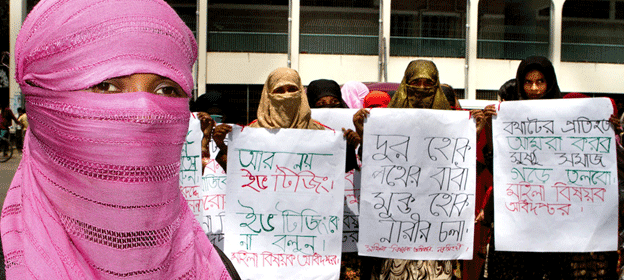
Women in Bangladesh stand up for gender equality. Credit: UNICEF/Jannatul Mawa

NEW YORK, Sep 7 2020 (IPS) – Twenty-five years ago, the Fourth World Conference on Women in Beijing set a path-breaking agenda for women’s rights. As a result of the two-week gathering with more than 30,000 activists, representatives from 189 nations unanimously adopted the Beijing Declaration and Platform for Action.


This historic blueprint articulated a vision of equal rights, freedom and opportunities for women – everywhere, no matter what their circumstances are – that continues to shape gender equality and women’s movements worldwide.

A quarter century on, the UN Secretary-General, Antonio Guterres, calls for urgent action: “With nations around the world searching for solutions to the complex challenges of our age, the leading way for all of us to rebuild more equal, inclusive, and resilient societies, is to accelerate the implementation of women’s rights – the Beijing Platform for Action. That vision has been only partly realized. We still live in a male-dominated world with a male-dominated culture, and this simply has to change”.

The Beijing Platform for Action imagined a world where every woman and girl can exercise her freedoms and choices, and realize her rights, such as to live free from violence, to go to school, to participate in decisions and to earn equal pay for work of equal value. As a defining framework for change, the Platform for Action made comprehensive commitments under 12 critical areas of concern.

Twenty-five years later, no country has fully delivered on the commitments of the Beijing Platform for Action, nor is close to it. A major stock-taking UN Women report published earlier this year showed that progress towards gender equality is faltering and hard-won advances are being reversed.

Women currently hold just one quarter of the seats at the tables of power across the board. Men are still 75 per cent of parliamentarians, hold 73 per cent of managerial positions, are 70 per cent of climate negotiators and almost all of the peacemakers.
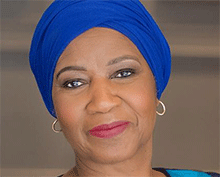
Phumzile Mlambo-Ngcuka

The anniversary is a wake-up call and comes at a time when the impact of the gender equality gaps is undeniable. Research shows the COVID-19 pandemic is exacerbating pre-existing inequalities and threatening to halt or reverse the gains of decades of collective effort – with just released new data revealing that the pandemic will push 47 million more women and girls below the poverty line.

We are also witnessing increased reports on violence against women throughout the world due to the lockdowns, and women losing their livelihoods faster because they are more exposed to hard-hit economic sectors.

While much works remains on fulfilling the promises of the Beijing Platform for Action, it continues to be a global framework and a powerful source of mobilization, civil society activism, guidance and inspiration 25 years later.

It was at the Fourth World Conference on Women, specifically at the Women & Health Security Colloquium, where Hillary Clinton coined the phrase, “Women’s rights are human rights, and human rights are women’s rights”.

In a recent article in The Atlantic, she recalled her participation at the Conference as the Honorary Chairperson of the US delegation, and the significance of the Beijing Declaration: “A 270-page document might not lend itself to bumper stickers or coffee mugs, but it laid the groundwork for sweeping, necessary changes.”

Underlining the urgency for implementation, she added: “As the changes laid out in the Platform for Action have been implemented, what’s become clear is that simply embracing the concept of women’s rights, let alone enshrining those rights in laws and constitutions, is not the same as achieving full equality. Rights are important, but they are nothing without the power to claim them.”

Years after, global activists continue the hard work and those who participated at the 1995 Beijing Conference remain touched by this historic meeting. Zeliha Ünaldi, a long-standing gender advocate from Turkey, said it was a life-changing experience: “When I recall those days, mingling around the tents with thousands of women committing to a better world, two words immediately come to my mind: sisterhood and peace. The Beijing Declaration and Platform for Action and the subsequent five years helped me understand the power in us and of us as the global women’s movement.”

The upcoming UN General Assembly later this month will be a key opportunity to bring to the forefront the relevance of the Beijing Declaration and move the needle on implementation, with a High-Level Meeting attended by global leaders on “Accelerating the Realization of Gender Equality and the Empowerment of all Women and Girls” on 1 October.

The event will showcase how building equal and inclusive societies is more urgent than ever, as the COVID-19 pandemic ravages lives and livelihoods.

Calling on world leaders to use their political power to accelerate robust action and resources for gender equality and the empowerment of all women and girls: “This is a re-set moment. On this important anniversary, let us reaffirm the promises the world made to women in 1995. Let us draw on the activist spirit of the Beijing Conference and commit to forging new alliances across generations and sectors to ensure we seize this opportunity for deep, systemic change for women and for the world.”

The anniversary will be further commemorated in the context of the Generation Equality Forum, a civil society–centred, global gathering for gender equality, convened by UN Women and co-hosted by the governments of France and Mexico, foreseen to take place in the first half of 2021.

Exactly 25 years after the opening of the Fourth World Conference on Women in Beijing, China, its significance is undimmed. In that quarter century we have seen the strength and impact of collective activism grow and have been reminded of the importance of multilateralism and partnership to find common solutions to shared problems.

Back in 1995, the deliberations of the Conference resulted in the framing of the Beijing Declaration and Platform for Action: a bold agenda for the change needed to realize the human rights of women and girls, articulated across 12 critical areas of concern.

The Platform for Action provided a blueprint for the advancement of gender equality and the empowerment of women and girls, adopted by 189 UN Member States and universally referenced.

The continued relevance of the Beijing Declaration and Platform for Action cannot be overstated today. The far-reaching social and economic impacts of the COVID-19 pandemic, including the significant increases in violence against women, threaten to reverse many of the hard-won advances made in the last 25 years to empower women and girls.

At the same time, the outstanding value of women’s leadership through the COVID-19 pandemic is in plain sight, along with the recognition of just how much women’s work and women’s movements have sustained the world, from domestic life, the fight for human rights, to national economies.

We also know that by next year, 435 million women and girls are likely to have been reduced to extreme poverty. Governments, local administrations, businesses and enterprises of all sorts must not let this happen.

To tackle persistent systemic barriers to equality, we need transformative approaches and new alliances that engage the private sector alongside governments and civil society. This is a re-set moment. The economic and policy lifeboats for our struggling world must put women and children first.

The political will of leaders can make the difference. World leaders convening at this year’s United Nations General Assembly have the opportunity to use their power in action to accelerate the realization of gender equality and the empowerment of all women and girls, and to support the role of civil society organizations and youth.

Our humanitarian responses to COVID-19, our economic stimulus packages, our reinventions of working life and our efforts to create solidarity across social and physical distance – these are all chances to build back better for women and girls.

For success, we need to work together on these transformative actions. In 2019, we launched a global campaign called Generation Equality: Realizing Women’s Rights for an Equal Future, with a call for renewed commitment by governments in partnership with civil society, academia and the private sector.

It included clear timelines, responsibilities and resources towards realizing the 2030 Agenda for Sustainable Development, an ambitious long-term framework that included goals to achieve universal gender equality.

On October 1, 2020, when a High-Level Meeting on the 25th anniversary of the Beijing Platform for Action is convened by the President of the General Assembly, Member States can put into action their commitment toward a more gender-equal world.

On this important anniversary, let us reaffirm the promises the world made to women and girls in 1995. Let us draw on the activist spirit of the Beijing Conference and commit to forging new alliances across generations and sectors to ensure we seize this opportunity for deep, systemic change for women and for the world.
  Source

It is Time for a Democratic Global Revolution

Civil Society, Climate Change, Democracy, Editors’ Choice, Featured, Global, Global Governance, Headlines, Human Rights, IPS UN: Inside the Glasshouse, TerraViva United Nations

Opinion

Daniel Jositsch is a Member of the Swiss Senate and President, Democracy Without Borders-Switzerland, and Andreas Bummel is Executive Director, Democracy Without Borders. Twitter: @democracywb

The UN’s Security Council, in particular, is suffering from a dysfunctional decision-making method that grants the five victors of the Second World War and official nuclear powers not only a permanent seat but also a veto right. Credit: United Nations

BERLIN / BERNE, Aug 28 2020 (IPS) – The people of the world need to seize the moment and bring about a democratic global revolution. It is time for a global parliament and real representation.

More than 21 million people got infected with the novel coronavirus and over 770,000 have died. Never before did the world witness similar collective lockdowns of social and economic activity that had to be enforced to contain the pandemic.


For many, the corona-related global crisis exacerbates a situation that was already critical before the outbreak of the virus.

The climate crisis is unfolding with record temperatures in Siberia, Greenland, the Antarctic and other places like the Middle East. The new climate apartheid is characterized by whether you can afford to shield yourself from such heat or not. Most cannot.

135 million people are facing crisis levels of hunger. There are currently more than 70 million displaced people who have fled war, persecution and conflict. It’s the worst humanitarian and refugee crisis in seventy years.

There is a global inequality crisis. Productivity gains and globalization disproportionately benefit the affluent. Financial assets in the trillions are hidden in offshore accounts from tax authorities. The world’s 26 richest billionaires own as much as the poorest 3.8 billion people on the planet.

While global surveys confirm that people across all world regions strongly believe in democracy, there is in fact a democratic retreat. Confidence in the actual performance of democratic governments is waning. Populist nationalism and authoritarianism has been advancing, aided and abetted by social media platforms and the internet. Major arms control treaties are crumbling, geopolitical tensions are rising and multilateralism is under attack.

Civil society and citizens across the world are fighting back, though. Pro-democracy movements are at an all-time high as widespread protests in dozens of countries now and in recent times demonstrate. Freedom and justice have lost no appeal. At the same time, millions of citizens joined climate protests around the world and called for quick and effective action in this critical field.

The present issues are symptoms of a crisis of global governance. There is a scale mismatch between a political world order that is based on 200 states and territories and issues that demand decisive global action.

As the UN celebrates its 75th anniversary this year, the organization continues to lose significance and impact. The UN is only as strong and effective as its member states allow it to be. The same applies to all intergovernmental organizations and forums, including the World Health Organization that had to launch an investigation into its handling of the Covid-19 pandemic.

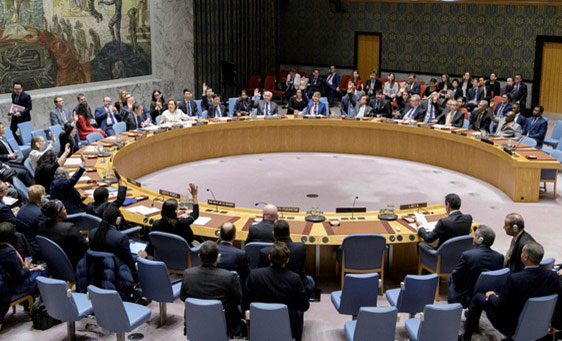
The UN’s Security Council, in particular, is suffering from a dysfunctional decision-making method that grants the five victors of the Second World War and official nuclear powers not only a permanent seat but also a veto right.

If long-lasting solutions are to be achieved, this scale mismatch must be tackled. It is not enough to call on individual governments to change their policies. The way how the world is governed must be changed. What is needed is a new vision of a democratic world order that is based on shared sovereignty on global issues, a clear commitment to human rights, the principle of subsidiarity and complete disarmament.

When the UN was founded it was recognized that this should only be a beginning and that changes would be required. Article 109 of the Charter provides that a conference to review the Charter should be held by 1955. The UN’s member states did not deliver on that promise. Now is the time to hold them to account.

The world’s people need an actual say in global affairs that is not intermediated by national governments and their diplomats. The key ingredient of a new UN should be a democratically elected world parliament that complements intergovernmental bodies such as the UN General Assembly.

The creation of a new democratic world organization that has actual powers seems to be a gigantic project that raises numerous questions. How is a global democracy to be created while major states themselves are not democratically organised? Can decisions of a world parliament be enforced against the will of individual states? How is it possible that states will agree to the creation of a superior political unit?

These questions show the way forward: The people of the world themselves need to embrace and call for global democracy. Eventually, they are the sovereigns not only in their individual states but on the planet as a whole, too.

A global democratic revolution needs to push for a legitimate, inclusive and representative global body that will deal with these questions in a serious way. The creation of a UN Parliamentary Assembly could be an important stepping stone to launch a global constitutional process and a transformation of global governance.

This global democratic revolution will be peaceful because it is not about destroying structures or conquering territories, but about opening up a political level that is lying idle. Supranational integration cannot be imposed by force. It will happen because the people want it.

If existing movements in the fields of climate, environment, peace, disarmament, democracy, social justice and others join forces, the global democratic revolution will become very real.

This may sound visionary. But the big issues troubling this planet and its people will remain, and worsen, unless the root cause is addressed. A democratic global government is not a mind game in some ivory tower. It is the most important question on the agenda of humanity today.

  Source

Modern Tools, Age-old Wisdom: on India-Sri Lanka Relations

Asia-Pacific, Civil Society, Featured, Global, Global Governance, Headlines, IPS UN: Inside the Glasshouse, Peace, TerraViva United Nations

Opinion

Prasad Kariyawasam was Sri Lanka’s one-time Foreign Secretary and High Commissioner to India

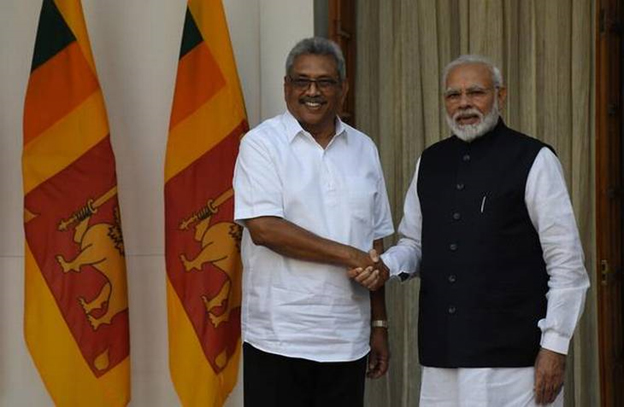
Indian Prime Minister Narendra Modi and Sri Lankan President Gotabaya Rajapaksa. Credit: V.V. Krishnan, the Hindu

COLOMBO, Sri Lanka, Jul 31 2020 (IPS) – The unique India-Sri Lanka relationship, de jure, is between equals as sovereign nations. But it’s asymmetric in terms of geographic size, population, military and economic power, on the one hand, and social indicators and geographical location, on the other. It is steeped in myth and legend, and influenced by religious, cultural and social affinities.


This is an opportune time for Sri Lanka and India to nourish the roots of the relationship using modern toolkits, but leveraging age-old wisdom and experience.

Historical ties

History reveals that the advent of Buddhism to Sri Lanka during the time of Emperor Ashoka was the result of cross-border discourse. For many centuries in the first millennia, the ancient capital city of Anuradhapura housed an international community which included traders from India, China, Rome, Arabia and Persia.

Later, Buddhist monks from Sri Lanka travelled to India, China, Cambodia and Java leaving behind inscriptions. Buddhist temples in Sri Lanka, to this day, contain shrines for Hindu deities. The colonial expansion of European maritime nations reshaped the Sri Lankan economy. Labour from south India was brought to Sri Lanka to work in plantations.

The Indian freedom struggle had its influence on Sri Lanka as well. There was cross-border support for the revival of culture, tradition, local languages, spiritual practices and philosophies, and education. Both countries transformed into modern nations with constitutional and institutionalised governance under colonial rule.

Most aspects of today’s globalisation existed in a different form in the pre-colonial era with free exchange of ideas, trade and intellectual discourse. However, process engineering by colonial powers for identification and categorisation of people was a factor in the emergence of separatist ideologies based on ethnicity, language and religion.

This mindset is now ingrained and accentuated in politics. Episodic instances of communal hostility are referenced often to suit tactical political gain. Around the world today, and not just in South Asia, policies and thinking are becoming communally exclusive, localised and inward-looking.

The COVID-19 pandemic hit the world against this backdrop, allowing some leaders an opportunity to double down on insular thinking, ostensibly for providing local communities with better economic and social prospects, and security.

Meanwhile, governance models favoured by nations keep vacillating between fundamental freedoms-based democratic systems and quasi democratic, socialist authoritarian systems.

In this regard, the people of Sri Lanka and India have been served well by long years of uninterrupted democratic governance. This has provided long-term stability for both countries and must not be vitiated.

Sri Lanka’s strategic location makes it apparent that not only economic fortunes but the security of both countries are inextricably linked. Therefore, it is heartening that India and Sri Lanka constantly strive for excellence in neighbourly relations, recognising that a calamity in one country can adversely impact the other.

Though robust partnerships with other countries must be sought in line with the non-alliance foreign policies of both countries, such efforts must be bounded by an atmosphere needed for peace, prosperity and stability.

Among others, freedom of navigation in the Indo-Pacific together with a rules-based international order and peaceful settlement of disputes are of common interest. While avoiding advocacy of zero-sum solutions on crucial issues, both countries must seek to harmonise strategic and other interests in line with common values and socioeconomic compulsions.

Addressing issues and imbalances

The socioeconomic development of Sri Lanka has remained linked to India. But there are many options available to address issues of imbalance and asymmetries. For instance, Sri Lanka can encourage Indian entrepreneurs to make Colombo another business hub for them, as logistical capacities and facilities for rest and recreation keep improving in Sri Lanka.

Integrating the two economies but with special and differential treatment for Sri Lanka due to economic asymmetries can be fast-tracked for this purpose. There is immense potential to accentuate or create complementariness, using locational and human resource potential, for harnessing benefits in the modern value chains.

Robust partnerships across the economic and social spectrum can promote people-to-people bonhomie. And engagement of legislatures is essential for promoting multiparty support.

With many countries receding into cocoons due to the pandemic, this is an opportunity for both countries to focus on the renewal and revitalisation of partnerships.

This article was originally published in the Hindu, the English-language daily owned by The Hindu Group and headquartered in Chennai, Tamil Nadu
https://www.thehindu.com/opinion/op-ed/modern-tools-age-old-wisdom/article32206425.ece

  Source

Reflections on the Charter of the United Nations on its 75th Anniversary

Civil Society, Climate Change, Development & Aid, Gender, Global, Headlines, Human Rights, Humanitarian Emergencies, IPS UN: Inside the Glasshouse, TerraViva United Nations

Opinion

Mona Juul is the seventy-fifth President of the Economic and Social Council and Permanent Representative of Norway to the United Nations.

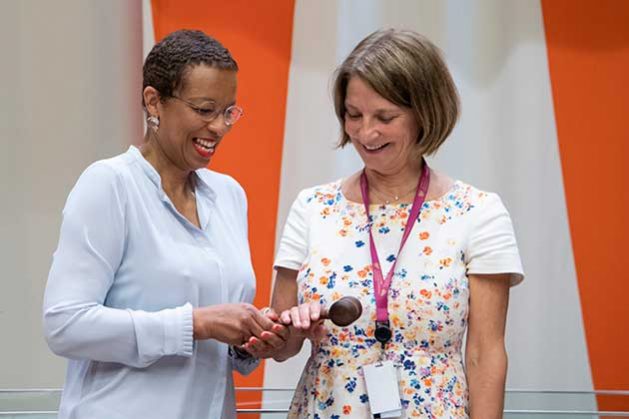
Inga Rhonda King (left), Permanent Representative of Saint Vincent and the Grenadines to the United Nations and seventy-fourth President of the Economic and Social Council (ECOSOC), hands over the gavel to Mona Juul, Permanent Representative of Norway to the United Nations and newly-elected seventy-fifth President of ECOSOC, at the opening meeting of the 2020 session of ECOSOC. New York, 25 July 2019. Credit: UN Photo/Eskinder Debebe

NEW YORK, Jul 29 2020 (IPS) – This year we celebrate the 75th anniversary of the Charter of the United Nations, written and signed during a period of great global change. Today, the world is again shifting beneath our feet. Yet, the Charter remains a firm foundation for our joint efforts.


These uncertain times of global disruption shine a light on the interdependences of our world. The COVID-19 pandemic, and the inequality it has exposed, are a global challenge that we must solve through global solutions. These solutions call for more, not less, cooperation across national borders.

Global cooperation is the enduring promise of the Charter of the United Nations. I am honoured to preside over the Economic and Social Council (ECOSOC), one of the principal organs of the United Nations, at its 75th anniversary.

In January 1946, 18 members gathered for the inaugural meeting of ECOSOC under the leadership of its first President, Sir Ramaswami Mudaliar of India. ECOSOC was vested with a powerful mandate, to promote better living for all ¬¬by fostering international cooperation on economic, social and cultural issues.

The Charter recognizes the value of social and economic development as prerequisites for stability and well-being. In a 1956 speech, Secretary-General Dag Hammarskjöld said that “while the Security Council exists primarily for settling conflicts […] the Economic and Social Council exists primarily to eliminate the causes of conflicts.”

For me, this is a reminder that sustainable peace and prosperity rely on global solidarity and cooperation.

Today, this unity of purpose to reach those furthest behind first is also the spirit of the Sustainable Development Goals (SDGs). The 2030 Agenda is our shared road map to transform the world as we recover better, protect our planet and leave no one behind. With ECOSOC serving as the unifying platform for integration, action, follow-up and review of the SDGs, our promise to eradicate poverty, achieve equality and stop climate change must drive our actions.

ECOSOC has the unique convening power to make this happen. It brings together valuable constituencies such as youth and the private sector to enhance our work and discussions. ECOSOC also remains the gateway for civil society engagement with the United Nations. Civil society has been central to progress on international economic, social and environmental cooperation, from the small but critical number of organizations present in San Francisco when the Charter was signed in 1945, to the 5,000-plus non-governmental organizations with ECOSOC consultative status today.

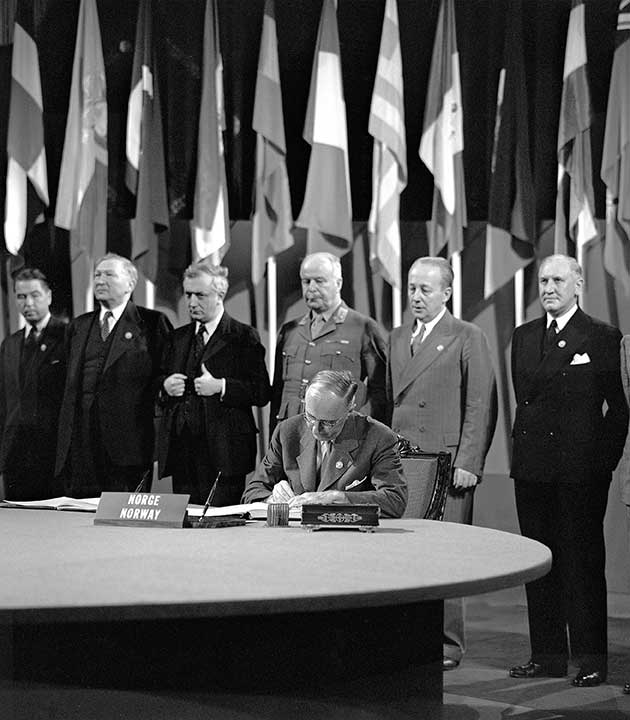
Wilhelm Munthe Morgenstierne, Ambassador to the United States, member of the delegation from Norway, signing the Charter of the United Nations at the Veterans’ War Memorial Building in San Francisco, United States, on 26 June 1945. Credit: UN Photo/McLain

The Charter also outlines that ECOSOC should promote universal respect and observance of human rights and fundamental freedoms for all, without distinction as to race, sex, language or religion. While much has shifted in our world, this mandate remains just as important today as in 1945. After all, human rights are a part of the foundation of the United Nations, quite literally. When Trygve Lie, the first Secretary-General and fellow Norwegian, laid the cornerstone of United Nations Headquarters at Turtle Bay in October 1949, it contained, together with the Charter, a copy of the Universal Declaration of Human Rights.

Human rights have always been a part of the work of ECOSOC. The former United Nations Commission on Human Rights was one of the first functional commissions created within ECOSOC and was charged with drafting the Universal Declaration. Today, ECOSOC remains committed to playing its part to promote all rights: civil and political, as well as economic, social and cultural rights.

In stark contrast to the 18 men who formed the first meeting of ECOSOC in 1946, I am proud to be the third consecutive female president of ECOSOC and one of five female presidents in its 75-year history. Although slow, this is progress, especially compared to 1945, when out of the 850 international delegates that convened in San Francisco to establish the Charter of the United Nations, only eight were women, and only four of them were signatories to the Charter. Today, the Secretary-General has achieved gender parity in all senior United Nations positions, and the Commission on the Status of Women is perhaps the highest profile part of the work of ECOSOC. The Commission’s annual session is instrumental in promoting women’s rights, documenting the reality of women’s lives throughout the world and shaping global standards on gender equality and the empowerment of women.

ECOSOC must work to place gender equality at the heart of all our work. Women’s rights and gender equality are imperative to a just world. In all my endeavours, I strive to promote and advance these rights with a vision of a more prosperous, peaceful and fair world, for the benefit of women and girls—and men and boys alike.

Before the current crisis, more people around the world were living better lives compared to just a decade ago. More people have access to better health care, decent work and education than ever before. Nevertheless, inequality, climate change and the lasting negative impacts of the COVID-19 pandemic are threatening to undo these gains. While we have technological and financial resources at our disposal, unprecedented changes will be needed to align resources with our sustainable development objectives. The United Nations must remain at the forefront of our collective efforts guided by our commitment to the Charter.

The true test of our success will be whether persons, communities and countries experience improvement in their lives and societies. The United Nations must be of value to people. To our family. To our neighbours. To our friends. Unless we achieve this, our credibility is at stake.

As we celebrate the 75th anniversary of the Charter of the United Nations, let us remind ourselves of the promise it embodies, to help the world become a more prosperous, just, equitable and peaceful place.

To me, the opening words of the Charter, “WE THE PEOPLES OF THE UNITED NATIONS”, are a humble and empowering reminder of our capability to overcome current and future challenges. Even in troubling times, there remains great hope in the power of working together. That is the founding spirit of the United Nations—and in this 75th anniversary year, as we face grave and global challenges, it is the spirit we must summon today.

This article was first published by the UN Chronicle on 26 June 2020.

  Source

The Great Lockdown Through a Global Lens

Civil Society, Development & Aid, Editors’ Choice, Featured, Global, Global Governance, Headlines, IPS UN: Inside the Glasshouse, Poverty & SDGs, TerraViva United Nations

Opinion

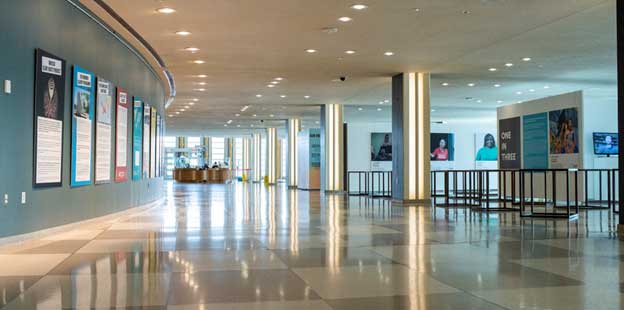
The empty corridors of a locked down UN Secretariat in New York. Credit: United Nations

WASHINGTON DC, Jun 17 2020 (IPS) – The Great Lockdown is expected to play out in three phases, first as countries enter the lockdown, then as they exit, and finally as they escape the lockdown when there is a medical solution to the pandemic.


Many countries are now in the second phase, as they reopen, with early signs of recovery, but risks of second waves of infections and re-imposition of lockdowns. Surveying the economic landscape, the sheer scale and severity of the Global Lockdown are striking.

Most tragically, this pandemic has already claimed hundreds of thousands of lives worldwide. The resulting economic crisis is unlike anything the world has seen before.

This is a truly global crisis. Past crises, as deep and severe as they were, remained confined to smaller segments of the world, from Latin America during the 1980s to Asia in the 1990s. Even the global financial crisis 10 years ago had more modest effects on global output.

For the first time since the Great Depression, both advanced and emerging market economies will be in recession in 2020. The forthcoming June World Economic Outlook Update is likely to show negative growth rates even worse than previously estimated. This crisis will have devastating consequences for the world’s poor.

Aside from its unprecedented scale, the Global Lockdown is playing out in ways that are very different from past crises. These unusual characteristics are emerging all over the world, irrespective of the size, geographic region, or production structure of economies.

First, this crisis has dealt a uniquely large blow to the services sector. In typical crises, the brunt is borne by manufacturing, reflecting a decline in investment, while the effect on services is generally muted as consumption demand is less affected.

This time is different. In the peak months of the lockdown the contraction in services has been even larger than in manufacturing, and it is seen in advanced and emerging market economies alike.

There are exceptions—like Sweden and Taiwan Province of China, which adopted a different approach to the health crisis, with limited government containment measures and a consequently proportionately smaller hit to services vis-à-vis manufacturing.

It is possible that with pent-up consumer demand there will be a quicker rebound, unlike after previous crises. However, this is not guaranteed in a health crisis as consumers may change spending behavior to minimize social interaction, and uncertainty can lead households to save more. In the case of China, one of the early exiters from lockdown, the recovery of the services sector lags manufacturing as such services as hospitality and travel struggle to regain demand.

Of particular concern is the long-term impact on economies that rely significantly on such services—for example, tourism-dependent economies.

Second, despite the large supply shocks unique to this crisis, except for food inflation, we have thus far seen, if anything, a decline in inflation and inflation expectations pretty much across the board in both advanced and emerging market economies.

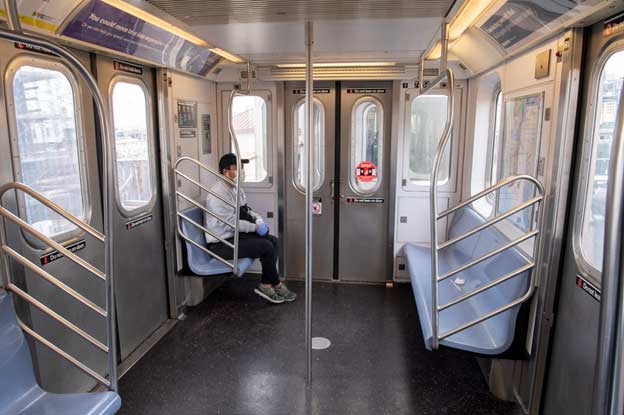
Scene in New York City Subway during COVID-19 Outbreak. Credit: United Nations

Despite the considerable conventional and unconventional monetary and fiscal support across the globe, aggregate demand remains subdued and is weighing on inflation, alongside lower commodity prices. With high unemployment projected to stay for a while, countries with monetary policy credibility will likely see small risks of spiraling inflation.

Third, we see striking divergence of financial markets from the real economy, with financial indicators pointing to stronger prospects of a recovery than real activity suggests. Despite the recent correction, the S&P 500 has recouped most of its losses since the start of the crisis; the FTSE emerging market index and Africa index are substantially improved; the Bovespa rose significantly despite the recent surge in infection rates in Brazil; portfolio flows to emerging and developing economies have stabilized.

With few exceptions, the rise in sovereign spreads and the depreciation of emerging market currencies are smaller than what we saw during the global financial crisis. This is notable considering the larger scale of the shock to emerging markets during the Great Lockdown.

This divergence may portend greater volatility in financial markets. Worse health and economic news can lead to sharp corrections. We will have more to say about this divergence in our forthcoming Global Financial Stability Report.

One likely factor behind this divergence is the stronger policy response during this crisis. Monetary policy has become accommodative across the board, with unprecedented support from major central banks, and monetary easing in emerging markets including through first time use of unconventional policies.

Discretionary fiscal policy has been sizable in advanced economies. Emerging markets have deployed smaller fiscal support, constrained to some extent by limited fiscal space. Furthermore, a unique challenge confronting emerging markets this time around is that the informal sector, typically a shock absorber, has not been able to play that role under containment policies and has instead required support.

We are now in the early stages of the second phase as many countries begin to ease containment policies and gradually permit the resumption of economic activity. But there remains profound uncertainty about the path of the recovery.

A key challenge in escaping the Great Lockdown will be to ensure adequate production and distribution of vaccines and treatments when they become available—and this will require a global effort. For individual countries, minimizing the health uncertainty by using the least economically disruptive approaches such as testing, tracing, and isolation, tailored to country-specific circumstances with clear communication about the path of policies, should remain a priority to strengthen confidence in the recovery.

As the recovery progresses, policies should support the reallocation of workers from shrinking sectors to sectors with stronger prospects.

The IMF, in coordination with other international organizations, will continue to do all it can to ensure adequate international liquidity, provide emergency financing, support the G20 debt service suspension initiative, and help countries maintain a manageable debt burden.

The IMF will also provide advice and support through surveillance and capacity development, to help disseminate best practices, as countries learn from each other during this unprecedented crisis.

  Source

Predicting COVID-19 Infection Fatality Rates Around the World

Civil Society, Development & Aid, Editors’ Choice, Featured, Global, Global Governance, Headlines, IPS UN: Inside the Glasshouse, Poverty & SDGs, TerraViva United Nations

Opinion

WASHINGTON DC, Jun 16 2020 (IPS) – The world saw more new confirmed COVID-19 cases last week than any week to date. And as the pandemic grows, its epicenter is moving from advanced economies to more developing countries, including Brazil, India, and South Africa.


How is the pandemic likely to evolve as it spreads to poorer countries?

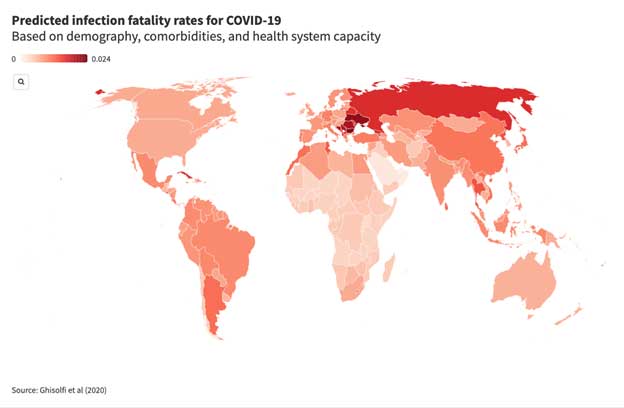
In a new working paper, we attempt to answer one piece of that question, predicting the infection fatality rate, or IFR, for COVID-19 for 187 countries based on demography, comorbidities, and the strength of health systems.

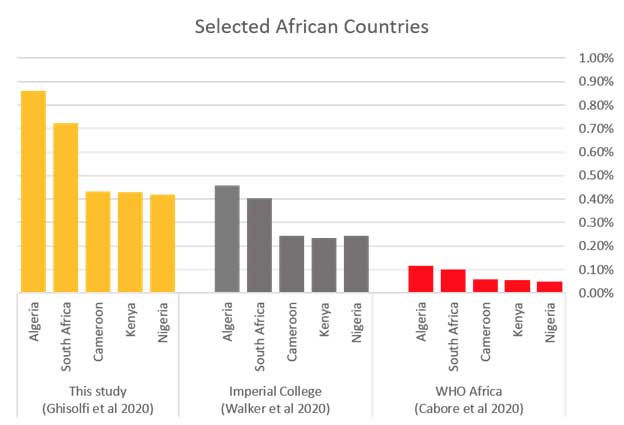
The IFR numbers we report are somewhat higher—sometimes dramatically so—than the figures given for many developing countries in earlier influential studies, including the Imperial College team’s scenarios for the global pandemic and a recent report by the WHO Africa bureau.

That difference can be chalked up to how we incorporate two factors: pre-existing health conditions, and the relative strength of health systems.

For many developing countries, comorbidities partially offset the advantages of youth

A recent study in Science by Salje et al., for instance, finds that with French-level healthcare, the probability of dying with COVID-19 rises roughly eight-fold when moving from the 60-69 age group to the 70 and above range. This is good news for developing countries, which generally have a much younger population than France.

Most previous forecasts of the COVID-19 infection fatality rate have incorporated this demographic advantage. However, they have generally not included the offsetting effect of cross-country differences in comorbidities.

Those comorbidities—such as diabetes, hypertension, and ischemic cardiovascular diseases— matter a lot. Data from Italy show that roughly 96 percent of COVID-19 fatalities report one or more relevant comorbidities.

Inverting that probability using Bayes’ rule and data on France’s IFR and comorbidity distribution, we find that the probability of dying from a COVID-19 infection for patients under 40 is roughly 134-times higher with a relevant comorbidity than without.

Developing countries generally have lower rates of relevant comorbidities compared to high-income countries (where the best measures of infection fatality rates come from). But whereas comorbidities are concentrated among the elderly in rich countries, some developing countries—such as South Africa—report a considerably higher share of these conditions among middle-aged people.

Future work would benefit from more careful treatment of comorbidities like HIV/AIDS that have higher prevalence in lower-income countries. But even a simple adjustment for comorbidities partially undermines many developing countries’ demographic advantages.

Evidence from other viral respiratory infections suggests a much bleaker scenario for COVID-19 in the developing world

So far, our estimates assume that an individual infected with COVID-19 in, say, Uganda has the same probability of dying as someone with the same sex, age, and number of comorbidities in France. Clearly that’s optimistic, given the overall capacity of Uganda’s health system relative to France’s. But exactly how optimistic?

To gauge how much fatality rates might vary with health system capacity, we draw on estimates of the infection fatality rate for another viral respiratory infection, namely influenza. We focus on children under five years old, to purge variation in age and comorbidities that typically begin later in life, and scale the odds ratio of dying from COVID-19 by the ratio of child influenza death rates across countries by income group.

Adjusting for health-system capacity in this way yields COVID-19 infection fatality rates that are considerably higher than previous estimates for the developing world. For the five countries in Sub-Saharan Africa with the largest confirmed COVID-19 epidemics to date, our results are roughly twice as high as those from Imperial College, which does not factor in comorbidities or health system strength beyond a simple capacity constraint on hospital beds.

And they are roughly eight times higher than forecasts from the WHO Africa, which do not adjust for health system capacity and only scale the IFR downward (never upward) due to comorbidities.

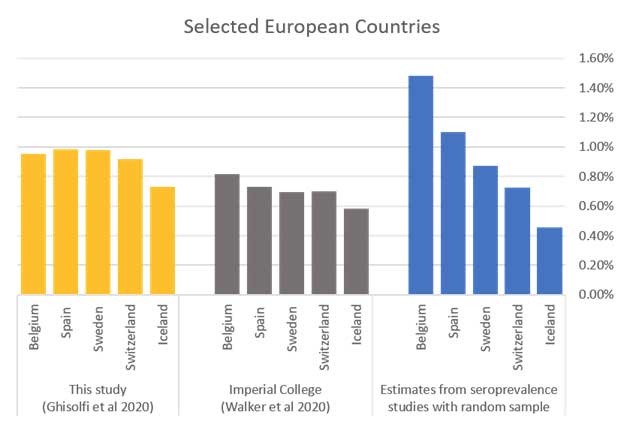
Comparing predicted COVID-19 infection fatality rates across studies

Our results are more in line with the Imperial College predictions for Europe, as shown in the bottom panel above. For the five European countries shown, we can also compare to a more “gold standard” benchmark, i.e., infection fatality rates calculated on the basis of seroprevalence studies of a random sample of the population (blue bars).

Both our results and the Imperial college results match these seroprevalence studies fairly well on average, but fail to explain much of the intra-European variance (some of which may be due to variance in how deaths are counted, e.g., Belgium’s fairly liberal definition of a COVID-19 death to include all unexplained nursing home deaths).

In short, our IFR estimates seem fairly plausible for Europe, where we have an independent reference point, and our results suggest that earlier predictions for developing countries that ignore health system capacity may be far too optimistic.

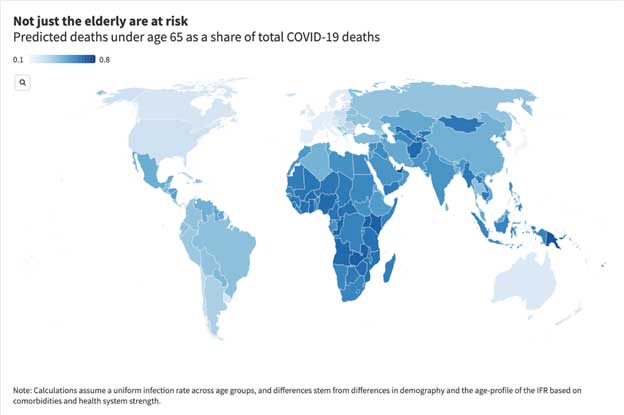
In line with recent news reports, it’s likely young people will make up a larger share of COVID-19 deaths in the developing world

In the United States to date, patients over 75 years old represent over 60 percent of COVID-19 deaths. In Italy, the number of fatalities above 70 is 85 percent.

Both demography and weak health systems explain why COVID-19 deaths are more concentrated among younger people in the developing world

Although predicted IFRs display a steep age gradient in all contexts, due to demographic differences the bulk of deaths in low- and lower-middle income countries is predicted to come from middle-aged patients (40-70).

Less obviously, differences in health system capacity are also likely to flatten the age gradient of COVID-19 deaths in developing countries. In Europe, data is consistent with the hypothesis that intensive care saves the lives of a higher proportion of young than elderly COVID-19 patients. Thus, when high-quality intensive care is lacking, the advantages of youth are more muted.

These estimates are far from the final word on this question. But we hope that our calculations provide an important cautionary note about developing countries’ demographic advantages in facing down COVID-19.

Planning for the ongoing pandemic response and calibration of containment policies should factor in the wide variation in predicted IFRs across contexts. Specifically, policymakers in low-income countries should be cognizant that any demographic advantages with respect to COVID-19 fatality rates are likely to be partially offset by disadvantages in terms of the age-distribution of comorbidities, and even more so by gaps in health system capacity.

*Justin Sandefur is a senior fellow at the Center for Global Development (CGD) ; Selene Ghisolfi is an economics post-doc at the Laboratory for Effective Anti-poverty Policies Bocconi, and a PhD student at the Institute for International Economic Studies, Stockholm University; Ingvild Almås is a professor of economics at the Institute for International Economic Studies, Stockholm University; Tillmann von Carnap is a PhD student at the Institute for International Economic Studies, Stockholm University; Jesse Heitner is a health economist at Aceso Global; and Tessa Bold is an associate professor at the Institute for International Economic Studies, Stockholm University.

  Source