Ode to U.S. Civil Rights Icon Rev. Jesse Jackson Sr: A Life That Carried the Rainbow

Civil Society, Democracy, Featured, Global, Headlines, Human Rights, IPS UN: Inside the Glasshouse, TerraViva United Nations
Opinion

Ode to U.S. Civil Rights Icon Rev. Jesse Jackson Sr: A Life That Carried the Rainbow

Secretary-General Antonio Guterres was saddened to learn of the passing of the Rev. Jesse Jackson, a giant of the civil rights movement in the US and a longtime champion of human rights, equality and justice around the world. Credit: United Nations

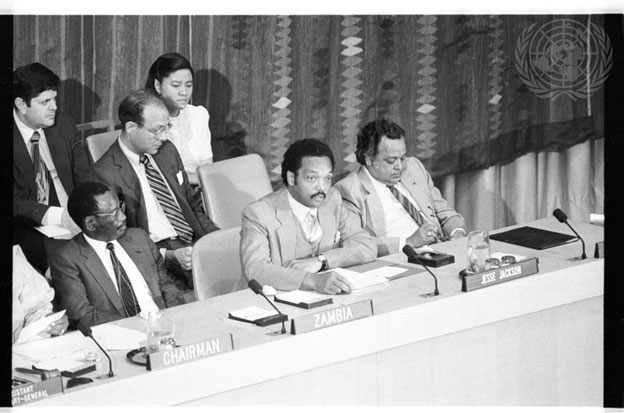
NEW YORK, Feb 20 2026 (IPS) – When the Rev. Jesse Jackson Sr. declared, “Keep hope alive,” it was not a slogan. It was a discipline. It was a moral posture. It was a promise to those America had locked out of its prosperity and pushed to the margins of its democracy. And for more than five decades, Jackson kept that promise – organizing, marching, preaching, negotiating, and standing in solidarity with oppressed peoples at home and abroad.


In mourning Jackson, the United States does not simply bid farewell to a towering civil rights leader. It salutes one of the architects of modern American conscience.

The Heir to a Movement, the Builder of a Coalition

Born in Greenville, South Carolina, in 1941, Jackson came of age in the crucible of segregation. As a young activist, he worked alongside the Rev. Dr. Martin Luther King Jr. and the Southern Christian Leadership Conference, absorbing the lessons of nonviolent resistance while sharpening his own gifts for oratory and mobilization. After King’s assassination in 1968, Jackson did not retreat into despair. He stepped forward.

In 1971, he founded Operation PUSH (People United to Save Humanity), later merging it into the Rainbow Coalition. That phrase – Rainbow Coalition – was not rhetorical flourish. It was strategic genius. Jackson understood that America’s power structure thrived on division: Black against white, native-born against immigrant, worker against worker. His coalition sought to transcend those fault lines.

Black, brown, yellow, and poor white Americans; labor unions; family farmers; peace activists; Arab Americans; Jewish progressives; Asian Americans; Latinos; Native Americans—Jackson invited them all into a shared moral project. In the 1980s, when he ran for the Democratic presidential nomination in 1984 and 1988, millions who had never seen themselves reflected in presidential politics suddenly felt visible. He did not win the presidency. But he expanded the boundaries of who could plausibly seek it.

In doing so, Jackson helped pave the road that others would travel – most notably Barack Obama who went on to become the first African American President of the United States of America. Without the Rainbow Coalition, the arc of American political inclusion would have bent far more slowly.

Internationalism as Moral Imperative

Jackson’s courage was not confined to domestic battles. At a time when Cold War orthodoxy and Middle East politics discouraged nuance and punished dissent, he insisted that American moral credibility required consistency.

He extended solidarity to the oppressed people of Palestine long before it was politically fashionable – or safe – to do so. Jackson argued that the dignity and rights of Palestinians were inseparable from the universal principles Americans claimed to cherish. He sought dialogue with leaders across divides, believing that empathy was not endorsement, and that engagement was a prerequisite for peace.

He was equally forthright in condemning South Africa’s apartheid regime. While many U.S. leaders hedged or prioritized strategic interests, Jackson stood with the anti-apartheid movement. He supported sanctions and economic pressure to dismantle a system that codified racial subjugation. When Nelson Mandela emerged from 27 years of imprisonment, Jackson was among those who celebrated not only a man’s freedom but a nation’s rebirth.

In both Palestine and South Africa, Jackson’s stance reflected a deeper conviction: that civil rights were not an American export but a universal birthright. His faith demanded it. His politics operationalized it.

Faith, Integrity, and the Politics of Presence

Jackson was first and always a preacher. His sermons were political, but his politics were pastoral. He believed that despair was the greatest ally of injustice. To tell the forgotten that they mattered was itself an act of resistance.

He traveled where others would not. He negotiated for the release of hostages in Syria and Cuba. He met with heads of state and with families in housing projects. He listened.

Critics sometimes accused him of courting controversy or of grandstanding. But Jackson understood a hard truth: marginalized communities often need someone willing to occupy uncomfortable space on their behalf. Silence, in his view, was complicity.

His life was not without flaws or missteps. No life of consequence is. Yet what distinguished Jackson was his refusal to abandon the struggle. He endured political setbacks, media caricatures, and internal party resistance. He persisted.

Leadership, he demonstrated, is not about perfection. It is about fidelity—to principles, to people, to purpose.

The Rainbow as a Democratic Blueprint

In an era increasingly defined by polarization, Jackson’s Rainbow Coalition reads less like a relic of the 1980s and more like a blueprint for democratic survival. He recognized demographic change not as a threat but as a promise. He saw in America’s diversity the possibility of moral and economic renewal.

He championed voting rights, labor protections, public education, and economic justice. He opposed apartheid abroad and discrimination at home. He insisted that foreign policy reflect domestic values and that domestic policy reckon with global inequality.

The Rainbow was not naïve about power. It was strategic. It sought to translate moral energy into electoral leverage. Jackson registered voters. He built grassroots networks. He forced party platforms to incorporate issues once dismissed as fringe.

His presidential campaigns altered the calculus of American politics. They demonstrated that Black candidates could compete nationally, that poor and working-class voters could be mobilized across racial lines, and that progressive foreign policy positions had a constituency.

A Hand Extended Across Divides

Perhaps Jackson’s most underappreciated gift was his willingness to extend a hand of friendship where animosity seemed entrenched. He believed in meeting adversaries face-to-face. He believed that even hardened systems could yield to persistent moral pressure.

In Palestine, Rev. Jesse Jackson Senior spoke of human rights and mutual recognition. In South Africa, he, spoke of freedom and reconciliation. At home, he, spoke of multiracial democracy.

When few American leaders dared to articulate solidarity with Palestinians living under occupation, Jackson did. When Washington’s establishment hesitated to confront Pretoria’s apartheid regime, Jackson did not. His courage was not abstract. It was embodied in travel, in speeches, in alliances, in risks taken.

He paid political costs for these positions. But he did not recalibrate his convictions to suit prevailing winds.

The Best of the United States

To commemorate Jesse Jackson is to acknowledge the paradox of America itself. He emerged from a nation scarred by slavery and segregation, yet he believed in its redemptive capacity. He criticized its failures unsparingly, yet he invested his life in its institutions.

He was, in that sense, profoundly patriotic.

The United States at its best is not defined by military might or economic dominance. It is defined by its capacity for self-correction. By its willingness to expand the circle of belonging. By its recognition that justice delayed is democracy diminished.

Jackson embodied that tradition. He did not romanticize America. He challenged it. He called it to live up to its founding ideals – not selectively, but universally.

As debates rage today over voting rights, racial equity, immigration, Middle East policy, and America’s global role, Jackson’s life offers a moral compass. He reminds us that coalitions are built, not assumed. That solidarity is practiced, not proclaimed. That hope is sustained through organization.

Keeping Hope Alive

In the final analysis, Jesse Jackson’s greatest achievement may have been psychological. He taught millions that their voices mattered. That they were not condemned to permanent marginalization. That politics could be an instrument of empowerment rather than exclusion.

For Black Americans who had never seen a serious presidential bid from one of their own, he opened a door. For Palestinians seeking recognition of their humanity, he offered validation. For South Africans resisting apartheid, he offered solidarity. For workers, immigrants, and the poor, he offered a coalition.

He lived the conviction that the struggle for justice is indivisible.

Today, as the rainbow he envisioned faces new storms, the measure of our tribute will not be in words but in action. To honor Jesse Jackson is to organize. To vote. To speak. To stand with the oppressed – whether in Chicago, Johannesburg, or Gaza. To build alliances across lines others insist are permanent.

He demonstrated that leadership grounded in faith, integrity, and courage can alter a nation’s trajectory. He showed that America’s story is not finished – and that its best chapters are written by those who refuse to surrender to cynicism.

Rev. Jesse Jackson Sr. kept hope alive.

The question now is whether we will.

Purnaka L. de Silva, Ph.D., is College and University Adjunct Professor of the Year 2022, Best Adjunct Professor 2024-2025 and Nominated Best Adjunct Professor 2026 at the School of Diplomacy and International Relations Seton Hall University; Visiting Professor Sol Plaatje University Faculty of Humanities; Director Institute of Strategic Studies and Democracy (ISSD) Malta; and Strategic Advisor Lead Integrity.

IPS UN Bureau
  Source

International Humanitarian Law is at Breaking Point – but not Beyond Repair

Armed Conflicts, Civil Society, Crime & Justice, Democracy, Global, Headlines, Human Rights, IPS UN: Inside the Glasshouse, TerraViva United Nations

Opinion

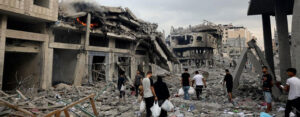
Credit: UNICEF/Eyad El Baba

 
What is international humanitarian law? Families flee their shattered homes in Tal al-Hawa neighbourhood in Gaza city. While aid workers serving conflict-affected civilian populations depend on a set of laws to protect them, some warring parties violate these global agreements, from targeting hospitals and schools to blocking aid workers from reaching civilians with lifesaving goods and services. Source: UN News

GENEVA, Feb 17 2026 (IPS) – International humanitarian law is at a breaking point, as rampant impunity for serious violations is enabling even greater abuses against civilians and detainees.


Across today’s wars, violations are no longer concealed or exceptional. They are increasingly open, systematic, and unpunished, with catastrophic consequences for those whom the law is supposed to protect.

New analysis of 23 situations of armed conflict between July 2024 and the end of 2025 reveals a consistent pattern: civilians are being killed, abused and starved at scale, while accountability mechanisms either falter or are actively undermined. Genocidal violence in Gaza, a renewed risk of genocide in Sudan, and mass atrocities elsewhere are not isolated horrors. Taken together, they point to a deeper failure – the collapse of meaningful restraint in the conduct of hostilities.

Conflict-related sexual violence has reached epidemic levels. Rape, sexual slavery, and sexual violence used as punishment or as a tool of territorial control have been documented across multiple conflicts, including in Colombia, the Democratic Republic of Congo, Myanmar, and Sudan. Particularly alarming is the growing number of cases involving attacks children, including victims as young as one.

These are not by-products of war, but violations long prohibited under international humanitarian law, now committed with near-total impunity. This occurs with the complicity of many other States, which have a duty to respect and ensure respect international humanitarian law.

This erosion of civilian protection is not primarily the result of gaps in legal knowledge. The rules exist. The problem is political choice – and a persistent failure to enforce, clarify and update the law where it no longer offers meaningful restraint.

Nowhere is this clearer than in the global arms trade. The United Nations Arms Trade Treaty has been widely ratified, including by major exporters such as China, France, and the United Kingdom. In theory, it requires its member States to deny arms transfers where there is a clear risk that weapons will be used to commit serious violations of international law. In practice, legal risk assessments are all too often overridden by strategic and political considerations.

Continued arms exports to Israel, Russia, and others, despite overwhelming evidence of civilian harm, have had devastating consequences on the ground.

Closing this gap does not require a raft of new rules in the short term. It requires the consistent application of existing ones: enforceable, evidence-based export controls; independent scrutiny of licensing decisions; and real accountability where transfers are authorised despite a clear risk that the law will be breached by the recipient.

Certain categories of weapons are though incompatible with the protection of civilians, but do not necessarily violate the already permissive standards. Repeated firing into populated areas of gravity ordnance from the air and inaccurate long-range artillery from the ground has been a major driver of civilian casualties across multiple conflicts.

There is a fundamental lack of clarity on two key rules: first, how close an attack may be launched to a military target while still complying with the law; and second, how much incidental civilian harm is permissible when targeting a military objective.

On both issues, the law urgently requires clarification. Restricting air-delivered weapons to precision-guided munitions alone would already make a measurable difference to civilian survival. Achieving this, however, requires States to clarify and update the rules of international humanitarian law that were drafted in the 1970s.

In State-on-State conflicts such as in Kherson province in Ukraine, drones have been used by Russian forces – and others – to target civilians, sometimes with real-time video footage disseminated online by the perpetrators.

At the same time, armed drones are no longer the preserve of States. Their use by non-State armed groups is increasing rapidly, including by JNIM in the Sahel, Islamic State in Somalia, and the Arakan Army in Myanmar. There is an urgent need for stronger mechanisms to attribute, investigate, and prosecute unlawful drone and autonomous weapon attacks.

Impunity on this scale is not inevitable. It is the product of sustained political and financial neglect. Institutions designed to promote compliance with international humanitarian law – including domestic courts and international tribunals – are under severe strain, with some facing paralysis or closure due to lack of resources.

Judges at bodies such as the International Criminal Court have even been sanctioned simply for carrying out their mandates. If States are serious about protecting civilians, political and financial support for these institutions must be treated as a core obligation and a policy priority, not an optional gesture.

The current moment represents a critical test for international humanitarian law itself. The international lawyer Hersch Lauterpacht once warned that the law existed at the “vanishing point” of international law. That warning is no longer theoretical.

Whether humanitarian law continues to function as a real constraint on warfare, or recedes into symbolic rhetoric, will depend on the political choices states make now – and on whether civilian protection is treated as a legal duty rather than a discretionary one.

Stuart Casey-Maslen is an international lawyer and lead author of War Watch: International Humanitarian Law in Focus at the Geneva Academy of International Humanitarian Law and Human Rights

IPS UN Bureau

  Source

The Veto May be the Weapon of Elimination in the Election of Next UN Chief

Civil Society, Featured, Global, Global Governance, Headlines, IPS UN: Inside the Glasshouse, TerraViva United Nations

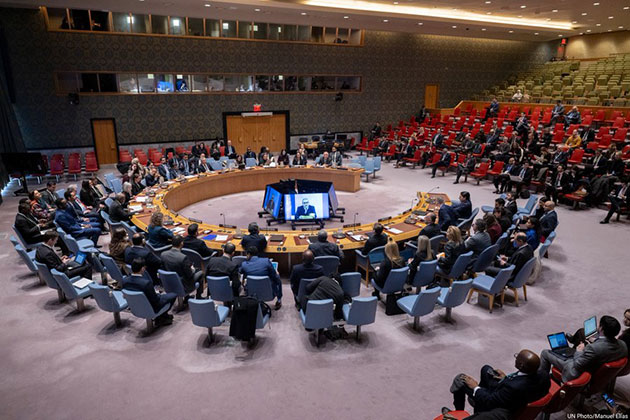
The Security Council armed with veto powers. Credit: UN Photo/Manuel Elías

UNITED NATIONS, Feb 17 2026 (IPS) – As the campaign for the next Secretary-General gathers momentum – at a relatively slow pace – there is widespread speculation that any candidate running for the post of UN chief will have to abide by the dictates of a politically hostile White House or face a veto in the Security Council.


So far, there are only two declared candidates: former Chilean President Michelle Bachelet and former Director-General of the International Atomic Energy Agency (IAEA) Rafael Grossi from Argentina—with more candidates expected to join the race.

The winning candidate, who will take office in January 2027, will be elected by the 15-member Security Council and subsequently ratified by the 193-member General Assembly (UNGA).

Annalena Baerbock, the president of UNGA, said the selection process is already underway, and the interactive dialogues with candidates have been scheduled for the week of 20 April, where they will present their “vision statements”.

Meanwhile, the US has publicly declared its opposition to some of the basic goals in the UN’s socio-economic agenda, including gender empowerment and policies relating to diversity, equity and inclusion (DEI), while dismissing climate change as “a hoax” and a “giant scam.”
The Trump administration has also downplayed human rights and adherence to international laws—two concepts ingrained in the UN system.

In an interview with the New York Times last January, President Trump said he does not “need international law” to guide his actions, arguing that only his own “morality” and “mind” will constrain his global powers.

So, what would be the fate of any candidate— male or female—who advocates these UN goals? Will there be a battle of the vetoes – as it happened in a bygone era?

Richard Gowan, Program Director, Global Issues and Institutions, International Crisis Group (ICG), who oversees ICG’s work on geopolitics, global trends in conflict and multilateralism, told IPS nobody knows how this race will end.

Obviously UN-watchers will be tracking the initial candidates’ vision statements and public appearances over the coming months, he pointed out.

“But diplomats in New York have a suspicion that the veto powers in the Security Council may suddenly announce support for a new candidate at the last minute to circumvent the entire public process. There is a strong sense that the U.S., China and Russia don’t want to be boxed in by the General Assembly.”

There is also a scenario, he said, where the veto powers cannot agree on a candidate, and the Council ends up grinding out discussions of a candidate right through to December.

“UN officials have even done some contingency planning for what happens if there is not an agreed candidate on 1 January 2027. It is possible that the Security Council might ask Guterres to hang on for a few months, although I don’t think either diplomats or Guterres want that outcome.”

There are definitely a few senior UN officials and ambassadors in New York who wonder if the Council could call on them at the very last minute, said Gowan.

Thomas G. Weiss, Presidential Professor Emeritus, Political Science, and Director Emeritus, Ralph Bunche Institute for International Studies at the CUNY Graduate Center, told IPS it is hard to imagine anyone running for UNSG who would not run into a veto from Washington in a candidacy necessarily addressing the values of cooperation (multilateralism of any shape) as well as honestly discussing such issues as climate, gender (male or female), nuclear proliferation, Palestine, and sovereignty—all “hoaxes” or “con jobs” according to DJT (President Trump) and his junta.

Both the 1996 and 1981 elections, he said, provide “models.”

“The Chinese vetoes probably are the most relevant precedent for Washington going to the mat indefinitely until an “acceptable” candidate emerges. Let’s hope that person is as competent as the compromise of 1996, Kofi Annan”, he declared.

In 1981, Salim Ahmed Salim of Tanzania, was backed by the Organization of African Unity, the Non-Aligned Movement and China. But his bid was blocked by a US veto.

In 1996, a second five-year term for Boutros Boutros-Ghali of Egypt was vetoed by the US – even though he received the support of 14 of 15 members in the Security Council.

In 1981, China cast a record 16 vetoes against Kurt Waldheim to prevent a third term, leading to his withdrawal and the selection of Javier Pérez de Cuéllar.

Meanwhile, there has been an intense campaign for a female UN chief, the first in the 81-year history of the UN. But the US has remained tight-lipped on the widely supported proposal.

The last 9 secretaries-general, all males, include:

António Guterres (Portugal), who took office in January 2017;
Ban Ki-moon (Republic of Korea), from January 2007 to December 2016;
Kofi A. Annan (Ghana), January 1997 to December 2006;
Boutros Boutros-Ghali (Egypt), January 1992 to December 1996;
Javier Pérez de Cuéllar (Peru), January 1982 to December 1991;
Kurt Waldheim (Austria), January 1972 to December 1981;
U Thant (Burma, now Myanmar), who served from November 1961, when he was appointed acting Secretary-General (he was formally appointed Secretary-General in November 1962), to December 1971;
Dag Hammarskjöld (Sweden), from April 1953 until his death in a plane crash in Africa in September 1961; and
Trygve Lie (Norway), who held office from February 1946 to his resignation in November 1952.

As for the U.S., said Gowan, “I don’t believe that Washington has settled on a candidate yet. But the Trump administration is definitely conscious that they have the power to reshape the political culture of the organization if they find someone who aligns with their views”.

He said U.S. diplomats have told other veto powers that they will hold back on various reform proposals and cuts until they have their own candidate as Secretary-General.

A lot of UN members assume that the U.S. won’t accept a female Secretary-General but I think that Washington could back a woman if she was a strong social conservative and willing to make large cuts to the UN system, he argued.

“Right now, there is not an obvious female candidate meeting those criteria, though. I think some candidates who could never align with the U.S. on things like development and diversity are already stepping out of the race.”

Meanwhile, there is a reason that Mia Mottley has gone from being the putative front runner to refocusing on domestic politics.

“I also think that all candidates recognize that they are going to have to talk a lot more about how they will advance the UN’s work on peace and security, which is a priority not only for the U.S. but a lot of member states.”

“That said, one senior UN diplomat recently told me that they cannot see Global South countries accepting another Western candidate after Guterres, regardless of gender. The non-Western members of the Security Council could create a blocking minority in the Security Council to keep candidates from U.S. allies out,” declared Gowan.

IPS UN Bureau Report

  Source

UN Human Rights Office Launches USD 400 million Appeal to Address Global Human Rights Needs

Civil Society, Democracy, Global, Headlines, Human Rights, IPS UN: Inside the Glasshouse, TerraViva United Nations

Opinion

UN Human Rights Office Launches USD 400 million Appeal to Address Global Human Rights Needs

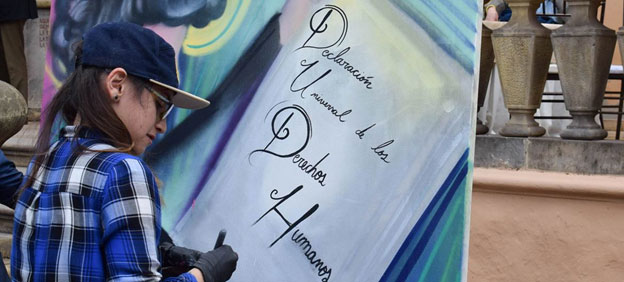
An artist in Colombia draws an image of the Universal Declaration of Human Rights. Credit: UN Colombia/Jose Rios Source: UN News

GENEVA, Feb 6 2026 (IPS) – The UN High Commissioner for Human Rights Volker Türk has launched a USD 400 million funding appeal for 2026 to address global human rights needs, warning that with mounting crises, the world cannot afford a human rights system in crisis.


“The cost of our work is low; the human cost of underinvestment is immeasurable,” Türk told States at the launch. “In times of conflict and in times of peace, we are a lifeline for the abused, a megaphone for the silenced, a steadfast ally to those who risk everything to defend the rights of others.”

In 2025, staff working for the UN Human Rights Office in 87 countries observed more than 1,300 trials, supported 67,000 survivors of torture, documented tens of thousands of human rights violations, and contributed to the release of more than 4,000 people from arbitrary detention.

Türk also stressed that addressing inequalities and respecting economic and social rights are vital to peace and stability. “Human rights make economies work for everyone, rather than deepening exclusion and breeding instability,” he said.

The Office in 2025 worked with more than 35 governments on the human rights economy, which aims to align all economic policies with human rights. For example, in Djibouti, it helped conduct a human rights analysis of the health budget, with a focus on people with disabilities. It provided critical human rights analysis to numerous UN Country Teams working on sustainable development.

Türk outlined several consequences of reduced funding in 2025. For instance, the Office conducted only 5,000 human rights monitoring missions, a decrease from 11,000 in 2024. The Office’s programme in Myanmar suffered cuts of more than 60 percent. In Honduras, support for demilitarisation of the prison system and for justice and security sector reforms was reduced. In Chad, advocacy and support for nearly 600 detainees held without legal basis had to be discontinued.

“Our reporting provides credible information on atrocities and human rights trends at a time when truth is being eroded by disinformation and censorship. It informs deliberations both in the UN Security Council and the Human Rights Council, and is widely cited by international courts, providing critical evidence for accountability,” he said.

The liquidity crisis of the regular budget also significantly affected the work of the broader human rights ecosystem. For instance, 35 scheduled State party dialogues by UN Human Rights Treaty Bodies could not take place.

Four out of eight planned country visits by the Sub-Committee on Prevention of Torture had to be cancelled. UN Special Rapporteurs’ ability to carry out country visits was curtailed, and the Human Rights Council’s investigative bodies were unable to fulfil their mandates fully.

The UN Human Rights Chief also regretted that the Office lost approximately 300 staff out of a total of 2,000 and was forced to close or radically reduce its presence in 17 countries, erasing entire programmes critical for endangered, threatened, or marginalised communities, from Colombia and Guinea-Bissau to Tajikistan.

“All this is weakening our ‘Protection by Presence’ – a simple idea with powerful impact: that the physical presence of trained human rights officers on the ground deters violations and reduces harm,” Türk said.

In 2025, the Office’s approved regular budget was USD 246 million, but it received only USD 191.5 million, resulting in a USD 54.5 million shortfall. It had also requested USD 500 million in voluntary contributions and received only USD 257.8 million.

The UN Human Rights Chief thanked the 113 funding partners – Governments, multilateral donors, private entities, among others – who contributed to the 2025 budget and helped save and improve lives.

For 2026, the UN General Assembly has approved a regular budget of USD 224.3 million, which is based on assessed contributions from Member States. This amount is 10 per cent lower than in 2025, and further uncertainty remains about the actual amount the Office will receive due to the liquidity crisis the UN is facing.

Through its 2026 Appeal, the Office is requesting an additional USD 400 million in voluntary contributions.

“Historically, human rights account for an extremely small portion of all UN spending. We need to step up support for this low-cost, high-impact work that helps stabilise communities, builds trust in institutions, and supports lasting peace,” the High Commissioner said.

“And we need more unearmarked and timely contributions so we can respond quickly, as human rights cannot wait.”

IPS UN Bureau

  Source

Is it the Budgetary Crisis – Or Leadership Crisis – Facing the United Nations – Or Both?

Civil Society, Democracy, Global, Headlines, Human Rights, IPS UN: Inside the Glasshouse, TerraViva United Nations

Opinion

NEW YORK, Feb 3 2026 (IPS) – In the month of February 2025, one year ago, United Nations Secretary-General Antonio Guterres commenced his briefing of the media by announcing that “I want to start by expressing my deep concern about information received in the last 48 hours by UN agencies — as well as many humanitarian and development NGOs — regarding severe cuts in funding by the United States.” He went on to warn that ““The consequences will be especially devastating for vulnerable people around the world.”


Is it the Budgetary Crisis – Or Leadership Crisis – Facing the United Nations – Or Both?

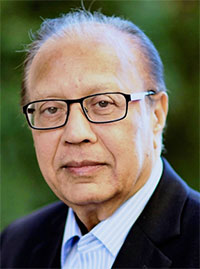
Anwarul K. Chowdhury

UN80 Initiative – Reform or Pressure?

That budgetary crisis was attempted to be put off by launching the anniversary-rationaled and liquidity-crunch-panic-driven, window-dressing reform agenda – the so-called UN80 Initiative. These long overdue structural and programmatic reforms of the UN system have been on the agenda of at least for the last four Secretaries-General but without having much significant impact, except acronym-changing, mandate-creeping and structure-tweaking, and now these days, staff-relocating.

An Alarm Bell for Financial Collapse

End of this January again the Secretary-General said in a letter to all UN Member States that cash for its regular operating budget could run out by July, which could dramatically affect its operations. He also called on the to fundamentally overhaul the UN’s financial rules to prevent an “imminent financial collapse”.

Why now ask the member states to do something concrete? Why not in February 2025 when he sounded the alarm himself?

It reminds me of the somewhat similar Aesop’s fable about boy who cried wolf.

Lamenting Limited Power – No Power, No Money

In the past, Secretary-General Guterres lamented to the media asserting that “… it is absolutely true that the Secretary-General of the United Nations has very limited power, and it’s also absolutely true that he has very little capacity to mobilize financial resources. So, no power and no money.”

That is the reality which every Secretary-General faces and has been aware of. That is also known generally to the people who follow the United Nations regularly and thoroughly understand the functional complexity of the world’s largest multilateral apparatus.

Why then does this reality surfaces and brought to public attention only when the UN leadership fails to carry out the mandated responsibilities?

I believe strongly that this “very limited power”, as worded by SG Guterres, should be highlighted as often as possible to avoid unnecessary and undue expectations of the global community about the UN and its top leadership. No Secretary-General has pointed out these limitations as he campaigned for the post and on assuming the office, as far as I know.

Current SG Guterres is no exception. He would have been realistic and factual if he had pointed out the limitations – better termed as obstacles – to his leadership as he took office in 2017, and not in 2026 after being in office for nearly nine years. This built-in operational weakness and inability of the world’s most important diplomat have always been there.

Controlling Or Quitting?

Some people speculate that the US is using its financial clout and pressure to threaten the collapse of the UN.

The US has always been using its huge power of veto and almost one-fourth of the budgetary contributions to the operations of the UN system. That is a reality which should be kept in mind by the leadership of the UN and its Member States, unless the Charter of the UN is changed to create a more democratic organization in the true sense.

For a long time, the US has used the part payment arrangements for its legally due contributions, with full understanding and acceptance of the Secretary-General, so that it can avoid losing its voting power and get its own pound of flesh each time such instalment payments are made.

I believe the US wants to use the world body in its own way by controlling, not quitting.

A Woman at the Helm for The UN

In this context, let me reiterate that after eight decades of its existence and choosing nine men successively to be the world’s topmost diplomat, it is incumbent on the United Nations to have the sanity and sagacity of electing a woman as the next Secretary-General in 2026 when the incumbent’s successor would be chosen.

There is a need for creative, non-bureaucratic and pro-active leadership initiative for a real change to ensure avoidance of “crying wolf” syndrome disrupting the work and activities of the most universal multilateral body with the mandate for working in the best interest of humanity.

Ambassador Anwarul K. Chowdhury is a former UN Under-Secretary-General, one-time Permanent Representative of Bangladesh to the United Nations, Chairman of the UN General Assembly’s Administrative and Budgetary Committee (1997-1998), former Senior Special Adviser to UN General Assembly President (2011-2012) and President of the UN Security Council (2000 and 2001) and a two-term Vice Chairman of the all-powerful UN Committee on Programme and Coordination (1984-85).

IPS UN Bureau

  Source

Do Resources Define the Parameters of Faith-based Engagement and Diplomacy Today?

Civil Society, Featured, Global, Global Governance, Headlines, International Justice, IPS UN: Inside the Glasshouse, Religion, TerraViva United Nations

Opinion

Do Resources Define the Parameters of Faith-based Engagement and Diplomacy Today?

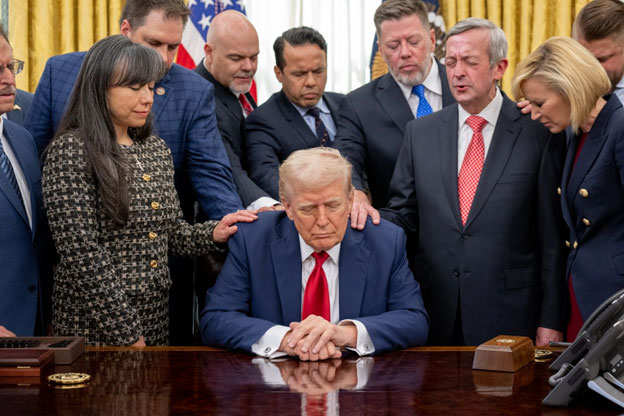
President Donald Trump Joins Faith Leaders in Prayer – Credit: The White House

 
According to the UN, Sunday marked the start of World Interfaith Harmony Week, a time to emphasize that mutual understanding and interreligious dialogue are essential to building a culture of peace. The week was established to promote harmony among all people, regardless of their faith.

NEW YORK, Feb 2 2026 (IPS) – Several events, meetings, consultations, initiatives, etc. taking place among faith-inspired, ‘faith-based’ and a variety of other similar efforts, over the past year, in the United States especially, concern me.


Coming from a background of human rights, international development, and humanitarian service, I have witnessed the arc of ‘none’ to increasing interest by Western governments in ‘religion’ – religious engagement, religion and development, religion and foreign policy, religious freedom, religious peacebuilding, or religion and peace, and more, including even religion and agriculture. Basically, religion and everything.

Non-Western governments within Africa and Asia, including areas overlapping with what we call (variably) “the Middle East”, have long been interested, and indeed actively engaging religious leaders and religious institutions.

As many scholars, observers, and foreign policy pundits have noted, the interest of such governments has often transcended any genuine fascination with faith, towards rather obvious instrumentalization of religious leaders, religious organisations and religious groups, in support of specific political agendas (e.g., making peace with Israel, legitimacy of corrupt – and violent – politically repressive leaders and regimes, etc.).

In fact, the marriage between select religious leaders/institutions/groups and some political actors goes back to the empires we have inherited pre-Westphalian states).

I recall some stories from my time serving as a staff member at the United Nations, and in other international fora. The first story revolves around one Arab and one Indian diplomat speaking with a European counterpart, during one of several UN Strategic Learning Exchanges on Religion, Development and Diplomacy, which I coordinated and facilitated, this one in 2014.

The discussion concerned how best to “benefit” from working with religious leaders to affirm a message of certain political parties, especially, albeit not only, around elections. The Arab patted the European on the back and said, with a smile and a wink: “you are finally catching up on how to use these religious leaders – congratulations my friend”. The Indian one, looking bemused, added “Yes. And be careful”.

Another story concerns another meeting I organised – in one of the basement meeting rooms of the UN – between UN officials and a diverse array of religious actors, around peace and mediation efforts, in select African and Asian conflict settings, early 2015.

A European Christian religious leader of a renowned multi-religious organisation made an intervention to address the concerns about “instrumentalization” of religious actors, which some faith-based NGO leaders were articulating.

While some faith representatives cautioned against religious actors being used to “rubber stamp decisions already made by governments and some intergovernmental organisations” (in the room were both UN and EU officials), this particular Western Christian religious leader spoke up and said, “I am not worried about that at all, in fact, I would like to say to my secular colleagues in this room, please use us… we can certainly benefit you… we are not common civil society actors, our mission makes us exceptional”.

My last story, is from my time serving as the secretary general of an international multireligious organisation which convenes religious leaders from diverse religious institutions around “deeply held and widely shared values”.

As soon as I became a member of the UN Secretary-General’s High Level Advisory Board on Effective Multilateralism, I arranged a meeting between some of my multi-religious Board members (religious leaders), and some members of this high Level UN SG’s Advisory Board.

The idea was to nurture a quiet but candid dialogue between pollical and religious leaders, around why and how multilateralism can be significantly strengthened by multireligious engagement.

I hasten to note that multireligious engagement, if served well, can be – as I have written and persistently argued – resistant to instrumentalization of select religious actors to serve any one particular governmental agenda. The latter is a feature I warn against, and small wonder, given developments from India to the United States, from Russia to Israel, and beyond.

Once again, I heard a religious leader invite the members of the SG’s Board to “use” their (religious) wisdom because of their “exceptional” mission (presumably the godly one). This time, later reflection among members of the UN SG Board led to noting that such multireligious engagement would be inadvisable, due to a concern about “Muslims” involved in such multireligious spaces.

Fast forward to 2026, one year after an increasingly belligerent US Presidential Administration’s record, which includes relatively ‘minor’ policy decisions such as transforming the name of the Ministry of Defence to the “Ministry of War”. And not so minor human rights abuses of citizens and immigrants, and some pointing to manipulation and outright disregard of the rule of law, both at home and abroad (I hope this is polite enough wording). Of course one dares not mention support to certain genocidal regimes killing thousands in the name of self-protection.

In this environment, I listen to conversations among some of the United States’ most esteemed faith-based organisations, all with a remarkable track record of serving humanity in all corners of the world. Who, apparently, are seeking to engage this Administration “constructively”, with some praising the “unprecedented” outreach of members of this Administration in engaging, largely (some would say exclusively), with certain Christian NGOs, certain Christian religious leaders, and certain Christian faith protagonists – no doubt to further noble objectives. Apparently, this is a form of strategic engagement of/with religion.

Even though there were likely some who felt uncomfortable with aspects of this rhetoric, the studiously diplomatic silences – including my own – about challenging anything said, was noteworthy. The bottom line is, “we need access to the White House… we need more resources to do our (good) work”.

Why was I silent? Because I am the quintessential ‘other’ whose outspokenness has already earned me the loss of a sense of ‘home’ and security, many times over. This is neither excuse nor justification, rather, an acknowledgement of cowardice.

Into this Kafkaesque reality, let me ask a few questions I am battling with: what will it take to speak truth to power publicly – the way Minnesotans and Palestinians are having to do with their own regimes? Is it strategic to be silent, or such consummate diplomats, especially when we work in the name of the ‘godly’ – being such “exceptional” actors?

Conversely, is this Administration which we endeavour to be so tactful with, being silent about it’s “divine mission”? Is being “nice and essentially a kind person with their heart in the right place”, and doing godly work, a good reason to work with those who are serving regimes which ignore the rule of law in their own nation and abroad? Does faith-based diplomacy mean we either collude, remain silent, or take the struggle to the streets?

If so, what difference is faith-based diplomacy and engagement actually making to civic engagement, to honoring human rights and the rule of law, or to serving principled leadership? Or do these simply not matter since it is the self-interests of the ruling and rich few, are what matters to determine the integrity of life, planet and leadership?

Perhaps we should ponder the advice of the Indian Diplomat, given to his Western counterpart 22 years ago: how can we “be careful”?

Professor Azza Karam serves as President of Lead Integrity; and Director of the Kahane UN Program, for Occidental College’s Diplomacy and World Affairs.

IPS UN Bureau

  Source