The UN is Being Undermined by the ‘Law of the Jungle’

Armed Conflicts, Civil Society, Crime & Justice, Democracy, Featured, Global, Headlines, Human Rights, IPS UN: Inside the Glasshouse, TerraViva United Nations
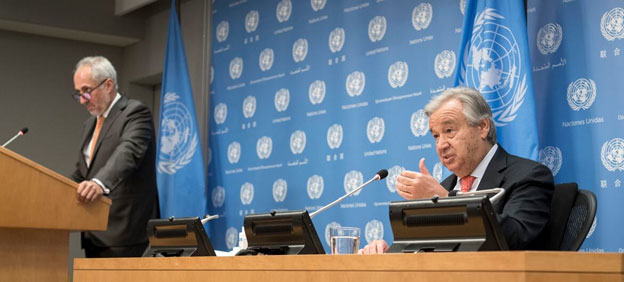
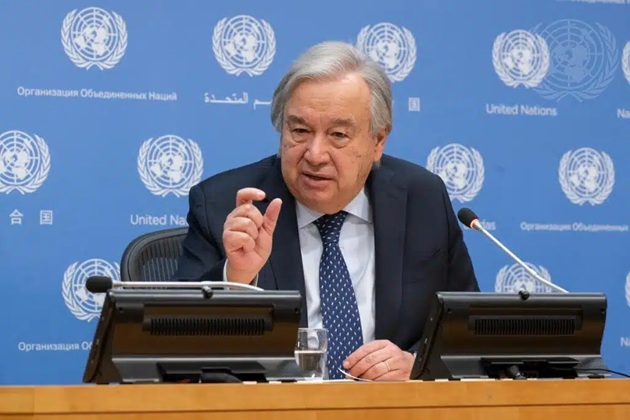
UN Secretary-General António Guterres (seated at right) speaks to reporters at a press conference at UN Headquarters, in New York. UN Photo/Mark Garten

UNITED NATIONS, Jan 30 2026 (IPS) – UN Secretary-General Antonio Guterres was dead on target when he told the Security Council last week that the rule of law worldwide is being replaced by the law of the jungle.

“We see flagrant violations of international law and brazen disregard for the UN Charter. From Gaza to Ukraine, and around the world, the rule of law is being treated as an à la carte menu,” he pointed out, as mass killings continue.


“The New York Times on January 28 quoted a recent study pointing out the four-year war between Russia and Ukraine has resulted in over “two million killed, wounded or missing”. The study published last week by the Center for Strategic and International Studies in Washington says nearly 1.2 million Russian troops and close to 600,000 Ukrainian troops have been killed, wounded or are missing.

In the war in Gaza, over 70,000 Palestinians, mostly civilians, including women and children, have been killed since October 7, 2023, with figures reaching over 73,600 by early January 2026, according to various reports from the Gaza Health Ministry and human rights organizations.

These killings have also triggered charges of war crimes, genocide and violations of the UN charter, as in the US invasion of Venezuela and the takeover threats against Greenland.

Guterres said in an era crowded with initiatives, the Security Council stands alone in its Charter-mandated authority to act on behalf of all 193 Member States on questions of peace and security. The Security Council alone adopts decisions binding on all.

No other body or ad hoc coalition can legally require all Member States to comply with decisions on peace and security. Only the Security Council can authorize the use of force under international law, as set out in the Charter. Its responsibility is singular. Its obligation is universal, declared Guterres.

Dr Ramzy Baroud, Editor of Palestine Chronicle and former Managing Editor of the London-based Middle East Eye, told IPS the statement by the Secretary-General is long overdue.

Too often, he said, UN officials resort to cautious, euphemistic language when describing egregious violations of international law—especially when those responsible are UN Security Council veto holders, states that have ostensibly sworn to uphold the UN Charter and the core mission of the international system.

Unfortunately, the UN itself has become a reflection of a rapidly shifting world order—one in which those with overwhelming military power sit at the top of the hierarchy, abusing their dominance while steadily hollowing out the very institutions meant to restrain them, he pointed out.

“We must be honest with ourselves and acknowledge that this crisis did not begin with the increasingly authoritarian misuse of law by the Trump administration, nor is it limited to Israel’s absolute disregard for the international community during its two-year-long genocide in Gaza.”

The problem is structural. It is rooted in the way Western powers have long identified—and exploited—loopholes within the international legal system, selectively weaponizing international law to discipline adversaries while shielding allies and advancing their own strategic agendas, he declared.

Responding to a question at the annual press briefing on January 29, Guterres told reporters it is obvious that members of the Security Council are themselves violators of international law –and it doesn’t make life easy for the UN in its efforts.

Unfortunately, he said, there is one thing that we miss. “It’s leverage. It’s the power that others eventually have, to force countries and to force leaders to abide by international law. But not having the power, we have the determination, and we’ll do everything possible with our persuasion, with our good offices, and building alliances to try to create conditions for some of these horrible tragedies we are witnessing. And from Ukraine to Sudan, not to mention what has happened in Gaza, we will be doing everything we can for these tragedies to stop”.

Dr Jim Jennings, President of Conscience International, told IPS the global humanitarian situation described by the Secretary-General is grim but very real. The climate crisis, natural disasters, numerous ongoing and expanding conflicts, and the impact of new technologies, all add to today’s global economic instability and affect every person on earth.

While President Trump continues bombing countries and strutting the world stage with his adolescent dream of US territorial expansion, a major readjustment of the global power balance among China, the US, Europe, and the BRICS nations is underway, he noted.

Stripping life-giving aid away from the poorest countries on earth to benefit those already rich, as his policies guarantee, is a recipe for even more global suffering and violence.

“Clearly one of the most blatant and harmful reasons for the present disastrous situation worldwide is the reduction of funding for UN agencies by the United States, which has traditionally paid a high percentage of their costs”.

With the further curtailment of The Department of State-USAID’s enormous support for people in critical need in almost every country in the world, the Trump administration’s one-two punch has already threatened to make a challenging set of problems unmanageable.

What is to be done? People and governments everywhere must stand up, speak out, and act against the colossal forces now arrayed against some of the world’s most vulnerable populations. How to do that has never been easy, Dr Jennings argued.

Put in the simplest terms, Secretary-General Guterres was merely pointing out the glaring fact of the true global situation and appealing for the critical need UN agencies have for support if their mission is not to fail. The answer is straightforward— more private funding.

Why not raise the level of our individual, corporate, and foundation donations to the UN Agencies and other aid organizations while continuing to advocate for responsible government backing for the irreplaceable United Nations agencies? he asked.

Dr Palitha Kohona, a former Chief of the UN Treaty Section, told IPS international relations, for a very long time, were dependent on the whims of powerful states and empires. Might was right and disputes were settled by using force. Land inhabited for centuries was annexed to empires and native populations were dispossessed or even exterminated.

From such fractured beginnings, an orderly world governed by agreed rules began to emerge gradually, although most of the rules were established by the powerful.

Thousands of treaties were concluded, customary rules were respected and a rudimentary judicial structure began to be established. The world rejoiced in the establishment of the United Nations.

Though lacking in proper enforcement mechanisms and largely dependent on voluntary mutually beneficial compliance, a rule based international order was beginning to emerge.

“Many, including the present writer, wrote enthusiastically about the consolidation of a rules-based international order. The violence that was commonplace in international dispute resolution prior to the Second World War appeared to be limited to distant parts of the world.”

But like a cozy dream being shattered in mid-sleep, he said, the USA has rudely disrupted the illusion of a new international rules-based world order of which it was once a champion. The trade rules, so painfully developed, have been ditched. Mutual deal making has resurfaced, he said.

“Now it would seem that the powerful would determine the rules, based on self-interest. Rules relating to sovereignty, territorial integrity and rights of people would now seem to depend on the whims of the powerful. The weak will draw their own conclusions. Acquire counterattack capabilities that would make an aggressor think twice”.

“Unless the medium powers and powerless band together and resolve to maintain the international rule of law, we may be entering an era of extreme uncertainty in international relations”, declared Dr Kohona, a former Permanent Representative of Sri Lanka to the UN and Ambassador to China.

Dr Baroud also pointed out that the 2003 US-British invasion of Iraq stands as a textbook example, but the same pattern has repeated itself in Libya, Syria, and across large parts of the Middle East and beyond. In each case, international law was either manipulated, ignored, or retroactively justified to accommodate power rather than principle.

Israel’s genocide in Gaza, the war in Ukraine, and the ongoing atrocities in Sudan and elsewhere are not aberrations. They represent the culmination of decades of legal erosion, selective enforcement, and the systematic degradation of the international legal order.

While I agree—and even sympathize—with Canadian Prime Minister Mark Carney’s comments at the World Economic Forum in Davos, in which he expressed criticism of the new power dynamics that have rendered the international political system increasingly defunct, one cannot help but ask why neither he nor other Western leaders are willing to confront their own governments’ historical role in creating this reality.

Without such reckoning, calls to defend international law risk sounding less like principled commitments and more like selective outrage in a system long stripped of credibility.

European powers that are critical of Trump have not raised their voice with the same intensity and vigor against Netanyahu for doing a lot worse than anything that Trump has done or threatened to do.

This also begets the same question about the latest comments by the UN Secretary-General. He should offer more specifics than generalized decrying the collapse of international morality.

“Moreover, we expect a roadmap that will guide us in the process of re-establishing some kind of a sane global system in the face of the growing authoritarianism, dictatorship, and criminality all around”, declared Dr Baroud.

IPS UN Bureau Report
  Source

Another of Trump’s Quixotic Imperial Designs

Armed Conflicts, Civil Society, Crime & Justice, Democracy, Global, Headlines, Human Rights, IPS UN: Inside the Glasshouse, TerraViva United Nations

Opinion

Another of Trump’s Quixotic Imperial Designs

Credit: White House

 
Trump’s proposed “Board of Peace” built around heads of state, including Russia, is structurally ill-suited to end the Israel–Hamas war and to govern postwar Gaza in any sustainable way.

NEW YORK, Jan 26 2026 (IPS) – At a press conference at the World Economic Forum in Davos last week, Trump unveiled his newly formed Board of Peace to end the Israel-Hamas war. During a press conference in the White House, he explained that he created the board because “The UN should have settled every one of the wars that I settled. I never went to them. I never even thought to go to them.”


He claimed that the Board of Peace will be dealing with ending the Israel-Hamas war in Gaza. He invited many heads of state to join the Board and threatened to impose heavy tariffs on the countries of those who refused. Paradoxically, he also invited Russian President Putin to join the pack.

Even a cursory review of the Board’s structure—its executive make-up, role, and responsibilities—makes it glaringly clear that he placed himself at the forefront of everything, from operations to ultimate decision-making. He basically codified US dominance, as long as he ran it.

He granted himself the authority to veto any decision he did not like, to invite or remove any board member, to approve the agenda, to designate his successor, and even dissolve the board entirely. Furthermore, he reserved a central role for himself even after leaving the presidency.

Shortcomings of the Board and its Structure

In more than one way, the creation of this board dissolves the American-built post-war international system and builds a new one with himself at the center. And while Trump is striving to consolidate authoritarian power domestically, he now wants to project himself on the international stage as if he were an Emperor, presiding over a board composed largely of heads of state. Although board members can have their say, they are nevertheless structurally subordinated to him.

No Seat for the Primary Stakeholders

The Board of Peace and the parallel Gaza Executive Board are designed to sit above a technocratic Palestinian committee, with no Palestinian political representative given a seat at the top table, despite their being primary stakeholders. Hamas is required to disarm, without specifying how, and to withdraw from administrative governance.

The Palestinian Authority is relegated to an “apolitical” managerial role, which in effect reproduces the long-standing problem of trying to impose solutions over Palestinians instead of negotiating with them. This has repeatedly undermined past peace frameworks and offers no pathway towards sustainable regional or world peace.

Conflict of Interests

The board is chaired by Trump himself, with membership effectively bought via a $1 billion “permanent seat” fee, creating apparent conflicts between profit, prestige, and peacemaking. Russia, Israel, Gulf monarchies, and others who have direct stakes in arms sales, regional influence, and energy routes, are not neutral guarantors but interested parties likely to instrumentalize Gaza for their own strategic agendas.

Colonial-Style Trusteeship

The architecture explicitly envisions international figures and heads of state supervising Gaza’s reconstruction, security, and governance, effectively turning Gaza into a protectorate administered by external powers.

Human rights advocates and regional observers are already criticizing this as a colonial-style trusteeship that denies genuine sovereignty, which is already generating local resistance, delegitimizing the arrangement, and providing ideological fuel for militant spoilers.

Israeli and Regional Objections

Israel’s leadership has publicly objected to the composition and design of the Gaza bodies. It is enraged over the role of Turkey and Qatar, forcing Netanyahu to distance himself from aspects of the plan even while joining the board under pressure from Trump.

Nevertheless, the Israeli government views key members of the Board and mechanisms as hostile or at odds with its security principles. Israel will either hinder implementation or hollow it out in practice, turning the board into an arena for intra-allied conflict rather than conflict resolution.

Great Power Rivalry Inside the Board

Ironically, the board anticipates concurrent participation by rivals such as Russia, the EU, and US-aligned states, while at the same time, Moscow is resisting US-backed peace terms in Ukraine and leveraging Middle East crises to weaken Western influence. This arrangement invites the board to become another theater of great power competition, where Russia, Hungary, Belarus, and others can obstruct or dilute measures that do not serve their broader geopolitical interests.

This is not to speak, of course, about the widespread concerns and suspicions among European leaders about Putin’s adversarial relations at the table, which is a recipe for discord and prevents concrete action.

Unclear Legal Basis

Another big hole in Trump’s Board is its framing as an alternative to, and possible replacement for, the United Nations, without any legal foundation, universal membership, or binding authority under international law.

A self-selected club by Trump of mostly invited heads of state, tied to a particular US administration and anchored in significant financial contributions, lacks the procedural legitimacy to impose security arrangements, adjudicate disputes, or credibly guarantee Palestinian rights over the long term, to which Trump pays no heed at all.

Overambitious, Under-Specified Mandate

The board’s responsibilities have already expanded from supervising a Gaza ceasefire to a broad charter “promoting stability” and “resolving global conflict,” which is ostentatious and will never come to fruition, while indicating mission creep before it even begins.

Such a variable mandate, with multiple overlapping structures (Board of Peace, Gaza Executive Board, Founding Executive Board), is almost guaranteed to generate bureaucratic turf wars, paralysis, and incoherence—particularly once crises beyond Gaza compete for attention and resources.

To be sure, this is just another of Trump’s stunts, always pretending that he is the only one who can come up with out-of-the-box ideas. Like many of his initiatives, this so-called Board of Peace one falls into the same category—transactional and reversible.

It is a grandiose idea that cannot be sustained structurally, has no enforcement capability, and relies on a contradictory algorithm to allow it to fulfill its mission, which, in any case, remains open-ended and unrealistic.

Dr. Alon Ben-Meir is a retired professor of international relations, most recently at the Center for Global Affairs at NYU. He taught courses on international negotiation and Middle Eastern studies.

IPS UN Bureau

  Source

Is the US Board of Peace Aimed at Undermining the UN?

Armed Conflicts, Civil Society, Crime & Justice, Democracy, Featured, Global, Headlines, Human Rights, IPS UN: Inside the Glasshouse, TerraViva United Nations

Htet Myat Phone Naing. Credit: Elizabeth Haines/IPS

UNITED NATIONS, Jan 26 2026 (IPS) – Judging by the mixed signals coming out of the White House, is the Board of Peace, a creation of President Donald Trump, eventually aimed at replacing the UN Security Council or the United Nations itself?

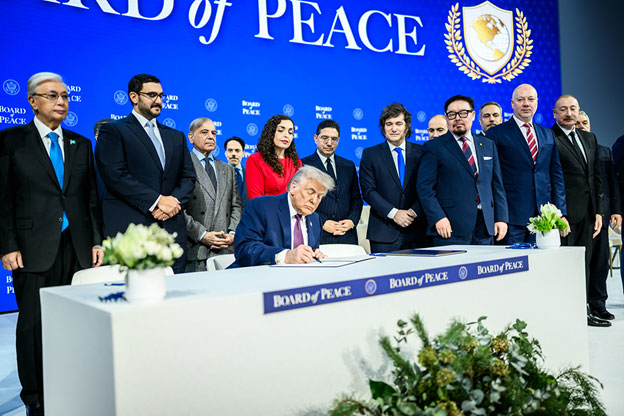
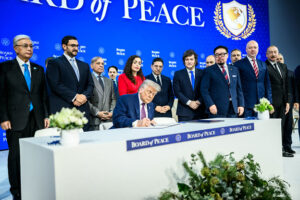
At a ceremony in Davos, Switzerland last week, Trump formally ratified the Charter of the Board — establishing it as “an official international organization”.


Trump, who will be serving as the Board’s Chairman, was joined by Founding Members* “representing countries around the world who have committed to building a secure and prosperous future for Gaza that delivers lasting peace, stability, and opportunity for its people.”

Norman Solomon, executive director, Institute for Public Accuracy and national director, RootsAction.org, told IPS President Trump’s “Board of Peace” is being designed as a kind of global alliance akin to the “coalition of the willing” that fraudulently tried to give legitimacy to the U.S.-led invasion of Iraq in 2003.

Trump, he said, is recruiting submissive governments to fall in line with his leadership for pushing the planet ever more in the direction of war for domination and plunder.

The price that members of the Orwellian-named “Board of Peace” will pay is much more than the sought amount upwards of $1 billion each. In a global gangster mode, Trump is making plans and putting up structures on imperial whim, he pointed out.

“At the same time, the methods to his madness are transparent as he seeks to create new mechanisms for U.S. domination of as much of the world as possible”.

Trump continues to push the boundaries of doublespeak that cloaks U.S. agendas for gaining economic and military leverage over other countries. The gist of the message on behalf of Uncle Sam is: “no more Mr. Nice Guy.”

Whereas Trump’s predecessors in the White House have often relied on mere doubletalk and lofty rhetoric to obscure their actual priorities and agendas, Trump has dispensed with euphemisms enough to make crystal clear that he believes the U.S. government is the light of the world that all others should fall in line behind, said Solomon, author of “War Made Invisible: How America Hides the Human Toll of Its Military Machine”

Asked about the Board of Peace, UN Spokesperson Stephane Dujarric told reporters last week: “Let’s be clear. We are committed to doing whatever we can to ensure the full implementation of Security Council Resolution 2803, which as you will recall, welcomed the creation of the Board of Peace for Gaza”.

And as you know, he said, part of that resolution and the plan put forward by President Trump talked about the UN leading on humanitarian aid delivery.

“I think we have delivered a massive amount of humanitarian aid in Gaza, as much as we’ve been able to allow. And we’ve talked about the restrictions, but you know how much more we’ve been able to do since the ceasefire. As part of that, we’ve worked very well with the US authorities, and we will continue to do so.”

The UN, Dujarric reaffirmed, remains the only international organization with universal membership. “We’ve obviously saw the announcements made in Davos. The Secretary-General’s work continues with determination to implement the mandates given to us, all underpinned by international law, by the charter of the UN. I mean, our work continues.”

Asked about the similarities between the UN logo and the logo of the Board of Peace, he said he saw no copyright or trademark infringements.

In a statement released last week, Louis Charbonneau, UN Director at Human Rights Watch (HRW) said the United States played a leading role in establishing the UN. Now, US President Donald Trump is undermining and defunding large parts of it.

For the past year, he said, the US government has taken a sledgehammer to UN programs and agencies because the Trump administration believes the institution is “anti-American” and has a “hostile agenda.”

In UN negotiations, US officials have tried to purge words like “gender,” “climate,” and “diversity” from resolutions and statements. Diplomats have described to Human Rights Watch how US officials aggressively oppose human rights language they see as “woke” or politically correct, he said.

In an apparent attempt to sideline the UN Security Council, Trump has proposed a so-called Board of Peace that he personally would preside over. Trump has reportedly offered seats on his board to leaders of abusive governments, including Belarus, China, Hungary, Israel, Russia, and Vietnam, Charbonneau pointed out.

Originally the Board of Peace was meant to oversee the administration of Gaza following over two years of onslaught and destruction by Israeli forces, with which the United States was complicit. But the board’s charter doesn’t even mention Gaza, suggesting that Trump’s ambitions for this body have expanded enormously since first conceived.

The board’s proposed charter doesn’t mention human rights. And it makes clear that Trump, as board chairman, would have supreme authority “to adopt resolutions or other directives” as he sees fit.

A seat on the Board of Peace doesn’t come cheap: there’s a US$1 billion membership fee. Some, like French President Emmanuel Macron, already turned down an offer to join. Trump responded with a threat to significantly increase tariffs on French wine and champagne.

“The UN system has its problems, but it’s better than a global Politburo. Rather than paying billions to join Trump’s board, governments should focus on strengthening the UN’s ability to uphold human rights,” he declared.

Elaborating further, Solomon said the entire “Board of Peace” project is a dangerous farce that seeks to reconstitute a unipolar world that has already largely fallen apart during this century in economic terms.

The criminality of Trump’s approach, supported by the Republican majority in Congress, is backed up by the nation’s military might. More than ever, U.S. foreign policy has very little to offer the world other than gangsterism, extortion and blackmail – along with threats of massive violence that sometimes turn into military attacks that shred all semblance of international law.

Every U.S. president in this century, as before, has disregarded actual international law and substituted the preferences of its military-industrial complex for foreign policy. Trump has taken that policy to an unabashed extreme, shamelessly adhering to George Orwell’s dystopian credo of “War Is Peace” while pushing to wreck what’s left of a constructive international order.

Incidentally, when Indonesia’s mercurial leader Sukarno decided to quit the UN and form the Conference of the New Emerging Forces (CONEFO) as an alternative, it did not last very long, as Sukarno’s successor, Suharto “resumed” Indonesia’s participation in the UN.

No lasting harm was done to the UN. And all was forgotten and forgiven.

In a further clarification, UN Deputy Spokesperson Farhan Haq told reporters the Board of Peace has been authorized by the Security Council for its work on Gaza – strictly for that. “

“We’re not talking about the wider operations or any of the aspects that have been in the media for the last several days. What we’re talking about is the work on Gaza”.

“As you know, we have welcomed the ceasefire in Gaza and measures to support it, including the Board of Peace, and we’ll continue to work with all parties on the ground to make sure that the ceasefire is upheld. That is about Gaza.”

The larger aspects, he said, are things for anyone wanting to participate in this grouping to consider. Obviously, the UN has its own Charter, its own rules, and you can do your own compare and contrast between the respective organizations.

“As you’re well aware, he pointed out, the UN has coexisted alongside any number of organizations. There are regional organizations, subregional organizations, various defence alliances around the world. Some of them, we have relationship agreements with. Some of them, we don’t.

“We would have to see in terms of details what the Board of Peace becomes as it actually is established to know what sort of relationship we would have with it,” declared Haq.

The participants* at the signing event in Geneva last week included:

    • Isa bin Salman bin Hamad Al Khalifa, minister of the prime minister’s court, Bahrain
    • Nasser Bourita, minister of foreign affairs, Morocco
    • Javier Milei, president, Argentina
    • Nikol Pashinyan, prime minister, Armenia
    • Ilham Aliyev, President, Azerbaijan
    • Rosen Zhelyazkov, prime minister, Bulgaria
    • Viktor Orban, prime minister, Hungary
    • Prabowo Subianto, president, Indonesia
    • Ayman Al Safadi, minister of foreign affairs, Jordan
    • Kassym-Jomart Tokayev, president, Kazakhstan
    • Vjosa Osmani-Sadriu, president, Kosovo
    • Mian Muhammad Shehbaz Sharif, prime minister, Pakistan
    • Santiago Peña, president, Paraguay
    • Mohammed Bin Abdulrahman Al Thani, president, Qatar
    • Faisal bin Farhan Al Saud, minister of foreign affairs, Saudi Arabia
    • Hakan Fidan, minister of foreign affairs, Turkey
    • Khaldoon Khalifa Al Mubarak, special envoy to the U.S. for the UAE
    • Shavkat Mirziyoyev, president, Uzbekistan
    • Gombojavyn Zandanshatar, prime minister, Mongolia

A long list of countries, including Canada, France, Germany, Italy and other European nations, were absent from the signing, and some have specifically rejected the invitation.

IPS UN Bureau Report

  Source

Global Survey Finds Citizens back a World Parliament as Trust in International System Erodes

Civil Society, Democracy, Global, Global Governance, Headlines, Human Rights, International Justice, IPS UN: Inside the Glasshouse, TerraViva United Nations

Opinion

A global survey across 101 countries finds global majority support for a citizen-elected world parliament to handle global issues, reflecting widespread concern over an outdated and undemocratic international order. Credit: Democracy Without Borders

BERLIN, Germany, Jan 20 2026 (IPS) – As democracy faces pressure around the world and confidence in international law drops, a new global survey reveals that citizens in a vast majority of countries support the idea of creating a citizen-elected world parliament to deal with global issues.


The survey, commissioned by Democracy Without Borders and conducted across 101 countries representing 90% of the world’s population, finds that 40% of respondents support the proposal, while only 27% are opposed. It is the largest poll ever carried out thus far on this subject.

Support is strongest in countries of the Global South, especially Sub-Saharan Africa, and among groups often underrepresented in national political systems—young people, ethnic minorities, and those with lower income or education levels. In 85 out of 101 countries surveyed, more respondents support the idea than oppose it.

“The message is clear: people around the world are ready to expand democratic representation to the global scale,” said Andreas Bummel, Executive Director of Democracy Without Borders. “This survey shows there is a growing global constituency that wants a voice in decisions affecting humanity as a whole,” he added.

The findings come at a time when the international system is under increasing strain from climate change, war, geopolitical conflicts, authoritarian resurgence, and stalled global cooperation. The results suggest that many citizens—especially in less powerful countries—see a world parliament as a pathway to fairer and more effective global governance.

In countries with limited political freedoms, support for a world parliament is particularly high. According to Democracy Without Borders, this points to a public perception that global democratic institutions could help advance democracy at home as well.

A notable 33% of respondents globally selected a neutral stance, suggesting unfamiliarity with the concept. An analysis of the survey results argues that this indicates a wide-open space for public engagement. If the idea gains visibility, support could grow substantially, it says.

“The international system created in the last century to prevent war and mass violence is built on the United Nations. But many UN member states do not represent their people. They represent oppressive authoritarian elites who have seized power.

The proposed vision of a citizen-elected world parliament could be a vital step in the discussion about building a more democratic global order,” said Oleksandra Matviichuk, head of the Centre for Civil Liberties in Ukraine awarded with the Nobel Peace Prize.

According to the survey, net opposition found in individual countries is most concentrated in high-income democracies. “This is not a rejection of democracy. It is a reminder that privilege may breed complacency, and that those who benefit from existing arrangements may underestimate how urgently they need renewal,” commented George Papandreou, Greek Member of Parliament and former Prime Minister.

Democracy Without Borders, an international civil society organization, advocates for the establishment of a United Nations Parliamentary Assembly as a step toward a democratic world parliament. The organization says the survey results reinforce the urgency for democratic governments to consider this long-standing proposal.

IPS UN Bureau

  Source

Children and Armed Conflict Must be at the Forefront of the Global Agenda

Armed Conflicts, Civil Society, Global, Global Governance, Headlines, Human Rights, International Justice, IPS UN: Inside the Glasshouse, TerraViva United Nations

Opinion

TOKYO, Japan, Jan 19 2026 (IPS) – Thirty years ago, the groundbreaking report by Graça Machel, renowned and widely respected global advocate for women’s and children’s rights, to the United Nations General Assembly laid bare the devastating impact of armed conflict on children and shook the conscience of the world. It led to the historic decision of the General Assembly to create the mandate of the Special Representative of the Secretary-General for Children and Armed Conflict (SRSG-CAAC).


Special Representatives of the Secretary-General are high-level envoys entrusted with carrying out specific responsibilities on behalf of the Secretary-General. Appointed at the rank of Under-Secretary-General, the SRSG-CAAC has since served as the global advocate for raising the awareness about the condition of children affected by armed conflict as well as their comprehensive protection and reintegration in the society.

Children and armed conflict as a peace and security agenda

The children and armed conflict (CAAC) agenda has evolved significantly over the past three decades. As appropriately affirmed in Security Council resolution 1261 (1999), the impact of armed conflict on children constitutes a matter affecting international peace and security. Subsequent resolutions firmly anchored the CAAC agenda within the work of the Security Council and established critical protection mechanisms.

Among the most significant of these is the Monitoring and Reporting Mechanism (MRM), created by Security Council resolution 1612 (2005). The MRM provides verified, credible, and timely information on grave violations committed against children in situations of armed conflict. It has become the backbone of the United Nations’ engagement with parties to conflict to halt such violations.

Credit: UN News

Through this mechanism, parties to conflict are encouraged to commit to ending and preventing grave violations through the development and implementation of time-bound action plans. To date, forty action plans have been concluded with parties to conflict, including non-State armed groups, in eighteen countries, resulting in full compliance by twelve parties.

UNICEF has played a pivotal role on the ground as the United Nations’ lead agency for children, supporting the operation of the MRM and monitoring the implementation of action plans.

Children and armed conflict as a fundamental child rights issue

Beyond peace and security, children and armed conflict is fundamentally a child rights issue. It was the first thematic area addressed as early as 1992 by the United Nations Committee on the Rights of the Child, the treaty body monitoring implementation of the Convention on the Rights of the Child adopted by the United Nations General Assembly in 1989.

That initiative paved the way for the Graça Machel report and the subsequent establishment of the SRSG-CAAC mandate in 1996. It also led to the adoption, in 2000, of the Optional Protocol to the Convention on the Rights of the Child on the involvement of children in armed conflict.

In March of this year, the Human Rights Council will dedicate its annual day on the rights of the child to children and armed conflict and is expected to adopt a related resolution, underscoring the continued relevance of this agenda.

Thirty years after the inception of the CAAC mandate

Despite these advances, grave violations against children in armed conflict reached an unprecedented 41,370 cases in 2024 alone. Calls for accountability have understandably grown louder.

The impact of armed conflict on children extends far beyond the six grave violations identified by the Security Council. Today, one in five children worldwide lives in a conflict-affected area, where the full spectrum of their rights is compromised, directly or indirectly.

This stark reality demands renewed urgency, enhanced political will, and more focused action.

Toward child rights-based and child-centred accountability

Children who are victims of armed conflict have too often been excluded from accountability processes.

Some positive developments deserve recognition. In 2023, the Office of the Prosecutor of the International Criminal Court adopted a revised Policy on Children that explicitly embraces a child rights approach. In the same year, the Secretary-General’s Guidance Note on Child Rights Mainstreaming called for the systematic integration of child rights into the mandates of United Nations investigative and accountability mechanisms, including commissions of inquiry and fact-finding missions.

Accountability must be both child rights-based and child-centred. Meaningful child participation is essential. Listening to children and taking their views seriously is fundamental to justice, remedies, and healing. Accountability processes must address children’s immediate and long-term needs, including education, psychosocial support, and family reunification.

Children as peacebuilders

Children want peace. Sustainable peace is the indispensable foundation for the full realization of child rights.

The Convention on the Rights of the Child guarantees the right of children to be heard and to have their views respected in all matters affecting them. Children also have the right to reintegration and to participate in efforts aimed at restoring social cohesion within fractured and traumatized communities.

In many conflict-affected societies, children constitute more than half of the population. Their role as peacebuilders is therefore not optional—it is essential. Recognizing and empowering children as agents of peace will also reinforce both the women, peace and security agenda and the youth, peace and security agenda.

Time for renewed mobilization, in partnership with civil society and children

Graça Machel reminded us that “universal concern for children presents new opportunities to confront the problems that cause their suffering.”

Children and armed conflict goes to the very core of our shared humanity. It demands broader public awareness, stronger political commitment, and sustained global mobilization.

Civil society organizations, working alongside children themselves, have a crucial role to play in advocacy, awareness-raising, and mobilizing support for the CAAC agenda.

The Special Representative of the Secretary-General for Children and Armed Conflict, created by the General Assembly, carries a unique responsibility as the Secretary-General’s envoy to strengthen cooperation and partnerships among United Nations entities, Member States, civil society, and children themselves.

Children and armed conflict must remain at the forefront of the global agenda and be treated as a central priority by the Secretary-General of the United Nations.

Dr. Mikiko Otani, widely recognized as an international human rights lawyer, is currently the President of the Child Rights Connect, a Geneva-based global NGO network promoting child rights. She was the Chair of the United Nations Committee on the Rights of the Child (2021-2023) during her eight-year membership for two terms.

IPS UN Bureau

  Source

The Iranian Military Is the Only Institution Capable of Catalyzing the Downfall of the Regime

Armed Conflicts, Civil Society, Featured, Global Governance, Headlines, Human Rights, International Justice, IPS UN: Inside the Glasshouse, Middle East & North Africa, TerraViva United Nations

The Iranian Military Is the Only Institution Capable of Catalyzing the Downfall of the Regime

UN Secretary-General Antonio Guterres, “shocked by reports of violence and excessive use of force by Iranian authorities against protesters”, is urging restraint and immediate restoration of communications, as unrest enters its third week. 11 January 2026. Credit: United Nations

NEW YORK, Jan 15 2026 (IPS) – Unlike ever before, Iran’s Islamic regime is facing a revolt led by a generation that has lost its fear. Young and old, men and women, students and workers, are flooding the streets across the country.


Iran’s future may well hinge on whether its military chooses to act and save the country, driven by economic collapse, corruption, and decades of repression. Women and girls are at the forefront, protesting without headscarves, defying the clergy that once controlled every aspect of their lives. They don’t want reform; they are demanding freedom, economic relief, and the end of authoritarianism.

Shutting down the internet, arresting nearly 17,000 protesters, killing at least 3,000, including children, and Trump’s threat to use force to stop the Iranian regime have not prevented the mullahs from continuing their onslaught. The regime’s ruthless crackdown has been a calamitous wave of repression, taking thousands of lives in a brutal attempt to crush dissent. Yet even in the face of such peril, the public remains undeterred, determined to continue their fight.

Now, however, they need the support of the most powerful domestic—not foreign—power to come to their aid. The Iranian military is the most pivotal institution in the country, capable of catalyzing the downfall of the regime. The military is the key player, with significant internal influence and the capability to drive the necessary change from within, ultimately leading to regime change.

Every officer in the military should stop and think, how do I want to serve my country.

Do I want to continue to prop up a bunch of reactionaries, self-obsessed old men who have long since lost their relevance, wearing the false robe of piety to appear sanctimonious while subjugating the people to hardship and hopelessness?

Should I not support the younger generation who are yearning for a better life, for opportunity, for a future that gives meaning to their existence?

Should I not participate in sparking the revival of this magnificent nation from the doldrums of the past 47 years that have consumed it from within?

Should I continue to prepare for war against Israel, or extend a peaceful hand and invest in building my country with such immense natural and human riches and be in the forefront of all other modern democratic and progressive nations, and restore the glory of ancient Persia?

Do I truly want to continue to wear blinders and let my country be destroyed from within, or should I become part of a newly reborn nation and take personal pride in helping to revive it?

The answer to these questions should be clear to every officer. The military should establish a transitional government and pave the way for a legitimate, freely elected government, and restore the Iranian people’s dignity and their right to be free.

The idea that the Shah’s son, Reza Pahlavi, could return and restore a monarchy is just the opposite of what the Iranian people need. Instead of another form of corruption or an old kingdom, they deserve a democracy and genuine freedom.

In the final analysis, Iran’s destiny may rest on a single profound choice—whether its military steps forward to reshape the nation’s destiny.

Dr. Alon Ben-Meir is a retired professor of international relations, most recently at the Center for Global Affairs at NYU. He taught courses on international negotiation and Middle Eastern studies.

  Source