Thales to recruit more than 9,000 new employees in 2026

DOHA, Qatar, 18 February 2026-/African Media Agency(AMA)/- Thales, world leader in high technologies for Defence, Aerospace and Cybersecurity & Digital, plans to recruit more than 9,000 employees worldwide in 2026.

These hiring prospects follow the recruitment of 8,800 employees in 2025, exceeding the initially announced target of 8,000 new talent. Over the past 5 years, Thales has recruited at least 8,000 people per year to support the growth dynamics of its three business sectors.

In 2025, Thales received 1.4 million applications worldwide, exceeding its record of one million CVs received in 2024. The Universum ranking positioned Thales in first place amongst the most attractive employers for engineering school students in France (and second place in 2024).

Strengthening the diversity of teams and management committees remains a priority for the Group. In 2025, women accounted for 32% of all recruitments. 69% of the Group’s management committees are composed of at least 4 women and Thales aims to reach 75% in 2026.

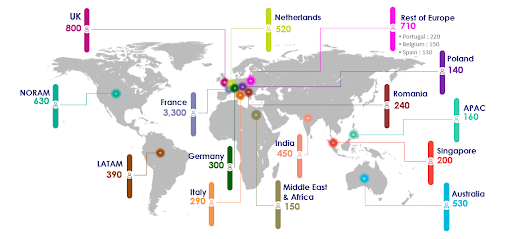
In 2026, Thales plans to recruit 150 people in the Middle East and Africa with 60 in the United Arab Emirates and 30 in the Kingdom of Saudi Arabia.

In France, Thales will recruit 3,300 people, including 1,630 in the Ile-de-France, 290 in Brittany, 280 in Nouvelle Aquitaine, 270 in Provence-Alpes-Côte d’Azur, 250 in Occitanie, 220 in Centre-Val de Loire, 180 in Auvergne-Rhône-Alpes and 130 in Pays de la Loire.

In addition to the 9,000 external recruitments, and thanks to the variety of Thales’ three business sectors, roles and geographies, 3,500 employees will benefit from internal mobility. Additionally, the Group’s “Learning Company” approach, with more than 35 internal academies, will enable employees to develop their skills, thereby maintaining Thales’ expertise at the highest level worldwide.

Thales is committed to advancing the integration of people with disabilities, with an employment rate of over 7% in France in 2025.

Around 40% of new arrivals will be assigned to engineering (software and systems engineering, cybersecurity, artificial intelligence, and data) and 25% to industry (technician, operator and engineer positions).

Thales reinforces commitment to inspire and support young talent in Science, Technology, Engineering and Mathematics (STEM)

Thales is dedicated to fostering the careers of young people and places strong emphasis on welcoming apprentices and interns, particularly in France, where it will support 1,700 trainees and 1,600 apprentices from Bac+2 to Bac+5, as well as 1,000 third-year and 500 second-year students in 2026. For these young people, these opportunities serve as a stepping stone to future employment. In 2025, apprentices and interns accounted for 15% of Thales’ recruitment in France.

Through its “Vocation Makers” programme, Thales is actively engaging with young people ages 6 to 18 to spark their interest in science and technology. This is achieved through site visits and educational presentations in schools. In 2025, the Group met with 250,000 students worldwide, ranging from primary to high school levels.

In parallel, Thales has launched the STEM for All’s programme, a scholarship and mentorship initiative in partnership with the French Academy of Technologies. The programme is designed to support and inspire young students from disadvantaged backgrounds who aspire to pursue careers in STEM. In its inaugural year, 40 awards were given in France and Belgium, each including a €5,000 grant and one-year of mentorship from a Thales employee. In 2026, STEM for All will be expanded in 2026 to countries including the Czech Republic, Poland, Greece, Romania, Italy, Germany, the Netherlands, Brazil and South Korea.

“We take great pride in seeing Thales’ appeal grow stronger year after year. The talented individuals who join us are driven by a desire to contribute to the development of sovereign, innovative, and sustainable solutions that the world needs more than ever. Together, we shaping the future by inspiring an increasing number of young people, especially young women, to pursue careers in science and technology.”
Patrice Caine, CEO of Thales

Candidates interested in the positions available at Thales can find out more and apply online at https://www.thalesgroup.com/fr/candidat and here for STEM for All.

Distributed by African Media Agency (AMA) on behalf of Thales

About Thales
Thales (Euronext Paris: HO) is a global leader in advanced technologies in advanced for the Defence, Aerospace and Cyber & Digital sectors. Its portfolio of innovative products and services addresses several major challenges: sovereignty, security, sustainability and inclusion.
The Group invests more than €4 billion per year in Research & Development in key areas, particularly for critical environments, such as Artificial Intelligence, cybersecurity, quantum and cloud technologies.
Thales has more than 83,000 employees in 68 countries. In 2024, the Group generated sales of €20.6 billion.

The post Thales to recruit more than 9,000 new employees in 2026 appeared first on African Media Agency.

The Maravi Post

Conditions Worsen for Belarus Migrants Stuck in ‘Death Zone’ on EU Border

Aid, Civil Society, Editors’ Choice, Europe, Featured, Headlines, Human Rights, Humanitarian Emergencies, Migration & Refugees, Sustainable Development Goals, TerraViva United Nations

Migration & Refugees

Aid agencies say that refugees caught on the Polish and Belarus borders are subject to brutal pushbacks. Graphic: IPS

Aid agencies say that refugees caught on the Polish and Belarus borders are subject to brutal pushbacks. Graphic: IPS

BRATISLAVA, Apr 25 2024 (IPS) – As the refugee crisis on the Belarus/EU borders approaches its fourth year, a crackdown on activism in Belarus is worsening the situation for migrants stuck in a “death zone” as they attempt to leave the country.

Groups working with refugees say the repression of NGOs in Belarus has led to many organizations stopping their aid work for migrants, leaving them with limited or no humanitarian help.


And although international organizations are operating in the country providing some services to refugees, NGOs fear it is not enough.

“There have been elevated levels of violence [against refugees from border guards] since the start of this crisis. But what has got worse is that before there were more people willing to help these refugees in Belarus, but now there is pretty much no one there helping as activism can be punished criminally in the country,” Enira Bronitskaya, human rights activist at Belarussian NGO Human Constanta, which was forced to pull out of the country and now operates from Poland, told IPS.

Since the start of the refugee crisis on the Belarus/EU border in the summer of 2021, rights groups have spoken out over brutal refugee ‘pushbacks’ by guards on both sides of the border.

Some have accused Minsk of manufacturing the crisis as a response to EU sanctions. They say Belarusian authorities actively organize, encourage, and even force migrants to attempt crossings over the border, but at the same time sanction violent and degrading treatment of those same migrants by border guards.

But others have also raised issue with what they say are equally violent and inhumane methods used by EU border guards in Poland, Latvia and Lithuania against those same migrants, as well as systematic breaches of their rights to claim asylum.

“These people are subjected to numerous forms of violence, both by Belarusian and Polish border guards. We’ve seen bruises, black eyes, knocked-out teeth after blows, kicks or hits with the back of rifles, irritation of skin and eyes after being sprayed with pepper gas, and teeth marks after dog bites,” Bartek Rumienczyk of the Polish NGO We Are Monitoring (WAM), which helps migrants who arrive in Poland from Belarus, told IPS.

“We also tell people they are entitled to ask for international protection in Poland, but in practice, these pleas are often ignored by border guards. We have witnessed numerous situations when people were asking for asylum in our presence and still they were pushed back to Belarus,” he added

These practices leave people stranded between the two borders in terrible conditions. Some aid workers describe it as a “death zone”.

“Refugees who manage to make it over [into the EU] talk about the ‘death zone’ between fences on the EU border and razor wires on the Belarus side and border guards who will not let them back into Belarus. They are therefore stuck there,” Joanna Ladomirska, Medical Coordinator for Medecins sans Frontieres (MSF) in Poland, told IPS.

“This death zone runs all along the Belarus/EU border, and it is huge—maybe tens of thousands of square kilometers—and no one knows how many people might have died there, or might be there needing treatment. My worry is that no one has access to this zone—not NGOs, no one,” she added.

At least 94 people have been known to have died in the border area since the start of the crisis, according to Human Constanta’s research, although it is thought many more may have also lost their lives.

Those that do manage to cross the border are invariably injured, some seriously. Exhaustion, hypothermia, and gastrointestinal affections because migrants have been forced to drink water from swamps or rivers are common, while almost a third of them have trench foot, and many have suffered serious injuries from razor- and barbed-wire fences. Some have also had to have parts of their limbs amputated due to frostbite, according to aid groups providing medical care to them.

Although both international and local organizations continue to work to help migrants on the EU side of the border, this is much more limited on the Belarusian side, say those working directly with migrants.

Since mass protests following his re-election in 2020, autocratic Belarusian President Alexander Lukashenko has implemented a sweeping crackdown on dissent. This has seen, among others, widespread prosecutions of workers in civil society.

Many NGOs, including some that had previously helped migrants, have been forced to close, leaving only a handful of major international organizations to do what they can for migrants.

However, questions have been raised about how effective their operations are.

“There are international organizations like the ICRC that are working with the Red Cross, but the Belarus Red Cross is only handing out food parcels in certain areas; it’s not a regular, stable supply,” said Bronitskaya.

“Basically, there is no one there giving [the migrants] the help they need. It is very possible there will be even more deaths than before,” she added.

But it is not just those stuck between the borders who are struggling to get help.

Anyone who fails to get into the EU and finds themselves back in Belarus is classed as an irregular migrant, is unable to access healthcare or benefits, and cannot legally work.

Many quickly find themselves in poverty, living in constant fear of being discovered by immigration authorities, and vulnerable to exploitation. Some aid workers told IPS they had heard of migrants in Minsk and other Belarussian cities forced to turn to prostitution to pay to support themselves.

Facing such problems, many decide they have little choice but to attempt the crossing again despite the risks.

Aid organizations and global rights groups say governments in EU countries and in Minsk must adhere to their obligations to protect the rights of these migrants.

“It’s not the best approach to the situation if the EU makes it difficult or impossible to cross its border by building walls or putting up legal barriers, nor is it good if Belarus creates a situation where people are stranded,” Normal Sitali, Medical Operations Manager for Medecins sans Frontieres (MSF) in Belarus, told IPS.

“There must be unhindered access to the border area for independent humanitarian organizations and for international and civil society organizations to respond to the dire situation there. Governments need to look at ensuring access to healthcare for these people so that international organizations do not need to provide and pay for it; they also need to look at legal protections for them; and they need to examine how these people can be ensured the space and protection to claim their rights as individuals while in transit,” he added.

MSF, which helped thousands of migrants during the crisis, last year stopped providing services to them after deciding migrants’ medical needs were outweighed by their need for protection and legal support, which MSF says can only be provided by dedicated organisations with specific expertise.

But some doubt the situation will improve any time soon with political relations between Belarus and the EU badly strained.

“Governments need to do something but the political situation makes things complicated. EU governments will not negotiate with Lukashenko because of the repressions going on in Belarus. Unless there is some significant change, nothing is going to get better,” said Bronitskaya.

However, others are hopeful of change.

Officials in Poland’s new government, which came to power in December last year, have claimed the number of pushbacks has fallen under the new administration and said a new border and migration policy is being drawn up that would treat the protection of human rights as a priority. Plans are also being put in place for the border forces to set up special search and rescue groups to stop humanitarian crises at the country’s borders, they have said.

“As a European country, [Poland] should respect European human rights laws and provide people with access to safety. You don’t need to negotiate with the Belarus regime to do that,” Ladomirska told IPS.

“I hope that with the new Polish government, something might change. We’re talking to them; change is feasible, and with the new government, there is an opportunity for that change.”

IPS UN Bureau Report

  Source



