

Active Citizens, Civil Society, Crime & Justice, Democracy, Economy & Trade, Energy, Featured, Headlines, Human Rights, International Justice, Latin America & the Caribbean, TerraViva United Nations
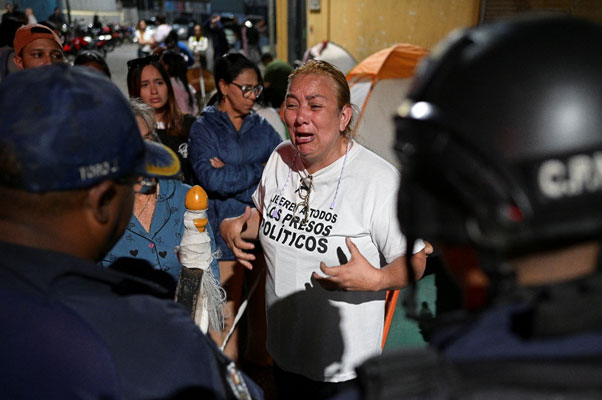
Evelis Cano, mother of political prisoner Jack Tantak Cano, pleads with the police for her son’s release outside a detention centre in Caracas, Venezuela, 20 January 2026. Credit: Gaby Oraa/Reuters via Gallo Images
– When US special forces seized Nicolás Maduro and his wife from the presidential residence in Caracas on 3 January, killing at least 24 Venezuelan security officers and 32 Cuban intelligence operatives in the process, many in the Venezuelan opposition briefly dared hope. They speculated that intervention might finally bring the democratic transition thwarted when Maduro entrenched himself in power after losing the July 2024 election. But within hours, those hopes were crushed. Trump announced the USA would now ‘run’ Venezuela and Vice-President Delcy Rodríguez was sworn in to replace Maduro. Venezuela’s sovereignty had been violated twice: first by an authoritarian regime that usurped the popular will, and then by an external power that deliberately violated international law.
A cynical intervention
Under Trump, the USA has abandoned any pretence of promoting democracy. Trump wrapped the intervention in the rhetoric of anti-narcotics operations while openly salivating over Venezuela’s oil reserves, rare earth deposits and investment opportunities. He repeatedly made clear that US regional hegemony is the number one priority. His contempt for Venezuelans’ right to self-determination was explicit: when asked about opposition leader María Corina Machado, Trump dismissed her as lacking ‘respect’ and ‘capacity to lead’. The message to Venezuela’s democratic movement was clear: your struggle doesn’t matter, only our interests do.
Ironically, the US intervention achieved what years of Maduro’s propaganda failed to do, giving anti-imperialist rhetoric a shot in the arm. For decades, Latin American authoritarian regimes have justified repression by pointing to the threat of US intervention, even though this was a largely historical grievance. Not anymore: Trump has handed every Latin American dictator the perfect justification for continuing authoritarian rule.
The global response has been equally revealing. The loudest defenders of national sovereignty are authoritarian powers such as China, Iran and Russia: states that routinely violate their citizens’ rights expressed their ‘solidarity with the people of Venezuela’ and positioned themselves as champions of international law. By blatantly violating a foundational principle of the post-1945 international order, Trump made the leaders of some of the world’s most repressive regimes look like the adults in the room. And across Latin America, the political conversation has now shifted dramatically: the question is no longer how to restore democracy in Venezuela, but how to prevent the next US military adventure in Latin America.
Authoritarianism continues
Meanwhile, Venezuela’s authoritarian regime remains intact. Maduro may be in a New York courtroom, but the structures that kept him in power – the corrupt military, embedded Cuban intelligence, patronage networks and the repressive apparatus – continue unchanged. Rodríguez will likely try to run down the clock, claiming Maduro could return at any moment to avoid calling elections while quietly negotiating oil deals with US companies and reasserting authoritarian control. For both Rodríguez and Trump, democracy seems like an inconvenient obstacle to resource extraction.
For Venezuelan civil society, this creates real dilemmas. As she was sworn in, Rodríguez denounced the operation that put her in charge and vowed that Venezuela would ‘never again be a colony of any empire’. She has wrapped herself in the flag, framing regime continuity as a patriotic stand against western imperialism, and can now easily paint opposition activists who have long demanded international pressure for democracy as treasonous collaborators with foreign powers. This is despite being an insider of a regime that welcomed Cuban intelligence, Iranian oil traders and Russian military advisers, and is now negotiating oil deals with the USA and crossing its own red line by promising legal changes to enable private investment.
A Venezuelan solution for Venezuela
But there may be some cracks in the regime. With Maduro gone, frictions inside the ruling party have become apparent. For instance, there have been obvious disagreements on how to handle the pressure to free Venezuela’s over 800 political prisoners. These may yield opportunities the democracy movement can exploit.
This is the time for the democratic opposition to reclaim the narrative. In the immediate aftermath of the intervention, families of political prisoners mounted vigils outside detention centres, demanding releases the government has only partially delivered. Civil society must amplify these voices, making clear that any transitional arrangement requires the dismantling of the repressive apparatus, not merely a change of faces at the top.
A broad coalition of civil society organisations has issued 10 demands that chart a path to democratic transition. They call for the immediate and unconditional release of political prisoners, the dismantling of irregular armed groups, unfettered access for human rights monitors and humanitarian aid and, crucially, a free and fair presidential election with international observers. These demands deserve international backing, not as conditions for oil contracts, but as non-negotiable requirements for any government that can claim to represent Venezuela.
Venezuela’s democratic forces can either accept marginalisation as Trump and Rodríguez carve up their country’s resources, or use this chaotic moment to advance a genuinely Venezuelan democratic agenda. That means rejecting both Maduro’s authoritarianism and Trump’s intervention, and insisting that any legitimacy Rodríguez’s government claims must come from Venezuelan voters, not US armed forces or oil contracts. Any window of opportunity may however be closing fast. The question is whether Venezuela’s democratic movement can seize it to build the country they have strived for, or whether they will remain spectators while others decide their fate.
Inés M. Pousadela is CIVICUS Head of Research and Analysis, co-director and writer for CIVICUS Lens and co-author of the State of Civil Society Report. She is also a Professor of Comparative Politics at Universidad ORT Uruguay.
For interviews or more information, please contact research@civicus.org






