USA Downgraded as Civil Liberties Deteriorate Across the Americas

Active Citizens, Civil Society, Environment, Global, Headlines, Human Rights, TerraViva United Nations

Opinion

Débora Leão is a Civic Space Researcher at CIVICUS, the global civil society alliance. She has a Master of Public Policy degree. Prior to joining CIVICUS, Débora worked on advocacy and research related to civic participation, urban development and climate justice.

 
Suraj K. Sazawal serves on the board to Defending Rights & Dissent and is co-author of ‘Civil Society Under Strain’, the first book to explore how the War on Terror impacted civil society and hurt humanitarian aid.
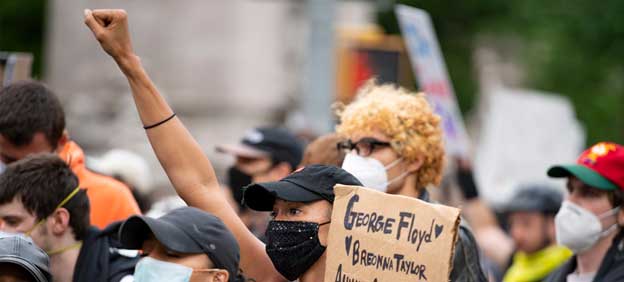
Protests in New York City against racism and police violence, following the death of George Floyd. Credit: UN Photo/Evan Schneider

São Paulo/ Washington DC, Dec 15 2020 (IPS) – Few images better illustrate the recent decline in civil liberties in the United States than that of peaceful protesters near the White House being violently dispersed so Donald Trump could stage a photo-op.


Moments before the president emerged from his bunker on June 1 to hold a bible outside a boarded-up church, federal officers indiscriminately fired tear gas at people who had gathered in Lafayette Park to protest about the police killing of George Floyd. This was far from an isolated incident: nationwide protests against systemic racism and police brutality have been met with widespread police violence.

Since May, the CIVICUS Monitor, an online platform that tracks fundamental freedoms across 196 countries, documented dozens of incidents where law enforcement officers, dressed in riot gear and armed with military grade-equipment, responded to Black Lives Matter protests with excessive force. These include officers driving vehicles at crowds of protesters and firing tear gas canisters and other projectiles at unarmed people, leaving at least 20 people partially blinded.

Throughout the year, journalists and health workers, clearly marked as such while covering the protests, have been harassed and assaulted. In one incident caught on live TV, a news reporter and camera operator from Louisville, Kentucky were shot by police with pepper balls while covering protests over the police killing of Breona Taylor.

This sustained repression of protests and an increased crackdown on fundamental freedoms led to the USA’s civic space rating being downgraded from ‘narrowed’ to ‘obstructed’ in our new report, People Power Under Attack 2020.

This disproportionate response by law enforcement officers to protesters goes beyond what is acceptable practice when policing protests, even during an emergency. Under international law, people have a right to assemble freely. Any restrictions to this right must be proportionate and necessary to address an emergency or reestablish public order.

The systematic use of excessive force and tactics such as kettling and mass arrests to enforce curfews raise troubling questions about the role of law enforcement agencies in responding to mass protests. The use of such tactics is contradictory to the alleged goal of maintaining public safety and health as they escalated tensions and prevented people from dispersing in a peaceful manner.

Even more concerning, they relocated protesters from open, outdoor spaces to police stations and other indoor facilities that often lack adequate space to allow for distancing, placing people at heightened risk for exposure to COVID-19.
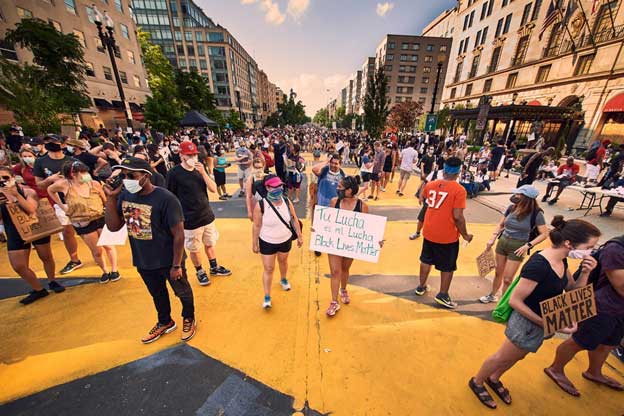
Black Lives Matter Protest June 2020 Washington, DC. Credit: Geoff Livingston // creative commons

While recent brutality against protests for racial justice is concerning, the decline in basic freedoms in the USA began before this crackdown. The repression seen in 2020 was preceded by a wave of legislation limiting people’s rights to protest.

In recent years, several states enacted restrictive laws which, for example, criminalise protests near so-called critical infrastructure like oil pipelines, or limit demonstrations on school and university campuses. Increased penalties for trespassing and property damage are designed to intimidate and punish climate justice activists and organisations that speak out against fossil fuels.

In the wake of Black Lives Matter protests, some of the ‘anti-protest’ bills introduced this year seem particularly cruel, for instance, by proposing to make people convicted of minor federal offences during protests ineligible for pandemic-related unemployment benefits.

Growing disregard for protest rights underscores wider intolerance for dissent. In parallel with restrictions on the freedom of peaceful assembly, the USA also saw an increase in attacks against the media, even before Black Lives Matter demonstrations erupted. Over the past three years, the CIVICUS Monitor has documented the frequent harassment of journalists by the authorities and civilians while covering political rallies or when conducting interviews.

Correspondents critical of the Trump administration or reporting on the humanitarian crisis in the USA/Mexico border region sometimes faced retaliation; documents obtained by ‘NBC 7 Investigates’ in 2019 showed the US government created a database of journalists who covered the migrant caravan and activists who were part of it, in some cases placing alerts on their passports.

In January 2020 a journalist was barred from accompanying Secretary of State Mike Pompeo in an official trip to Europe after Pompeo objected to the questions by another reporter from the same outlet.

The harsh treatment of people wanting to express themselves and the decline of civil liberties is part of a broader global decline in fundamental freedoms. Our new report shows less than four percent of the world’s population live in countries that respect the freedoms of association, peaceful assembly and expression.

Each country’s civic space is rated in one of five categories: ‘open, ‘narrowed, ‘obstructed,’ ‘restricted,’ or ‘closed’. The USA was one of 11 countries downgraded from its previous rating.

In the Americas, three other countries showed significant declines: Chile and Ecuador were downgraded to ‘obstructed’ and Costa Rica’s rating changed to ‘narrowed’. In the first two countries, as with the USA, rating changes reflected unnecessary and disproportionate crackdowns on mass protest movements.

Violations of protest rights were common across the region, with detention of protesters and excessive use of force among the top five violations of civic freedoms recorded this year. In addition, the Americas continue to be a dangerous place for those who dare to stand up for fundamental rights: across the world, 60 percent of human rights defenders killed in 2020 came from this region.

Stopping the erosion of fundamental freedoms requires a robust response. Governments must take steps to repeal legislation restricting the freedoms of association, peaceful assembly and expression and make sure those who violate these freedoms are held accountable.

In the USA, the incoming Biden administration must actively work to reverse the narrowing of civic space. To rebuild trust between people and law enforcement, for instance, the Department of Justice should investigate misconduct and discriminatory practices at local police departments.

The authorities must engage with civil society and human rights defenders to create an environment where they are able to fulfil their vital roles and hold officials accountable.

  Source

Intellectual Property Monopolies Block Vaccine Access

Civil Society, Development & Aid, Economy & Trade, Featured, Global, Headlines, Health, Human Rights, Humanitarian Emergencies, Poverty & SDGs, TerraViva United Nations

Opinion

SYDNEY and KUALA LUMPUR, Dec 15 2020 (IPS) – Just before the World Health Assembly (WHA), an 18 May open letter by world leaders and experts urged governments to ensure that all COVID-19 vaccines, treatments and tests are patent-free, fairly distributed and available to all, free of charge.


Pious promises
Leaders of Italy, France, Germany, Norway and the European Commission called for the vaccine to be “produced by the world, for the whole world” as a “global public good of the 21st century”, while China’s President Xi promised a vaccine developed by China would be a “global public good”.

Anis Chowdhury

The United Nations Secretary-General also insisted on access to all when available. The WHA unanimously agreed that vaccines, treatments and tests are global public goods, but was vague on the implications.

As COVID vaccines have become available, nearly 70 poor countries are left out. Many more people will be infected and may die without vaccinations, warns the People’s Vaccine Alliance, advocating equitable and low-cost access.

As the rich and powerful secure access, poor countries will leave out most people as only one in ten can be vaccinated in 2021, making a mockery of the Sustainable Development Goals’ over-arching principle of ‘leaving no one behind’.

Waiving WTO rules
The authors of “Want Vaccines Fast? Suspend Intellectual Property Rights (IPR) argue that IPR are the main stumbling block. Meanwhile, South Africa and India have proposed that the World Trade Organization (WTO) temporarily waive its Trade-Related Aspects of Intellectual Property Rights (TRIPS) rules limiting access to COVID-19 medicines, tools, equipment and vaccines.

The proposal – welcomed by the WHO Director-General and supported by nearly 100 governments and many civil society organisations around the world – goes beyond the Doha Declaration’s limited flexibilities for national emergencies and circumstances of extreme urgency.

Jomo Kwame Sundaram

But Brazil, one of the worst hit countries, opposes the proposal, together with the US, the EU, the UK, Switzerland, Norway, Canada, Australia and Japan, insisting the Doha Declaration is sufficient.

The empire fights back
The US insists that IP protection is best to ensure “swift delivery” while the EU claims there is “no indication that IPR issues have been a genuine barrier … to COVID-19-related medicines and technologies” as the UK dismisses the proposal as “an extreme measure to address an unproven problem”.

The Federation of Pharmaceutical Manufacturers and Associations Director-General claims it “would jeopardize future medical innovation, making us more vulnerable to other diseases”, while The Wall Street Journal denounced it as “A Global Covid Vaccine Heist”, warning “their effort would harm everyone, including the poor”.

Citing AstraZeneca’s agreement with the Serum Institute of India (SII) and Brazilian companies, other opponents assert that voluntary mechanisms should suffice, insisting the public-private COVAX initiative ensures fair and equitable access.

But the US has refused to join COVAX, part of the WHO-blessed, donor-funded Access to COVID-19 Tools Accelerator (ACT-A), ostensibly committed to “equitable global access to innovative tools for COVID-19 for all”.

Intellectual property fraud
The Doha Declaration only covers patents, ignoring proprietary technology to safely manufacture vaccines. Meanwhile, there is not enough interest, let alone capacity among leading pharmaceutical companies to produce enough vaccines, safely and affordably, for everyone before 2024.

Despite the Doha Declaration, developing countries are still under great pressure from the EU and the US. The rules allowing ‘compulsory licensing’ are very restrictive, with countries required to separately negotiate contracts with companies for specific amounts, periods and purposes, deterring and thus often bypassing those with limited financial and legal capacities.

South Africa cited the examples of Regeneron and Eli Lilly, which have already committed most of their COVID-19 antibody cocktail drugs to the US. In India, Pfizer has legally blocked alternative pneumococcal vaccines from Médecins Sans Frontières (MSF). In South Korea, Pfizer has forced SK Bioscience to stop producing its pneumococcal conjugate vaccine (PCV).

To be sure, patents are not necessary for innovation, with the Harvard Business Review showing IPR law actually stifling it. Meanwhile, The Economist has condemned patent trolling, which has reduced venture capital investment in start-ups and R&D spending, especially by small firms.

Public subsidies
Like most other life-saving drugs and vaccines, COVID-19 vaccines and treatment technologies owe much to public investment. Even the Trump administration provided US$10.5 billion to vaccine development companies.

Moderna’s vaccine emerged from a partnership with the National Institute of Health (NIH). Research at the NIH, Defence Department and federally funded university laboratories have been crucial for rapid US vaccine development.

Pfizer has received a US$455 million German government grant and nearly US$6 billion in US and EU purchase commitments. AstraZeneca received more than £84 million (US$111 million) from the UK government, and more than US$2 billion from the US and EU for research and via purchase orders.

But although public funding for most medicine and vaccine development is the norm, Big Pharma typically keeps the monopoly profits they enjoy from the IPR they retain.

Voluntary mechanisms inadequate
COVAX seeks to procure two billion vaccine doses, to be shared “equally” between rich and poor countries, but has only reserved 700,000 vaccine doses so far, while the poorest countries, with 1.7 billion people, cannot afford a single deal. Meanwhile, rich countries have secured six billion doses for themselves.

Thus, even if and when COVAX procures its targeted two billion vaccine doses, less than a billion will go to poor countries. If the vaccine requires two doses, as many – including Gavi, the Vaccine Alliance – assume, this will only be enough for less than half a billion people.

Meanwhile, ACT-A’s diagnostics work seeks to procure 500 million tests, only a small fraction of what is required. Even if fully financed, which is not the case, this is only a partial solution at best.

But with the massive funding shortfall, even these modest targets will not be reached. To date, only US$5 billion of the US$43 billion needed for poor countries in 2021 has been raised.

Profitable philanthropy
As of mid-October, while 18 generic pharmaceutical companies had signed up, not a single major drug company had joined WHO’s COVID-19 Technology Access Pool (C-TAP) to encourage industry contributions of IP, technologies and data to scale up worldwide sharing and production of all such needs.

Meanwhile, a few companies have ‘voluntarily’ given up some IPR, if only temporarily. Moderna has promised to license its COVID-19 related patents to other vaccine manufacturers, and not enforce its own patents. But their pledge is limited, allowing it to enforce its patents “post pandemic”, as defined by Moderna.

Besides profiting from licensing in the longer term, Moderna’s pledge will enable it to grow the new mRNA market its business is based on, by establishing and promoting a transformational drug therapy platform, yielding gains for years to come.

AstraZeneca has announced that its vaccine, researched at Oxford University, will be available at cost in some locations, but only until July 2021. Meanwhile, Eli Lilly has agreed, with the Gates Foundation, to supply – without demanding royalties from low- and middle-income countries – its (still experimental) COVID-19 antibody treatment, but did not specify how many doses.

Indeed, as Proudhon warned almost two centuries ago, ‘property is theft’.

  Source