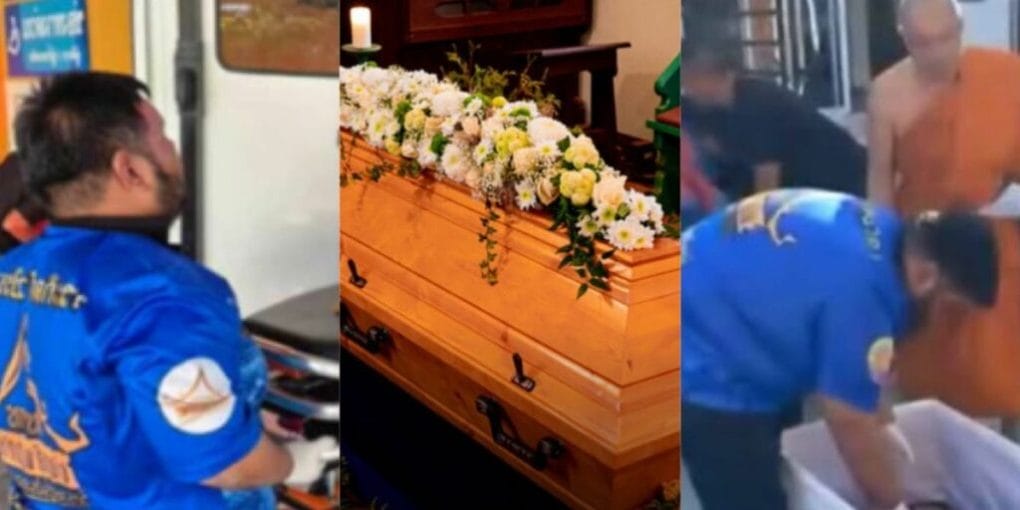
BANGKOK-(MaraviPost)-A 65-year-old woman in Nonthaburi, on the outskirts of Bangkok in Thailand has shocked her family when she knocked from inside her coffin after being declared dead.
Chonthirat Sakulkoo, who had been unwell for two years, was cared for by her brother, Mongkol Sakulkoo. When she was found unresponsive, Mongkol assumed she had passed away and began preparations for her cremation.
“All the documents had been issued, and we placed her in a coffin,” Mongkol explained.
However, before the cremation, Mongkol took Chonthirat to Chulalongkorn University Hospital to fulfill her wish to donate organs, but the hospital refused to accept her without an official death certificate.
At the Wat Rat Prakongtham crematorium, staff also insisted on a doctor’s certification before proceeding. It was during this discussion that Chonthirat suddenly knocked from inside the coffin.
Mongkol, surprised, asked to have the coffin opened, where family members were stunned to see her eyes slightly open and knocking.
Watch the video…
Doctors later diagnosed Chonthirat with acute hypoglycaemia, a condition that causes dangerously low blood sugar and can mimic death-like symptoms.
She is now receiving proper medical care at Bang Yai Hospital.
Share this:
Like this:
LikeLoading…
Discover more from The Maravi Post
Subscribe to get the latest posts sent to your email.
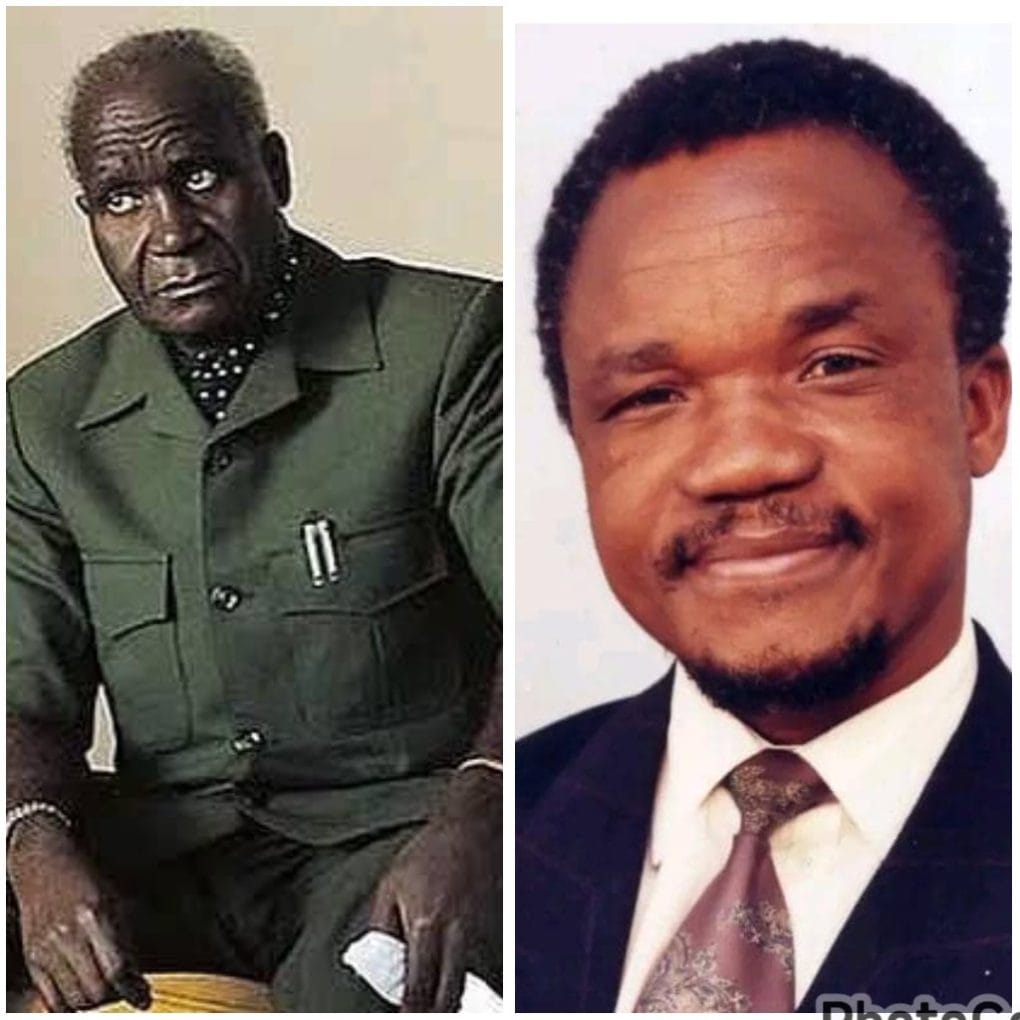
LUSAKA-(MaraviPost)-When Zambia transitioned from Kenneth Kaunda’s 27-year rule to Frederick Chiluba’s new multiparty era, the change appeared peaceful on the surface.
However, beneath the handshake diplomacy, one of Southern Africa’s most psychologically brutal political confrontations was unfolding.
On Christmas Day, 1997, Kaunda was arrested, a moment chosen for maximum symbolic impact.
Christmas, traditionally a day of presidential addresses and national unity, became the backdrop for Kaunda being bundled into a vehicle by armed officers.
The timing led many senior diplomats to conclude that the arrest was meant to break Kaunda psychologically, rather than simply pursue legal action.
The government accused Kaunda of involvement in a failed coup in October 1997, led by junior soldiers.
Yet Zambian intelligence insiders later admitted that there was no concrete evidence linking Kaunda to the mutiny.
Kaunda had been out of power for six years, had no military command, and was leading a peaceful political movement under UNIP.
Despite this, he became the central figure blamed for a coup he did not participate in.
At the time, Kaunda was experiencing an unexpected political resurgence, drawing large crowds to his rallies and maintaining widespread respect across rural districts.
Inside State House, Chiluba’s camp feared that Kaunda could potentially win the 1998 elections if allowed to run.
Kaunda’s moral authority still overshadowed other political figures and remained a unifying force across tribal lines, unlike the fragmented new elite.
For many observers, his arrest was interpreted as a pre-emptive political strike rather than a measure of national security.
During the same period, Kaunda was shot in the neck by government forces while leading a peaceful protest.
This injury left him physically vulnerable at the time of his detention.
For many Zambians, this act reinforced the perception that the state was willing to use lethal force against a national symbol.
Kaunda was subsequently held in Mukobeko Maximum Security Prison, a facility typically reserved for murderers, armed robbers, and political radicals.
This was not merely imprisonment but an attempt to erode his legacy by equating him with dangerous criminals.
Some prison officials later revealed they were instructed to treat Kaunda “as an ordinary dangerous suspect,” delivering a psychological blow aimed at undermining his stature.
The international community, including the Commonwealth, the United Nations, and African heads of state, intervened behind the scenes to pressure Chiluba to release Kaunda.
Even Nelson Mandela reportedly sent private messages condemning the treatment of the former president.
Diplomats feared that Zambia was descending into personal vendetta politics, with the potential to trigger ethnic tensions or civil unrest.
Chiluba’s own cabinet was divided on the matter, with some ministers warning that humiliating Kaunda could backfire politically.
Nevertheless, hardline security advisors convinced Chiluba that neutralising Kaunda was essential to consolidating power.
Ironically, the detention had the opposite effect of what Chiluba intended.
Kaunda emerged from prison more respected, seen as a statesman, and admired internationally as a martyr of democratic abuse.
The attempted political witch hunt, while meant to cripple Kaunda’s comeback, ultimately strengthened his legacy.
Historians agree that there was no direct evidence linking Kaunda to the coup, the arrest’s timing and style were deeply political, and Chiluba had strong incentives to remove a key rival.
Official statements cited national security, but the methods, symbolism, and sequence of events pointed clearly to a targeted political campaign.
The detention of Kaunda remains a powerful reminder of how political power struggles can shape the destiny of nations and the enduring respect commanded by principled leadership.
Share this:
Like this:
LikeLoading…
Discover more from The Maravi Post
Subscribe to get the latest posts sent to your email.
MZUZU-(MaraviPost)-Mzuzu University (MZUNI) emerged as the overall winner of the Tertiary Students Sports Association of Malawi (TESSAM) Weekend Sports Festival, held on Saturday and Sunday at the University of Malawi in Zomba in a competition designed to scout athletes for the 2026 CUCSA Games in Botswana.
MZUNI outperformed its rivals with victories in men’s and women’s football, netball and volleyball, securing its position as the top institution of the tournament.
Bunda College claimed both men’s and women’s basketball, the University of Malawi triumphed in chess, while Lilongwe University of Agriculture and Natural Resources (LUANAR) led in athletics.
The festival, sponsored by National Bank of Malawi (NBM) Plc through a K17 million investment, brought together universities and colleges for a high-stakes talent identification platform aimed at assembling the next national university team, TESSAM Malawi.
Zomba NBM Plc Service Centre Manager, Tawina Malata, expressed pride in the Bank’s role in supporting Malawi’s sporting youth.
“We strongly believe that the future of our country rests in the hands of the youth, and supporting this festival allows us to nurture their talents and potential. We are pleased that several outstanding players have been identified to represent Malawi. As National Bank, we are honoured to stand with institutions in promoting discipline, ambition, and national development through sports,” said Malata.
TESSAM Malawi Vice President, Geoffrey Biya, said the tournament fulfilled its primary mission of scouting athletes for the CUCSA Games and praised NBM Plc for bridging the resource gap universities often face.
“These games were specifically organized to identify players who will represent Malawi next year. National Bank’s support made it possible for all these universities to come together and compete at this scale. We are grateful for their commitment to youth development and sports excellence,” said Biya.
MZUNI Sports Director, Thomas Movetie, whose institution delivered the strongest overall performance, described the victory as a proud moment for the university.
“We are extremely proud of what our athletes have achieved. Their hard work has paid off, and it shows the strength and determination of the MZUNI community. We also appreciate National Bank Plc for stepping in to support university sports and helping create opportunities for young athletes across the country,” said Movetie.
The festival successfully met its objective, with 30 netball players, 12 chess players, 24 volleyball players, 24 men’s basketball players, 34 women’s basketball players, 28 women’s football players, and 34 athletics competitors scouted for provisional inclusion in the national university squad.
Selected athletes will begin preparations for Botswana with their first training camp in January, followed by monthly camps until the final CUCSA team is confirmed.
Other institutions that participated in the TESSAM sports festival included Kamuzu College of Health Sciences, Natural Resources College (NRC), University of Livingstonia, DMI St John the Baptist University, MUBAS, and Bunda Campus of LUANAR.
Share this:
Like this:
LikeLoading…
Discover more from The Maravi Post
Subscribe to get the latest posts sent to your email.
BLANTYRE-(MaraviPost)-National Bank of Malawi (NBM) plc, says it is impressed with the Scorchers’ overall performance in the Women’s Three-Nations Tournament underway in Lilongwe as the team prepares for the upcoming WAFCON.
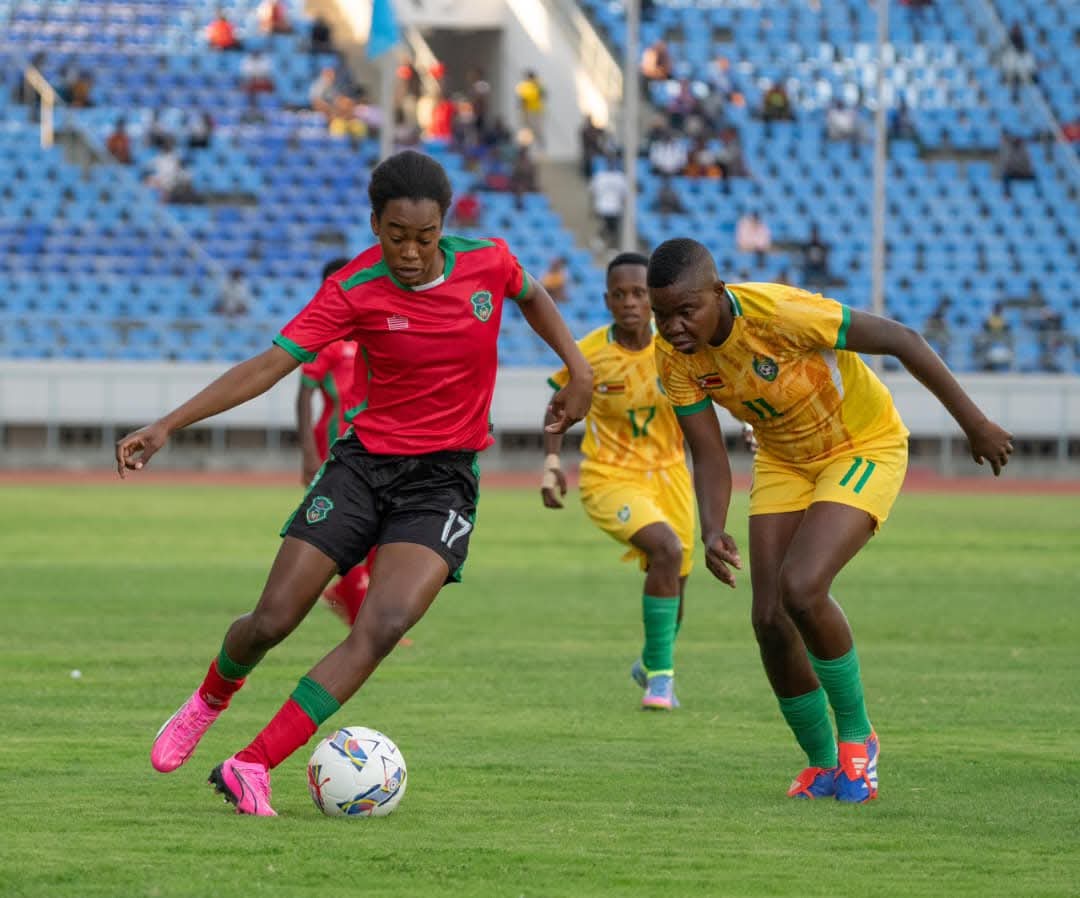
During the tournament at Bingu National Stadium, Malawi put up competitive performances, despite their 2–1 loss Zimbabwe in the opening match on Friday, before a one-all with Zambia on Sunday.
With those results, the hosts stand no chance to win the tournament as it is being played on a league-format.
This means Zimbabwe lead the table with three points, followed by Zambia’s point as they head into their last encounter on Tuesday.
Malawi’s consolation goal against Zimbabwe came through a 40th-minute strike from Faith Chinzimu, while Rose Kabzere netted a powerful 56th-minute rebound to secure the draw against Zambia.
NBM plc Product Development and Strategy Manager, Ibrahim Chapeyama, said that as the official Scorchers’ sponsors, they were satisfied with the team’s overall performance and described the tournament as an important foundation for WAFCON preparations.
“We are focusing on the positives because the coach was able to try out new players. We are impressed with what we have seen and are hoping for the best,” said Chapeyama.
He added that the Bank’s sponsorship aims to strengthen the development of women’s football and enhance Malawi’s competitiveness at the continental level.
“We have been with them from the start. We sponsored the premiership that led to WAFCON qualification. Our message has always been the same: keep pushing and make the dream come true. We want the team not just to qualify again, but to go beyond and win it,” he said.
Commenting on the matches, Scorchers Coach Lovemore Fazili said he was also encouraged by the team’s performance and emphasized the need for squad depth as part of the build-up to major future competitions.
“The games were not bad. I wanted to give a chance to players who have not played before. We cannot rely on just a few individuals building a strong team requires depth” he said.
He said friendly matches are vital for assessing new combinations and refining tactical harmony.
“Even though we failed to win the tournament, I was looking for coordination between the new players and the usual squad. We learnt a lot from Zimbabwe and Zambia, and I believe they learnt from us as well,” Fazili said.
Zambia Coach Charles Haaluubono also praised Malawi’s continued progress in women’s football.
“They keep improving, and we are now almost at the same level if not already there. You can see young players coming in and performing very well. I follow the Malawian league closely, and the development here is impressive,” he said
Share this:
Like this:
LikeLoading…
Discover more from The Maravi Post
Subscribe to get the latest posts sent to your email.
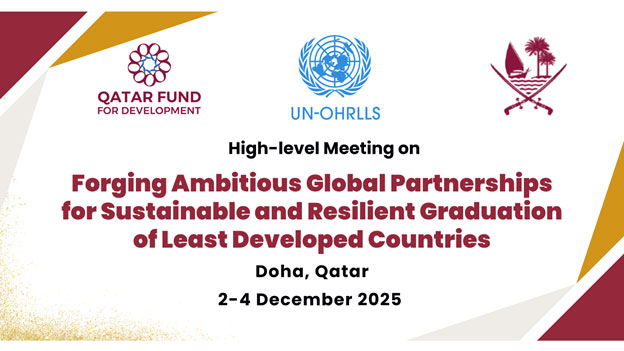
UNITED NATIONS, Dec 1 2025 (IPS) – As we gather in Doha for the High-Level Meeting on “Forging Ambitious Global Partnerships for Sustainable and Resilient Graduation of Least Developed Countries,” the stakes could not be higher. A record number of fourteen countries-equally divided between Asia and Africa are now on graduation track. Graduation from the Least Developed Country (LDC) category is a landmark national achievement—a recognition of hard-won gains in income, human development, and resilience. Yet, for too many countries, this milestone comes with new vulnerabilities that risk undermining the very gains that enabled graduation.
Since the establishment of the LDC category in 1971, only eight countries have graduated. Today, 44 countries remain in the group, representing 14% of the world’s population, but contributing less than 1.3% to global GDP. The Doha Programme of Action (DPoA) charts an ambitious yet achievable target: enabling at least 15 additional countries to graduate by 2031. But as the DPoA underscores graduation must be sustainable, resilient and irreversible. It must serve as a springboard for transformation— not a moment of exposure to new risks.
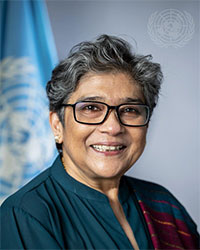
USG Rabab Fatima
Graduation with momentum: Graduation often coincides with a significant shift in the international support landscape. As preferential trade arrangements, concessional financing, and dedicated technical assistance begin to phase down, countries may face heightened fiscal pressures, reduced competitiveness, and increased exposure to external shocks. Without well-sequenced and forward-looking transition planning, these shifts can slow progress toward the Sustainable Development Goals (SDGs) and strain national systems.
Yet within these challenges also lie opportunities. With the right policies, partnerships, and incentives, graduation can catalyse deeper structural transformation, expand access to new financing windows, strengthen institutions, and unlock pathways to diversified, resilient, and inclusive growth. The task before us is to manage risks while harnessing these opportunities—ensuring that no country graduates without momentum.
Smooth Transition Strategies: A National Imperative The DPoA calls for every graduating country to develop inclusive, nationally owned Smooth Transition Strategies (STS) well-ahead of the graduation date. These strategies must be fully integrated into national development plans and SDG frameworks, ensuring coherence and resilience. They should prioritize diversification, human capital investment, and adaptive governance, while placing women, youth, and local actors at the center of design and oversight. STS must be living documents—flexible, participatory, and backed by robust monitoring and financing.
Reinvigorated Global Partnerships: The essential Pillar No country can navigate this transition alone. The Doha Programme of Action calls for an incentive-based international support structure that extends beyond graduation. For LDCs with high utilization of trade preferences – the withdrawal of preferential market access must be carefully sequenced to avoid abrupt disruptions. For climate-vulnerable SIDS and LLDCs, enhanced access to climate finance, debt solutions, and resilience support are key elements in their efforts to tackle post-graduation challenges.
Deepened South-South and triangular cooperation, innovative financing instruments, blended finance, and strengthened private-sector engagement will be essential to building productive capacities and unlocking opportunities in digital transformation, green and blue economies, and regional market integration.
iGRAD: A Transformative Tool The operationalization of the Sustainable Graduation Support Facility—iGRAD—is a concrete step forward. By providing tailored advisory services, capacity-building, and peer learning, iGRAD can serve as a critical tool to help countries anticipate risks, manage transitions, and sustain development momentum. Its success, however, hinges on strong political support and adequate, predictable resourcing from development partners.
Graduation as a Catalyst for Transformation Graduation should not be the end of the story—it should be the beginning of a new chapter of resilience and opportunity. With integrated national strategies and reinvigorated global partnerships, we can turn graduation into a catalyst for inclusive, sustainable development. Let us seize this moment in Doha to reaffirm our collective commitment: no country should graduate into vulnerability. Together, we can ensure that graduation delivers on its promise—for communities, for economies, and for future generations.
Rabab Fatima is UN Under Secretary General and High Representative for the Least Developed Countries, Landlocked Developing Countries and Small Island Developing States
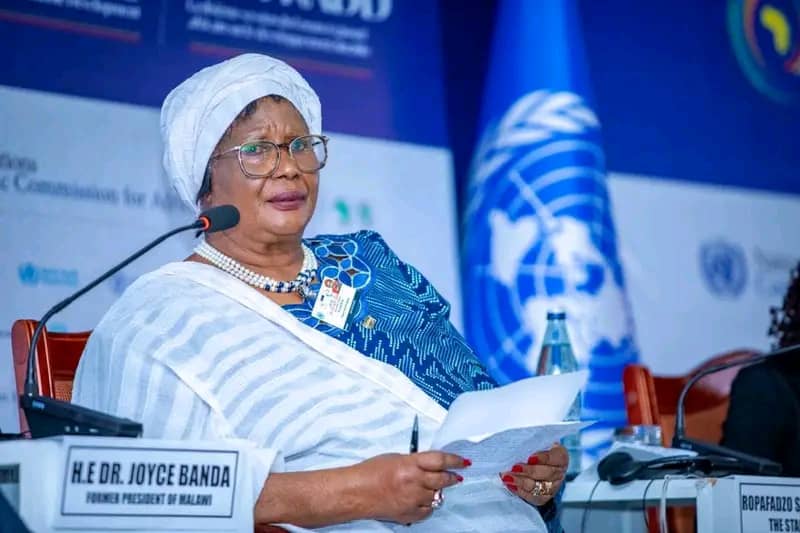
LILONGWE-(MaraviPost)-The country’s former President Joyce Banda has been appointed as board Chairperson for Global Fairness Initiatives (GFI).
Banda’s Executive Assistant, Media and Public Relations Arnold Mnelemba has to confirmed the news to The Maravi Post a while ago.
“I can indeed confirm that the 4th President of the Republic of Malawi Her Excellency Dr Joyce Banda has been appointed board chair for Global Fairness Initiative.
“It is something of great honour considering the fact that the initiative is a global institution of highest reputation,” Mnelemba said.
He added, “We are thrilled to hear the news and Her Excellency is ready to serve. It will be a great honour for Her Excellency to serve in the board whose first chairperson was President Bill Clinton.
“She is ready to serve in that capacity and her term begins on first January. She will chair Her first board meeting in May, Ghana”.
According to the Global Fairness Initiative (GFI), a leading NGO committed to creating more equitable, and secure livelihoods for the working poor, announced today that Banda will head the GFI Board of Directors replacing outgoing Chair H.E. Kabine Komara, Former Prime Minister of Guinea.
“We are honored to welcome President Banda as Chairperson of the GFI Board of Directors,” said H.E. Komara. “She has been a champion of working people in Malawi and throughout Africa, and her deep intellect and practical experience will bring great benefit to the important work of GFI and our grassroots partners throughout the world.”
Joyce Banda served as the 4th President of the Republic of Malawi from 2012 to 2014 following over a decade in public service as Vice President, Minister of Foreign Affairs, Minister for Gender and Community Services and a Member of Parliament. Dr. Banda was Malawi’s first female Head of State and the 2nd in Africa.
During her Presidency, she championed reforms that exemplified good governance and the democratic rule of law.
She is the recipient of numerous international awards and accolades and is celebrated for her work to tackle global challenges ranging from hunger to maternal health.
Through her Joyce Banda Foundation, she has supported primary and secondary school education of some of Malawi’s most vulnerable children.
The Joyce Banda Foundation also feeds and provides head-start education to over 10-thousand children across the country. The Foundation’s other key activity has been building climate-resilient houses for the vulnerable across the country, with recent focus being on those who lost their homes to the four cyclones that have hit Malawi in recent years.
“It is a privilege to have President Banda as the new Chair of the GFI Board of Directors,” said Karen Tramontano, Founder of Global Fairness Initiative.
“She has been a true advocate and partner to the grassroots, and we look forward to collaborating on our shared work to uplift working poor communities in Malawi and throughout the world.”
Global Fairness Initiative is a US-based INGO committed to creating a more equitable, sustainable approach to economic development through programs to reduce poverty, enfranchise informal workers, and create a more just, secure future for workers.
Founded by Karen Tramontano with Former President Bill Clinton as founding Chair, GFI has implemented programs that strengthen rights and livelihoods for the working poor in nations across the Global South.
Who is Joyce Banda?
Joyce Banda became President of the Republic of Malawi in 2012 following more than a decade in public service beginning with her election to Parliament and service as Malawi’s Foreign Minister and Minister for Gender and Community Services and then as Vice President.
Dr. Banda was Malawi’s first woman Head of State and only the 2nd in Africa, and she has been widely recognized for her work to expand the country’s economy, strengthen democratic systems and build strong diplomatic ties globally.
During her Presidency, Dr. Joyce Banda is credited with turning around an ailing economy which was on the verge of collapse to one that registered 6.2% in 2014 from 1.8% registered in 2012.
This followed her aggressive economic reforms which led to significant economic expansion.
Under President Banda, Malawi’s operational industrial capacity improved from 35% in 2012 to 85% in July 2014, and the foreign exchange import cover improved from one week to three and half months in July 2014.
In the areas of democracy, good governance, and rule of law, President Banda repealed a number of draconian laws which had weakened essential democratic institutions, infringed upon civil liberties, and restricted the freedom of the press.
Since her Presidency, Dr. Banda has launched women-centered organizations across Africa, including the African Federation of Women Entrepreneurs (AFWE), the Council for Economic Empowerment for Women in Africa (CEEWA), the American & African Business Women’s Alliance (AABWA), and her Joyce Banda Foundation.
She served as a Distinguished Fellow at the Center for Global Development and the Woodrow Wilson Center, a member of the United Nations Council of Women World Leaders and is a standing member of the Club de Madrid.
Share this:
Like this:
LikeLoading…
Discover more from The Maravi Post
Subscribe to get the latest posts sent to your email.