Bombing and Ballots, Myanmar’s Contentious Election

Armed Conflicts, Asia-Pacific, Civil Society, Crime & Justice, Democracy, Editors’ Choice, Featured, Freedom of Expression, Headlines, Human Rights, Press Freedom, TerraViva United Nations
Human Rights

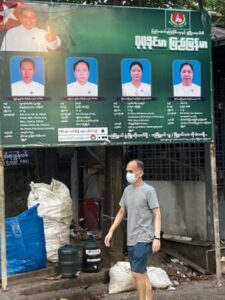
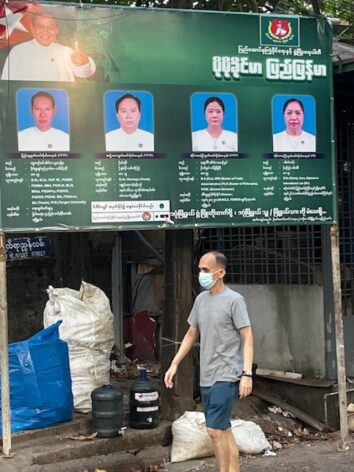
A man walks past a campaign poster for the military’s proxy party USDP ahead of strictly controlled elections in Myanmar. Credit: Guy Dinmore/IPS

A man walks past a campaign poster for the military’s proxy party USDP ahead of strictly controlled elections in Myanmar. Credit: Guy Dinmore/IPS

YANGON, Myanmar and BANGKOK , Jan 6 2026 (IPS) – With thousands of civilians killed in years of civil war and over 22,000 political prisoners still behind bars, no one was surprised that early results from Myanmar’s first but tightly controlled elections since the 2021 coup show the military’s proxy party speeding to victory.


“How can you hold elections and bomb civilians at the same time?” asked Khin Ohmar, a civil rights activist outside Myanmar who is monitoring what the resistance forces and a shadow government reject as “sham” polls.

The junta had already cleared the path towards its stated goal of a “genuine, disciplined multi-party democratic system” by dissolving some 40 parties that refused to register for polls, which they regard as illegitimate, with their leaders and supporters still in prison.

These include the National League for Democracy (NLD) and its leader, Aung San Suu Kyi, who won a landslide second term  in the 2020 elections – only for the results to be annulled by Senior General Min Aung Hlaing, a coup leader and self-appointed acting president. Mass street protests were crushed in early 2021 and war spread across Myanmar.

Although these elections will deliver just a façade of the legitimacy craved by some of the generals, they did succeed in projecting a power and authority that was quickly slipping away just two years ago as long-standing ethnic armed groups and newly formed People’s Defence Forces (PDFs) inflicted a series of humiliating defeats on the junta.

“The tide has turned in favour of the military,” commented a veteran Myanmar analyst in Yangon, crediting China, which reined in the ethnic groups on its shared border, fully embraced Min Aung Hlaing and, along with Russia, delivered the arms, technology and training needed to peg back the resistance.

Campaigners for the pro-military USDP canvas residents and check voters lists in Yangon ahead of the December 28 parliamentary election that excluded major anti-junta parties. Credit: Guy Dinmore/IPS

Campaigners for the pro-military USDP canvas residents and check voters lists in Yangon ahead of the December 28 parliamentary election that excluded major anti-junta parties. Credit: Guy Dinmore/IPS

The regime’s air power and newly acquired drones have been deployed to ruthless effect, often hitting civilian targets in relatively remote areas where the resistance has grassroots support. Air strikes were stepped up as the elections approached. Major cities like Yangon were calm; people subdued.

Bombs dropped on Tabayin township in the Sagaing Region on December 5 killed 18 people, including many in a busy tea shop, AFP reported. On December 10, air strikes on a hospital in the ancient capital of Mrauk-U in Rakhine State were reported to have killed 10 patients and 23 others. The regime accused the insurgent Arakan Army and PDFs of using it as a base.

“I don’t think that anyone believes that those elections will be free and fair,” UN Secretary General Antonio Guterres stated while visiting the region ahead of the polls. He called on the junta to end its “deplorable” violence and find “a credible path” back to civilian rule.

In contrast, the Trump administration declared in November that the junta’s election plans were “free and fair” and removed Temporary Protected Status from Myanmar refugees in the US, saying their country was safe for them to return to.

“I’ll be jailed if I don’t vote,” said Min, a Yangon taxi driver, only half-joking on the eve of voting in Yangon, the commercial capital. “And what difference does it make? We are ruled by China and Xi Jinping, not Min Aung Hlaing,” he added.

With the polls spread over three stages, the first 102 townships voted on December 28. Others will follow on January 11 and January 25 to make a total of 265 of Myanmar’s 330 townships scheduled to vote for the bicameral national parliament and assemblies in the 14 regions and states.
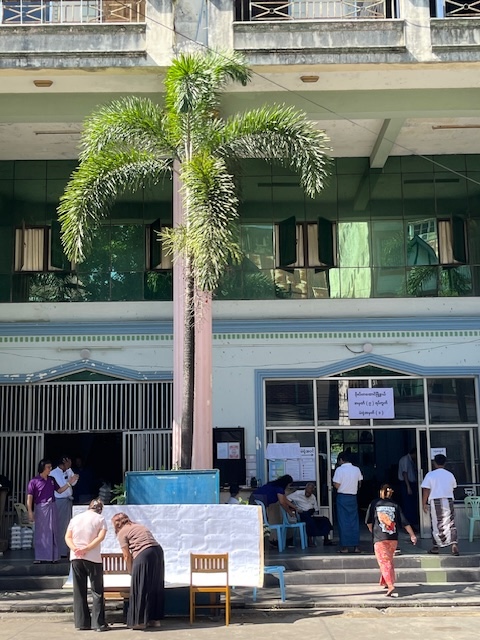
Residents in downtown Yangon check their names on the electoral register and then cast their votes in a polling station on December 28. Credit: Guy Dinmore/IPS

Residents in downtown Yangon check their names on the electoral register and then cast their votes in a polling station on December 28. Credit: Guy Dinmore/IPS

No voting is to be held at all in the remaining 65 townships that the election commission deemed too unsafe.

Voting in the first round in Yangon, an urban and semi-rural sprawl of seven million people, proceeded calmly and slowly on a quiet Sunday – despite intense efforts, and sometimes threats, by the regime to boost the turnout.

In 2020 and 2015 – when Myanmar arguably held the region’s most open and fair elections and the military’s proxy Union Solidarity and Development Party (USDP), was soundly defeated – people gaily posted images of their ink-stained little fingers on social media as evidence of their vote after weeks of packed rallies and vibrant campaign rallies.

But not this time. Social media posts hurled insults, some comic and vulgar, at the regime. Those eager to support the resistance’s boycott but who were afraid of reprisals were relieved if they found their names had been omitted by mistake on electoral lists. Electronic voting machines in use for the first time made it impossible to leave a blank.

But as in past elections, a solid core of people close to the military and its web of powerful economic interests turned out to vote for the USDP.

“We are choosing our government,” declared one man exiting a polling station in central Yangon with his family, apparently USDP supporters. One proudly waved his little finger dipped in indelible ink.

How can you hold elections and bomb civilians at the same time? – Khin Ohmar, civil rights activist

Turnout for the first round was put by regime officials at 52 percent. This compares with about 70 percent in the past two elections. China’s special envoy – sent as an official observer, along with others from Russia, Belarus, Vietnam and Cambodia – praised the elections.

On January 2, the election commission unexpectedly issued partial results: the USDP, led by retired generals, had won 38 of 40 seats in the lower house where votes had been tallied to date. No one blinked.

The USDP campaign message focused on two main elements – get out and vote with all your family, and back a USDP government to restore stability and progress to Myanmar.

Its underlying message was a reminder that the last USDP administration, led by President Thein Sein introduced socio-economic and political reforms and ceasefire negotiations with ethnic groups after securing a large majority in the 2010 elections when the NLD and other opposition groups were also absent.

Aung San Suu Kyi, then under house arrest, was released just after the 2010 polls and went on to contest and win a seat in a 2012 by-election ahead of the NLD’s own sweeping victory in 2015. Aung San Suu Kyi governed in a difficult power-sharing arrangement with the military for the next five years and was thrown back into prison in the coup.

For now a large proportion of Myanmar’s population lives in areas under junta control, including all 14 of the state and regional capitals, swollen by an influx of people fleeing conflict.  The military also holds major seaports and airports and – to varying degrees – the main border crossings for China and Thailand.

But in terms of territory, over half of Myanmar is in the hands of disparate ethnic armed groups and resistance forces. Alliances are fluid and negotiable.

The shadow National Unity Government is trying to establish its own authority over liberated territory, looking to cement a consensus around the concept of a democratic and federal Myanmar free of the military’s interference – something that has eluded the country since independence from British colonial rule in 1948.

Front lines shift back and forth as the military struggles to regain control over the Bamar heartlands of central Myanmar, once considered their bastion, while stretched elsewhere after losing vast tracts of border areas since the coup. Several million people have fled the country or are internally displaced.

Once again there is some speculation that a “smooth” election and the formation of a USDP government in April will lead to a gesture signalling the military’s confidence, such as a possible ending of forced conscription and the release of some political prisoners. Project power, then collect legitimacy.

“Political prisoners are used as bait,” said Khin Ohmar, the civil rights activist in Bangkok. “The world would at least have to applaud.”

IPS UN Bureau Report

  Source

When Democracy Freezes, Autocrats Rise

Civil Society, Democracy, Economy & Trade, Editors’ Choice, Global, Headlines, Human Rights, IPS UN: Inside the Glasshouse, TerraViva United Nations

Opinion

When Democracy Freezes, Autocrats Rise

Pro-Democracy protesters gather in front of the headquarters of the Sudanese army in the capital, Khartoum. Credit: Masarib/Ahmed Bahhar via UN News

VIENNA, Austria, Jan 5 2026 (IPS) – Consider our political systems not merely as battlegrounds of passions, ideologies and economic interests, but as systematically functioning arrangements of interactions, akin to game theory. In recent decades, we have witnessed the dissolution of large homogeneous groups into numerous subgroups — a patchwork of minorities.


This fragmentation, compounded by individualisation and the resulting weakening of strong political bonds, has profound consequences for democratic governance.

In nations with majority voting systems, this process fragments the party system itself. As dissatisfaction with political parties grows – initially quietly but eventually becoming pronounced – new parties emerge, further splintering the political landscape.

This increasing fragmentation complicates government formation and makes majorities more precarious. Often, only coalitions that can agree on the lowest common denominator are formed. Consequently, the outcomes of politics do not necessarily improve; in most cases, they worsen.

A vicious circle

Decisive action, bold moves and clear leadership have become increasingly elusive. This reinforces dissatisfaction and the prevailing sentiment among voters that politicians are failing to achieve meaningful results. Doubts about the effectiveness of the political system become self-perpetuating, creating a situation where decisive politics is nearly impossible.

The rise of populists and right-wing extremists is both a consequence of this stagnation and a further catalyst — a ratchet effect. Right-wing agitators stoke discontent, transforming it into anger and outrage while exploiting negative emotions.

As they gain strength, democratic politics becomes more paralysed, often preoccupied with defending against radicalism, preventing the worst outcomes, and forming coalitions whose members can agree on little more than a lacklustre commitment to ‘more of the same’.

When social cohesion erodes, the radical right gains ground — which then leads to even more division. The perceived polarisation and alienation that accompanies the rise of right-wing extremism increases the perception of social disintegration and decay.

Democracy gives rise to its own threats

In a sense, right-wing radicalism is itself the problem that it then laments in a subsequent cycle. It is the disintegration that it denounces. In this way, it contributes to the chain of evidence that reinforces authoritarian reflexes. Authoritarianism feeds authoritarianism.

These framework conditions of political systems – fragmentation and the resulting weakness of action – lead German democracy theorist Veith Selk to diagnose that modernisation and social change are increasingly putting democracy under stress, making a reversal unlikely.

This presents a rather depressing diagnosis of decline: democracy gives rise to its own threats.

Additionally, globalisation necessitates ‘global governance’, which, even under favourable circumstances, has historically produced solutions at an unbearably slow pace and is now reaching its limits amid chaotic multilateralism.

Conversely, ‘de-globalisation’ – through national power politics, tariffs and trade wars – provides no relief and instead creates new problems, such as the loss of sales markets, disrupted supply chains and a consequent decline in economic growth, potentially destroying whole economic sectors.

Europe’s mounting crises

The emergencies of the future are already on the horizon. The climate catastrophe threatens not only our livelihoods but also has tangible economic repercussions. Crop failures due to droughts and floods are already contributing to rising inflation in the cost of living, particularly for vegetables and fruit.

This situation is certain to become much more severe. Even if successful, socio-economic transformation will be costly. Insurance companies may face financial difficulties, asset portfolios could lose value rapidly, and if we are unfortunate, a sudden ‘Minsky moment’ could trigger a downward spiral leading to a financial crisis.

Ageing populations are already straining public finances, with healthcare and care systems becoming increasingly expensive, pushing European welfare states to their financial limits.

Government debt is rising, and under current conditions, it will be more challenging to “grow out” of debt than it was in the past. Growth will be harder to mobilise, and austerity is not a viable alternative, as contraction strategies lead to dire consequences. These are all concerning prospects.

Here are a few highlights:

Germany’s economy has stagnated for six years, and private investment remains weak. France is facing a budget deficit of 5.8 per cent and a public debt ratio of 113 per cent of GDP, while sliding from one government crisis to another. Political actors are unable to achieve a socially just change of course that would reconcile savings in the pension system with additional revenue from wealth taxes.

Austria was projected to have a budget deficit of six per cent, prompting left-wing Keynesian Finance Minister Markus Marterbauer to assemble a package of tightening measures aimed at reducing the deficit to 4.5 per cent by 2025.

Ensuring that large fortunes contribute to costs through higher taxation is not only a matter of fairness but also an economic necessity — yet there is a lack of parliamentary majorities for decisive measures nearly everywhere.

There is a growing desire for politics to provide sensible solutions instead of getting bogged down in petty details.

A whole panorama of emergencies is unfolding before us. As noted earlier, most of those in power have little energy or flexibility to think and act beyond daily problems. This situation has tangible and psychopolitical effects: citizens feel that things are deteriorating and that serious trouble is brewing, while simultaneously sensing that those in power are merely tinkering with details.

For many, this leads to outright fear and a generally pessimistic mood, which in turn fuels the rise of right-wing radicals.

The political forces of the left and the conservative centre must, above all, demonstrate their ability to act together. A few years ago, the prevailing view was that various political camps should dare to engage in more conflict to make democratic life more vibrant.

At that time, there were complaints about everyone crowding into the centre and becoming interchangeable. However, we find ourselves in a different situation today.

There is a growing desire for politics to provide sensible solutions instead of getting bogged down in petty details or wasting time on pointless culture wars. The left may need to acknowledge that states are reaching their financial limits, while conservatives must recognise that clientele politics, which ensures free rides for the super-wealthy, is no longer viable.
Urgent issues require swift action, and all of this comes at a high cost.

Rhetoric is no longer effective, and pandering to the extreme right leads nowhere. Conservatives, in particular, need to understand this, as they sometimes give the impression that they view fascists as merely slightly more radical conservatives (or conservatives as moderate fascists).

This perception is not only misguided; it also highlights a significant identity crisis within traditional conservatism. Fortunately, some are beginning to realise that authoritarianism is not a relative; it is the enemy. The best way to undermine it is to demonstrate a commitment to action.

Robert Misik is a writer and essayist. He publishes in many German-language newspapers and magazines, including Die Zeit and Die Tageszeitung.

This is from a joint publication by Social Europe and IPS Journal.

Source: International Politics and Society (IPS), Brussels, Belgium

IPS UN Bureau

  Source

Amorim sacked as Manchester United’s turbulent chapter closes

LONDON-(MaraviPost)-Manchester United have dismissed head coach Ruben Amorim after just 14 months in charge, bringing an end to a turbulent spell marked by inconsistent results, internal tensions and a public fallout with the club’s hierarchy.

The decision was taken following United’s 1-1 Premier League draw away to Leeds United, on Saturday a match that proved to be the final straw for the Old Trafford board.

Amorim’s exit comes after an extraordinary post match press conference in which the Portuguese coach launched a thinly veiled attack on senior club officials, questioning recruitment decisions and expressing frustration over his authority within the club.

His comments reportedly angered the board, who moved swiftly to terminate his contract with immediate effect.

The 40-year-old leaves United with a disappointing record, having won just 24 of his 63 matches in charge.

His win percentage of around 38 per cent places him among the least successful managers in the club’s modern history, underlining the scale of the struggles United faced during his tenure.

On the pitch, Amorim was unable to steady a side plagued by defensive frailties.

United endured a historically poor run without an away clean sheet and failed to build any sustained momentum in the league, managing consecutive wins only once during his time at the club.

Last season’s 15th-place Premier League finish and a Europa League final defeat to Tottenham further intensified pressure on the former Sporting Lisbon boss.

Despite heavy investment in the transfer market, including the arrivals of high profile attackers and young defensive prospects, Amorim’s favoured 3-4-3 system never truly took hold.

Critics argued that his tactical rigidity left the team exposed, while Amorim himself later admitted the formation required significant financial backing to function properly.

Behind the scenes, relations between the coach and the club’s recruitment department reportedly deteriorated.

Disagreements over transfer targets and long-term strategy created a growing rift, culminating in Amorim’s public complaints about his role being labelled “head coach” rather than “manager”.

With Amorim now gone, former United midfielder Darren Fletcher is expected to take charge on an interim basis as the club begins the search for a permanent successor.


Discover more from The Maravi Post

Subscribe to get the latest posts sent to your email.

The Maravi Post

U.S. In Venezuela, Future Of Venezuela, Maduro In NYC Court

President Trump says the United States will run Venezuela after U.S. forces seized Nicolás Maduro and his wife in Caracas.
Venezuela’s acting president Delcy Rodriguez shifts from defiance to calls for cooperation as the White House ramps up pressure and threatens further action.
And Nicolás Maduro is set to appear in a New York courtroom, facing drug trafficking, weapons, and narco-terrorism charges that could test the reach of U.S. law overseas.

Want more analysis of the most important news of the day, plus a little fun? Subscribe to the Up First newsletter.

<

p class=”readrate”>Today’s episode of Up First was edited by Andrew Sussman, Tara Neill, Krishnadev Calamur, Mohamad ElBardicy, and HJ Mai.

<

p class=”readrate”>

<

p class=”readrate”>It was produced by Ziad Buchh, Nia Dumas and Christopher Thomas.

<

p class=”readrate”>

<

p class=”readrate”>We get engineering support from Neisha Heinis. And our technical director is Carleigh Strange.

<

p class=”readrate”>(0:00) Introduction
(01:54) U.S. In Venezuela
(05:49) Future Of Venezuela 
(09:46) Maduro In NYC Court

Learn more about sponsor message choices: podcastchoices.com/adchoices

NPR Privacy Policy


Discover more from The Maravi Post

Subscribe to get the latest posts sent to your email.

The Maravi Post

Indomitable Lions eliminate overrated Bafana Bafana out of 2025 AFCON

….Cameroon 2-1 South Africa…..

RABAT-(MaraviPost)-Cameroon booked their place in the quarterfinals of the Africa Cup of Nations (AFCON) 2025 after a tense 2–1 victory over South Africa in the Round of 16.

The match,saw the Indomitable Lions take control early and withstand a late fightback from Bafana Bafana.

The first breakthrough came in the first half when Junior Tchamadeu opened the scoring for Cameroon.

His goal rewarded the Lions’ early dominance and left South Africa trailing as the teams went into halftime.

The goal also highlighted Cameroon’s clinical approach in taking chances when they arise.

South Africa tried to respond but struggled to create clear-cut opportunities in the first half.

Cameroon’s midfield controlled the tempo and limited the South African attacks, frustrating Bafana Bafana’s attempts to level the score before the break.

Cameroon returned from halftime with renewed energy. Just minutes into the second half, Christian Kofane doubled the lead for the Indomitable Lions.

His composed finish gave Cameroon a 2–0 advantage and put South Africa under significant pressure to mount a comeback.

Trailing by two goals, South Africa intensified their attacking efforts.

They pressed higher up the field and tried to exploit spaces left by Cameroon, determined to keep their AFCON dreams alive.

The persistence paid off when Evidence Makgopa scored for Bafana Bafana on 88 minutes, reducing the deficit to 2–1.

The goal injected belief into the South African side and made the final stages of the match highly competitive and tense.

Cameroon, however, relied on their experience and composure to manage the closing minutes. They defended resolutely and slowed down the tempo whenever South Africa threatened, ensuring the lead remained intact.

Despite South Africa’s late pressure and attacking forays, they could not find the equalizer.

Cameroon’s defensive discipline and strategic play proved decisive in securing the win.

The victory ensures Cameroon progresses to the AFCON 2025 quarterfinals, keeping their hopes of winning the tournament alive since winning AFCON in 2017.

South Africa, meanwhile, exit the competition after a spirited but ultimately unsuccessful effort.


Discover more from The Maravi Post

Subscribe to get the latest posts sent to your email.

The Maravi Post

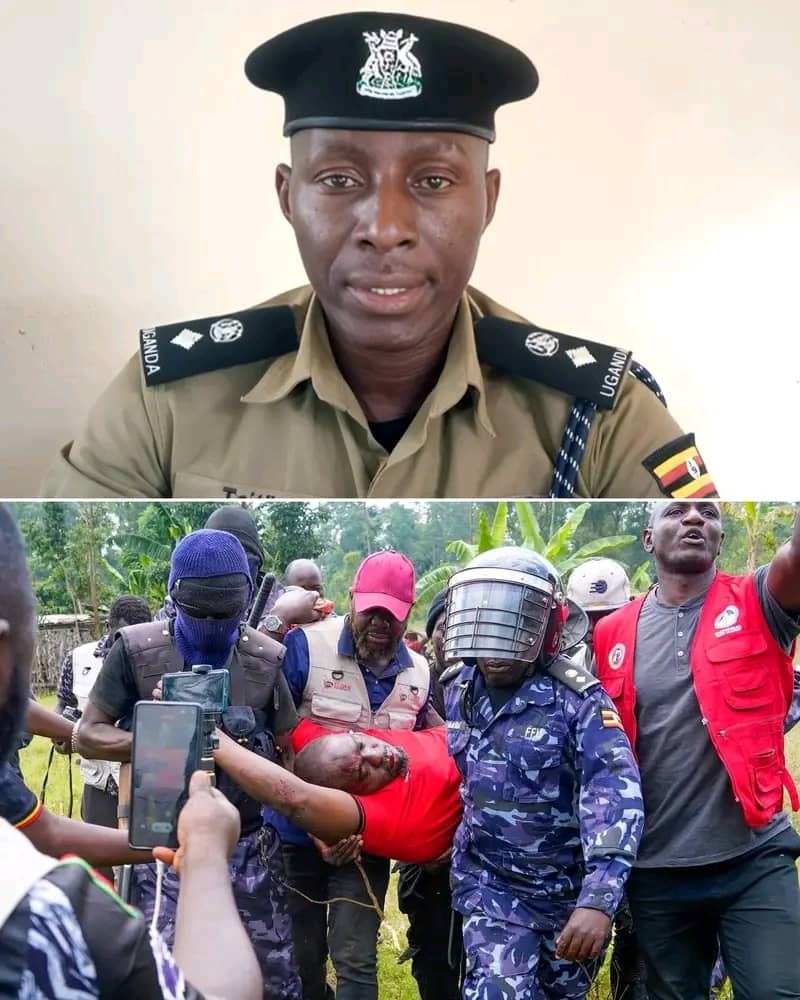
Tension rises in Sironko as police deny shooting Bobi Wine’s NUP supporter: Uganda 2026 polls

SIRONKO-(MaraviPost)-Uganda Police have dismissed claims that a National Unity Platform (NUP) supporter was shot during the party’s campaign activities in Sironko District.

The individual, identified as Lubulwa Hamza, sustained a head injury during a scuffle after resisting arrest, not from gunfire, according to police.

Hamza was driving recklessly, ignored orders to stop after overtaking the convoy of NUP presidential candidate Robert Kyagulanyi (Bobi Wine), and nearly caused an accident, prompting his interception.

Authorities insist there is no medical evidence of a gunshot wound and have urged the public to remain calm as investigations continue.

The incident has sparked rising tensions ahead of the 2026 elections, with conflicting accounts from NUP supporters and police.

Elgon Region Police spokesperson SP Rogers Taitika emphasized that allegations of a shooting are false and unsupported by clinical evidence.


Discover more from The Maravi Post

Subscribe to get the latest posts sent to your email.

The Maravi Post