As the Pandemic Devastates the Poor, the World’s 10 Richest Have Multiplied their Wealth into Trillions

Featured, Global, Global Governance, Headlines, IPS UN: Inside the Glasshouse, Poverty & SDGs, Sustainability, TerraViva United Nations

In Malawi, some students have been going to school amid the COVID-19 pandemic. Credit: UNICEF/Malumbo Simwaka

UNITED NATIONS, Jan 17 2022 (IPS) – The numbers are unbelievably staggering: the world’s 10 richest men more than doubled their fortunes from $700 billion to $1.5 trillion —at a rate of $15,000 per second or $1.3 billion a day, according to a new study from Oxfam International.


These phenomenal changes in fortunes took place during the first two years of a Covid-19 pandemic that has seen the incomes of 99 percent of humanity fall, and over 160 million more people forced into poverty—60 million more than the figures released by the World Bank in 2020.

“If these ten men were to lose 99.999 percent of their wealth tomorrow, they would still be richer than 99 percent of all the people on this planet,” said Oxfam International’s Executive Director Gabriela Bucher.
“They now have six times more wealth than the poorest 3.1 billion people.”

“It has never been so important to start righting the violent wrongs of this obscene inequality by clawing back elites’ power and extreme wealth including through taxation —getting that money back into the real economy and to save lives,” she said.

According to Forbes magazine, the 10 richest people, as of 30 November 2021, who have seen their fortunes grow, include Elon Musk, Jeff Bezos, Bernard Arnault & family, Bill Gates, Larry Ellison, Larry Page, Sergey Brin, Mark Zuckerberg, Steve Ballmer and Warren Buffet.

The pandemic has hit the poorest people, women and racialized and marginalized groups the hardest. For example, in the US, 3.4 million Black Americans would be alive today if their life expectancy was the same as White people —this is directly linked to historical racism and colonialism, according to the study titled “Inequality Kills” released January 17, ahead of the World Economic Forum’s (WEF) online Davos Agenda.

The report finds that a new billionaire is created every 26 hours while inequality is contributing to the death of at least 21,000 people each day, or one person every four seconds.

Other findings include:

    — The pandemic has set gender parity back from 99 years to now 135 years. 252 men have more wealth than all 1 billion women and girls in Africa and Latin America and the Caribbean combined.

    — During the second wave of the pandemic in England, people of Bangladeshi origin were five times more likely to die of COVID-19 than the White British population. Black people in Brazil are 1.5 times more likely to die from COVID-19 than White people.

    — Inequality between countries is expected to rise for the first time in a generation. The proportion of people with COVID-19 who die from the virus in developing countries is roughly double that in rich countries.

Asked for his comments, Ben Phillips, author of How to Fight Inequality, told IPS the new report “confirms four vital truths about inequality are now proven beyond doubt.

Firstly, inequality kills. Inequality is not just inefficient and unfair. As the data shows, it is deadly.

Secondly, inequality is spiralling. The driving cause is neoliberalism, but it has now been supercharged by the pandemic.

Thirdly, inequality is a political choice. The rise in inequality is not inevitable. Governments can reduce inequality if they decide to do so.

Fourthly, policy-makers will only shift if we make them do so. A reversal in inequality depends on us, ordinary citizens, organizing to push our leaders to make them do their job and put in place the policies that will deliver a fairer, safer, world.”

Striking a hopeful note, Phillips said: “Though the crisis has made inequality even worse and even harder to bear,” he said, “the crisis also, paradoxically, has generated an opportunity for transformational shift to tackle inequality, if we seize this moment”.

“We know the policy mix needed – get the vaccine to everyone by sharing the rights and recipes, drop the debt, expand public services like free health and education, raise up ordinary people’s wages and worker’s rights, tackle discrimination, put money in the hands of ordinary people, and properly tax, and restrain the economic and political power, of big corporations and the super-rich.”

Change depends on ordinary people, Phillips said. “The myths of equal opportunity and rising tides have been busted, but the truth alone will not set us free. Left to itself, the rigged economy will continue to worsen inequality. Left to themselves, politicians will allow it, even enable it, to do so.

Only pressure from below can secure a reversal of rising inequality. The good news is that around the world, frustration is increasingly being channelled into a resurgence of organizing that has potential to shift the balance of power.

Unions, community organizations, women’s groups, progressive faith organizations and social movements are standing up and standing together. This is the source of hope. This is our chance – if enough people join in. Inequality defines this moment but need not be our fate,” declared Phillips.

According to the Oxfam report, billionaires’ wealth has risen more since COVID-19 began than it has in the last 14 years. At $5 trillion dollars, this is the biggest surge in billionaire wealth since records began. A one-off 99 percent tax on the ten richest men’s pandemic windfalls, for example, could pay:

    — to make enough vaccines for the world;
    — to provide universal healthcare and social protection, fund climate adaptation and reduce gender-based violence in over 80 countries;
    — All this, while still leaving these men $8 billion better off than they were before the pandemic.

“Billionaires have had a terrific pandemic. Central banks pumped trillions of dollars into financial markets to save the economy, yet much of that has ended up lining the pockets of billionaires riding a stock market boom. Vaccines were meant to end this pandemic, yet rich governments allowed pharma billionaires and monopolies to cut off the supply to billions of people. The result is that every kind of inequality imaginable risks rising. The predictability of it is sickening. The consequences of it kill,” said Bucher.

Extreme inequality is a form of economic violence, where policies and political decisions that perpetuate the wealth and power of a privileged few results in direct harm to the vast majority of ordinary people across the world and the planet itself.

Oxfam recommends that governments urgently:

    — Claw back the gains made by billionaires by taxing this huge new wealth made since the start of the pandemic through permanent wealth and capital taxes.

    — Invest the trillions that could be raised by these taxes toward progressive spending on universal healthcare and social protection, climate change adaptation, and gender-based violence prevention and programming.

    — Tackle sexist and racist laws that discriminate against women and racialized people and create new gender-equal laws to uproot violence and discrimination. All sectors of society must urgently define policies that will ensure women, racialized and other oppressed groups are represented in all decision-making spaces.

    — End laws that undermine the rights of workers to unionize and strike, and set up stronger legal standards to protect them.

    — And rich governments must immediately waive intellectual property rules over COVID-19 vaccine technologies to allow more countries to produce safe and effective vaccines to usher in the end of the pandemic.

Download the “Inequality Kills” report and summary and the methodology document outlining how Oxfam calculated the statistics in the report.

Oxfam’s calculations are based on the most up-to-date and comprehensive data sources available. Figures on the very richest in society come from Forbes’ 2021 Billionaires List. Figures on the share of wealth come from the Credit Suisse Research Institute’s Global Wealth Databook 2021. Figures on the incomes of the 99 percent are from the World Bank.

  Source

SAD|| Lady Dies While On Honeymoon Just 10 Days After Wedding (Photos)

An African-American socialite by the name of Tatiana has reportedly died just 10 days after her wedding ceremony while she was on a honeymoon with her husband.

According to reports, Tatiana was said to have traveled to Cameroon to fast track her wedding with her boyfriend but unfortunately died just ten days after the wedding ceremony.

Friends of Tatiana revealed that she had complained of a stomach ache before giving up the ghost a few hours later. Her death has shaken social media as all eyes were on her and her spouse for holding what many describe as one of the plush weddings for 2021.


See her wedding photos below:

(Visited 1 times, 1 visits today)

Subscribe to our Youtube Channel :

Follow Us on Instagram Source

On Nuclear Weapons, Actions Belie Reassuring Words

Armed Conflicts, Civil Society, Featured, Global, Global Geopolitics, Global Governance, Headlines, IPS UN: Inside the Glasshouse, Nuclear Energy – Nuclear Weapons, Peace, TerraViva United Nations

Opinion

Credit: Campaign for Nuclear Disarmament/Henry Kenyon

WASHINGTON DC, Jan 13 2022 (IPS) – On Jan. 3, the leaders of the five nuclear-armed members of the nuclear Nonproliferation Treaty (NPT) issued a rare joint statement on preventing nuclear war in which they affirmed, for the first time, the 1985 Reagan-Gorbachev maxim that “a nuclear war cannot be won and must never be fought.”


The U.S., Chinese, French, Russian, and UK effort was designed in part to create a positive atmosphere for the 10th NPT review conference, which has been delayed again by the pandemic. It also clearly aims to address global concerns about the rising danger of nuclear conflict among states and signals a potential for further cooperation to address this existential threat.

The question now is, do they have the will and the skill to translate their laudable intentions into action before it is too late?

U.S. State Department spokesperson Ned Price hailed the statement as “extraordinary.” A more sober reading shows that it falls woefully short of committing the five to the policies and actions necessary to prevent nuclear war.

In fact, the statement illustrates how their blind faith in deterrence theories, which hinge on a credible threat of using nuclear weapons, perpetuates conditions that could lead to nuclear catastrophe.

The statement asserts that “nuclear weapons—for as long as they continue to exist—should serve defensive purposes, deter aggression, and prevent war.” Yet, such broad language suggests they might use nuclear weapons to “defend” themselves against a wide range of threats, including non-nuclear threats.

Given the indiscriminate and horrific effects of nuclear weapons use, such policies are dangerous, immoral, and legally unjustifiable.

At the very least, if the leaders of these states are serious about averting nuclear war, they should formally adopt no-first-use policies or, as U.S. President Joe Biden promised in 2020, declare that the sole purpose of nuclear weapons is to deter or possibly respond to a nuclear attack.

Even this approach perpetuates circumstances that could lead to nuclear war by accident or miscalculation. The only way to ensure nuclear weapons are never used is “to do away with them entirely,” as President Ronald Reagan argued in 1984, and sooner rather than later.

But on disarmament, the statement only expressed a “desire to work with all states to create a security environment more conducive to progress on disarmament with the ultimate goal of a world without nuclear weapons with undiminished security for all.” This vague, caveated promise rings hollow after years of stalled disarmament progress and an accelerating global nuclear arms race.

A year ago, Russia and the United States extended the 2010 New Strategic Arms Reduction Treaty, but they have not begun negotiations on a follow-on agreement. Meanwhile, both spend billions of dollars annually to maintain and upgrade their nuclear forces, which far exceed any rational concept of what it takes to deter a nuclear attack.

China is on pace to double or triple the size of its land-based strategic missile force in the coming years. Worse still, despite past promises “to engage in the process leading to the total elimination of nuclear weapons,” Chinese leaders are rebuffing calls to engage in arms control talks with the United States and others. The United Kingdom, meanwhile, announced last year it would increase its deployed strategic warhead ceiling.

Fresh statements by the five NPT nuclear-armed states reaffirming their “intention” to fulfill their NPT disarmament obligations are hardly credible in the absence of time-bound commitments to specific disarmament actions.

At the same time, the five, led by France, have criticized the good faith efforts by the majority of NPT non-nuclear-weapon states-parties to advance the 2017 Treaty on the Prohibition of Nuclear Weapons (TPNW). Contrary to claims by the nuclear-armed states, the TPNW reinforces the NPT and the norm against possessing, testing, and using nuclear weapons.

Rather than engage TPNW leaders on their substantive concerns, U.S. officials are pressuring influential states, including Sweden, Germany, and Japan, not to attend the first meeting of TPNW states-parties as observers. Such bullying will only reinforce enthusiasm for the TPNW and undermine U.S. credibility on nuclear matters.

The leaders of the nuclear five, especially Biden, can and must do better. Before the NPT review conference later this year, Russia and the United States should commit to conclude by 2025 negotiations on further verifiable cuts in strategic and nonstrategic nuclear forces and on constraints on long-range missile defenses.

China, France, and the UK should agree to join nuclear arms control talks no later than 2025 and to freeze their stockpiles as Washington and Moscow negotiate deeper cuts in theirs.

Instead of belittling the TPNW, the five states need to get their own houses in order. Concrete action on disarmament is overdue. It will help create a more stable and peaceful international security environment and facilitate the transformative move from unsustainable and dangerous deterrence doctrines toward a world free of the fear of nuclear Armageddon.

Source: Arms Control Today

Daryl G. Kimball is Executive Director of the Arms Control Association, Washington DC.

  Source

Lady Dies Whiles On Honeymoon Just 10 Days After Wedding [Photos]

An African-American socialite by the name of Tatiana has reportedly died just 10 days after her wedding ceremony while she was on a honeymoon with her husband.

According to reports, Tatiana was said to have traveled to Cameroon to fast track her wedding with her boyfriend but unfortunately died just ten days after the wedding ceremony.

Friends of Tatiana revealed that she had complained of a stomach ache before giving up the ghost a few hours later. Her death has shaken social media as all eyes were on her and her spouse for holding what many describe as one of the plush weddings for 2021.


See her wedding photos below:

In other news, Ghanaian media personality and business mogul, Deloris Frimpong Manso, affectionately known as Delay has come out with a clearer yet hilarious explanation as to why she always has trust issues.

Trusting is a decision you must make knowing there are never any guarantees that you won’t feel this way again in the future. Trust happens to be one of the most-priced values in life, hence it is very difficult for one to give it out completely.

Trusting people too much makes you vulnerable, but on the flip side, not trusting people enough makes cooperation difficult or impossible and also severely harms your odds of building meaningful relationships with people.

(Visited 91 times, 19 visits today)

Subscribe to our Youtube Channel :

Follow Us on Instagram Source

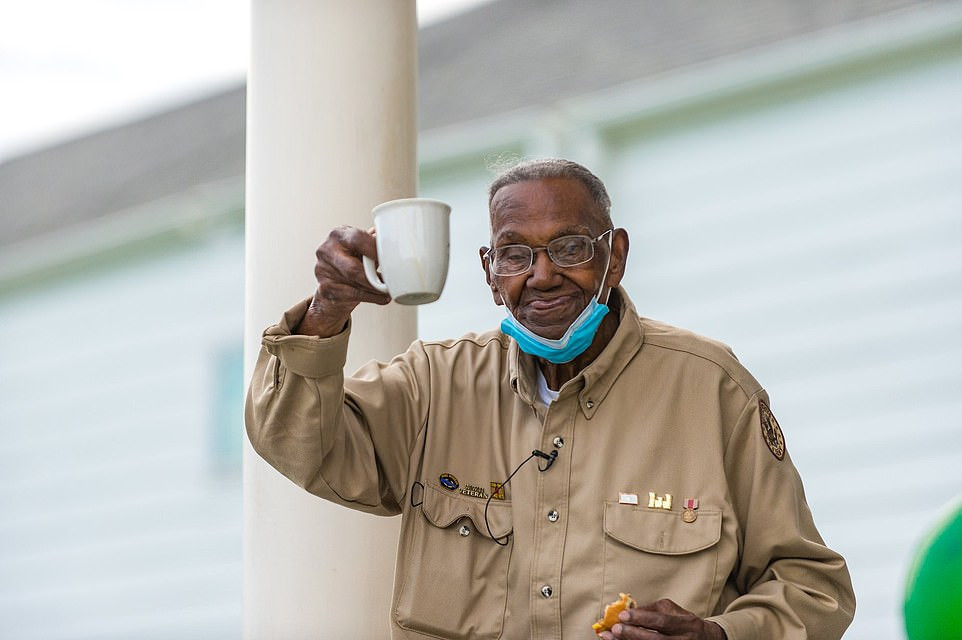
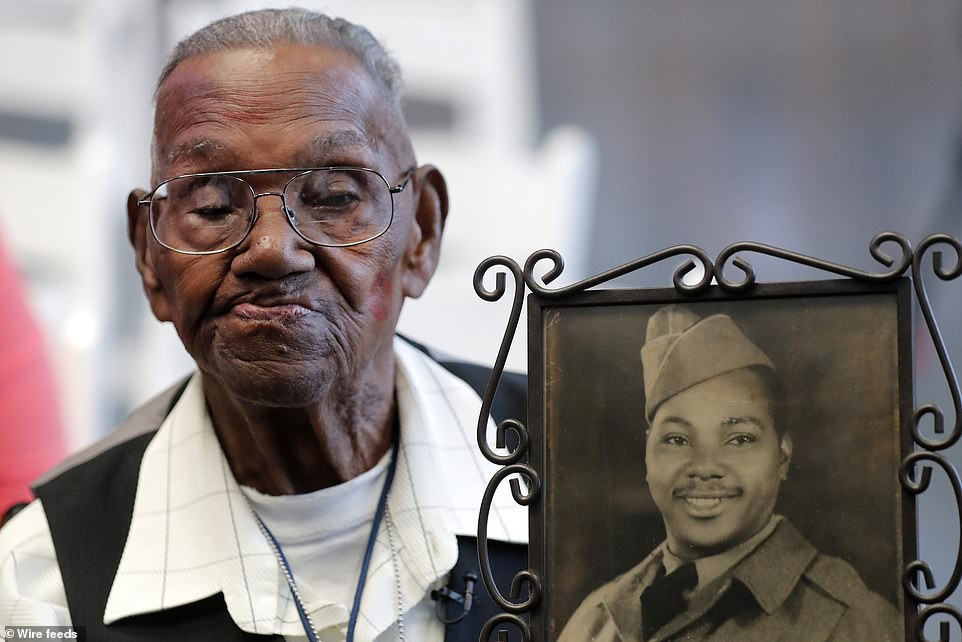
Oldest surviving World War II veteran Lawrence Brooks dies at 112

Lawrence Brooks, the oldest surviving World War II veteran, who served in a segregated Army unit in the South Pacific in the 1940s has died.

He died in his New Orleans home Wednesday morning, January 5, 2022 at the age of 112.

While in service, Lawrence N. Brooks was part of the mostly black 91st Engineer General Service Regiment, which built roads, hospitals and housing in places like Horn Island, Papua-New Guinea and the Philippines, according to Military Times.

Oldest surviving World War II veteran Lawrence Brooks dies aged 112

He was drafted in 1940 at the age of 31. Even though he never saw combat, he worked as a driver and cook for his white officers. Most African Americans serving in the segregated US armed forces at the beginning of World War II were assigned to noncombat units and relegated to service duties, such as supply, maintenance and transportation, said Col. Pete Crean, vice president of education and access at the museum in New Orleans.

‘The reason for that was outright racism – there’s no other way to characterize it,’ Crean added.

Oldest surviving World War II veteran Lawrence Brooks dies aged 112

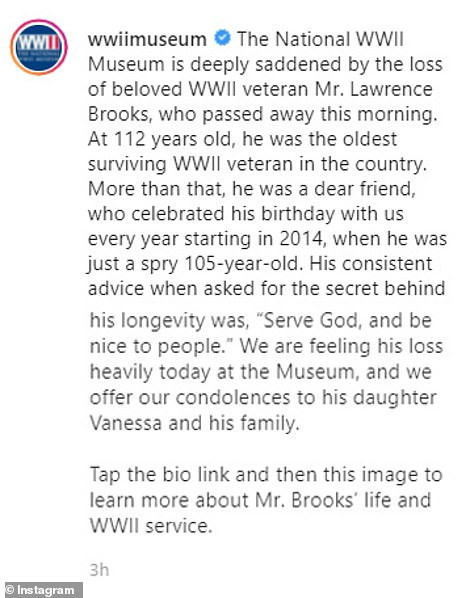
The National WWII Museum announced his death and it was confirmed by his daughter and caregiver, Vanessa Brooks. He is survived by five children, 13 grandchildren and 32 great-grandchildren.

‘At 112 years old, he was the oldest surviving WWII veteran in the country,’ the museum wrote on Instagram.

 ‘More than that, he was a dear friend, who celebrated his birthday with us every year starting in 2014, when he was just a spry 105-year-old.

‘His consistent advice when asked for the secret behind his longevity was, “Serve God, and be nice to people.”‘

Oldest surviving World War II veteran Lawrence Brooks dies aged 112

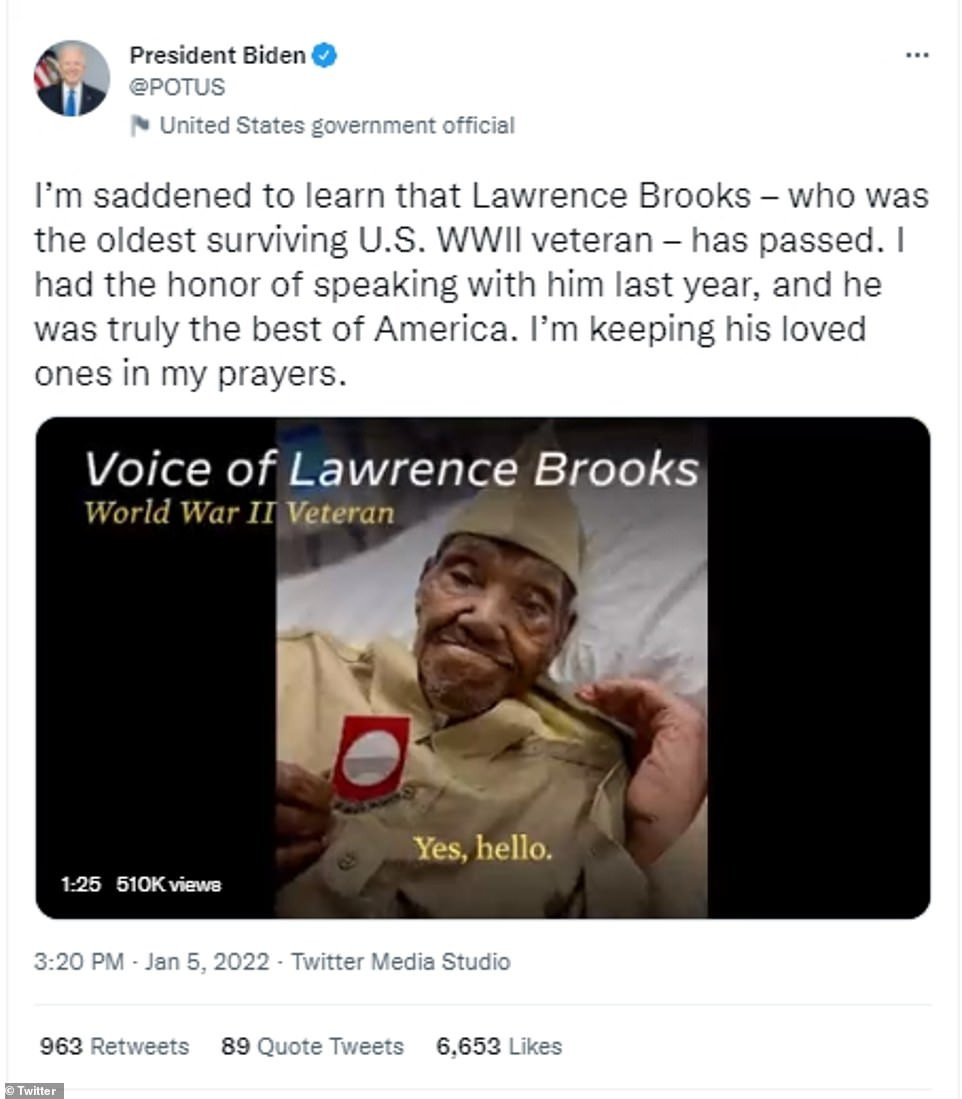
US president, Joe Biden also tweeted a tribute to Brooks, writing;

‘I had the honor of speaking with him last year, and he was truly the best of America. I’m keeping his loved ones in my prayers.’

Oldest surviving World War II veteran Lawrence Brooks dies aged 112
The Maravi Post has over one billion views since its inception in December of 2009. Viewed in over 100 countries Follow US: Twitter @maravipost
Facebook Page : maravipost Instagram: maravipost    

NBS Bank Your Caring BankNBS Bank Your Caring Bank

Source

Stories that changed us in 2021: Redrawing the conversation about race

YE Reporter's Notebook Equity

FILE – In this June 25, 2021, file image taken from pool video, former Minneapolis police Officer Derek Chauvin addresses the court as Hennepin County Judge Peter Cahill presides over Chauvin’s sentencing at the Hennepin County Courthouse in Minneapolis. Chauvin pleaded guilty Wednesday, Dec. 15, to a federal charge of violating George Floyd’s civil rights, admitting for the first time that he kept his knee on Floyd’s neck, resulting in the Black man’s death. Chauvin was convicted earlier of state murder and manslaughter charges in Floyd’s May 25, 2020, death. 

After 2020 became a year of racial reckoning with the public killing of George Floyd and the protests of injustices against Black people, 2021 offered what can best be described as a follow-up year — a continuation of some familiar story threads with other new ones emerging.

Derek Chauvin, the former police officer who killed Floyd, was convicted of murder. Three men in Georgia were convicted in the killing of Ahmaud Arbery. A white gunman in Atlanta killed eight people, six of Asian descent. The movement to identify and reckon with structural racism rolled forward. And as local and state governments grappled with the removal of statues of racist historical figures, local school boards fought over how to teach the uneasy history of racism in the United States.

YE Reporter's Notebook Equity

FILE – Ahmaud Arbery’s mother, Wanda Cooper-Jones his hugged by a supporter after the jury convicted Travis McMichael in the trial of McMichael, his father, Greg McMichael, and neighbor, William “Roddie” Bryan, Wednesday, Nov. 24, 2021, in the Glynn County Courthouse in Brunswick, Ga. The three defendants were found guilty Wednesday in the death of Ahmaud Arbery. 

Against this backdrop, AP’s Race and Ethnicity team tried to capture the story both in sweep and in painstaking detail. Here, some AP journalists from that team involved in the coverage reflect on some of the year’s stories and how journalism handles the coverage of race.

People are also reading…

KAT STAFFORD, AP national investigative race writer:

I feel as if 2021 was really a continuation of everything that we dealt with in 2020. Race is still the story. It is still that constant through line to a lot of the issues that we have been covering. … This country right now is at a place where people are demanding that we talk more frankly about the role of structural and systemic racism and how that has led to all of these inequities that really cross over into every single beat that we cover here at AP. So that’s been what I’ve been reflecting on — how racism is at the forefront of all of these issues. And it’s not going away anytime soon.

YE Reporter's Notebook Equity

FILE – In this May 25, 2020, file photo, from police body camera video George Floyd responds to police after they approached his car outside Cup Foods in Minneapolis. 

Journalists of color for decades in this country have been trying to bring race and coverage of inequity to the forefront, but it’s been a struggle. I don’t think that’s a secret. And I think that there are still struggles in terms of how to make sure that coverage is equitable, how to make sure that we are centering these voices from communities that have been ignored for so long.

I wrote a story this year about the amount of grief that Black Americans in particular are feeling because of the constant stream of Black Americans dying at the hands of police but also the toll of the dead that we’ve seen from the pandemic. So paying attention to grief and how people are grappling with all these issues that are impacting them right now. I would also say climate change. I think that looking forward, we’re all in some way or another going to be climate reporters because this is a topic that intersects race and inequity — and intersects every single beat that we cover. So I think when we saw the hurricane earlier this year, there was a lot of talk about is this yet another example of how climate and environmental issues are going to have a disparate toll on communities of color.

I firmly believe that race coverage is not a standalone topic. It’s not a special interest topic, right? This is the through line in all of the coverage areas that we have in AP as well as other news organizations. So I think we as journalists right now in this moment really need to think about how we can dig deeper. How can we go beyond the breaking news headlines, and really tell robust stories and create robust coverage that moves the conversation forward, but again, you know, stick with the facts and report the truth? I think that is really one of the most important issues facing journalism right now.

TERRY TANG, AP Race & Ethnicity reporter:

What kind of sticks out in my mind is the Gabby Petito case, how it brought back around that whole conversation about missing white woman syndrome. And are we as one of multiple news organizations doing enough to cover the nonwhite victims in those kinds of cases? That’s something that I was sort of re examining. I’m glad that I got to help out on the story about that issue, where a few of us went out and tried to find family members of missing persons of color and give them a chance to speak. So I was grateful to be able to do that, and give a couple of families a platform. So that’s something that I’m going to try to remember in the future is how can we address those gaps so it’s not just the white high-income person who’s getting attention.

People think that it’s kind of out of the ordinary when somebody who comes from the middle class or higher goes missing mysteriously like that, and especially on something like being able to afford to take a cross-country road trip. That’s more a luxury. Whereas people of color who go missing are probably not always from the middle class and they’re not doing something glamorous-sounding like taking a road trip. And they don’t have a smartphone or have a presence and leave a trail on social media.

YE Reporter's Notebook Equity

FILE – Law enforcement officials confer outside a massage parlor following a shooting on Tuesday, March 16, 2021, in Atlanta. Shootings at two massage parlors in Atlanta and one in the suburbs left multiple people dead, many of them women of Asian descent. After after the shootings, there was an overwhelming wave of support for the Asian American community. 

I think initially, after the shootings, there was an overwhelming wave of support for the Asian American experience right now in the age of COVID. And you know, it did matter that there were a lot of people who were not Asian speaking out. And yes, it was nice, for a while to see all these people — not Asian as well — who were you know, using the #StopAAPIHate or #StopAsianHate hashtags. And to degree you know, it was nice to see certain companies, corporations, and even small businesses echo those sentiments. But, of course, like anything, I feel like it’s kind of petered out somewhat. I mean, even as recently as this month there’s an elderly man in Chicago who was shot and killed very viciously in the Chinatown neighborhood there. And I only see outrage among Asian American social media channels or independent Asian American social media platforms like Instagram accounts, Twitter accounts where their mission is to just go and pull out like all Asian American news. But I don’t see much outrage beyond that.

As dark and harrowing as some of the news has been, you know, there’s been some positive things too. I mean, at the same time that all this is happening, there were a lot of Asian Americans who were really happy by the increase in on-screen representation and also as a chance to escape the darkness of real life. Like, I have to say, “Shang-Chi,” the Marvel movie, to some people it’s just a comic-book movie but for a lot of people it was a big step in representation in media. … For a lot of people to see someone who looks like them up on the big screen, being the action hero, was important, although I think we’re also ready to see more roles outside of martial arts roles, even if they are very fleshed out and three dimensional.

YE Reporter's Notebook Equity

FILE – Ernie, a muppet from the popular children’s series “Sesame Street,” appears with new character Ji-Young, the first Asian American muppet, on the set of the long-running children’s program in New York on Nov. 1, 2021. Ji-Young is Korean American and has two passions: rocking out on her electric guitar and skateboarding. 

I will say that one of maybe my favorite stories of 2021 was the new Asian American muppet on “Sesame Street.” Growing up watching “Sesame Street,” I never thought I’d write a story about an Asian American muppet.

ANDALE GROSS, AP Race & Ethnicity editor and team leader:

One thing we will obviously keep an eye on going into this next year is those issues that we know are going to be at the forefront, whether it’s voting rights, particularly with the Black and Latino vote, but obviously other groups as well; whether it’s looking at law enforcement in have things changed? Are there some signs of reform? Is there any kind of indication or signaling there’ll be some progress?

And then of course we will be looking closely at hate crimes, continue to look at health and also looking at education, because another issue that came up this year was the teaching of history, particularly history around slavery, and how the groups of people who make up America came to be here in America. There’s push and pull about whether to tell the story particularly to young people, or to protect them from some aspects of it. That push and pull with education is going to continue to be something we see in the next year, particularly as you have local school board races and things like that.

YE Reporter's Notebook Equity

FILE – Crews remove one of the country’s largest remaining monuments to the Confederacy, a towering statue of Confederate General Robert E. Lee on Monument Avenue in Richmond, Va., Wednesday, Sept. 8, 2021. The movement to identify and reckon with structural racism moved forward in 2021. As local and state governments grappled with the removal of statues of racist historical figures, local school boards fought over how to teach the uneasy history of racism in the United States. 

We’re definitely talking about race more, and it’s definitely more front and center than it has been in decades past. Where we really need to improve is everybody kind of settling down and putting aside their perspective on the race situation and then hearing it from other people’s perspectives and assessing all sides. There’s so much emotion on both sides. Obviously, there’s more than two sides, but on all these different ends of it there’s so much emotion involved. That’s when things just become more agitated, and politicized and even more divisive. It’s messy. It’s complicated. But I think people are now more willing to at least address it.

#pu-email-form-breaking-email-article { clear: both; background-color: #fff; color: #222; background-position: bottom; background-repeat: no-repeat; padding: 15px 20px; margin-bottom: 40px; border-top: 4px solid rgba(0,0,0,.8); border-bottom: 1px solid rgba(0,0,0,.2); display: none; } #pu-email-form-breaking-email-article, #pu-email-form-breaking-email-article p { font-family: -apple-system, BlinkMacSystemFont, “Segoe UI”, Helvetica, Arial, sans-serif, “Apple Color Emoji”, “Segoe UI Emoji”, “Segoe UI Symbol”; } #pu-email-form-breaking-email-article h1 { font-size: 24px; margin: 15px 0 5px 0; font-family: “serif-ds”, Times, “Times New Roman”, serif; } #pu-email-form-breaking-email-article .lead { margin-bottom: 5px; } #pu-email-form-breaking-email-article .email-desc { font-size: 16px; line-height: 20px; margin-bottom: 5px; opacity: 0.7; } #pu-email-form-breaking-email-article form { padding: 10px 30px 5px 30px; } #pu-email-form-breaking-email-article .disclaimer { opacity: 0.5; margin-bottom: 0; line-height: 100%; } #pu-email-form-breaking-email-article .disclaimer a { color: #222; text-decoration: underline; } #pu-email-form-breaking-email-article .email-hammer { border-bottom: 3px solid #222; opacity: .5; display: inline-block; padding: 0 10px 5px 10px; margin-bottom: -5px; font-size: 16px; } @media (max-width: 991px) { #pu-email-form-breaking-email-article form { padding: 10px 0 5px 0; } }

Source