2021 was greeted with many uncertainties, with many wondering how long coronavirus would continue to stay with us. In the midst of the uncertainties, news about the disappearance of 20-year-old Senegalese student Diary Sow broke.
Described as a punctual and serious student, the absence of Diary Sow after the Christmas holidays came as a worry to many around her.
Ten months later, Diary Sow published a novel about a young woman fleeing, in order to respond to criticism and reclaim her story.
In the same month, the world was hit by the sad news of the demise of black actor Cicely Tyson, icon for two generations of African-American actors and Broadway figure, who died on January 28.
After a year of absence, the International Animation Film Festival returned to Annecy, France. African animation was in the spotlight with retrospectives, on-site screenings and online conferences.
If you are a food lover who found yourself in Lyon in September then I guess you loved the Lyon food festival. Chefs from several African countries were invited to introduce the diversity and richness of African cuisines to Europeans.
Still in September Pianist Ray Lema paid tribute to one of the pillars of Congolese Rumba, Franco Luambo. Ray Lema accompanied by his eight musicians performed on the stage of the Musée des confluences.
In December, the Congolese rumba, got the oppourtunity to be listed on UNESCOs intangible heritage list.
2021 also marked the return of several African art works stolen by European countries during the colonial era. While Ethiopia presented in November its arts objects looted by British soldiers over 150 year ago, Benin welcomed nearly 30 royal treasures looted by France more than 130 years ago.
Abdulrazak Gurnah, a former refugee from Zanzibar received his nobel prize for literature. The writer is the first author of African origin to receive the distinctions in 2003.
A review of 2021 would not be complete without recognizing the fact that event organisers got the oppourtunity to organize face to face events after a year of going virtual due to Covid 19.
This time, the public was able to admire creative designs from Ghana, Benin, south Africa, Nigeria and other parts of the region.
Just when we thought the industry had had a good year with all the glitz, glam and exceptional exhibition of the African culture, the fashion industry was hit with a sad news in November.
A Ghanaian American fashion stylist, Virgil Abloh who was the artistic director for the men’s collection for the house of Louis Vuitton died at the age of 41 after battling cancer.
The Maravi Posthas over one billion views since its inception in December of 2009. Viewed in over 100 countriesFollow US: Twitter @maravipost
Facebook Page : maravipost Instagram: maravipost
The continued rise of new COVID cases throughout the state, especially those from the Omicron and Delta variants, is pushing California health officials to keep the public informed and protected during the Christmas holiday season.
According to data collected in November and early December, California Department of Public Health officials have confirmed 4,909,188 COVID-19 cases — the current average daily rate of cases stood at 5,307 — and 74,996 deaths since the pandemic began.
The number of new cases remains high among those who are not vaccinated. According to Public Health, unvaccinated people were 7.1 times more likely get COVID-19 (from data collected between Nov. 28 and Dec. 4); 12.8 times more likely to be hospitalized for COVID-19 (from data collected Nov. 21 to Nov. 27); and 15.8 times more likely to die from COVID-19 (from data collected Nov. 14 to Nov. 20) than people who were vaccinated.
Latinos (52.3%) have had the largest number of COVID cases (52.3%) and deaths (45.5%), in the state, followed by whites, Asians and African Americans.
These totals are expected to increase as more people travel into and out of California through Christmas and New Year’s Day.
Health officials reinstated the wearing of face masks in all indoor settings — whether vaccinated or not — on Dec. 15, and the mandate will stay in place at least through Jan.15.
The following individuals are exempt from wearing masks at all times:
Persons younger than two years old. Very young children must not wear a mask because of the risk of suffocation.
Persons with a medical condition, mental health condition, or disability that prevents wearing a mask. This includes persons with a medical condition for whom wearing a mask could obstruct breathing or who are unconscious, incapacitated, or otherwise unable to remove a mask without assistance.
Persons who are hearing impaired, or communicating with a person who is hearing impaired, where the ability to see the mouth is essential for communication.
Persons for whom wearing a mask would create a risk to the person related to their work, as determined by local, state, or federal regulators or workplace safety guidelines.
For those who plan to attend a “mega-event” this holiday season (crowds greater than 1,000 indoors and greater than 10,000 outdoors), if you cannot show proof of vaccination you must then show proof of a negative test result from an antigen test within one day of the event, or proof of a negative result from a PCR test within two days of the event before being allowed to enter the venue.
Current antigen and PCR testing methods can detect the Omicron variant and other variants of COVID-19.
Besides vaccinating, wearing masks, social distancing among people who don’t live with you, good ventilation and the constant washing/sanitizing of your hands, the health department also wants to remind the public to:
— Get Tested. You should immediately get tested for COVID-19 if you are feeling any symptoms — regardless of your vaccination status. COVID-19 symptoms can feel like a common cold (including just “the sniffles”), seasonal allergies, or flu. COVID-19 testing in California is free to anyone who needs it.
— If You Are Returning From a Country of Concern, the CDC recommends that travelers from Southern Africa, Botswana, Zimbabwe, Namibia, Lesotho, Eswatini, Mozambique and Malawi to test within 3-5 days after arrival, quarantine for 7 days, and isolate and test if COVID-19 symptoms develop.
Most important: if you are ill, stay home.
If you are seeking a free test appointment, walk-in test clinic, or want to buy a self-test kit from your local drugstore, you can find a testing site online by call ing (833) 422-4255 or 211.
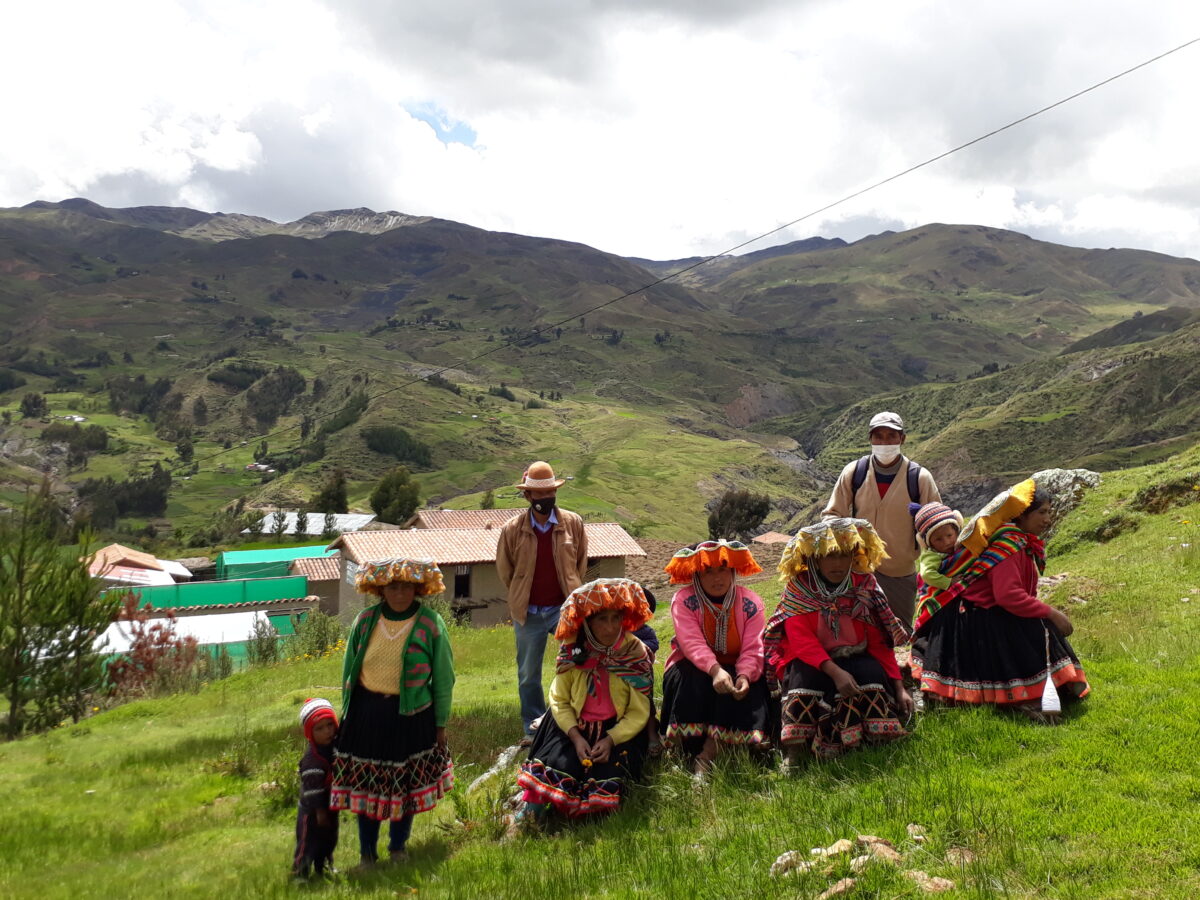
Women and men from the rural community of Sachac, at more than 3500 meters above sea level, build a kilometer-long infiltration ditch to capture rainwater and use it to irrigate crops in Cuzco, in Peru’s Andes highlands. CREDIT: Janet Nina/IPS
CUZCO, Peru , Dec 22 2021 (IPS) – “When I was a little girl we didn’t suffer from water shortages like we do now. Today we are experiencing more droughts, our water sources are drying up and we cannot sit idly by,” Kely Quispe, a small farmer from the community of Huasao, located half an hour from Cuzco, the capital of Peru’s ancient Inca empire, told IPS.
She is one of the 80 members of the Agroecological School of the Flora Tristan Peruvian Women’s Center, a non-governmental institution that has worked for the recovery of water sources through traditional techniques known as seeding and harvesting water in this part of the southern Andean region of Cuzco.
Muñapata, Huasao and Sachac are the three rural Quechua-speaking communities in the province of Quispicanchi, located between 3150 and 3800 meters above sea level, that have so far benefited from the project. The feminist-oriented institution promotes solutions based on nature and community work to address the problem of water scarcity and inadequate water use practices.
“We want to boost water security as well as gender equality because they are two sides of the same coin,” Elena Villanueva told IPS. On Dec. 14 she presented in this city the results of the initiative whose first phase was carried out in 2020 and 2021, with the support of the Basque Development Cooperation Agency and Mugen Gainetik, an international association for cooperation with countries of the developing South also based in Spain’s northern Basque region.
According to the National Water Authority (ANA), Peru is the eighth country in the world in terms of water availability, with a rich hydrodiversity of glaciers, rivers, lakes, lagoons and aquifers. However, various factors such as inefficient management of water and uneven territorial distribution of the population, in addition to climate change, make it impossible to meet consumption demands.
“The lack of water severely affects families in rural areas because they depend on small-scale agriculture for their livelihoods. The melting of glaciers as well as the increase in the frequency and intensity of droughts due to climate change are reducing water availability,” Villanueva explained.
This impact, she said, is not neutral. Because of the gender discrimination and social disadvantages they face, it is rural women who bear the brunt, as their already heavy workload is increased, their health is undermined, and their participation in training and decision-making spaces is further limited.
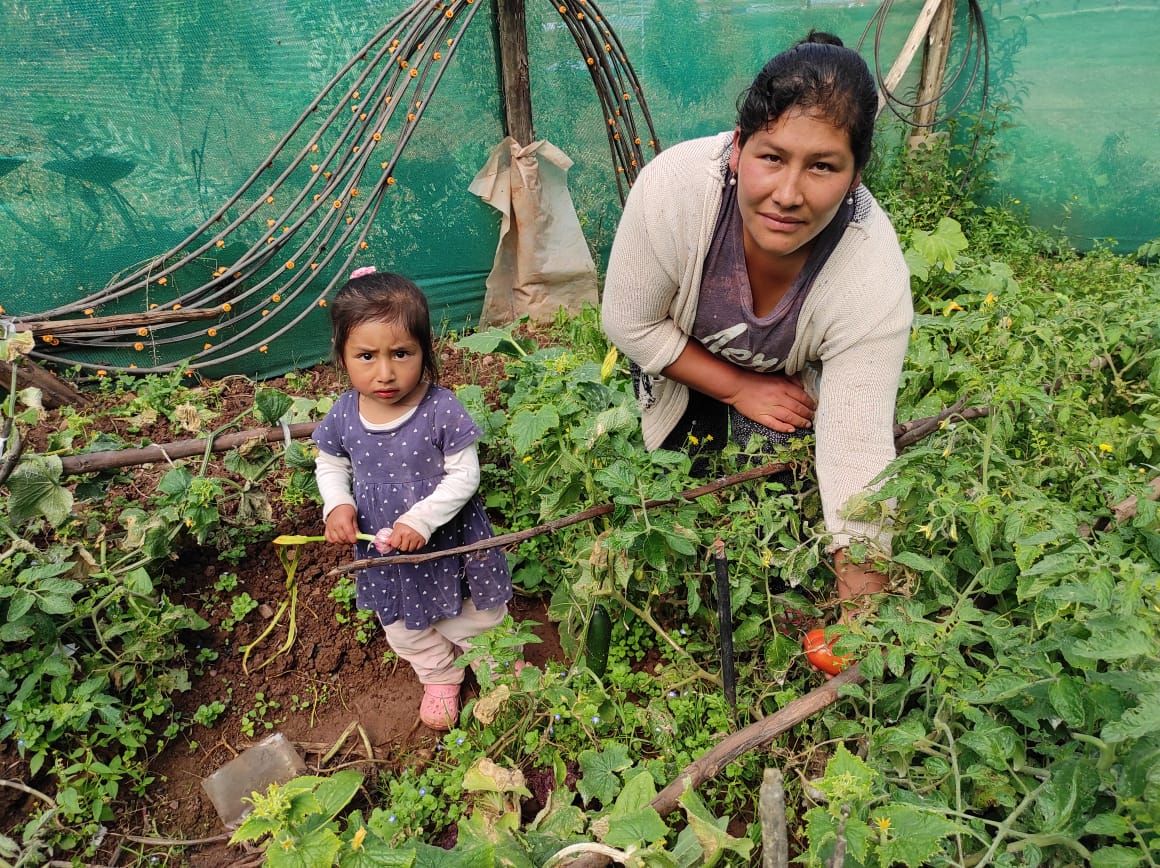
Kely Quispe, a farmer trained at the Flora Tristán Center’s Agroecological School, holds a tomato in her organic garden in the farming community of Huasao. Her vegetable production depends on access to water for irrigation, but climate change has made water more scarce in the Andes highlands region of Cuzco in southern Peru. CREDIT: Janet Nina/IPS
“Moreover, although they are the ones who use water to ensure food, hygiene and health, and to irrigate their crops, they are not part of the decision-making with regard to its management and distribution,” she stressed.
The expert said that precisely in response to demand by the women farmers at the Agroecological School, where they receive technical and rights training, they are focusing on reviving water harvesting techniques used in ancient Peru, while promoting the equal participation of women in rural communities in the process.
She said that approximately 700 families living in poverty, some 3,500 people – about 11 percent of the population of the three communities – will benefit from the works being carried out.
Harvesting water
So far, these works are focused on the afforestation of 15 hectares and the construction of six “cochas” – the name for small earthen ponds, in the Quechua language – and an infiltration ditch, as part of a plan that will be expanded with other initiatives over the next two years.
The ditch, which is one kilometer long in 10-meter stretches, 60 centimeters deep and 40 centimeters wide and is located in the upper part of the community, collects rainwater instead of letting it run down the slopes.
The technique allows water to infiltrate slowly in order to feed natural springs, high altitude wetlands or small native prairies, as well as the cochas.
The mayor of the rural community of Sachac, Eugenio Turpo Quispe (right), poses with other leaders of the village of 200 families who will benefit from the forestation works and the construction of small reservoirs and infiltration ditches that will increase the flow of water in this highlands area that is suffering from prolonged droughts due to climate change. CREDIT: Mariela Jara/IPS
In their communal work, villagers use local materials and greenhouse thermal blankets to help retain water. In addition, they have used extracted soil to raise the height of the ditch, to keep rainwater from running over the top.
Although the ditch has been receiving rainwater this month (the rainy season begins in November-December), the ecosystem impact is expected to be more visible in about three years when the cocha ponds have year-round water availability, helping villagers avoid the shortages of the May-October dry season.
Several community members explained to IPS that they will now be able to harvest water from the ditch while at the same time caring for the soil, because heavy rain washes it away and leaves it without nutrients. Some 150 agricultural plots will also benefit from a sprinkler irrigation system, thanks to the project.
Since agriculture is the main livelihood of the families and this activity depends on rainwater, the main impact will be the availability of water during the increasingly prolonged dry periods to irrigate their crops, ensure harvests and avoid hunger, for both villagers and their livestock.
Eucalyptus and pine, huge consumers of water
The mayor of the Sachac community, Eugenio Turpo Quispe, told IPS that this is the first time that water seeding and harvesting practices have been carried out in his area. “We had not had the opportunity before; these works have begun thanks to the women who proposed forestation and the construction of cochas and ditches,” he said.
The local leader lamented that due to misinformation, two decades ago they planted pine and eucalyptus in the highlands of his community. “They have dried up our water sources, and when it rains the water disappears, it does not infiltrate. Now we know that out of ten liters of rain that falls on the ground, eight are absorbed by the eucalyptus and only two return to the earth,” he explained during the day that IPS spent in the community.
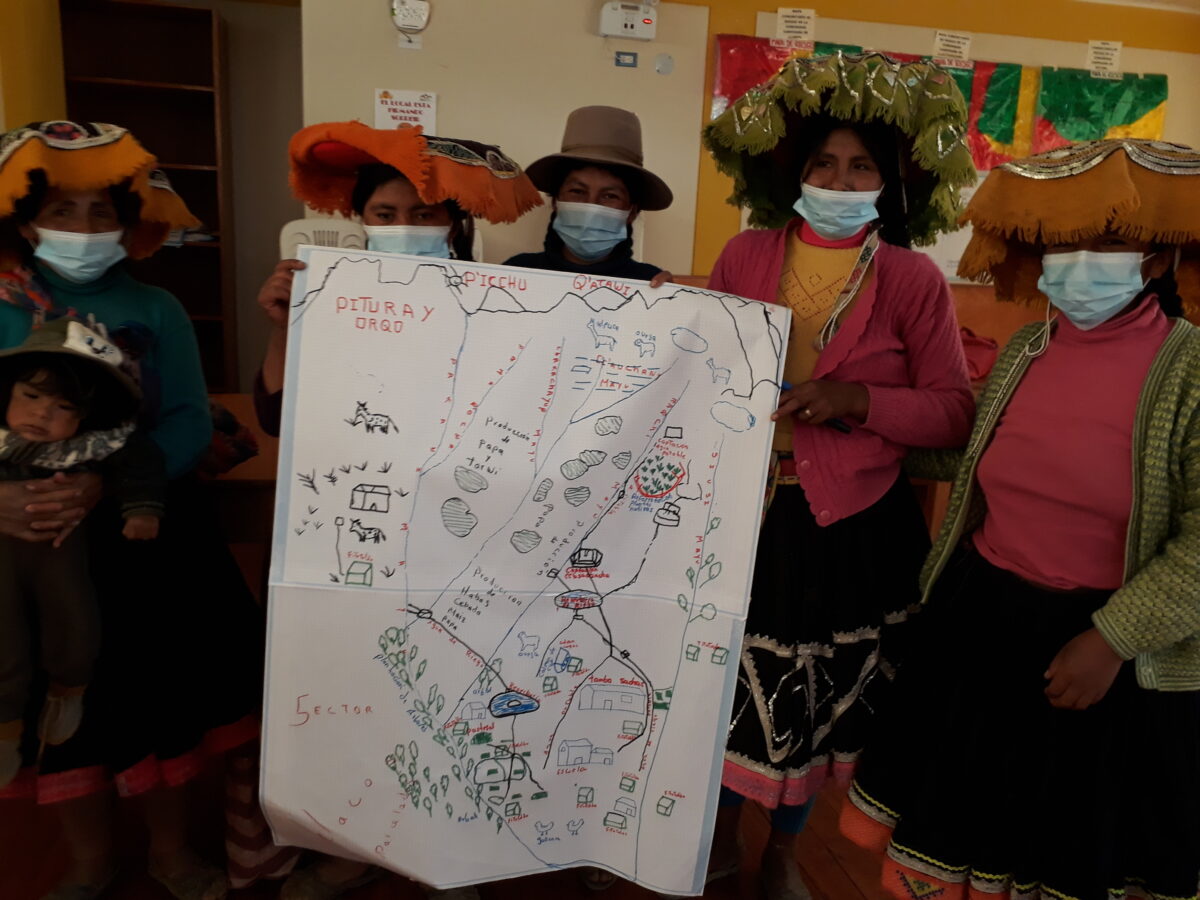
Women farmers from the rural community of Sachac show the map of water sources in their area and the uses for irrigation of their crops, for human consumption and household needs, as well as watering their animals, which they cannot satisfy throughout the year due to the increasingly long and severe dry season. CREDIT: Mariela Jara/IPS
Turpo Quispe said they had seen forestation and construction of cochas and ditches in other communities, but did not know how to replicate them, and that only through the Flora Tristán Center’s project have they been able to implement these solutions to tackle the serious problem of shrinking water sources.
In Sachac, the three techniques have been adopted with the participation of women and men in communal work that began at six in the morning and ended at four in the afternoon. “Side by side we have been planting native plants, digging ditches and hauling stones for the cochas,” the mayor said proudly.
In this community, 9,000 seedlings of queuñas (Polylepis) and chachacomos (Escallonia Resinosas) – tree species that were used in the times of the ancient Inca empire – were planted. “These trees consume only two liters of rainwater and give eight back to Pachamama (Mother Earth),” Turpo Quispe said. As part of the project, the community has built fences to protect crops and has relocated grazing areas for their animals.
“We have planted seedlings and in 10 or 15 years our children and grandchildren will see all our hills green and with living springs so that they do not suffer a lack of water,” the mayor said.
Kely Quispe from the community of Huasao is equally upbeat: “With water we can irrigate our potatoes, corn and vegetables; increase our production to have enough to sell and have extra money; take care of our health and that of the whole family, and prevent the spread of covid.”
“But just as we use water for life, it is also up to us to participate on an equal footing with men in irrigation committees and community councils to decide how it is distributed, conserved and managed,” she added.
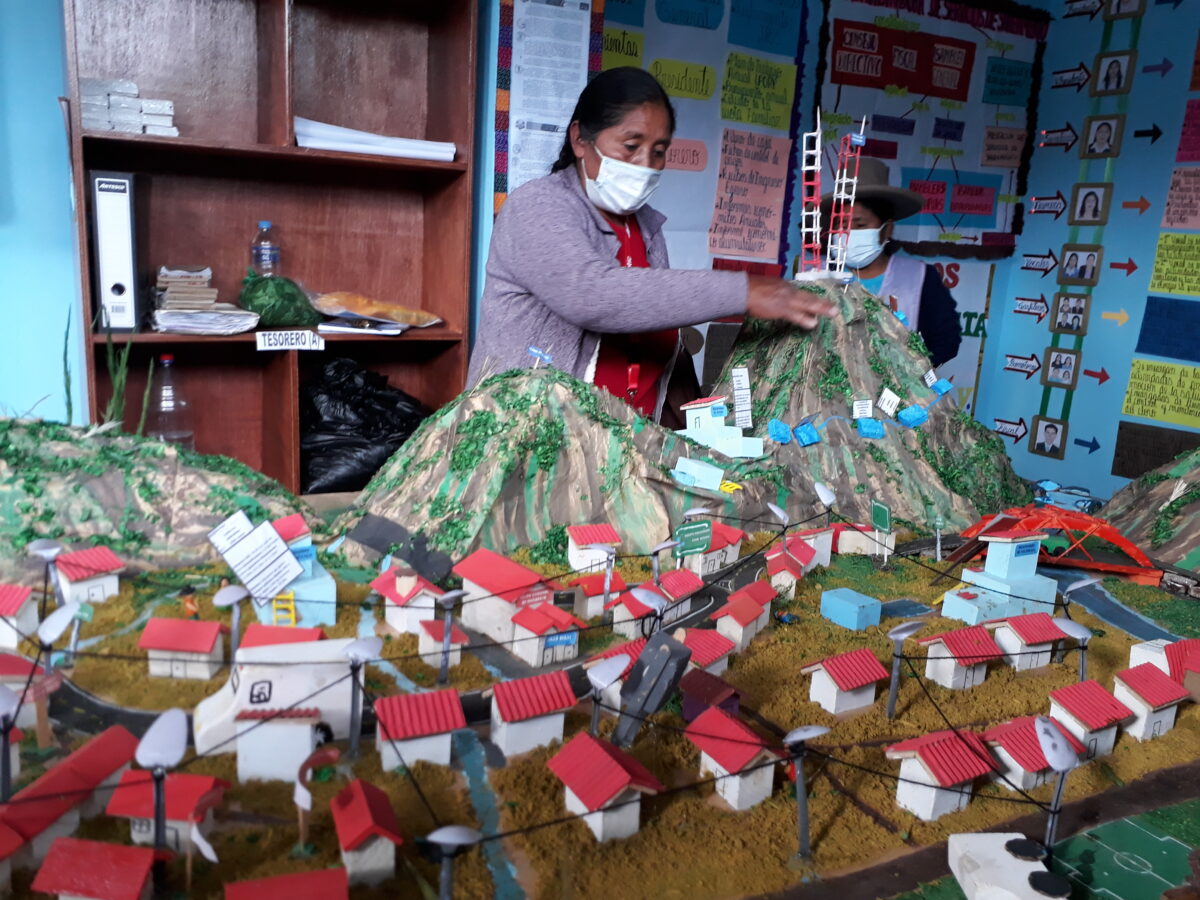
A model shows the water sources in the rural community of Muñapata in the Cuzco region, in Peru’s southern highlands. It was made by local women and men who built a system based on ancestral techniques for the collection and management of water, as increasing drought threatens their lives and crops. CREDIT: Mariela Jara/IPS
The decade of water security
Villanueva of the Flora Tristán Center said it was important for the country’s local and regional authorities to commit to guaranteeing water security in rural areas within the framework of the Sustainable Development Goals (SDGs).
The International Decade for Action: Water for Sustainable Development was declared for 2018-2028 by the United Nations and SDG6 is dedicated to water and sanitation, to ensure universal and equitable access for all, protect and restore water-related ecosystems, and support the participation of local communities in improving management and sanitation.
“At the national level, public policies aimed at seeding and harvesting water should be strengthened because they revive the communities’ ancestral knowledge, involving sustainable practices with low environmental impact that contribute to guaranteeing the food security of families,” she said.
However, Villanueva remarked, in order to achieve their objectives, these measures must not only promote equal participation of men and women, but must also be accompanied by actions to close the gender gap in education, access to resources, training and violence that hinder the participation and development of rural women.
MEXICO CITY, Dec 20 2021 (IPS) – In a ceremony in early October, the president of Ecuador and my opponent in the presidential elections, Guillermo Lasso, issued a warning to those “daring who seek to scrutinize” his assets. He was referring to the Pandora Papers published by the International Consortium of Investigative Journalists (ICIJ), which revealed how dozens of world leaders – including Lasso – hid billions of dollars to avoid paying taxes.
His threatening words were directed primarily at me, because of my knowledge of the offshore underworld and my determination to investigate him despite receiving death threats.
In 2017, Ecuador approved an anti-corruption law prohibiting public servants from holding assets in tax havens, directly or indirectly. This term was there to avoid the use of opaque and complex financial structures like trusts, foundations or partnerships. Last year I formally challenged Lasso’s candidacy for that reason, but he then signed an affidavit in which he claimed not to have properties in tax havens and the electoral commission agreed with him.
That led me to drop this issue and when I lost the election in February, I even gave a concession speech and spoke by phone to congratulate him. He offered me to put an end to the political persecution against progressives that former president Lenín Moreno had started.
However, the Pandora Papers revealed that Lasso had in fact transferred shares in limited liability companies representing 130 Florida properties from Panama to two trusts in the state of South Dakota. Lasso also recognised the existence of 14 entities that had been hidden from the Ecuadorian tax authorities.
Lasso denied having ties to these entities before assuming the presidency, including Banco Banisi in Panama. However, an investigation by the Latindadd organisation revealed that Lasso, a day before signing the affidavit, transferred his shares from Banco Banisi to the Banisi International Foundation, a new private interest foundation where his children are nominal beneficiaries but without any decision-making powers.
After the Pandora Papers were released, a large majority in parliament ordered an investigation. Official institutions cooperated little or nothing, claiming that it is confidential information while Lasso refused to attend the hearings. When the parliamentary commission approved the report linking Lasso to tax havens, his government immediately attacked the commission, and the Prosecutor’s Office launched a criminal investigation against the parliamentarians.
Soon afterwards, I started receiving threats and intimidation, not for having been a presidential candidate, but for insisting in investigating Lasso and speaking in the media about this case as an economic expert in offshore banking. Government supporters then launched coordinated troll attacks on social media, spreading false news about me, death threats, and insults.
On December 8, the Comptroller General concluded that Lasso had no offshore interests since it did not consider South Dakota a tax haven, despite being widely recognised for this. But the blockade of the investigation against Lasso did not end there. That same day, a majority of the National Assembly of Ecuador decided not to impeach the president, referring their investigation to other state institutions, but asked him to go to parliament and give an explanation, which he refused to do.
Ironically, Lasso – along with the presidents of other countries such as Kenya and Chile, whose leaders were also revealed in the Pandora Papers to have hidden assets in tax havens – was invited to the recent ‘Summit for Democracy’ organised by the United States. During the summit the creation of a beneficial ownership registry was announced, including for South Dakota trusts, as well as anti-fraud measures on real estate which could impact Lasso, but it’s still uncertain whether these commitments by the US and other countries will become reality.
In total, $7 trillion is hidden in secret jurisdictions and tax havens, equivalent to 10% of global revenues, according to the UN High-Level Panel on International Financial Accountability, Transparency and Integrity. Meantime especially developing countries are fighting the resurgent Covid-19 pandemic and its economic impacts, struggling to provide basic social protection to its citizens and purchase vaccines.
So clearly the problem of tax evasion and financial opacity, and money being funneled by powerful individuals to tax havens, is an issue that not only affects my country, but affects everyone. Fighting for financial transparency is a fight for truth and social justice that we cannot afford to give up.
Andrés Arauz is an Ecuadorian economist and candidate for President in the 2021 elections, currently based in Mexico City where he is a Doctoral Fellow at the National Autonomous University of Mexico, UNAM.
Where much of the province’s population is preparing for Christmas this holiday season, Yasin Kiraga Misago is making plans to celebrate Kwanzaa with his community.
A holiday that spans seven days, Kwanzaa is the celebration of Pan-African and African-American cultures, history and community. It was created in 1966. The word Kwanzaa comes from the Swahili phrase, ‘matunda ya kwanza’ which translates to ‘first fruits’ of the harvest season.
The festivities run from Dec. 26 to Jan. 1.
“When you celebrate Kwanzaa, mainly the purpose of it is that we should know each other, we should have the spirit of solidarity, of supporting our community. We should show love towards one another,” said Misago, founder of the African Descent Society of B.C.
He says that celebrating Kwanzaa is especially important in this province because there is not a large African community in B.C.
Misago – born in Burundi and grew up in Uganda and Malawi – came to Canada as a refugee in 2009. This was when he began celebrating Kwanzaa, before going on to create the society in 2012, which now has over 40 members.
“It’s a solution-based event, we discuss how we can deal with our community issues as an individual, as a group and on a communal level,” Misago said.
The number seven is significant in the celebration of Kwanzaa: Seven principles, seven days, seven candles (Mishumaa Saba) lit on the Kinara and seven symbols.
The symbols in Kwanzaa are: Muhindi, or corn, Mazao, meaning crops, Zawadi, or gifts, Mkeka, which is the placemat representing the foundation of Kwanzaa, Kikombe cha Umoja, or the unity cup, candles in green, red and black which rest on the last symbol, the Kinara.
The word ‘Kwanzaa’ itself has an extra ‘a’ added at the end to make it seven letters.
Seven days of Kwanzaa through Misago’s eyes
Misago and his community get together on Dec. 26 to mark the beginning of the celebrations – a day referred to as Umoja, which means unity.
“Our community is broken up into various pieces. Kwanzaa reminds us that we need to unite in order to make an effort and create change in the community,” he said.
Dec. 27 is about Kujichagulia, which means self-determination. For Misago, this day is about having conversations on how to fight against the inequalities that Black and African people experience.
“If we face discrimination – Kujichagulia – let’s stand for our rights and speak our minds,” he said.
The third day, or Dec. 28, focuses on Ujima, which is about collective work and responsibility.
Every Dec. 29 is about Ujamaa, or cooperative economics. This day is dedicated to supporting businesses run by African people and working to begin new ones.
Day Five is called Nia, or purpose, and reflects on honouring the ones who came before them through collaboration and building a strong community.
On the sixth day of Kwanzaa, the Kikombe cha Umoja is used in a libation ritual to honour the African ancestors. This day is also all about Kuumba, or creativity, and is about bringing together artists, performers and storytellers to showcase their talents in a festival.
Kwanzaa itself is not about religion, but for Misago, a Muslim-man, celebrating the holiday without Allah is not possible. This is why the last day of Kwanzaa, which means faith, is the most important to Misago: Imani.
“Kwanzaa is important to Muslims as well, we celebrate it together. To Muslims, words like ‘Nia’ are a part of them. Iman in Islam is the same as Imani in Kwanzaa,” he said.
“When you have faith, everything is possible. If you believe in the people we work with, we can build cooperation and work together. If you have Iman, you can trust each other, you can build resilience and be able to believe in other people,” Misago said.
The last day, Jan. 1, is also typically the day where Zawadi, or gifts, are given. The zawadi represent the labour and love of parents towards their children and are typically handmade presents.
Legacy of Kwanzaa in B.C. still needs work
It is important for Black and African children to grow up celebrating Kwanzaa, Misago said.
“It’s a cultural awareness for them, instilling values, wisdom, culture, heritage – giving them the opportunity as children to learn and celebrate and embrace all of it. I think it is an excellent thing.”
While virtual opening and in-person closing festivals are scheduled in Vancouver this year, African and Black communities are yet to have a cultural space in B.C.’s largest city – a goal Misago is hoping to reach through his efforts at the society.
“In Canada, the government has been slow to support Kwanzaa and we don’t know why but that is something that we’d like to see.”
To celebrate or learn more about Kwanzaa, anyone is encouraged to visit adsbc.org.
Family members of Priyantha Kumara, who died in the Sialkot mob attack, taking part in religious rites at his funeral.
COLOMBO, Si Lanka, Dec 13 2021 (IPS) – Every time, breaking news of a barbaric crime or terror act is reported from anywhere in the world, peace-loving Muslims the world over feel dejected and wish it had not been another tragedy that will make others glower at them with suspicion as though they too are complicit in the crime.
But often, what they dread is the case, for more than 90 percent of such inhumane and barbaric acts – like the Sialkot slaying of a Sri Lankan factory manager and the Easter Sunday massacres — are associated with Islamic extremism.
Last Friday’s lynching of factory Manager Priyantha Kumara Diyawadanage in Pakistan by an extremist mob will not be the last of such acts.
No amount of ‘We Are Sorry Sri Lanka’ placards, flowers and candles at makeshift memorials and political statements denouncing the crime can bring back his life that was cruelly brought to an end as a burnt offering on the altar of bigotry in an expression of savagery that has no place in civilized society.
However much Pakistanis who are humiliated by extremism dissociate themselves from the horrible act, however profound their apology is, however remorseful Pakistan Prime Minister Imran Khan, who decried the incident as Pakistan’s day of shame, is, the country will continue to be plagued by violent extremism unless and until extremism is rooted out by radical social reforms in line with the peaceful message of Islam.
The Priyantha Kumara lynching by a mob linked to an extremist outfit called Tehereek-e-Labbaik Pakistan, for tearing off a political poster that allegedly had some religious verses in Urdu warrants the immediate revocation of Pakistan’s blasphemy law or its amendment in keeping with the Islamic virtue of tolerance and magnanimity.
Research shows a higher prevalence of extremism in countries that have blasphemy laws than in countries that do not have such laws. Blasphemy laws are often misused to persecute the minorities or treat them as second-class citizens. Such laws are incompatible with the Islamic teaching which calls for protection of the minorities and non-interference in their worship.
If the Pakistan Government fails to make use of this heartrending incident as an opportunity to bring about radical reforms, it itself will be committing an act of blasphemy because its inaction allows the badly constructed law to distort and disgrace Islam.
Pakistan was carved out of the British Raj for the Muslims of the subcontinent. Its founder Muhammad Ali Jinnah promoted a theory of two nation two state, saying that the Muslims and Hindus were two different nations and belonged to two different civilizations and therefore needed to live in separate states.
The world’s first nation-state to be formed on the basis of religion, Pakistan, however, has never been a theocracy.
In a 2017 BBC interview, historian Ayesha Jalal pointed out that Jinnah envisaged Pakistan as a “homeland for India’s Muslims”, as opposed to an Islamic state. But she said that his theory had been used by Islamists “as an ideological device” to justify claims for Pakistan to be a theocratic state.
This is Pakistan’s existential crisis. While the extremists fight for the setting up of a theocracy, secular politicians skillfully make use of Islam and side with Islamists to swell their vote banks or to whip up nationalistic emotions against archrival India.
Perhaps, this was why Pakistan’s Defence Minister Pervez Khattak was seen belittling the gruesome murder of Priyantha Kumara, by calling it “youthful exuberance of Muslim youngsters” and “happens all the time”.
He reportedly added, “When the youth feel Islam has been attacked, they react to defend it.” This was while Premier Khan vowed to bring the murderous mob to justice and Pakistan police arrested more than 130 people.
If we play with fire, we get burnt. Pakistan has been burnt enough, yet it appears to have not learnt enough. Seven years ago this month, extremists carried out a gruesome school massacre in Peshawar. In this terror attack some 134 schoolchildren, aged between 8 and 18, and 16 staff members were brutally gunned down by the Pakistan Taliban. So why pamper the extremists?
In 2011, Pakistan’s Punjab Province Governor Salman Taseer was shot dead by a police guard over his opposition to the country’s blasphemy law that calls for death sentence to those who insult Islam or its holy personalities.
Taseer was also calling for the release of Asia Bibi, a Christian woman who was falsely accused by her neighbours of insulting the Prophet Muhammad. Taseer’s assassin was hailed as a hero by a large number of extremists who took to the street to celebrate the murder.
As a result of violent extremism, many non-Muslims find it difficult to accept the Muslims’ assertion that Islam is a religion of peace. What many do not understand is that there is little Islam in today’s world, although about 2 billion Muslims constitute one fourth of the world’s 8 billion population.
In Islam, jihad or holy war is not the norm, but a last resort exception to defend the oppressed. Vigilante justice has no place in Islam. The accused should be heard, Islam commands.
To whatever religion they belong, the problem with extremists is their ignorance of the teachings of the religion they are supposed to follow. As historian and comparative religions expert Karen Armstrong would say, “Terrorism has nothing to do with Muhammad, any more than the Crusades had anything to do with Jesus.”
Certainly, violence is not the answer to blasphemy. According to the Quran, the Prophet Muhammad was heaped the worst form of scorn. He was called a liar, a magician, a madman, and possessed. Garbage was thrown over his head and stone-throwing street urchins were set upon him.
Yet as commanded by God, he exercised beautiful patience — Sabran Jameelan — and when his companions sought permission to retaliate, he would teach them the virtues of patience and remind them that he was sent as a mercy to the whole world. He befriended his persecutors by practising the Quranic injunction which exhorts the Muslims to “repel that which is evil with that which is good (and virtuous)”.
Unfortunately, the verses on defensive wars the Prophet and the early Muslims were forced to fight were misinterpreted by latter day Muslim rulers and terrorists for political purposes. Glorification of violence in the name of Islam became the norm. Islam’s peaceful message was forgotten.
Also overlooked is the Quranic message against violence as explained in the story of angels who expressed their deep concern over bloodshed and mischief on earth when God wanted to create man. (Quran 2: 30.)
It appears that instead of Islam, some Muslims are following a violent creed and calling it Islam. The fake Islam is largely practised while the real Islam remains buried. The task before the Muslims is to search for the buried Islam, resurrect it and live it.
Ameen Izzadeen is the deputy editor of the Sunday Times, Sri Lanka. He also writes a weekly column for the Daily Mirror, Sri Lanka, on international politics and good governance issues; and is a visiting lecturer in journalism and international politics.