GENEVA, May 23 2019 – On 9 May 2019, the Geneva Centre for Human Rights Advancement and Global Dialogue, the World Against Racism Network and the Global Coalition for the International Decade for People of African Descent organized an Emergency Assembly on the Rise of Global Racism. It was held at the United Nations Office in Geneva in the presence of more than 150 representatives of Permanent Missions, UN staff, civil society and academics.
The aim of this Assembly was to invite the international community to take a joint stand against racism, racial discrimination and intolerance and to address the fundamental structural root causes of these scourges through a robust and universal implementation of the DDPA.
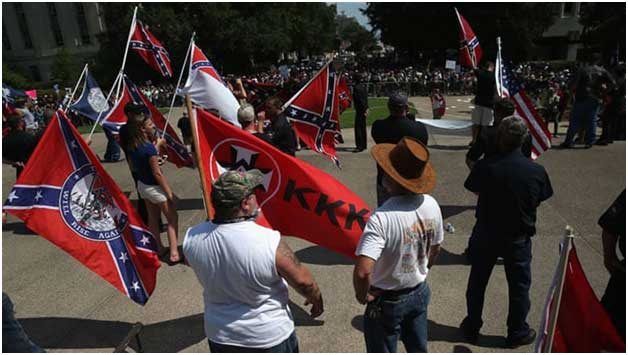
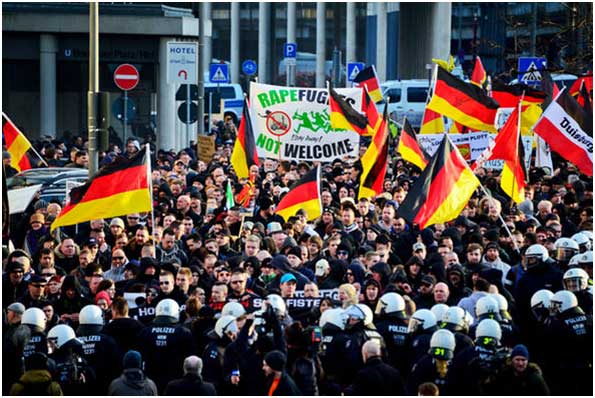
It served as a timely opportunity to give a new impetus to ongoing efforts to counter the rise of extremism and xenophobia in all its forms and manifestations, which is taking openly aggressive forms expressed through Islamophobia, Afrophobia, anti-Arabism and anti-Semitism. The recent spate of terrorist attacks of 15 March 2019 in Christchurch, New Zealand and of 21 April 2019 in Colombo, Sri Lanka as well as in California on 27 April 2019 are a reminder that the rise of hate and supremacist ideologies erupts into blind violence unexpectedly.
The Emergency Assembly was likewise held strategically in between two important events in Geneva that brought international human rights experts to the UN on the issue of racism.
In its 6-9 May session the Group of Independent Eminent Experts – composed of HE Hanna Suchocka Dr Edna Roland, Professor Ibrahim Agboola Gambari and Dr. Saied A. Ashshowwaf – discussed the continued relevance of the DDPA, commemorating its 20th anniversary and developing a multiyear outreach programme for DDPA information and public mobilisation.
In order to consult with the Independent Eminent Experts on the continued relevance of the DDPA, the co-organizers of the Emergency Assembly invited Dr Roland to offer her viewpoints on the imperative need for the full and effective implementation of the DDPA.
In her statement, Dr Roland observed that the Sustainable Development Goals (SDGs) do not mention the ethics and issues of racism which represent an impediment to development. Dr Roland suggested that national governments should include this in their national SDG implementation plans provisions concerning the implementation of the DDPA. She likewise stressed the need to develop a multi-year outreach programme to implement the DDPA including mobilizing NGOs and seeking new ideas to fight against xenophobia, racism and related intolerance.
The day after the Emergency Assembly, the Office of the High Commissioner for Human Rights (OHCHR) organized a consultation on People of African Descent through a meeting of the Permanent Forum on People of African Descent. This is an integral part of the full and effective implementation of the DDPA. The Forum was established by the UN General Assembly in resolution 69/16 of 1 December 2014 entitled “Programme of activities for the implementation of the International Decade for People of African Descent.”
At the Emergency Assembly, the co-organizers highlighted that the pursuit of the International Decade for People of African Descent and the establishment of the Permanent Forum on People of African Descent should not be seen as a substitute for the DDPA. These frameworks should instead complement existing mechanisms related to the implementation of the DDPA, its programme of activities and the Independent Eminent Experts’ recommendations to achieve full and effective equality.
In this connection, the Emergency Assembly underscored the importance of political will, unity of purpose and international cooperation in the pursuit of action-oriented recommendations to address all forms and manifestations of racism, racial discrimination and related intolerance through the implementation of the DDPA, whether the issue refers to Afrophobia, Arabophobia, Islamophobia or Anti-Semitism.
UNITED NATIONS, May 20 2019 (IPS) – The UN’s longstanding mandate to promote and protect human rights worldwide –- undermined recently by right-wing nationalist governments and authoritarian regimes – has taken another hit.
The Geneva-based Office of the UN High Commissioner for Human Rights (OHCHR) says six of the UN’s 10 treaty bodies are being forced to cancel their sessions this year due to financial reasons.
The situation has been described as “an unprecedented consequence of some UN member States delaying payments due to the Organisation.”
Anna-Karin Holmlund, Senior UN Advocate at Amnesty International (AI), told IPS: “Amnesty is deeply concerned by member states’ delay in paying their assessed contributions, which will have a direct effect on the ability of the UN to carry out its vital human rights work.”
Without these funds, the UN’s human rights mechanisms and International tribunals could be severely affected, she warned.
By 10 May, only 44 UN member states – out of 193 — had paid all their assessments due, with the United States owing the largest amount.
“Unfortunately, this is only the latest in a worrying trend of reduction in the UN budget allocated to its human rights mechanisms. To put this in perspective, the budget of the OHCHR is only 3.7 % of the total UN regular budget,” she pointed out.
In addition to the possible cancellation of sessions of the treaty bodies, mechanisms created by the Human Rights Council such as Fact-Finding Missions and Commissions of Inquiry may be hampered in carrying out their mandate of investigating serious human rights violations.
The OHCHR said last week the cancellations meant that reviews already scheduled with member states, as well as consideration of complaints by individual victims of serious human rights violations — including torture, extra-judicial killings, enforced disappearances -– will not take place as scheduled.
“The cancellation of sessions will also have numerous other negative consequences, and will seriously undermine the system of protections which States themselves have put in place over decades,” said a statement released by the OHCHR.
The chairpersons of the 10 Committees are deeply concerned about the practical consequences of cancelling these sessions and have sent a letter to the UN Secretary General and the High Commissioner for Human Rights, requesting they, together with Member States, explore ways of addressing this situation, “as a matter of urgency.”
Alexandra Patsalides, a Legal Equality programme officer at Equality Now, told IPS that it is deeply concerned that UN Treaty body review sessions have been postponed for financial reasons, including the Committee to Eliminate Discrimination Against Women (CEDAW), with its focus on ending all forms of discrimination again women and girls.
She said the crisis comes particularly at a time when women’s rights are continuously being undermined and eroded around the world– and civil society organisations are operating in a space that is increasingly under attack and shrinking.
The UN should strongly call on state parties to prioritise their international human rights obligations, she added.
“The UN treaty bodies are vital to holding states accountable to their commitments on women and girl’s rights — and now is the time to increase the international response, not cut back,” said Patsalides.
These review sessions offer civil society organisations a vital opportunity to hold their governments to account for their international human rights commitments and raise awareness of human rights violations in their countries.
But with the backsliding on women’s rights across the globe, it is now more urgent than ever that the various mechanisms stand up to defend hard won gains, she noted.
“The UN treaty bodies are often the only mechanism for women and girls to hold their countries to account for violations of their rights. We cannot allow these voices to be silenced and call on the UN to prioritize the protection of women and girls’ rights and ensure these treaty bodies have appropriate and sustainable funding.”
The 10 UN human rights treaty bodies are: the Human Rights Committee, the Committee on the Elimination of Racial Discrimination, the Committee against Torture, the Committee on Migrant Workers, the Committee on Enforced Disappearances, the Committee on Economic, Social and Cultural Rights, the Committee on the Elimination of Discrimination Against Women, the Committee on the Rights of the Child, the Committee on the Rights of Persons with Disabilities And the Subcommittee on Prevention of Torture.
Meanwhile the budget cuts come at a time when the UN is battling a series of setbacks in the field of human rights.
The UN Human Rights Office in Burundi was closed down last February at the insistence of the government, with the UN High Commissioner for Human Rights Michelle Bachelet expressing “deep regrets” over the closure, after a 23-year presence in the country.
A UN Commission of Inquiry has called on Eritrea to investigate allegations of extrajudicial killings by its security forces, including torture and enslaving hundreds of thousands, going back to 2016.
And under the Trump administration, the US has ceased to cooperate with some of the UN Rapporteurs, and specifically an investigation on the plight of migrants on the Mexican border where some of them have been sexually assaulted—abuses which have remained unreported and unprosecuted.
The government of Myanmar has barred a UN expert from visiting the country to probe the status of Rohingya refugees.
On the setbacks in Colombia, Robert Colville, Spokesperson for the UN High Commissioner for Human Rights, said May 10: “We are alarmed by the strikingly high number of human rights defenders being killed, harassed and threatened in Colombia, and by the fact that this terrible trend seems to be worsening”
“We call on the authorities to make a significant effort to confront the pattern of harassment and attacks aimed at civil society representatives and to take all necessary measures to tackle the endemic impunity around such cases.”
In just the first four months of this year, he pointed out, a total of 51 alleged killings of human rights defenders and activists have been reported by civil society actors and State institutions, as well as the national human rights institution.
The UN Human Rights Office in Colombia is closely following up on these allegations. This staggering number continues a negative trend that intensified during 2018, when our staff documented the killings of 115 human rights defenders.
According to a press release from the OHCHR, the 10 United Nations human rights treaties are legally binding treaties, adopted by the UN General Assembly and ratified by States.
Each Treaty establishes a treaty body (or Committee) comprising elected independent experts who seek to ensure that States parties fulfil their legal obligations under the Conventions.
This system of independent scrutiny of the conduct of States by independent experts is a key element of the United Nations human rights system, supported by secretariats in the Office of the High Commissioner for Human Rights
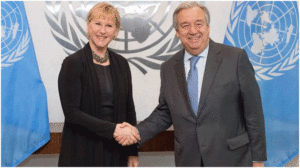
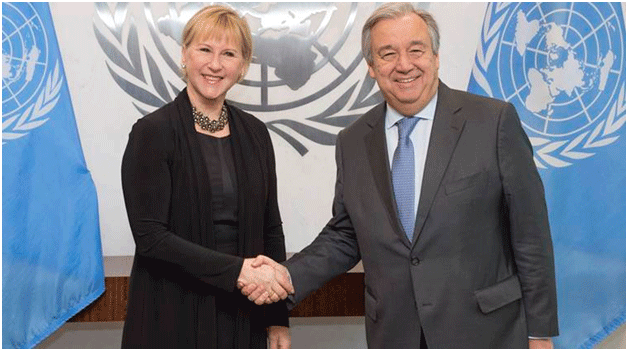
Swedish Foreign Minister Margot Wallström with UN Secretary-General Antonio Guterres
STOCKHOLM, May 17 2019 (IPS) – I want to talk about peacebuilding and inclusive peace. My main point is that peace begins in the minds of people, and people, communities, societies must be allowed to participate in peace for it to be sustainable. Peace means a lot more than just the absence of war.
I want to highlight the need for this perspective in three aspects of peacebuilding – conflict prevention, crisis response and peace processes. But before going into those aspects, let me begin with the example of Colombia.
As you know, the war between FARC and the government had been going on since the 1960’s, with hundreds of thousands of victims.
The peace process that was initiated around 2012 was in a way unique. It included in different ways victims and local communities, the private sector, civil society, LGBT organisations. And of course, there was a strong presence of women.
The peace deal that was signed in 2016 (one of few good news that year) included agreements on much more than just the laying down of arms – it mentions land reform, political participation, guarantees for social movements, a strategy to tackle drug trafficking and much more.
We keep on being reminded that the implementation is often the most complicated part of a deal. But even that is part of the point I want to make. That – just as with democracy – peace is something you have to work on and conquer every day.
And even if there have been and are challenges related to the peace in Colombia, I maintain that this process was remarkable, because it put the Colombian people at center, and today both parties, the former guerilla FARC and the Colombian government are jointly working on sustainable peace in their country.
1) Going back to the three aspects of peacebuilding, let me start with conflict prevention. We seldom get the credit we deserve for the conflicts that didn’t happen.
And unfortunately, it is often easier to get support for interventions once there actually is a fire. But how many tears would not have been saved, if we had been able to prevent Rwanda? Bosnia? South Sudan?
My conviction is that societies that are democratic and inclusive, with gender and social equality, with a strong civil society have are strongly vaccinated against conflict.
This is one of the reasons why the global backslide of democracy that we experience right now is worrying me. Growing authoritarianism together with growing social inequalities has often been a prelude to conflict.
And this year, for the first time in decades, more people live in countries with growing authoritarian tendencies, than in countries that are making democratic progress.
There is still hope. I recently visited the Tunis Forum on Gender Equality, where I met with a lot of young civil society activists. And coming back to inclusive peacebuilding, I heard one interesting example of how women’s grassroots organisations took part in conflict early warning mechanisms.
They did so by reporting local peace and security risks and threats to the community, the government and international bodies.
2) Let me continue with a second aspect of peacebuilding, which is crisis response, including peacekeeping and stabilization.
Here, a security approach is often needed to save lives. But also, in interventions to stabilise we can help steer the course to a more inclusive process. Women in peacekeeping operations is an example.
When we plan for these interventions, we must think of inclusion and gender from the start. There is no conflict between the need for a quick end of violence, and the long-term aim of creating peaceful, just and inclusive societies. All interventions can be designed to contribute to this.
3) Thirdly, peace processes. Here, an inclusive approach means focusing more on women; less on men with weapons.
It is understandable that, at crunch time, a hasty deal between leaders of conflicting parties might seem attractive. But sometimes; easy come, easy go.
A peace where the voices of communities, of victims, of women have been heard – in preparations, in negotiations and implementation – will be more deeply rooted and has a greater chance of lasting longer.
Coming back to the example of Colombia – it was women that brought issues of land restitution and victims to the agenda; that ensured that confidence-building measures were implemented, that child soldiers were released.
There are other processes where women are less visible, but still make critical contributions. In Libya and Afghanistan, women, young people and local peacebuilders have done important work, with their local knowledge and commitment.
Conflicts are not linear. You can never draw a straight line from a beginning to an end. Their dynamics often look more like a child’s drawing, with strokes forward, backward, to the sides, in all possible directions.
As I said in the beginning, sustaining peace is an ongoing process, of constantly strengthening factors that underpin peace – such as confidence, reconciliation, institutions, equality, democracy.
And in a way, conflict, in a broader sense, is an inevitable part of life in a society. For a democracy, I would say, conflict is vital.
The challenge is to find ways to handle conflicts in a peaceful and constructive way. Strong, well-functioning institutions – be they national, or in the shape of multilateral cooperation, are the way of managing this.
And this is another reason why today’s backsliding of democracy and questioning of international cooperation is such a worrying threat, To conclude, let me get back to the main point about peace beginning in the minds of people.
You might recognize the source of this: the first words of the constitution of UNESCO, which I want to return to, since they so well summarize what peacebuilding is about:
“Since wars begin in in the minds of men, it is in the minds of men that the defences of peace must be constructed”.
In other words – putting people at the center of our thinking.
I’m glad that we are doing that today and tomorrow, and I hope that we can keep on doing it in our daily work for peace and development.
*Excerpted from an address to the SIPRI Forum on Peace and Development
Masana Ndinga-Kanga is Crisis Response Fund Lead with global civil society alliance, CIVICUS.
JOHANNESBURG, May 16 2019 (IPS) – Does the name Ihsan Al Fagiri ring a bell? How about Heba Omer or Adeela Al Zaebaq?
It’s likely that these names, among countless others, are not known to the average news consumer. But their tireless and dangerous work, however, has made news headlines as protests led to historic political change in Sudan.
To the communities of protesting women in Sudan, these names represent the valiant efforts to defy the authoritarianism of the Omar Al Bashir regime.
The sustained efforts of these women include mass mobilization, calling people to the streets of Sudan through ‘Zagrouda’ (the women’s chant) in response to rising costs of living amidst the country’s worst economic crisis.
These rallying calls of #SudanUprising, have been led by Sudanese women who are teachers, stay-at-home-mothers, doctors, students and lawyers. And yet, when President Al Bashir stepped down on April 11, the names of the women who spearheaded this political shift, were largely missing from the headlines.
This erasure is not uncommon. Women Human Rights Defenders (WHRDs) are often erased or slandered in efforts to intimidate them into quitting continuing their human rights work. In Egypt, Guatemala, Saudi Arabia, Uganda or the Philippines they are often called agents of international interests.
In Kenya, the United States and South Africa, their sexuality is called into question and they are harassed online. In China and the United Arab Emirates, they are detained for reporting or highlighting endemic levels of harassment. And yet, they refuse to be silenced.
These women are not alone at the interface of sustaining justice in sexual and reproductive health, environmental rights, economic accountability and conflict areas.
In spite of restrictions against them, WHRDs have campaigned boldly in the face of mounting opposition: #MeToo #MenAreTrash, #FreeSaudiWomen, #NiUnaMenos, #NotYourAsianSideKick, #SudanUprising and #AbortoLegalYa are just a few social campaigns that represent countless women at the coal face of systemic change for equality and justice. More and more WHRDs worldwide are working collectively to challenge structural injustices and promote the realisation of human rights and fundamental freedoms.
But there is a stark absence of knowledge on their work. Media reporting on the courageous work of women defenders tends to focus more on the challenges they face. Awareness of their restrictions is critical to the push for justice but equally important is knowledge about the work they do to sustain women’s rights globally.
Combined with the risks of ostracization and assault from relatives, community members and the state, WHRDs defy these risks to sustain social justice. Recognizing them only for their restrictions further contributes to the erasure they experience daily from state and others.
One way the narrative on WHRDs can shift is by focusing on the critical role they play in pushing forward a progressive agenda of change for all.
In Ireland last year, activists working in sexual and reproductive health and rights achieved a landslide referendum victory in which two thirds of voters chose to legalise abortion, after many years of pro-choice campaigning.
In the southern African kingdom of eSwatini, formerly known as Swaziland, the first ever Pride march was held last year in support of LGBTQI rights. LGBTQI groups in Fiji also scored the same first that year – the country’s inaugural Pride event, a victory of freedom of assembly for LGBTQI activists around the world.
The power of collective action was also on display in January when five million women formed a human chain across the southern Indian state of Kerala. The massive protest was organised in response to experiences of violence against women attempting to enter Kerala’s Sabarimala temple, a prominent Hindu pilgrimage site.
In Iran, a small women’s movement challenging the compulsory rule that requires women to fully cover their hair, has been developing. While in Colombia, activist Francia Marquez organised a 10-day march of some 80 women to protest against illegal mining on their ancestral land in the east of the country.
This activism is often thankless and dangerous work. Indeed, 2017 was the deadliest year on record for environmental women human rights defenders, with 200 environmental campaigners murdered.
WHRDs are at increasing risk of harassment not just from state actors, but also from multinational corporations, their communities and in some cases, their own families. International policy frameworks have tried to keep up with the heavy-handed crackdown from states on environmental WHRDs.
Last September, United Nations High Commissioner for Human Rights, Michelle Bachelet launched the For All Coalition to integrate human rights and gender equality throughout all major multilateral environmental agreements, including the Paris Agreement under the UN Framework Convention on Climate Change.
The Coalition is an important step in highlighting the ways in which climate change disproportionately affect WHRDs, and also recognises the role of local and indigenous communities of women in the realisation of environmental protection.
These policy gains are the first step in creating an enabling environment for WHRDs working in remote areas on land, indigenous rights and climate justice. They are often labelled as ‘anti-development’ for calling for accountable and transparent change.
In South Africa and Honduras, the gains of environmental women campaigners have been some international recognition of their work, but at high costs: for some, these costs sometimes include their lives. Since 2001, 47 human rights workers in the Philippines have been killed for their work of attempting to document environmental violations.
In order to take seriously the work of women human rights defenders, the mechanisms for protecting them have to begin to adapt to respond to their nuanced needs as women. They need to be sensitive to other dimensions that affect WHRDs such as sexual orientation, gender, race, class and indigenous status. Adequate institutional and policy support must be built on intersectional feminism which is consultative and responsive.
What will create a more favourable policy environment for women activists? That answer should include decriminalizing sexual and reproductive rights, for example, and removing restrictions on the registration of associations supporting WHRDs.
Governments should also conduct training and sensitisation programmes for law enforcement agencies, members of the judiciary and staff of national human rights institutions on the challenges faced by WHRD, and develop a national action plan for the protection of WHRDs.
To this day, resources do not reach WHRDs in remote areas and on the frontlines, and not because they are not applying! Gender-sensitive resourcing is critical to address the gap.
These suggestions are a smaller part of a larger need for systemic change but point to the need for consistent global activism to support women human rights defenders at all times – oftentimes before crises emerge.
The victory of Sudanese women, and the ensuing capture of the end of dictatorship this year, should give us pause to remember particularly the women who push on through layers of repression, risking all, to demand basic rights.
UNITED NATIONS, May 10 2019 (IPS) – The rise of right-wing nationalism and the proliferation of authoritarian governments have undermined human rights in several countries in Europe, Asia, Africa, the Middle East and Latin America.
As a result, some of the international human rights experts – designated as UN Rapporteurs – have either been politically ostracized, denied permission to visit countries on “fact-finding missions” or threatened with expulsion, along with the suspension of work permits.
The Philippines government, a vociferously authoritarian regime, has renewed allegations against Victoria Tauli-Corpuz, the UN Special Rapporteurs on the Rights of Indigenous Peoples.
The Deputy Chief of Staff for Civil-Military Operations, Brigadier General Antonio Parlade, told reporters that the United Nations had been infiltrated by the Communist Party of the Philippines through Tauli-Corpuz.
But a group of UN human rights experts denounced the politically-inspired charges against a longstanding UN envoy on human rights.
“The new accusations levelled against Ms. Tauli-Corpuz are clearly in retaliation for her invaluable work defending the human rights of indigenous peoples worldwide, and in the Philippines,” the experts said
Anna-Karin Holmlund, Senior UN Advocate at Amnesty International, told IPS “We have witnessed several deeply worrying personal attacks by UN Member States against the independent experts, including personal attacks, threats of prosecution, public agitation and physical violence in the past year”.
“It is clear they are targeted for simply doing their job,” she added.
On occasion, she noted, these have been carried out by members of the UN Human Rights Council that are expressly required to uphold the highest standards in the promotion and protection of human rights.
“Such attacks are part of a disturbing trend of a shrinking space for human rights work more broadly in many places around the world,” declared Holmlund.
Meanwhile, the Government of Burundi has closed down the UN Human Rights Office triggering a protest from Michelle Bachelet, the UN Human Rights Commissioner in Geneva.
And under the Trump administration, the US has ceased to cooperate with some of the UN Rapporteurs, and specifically an investigation on the plight of migrants on the Mexican border where some of them have been sexually assaulted—abuses which have remained unreported and unprosecuted.
The government of Myanmar has barred a UN expert from visiting the country to probe the status of Rohingya refugees.
In March, the UN Special Rapporteur on the Independence of Judges and Lawyers, Diego García-Sayán, postponed an official visit to Morocco because the government “has not been able to ensure a programme of work in accordance with the needs of the mandate and the terms of reference for country visits by special procedures.”
He was scheduled to visit the country from 20 to 26 March “to examine the impact of measures aimed at ensuring the independence and impartiality of the judiciary and prosecutors, and the independent exercise of the legal profession.”
“It is most regrettable that the suggestions of places to visit and schedule of work were not fully taken into consideration by the Government. It is an essential precondition for the exercise of the mandate of Special Rapporteur that I am able to freely determine my priorities, including places to visit,” he said.
Referring to the situation in Colombia, Robert Colville, Spokesperson for the UN High Commissioner for Human Rights, said May 10: “We are alarmed by the strikingly high number of human rights defenders being killed, harassed and threatened in Colombia, and by the fact that this terrible trend seems to be worsening”
“We call on the authorities to make a significant effort to confront the pattern of harassment and attacks aimed at civil society representatives and to take all necessary measures to tackle the endemic impunity around such cases.”
In just the first four months of this year, he pointed out, a total of 51 alleged killings of human rights defenders and activists have been reported by civil society actors and State institutions, as well as the national human rights institution.
The UN Human Rights Office in Colombia is closely following up on these allegations. This staggering number continues a negative trend that intensified during 2018, when our staff documented the killings of 115 human rights defenders.
And last month, Israel revoked the work permit for Omar Shakir, the Israel and Palestine Director of Human Rights Watch, prompting a protest from the United Nations.
“This ruling threatens advocacy, research, and free expression for all and reflects a troubling resistance to open debate,” a group of UN experts said. “It is a setback for the rights of human rights defenders in Israel and the Occupied Palestinian Territory.
Dr Palitha Kohona, a former chairman of the Israeli Practices Committee, mandated to monitor human rights violations in Israeli-occupied Palestinian territories, told IPS that official visits to the West Bank were barred by Israel (“and not for want of trying”) but not to Gaza, which they could not.
He said several approaches were made through the Israeli Missions in New York and Geneva to seek approval to interview persons on the ground in the West Bank, but to no avail.
“In 2011, we waited an extra day in Amman hoping to get approval which was never forthcoming. A ministerial visit by delegates from the Non-Aligned Movement (NAM) to the West Bank was stopped at the Allenby Bridge by Israel”.
The Rafah crossing was controlled by Egypt and the Gaza authorities. Entry to Gaza for the Committee was through Sinai following a long bus ride from Cairo across the Sinai desert, said Dr Kohona, a former Permanent Representative of Sri Lanka to the United Nations.
“I visited Gaza twice in 2010 and 2011 with the Committee. I believe that these were the only two occasions that the Committee was able to visit Gaza.”
Egypt itself seemed to make the entry uncomfortable for the Committee, perhaps to keep Israel happy, he said.
In 2011, the Committee was held up for over four hours at the Rafah Crossing to Sinai. “Eventually I had to contact the Sri Lanka embassy in Cairo by phone to get us across”.
According to a report in the New York Times March 10, Leilana Farha, the UN Special Envoy for Housing was “shocked” to discover that some of the Egyptians she interviewed in Cairo’s poor areas “had suffered reprisals for talking to her.”
“Some were flung from their homes by officials, their belongings strewn in the streets. Others were harassed by the security services or barred from leaving Egypt,” said the report from New York Times correspondent Declan Walsh in Cairo.
“The foreign ministry accused Farha of fabricating stories and implied that she was a terrorist sympathizer, bent on smearing Egypt”.
The Times said “such defensive, conspiratorial talk is standard fare on Egypt’s television stations, which are heavily influenced by (Egyptian President) el-Sisi’s government. And it has seeped down into the street.
The United Nations currently has 38 Rapporteurs or independent experts appointed by the Human Rights Council in Geneva to investigate violations of the legitimate political, economic and legal rights of individuals and minorities worldwide going as far back as 1982.
These fact-finding missions, undertaken by UN Rapporteurs, cover a wide range of issues, including investigations into torture, extra-judicial killings, arbitrary executions, involuntary disappearances, racism, xenophobia, modern day slavery and the abuse of the rights of migrants and indigenous peoples.
Urmila Bhoola of South Africa, Special Rapporteur on Contemporary Forms of Slavery, told IPS she has visited Niger, Belgium, Nigeria, El Salvador, Mauritania, Paraguay and, lastly Italy, in October 2018.
She pointed out that “country visits are only conducted upon invitation from governments”.
“I have issued requests for country-visits to many countries but due to the mandate’s name and focus, member states are often reluctant to invite the mandate on contemporary forms of slavery, to conduct a visit”.
In this sense, she pointed out, member states may not openly refuse a visit but may not reply to country visit requests.
According to the Office of the UN High Commissioner for Human Rights, member states generally cooperate with the independent human rights experts in the Special Procedures of the Human Rights Council.
The number of States that have never received a visit by a mandate holder has diminished to 22. And the number of States that have issued a ‘standing invitation’ to Special Procedures has now reached 120 Member States and 1 non-Member Observer State.
Some States receive more than one visit per year. Each year, on average, Special Procedures conduct around 80 visits to different States.
At this time, said a spokesperson, “ we have not been notified of any changes concerning cooperation with Special Procedures by the United States’ Permanent Mission here in Geneva. Indeed, they have been in contact with several mandate holders recently”.
In December, 2017 the Government of Myanmar informed the Special Rapporteur on the situation of human rights in Myanmar that all access to the country has been denied and cooperation withdrawn for the duration of her tenure. The writer can be contacted at thalifdeen@ips.org
DEWAS, India, May 3 2019 (IPS) – No external force can bring about real change in society. Only the community itself can.
There are 650 districts in India. However, most nonprofits work only in a few districts. Given how large our country is, there are only two types of people that can work towards creating change at scale – the communities that are facing the issues first hand, and the government.
The government has not been able to work on issues related to social justice in the last 60 years. Perhaps they think that this is not important enough, or there is no political will to do it. So, we at Jan Sahas, chose to involve the community.
We realised that if issues around social justice had to be taken to scale, and if we wanted to create deeper impact,we needed to involve the communities affected. If it didn’t become the community’s own initiative, or if they kept thinking that some civil society organisation or government agency would come and work on their issues, it would never be sustainable.
That’s why in 2001, we started a national campaign named Rashtriya Garima Abhiyan. Centred around the idea of dignity, this campaign was aimed at mobilising Dalit manual scavengers, all of whom were women. We wanted to empower them to move out of this work and enable them to scale up the programme on their own. We thought that working with manual scavengers would be a good entry point to work on ending exclusion.
Caste-based marginalised communities in our country have faced historical injustice — not just for the last five-six generations, but for the last 2,500 years
But caste-based marginalised communities in our country have faced historical injustice — not just for the last five-six generations, but for the last 2,500 years. Even if they earn money and stop doing caste-based work, the social stigma never goes away. Even if the person becomes a collector, or starts an enterprise, the discrimination continues.
We need three types of rehabilitation
If people have to come out of caste-based work, they need three types of rehabilitation:
1. Economic or livelihood rehabilitation
In the caste-based work of manual scavenging, the biggest issue is that the oppressor or employer provides them food, clothing and shelter. In rural India, they get two rotis every day, clothes twice a year — during Holi and Diwali, and the panchayat gives them a place to stay, So, in essence, their basic needs of roti-kapda-makaan are taken care of by the person or the institution that employs them. What this means though is that they are unable to negotiate with their employers.
If you are going to get paid in cash for work, you can negotiate. For instance, if the employer says ‘I will give you INR 20’, you can say, ‘No, I will charge INR 50’. But if your life itself is dependent on what they give you, then you can never negotiate.
Therefore, if we have to start changing the way caste is viewed and reinforced, we have to start with economic rehabilitation. If marginalised caste groups get work which pays them in cash, they can negotiate the terms for their wages, working conditions, dignity and relationships at the workplace.
However, this is only step one. The second, and more important one, is social rehabilitation.
2. Social rehabilitation
The government never thinks about this aspect. Under social rehabilitation, if someone gives up their (caste-based) work, they should be given work that factors in the social aspect as well.
For instance in 2013, we appealed to several state governments; we said that when you appoint ICDS workers and helpers — positions that do not require an educational background, offer INR 3,000-4,000 monthly salary and where the employee has to be a woman, give priority to the women from the manual scavenging community.These women could prepare the meals provided under the ICDS scheme, and all children regardless of their caste would eat that food.
This process was started in Uttar Pradesh but many powerful groups forced the state to rescind the order; today it is no longer compulsory. In Madhya Pradesh on the other hand, while there was some struggle to start with, it has now been firmly established in many districts.
The discrimination extends across several government schemes. In many villages, where the PMAY is being implemented, Dalit communities are given homes in a separate place. They call it a ‘colony’ and it is commonly understood to be land outside the village. However, all the resources such as electricity, water, anganwadis are available only inside the village.
If you want to stop caste-based practices, you cannot work with the excluded people alone. Other related stakeholders have to be held accountable. Like they say in the gender discourse — if you want to end sexual violence, you have to get the male members of the community involved.
3. Political rehabilitation
Being political is not about party politics. It is about the power of representation. If women from excluded communities want to be part of the local panchayat, they should have the space to do so. The problem is, that today, they don’t have this space.
For example, we started a campaign with rape survivors, that they should contest elections for the panchayat. As a result of this campaign, 104 women participated in panchayat elections. Almost 50 percent of them won. Many of them contested on unreserved seats. They fought and they won. The idea was for them to challenge the power structure.
In some places we had to work with their family members as well, in some with the society at large. When these excluded women gain power, then at some level, the discrimination stops.
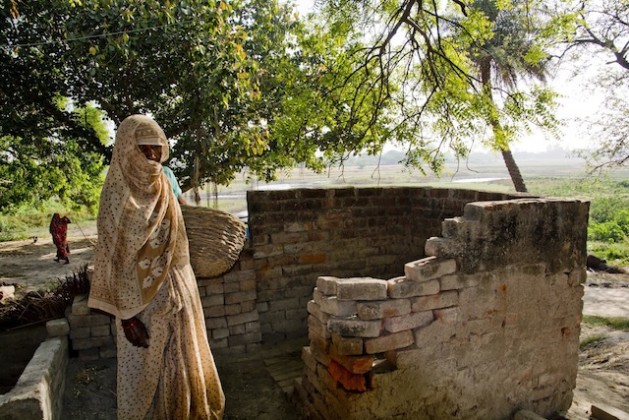
A Dalit woman stands outside a dry toilet located in an upper caste villager’s home in Mainpuri, in the northern Indian state of Uttar Pradesh. Credit: Shai Venkatraman/IPS
It takes years to break social barriers, even among the marginalised
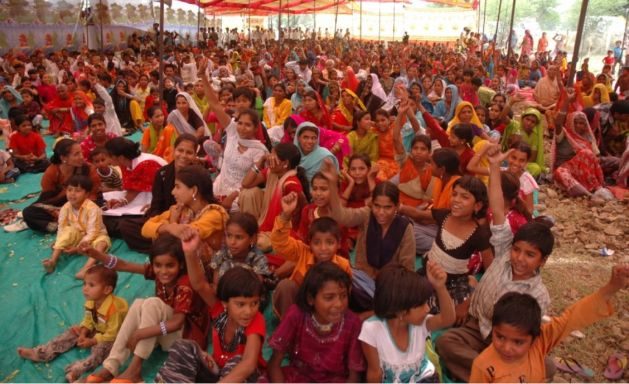
Jan Sahas works with manual scavengers, rape survivors and young girls who have been forced into commercial sexual exploitation. One of the biggest challenges we face is that it is very difficult to make these communities come together. Getting ‘outsiders’ to change their social behaviour requires work at a different level. But even within these disadvantaged groups, people follow discrimination and untouchability practices.
For example, in Bhaurasa, a village in Madhya Pradesh, we had women who had managed to stop doing caste-based work. There were 17 women from the Valmiki community, and 10 from the Hela community. Valmiki is a Dalit Hindu community, while Hela is a Muslim community. It took us three years to bring them together in one place for a meeting.
For two and a half years, we conducted meetings with adults in the community to convince them. Despite that we failed to change their beliefs. But when we started working with the young — using games and activities — it took almost no time.
One of the games we played was taking one child from the Valmiki community and the other from the Hela — one a Dalit and the other a non-Dalit. We told them that the Dalit child would become non-Dalit for a day, and vice versa.
We observed a big change in behaviour. The children soon realised that what one was doing with another human being was not based on any rationale. There is no rationale for caste discrimination, and that it didn’t make sense to follow this nonsensical practice.
The activities brought about a change in the children; they then started convincing their families and the families changed because of the children’s intervention.
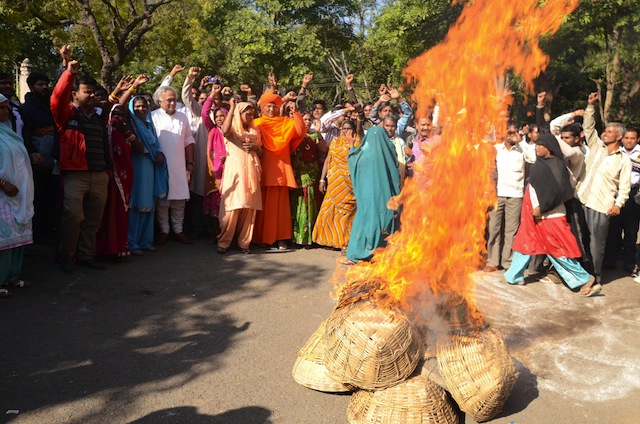
At a rally in New Delhi, Dalit women burn baskets used to collect human waste as a sign of protest against the caste-based practice of ‘manual scavenging’. Credit: Shai Venkatraman/IPS
Communities can solve their own problems. All they need are platforms.
Most of us in civil society who work with marginalised communities feel that ‘we are going to give them something’, ‘deliver’ something. In reality though, no one really is in a position to deliver anything to the community. What do we really know about the communities? How can we assume leadership on their behalf when we don’t know enough?
Consider the Dignity March where 25,000 rape survivors travelled over 10,000 kms and spoke openly in public forums about being raped. Jan Sahas might have coordinated the march, but the idea was not ours.
We were conducting a meeting in a village. There were four rape survivors along with their family members. One of the women said that there had been a conviction in her case, while a second women said that she was still struggling with her case and was facing many problems. The families were fighting among themselves, and demanding answers from us, saying if one woman’s case was solved, why wasn’t there a judgement yet in the second case?
One of the rape survivors told us: “You don’t explain what the problems are; let the woman who got the conviction explain to the others what steps need to be taken and how they can bring their own case to a closure”.
When she started explaining, the idea clicked in our minds; that instead of us doing this work — going to each village and talking to all the families about how to fight their cases — what if 1,000 rape survivors came together in one place and travelled all over the country and explained how to get a conviction to other survivors.
Nonprofits should only play the role of facilitators
We can’t be leaders of the manual scavengers, or rape survivors, or communities who are involved caste-based commercial sexual exploitation. They are their own leaders because they know what that pain has meant in how they live their lives. We cannot even imagine how much power or courage is required to change this situation.
No one else can do it — no Chief Minister or Prime Minister can work on it as effectively as a rape survivor can work on rape, or manual scavengers can work on their own issues. We need to understand this.
The role of the government or nonprofits is limited in this. We can help create appropriate forums for them; but it is they who will come up with the strategies. During the march, we observed this very clearly: people who’ve been facing oppression and discrimination, were ready to take up the struggle; they were ready to find solutions. What they needed was a platform to talk about their issues.
The current strategies which are made by the government or other institutions, rarely involve the affected communities. But no external force can bring about real change in society. Only the community itself can.
Translations from Hindi to English by Anupamaa Joshi.
Ashif Shaikh is an Indian social activist, known for his role in Rashtriya Garima Abhiyan, a campaign for the eradication of manual scavenging. He is also a co-founder of Jan Sahas, a human rights organisation. Since 2000, Jan Sahas has been working to end caste- and gender-based slavery and violence through the eradication of manual scavenging, caste-based sex work, forced labour, and trafficking. He has won several awards for this work, including the Sadbhavana Award and the Times of India Social Impact Award.


 The aim of this Assembly was to invite the international community to take a joint stand against racism, racial discrimination and intolerance and to address the fundamental structural root causes of these scourges through a robust and universal implementation of the DDPA.