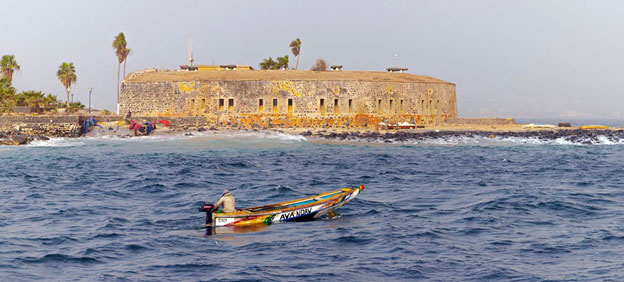
Unsplash Fort of Goree Island, Senegal, was the site of one of the earliest European settlements in Western Africa. Source UN News
The calls for reparatory justice can no longer be ignored, speakers at the fourth session of the United Nations Permanent Forum on African Descent said last April.
They urged greater collaboration between governments, civil society and regional organizations to create a system that would compensate Africa and the African diaspora for the enduring legacies of colonialism, enslavement, apartheid and genocide between the 16th and 19th centuries. “Africa was under siege,” said Hilary Brown, speaking on behalf of the Caribbean Community (CARICOM) about the 300 years of enslavement and exploitation on the continent. “Her political, economic and social systems thrown into chaotic instability as Europe plundered the continent for her most valuable asset, her people.”
MOSCOW, Mar 13 2026 (IPS) – Professor Jude Osakwe—a Nigerian scholar at the Namibian University of Science and Technology (NUST) and Continental Chairman of the Nigerians in Diaspora Organisation Africa (NIDOAF)—has reiterated the absolute truth over Reparations for Africa, noting that African governments have consistently expressed only ’emotional solidarity’ over Reparations instead of tackling and addressing, with seriousness, this pertinent issue within the context of diplomacy.
He strongly believes that despite sharp political and cultural diversity influencing developments, African leaders can still adopt a collective strategy in pursuit of advantageous aspirations for sustaining continental sovereignty. The concept of Pan-Africanism is noticeably fragmented while grassroot movements lack strategic coordination.
Here are excerpts from the interview:
How well do African people represent the continent on Reparations and Pan-Africanism?
Professor Jude Osakwe: Honestly, inadequately, but not without effort. Representation is fragmented. The loudest voices on reparations often come from the Caribbean and African-American communities, while continental Africans, remain largely sidelined in that global conversation.
Pan-Africanism as an ideology is more spoken about than practiced. There is emotional solidarity, but very little structural unity. The honest reality is that African governments have not made reparations a serious diplomatic priority, and grassroots movements lack the coordination to pressure them to do so.
Does the diaspora media landscape affect how these topics are viewed in a Western light?
Professor Osakwe: Absolutely.
Western media frames Pan-Africanism as either nostalgic romanticism or a political threat, and frames reparations as a Black American issue, effectively erasing the continental African dimension entirely. As an African in the diaspora, you are constantly navigating between your own lived framework and a media environment that either misrepresents or ignores your perspective.
This creates a psychological burden, you must actively resist the dominant narrative just to maintain an accurate self-understanding. African diaspora media exists, but it remains underfunded and underreached compared to mainstream outlets, which means the Western framing dominates public discourse by default.
What are the measures for upholding African identity in the diaspora, and diaspora contributions amid geopolitical shifts?
Professor Osakwe: Key measures:
• Intentional cultural transmission, language, history, and values must be actively taught, not assumed • Building diaspora institutions that are African-led, not just African-themed • Political engagement both in host countries and in countries of origin • Economic networking through platforms like NIDO that connect diaspora professionals to continental development
On geopolitical contributions: The current moment, with Africa renegotiating relationships with Western powers, China, Russia, and Gulf states, is actually an opportunity for the diaspora. Diaspora Africans sitting inside Western governments, universities, and financial institutions carry real leverage.
The question is whether that leverage gets used collectively or dissipates individually. Remittances already outpace foreign aid to many African countries. What’s needed now is moving beyond remittances to strategic investment, policy advocacy, and knowledge transfer, turning the diaspora from a financial lifeline into a genuine development partner.
Kester Kenn Klomegah focuses on current geopolitical changes, foreign relations and economic development-related questions in Africa with external countries. Most of his well-resourced articles are reprinted in several reputable foreign media.
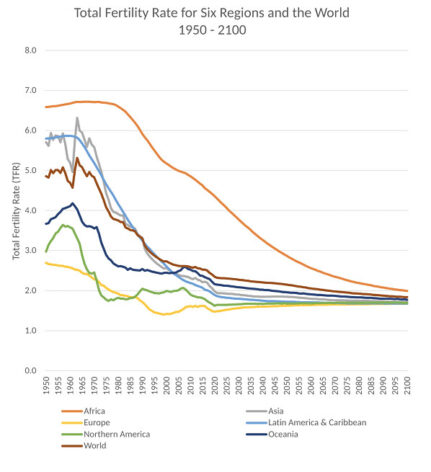
Total Fertility Rate (TFR) is the average number of children that would be born to a woman over her lifetime. Source: World Population Prospects 2022 report from the Population Division of the United Nations Department of Economic and Social Affairs
ST. PAUL, Minnesota, USA, Mar 12 2026 (IPS) – As birthrates continue to decline in many industrialized countries, anxious governments are running out of schemes to keep women procreating.
In the US, millionaires and billionaires are lining up to donate to Trump’s “baby bonus” savings accounts. Trump accounts give parents $1,000 for all babies born between now and 2028, plus whatever private donors add.
Late last year tech billionaires Michael and Susan Dell donated $6.25 billion to them. The accounts are part of Trump’s far-Right pronatalist agenda, and also part of the broader trend of governments using heavy-handed pronatalist policies, ranging from bribes to outright coercion, to convince women to have more babies and shore up the supply of future workers, taxpayers, and soldiers.
These interventions are notoriously ineffective. A recent Heritage Foundation report recommended using economic incentives to convince American women to have more babies, “with preferences for larger-than-average [families],” while shaming those who choose to have fewer or no children.
A family in South Korea, which has the lowest Total Fertility Rate in the world (0.8).
But it also admitted, “Other nations have tried to reverse declining birthrates through financially generous family policies, none has succeeded. Government spending alone does not ensure demographic success.”
Nor can such policies achieve what Heritage calls “success.” Trying to raise birthrates by incentivizing women to have babies not only undermines hard-won reproductive rights, it’s a waste of money.
Such spending is not a priority for U.S. taxpayers, as most Americans do not see falling birth rates as a crisis. Instead, they overwhelmingly want the government to address untenably high child care costs. But a one-time Trump account infusion makes no dent in high costs of raising children and other barriers to motherhood.
Just as recent cuts to SNAP and Medicaid disproportionately affect marginalized women and children, Trump accounts benefit least those who need help most. By the Administration’s own calculations, the accounts will benefit wealthy parents disproportionately.
This shouldn’t be surprising. Trump accounts and other pronatalist policies aren’t really about empowerment or saving families or supporting children. They are a bid to make more white Americans, part of a larger nativist program which includes cracking down on immigration from African and Muslim countries, detaining and deporting non-white people in huge numbers, and even abandoning former U.S. efforts to fight child exploitation and trafficking.
And even when such policies intend to serve feminist goals–for example Finland’s generous parental leave and child and health care—they fail to raise birthrates. That’s because the biggest factor in childbearing decisions isn’t affordability; it’s empowerment.
Nobel prizewinning economic historian Claudia Goldin has shown high birthrates are no longer tied to economic prosperity, as women increasingly choose education and careers over traditional family roles. In fact, she found an inverse relationship between per capita income and fertility. “Wherever you get increased agency,” she said, “you get reduction in the birth rate.”
Another study across 136 countries confirms this: whenever women achieve reproductive agency, birthrates decline, whether the economy is growing or shrinking.
But hundreds of millions of women and girls are denied this agency. Over 640 million alive today were child brides (including in the US). Over 220 million have an unmet need for contraception. More than half of pregnancies are unintended—121 million annually. Cuts in USAID and other aid programs make the situation more dire.
As median age rises, changing demographics could enable policy shifts that improve wages and conditions for workers and extend job opportunity to billions on the sidelines who want work but don’t have it.
There is no lack of good ideas, from economic models that center wellbeing and rethink growth to radical ecological democracy. Exploring them requires getting off the endless growth treadmill that enriches elites at the expense of the rest of us. We must stop treating women like reproductive vessels for making more people to serve the economy, and start reshaping our economies to serve more people and the planet.
Nandita Bajaj is executive director of the NGO Population Balance, senior lecturer at Antioch University, and producer and host of the podcasts OVERSHOOT and Beyond Pronatalism. Her research and advocacy work focuses on addressing the combined impacts of pronatalism and human expansionism on reproductive and ecological justice.
NEW YORK, Mar 11 2026 (IPS) – I have often been asked a simple but important question: How can we make it sustainable if we are not being compensated for it?
That question sits at the heart of a conversation we do not address enough. Somewhere between exposure and exploitation lies a line we still have not learned to draw clearly. And perhaps that is exactly where the real conversation on “inclusion” begins.
The cost of being seen, is probably the heaviest cost youth have to bear in pursuit of carrying the passion and aspirations they strive for when trying to make an impact.
As conversations around the 2030 Agenda and the SDGs continue to grow, one question remains: how far have we really come in shaping perspectives, and not just numbers?
Too often, inclusion is measured by attendance, representation, and diversity metrics. But inclusion is not just about presence. It is about value. It is about whether people are acknowledged, respected, and taken seriously for their contribution. Inclusion does not live in the excel sheets we fill or the rooms we temporarily occupy during events.
It begins where age, gender, ethnicity, and job titles are not weighed before credibility is given. This matters even more for young people.
A single voice, a single appearance, or a single statement is often framed as an opportunity. And sometimes, it is. But when visibility becomes a substitute for fair compensation, authorship, decision-making power, or real support, exposure stops being empowered and starts becoming exploitative.
Exposure on its own is not empowerment. Visibility can open doors, but it cannot replace fair structures. Being seen is meaningful only when it is followed by trust, ownership, opportunity, and value.
Too often, young people are handed advice when what they really need is access. They are mentored, encouraged, and told to keep going, yet rarely sponsored in the spaces that shape outcomes. If we want inclusion to move beyond symbolism, we must build cultures where support does not end at guidance.
It must extend into advocacy. Because for many underrepresented voices, the issue is not a lack of talent or preparation. It is the absence of someone willing to open the right door and say, this person belongs here.
The goal is not to reject exposure. Exposure can be powerful. But it cannot be the only thing being offered. Real inclusion begins when participation is respected, contribution is valued, and visibility leads to something more lasting. Being seen may open the door, but being valued is what makes inclusion real.
Bisma Qamar is Pakistan’s Youth Representative to the UN & USA chapter under the Prime Minister’s Youth Programme (PMYP). Her work is centered towards learning and development and capability building initiatives, with a strong emphasis on creating inclusive and sustainable opportunities through “Bridging talent with opportunities” by upskilling individuals focusing on SDG 4 ( Education ) and SDG 5 ( Gender Equality )
Credit: Office of the High Commissioner for Human Rights (OHCHR)
NEW YORK, Mar 6 2026 (IPS) – In recent months, the language surrounding the escalating confrontation between the United States, Israel, and Iran has taken on a tone that should trouble anyone concerned with global peace.
Across television studios, online sermons, and political commentary, some American preachers and commentators have begun describing the conflict not merely as geopolitics or national security, but as a “holy war.”
Reporting in outlets such as The Guardian, along with coverage in other international media, has noted the growing number of Christian nationalist and Evangelical voices framing the Middle Eastern conflict in explicitly theological terms.
Certain Evangelical preachers in the United States have long interpreted tensions involving Israel through apocalyptic or biblical narratives. In these interpretations, the confrontation with Iran is sometimes presented as part of a divinely ordained struggle between good and evil.
In sermons broadcast online and amplified through social media, the war is described as a moment in which believers must stand with Israel in a battle perceived as spiritually consequential – even leading to ‘the rapture’.
The rhetoric is not limited to pulpits. Some former military figures and commentators have echoed similar themes, invoking civilizational language that portrays the confrontation with Iran as part of a broader clash between Judeo-Christian civilization and an Islamic adversary.
When such language enters strategic discourse, it transforms political conflict into something far more dangerous: a war imbued with sacred meaning.
History shows that once wars are framed as sacred struggles, compromise becomes nearly impossible. Political conflicts can, at least in theory, be negotiated. Holy wars, by contrast, are perceived as battles for divine truth. In that framing, negotiation is betrayal.
This phenomenon is not unique to the current Middle Eastern crisis. Religious legitimization of war has surfaced repeatedly in contemporary conflicts. At the outbreak of Russia’s full-scale invasion of Ukraine in 2022, for example, the head of the Russian Orthodox Church, Patriarch Kirill, framed the war in spiritual terms.
In sermons and public statements, he suggested the conflict represented a metaphysical struggle over the moral future of the Russian world. The language of spiritual warfare, cultural purification, and civilizational defence became intertwined with political justification for military action.
Such rhetoric matters. When religious authority sanctifies violence, it grants moral legitimacy to warfare and discourages dissent among believers. Faith communities that might otherwise advocate peace can become mobilized behind nationalistic or militaristic agendas.
We are therefore witnessing something deeply unsettling: the return of explicitly religious language to modern warfare. For decades after the Second World War, global diplomacy attempted—imperfectly but deliberately—to frame conflicts primarily in political and legal terms.
International institutions, treaties, and multilateral frameworks were designed to prevent precisely the kind of civilizational framing that once fueled centuries of bloodshed.
Yet the present moment suggests that these restraints are weakening. Wars are again being narrated as existential struggles between belief systems. Political leaders, clergy, and media personalities increasingly draw upon religious symbolism to rally support.
The danger is not simply rhetorical. When wars are sacralized, they risk becoming limitless conflicts, unconstrained by borders or diplomacy.
The Collapse of Multilateralism and the Silence of Faith Institutions
For years, I have written and spoken about the uneasy relationship between religion, global governance, and peacebuilding. In articles as well as in interviews and public lectures, I have repeatedly warned that governments and intergovernmental entities have failed to develop a coherent framework for engaging religions constructively in international affairs.
Faith-based organizations today are everywhere. They participate in humanitarian work, development programs, diplomacy initiatives, and interfaith dialogues. International institutions increasingly acknowledge the importance of religious actors in peacebuilding and development. Conferences, seminars, department programmes, global initiatives on “religion and …” or “faith and …” are not only commonplace, but proliferating.
Yet despite this apparent proliferation of engagement, the deeper structural problem remains unresolved: religious actors themselves remain profoundly fragmented, as are the political protagonists dealing with them.
Rather than forming robust alliances capable of confronting violence carried out in the name of religion, many faith organizations continue to operate within narrow institutional or theological boundaries. Interfaith initiatives exist, but they often remain symbolic—highly visible yet limited in their capacity to challenge political power or mobilize believers at scale.
I have argued that religious organizations too often underestimate their responsibility in shaping public narratives around conflict, and doing so together. When religion is invoked to legitimize violence, silence from religious leaders becomes complicity.
At the same time, the broader international system that might once have moderated such dynamics is itself under strain. The erosion of multilateralism has been one of the defining features of the past decade. International institutions that once served as mediators of global crises increasingly appear weakened or sidelined.
The United Nations Security Council remains gridlocked. International law is invoked selectively – if at all. Great-power competition has returned with renewed intensity. In such an environment, appeals to universal norms carry less weight.
Alongside this institutional weakening has come a worrying rise in authoritarianism worldwide. Governments across regions have adopted increasingly illiberal practices—restricting civil liberties, marginalizing minorities, and suppressing dissent. In many cases, religion is instrumentalized to reinforce nationalist narratives or legitimize political authority.
This combination—the decline of multilateral governance and the rise of politicized religion—creates a volatile global environment. Without strong international frameworks to mediate disputes, imperialist narratives and actions gain traction – as in Trump’s and Netanyahu’s war against Iran. Religion, ethnicity, and culture become tools through which political conflicts are interpreted and mobilized.
Faith-based organizations, despite their potential influence, have struggled to counter this trend effectively. Some remain focused on humanitarian services rather than confronting the ideological narratives that legitimize violence. Most hesitate to challenge political authorities with whom they maintain close relationships, and seek financial and/or political backing.
As a result, the global religious landscape today is marked by a paradox: religion is increasingly present in global discourse, yet its potential as a force for peace remains under-realized.
Islamophobia and the Seeds of a Wider Religious Conflict
Perhaps the most troubling dimension of the present moment is the resurgence of Islamophobia as a powerful political force in international discourse.
For more than two decades following the attacks of September 11, 2001, narratives portraying Islam as inherently linked to extremism became deeply embedded in political rhetoric and media representation across many Western societies.
Despite sustained efforts by scholars, religious leaders, and civil society actors to challenge these narratives, they continue to shape public perceptions.
In the context of the current confrontation with Iran, such narratives risk reinforcing the perception that the conflict is not merely geopolitical but civilizational. When Iran is framed not simply as a state actor but as a representative of a threatening Islamic force, the conflict becomes symbolically larger than any single nation.
The danger is clear: political wars are becoming interpreted as religious wars.
If such framing takes hold, the implications extend far beyond the Middle East. Conflicts that are perceived as religious struggles can mobilize believers across borders. They can radicalize communities, fuel sectarian polarization, and undermine the fragile coexistence of diverse religious populations.
History provides sobering examples. The European wars of religion in the sixteenth and seventeenth centuries devastated entire regions, entangling political power struggles with theological disputes. Once religious identity became intertwined with warfare, violence spread across kingdoms and empires.
Today’s globalized world is even more interconnected. Diaspora communities, digital media, and transnational networks allow narratives of conflict to circulate instantly across continents. A war perceived as targeting Islam could ignite tensions in communities thousands of miles away from the battlefield.
Similarly, religious nationalism in multiple regions—whether Christian, Jewish, Hindu, Buddhist, or Muslim—has been gaining strength in recent years. When one religiously framed conflict emerges, it can reinforce others. Narratives of civilizational struggle feed upon each other.
As the confrontation between the United States, Israel, and Iran becomes widely interpreted through a religious lens, the consequences may be profound. Christian–Muslim tensions, already strained in many contexts, could escalate dramatically. Such conflicts would not respect national borders. They would unfold within societies, across communities, and through global networks of believers.
Ironically, this escalation occurs at a time when religious leaders frequently emphasize the peace-promoting teachings of their traditions. Interfaith initiatives celebrate dialogue, coexistence, and shared values. Religious texts across traditions contain powerful injunctions toward compassion, justice, and reconciliation.
Yet these ideals remain fragile when confronted with political realities.
If religious institutions fail to challenge narratives that sanctify violence, they risk becoming spectators to a new era of religious conflict. Worse still, they may be drawn into it.
Are “Religions” Truly for Peace?
We may therefore be standing at the threshold of a profoundly dangerous historical moment.
Religious language is once again being used to justify war. Political conflicts are increasingly framed as civilizational struggles. Multilateral institutions that once mediated global disputes appear weakened. And faith communities—despite their moral authority—have yet to mount a unified challenge to the narratives that sacralize violence.
None of this means that religion inevitably leads to war. On the contrary, religious traditions contain some of humanity’s most powerful ethical teachings about peace, justice, and compassion. Faith communities have played vital roles in reconciliation processes, humanitarian action, and social movements for justice.
But these possibilities are not automatic. They depend on conscious choices by religious leaders, institutions, and believers.
If religious actors allow their traditions to be mobilized in support of political violence, then religion will become part of the problem rather than the solution.
The question confronting us today is therefore both urgent and uncomfortable.
At a moment when wars are increasingly described as sacred struggles, when geopolitical conflicts are interpreted through religious narratives, and when Islamophobia and other forms of religious prejudice continue to spread, we must ask ourselves: How are religions truly forces for peace?
Prof. Azza Karam, PhD. is President, Lead Integrity
Credit: Global Centre for the Responsibility to Protect
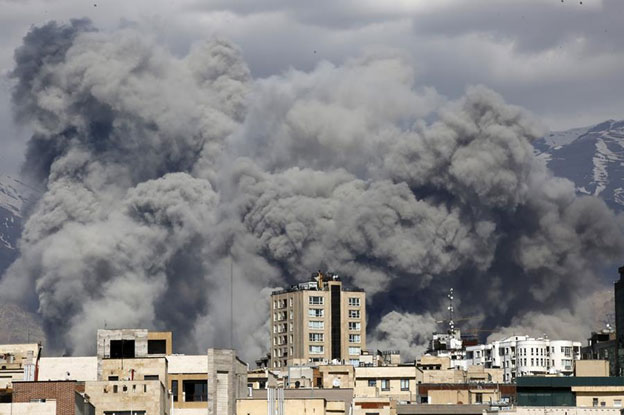
UNITED NATIONS, Mar 3 2026 (IPS) – As the build-up for a proposed “new world order” continues, a lingering question remains: will the country with the most powerful military reign supreme?
The United Nations remains politically impotent. The UN charter is in tatters. The sovereignty of nation states and their territorial integrity have been reduced to political mockery. And the law of the jungle prevails—be it Palestine, Ukraine, Venezuela or Iran.
What’s next: Colombia? Cuba? Greenland? North Korea?
The widespread condemnation of the ongoing conflicts – including charges of war crimes and genocide— has continue to fall on deaf ears.
UN Secretary-General Antonio Guterres told the Security Council that under Article 2 of the UN Charter, all member states shall “refrain in their international relations from the threat or use of force against the territorial integrity or political independence of any state.”
But is anybody out there listening?
Norman Solomon, executive director, Institute for Public Accuracy and national director, RootsAction.org, told IPS killing from the sky has long offered the sort of detachment that warfare on the ground can’t match. Far from its victims, air power remains the height of modernity
Reliance on overwhelming air power is key to what the U.S. is doing in tandem with Israel. Bombing from the skies while not attacking with ground forces is the ultimate way of killing without suffering many casualties.
This reduces political blowback at home in a political and media culture that values American lives but sees the lives of “others” as readily expendable, he pointed out.
“This flagrant war of shameless aggression, launched by the United States and Israel, cannot be contained — much less rolled back — by the typical diplomatic euphemisms and caution.”
The U.S. and Israeli governments, said Solomon, are too completely run by psychopathic leaders who adhere only to the “principle” that might makes right. If ever there were a time that the vaunted “international community” should step up and confront an alliance of reckless outlaw governments, this is it.
The European allies of the United States, he said, should stop their cowardly vagueness and finally step up to demand a halt to this aggression that is setting the Middle East tinderbox on fire. The EU should be threatening huge countermeasures against the United States and Israel unless that pair of sociopathic governments immediately halts their assault on Iran.
“Playing evasive games with Washington makes the leaders in London, Paris, Berlin and elsewhere accomplices to methodical ongoing war crimes”, declared Solomon, author of “War Made Invisible: How America Hides the Human Toll of Its Military Machine”
According to the Global Centre for the Responsibility to Protect, the US-Israeli act of aggression against Iran was undertaken in violation of international law and the UN Charter, as they exercised use of force without authorization from the UN Security Council (UNSC) or without a demonstrated threat to their security that would trigger the right to self-defense under Article 51 of the UN Charter.
“The attack came amid ongoing nuclear talks between the US and Iran and just hours after Oman’s Foreign Minister – a key mediator in the negotiations – shared details on progress achieved and announced that a breakthrough was near. The attack also mirrors the recent unlawful actions undertaken by the US in Venezuela on 3 January, culminating in the kidnapping of the head of state and setting in motion profound uncertainty for the region and the global order.”
Meanwhile, the Geneva-based UN refugee agency, the UNHCR, said it is deeply concerned about the escalation of conflict in the Middle East and its impact on civilians and further displacement in the region.
“Many affected countries already host millions of refugees and internally displaced people. Further violence risks overwhelming humanitarian capacities and placing additional pressure on host communities”.
“We echo the UN Secretary-General’s urgent call for dialogue and de-escalation, respect for human rights, the protection of civilians and full adherence to international law”.
James Jennings, President of Conscience International, told IPS the joint US-Israeli attack on Iran was misguided, illegal, and based on lies. It will retard, not advance, any future nuclear agreement, perhaps for decades.
It was illegal, he pointed out, because it violates both the US constitution and international law as enshrined in the UN Charter. It was based on lies because the nuclear watchdog groups have clearly indicated in essence that “There’s nothing to see here.”
“Trump regularly claims that June’s joint “Operation Midnight Hammer” obliterated Iran’s nuclear capability, yet his weak case for the current “Operation Epic Fury” war rests on the idea that perhaps someday in the future Iran might get a bomb. Several US administrations have worked diplomatically to prevent that, yet Trump tore the agreement up”.
Trump claims to be limited by no law, constitution, or the UN Charter. Guided only by his own morality, as he said recently, he followed Israel obediently in launching a massive war against a sleeping country of 92 million people, said Jennings.
“All the while, his amateur diplomats were negotiating deceptively for a compromise like Imperial Japan did in the run-up to the WW II Pearl Harbor attack. Ask the parents of the more than l00 schoolgirls killed on the first horrifying day of joint US-Israel bomb attacks at Minaj, Iran, and they will probably not see Mr. Trump as particularly moral”.
George W. Bush called himself “The Decider, so he foolishly decided to take the US into two unwinnable wars that most politicians in Washington, and even Trump himself, now consider monumental mistakes. Trump campaigned vigorously on keeping the US out of mistaken Middle East wars that became “Forever Wars,” said Jennings.
“Yet here he is being pulled around by the nose by Mr. Netanyahu. According to a classic rule when launching a war, one must recognize that two things cannot be changed: one is history and the other is geography. It is stunning that the leader of the United States is cavalier about going to war without understanding that or clearly stating the mission’s purpose or end game.”
Pundits and TV reporters are calling the attack on Iran “a war of choice,” said Jennings.
“Why not call it what it really is–a war of naked aggression? Nobody knows when will it end. Trump’s claim that the war will be over in a few days is a cruel joke. The other side gets a vote. Iran celebrated its 2,500th anniversary in 1971. Maybe people who have been around so long know a few things about survival,” declared Jennings.
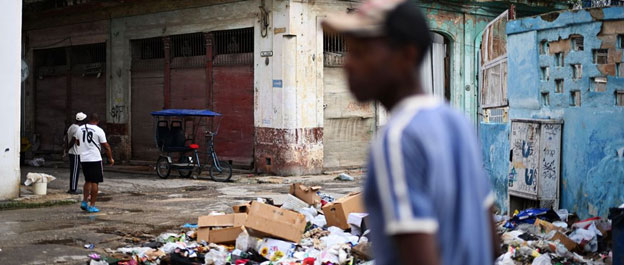
BERLIN, Germany, Mar 2 2026 (IPS) – The crisis could scarcely be more dramatic. The US is blocking practically all oil deliveries to Cuba. The island depends on imports for all diesel, petrol and kerosine. Without diesel trucks cannot move, food cannot reach Cuban towns and hospitals will not get any oxygen.
The airports are already without kerosine and several airlines have already suspended flights to and from Havana. The strategy is clear: strangulation. The US extreme right is jubilant; at last, they have found the ‘choking point’ that may finally bring Havana to its knees, 67 years after Fidel Castro’s revolution.
Trump says that negotiations are already under way, outside of declaring that Cuba is a ‘failed state’ and the government there needs to make a deal. But Trump says a lot of things. Even a sober look at the alternatives, however, is fairly terrifying. There are basically four scenarios:
Scenario 1: Cuba continues to be denied oil deliveries. The government can impose austerity measures and commit itself to heroic resistance. But without new petrol or diesel the current crisis will become a humanitarian catastrophe within weeks. Havana could pin the blame for this on the US and with complete justification. For all its own faults, no other Caribbean island could withstand such an oil embargo, whatever its political system. But what good would playing the blame game do in the end? The social and human costs would be horrendous. Without diesel even international humanitarian aid deliveries couldn’t get from the ports to the towns that need them.
Moscow says that it is willing to supply Cuba with oil, but so far it hasn’t followed through.
Scenario 2: Some oil tankers reach the island, perhaps from Moscow, from spot market purchases or from other sources. This could relieve the worst of it, no doubt. But the question remains, to what degree? And for the foreseeable future? Trump’s threats of punitive tariffs and the seizure of proscribed tankers are already sufficient deterrent.
Even Mexico had to pull its support under pressure from Washington. But who else is up for incurring America’s wrath? Moscow says that it is willing to supply Cuba with oil, but so far it hasn’t followed through.
On top of that, Russian airlines are bringing their passengers home and suspending flights. Up until the US military strikes on Maduro on 3 January Venezuela had provided 70 per cent of Cuba’s oil imports. Instead of demanding hard currency payments, it settled for Cuban medical personnel. Who will take over this role?
Scenario 3: The desperate situation intensifies, leading to protests, unrest and the fall of the government. This is what the hardliners in Miami have been dreaming of. But for all the pent-up frustration Washington’s own policy is stymying mobilisation. Already in Venezuela Trump and Rubio ignored the opposition and made deals only with the post-Maduro elite.
If Trump is now saying that negotiations with Havana are already going on and the regime will fall of its own accord, who on the island will be inclined to put themselves on the line in demonstrations or protests? No doubt there’ll be outbreaks of desperation, windows may be smashed and sporadic looting.
But if the message is that only the power struggle between Washington and Havana really counts it makes more sense for the populace to see how things develop, waiting until things have been decided by those at the top.
Scenario 4: The US oil blockade could be lifted in the course of negotiations. But even though Havana has resumed communications with Washington dialogue remains a distant prospect. Some possible steps seem realistic. The Cuba government could order the release of hundreds of prisoners, held in the protests of 11 July 2021.
It could also remove particularly controversial sections of the penal code, push ahead with market reforms or improve investment possibilities for Cuban emigrees. And all without undermining the foundations of the system. This would not only serve US interests, but also many of the civilian population. In return, Washington could permit a resumption of oil deliveries to Cuba from Mexico and elsewhere. Restrictions on remittances from US Cuban expats could be lifted. A first milestone would be reached.
Never been weaker
Nevertheless, it is difficult to imagine what kind of common denominator could be found that would ease the tension and usher in some kind of new normal. Cuba has been a worldwide symbol for the left since the revolution in 1959. But the same could be said for the right in the US.
Indeed, the latter would like nothing better than to see it fall. Trump won’t say what kind of deal he wants. But rest assured it will involve Cuba once more within the US sphere of influence and a US-friendly government in Havana.
Cuba really has its back against the wall. Its negotiating position has never been weaker. Venezuela has shown, however, that the US wants more than political alignment and access to resources. It also desires stability. The government in Caracas may have changed, but the military and the police, the state apparatus and even para-military forces remain intact.
Cuba isn’t a complete match in this respect, but if the US doesn’t want to put boots on the ground it will continue to need the state’s existing forces of order: police, military and administration. This gives the Cuban side at least something to bring to the negotiating table.
Nevertheless, Havana will have to cross a lot of red lines to reach an agreement with this US administration. And what’s more, under the constant shadow of the latent threat that Washington will again turn off the oil tap. The US government would be well advised to be pragmatic enough to allow the other side to save face.
But this is unlikely given the intoxicating fantasy of omnipotence by which Washington is currently spellbound. Cuban-born hardliners in the US Congress are already demanding that the Department of Justice bring the 94-year-old Raúl Castro to trial.
Or perhaps everything will be resolved very quickly. The power bloc around Raúl Castro’s family and its associated network controls not just the military and the security apparatus, but also by far the biggest business entity in the country, the military holding GAESA. The profound crisis of recent years has enabled them to invest with grim determination in the expansion of luxury hotels, transferring state-run restaurants into private management and acquiring stakes in lucrative online supermarkets that emigrants in Miami and elsewhere use to support their families on the island.
Could the upshot be a form of capitalism that maintains their economic privileges, with American partners in the hotels, while the old networks retain control?
None of the four scenarios seem entirely credible, but surely one of them, or some combination, will be realised in the not-too-distant future. But maybe not, if all those who are currently mute in fear of falling victim to Trump’s random impulses actually come together. Not out of nostalgia for the Cuban revolution, but to stand up and be counted as the Washington regime calls into question the basic norms of coexistence between peoples and states, whether in Cuba or Greenland.
Professor Dr Bert Hoffmann is Lead Research Fellow at the GIGA German Institute for Global and Area Studies in Hamburg and Honorary Professor at Freie Universität Berlin.
Source: International Politics and Society, Brussels