Hidden Danger: How War Remnants Threaten Syrian Lives

Armed Conflicts, Civil Society, Development & Aid, Editors’ Choice, Featured, Headlines, Human Rights, Humanitarian Emergencies, Middle East & North Africa, Sustainable Development Goals, TerraViva United Nations

Armed Conflicts

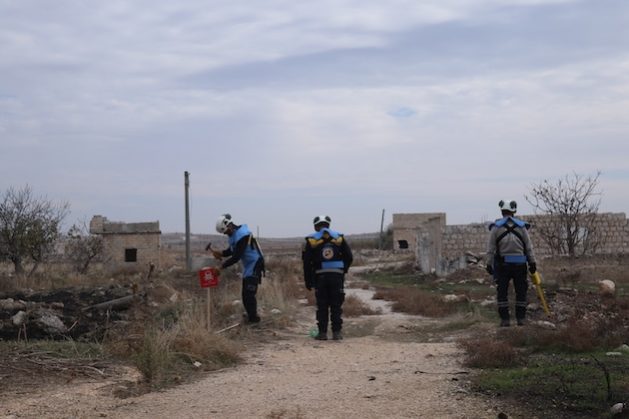
Syrian Civil Defense prepares to remove unexploded munitions of all shapes and types, including landmines. Credit: Sonya Alali/IPS

Syrian Civil Defense prepares to remove unexploded munitions of all shapes and types, including landmines. Credit: Sonia Alali/IPS

IDLIB, Syria, Feb 3 2025 (IPS) – When 42-year-old Amina al-Hassan’s family returned home after the fall of the Bashar al-Assad regime, her son stood on a landmine.

Hassan, from Kafranbel in southern Idlib countryside, sits beside her son’s bed in the hospital after his leg was amputated following the explosion on agricultural land near their home.


“After the fall of the Bashar al-Assad regime and the expulsion of its elements from our city, we went to check on our house, while my son went to inspect the agricultural land near the house. He did not notice a landmine planted among the weeds and plants, and it exploded, amputating his leg,” she told IPS.

Explosive remnants of war and landmines are scattered haphazardly across Syria, endangering the lives of civilians, hindering the return of displaced persons to their cities and villages, and obstructing their agricultural work. The frequency of explosions caused by unexploded ordnance and abandoned explosive ordnance has significantly increased following the collapse of the Bashar al-Assad regime and the fading of the frontlines between the regime and the opposition, where mines and unexploded ordnance are widely dispersed.

“When I heard the explosion, I ran as fast as lightning towards the source of the sound. When I reached the explosion site, I tried to take out my son myself, but the people present at the scene prevented me from doing so. One of the engineering team specialists took charge of removing the mines around him and took him out, then we rushed him to the nearest hospital in the city,” she said, her voice tinged with sorrow.

The United Nations Children’s Fund (UNICEF) confirmed on January 14 that the deadly legacy of landmines and other explosives left behind by years of conflict in Syria had killed more than 100 children in December alone, urging the international community to urgently support mine clearance projects across the country.

According to the Syria Response Coordinators team, the war remnants left by the former Syrian regime continue to claim the lives of Syrians. Since December 8, 2024, explosions of mines and cluster munitions in more than 108 locations in Syria have killed 109 people, including 9 children and 6 women. More than 121 others were injured, including 48 children and one woman.

Rowan al-Kamal (46), from the western Aleppo countryside, visited her home after Syria was liberated from the Assad regime. Unlike many others, she was fortunate, not because her house was intact, but because she noticed an unexploded shell near the house. She recounts, “I moved my children away and called the Syrian Civil Defense, who worked to dismantle it. We were saved from death or injury.”

Kamal adds, “I don’t know how I spotted it amidst the rubble. When I saw it, I was rushing to check what remained of the house. I think my eyes have become accustomed to recognizing shells, as we lived with them throughout the long years of war.”

She reveals that she won’t be able to return to her home due to the presence of landmines and unexploded ordnance, despite living in a makeshift camp with her family of seven and facing extremely harsh conditions, especially with the significant drop in temperatures and the inability of humanitarian organizations to provide the displaced with necessary supplies such as food and heating.

While Kamal and her family survived injury or death, Wael al-Ahmad (22), from Has town in southern Idlib, lost his life after his city was liberated. His mother, Fatima al-Ahmad, recounts, “My son was tending to the sheep on the outskirts of the town and stepped on a landmine without noticing it, causing him severe injuries. He passed away hours later due to his injuries.”

Ahmad calls for intensified efforts to remove these remnants to prevent further casualties and ensure the safe return of the displaced. “The war remnants planted by the Syrian regime and its allies represent a delayed death for Syrians, as they threaten lives and prevent civilians from returning to their homes and farms,” she says tearfully.

Mohammed al-Saeed (32), who works on a war remnants removal team at the Syrian Civil Defense, explains, “War remnants are unexploded munitions of all shapes and types that remain in an area after the end of a war.”

He adds, “War remnants pose a real threat to Syrians in various parts of the country. They are divided into unexploded ordnance such as bombs, rockets, and shells, in addition to landmines.”

Al-Saeed clarifies that the first type is easier to remove and avoid because it can be seen and is usually found above ground. However, the biggest challenge lies in landmines that people cannot see.

Saeed further explained that Syrian government forces planted hundreds of thousands of mines in various regions of Syria, particularly in agricultural lands, military barracks, and frontline areas between the regime and the opposition. He warned that anyone returning to their town, home, or land should be aware that there may be unexploded ordnance present.

According to Saeed, Syrian Civil Defense teams conducted 822 operations to dispose of unexploded ordnance in northwestern Syria between November 27, 2024, and January 3, 2025.

He urged residents to be cautious of strange objects, to avoid touching or moving them, and to report them immediately. Meanwhile, Civil Defense engineering teams continue to conduct daily technical surveys of land contaminated with war remnants and work to dispose of munitions.

Saeed emphasized the need for the international community to work with the new Syrian government and coordinate with it to remove mines by providing funding to expand the Civil Defense’s capacity, hire more personnel, purchase more equipment, and operate in wider areas.

‘The former Syrian regime and its allied militias deliberately planted mines in vital areas, aiming to inflict the maximum number of civilian casualties. This long-term crime represents another facet of their brutal practices,” says Saeed.

IPS UN Bureau Report

  Source

‘Digital platforms amplify the Israeli narrative while systematically silencing Palestinian voices’

Armed Conflicts, Civil Society, Crime & Justice, Featured, Headlines, Human Rights, Middle East & North Africa, Migration & Refugees, Press Freedom, TerraViva United Nations

Jan 2 2025 (IPS) –  
CIVICUS discusses the challenges Palestinian civil society faces in resisting digital suppression and advocating for justice with Palestinian lawyer and researcher Dima Samaro.


As the director of Skyline International for Human Rights, Dima advocates for digital freedoms and human rights in the Middle East and North Africa (MENA). She is a board member of Innovation for Change, MENA Hub, and the Surveillance in the Majority World Network, and volunteers with Resilience Pathways, which helps Palestinian civil society organisations (CSOs) reclaim the narrative amid Israeli efforts to manipulate public opinion, block funding and restrict civic space.

Dima Samaro

How are digital platforms influencing the narrative on Palestine?

Digital platforms have become key to shaping narratives about Palestine, often amplifying the Israeli narrative while systematically silencing Palestinian voices. Platforms such as Meta, TikTok and X, formerly Twitter, routinely remove Palestinian content under vague ‘policy violations’. This has intensified since October 2023, with the Israeli Cyber Unit issuing over 9,500 takedown requests, 94 per cent of which were approved. These actions have resulted in the removal of posts, shadow bans – a form of censorship that limits visibility of pro-Palestinian content without user notification – and account suspensions, and have extended to the censorship of hashtags such as #FreePalestine.

Algorithmic bias further marginalises Palestinian narratives. For example, Instagram once mistranslated the Arabic phrase ‘alhamdulillah’ – praise be to God – next to a Palestinian flag as ‘terrorists fighting for their freedom’. On WhatsApp, AI-generated images depicted militarised scenes as illustrations for ‘Palestinian’ but benign cartoons for terms such as ‘Israeli boy’ or ‘Israeli army’. While these incidents are often dismissed as technical errors, they reveal a systemic bias.

Policies such as Meta’s Dangerous Organisations and Individuals framework are heavily influenced by US terrorism designations and stifle Palestinian discourse by prohibiting expressions of ‘praise’ or ‘support’ for major political movements. Meanwhile, hate speech targeting Palestinians – including posts celebrating violence or calling for the destruction of Gaza – often goes unchecked. While ads inciting violence against Palestinians are allowed, the use of terms like ‘Zionist’ is flagged as hate speech. This double standard silences Palestinian voices while enabling propaganda that justifies collective punishment and shields atrocities from scrutiny.

Platform complicity goes beyond censorship. In April, +972 Magazine reported that WhatsApp, which belongs to Meta, played a role in supporting the Israeli AI surveillance system Lavender, which has been linked to the killing of civilians in Gaza. These disturbing revelations suggest direct corporate complicity in violations of international law.

Digital platforms are distorting narratives, dehumanising Palestinians and normalising violence against an already oppressed and besieged population. They actively suppress efforts to document war crimes and manipulate information. They must be held accountable for this.

What challenges does Palestinian civil society encounter?

Palestinian CSOs work under immense pressure, facing arbitrary arrests, travel bans, funding cuts and violence. In October 2021, Israel designated six prominent Palestinian human rights groups as terrorist organisations. These unfounded accusations delegitimised their work, fuelling defamation campaigns and enabling harassment and other restrictions on their work.

Many human rights defenders have also become targets of digital surveillance. Pegasus spyware, developed by the Israeli company NSO Group, has been used to hack the devices of Palestinian activists and human rights defenders, putting their safety and work at risk. This surveillance has been widely condemned by organisations such as Amnesty International and Human Rights Watch.

But the crackdown on Palestinian civil society goes beyond digital tactics: human rights defenders are harassed, arbitrarily detained and physically attacked. In Gaza, the situation has worsened after October 2023. Several civil society workers have been killed, injured or detained, and many have been displaced by the ongoing bombardment. The destruction of infrastructure has further hampered their work.

Journalists also face violence. Gaza has become the world’s deadliest place for journalists, with 195 media workers killed to date, many of them deliberately targeted while carrying out their duties. This loss of independent reporting creates a massive information gap, leaving human rights violations unreported and unchecked.

To make matters worse, international donors such as Germany, Sweden and Switzerland have suspended funding over unsubstantiated allegations of links to terrorism. The European Union’s imposition of ‘anti-incitement’ clauses also stigmatises Palestinian CSOs by forcing them to prove their neutrality, limiting their ability to document human rights violations without risking their safety.

How is Skyline International helping address these challenges?

We work at the intersection of technology, social media and human rights in Palestine and the region. We track, monitor and document human rights violations committed by states and corporations, particularly in the digital sphere. This includes tracking digital surveillance, analysing the ethical implications of AI in conflict settings and advocating for the protection of fundamental online rights such as freedom of expression, access to information and the right to privacy.

In Palestine, we support civil society activists and journalists by tackling online censorship and digital bias. We work closely with human rights defenders to document cases of over-enforcement of policies, content takedowns, account suspensions and algorithmic bias by social media platforms, as well as the illegal use of spyware and new technologies to target media workers. We also condemn Israel’s use of digital tools to target journalists in Gaza and Lebanon. Our aim is to draw national and international attention to these violations and advocate for the protection of press and online freedoms, ensuring that journalists can report without fear of retribution.

We also hold technology companies to account for their impact on human rights. In September, for example, we sent an open letter to Binance, a leading cryptocurrency exchange, expressing serious concerns about allegations of a mass seizure of Palestinian crypto wallets at Israel’s request. These actions exacerbate the economic and financial blockade of Gaza, making it even more difficult to access essential resources such as water, food and medical supplies. We demanded transparency regarding the criteria used to determine which accounts were frozen and immediate action to mitigate the humanitarian impact on Palestinian users. Although Binance responded, it didn’t provide a clear explanation or take any action.

What can the international community do to support Palestinian civil society?

Support for the work of Palestinian civil society is crucial to documenting abuses and advocating for justice. But this support must go beyond expressions of solidarity or charity. We need our allies to support our struggle for freedom and dignity.

The international community must move beyond empty rhetoric and take tangible action. It must also do more than just provide financial aid: it must put political pressure on Israel to end its occupation and respect Palestinian human rights. This includes protecting activists, fighting Israel’s constant attempts to criminalise and silence our work and holding accountable those who profit from the ongoing genocide. It means stopping arms exports to Israel and holding tech platforms accountable for their complicity in suppressing Palestinian voices, amplifying hate speech and facilitating Israeli surveillance and repression.

GET IN TOUCH
Website
Facebook
Twitter
Dima on Twitter

SEE ALSO
Palestine: ‘The international community has failed to stop the genocide, not because it can’t, but because it won’t’ Interview with Tahreer Araj 26.Nov.2024
‘AI-powered weapons depersonalise the violence, making it easier for the military to approve more destruction’ Interview with Sophia Goodfriend 23.Nov.2024
Palestine: ‘Ending impunity for violations of Palestinians’ rights would strengthen global norms that protect all humanity’ Interview with Kifaya Khraim 11.Nov.2024

  Source

UNCCD COP16 Spotlights Drought But Fails to Agree on a Legally Binding Protocol

Combating Desertification and Drought, Conferences, Development & Aid, Environment, Featured, Global, Headlines, Middle East & North Africa, Sustainable Development Goals, TerraViva United Nations

Combating Desertification and Drought

COP16 in Riyadh launched a drought resilience initiative, which also saw contributions of over USD 12 billion for land restoration and drought resilience. Credit: IISD/ENB

COP16 in Riyadh launched a drought resilience initiative, which also saw contributions of over USD 12 billion for land restoration and drought resilience. Credit: IISD/ENB

RIYADH & HYDERABAD, Dec 17 2024 (IPS) – The 16th meeting of the Conference of the Parties to the UN Convention to Combat Desertification (UNCCD COP 16) concluded early hours of Saturday with a renewed focus on building drought resilience globally. However, the COP also failed to agree on bringing a legally binding drought protocol. Like the biodiversity and climate change COPs held earlier in the year, COP16 also failed to finish in time and ended by postponing several key decisions to COP17 scheduled to be held in 2026.


The COP started on December 2 in Riyadh, under the presidency of Saudi Arabia. On Saturday, in a press statement, Osama Faqeeha, Deputy Minister for Environment, Ministry of Environment, Water and Agriculture, and Advisor to the UNCCD COP16 Presidency, claimed that the conference was a resounding success because it had attracted the largest number of participants till date, representing diverse sectors.

“The Riyadh Action Agenda has already helped galvanize state and non-state actors around the world. However, COP16 in Riyadh is just the beginning of its impact, and Saudi Arabia’s UNCCD COP16 Presidency will continue to engage with everyone, from the investment community, NGOs and scientists to Indigenous Peoples and farmers, to maximize its lasting global legacy,” he said.

One of the biggest success stories scripted in Riyadh was the launch of a drought resilience initiative, which also saw contributions of over USD 12 billion for land restoration and drought resilience. Launching the initiative on the first day of the COP, Saudi Arabia announced it was contributing USD 150 million for its operationalization. The rest of the fund was pledged by the Arab Coordination Group, which has 22 member countries, including the UAE, Egypt and Bahrain. The initiative would aim to support 80 of the world’s most vulnerable countries to increase their capacity to combat the effects of drought and build their drought resilience.

“The Riyadh Global Drought Resilience Partnership will work to deliver a transformative shift in how drought is tackled around the world. Harnessing the collective impact of major global institutions will move drought management beyond reactive crisis response through enhancing early warning systems, financing, vulnerability assessments, and drought risk mitigation. This stands to be a landmark moment for combating international drought, and we are calling on countries, companies, organizations, scientists, NGOs, financial institutions and communities to join this pivotal partnership,” Faqeeha said.

AI For Combating Drought

As part of the Riyadh Action Agenda, Saudi Arabia’ also launched the International Drought Resilience Observatory (IDRO). This is the first artificial intelligence-driven global platform that will help countries assess and improve their ability to cope with more severe droughts. This innovative tool is an initiative of the International Drought Resilience Alliance (IDRA).

Saudi Arabia also announced the launch of an international sand and dust storm monitoring initiative. This effort, part of a regional early warning system, aims to complement existing efforts overseen by the World Meteorological Organization. Based in Jeddah, the Sand and Dust Storm Warning Advisory and Assessment System (SDS-WAS) increases the number of global World Meteorological Organization-affiliated nodes to four. Saudi Arabia also pledged $10 million in funding over the next five years to enhance early warning systems in countries currently unable to monitor for sand and dust storms.

However, despite their best efforts, the COP16 could not bring all negotiators to agree on its proposal of creating a legally binding treaty for action on drought. The protocol, if agreed upon, could have been a huge step forward, having the world’s first legally binding global treaty on drought, land degradation and desertification, equivalent to the UNFCCC’s Paris Agreement and the Global Biodiversity Framework.

Paving Greater Participation of Youths and IPLCs

Among the other decisions taken at the COP16 is the creation of a Youth Caucus and an Indigenous Peoples and Local Communities Caucus. Though a caucus within the COP has an advisory role without any voting power, it can help broaden the participation of the Indigenous people and provide an opportunity to them for lobbying for language concerning Indigenous issues in the future negotiation texts.

Reacting to the development, Jennifier Corpuz, leader of the International Indigenous Forum on Biodiversity (IIFB), an umbrella organization of Indigenous Peoples and local communities from seven global regions, said that it was a decision that had been long overdue.

“The decision by the UNCCD to support the development of a Terms of Reference for an Indigenous Peoples Caucus and a local communities caucus is a great development for enhancing rights-holder engagement in the work of the UNCCD. It is the last Rio Convention to support the establishment of an IP Caucus and the first to explicitly support a specific local community Caucus, so it is about time, even long overdue. The hope is that the new UNCCD IP and LC caucuses learn from the nest practices and enhanced participation arrangements established in the other Rio Conventions and avoid the mistakes,” Corpuz told IPS News.

UN Warns Against Business-As-Usual Approach

Meanwhile, throughout COP16 in Riyadh, the UNCCD released several major publications highlighting the urgency of tackling land degradation, desertification and drought. The UNCCD’s financial risk assessment flagged that presently there is a $278 billion annual shortfall in funding for land restoration and drought resilience and emphasized the urgent need for private sector engagement.

The UNCCD also issued a landmark report into the growing global expansion of drylands, finding three-quarters of the Earth’s land became permanently drier over the last three decades. In addition, the rate of land degradation has rapidly increased. As a result, there are now 1.6 billion hectares of degraded land instead of 1 billion hectares in 2015. This means the convention’s flagship program, Land Degradation Neutrality, which aims to restore all degraded land by 2023, now also urgently needs a greater level of efforts as there is now half a billion more hectares to be restored. If this was to be achieved, the parties must shun their business-as-usual approach and put greater focus on land restoration, said Ibrahim Thiaw, the Executive Secretary of UNCCD.

“Land Degradation Neutrality is an ambition that was adopted in 2015 based on the science and it is still valid. If we manage to achieve it as it was conceived in 2015, that is a big step forward. Unfortunately, with more recent studies and data, we realized that we need to restore even more land by 2030 than it was envisaged in 2015. It doesn’t change or diminish the importance of the decision made in 2015. Because now we have updated science, we know that we need to restore 1.5 billion hectares of land instead of 1 billion hectares by 2030 in order to have equilibrium in the world. So basically, we have science to tell the decision-makers of the world that business as usual does not work,” Thiaw told IPS News.

The next UNCCD COP will be held in 2026 under the presidency of the Government of Mongolia. With the most ambitious of the decision—a global drought protocol—left unreached, onus is now on the UN to build a consensus among parties on a global drought agreement before they convene at COP17.

IPS UN Bureau Report


Camps of Death, Terror: Syrian Survivors Face Long Road To Recovery

Armed Conflicts, Civil Society, Crime & Justice, Democracy, Editors’ Choice, Featured, Headlines, Human Rights, Humanitarian Emergencies, International Justice, Middle East & North Africa, Peace, Sustainable Development Goals, TerraViva United Nations

Human Rights

The people walk to Saydnaya prison to search for the detainees. Credit: Abdul Karem al-Mohammad/IPS

The people walk to Saydnaya prison to search for the detainees. Credit: Abdul Karem al-Mohammad/IPS

IDLIB, Syria, Dec 16 2024 (IPS) – Detained without trial for over three years for trial for allegedly treating “terrorists” (as opponents of former Syrian President Bashar al-Assad were deemed), Alaa al-Khalil, a 33-year-old nurse from the Syrian city of Hama, recounts the agony of her time in a prison cell she shared with at least 35 women.


She was released from Aydnaya prison on December 8 after the fall of the Assad regime.

Following the fall of Assad’s regime and his escape to Moscow on December 8, armed opposition factions managed to open the doors of prisons, freeing hundreds of detainees who had endured the most horrific forms of torture for opposing Assad’s rule and demanding his removal from power. Many lost their lives within the prisons and were buried in mass graves, while the families of the detainees continue to search for their missing loved ones in the prisons of tyranny.

Years of Torture

“I was arrested at a security checkpoint belonging to the former Syrian regime and transferred to the Political Security Branch in Damascus—my hands were cuffed, and my eyes were blindfolded. In prison, we were 35 women in a small, cramped room with the toilet in the same room, without any privacy,” Khalil told IPS. “The marks of severe torture were clearly visible on some of the women. As for sleep, we would lie on the floor and take turns sleeping due to the very small size of the room. The most painful thing was that there were many pregnant women who gave birth to children who grew up inside the prison.”

The search for survivors in Sednaya prison. Credit: Abdul Karem al-Mohammad/IPS

The search for survivors in Sednaya prison. Credit: Abdul Karem al-Mohammad/IPS

During that time, she said the prisoners suffered from “hunger, cold, and all forms of torture, including beatings, burning with cigarettes, and nail pulling.”

Many of the female detainees were raped and exposed to sexual violence as a form of punishment. After midnight, the guards would come to the detainees’ room to select the most beautiful girls to take them to the officers’ rooms.

“We preferred torture and even death to rape. When a girl refused to have sex or confess to the charges against her during interrogation, she would be killed by the guards or interrogators, and her body would be thrown into the salt room, which was prepared in advance to preserve the bodies of the dead for as long as possible,” she said, tearfully remembering the daily trauma.

Khalil confirms that prisoners were not allowed to look at the guards, talk, or make any noise, even during torture. They were punished by being deprived of water or forced to sleep naked without covers in the freezing cold. The meals consisted of a few bites of spoilt food, and many people contracted serious infections, diseases, and mental disorders.

Now released, Khalil hopes to enjoy safety, stability, and peace in this country after years of oppression and injustice.

Adnan al-Ibrahim, 46, from the southern Syrian city of Daraa, was also released a few days ago from Adra prison on the outskirts of Damascus after spending over 10 years there on charges of defecting from Bashar al-Assad’s army and seeking asylum in Lebanon.

“I feel like I’m dreaming after being released from prison. They accused me of terrorism, subjected me to torture, and I was never brought before a court during my imprisonment. I’m still traumatized by what I endured,” Ibrahim says.

“We were subjected to the worst treatment imaginable in prisons. All we want now is the right to live a decent life, far from injustice, arbitrary arrests, and the ongoing killing in Syria.”

He is now emaciated and weak—his weight drastically reduced due to malnutrition and poor diet. Most of his fellow inmates suffered from life-threatening illnesses as a result of the torture they endured. Many inmates lost their memory due to being beaten on the head during interrogations, and the bodies of the dead remained for long periods before being removed. Many of these bodies were disposed of by burning.

Burdened by Psychological Prauma

Samah Barakat, a 33-year-old mental health specialist, says the survivors of Syrian detention centres will need help to overcome their traumas.

‘The experience of imprisonment and torture in prisons is painful and traumatic for survivors. Imprisonment is not limited to physical torture; the mental state is also affected. Prisoners were subjected to various forms of torture and oppression, leading to a significant deterioration in their mental health. These effects include a range of psychological disorders such as psychosis, memory loss, and speech impediments, in addition to the spread of diseases due to their deprivation of basic medical care.”

Barakat confirms that some detainees are likely to suffer from physical, psychological, and behavioural effects, accompanied by constant anxiety, depression, and social withdrawal.

She explains that survivors of detention need psychological support, which varies depending on the impact of the detention experience. Some need psychological counseling or therapy sessions with specialists, while others require medication prescribed by a psychiatrist due to depression or other mental illnesses.

An Unknown Fate

For some, the uncertainty of the fates of their loved ones means the trauma of the Asad regime lives on.

Alaa al-Omar, 52, from the northern Syrian city of Idlib, went to Saydnaya prison and the Palestine Branch in Damascus after the fall of the Assad regime, hoping to find his son, who had disappeared in the prison’s depths.

“I went to the prison with great longing, but I found no trace of my son. I think he died as a result of torture.”

Omar affirms that his son was arrested by the Assad regime forces in 2015 while studying at a university in Aleppo, accused of participating in demonstrations, carrying weapons, and joining the opposition factions.

Omar indicates he heard nothing from his son or about his son since his arrest, and his fate remains unknown even now.

Human Rights Violations

Human rights activist Salim Al-Najjar (41), from Aleppo, speaks about the suffering of survivors of detention and told IPS that the history of building prisons and expanding detention centers in Syria dated back to the rule of Hafez al-Assad, whose regime in the 1980s exercised excessive force against its opponents, turning the country into a “large slaughterhouse.”

“In the regime’s prisons, lives are as equal as stones in the hands of a sculptor, killed and discarded without regard or importance. In them, a person becomes a mere number, with their history, feelings, and even dreams that haunted them until the last moment of their lives ignored,” Najjar says.

Al-Najjar confirms the existence of many prisons in Syria, but the Saydnaya prison, located north of the Syrian capital Damascus, is known as the most prominent political detention center in Syria and was notorious for its horrific reputation as a site of torture and mass executions, especially after the outbreak of the Syrian revolution in 2011. Saydnaya prison was where Assad’s detained opponents or defectors from his army or those who rejected his “killing policy.”

He points out that few detainees were released through family connections or bribes, while the detainees were left to die from their untreated wounds and diseases in “dirty, overcrowded” cells.

He notes that many detainees emerged from behind bars suffering from a loss of their mental faculties, unable to remember their names or identify themselves, and due to the severe changes caused by malnutrition and brutal torture, their features had changed to the point that their families did not recognize them at first.

Najjar hopes to achieve justice for the victims by presenting evidence and documents to international courts and holding Assad and all perpetrators of violations in Syria accountable.

The Syrian Network for Human Rights said in a statement on December 11 that Assad is accused of killing at least 202,000 Syrian civilians, including 15,000 killed under torture, the disappearance of 96,000 others, and the forced displacement of nearly 13 million Syrian citizens, as well as other heinous violations, including the use of chemical weapons.

“Syrian detention centers and torture chambers symbolize the agony, oppression, and suffering that Syrians have endured for decades. Survivors of detention continue to heal their wounds and strive to return to their normal lives and reintegrate into society. Sadly, a significant number of them have perished under torture.”

IPS UN Bureau Report

  Source

Now it’s Officially the Israeli-American Genocide in Gaza

Armed Conflicts, Civil Society, Democracy, Global Governance, Headlines, Human Rights, IPS UN: Inside the Glasshouse, Middle East & North Africa, TerraViva United Nations

Opinion

The International Criminal Court (ICC) Headquarters in The Hague, Netherlands. Credit: ICC
 
ICC issues arrest warrants for Israel, Hamas leadership: what happens next?

ATLANTA, USA, Nov 27 2024 (IPS) – As of last week, in the wake of the Nov. 21 issuance by the International Criminal Court (ICC) of arrest warrants for Israeli Prime Minister Benjamin Netanyahu and former IDF Defense chief Yoav Gallant, all eyes turned to Washington to see the what the response of Israel’s main backer would be.


The charges were for “Crimes Against Humanity” and “War Crimes” for using starvation as a method of warfare in Gaza, something is explicitly forbidden in international law. A HAMAS operative, Muhammad Deif, who may already be dead, was also charged. One would think that the US should find it easy to agree. But what was the message from the Biden White House?

Press spokesperson Karine Jean-Pierre said that the United States of America “Rejects the ICC ruling,” as if the International Criminal Court were just an off-beat punk yelling his head off in Lafayette Park just across from the presidential residence. But the prestigious court in the Hague has no option. It is bound to rule according to the law. It’s actions are neither political nor enacted on a whim.

The international law that created the treaty was endorsed by a host of national governments around the world—except for a few, Israel and the United States being the most prominent.

The US is not a State Party (signatory) to the ICC, even though 124 countries have signed the Rome Statute that created the ICC in 2002. Presidents Clinton and Obama tried to get ratification from the US Senate but failed. George W. Bush and the Neo-Cons flatly rejected the idea of endorsing the statute, not wanting any restrictions on their disastrous plan to attack Iraq.

Just the day before at the United Nations, the Security Council voted overwhelmingly 14-1 to demand a cease-fire in Gaza. But the US, by a single vote –because it has veto power under the rules set up in the wake of WW II—blocked the resolution.

The argument that a cease fire would help bring the hostages home, not hinder their release, was urged by the council but fell on deaf ears.

In a shameful action that will be long remembered throughout the world, the US representative, Deputy Ambassador Robert Wood, raised his hand to block the resolution. These two actions in the same week—flat out rejection of the ICC warrants and blocking a Security Council cease fire resolution intended to relieve massive human suffering, when taken together, mean not only that the United States is fully on board with the endless slaughter of civilians in Gaza under continuous Israeli bombing, but it now supports starving women and children too.

This is a stain that will not go away. Protestors in the streets and on university campuses have long been chanting, “Genocide Joe has got to go!” How out of touch is the near-senile President Biden? How corrupt, misguided, and inhumane do you have to be to make that decision, condemning the United States to be forever labeled as contributing to war crimes?

It’s true that Washington has long supplied arms to Israel, including during this conflict, but to support continued starvation and bombing of civilians as a matter of policy is much worse—either deliberately evil or insanity. No fancy negotiating tricks are allowed when innocent lives are at stake.

And where does the recent Democratic nominee for President, Vice President Kamala Harris, stand on all this? Does she have a voice within the Administration? She pledged repeatedly if elected to increase, not decrease, humanitarian aid to Gaza.

What’s wrong with advocating a cease fire after 13 months of massive, one-sided bloodletting that has killed and wounded nearly 150,000 people among the unfortunate citizens of Gaza?

Let’s define terms: A war is when both sides shoot at each other. A Turkey Shoot is different—the Turkey doesn’t have a chance, and sharpshooters just keep shooting to see who has the best aim. A slaughterhouse is when only one side has all the power and just keeps killing on a massive scale.

Israel’s troops have guns and bombs supplied by the United States, Germany, and the UK, and continues to shoot and bomb people in Gaza long after the other side has ceased firing. If the operation is a manhunt, call it a manhunt. If a reprisal, call it a reprisal. If ethnic cleansing, call it that. If the term “Warsaw Ghetto” is fitting, call it that. But don’t call it a righteous battle if the atrocities keep piling up on just one side with no sign of stopping.

Does anybody know how long it has been since HAMAS has fired rockets, or even machine guns at Israeli troops? You would think that if that were the case the slick Israeli lie machine would trumpet that information. So why not cease firing today, not tomorrow?

Why doesn’t the esteemed American President, “Genocide Joe,” just decide for once to do the right thing?

James E. Jennings, PhD is President of Conscience International, an aid organization that has worked in Gaza over many years.

IPS UN Bureau

  Source

Qatar Committed to Achieving Nationally Determined Contributions by 2030

Climate Change, Climate Change Finance, Conferences, COP29, COP29 Blog, Environment, Featured, Global, Headlines, Middle East & North Africa, Sustainable Development Goals, TerraViva United Nations

COP29 Blog

Saad Abdulla Al-Hitmi, Director of the Climate Change Department at the Government of Qatar. Credit: Umar Manzoor Shah/IPS

Saad Abdulla Al-Hitmi, Director of the Climate Change Department at the Government of Qatar. Credit: Umar Manzoor Shah/IPS

BAKU, Nov 19 2024 (IPS) – As global leaders gather at COP29 to address the urgent challenges posed by climate change, Saad Abdulla Al-Hitmi, Director of the Climate Change Department at the Government of Qatar, highlighted the nation’s ambitious goals in an interview with IPS, stressing its commitment to balancing environmental stewardship with economic growth.


Qatar’s Vision for Climate Action

Qatar’s participation at COP29, Al-Hitmi says, aligns with its National Vision 2030 and the National Environment and Climate Change Strategy 2021.

“Our message is clear: we aim to contribute to meaningful changes that reduce the impact of climate change while preserving the environment and its resources,” Al-Hitmi stated. This, according to him, is Qatar’s commitment to sustainability, focusing on achieving its nationally determined contributions (NDCs) by 2030 to protect and enhance environmental quality.

Key among Qatar’s goals, he says, is a 25 percent reduction in greenhouse gas emissions by 2030 compared to 2019 levels.

“We are implementing practical solutions and proven technological applications across all sectors to achieve this target,” Al-Hitmi said.

Adapting and Financing for the Future

According to Al-Hitmi, adaptation financing must complement mitigation efforts to ensure vulnerable countries can effectively address the impacts of climate change.

“We are working to balance adaptation and mitigation financing during climate negotiations,” he said. “Adaptation is vital for developing countries, and we are negotiating to secure gains that will fund critical adaptation projects.”

‘A Leading Voice in Climate Diplomacy’

Al-Hitmi said that by leveraging cutting-edge technology and championing equitable financing mechanisms, the nation seeks to inspire collective action on the global stage.

“Our participation at COP29 is about collaboration,” Al-Hitmi said. “It’s about ensuring that our shared planet is preserved for future generations.”

IPS UN Bureau Report