Once Evicted From This Kashmir Lake, People Now Seen as Its Saviours

Asia-Pacific, Biodiversity, Civil Society, Environment, Featured, Headlines, Sustainable Development Goals, TerraViva United Nations
Environment

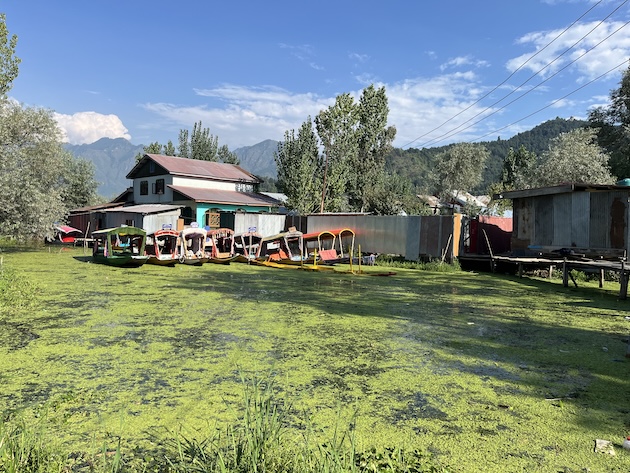
Boats docked outside a house in Dal Lake with a green film on the water in the foreground. Credit: Athar Parvaiz/IPS

Boats docked outside a house in Dal Lake with a green film on the water in the foreground. Credit: Athar Parvaiz/IPS

SRINAGAR, India, Mar 31 2026 (IPS) – For the past few weeks, residents living in and around Dal Lake in Indian Kashmir have witnessed “a different phenomenon” as a green sludge has accumulated on the once pristine water. Photos circulating widely on social media triggered a public outcry.


Some citizens and environmentalists warned that the transformation reflects heavy sewage pollution in this Himalayan Lake in the heart of Srinagar, Kashmir’s summer capital.  The Dal Lake is a complex wetland ecosystem covering roughly 18 square kilometres that supports fisheries, aquatic vegetation, and thousands of livelihoods tied to tourism and lake agriculture.

Officials managing the lake, however, urged calm and said that the sudden discolouration was most likely caused by a lack of rainfall and unusual temperatures for the season in Kashmir, though they didn’t deny the pollution problem and nutrient richness in the lake.

Muzamil Ahmad Rafiqui, Superintending Engineer for Kashmir’s Lake Conservation and Management Authority (LCMA), said that the lake is receiving nutrients, pesticides and other pollutants from the peripheries at many sources because of agricultural and other activities.

But Rafiqui added that the discolouration was more so due to over 50 percent reduction in precipitation and constant above-normal temperatures for weeks in this part of the season in Kashmir.

“Also, when the inflow from all the channels supplying water to the lake is extremely low and the outflow gates of the lake are also closed for retaining water in the lake, it is quite natural there will be changes in the water colour in a stagnant water body,” Rafiqui said.

Experts, scientific studies and official watchdogs have highlighted decades of pollution, sewage inflow and unregulated urban growth that have steadily degraded this iconic lake in the Kashmir Himalayas. A report submitted by Kashmir’s Pollution Control Committee (PCC) to the National Green Tribunal in response to the latter’s directions and other reports in recent years confirmed the “unabated flow of untreated sewage” into the Dal Lake in “violation of environmental norms”.

From Exclusion to Participation     

Earlier this year, the Jammu and Kashmir government, in a dramatic policy shift, shelved a 416-crore rupees (USD 4.5 million) Dal Lake restoration project that had started implementation nearly two decades ago but had made little progress. The project aimed to move nearly 9,000 families living near Dal Lake to the city outskirts but was able to relocate only 1,808 families in 17 years.

The project, approved in 2009, centred on relocating thousands of families living inside the lake to newly built colonies on the outskirts of Srinagar, as the authorities believed human settlements within the lake were a major source of pollution and encroachment.

Now the government has abandoned the relocation-driven strategy altogether. In its place, officials are now promoting an in-situ conservation model that recognises lake dwellers as part of the ecosystem rather than obstacles to restoration.

The new approach proposes developing “eco-hamlets” within the lake’s settlements, installing sewage systems, treating inflowing drains and improving water circulation through dredging and channel restoration.

“It is a striking shift in philosophy. The very communities who were once blamed for the lake’s decline are now being seen as potential guardians,” said Raja Muzaffar Bhat, a prominent environmental and social activist based in Srinagar who often files petitions in India’s National Green Tribunal against the local administration for “failing to implement environmental safety rules and regulations” available under a broader regulatory framework in India for environmental protection.

Whether the new conservation strategy succeeds, said Bhat, may depend on “whether it combines community participation with stronger environmental governance.”

Iftikhar Drabu, a senior engineer who specialises in water engineering, warned that without stronger sewage infrastructure, strict regulation of tourism and effective monitoring of inflowing drains, community participation alone will not restore the lake. “Nothing will work in isolation. A multi-pronged approach is needed for conserving the lake,” he said.

‘We Know How to Protect the Lake’

For many families who have so far been relocated, the policy reversal has reopened painful questions. At Rakh-e-Arath, a rehabilitation colony on Srinagar’s outskirts built for displaced lake residents. “They told us our presence was destroying the lake. We believed the government and moved here,” said a resident, Mohammd Ashraf, whose family was relocated 10 years back, adding that life away from the water, all these years, has been difficult.

“Our time was wasted and our livelihoods were ruined,” he said. “We only know the lake as we were born there and have spent our childhood and youth by the lake. Fishing, growing vegetables on floating gardens, and rowing tourists in small boats are what we are adapted to,” Ashraf told Inter Press Service (IPS).

If the government now says people are needed to protect the lake, he said, “I welcome it, and I hope we will be taken back to the lake.” Other relocated families, who IPS spoke with, expressed similar feelings.

Communities living on the lake have historically maintained its channels, harvested weeds and monitored changes in water conditions. Integrating them into restoration efforts, they say, could help control the pollution and conserve the lake. “We have always been urging the government to give us the responsibility of conserving the lake. We are the ones who know the lake, not the people who sit in government offices,” said Akram Guru, a Shikara Walla at Dal Lake.

“We have been dubbed as the lake’s destroyers for decades. Now they say the lake needs its people,” he said smilingly. “I hope the change in the government’s approach finally facilitates our contribution to protecting the lake.”
  Source

An Ominous Reckoning for the Gulf States

Armed Conflicts, Civil Society, Crime & Justice, Democracy, Headlines, Human Rights, IPS UN: Inside the Glasshouse, Middle East & North Africa, TerraViva United Nations

Opinion

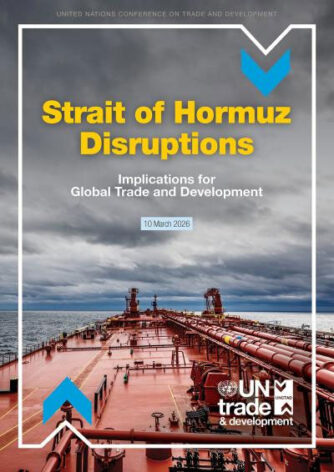
The Strait of Hormuz is one of the world’s most critical maritime chokepoints, carrying around a quarter of global seaborne oil trade and significant volumes of liquefied natural gas and fertilizers.

NEW YORK, Mar 31 2026 (IPS) – Trump’s Iran war has left the Gulf shattered: US bases turned into targets, economies battered, and the “oasis” myth destroyed. Gulf rulers now confront a harsh reckoning over their reliance on Washington and the uncertain search for a new, fragile security order.


As Trump assembled major US naval and air assets in the eastern Mediterranean and the Gulf, Saudi Arabia, the UAE, Qatar, and others quietly urged Washington to avoid a full-scale assault on Iran, fearing a direct blowback on their territory and energy infrastructure.

Nevertheless, the US–Israeli air campaign began on February 28, 2026, without a clearly defined and publicly articulated political endgame beyond “crippling” Iran’s capabilities. This disconnect between military escalation and strategic purpose now lies at the core of Gulf leaders’ anger and sense of betrayal toward Washington.

Trump’s Strategic Miscalculation

Trump’s decision to launch joint US–Israeli strikes on Iran has produced far higher strategic costs than his administration appears to have anticipated, from energy shock and disrupted shipping to heightened regional fragmentation and anti-American sentiment.

Even if Iranian capabilities are significantly degraded, the war has exposed vulnerabilities in US power projection, unsettled allies, and invited greater Russian and Chinese diplomatic activism in the Gulf. The long-term “price” for Washington will be measured less in battlefield metrics than in diminished trust and leverage among its traditional Arab partners.

US Bases Turned to Liabilities

From a Gulf perspective, US bases in Qatar, Bahrain, Kuwait, and the UAE were meant to deter Iran and guarantee regime security; instead, they became priority targets once the war began. Iran explicitly framed its strikes on these facilities as retaliation against Washington, but their location in densely populated and economically vital areas meant that nearby civilian infrastructure also suffered severe damage.

This experience is reinforcing a view in Gulf capitals that foreign basing arrangements draw fire without delivering the reliable protection they assumed for decades.

A Nightmare Realized

Gulf leaders long warned that a war with Iran would shatter their security and economies, a nightmare that has now materialized as Iranian missiles and drones hit oil facilities, ports, power plants, and cities across the region. They blame Washington for launching the campaign and Israel for pressing to “neutralize” Iran regardless of collateral damage in neighboring Arab states.

The sense in Gulf capitals is that their caution was dismissed, while they have paid a disproportionate price in physical destruction, economic setback, disrupted exports, and heightened domestic anxiety.

Shattered Oasis Narrative

The image of Gulf hubs like Dubai, Doha, and Riyadh as insulated “oases” open to business, tourism, and investment has been badly damaged by missile alerts, strikes on ports and airports, and the closure of key sea lanes.

Restoring confidence will require visible reconstruction, enhanced civil defense, improved air and missile defenses, and credible diplomacy that lowers the perceived risk of another sudden war. Investors and tourists will demand proof that the region can manage Iran-related tensions, not just high-end events and mega-projects.

Trump’s Misreading of Iranian Escalation

Trump publicly argued that overwhelming force would quickly coerce Iran and usher in regime change while keeping fighting “over there,” yet he appears not to have anticipated the breadth of Iranian retaliation against neighboring Gulf states or a prolonged closure of the Strait of Hormuz.

The IRGC’s effective shutdown of the strait, including attacks and threats against commercial shipping, has produced global energy shocks and exposed the fragility of US planning assumptions. For Gulf leaders, this underscores how inadequate Washington’s war planning was in accounting for second- and third-order consequences.

Calculated Decision Not to Retaliate

Despite heavy damage, Gulf rulers have so far avoided direct retaliation against Iran, calculating that further escalation would expose their cities and infrastructure to even more punishing strikes. Publicly, they stress restraint and international law, but privately, officials acknowledge their enduring geographic reality: they must coexist with a powerful and proximate Iran long after this US-led campaign ends.

By holding their fire, they hope to preserve space for postwar de-escalation and avoid being locked into a permanent state of open conflict.

Recasting Security Arrangements with Washington

Given their limited strategic alternatives, Gulf monarchies are unlikely to sever ties with Washington but will seek more conditional, transactional security arrangements. They are pressing for clearer US commitments on defense of their territory, better integration of regional missile defenses, and greater say over decisions that could trigger Iranian retaliation.

At the same time, they will hedge by deepening ties with China, Russia, Europe, and Asian energy importers, thereby reducing exclusive reliance on the US while keeping the American security umbrella in place.

Gulf Options to Prevent Future Conflagration

To prevent a repeat, Gulf states are also exploring limited de-escalation channels with Tehran, tighter regional crisis hotlines, and revived maritime security arrangements that include non-Western actors such as China and India. They may push for new rules of engagement around energy infrastructure and shipping lanes, seeking informal understandings that keep these off-limits even in crises.

Internally, they are reassessing missile defense, hardening critical facilities, and considering more diversified export routes that reduce dependence on Hormuz. None of these options are fully reassuring, but together they offer partial risk reduction.

Prospects for Normalization with Iran

Speculation about full normalization, including a non-belligerency pact between Iran and Gulf states, builds on prewar trends of cautious dialogue and economic engagement. Whether this is truly “in the cards” depends on war outcomes, Iran’s internal politics, and Gulf threat perceptions: if Tehran’s regime survives but remains hostile, Gulf states will likely revert to hedging—combining deterrence, limited engagement, and outreach to outside powers.

A more pragmatic Iranian leadership could make structured security arrangements and phased confidence-building measures more plausible over time.

No Return to Status Quo Ante

The Gulf States will not return to the prewar status quo; instead, they are likely to pursue a more diversified security architecture, combining a thinner US shield with expanded ties to China, Russia, and Asian importers. This shift will gradually dilute Washington’s centrality in Gulf security, complicating US force posture and Israel’s assumption of automatic Arab backing against Iran.

For Israel, a more cautious, risk-averse Gulf may limit overt strategic alignment, while for the US, enduring mistrust will make coalition-building for future crises far more difficult.

Trump’s Iran adventure is not an isolated blunder but the latest, and perhaps most explosive, expression of his assault on an already fragile global order. By discarding restraint, sidelining allies, and weaponizing American power for short-term political gain, he has accelerated the erosion of US credibility, fractured Western alliances, and opened new strategic space for Russia and China. The Gulf States are simply the newest casualties of this disorder: their cities struck, economies shaken, and security assumptions shattered.

Whatever emerges from this war, it will not be a restored status quo, but a more fragmented, volatile Middle East in which Israel and the United States confront a diminished margin for error and a far narrower circle of willing, trusting partners.

Dr. Alon Ben-Meir is a retired professor of international relations, most recently at the Center for Global Affairs at New York University (NYU). He taught courses on international negotiation and Middle Eastern studies.

alon@alonben-meir.com

IPS UN Bureau

  Source



