On this day: Several key events held on July 6, continue to impact our lives and affect the present geopolitical, social and economic scenario. The day witnessed Dadabhai Naoroji becoming the first Indian to become a member of the UK Parliament in 1892. A century later, the day marked the reopening of Nathula Pass, a strategic route separating India and China in 2006. The trading post was closed since the India-China war of 1962. Take a look at the key events held on July 6 in the past.
Dadabhai was first UK Parliamentarian
Dadabhai Naoroji was the first Indian to be elected to Parliament in Britain. Naoroji travelled to Britain in 1885 as a business partner if Cama and Cimpany. Later he began his career in academics in the UK and also founded journals like Rast Goftar in Bombay. During his stay in the UK, he became a staunch advocate of Indian rights regarding the ICS and trade. Naoroji was also a famous economist and the man behind ‘drain theory’.
He was also one of the founding members of the Indian National Congress in 1885 in Bombay. Dadabhai Naoroji contested UK elections from the seat of Central Finsbury, campaigning on Gladstone’s platform of Liberalism, and was successfully elected with a majority of five in 1892.
Reopening of Nathula Pass
Nathu La Pass connects Sikkim with China’s Tibet Autonomous Region. The route serves as a key link between India and Sikkim. The route was closed after Indo-China war, however, it reopened in 2006 for trade and other use. Nathu La is situated at an elevation of 4,310 meters (14,140 feet) above sea level. It is located on the Indo-China border, approximately 54 km east of Gangtok, the capital of Sikkim. The pass forms part of the ancient Silk Road, linking India and China. It has been a strategic trade route for centuries.
Malawi independence in 1964
Malawi, a Southeast African country, gained independence from the British on July 6, 1964. The nation was part of a British-controlled federation called the Federation of Rhodesia and Nyasaland. After the federation was dissolved, Naysaland gained independence and its name was changed to Malawi.
First African American woman to win Wimbledon
The day also marks a historic moment in the Wimbledon tennis tournament. On July 6, Althea Gibson claimed the women’s singles tennis title at Wimbledon and became the first African American to win a championship at London’s All England Lawn Tennis and Croquet Club
1189: Richard I is crowned King of England upon the death of King Henry II.
1249: Death of Alexander II, King of Scots, aged 50.
1483: Richard III is crowned King of England after deposing Edward V.
1484: Portuguese sea captain Diogo Cão finds the mouth of the Congo River.
1535: Sir Thomas More is beheaded for treason.
1553: Edward VI dies aged 15.
1560: England and Scotland sign the Treaty of Edinburgh.
1590: Admiral Francis Drake takes Portuguese Forts at Taag.
1673: French troops conquer Maastricht as part of the Franco-Dutch War.
1685: James II beats the Duke of Monmouth at the Battle of Sedgemoor.
1699: The pirate Captain William Kidd is captured in Boston, Mass.
1785: The US Congress unanimously resolves the name of US currency to the “dollar” and adopts decimal coinage.
1885: Louis Pasteur successfully administers an anti-rabies vaccine to 9-year-old Joseph Meister, saving his life.
1886: Horlick’s of Wisconsin offers the first malted milk to the public.
1887: Lottie Dod becomes youngest ever Wimbledon champion (15 years, 285 days) beating Blanche Bingley 6-2, 6-0.
1898: The US Senate agrees to annex Hawaii.
1907: Birth of Mexican artist Frida Kahlo.
1908: Robert Peary’s arctic expedition sails from New York for the north pole.
1912: The Olympic Games officially open Stockholm, Sweden even though events have been taking place since May 5.
1917: T E Lawrence captures the port of Aqaba from the Turks.
1919: The British R-34 lands in New York, becoming the first airship to cross the Atlantic.
1924: The first photo is sent experimentally across Atlantic from the US to England by radio.
1928: “Lights of New York”, the first all talking movie is shown in New York.
1931: Billy Burke wins the US Open.
1932: Death of author Kenneth Grahame aged 73.
1934: Britain’s Fred Perry beats Australian Jack Crawford 6-3, 6-0, 7-5 for the first of three straight Wimbledon titles.
1936: A major breach in the Manchester, Bolton and Bury Canal sends millions of gallons of water cascading 200 feet into the River Irwell.
1942: Anne Frank’s family goes into hiding in After House, Amsterdam.
1944: US General George Patton lands in France. On the same day, the world’s largest circus tent catches fire in Hartford, Connecticut, killing 168.
1949: A freak heatwave sends the central coast of Portugal to 158°F for two minutes.
1951: Max Faulkner wins the British Open at Portrush.
1952: After nearly a century, London trams are taken out of service.
Advertisement
1957: John Lennon and Paul McCartney meet for the first time at Woolton Church Parish Fete in Liverpool where The Quarry Men are appearing. Eager to impress the older teen, McCartney picks up a guitar and plays Twenty Flight Rock, but what seals it for Lennon is when the 15-year old youngster shows him how to tune his guitar. On the same day, Althea Gibson becomes the first black female athlete to win Wimbledon beating Darlene Hard 6-3, 6-2.
1962: Rod Laver beats fellow Australian Martin Mulligan 6-2, 6-2, 6-1 in the Wimbledon Men’s singles final for the third leg of his first Grand Slam. On the same day, author William Faulkner dies aged 64.
1964: The Beatles film A Hard Day’s Night premieres at The Pavilion in London. On the same day, Malawi declares independence from the UK.
1967: Civil War erupts as Nigerian forces invade the secessionist state of Biafra.
1968: The Woburn Music Festival features Donovan. Fleetwood Mac, Tyrannosaurus Rex, The Jimi Hendrix Experience and Family.
1971: Jazz trumpeter, singer and bandleader, Louis Armstrong dies aged 69.
1972: David Bowie appear on BBC TV’s Top Of The Pops with the Spiders From Mars, performing the song Starman. It is a pivotal moment for many aspiring musicians who more than a decade later would cite it as a major influence.
1978: A blaze on the Penzance to Paddington sleeper train leaves 11 dead.
1979: Record producer/songwriter, Van McCoy dies from a heart attack. On the same day, an IRA bomb explodes in the British consulate in Antwerp.
1986: In the 100th Wimbledon Men’s Tennis final, Boris Becker defends his title, beating Ivan Lendl 6-4, 6-3, 7-5.
Film: Victoria the Great (1937) starring Anna Neagle.
16.45
Durrell in Russia
17.15
News and weather
17.20
Wall of Light
18.15
Tour de France Stage three – Levallois-Pettet to Lievin, a 200 kilometres leg that stretches from the west of Paris to the Belgium border.
19.15
The Arabs, A Living History
20.15
People to People: Caught in a Web
21.15
Picturing Women
22.20
Film: Saboteur (1942) Chase thriller directed by Alfred Hitchcock.
BBC ONE
06.45
Open University
08.55
Play School
09.15
Knock Knock
09.30
This is the Day
10.00
Asian Magazine
10.30
The Great Palace: The Story of Parliament
11.20
Cameo
11.30
Seabrook’s Year
12.00
Cartoon
12.10
See Hear!
12.35
Farming
13.00
News Headlines
13.05
Bonanza 1960s Western series
13.55
Bugs Bunny
14.00
EastEnders
15.00
Film: Tiara Tahiti (1962) A pompous, self-made man, arrives in Tahiti to establish a luxury tourist hotel. There, to his horror, he discovers his old army and class enemy Brett Aimsley living an idyllic existence with a beautiful Tahitian girl. Stars James Mason.
16.35
Rolf Harris Cartoon Time
17.05
Great Railway Journeys of the World
18.05
Wild Britain
18.30
News
18.40
Home on Sunday
19.15
Film: A Deadly Puzzle (1983) TV movie – When her husband is reported killed in a plane crash off the coast of France, Linda Dobbins finds herself unable to believe the official explanation.
20.50
News
21.05
That’s Life Presented by Esther Rantzen.
21.50
Wimbledon 86 Match of the Day. Desmond Lynam introduces highlights of the afternoon’s finals,
22.50
Choices
23.30
Favourite Walks
23.55
Weather
BBC TWO
06.50
Open University
13.30
Pages from Ceefax
13.45
Sunday Grandstand Wimbledon Men’s Final
18.50
Foley Square
19.15
The World About Us
20.05
Favourite Things Jeffrey Archer in conversation with Richard Baker
20.35
Dancemakers
21.20
French Grand Prix From the Paul Ricard circuit in Southern France.
21.50
The AFI Salute to John Huston
23.05
Film: The Maltese Falcon (1941) Classic film noir starring Humphrey Bogart, Peter Lorre and Sidney Grenstreeet
1987: Pakistan cricketer and future prime minister, Imran Khan, reaches his 300th Test wicket milestone during the third test vs England at Headingley.
1988: In the world’s worst offshore oil disaster, a fire on the Piper Alpha oil rig in the North Sea claims 167 lives.
1992: The French Government mobilises the army and police to remove lorries blocking the nation’s major roads in a protest over new driving licence laws.
1997: A robot buggy is released from the Mars Pathfinder probe and begins to explore the surface.
Singles chart:
I’ll Be Missing You – Puff Daddy & Faith Evans
Ecuador – Sash! Ft Rodriguez
The Journey – 911
Free – Ultra Nate
Something Goin’ On – Todd Terry
Bitter Sweet Symphony – The Verve
Mmm Bop – Hanson
A Change Would Do You Good – Sheryl Crow
I Wanna Be The Only One – Eternal ft Bebe Winans
Just A Girl – No Doubt
1997: Radiohead – OK Computer
Album chart:
The Fat Of The Land – The Prodigy
OK Computer – Radiohead
Heavy Soul – Paul Weller
Spice – The Spice Girl
Before The Rain – Eternal
Some Other Sucker’s Parade – Del Amitri
Guns In The Ghetto – UB40
Destination Anywhere – Jon Bon Jovi
Stoosh – Skunk Anansie
Romanza – Andrea Bocelli
2000: Prime Minister Tony Blair’s eldest son, Euan, 16, is arrested for being drunk in Leicester Square. On the same day, West Ham United pay a record £1.8 million for late former skipper Bobby Moore’s collection of memorabilia including his 1966 World Cup winner’s medal.
2002: Serena Williams beats older sister Venus 7-6, 6-3 for her first Wimbledon singles title.
2003: Roger Federer beats Australian Mark Philippoussis 7-6, 6-2, 7-6 for his first Wimbledon Men’s title.
2004: Soul singer-songwriter Syreeta Wright dies aged 58 from bone cancer.
2005: The International Olympic Committee announces London will host the 2012 Olympic Games. On the same day, rapper Lil’ Kim is sentenced to a year in jail for lying to a grand jury to protect friends.
2008: Rafa Nadal ends Roger Federer’s five-year reign at Wimbledon 6-4, 6-4, 6-7, 6-7, 9-7.
2012: Carol Hawkins, the former personal assistant of U2 bassist Adam Clayton is jailed for seven years after embezzling 2.8m euros (£2.2m) of his money to fund a lavish lifestyle.
2013: 42 people are killed in an attack on a boarding school in Mamudo, Nigeria.
2014: An Israeli air strike kills seven Hamas militants in the Gaza Strip.
2015: Floyd Mayweather Jr is stripped of his WBO welterweight boxing title after failing to pay a $200k sanctioning fee and vacate his two junior middleweight titles.
2016: South African paralympian Oscar Pistorius is sentenced to six years in jail for the murder of his girlfriend Reeva Steenkamp in 2013. On the same day, the Chilcot Report into Britain’s part in the Iraq War concludes prime minister Tony Blair overstated the case for war and was unprepared. Also, African American Alton Sterling is filmed being shot by Louisiana police in Baton Rouge, while being restrained on the ground and African American Philando Castile is shot by police in St Paul, Minnesota after being pulled over for a broken rear light.
2017: France announces it will ban petrol and diesel cars by 2040.
2020: Singer-songwriter and multi-instrumentalist Charlie Daniels dies aged 83 of a haemorrhagic stroke.
2022: More than 40 government ministers and aides withdraw their support for PM Boris Johnson and resign. On the same day, The heads of MI5 and the FBI appear together for the first time warning that China is the “biggest long-term threat to our economic and national security” and actor James Caan dies aged 82.
BIRTHDAYS: Dalai Lama, spiritual leader of Tibet, 89; Vladimir Ashkenazy, concert pianist, 87; Lady Mary Peters, pentathlete, 85; Sylvester Stallone, actor/director/screenwriter, 78; George W Bush, former US president, 78; Geraldine James (Blatchley), actress, 74; Sir Jonathon Porritt, environmentalist, 73; Geoffrey Rush, actor, 73; Dame Hilary Mantel, author, 72; Jennifer Saunders, comedian/actress/screenwriter, 66; John Keeble, drummer (Spandau Ballet) 65; Georgi Kinkladze, footballer, 51; 50 Cent (Curtis Jackson), rapper, 49; Rory Delap, footballer, 48; Tia Mowry (Hardrict), actress, 46; Tamera Mowry (Housle) actress, 46; Kevin Hart, comedian/actor, 45; Eva Green, actress, 44; Kate Nash, singer-songwriter/actor, 37.
Members of a “Jugnu” club get trained by UN Women to support women who experience gender-based violence. Credit: UN Women
NEW DELHI, India, Jul 4 2024 (IPS) – As the temperature soars to new heights in India, so does domestic violence. It’s a well-established correlation that is largely left out of the climate change discussion, but the gap is glaring and needs to be bridged.
For the third summer in a row, temperatures in India are breaking historical records. The recent record high of 52.9° C (127.22° F), has resulted in loss of livelihood, water rationing, health impacts, and even death. The heat affects some more than others. As people are advised to shelter at home, those in lower economic strata contend with cramped living situations, lack of air conditioning, and power cuts.
Women bear the worst impacts. New Delhi’s Heat Action Plan (HAP) registers their greater vulnerability – noting, for example, that they’re more susceptible to falling sick from the heat compared to men, the heightened risks for pregnant people, and greater expectations of women to be caretakers. But it fails to note the increased threat of violence.¬¬¬¬¬
It is well-documented that temperature extremes lead to an increase in domestic violence cases, with low-income women bearing the brunt. In South Asia, for every degree that the temperature rises, domestic violence increases about 6%.
As India grapples with its large carbon footprint, rising temperatures, and growing population, intimate partner violence can be expected to increase drastically. P¬¬ar¬¬¬ticularly if greenhouse gas emissions aren’t regulated effectively, India could see a spike in domestic violence of more than 20% by the end of the century.
Extreme temperatures are associated with frustration, aggression, and disruptions in people’s daily routines. Researchers theorize this is the reason why heat has a such a strong influence on rates of intimate partner violence.
For low-income daily wage laborers in India, heat may result in loss of livelihood and income. Economic stress and resultant anxiety can significantly increase domestic violence risk.
In addition, women are expected to be caretakers for the family, which gives them little chance of escape from abusers and increases their vulnerability under extreme conditions. This phenomenon was prevalent during Covid-19 pandemic, when the “shadow pandemic” of domestic violence affected women across India.
Despite research demonstrating this, the spike in domestic violence during heat waves remains hush-hush. New Delhi’s Heat Action Plan (HAP) does not mention gender-based violence even once across its 66 pages.
While it acknowledges women as a vulnerable group and deals with increased risk during pregnancy, other risks to women remain shrouded in the vagueness of “social norms” and “gender discrimination.” Failing to address the threat of intimate partner violence explicitly leaves out a key piece of the puzzle.
The omission has manifold impacts. It lets policymakers shy away from confronting the issue, creating a gap in policy at the highest level. It sets up government workers tasked with implementing the plans such as New Delhi’s HAP on the ground for failure.
With no guidance on how to deal with the predictable increase in domestic violence during extreme heat, government can offer little support for women who need it. Mahila Panchayats (“women’s councils”) and grassroots non-profits often help rural and low-income women find support and community, but extreme weather can cut them off from these resources.
Forced to stay indoors and unable to access help, women have little recourse or respite. In theory, India’s laws protect them. But in practice, implementation is spotty, and they remain vulnerable.
India’s climate policy must not leave women out in the cold. New Delhi’s Heat Action Plan and other policy initiatives must protect women and offer them accessible support. First responders and government workers must be given the tools they need to help support those at risk for domestic violence, not only during heat waves but year-round.
Finally, India’s problem with domestic violence might be exacerbated during the summers but is not unique to them. India needs a suite of policies and concrete actions to contend with rising intimate partner violence, starting at the grassroots level and prioritizing education, employment, economic stability, and family planning for all.
Heat waves and the stressors they bring might be unforeseeable in a sense, but rising temperatures and rising domestic violence are completely predictable effects of climate change. There’s no excuse for failing to redress them.
By leaving women vulnerable year after year, we are doing a disservice, both to women who need help and to the institutions that they place their trust in.
Umang Dhingra is a Duke University undergraduate and a Stanback Fellow at the Population Institute, a Washington D.C.-based nonprofit that supports reproductive health and rights.
LONDON, Jul 3 2024 (IPS) – Myanmar’s army, at war with pro-democracy forces and ethnic militias, must know it’s nowhere near victory. It recently came close to losing control of Myawaddy, one of the country’s biggest cities, at a key location on the border with Thailand. Many areas are outside its control.
The army surely expected an easier ride when it ousted the elected government in a coup on 1 February 2021. It had ruled Myanmar for decades before democracy returned in 2015. But many democracy supporters took up arms, and in several parts of the country they’ve allied with militia groups from Myanmar’s ethnic minorities, with a long history of resisting military oppression.
Setbacks and violence
Army morale has collapsed. Thousands of soldiers are reported to have surrendered, including complete battalions – some out of moral objections to the junta’s violence and others because they saw defeat as inevitable. There have also been many defections, with defectors reporting they’d been ordered to kill unarmed civilians. Forces fighting the junta’s troops are encouraging defectors to join their ranks.
In response to reversals, in February the junta announced it would introduce compulsory conscription for young people, demanding up to five years of military service. An estimated 60,000 men are expected to be called up in the first round. The announcement prompted many young people to flee the country if they could, and if not, seek refuge in parts of Myanmar free from military control.
There have also been reports of army squads kidnapping people and forcing them to serve. Given minimal training, they’re cannon fodder and human shields. Rohingya people – an officially stateless Muslim minority – are among those reportedly being forcibly enlisted. They’re being pressed into service by the same military that committed genocide against them.
People who manage to cross into Thailand face hostility from Thai authorities and risk being returned against their will. Even after leaving Myanmar, refugees face the danger of transnational repression, as government intelligence agents reportedly operate in neighbouring countries and the authorities are freezing bank accounts, seizing assets and cancelling passports.
Conscription isn’t just about giving the junta more personnel to compensate for its losses – it’s also part of a sustained campaign of terror intended to subdue civilians and suppress activism. Neighbourhoods are being burned to the ground and hundreds have died in the flames. The air force is targeting unarmed towns and villages. The junta enjoys total impunity for these and many other vile acts.
The authorities hold thousands of political prisoners on fabricated charges and subject them to systematic torture. The UN independent fact-finding mission reports that at least 1,703 people have died in custody since the coup, likely an underestimate. Many have been convicted in secret military trials and some sentenced to death.
There’s also a growing humanitarian crisis, with many hospitals destroyed, acute food shortages in Rakhine state, where many Rohingya people live, and an estimated three million displaced. Voluntary groups are doing their best to help communities, but the situation is made much worse by the military obstructing access for aid workers.
International neglect
In March, UN human rights chief Volker Türk described the situation in Myanmar as ‘a never-ending nightmare’. It’s up to the international community to exert the pressure needed to end it.
It’s by no means certain the military will be defeated. Adversity could lead to infighting and the rise of even more vicious leaders. One thing that could make a decisive difference is disruption of the supply chain, particularly the jet fuel that enables lethal airstrikes on civilians. In April, the UN Human Rights Council passed a resolution calling on states to stop supplying the military with jet fuel. States should implement it.
Repressive states such as China, India and Russia have been happy enough to keep supplying the junta with weapons. But democratic states must take the lead and apply more concerted pressure. Some, including Australia, the UK and USA, have imposed new sanctions on junta members this year, but these have been slow in coming and fall short of the approach the Human Rights Council resolution demands.
But the worst response has come from the Association of Southeast Asian Nations (ASEAN). Ignoring reality and civil society’s proposals, ASEAN has stuck to a plan it developed in April 2021 that simply hasn’t worked. The junta takes advantage of ASEAN’s weakness. It announced compulsory conscription shortly after a visit by ASEAN’s Special Envoy for Myanmar.
ASEAN’s neglect has allowed human rights violations and, increasingly, transnational organised crime to flourish. The junta is involved in crimes such as drug trafficking, illegal gambling and online fraud. It uses the proceeds of these, often carried out with the help of Chinese gangs, to finance its war on its people. As a result, Myanmar now ranks number one on the Global Organized Crime Index. This is a regional problem, affecting people in Myanmar’s neighbouring countries as well.
ASEAN members also have an obligation to accept refugees from Myanmar, including those fleeing conscription. They should commit to protecting them and not forcing them back, particularly when they’re democracy and human rights activists whose lives would be at risk.
Forced conscription must be the tipping point for international action. This must include international justice, since there’s none in Myanmar. The junta has ignored an order from the International Court of Justice to protect Rohingya people and prevent actions that could violate the Genocide Convention, following a case brought by the government of The Gambia alleging genocide against the Rohingya. The UN Security Council should now use its power to refer Myanmar to the International Criminal Court so prosecutions of military leaders can begin.
China and Russia, which have so far refused to back calls for action, should end their block on Security Council action, in the interests of human rights and to prevent growing regional instability.
From differences in age and diverse partnerships to relationships influenced by Tinder, these figures are far from ordinary.
So, grab a drink and get comfortable, as we explore the “35 Facts About Relationships in 2024.” Whether you’re navigating the complexities of modern love or simply curious, there’s something here for everyone.
Teenage Relationship Stats
Let’s explore the realm of young romance, where hearts are just starting to flutter and bonds are forming. Here are some important relationship statistics for teenagers in 2024:
Teenage Dating Insights
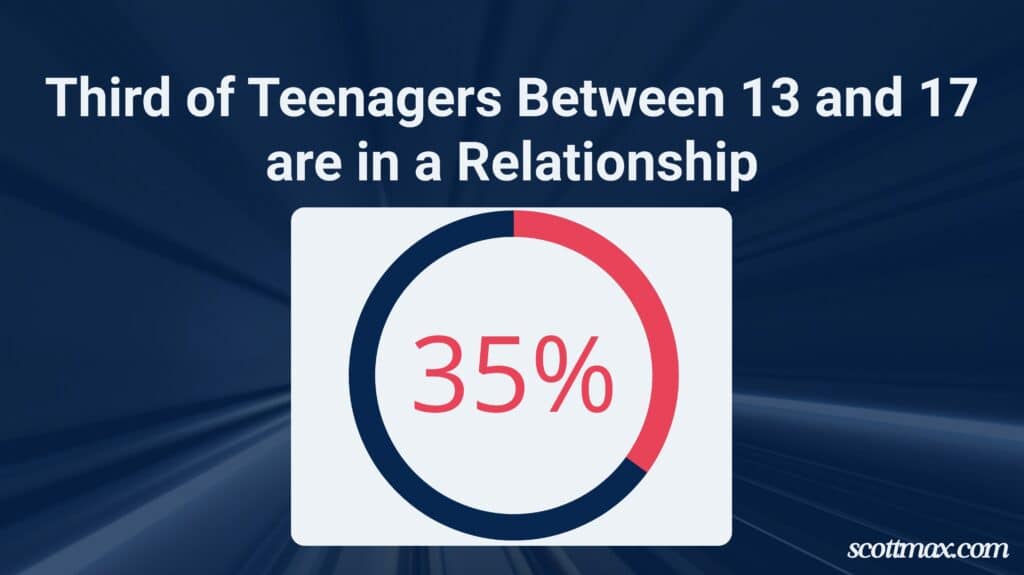
Surprisingly, 35% of teenagers aged 13 to 17 have some dating experience. This includes those currently in relationships and those who have explored casual or serious connections.
For those curious about sweethearts, 40% of teens are in committed relationships, while 16% have had past romantic involvements but are not currently dating.
You may have heard of high school sweethearts getting together during their school years. Interestingly, 14% of couples met in high school, but only one out of five of these couples pursued further education together in college.
Even more intriguing, less than two percent of these high school couples graduated from college together. This suggests that marrying your high school sweetheart might mean a less competitive journey in the workforce.
Verified 2024 | 👨🎓Cite this data. This picture is available for public use.
Face-to-Face Connections Are Still Popular
Even with the rise of online friendships, it’s interesting that 26% of teenagers met their partners in person. While a significant 57% of teens form friendships online, only 8% mention finding their partners there.
And when they did find them, it often happened through platforms like Facebook or other social media sites.
Verified 2024 | 👨🎓Cite this data. This picture is available for public use.
Romantic Interactions Among Teens
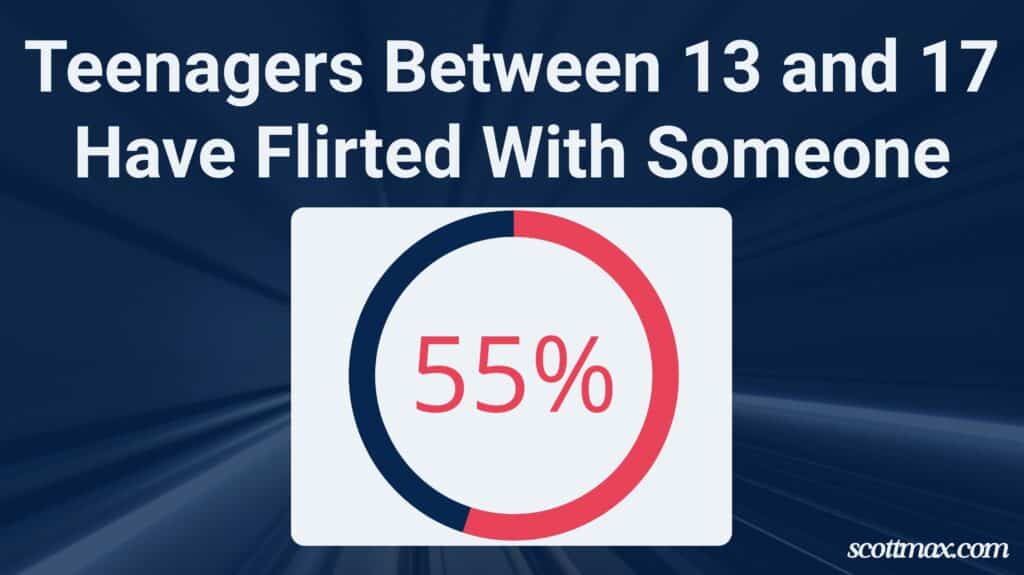
Ah, young love! Here’s an interesting fact: 55% of teenagers aged 13 to 17 have flirted with someone. What’s more surprising is that 50% of them did so through social media platforms like Instagram or Facebook.
Furthermore, almost half, 47%, conveyed their feelings for someone by engaging in activities such as comments and likes. It seems digital heart emojis are all the rage these days!
Verified 2024 | 👨🎓Cite this data. This picture is available for public use.
College Relationship Stats
Entering the college world, where life is a mix of self-discovery and the transition into adulthood. Below are some fascinating relationship statistics for college students in 2024:
Serious vs. Casual Relationships in College
College years may appear to be all about casual encounters, but here’s a surprise: 63% of college males are actually looking for serious relationships.
Women in college are not far behind, with an impressive 83% seeking traditional relationships in the love department. However, many are open to short-term, casual affairs.
One reason for this trend is their intense focus on academic achievements and ambitions, which leave little time for long-term commitments.
You might be amazed to find out that 75% of university students have had a long-distance relationship. Among these lovebirds, 66% found the biggest obstacle to be the lack of physical closeness, while 31% mentioned that not having sex was the most challenging part.
The good news is that more than half of these long-distance relationships managed to survive the distance and stay strong.
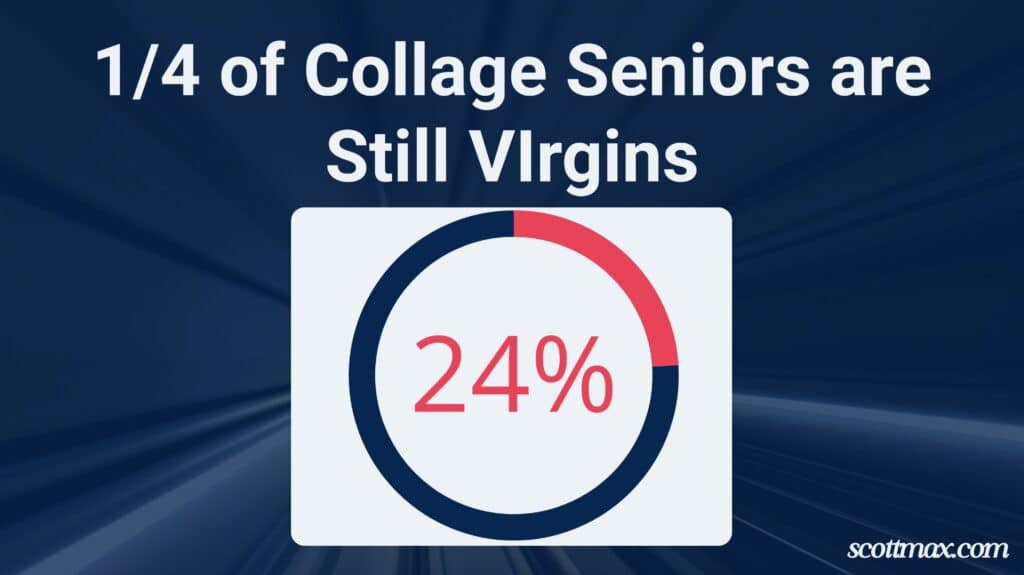
This might surprise you—24% of college seniors are still virgins. Yes, one-fourth of male and female students in their last year of college have never engaged in sexual activity before college.
For individuals aged between 20 and 24, 12% of women and 13% of men proudly consider themselves virgins.
Oh, millennials, the generation that keeps us guessing. They have their own unique set of relationship statistics from 2024 that reflect how they handle matters of the heart. Let’s explore:
Concerns About Financial Stability in Marriage
Millennials value financial security, and 29% of them feel they are not yet prepared for marriage. This generation gives more importance to the financial side of getting married. Surprisingly, data shows that millennials are three times more likely to stay unmarried compared to the Silent Generation (those born between 1925 and 1942). Among millennials, 26% are waiting for a partner with specific qualities, while another 26% believe they are too young to get married.
Millennials are not rushing into marriage. In fact, a huge 72% of them plan to stay single until they find their perfect match. However, some millennials also confess to feeling lonely as a result of this mindset.
When millennials look for a partner, they are very careful. A significant 40% of them say they won’t just settle for anyone in a relationship. They prefer being single rather than being with someone they don’t see a future with.
This selectiveness is visible in their older age when they first get married, but this is also linked to a decrease in divorce rates. Half of millennials, which is 50%, have worries about long-term relationships, mainly about losing their independence.
Despite their caution and pickiness, 70% of millennials aim to get married in the future, and an even larger percentage, 74%, want to have children.
This generation is known for their thoughtful approach to relationships, considering the positives and negatives related to their happiness, work, and health. They seem to focus on long-term objectives.
The world of long-distance relationships has evolved over time. While the era of handwritten letters and waiting for weeks for a response is over, the ups and downs of these relationships continue. Let’s explore some 2024 data to understand this modern concept of love better:
Successful Long-Distance Relationships
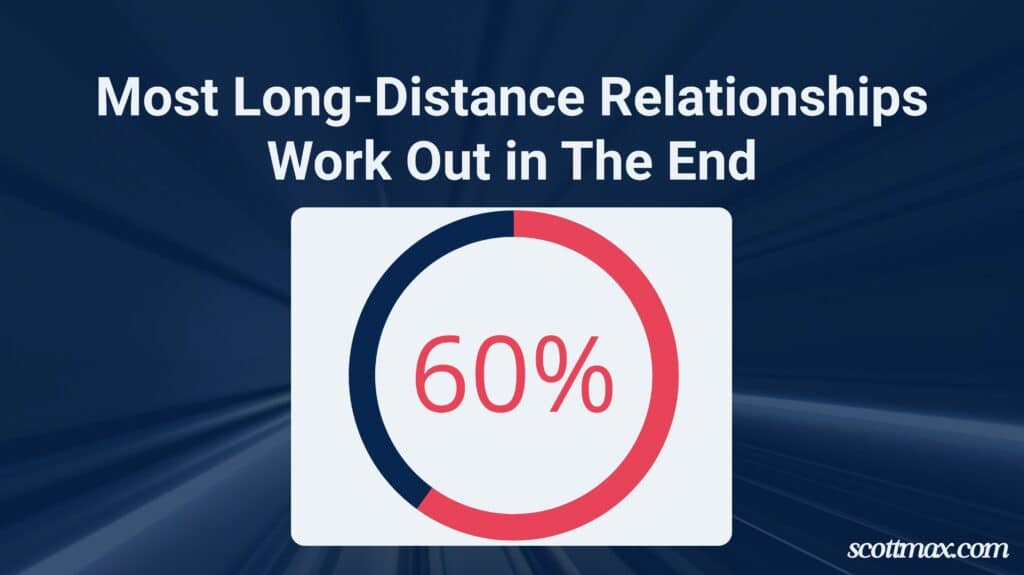
Good news! 60% of couples who engage in long-distance relationships are able to sustain it long-term. Typically, a long-distance relationship refers to partners living at least 132 miles apart.
These relationships are a significant commitment and can be tough, but this data demonstrates their success.
Communication plays a vital role, especially for long-distance couples. On average, these partners exchange around 343 texts per week. The more you talk, the closer you feel, increasing the chances of success.
Checked for accuracy in 2024 |👨🎓Cite this stat. This picture can be used without worrying about copyright.
Love Grows Stronger with Distance
A surprising 81% of individuals engaged in long-distance relationships feel closer to their partners when they come together after being apart. For 5% of them, this time away actually strengthens their bond more than ever.
Interestingly, 70% of people communicate more frequently when they are separated.
Checked for accuracy in 2024 | 👨🎓Cite this stat. This picture can be used without worrying about copyright.
The Many Long-Distance Relationships
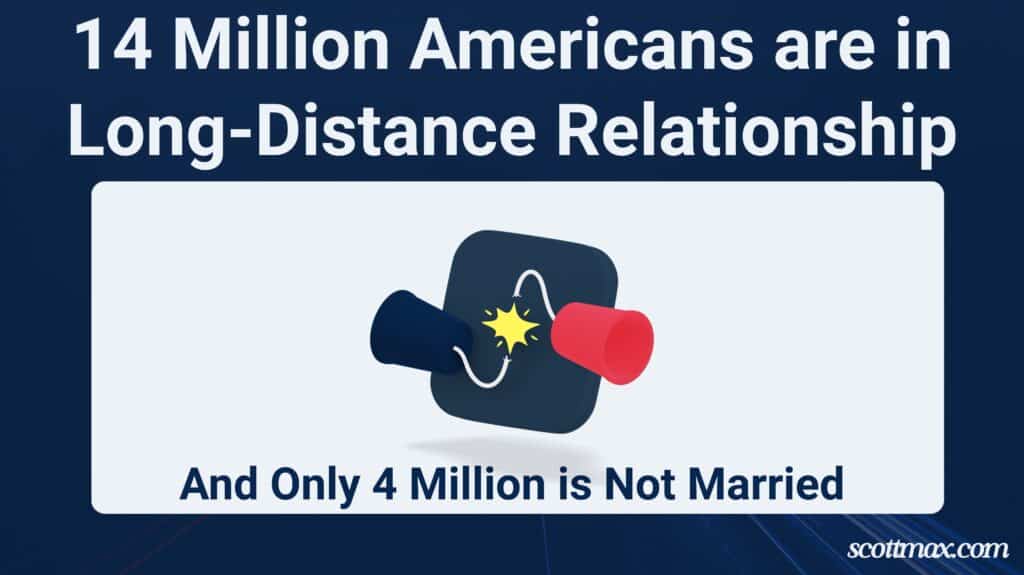
Prepare yourself as a whopping 14 million Americans are navigating the challenges of long-distance relationships. Out of this vast number, 4 million couples are in non-marital relationships.
These relationships emerge due to various reasons like attending college, career opportunities, and military obligations.
Checked for accuracy in 2024 | 👨🎓Cite this stat. This picture can be used without worrying about copyright.
Planning Ahead for Success
The success of long-distance relationships often depends on preparing for the future. A notable 66% of these couples fail due to their lack of concrete plans.
According to these statistics, some suggest that long-distance relationships typically last around 14 months, while some end within five months or even sooner, usually due to concerns about infidelity.
Checked for accuracy in 2024 | 👨🎓Cite this stat. This picture can be used without worrying about copyright.
Visits, Calls, and Letters
In a long-distance relationship, couples commonly meet each other twice a month or sometimes even less. They make sure to have a conversation at least once every three days. Surprisingly, many pairs still exchange letters, approximately three times per month.
Checked for accuracy in 2024 | 👨🎓Cite this stat. This picture can be used without worrying about copyright.
Interracial Relationship Statistics
As a society, we have made progress, and interracial relationships are more widely accepted today than ever. Below are some fascinating 2024 stats. Data showing how interracial relationships are becoming more common:
Mixing Things Up in America
Impressively, 11 million Americans are currently married to someone of a different race or background.
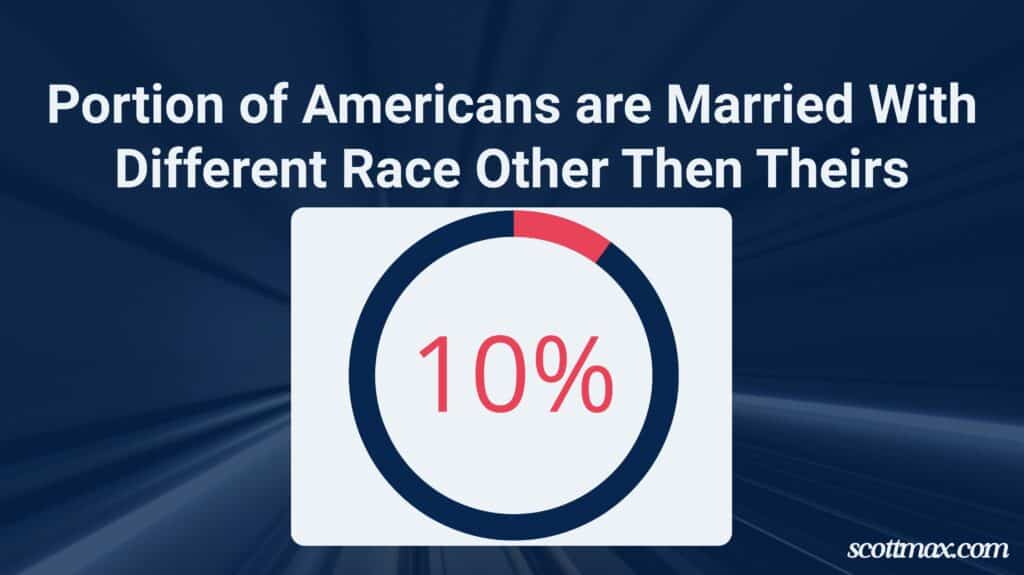
So, it turns out that around 10% of Americans have chosen to embrace diversity in their love lives. It’s interesting to know that interracial marriage was made legal in the USA back in 1967.
Checked in 2024 | 👨🎓Cite this stat. No restrictions on using this image.
New Couples, New Cultures
Love doesn’t care about where you’re from for Asian and Hispanic couples. A notable 46% of Asian newlyweds and 39% of Hispanics born in the USA have decided to embrace diverse relationships.
Checked in 2024 | 👨🎓Cite this stat. No restrictions on using this image.
Increasing Diversity in African American Marriages
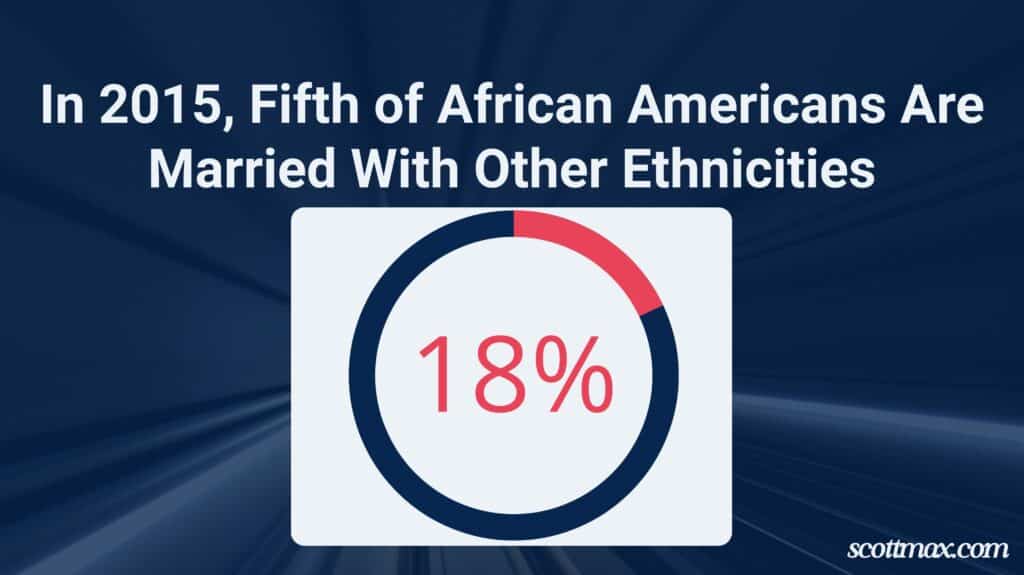
More African Americans are choosing to marry outside their race. In 2015, 18% of African Americans tied the knot with partners of a different race or background, a significant jump from the 5% recorded in 1980.
Checked in 2024 | 👨🎓Cite this stat. No restrictions on using this image.
Growth in Acceptance
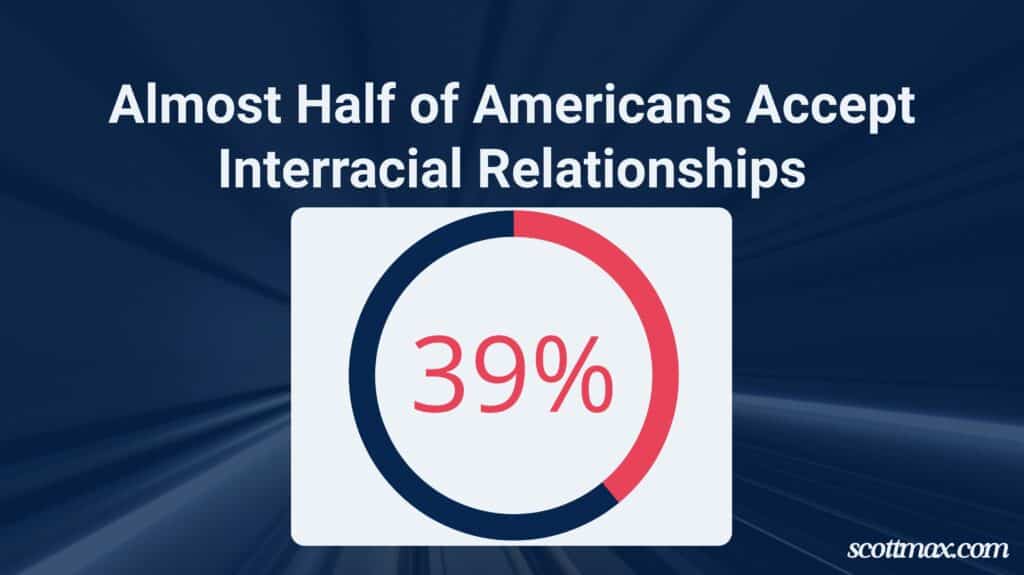
Thankfully, people are more open to the idea of interracial marriages now. Currently, 39% of Americans are in favor of such relationships. Although there’s still room to grow, this percentage has risen by 15% in just seven years.
Checked in 2024 | 👨🎓Cite this stat. No restrictions on using this image.
Need for Diversity in Media
Youth today want to see more representation of interracial couples in movies and TV shows. A considerable 56% of individuals aged 18 to 29 believe that TV programs should showcase more interracial couples.
In fact, 43% of women and 39% of the general population are eager for greater visibility of interracial relationships on screen.
Checked in 2024 | 👨🎓Cite this stat. No restrictions on using this image.
Popular Locations for Interracial Marriages
CertainCities in America are setting an example in mixed-race marriages. Honolulu leads the way, with a surprising 43% of its marriages being between people of different races. Following closely is Las Vegas, Nevada, where 31% of marriages are interracial. Santa Barbara, California, is not far behind with 30% of such marriages. When it comes to the statistics on age differences in relationships, it’s fascinating to note that in countries like the US and Europe, 8% of married couples have an age gap of ten years or more. Usually, it involves an older man and a younger woman. Surprisingly, only 1% of such relationships have the woman being older than the man. In Eastern countries, the age gaps tend to be even larger and more common. In terms of same-sex relationships, a significant 25% of male-male couples have a considerable age difference. This suggests that there are more gay couples with notable age gaps compared to straight couples. Research shows that the size of the age gap can impact the stability of a relationship. A study involving 3,000 individuals revealed that couples with a five-year age difference are 18% more likely to divorce. If the gap increases to ten years, the likelihood of divorce rises to 39%. Surprisingly, if the age gap is a massive 20 years, the risk of divorce soars to a remarkable 95%. Experts believe that larger age gaps can lead to differences in values, preferences, cultural backgrounds, and attitudes towards intimacy.This information was checked in 2024 | 👨🎓Cite this stat. This picture is free to use.
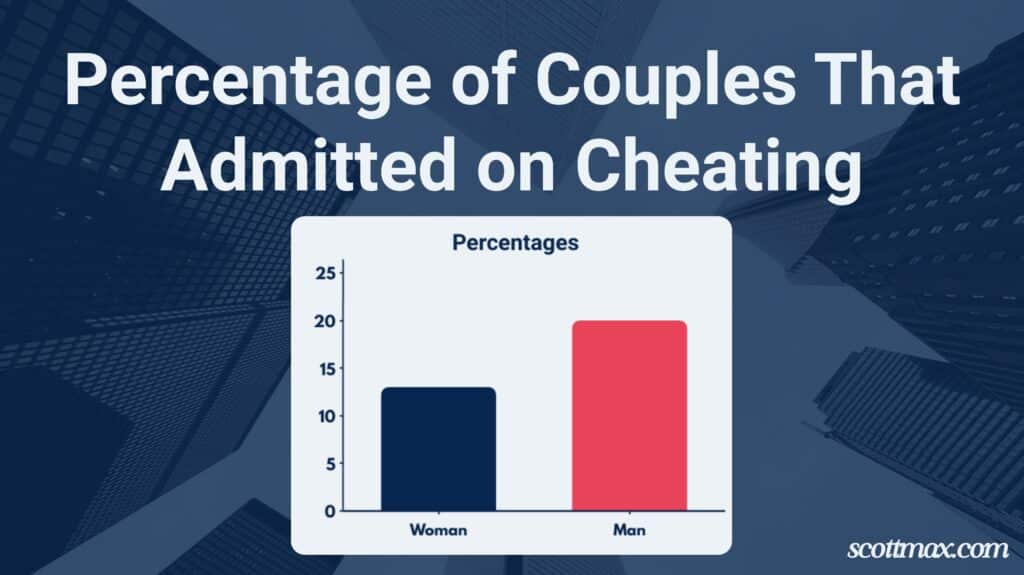
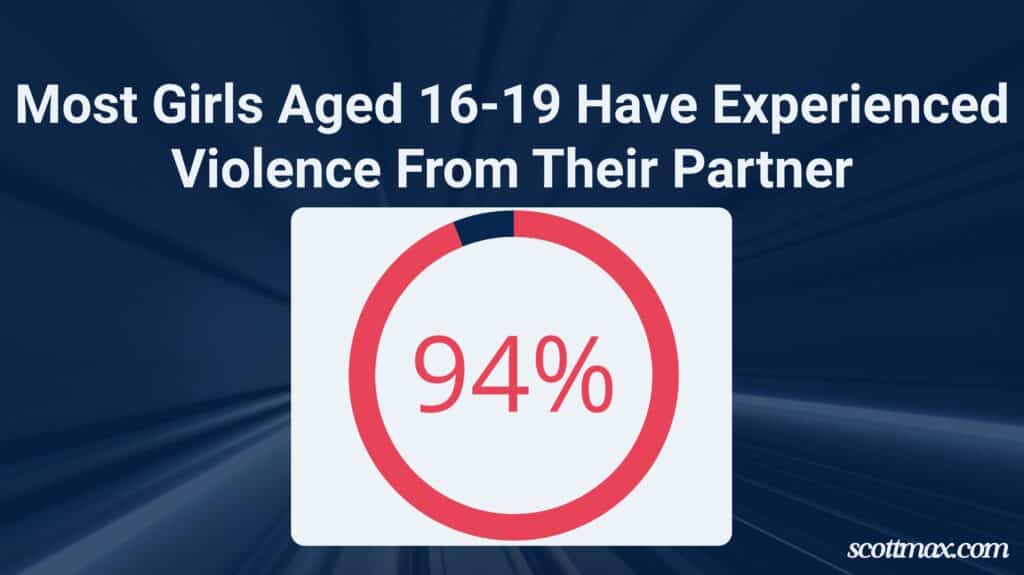
Stats on Abusive RelationshipsUnfortunately, not all relationships are about love and respect. Let’s explore some harsh facts from 2023 that show us how people can behave abusively in different types of relationships, even in those involving teens:Cheating in RelationshipsRegrettably, some relationships involve cheating. Approximately 20% of men and 13% of women have confessed to being unfaithful.These percentages may sound small, but when added up, they represent a significant number of people either cheating or being cheated on.It’s important to mention that the chances of cheating can change with age, and younger women aged 18 to 29 are more likely to cheat than men in the same age group.This data was validated 2024 | 👨🎓Cite this stat. This picture is free to use.Online Cheating BehaviorsIn the modern era, technology has introduced new ways of cheating. Nowadays, most cheating behaviors occur online, like developing feelings for someone over the internet, sharing personal details, or even contacting an ex-partner through messages.This information was verified in 2024 | 👨🎓Cite this stat. This picture is free to use.Violence by Partners among Young WomenA startling fact shows that 94% of women aged 16 to 19 have faced violence from their partners. Among them, 70% belong to the 20 to 24 age bracket.The data indicates that violent conduct often begins during the critical teenage years between 12 and 18.This data was checked in 2024 |👨🎓Refer to this data. This picture is free to use.
Problems in American High Schools
Distressing data shows that around 1.5 million high school students in America go through some type of mistreatment in their relationships. This implies that one out of every three high school students deals with emotional, verbal, sexual, or physical abuse from their partner.
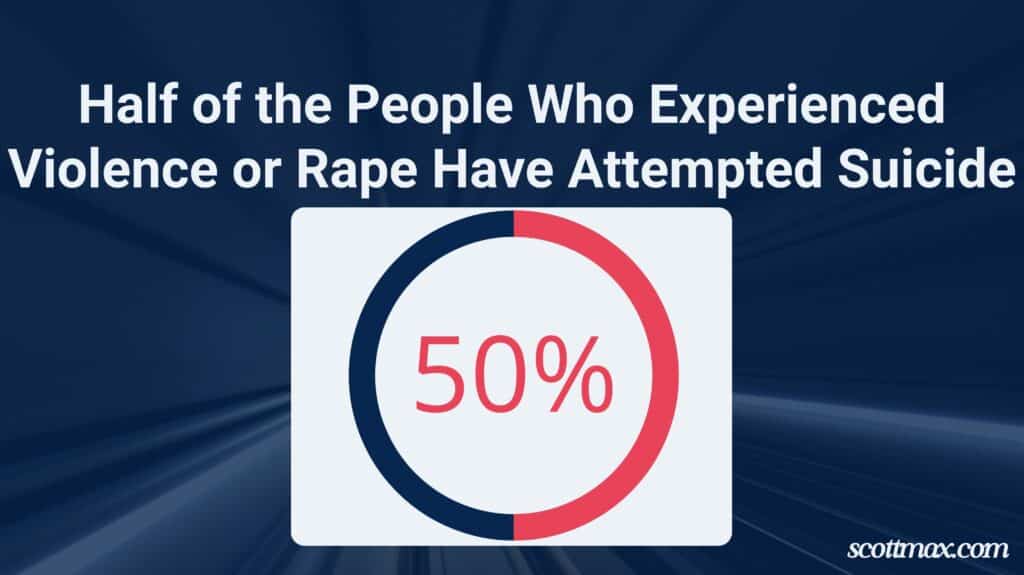
Shockingly, half of young people who have encountered violence or sexual assault have tried to commit suicide. This is a stark difference from typical suicide rates, where approximately 5.4% of boys and 12.5% of girls who haven’t faced violence or assault attempt suicide.
In today’s digital era, online dating plays a significant role in how we meet potential partners. Let’s delve into some interesting Tinder numbers for 2023:
Tinder’s Popularity in America
Tinder boasts an impressive 7.86 million users in the United States, making it a major player in the online dating scene.
Receiving compliments online can greatly improve self-confidence, with 45% of Tinder users confessing to using the app for a self-esteem boost. It provides an easy way to receive compliments from strangers and feel positive about oneself.
An outstanding 77% of Tinder users are open to dating someone from a different ethnic background. This figure shows the increasing acceptance of diverse relationships in the realm of online dating.
People on Tinder quickly say they love each other. An astonishing 85% of them express love within the initial year of being together. This shows how fast emotional ties form in the world of digital dating.
That wraps up everything in the world of relationships in 2023! We’ve seen the growing acceptance of differences, explored how age gaps influence relationships, and looked into the interesting realm of online dating with Tinder.
Whether you’re trying to understand love dynamics or just curious, these numbers give a nice peek into the complicated world of current relationships.
So, keep interacting, dating, and loving! In today’s digital era, the connections we create are limitless. Cheers to all forms of love, now and forever!
Frequently Asked Questions
1. What is the average age of people who use online dating apps like Tinder?
The typical age of online daters varies, but many fall in the 18 to 34 age group. This range is most active on apps like Tinder, although users come from all age groups as digital dating becomes more accepted across different generations.
2. Is online dating safe?
Approach online dating with caution for safety. Safeguard your personal info, meet in public places for first dates, and trust your instincts.
Tinder and similar platforms offer safety tools and reporting features to enhance user security.
3. What are the main reasons people use Tinder?
People use Tinder for various purposes, such as seeking romance, casual meetings, and boosting self-confidence. It’s a flexible platform that caters to different dating preferences and goals.
4. How common are interracial relationships on apps like Tinder?
Interracial relationships are increasingly seen on apps like Tinder. A notable number of users are open to dating someone of a different race, indicating a growing acceptance of diversity in online dating.
5. Can relationships started on Tinder lead to long-lasting, meaningful bonds?
Indeed, relationships formed on Tinder can result in lasting, meaningful connections.
Many individuals have discovered love, companionship, and even marriage on the platform. The key is being open, communicating effectively, and investing time in understanding your potential partner, just like in any other relationship.
A child waits to fill water containers in Gaza. Credit: UNRWA
In its latest update last week. the UN agency for Palestinian refugees, UNRWA, reported “especially intense” airstrikes in central Gaza in recent days, particularly in Bureij, Maghazi and Nuseirat refugee camps and eastern Deir Al-Balah.
Meanwhile, the Israeli military’s ground offensive “continues to expand”, UNRWA noted, particularly in the southern regions of Gaza City and eastern Rafah, causing further suffering and further “destabilising” humanitarian aid flows.
ATLANTA, Georgia, Jul 3 2024 (IPS) – Zionism is broken. It is finished as a political philosophy and cannot long survive. Having earned the visceral opposition of multitudes of people and countries around the world for engaging in vast overkill in Gaza, that historical reality will likely become clear to the Israeli people over time.
Still, how could the most powerful state in the Middle East, the most flourishing economically, with the strongest superpower backing, become defunct? It cannot—unless somehow its chief raison d’etrê, its founding philosophy, collapses. That has already happened.
In the wake of the October 7 attack by Hamas, the visceral racist core of Zionism has become evident in the indiscriminate slaughter of tens of thousands of innocent Palestinian civilians, including many thousands of children.
No reason of state can ever excuse that. Israel’s righteous anger against HAMAS for its obscene October 7 attack transitioned quickly into racial hatred, ending in, if not genocide, then certainly war crimes and crimes against humanity. Netanyahu and his Likud allies have not hidden their racism for decades. Now it is explicit in full view of the world.
The Zionism of Netanyahu and his supporters must be repudiated by the Israelis themselves. Israel’s leaders from Menachem Begin to today have long endorsed statements lauding Israel uber alles.
Zionism can only be rehabilitated if it separates its reason for existing from the current triumphalist military identity that is determined to kill, kill, and kill again until the utter destruction and suppression of all every tangible and ideological enemy.
In a recent CNN interview, former Shin Beth Director Ami Ayalon, was very explicit: he said “The toxic leadership of Prime Minister Netanyahu” [in pursuing an endless war] will “lead to the end of Zionism.” In that case, he said, “We cannot be secure and we shall lose our identity.”
Ayalon was preceded by a number of courageous Israeli thinkers and writers who warned of the same outcome—Israel was founded in 1948 but in their opinion, Zionism had already failed ideologically by the mid-1960s. They included Hebrew University professor Israel Shahak (1933-2001), who wrote, “It is my considered opinion that the State of Israel is a racist state in the full meaning of the term.”
He insisted that, “You cannot have humane Zionism. It (too) is a contradiction in terms.” Uri Avnery (1923-2018), a decorated Israeli soldier and later a publisher and politician, published a book in 1968 titled Israel without Zionists.
Many of the original Jewish colonists had utopian dreams, but their leaders would probably not recognize the grim, revengeful militarism of today’s Israel. A few tiny orthodox religious parties in Israel have never bought into the military machine that is the Likud Party’s pride and joy.
Some have steadfastly refused even to serve in the Israeli army because they don’t believe in the Israeli state. Now even they are being conscripted.
The original dream of Zionism from Theodore Herzl to Chaim Weizmann to David Ben Gurion, although containing seeds of a today’s hob-booted military identity, nevertheless also expressed a grandiosely humane, even a universal, goal—to become a “light to the nations.” In that, Israel has signally failed.
Like HAMAS and most Palestinians, Israel’s people—and Israel as a country—has become increasingly and deeply racist. Now racism—hatred of others for their differences—has become racial-ism, which is even worse, a doctrine of race superiority, which was the Nazi credo.
The Israel of Benjamin Netanyahu and his thuggish coalition has succumbed to such race hatred that Zionists from pre-1948 Palestine would not recognize it. A Jan. 6, 2024 opinion article in the Jerusalem Post urges Israel to reform its politics along better Zionist lines and take power away from the extremists now in charge. Commendable, but not nearly enough.
What if Abraham Lincoln had countenanced America’s original sin of slavery by merely taking half steps? We might still have “slavery lite.” No, Israel’s race-based philosophy must change to the democratic ideal: a single state in Israel and the occupied territories for Muslims, Christians, and Jews. One person, one vote.
When Palestinians are treated as human beings—as real people instead of enemies to be eradicated en masse—people everywhere would soon see how quickly peace would come to the Middle East.





















 This data was validated 2024 |
  This information was verified in 2024 |
  This data was checked in 2024 |