Defending Democracy in a “Topsy-Turvy” World

Active Citizens, Africa, Asia-Pacific, Civil Society, Democracy, Development & Aid, Editors’ Choice, Featured, Green Economy, Headlines, Human Rights, Humanitarian Emergencies, Middle East & North Africa, Press Freedom, Sustainable Development Goals, TerraViva United Nations
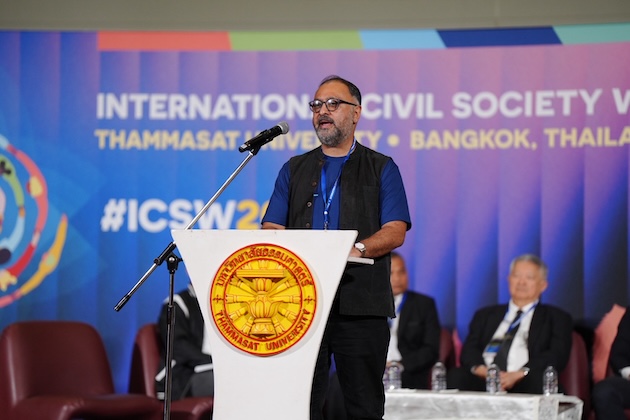
Secretary General of CIVICUS, Mandeep Tiwana, at International Civil Society Week 2025. Credit: Civicus

Secretary General of CIVICUS, Mandeep Tiwana, at International Civil Society Week 2025. Credit: Civicus

BANGKOK, Nov 1 2025 (IPS) – It is a bleak global moment—with civil society actors battling assassinations, imprisonment, fabricated charges, and funding cuts to pro-democracy movements in a world gripped by inequality, climate chaos, and rising authoritarianism. Yet, the mood at Bangkok’s Thammasat University was anything but defeated.


Once the site of the 1976 massacre, where pro-democracy students were brutally crushed, the campus—a “hallowed ground” for civil society actors—echoed with renewed voices calling for defending democracy in what Secretary General of CIVICUS, Mandeep Tiwana, described as a “topsy-turvy world” with rising authoritarianism—a poignant reminder that even in places scarred by repression, the struggle for civic space endures.

“Let it resonate,” said Ichal Supriadi, Secretary General, Asian Democracy Network. “Democracy must be defended together,” adding that it was the “shared strength” that confronts authoritarianism.

Despite the hopeful spirit at Thammasat University, where the International Civil Society Week (ICSW) is underway, the conversations often turned to sobering realities. Dr. Gothom Arya of the Asian Cultural Forum on Development and the Peace and Culture Foundation reminded participants that civic freedoms are being curtailed across much of the world.

Citing alarming figures, he spoke bluntly of the global imbalance in priorities—noting how military expenditure continues to soar even as civic space shrinks. He pointedly referred to the United States’ Ministry of Defense as the “Ministry of War,” comparing its USD 968 billion military budget with China’s USD 3 billion and noting that spending on the war in Ukraine had increased tenfold in just three years—a stark illustration of global priorities. “This is where we are with respect to peace and war,” he said gloomily.
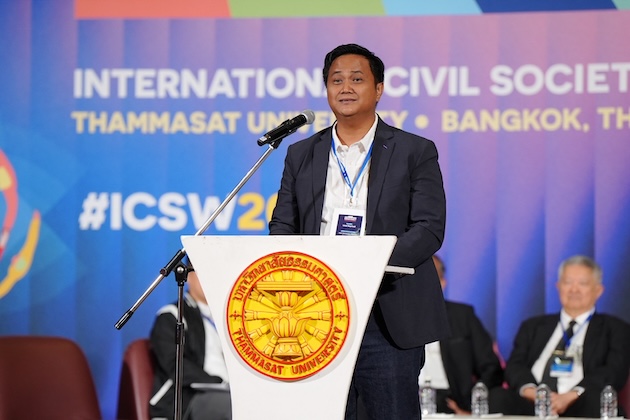
Ichal Supriadi, Secretary General, Asian Democracy Network. Credit: Civicus

Ichal Supriadi, Secretary General, Asian Democracy Network. Credit: Civicus

At another session, similar reflections set the tone for a broader critique of global power dynamics. Walden Bello, a former senator and peace activist from the Philippines, argued that the United States—especially under the Trump administration—had abandoned even the pretense of a free-market system, replacing it with what he called “overt monopolistic hegemony.” American imperialism, he said, “graduated away from camouflage attempts and is now unapologetic in demanding that the world bend to its wishes.”
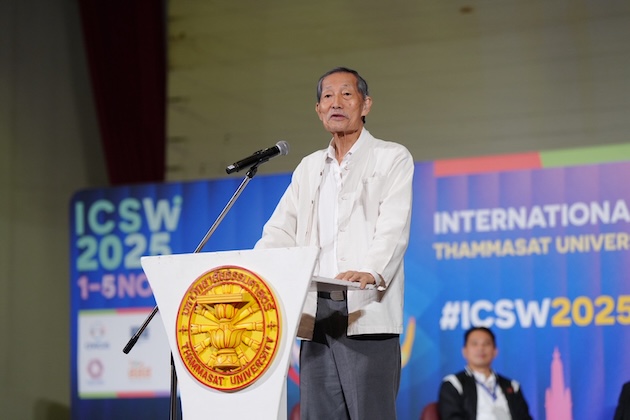
Dr. Gothom Arya of the Asian Cultural Forum on Development and the Peace and Culture Foundation. Credit: Civicus

Dr. Gothom Arya of the Asian Cultural Forum on Development and the Peace and Culture Foundation. Credit: Civicus

Dr. Pervez Hoodbhoy, a Pakistani physicist and author, echoed the sentiment, expressing outrage at his own country’s leadership. He condemned Pakistan’s decision to nominate a “psychopath, habitual liar, and aggressive warmonger” for the Nobel Peace Prize, saying that the leadership had “no right to barter away minerals and rare earth materials to an American dictator” without public consent.

Hoodbhoy urged the international community to intervene and restart peace talks between Pakistan and India—two nuclear-armed neighbors perpetually teetering on the edge of renewed conflict.

But at no point during the day did the focus shift away from the ongoing humanitarian crises. Arya reminded the audience of the tragic loss of civilian lives in Gaza, the devastating fighting in Sudan that had led to widespread malnutrition, and the global inequality worsened by climate inaction. “Because some big countries refused to follow the Paris Agreement ten years ago,” he warned, “the rest of the world will suffer the consequences.”

That grim reality was brought into even sharper relief by Dr. Mustafa Barghouthi, a Palestinian physician and politician, who delivered a harrowing account of Gaza’s devastation. He said that through the use of  American-supplied weapons, Israel had killed an estimated 12 percent of Gaza’s population, destroyed every hospital and university, and left nearly 10,000 bodies buried beneath the rubble.

“Even as these crises unfolded across the world, the conference demonstrated that civil society continues to persevere, as nearly 1,000 people from more than 75 organizations overcame travel bans and visa hurdles to gather at Thammasat University, sharing strategies, solidarity, and hope through over 120 sessions.

Among them was a delegation whose presence carried the weight of an entire nation’s silenced hopes—Hamrah, believed to be the only Afghan civil society group at ICSW.

“Our participation is important at a time when much of the world has turned its gaze away from Afghanistan,” Timor Sharan, co-founder and programme director of the HAMRAH Initiative, told IPS.

“It is vital to remind the global community that Afghan civil society has not disappeared; it’s fighting and holding the line.”

Through networks like HAMRAH, he said, activists, educators, and defenders have continued secret and online schools, documented abuses, and amplified those silenced under the Taliban rule. “Our presence here is both a statement of resilience and a call for solidarity.”

“Visibility matters,” pointed out Riska Carolina, an Indonesian woman and LGBTIQ+ rights advocate working with ASEAN SOGIE Caucus (ASC). “What’s even more powerful is being visible together.”

“It was special because it brought together movements—Dalit, Indigenous, feminist, disability, and queer—that rarely share the same space, creating room for intersectional democracy to take shape,” said Carolina, whose work focuses on regional advocacy for LGBTQIA+ rights within Southeast Asia’s political and human rights frameworks, especially the ASEAN system, which she said has historically been “slow to recognize issues of sexuality and gender diversity.”

“We work to make sure that SOGIESC (Sexual Orientation, Gender Identity and Expression, and Sex Characteristics) inclusion is not just seen as a niche issue, but as a core part of democracy, governance, and human rights. That means engaging governments, civil society, and regional bodies to ensure queer people’s participation, safety, and dignity is part of how we measure democratic progress.”

She said the ICSW provided ASC with a chance to make “visible” the connection between civic space, democracy, and queer liberation and to remind people that democracy is not only about elections but also about “who is able to live freely and who remains silenced by law or stigma.”

Away from the main sessions, civil society leaders gathered for a candid huddle—part reflection, part reckoning—to examine their role in an era when their space to act was shrinking.

“The dialogue surfaced some tough but necessary questions,” he said. They asked themselves: ‘Have we grasped the full scale of the challenges we face?’ ‘Are our responses strong enough?’ ‘Are we expecting anti-rights forces to respect our rules and values?’ ‘Are we reacting instead of setting the agenda? And are we allies—or accomplices—of those risking everything for justice?’

But if there was one thing crystal clear to everyone present, it was that civil society must stand united, not fragmented, to defend democracy.

IPS UN Bureau Report

  Source

U.S. White House Executive Order Raises Concerns for Its Support to the UN

Aid, Armed Conflicts, Civil Society, Development & Aid, Editors’ Choice, Featured, Headlines, Human Rights, Humanitarian Emergencies, IPS UN: Inside the Glasshouse, Sustainable Development Goals, TerraViva United Nations

Humanitarian Emergencies

Coly Seck (at microphone), Chair of the Committee on the Exercise of the Inalienable Rights of the Palestinian People and Permanent Representative of the Republic of Senegal to the United Nations, briefs reporters with Members of the newly-elected Committee on the Exercise of the Inalienable Rights of the Palestinian People (CEIRPP Bureau). At fourth from right is Riyad Mansour, Permanent Observer of the State of Palestine to the United Nations. Credit: UN Photo: Manuel Elías

Coly Seck (at microphone), Chair of the Committee on the Exercise of the Inalienable Rights of the Palestinian People and Permanent Representative of the Republic of Senegal to the United Nations, briefs reporters with Members of the newly-elected Committee on the Exercise of the Inalienable Rights of the Palestinian People (CEIRPP Bureau). At fourth from right is Riyad Mansour, Permanent Observer of the State of Palestine to the United Nations. Credit: UN Photo: Manuel Elías

UNITED NATIONS, Feb 6 2025 (IPS) – A new executive order from the United States White House calls for withdrawing support from major UN entities and a review of all international intergovernmental organizations which the United States is a member of. The U.S.’s orders against the UN Palestine Refugee Agency also do not bode well for ongoing ceasefire negotiations in Gaza.


President Donald Trumps comments that the “US will take over the Gaza Strip and we will do a job with it, too. We’ll own it,” have also been widely criticized.

On Tuesday, the White House issued an executive order, where they announced that they will pull out from the UN Human Rights Council (UNHRC) effective immediately and called for a review of its membership in UN and other intergovernmental organizations. The executive order singles out other UN entities that needed “further scrutiny”—the UN Relief and Works Agency for Palestine Refugees in the Near East (UNRWA); and the UN Educational, Scientific, and Cultural Organization (UNESCO). The executive order suspended all funding to these organizations.

The executive order also cites that UNESCO has failed to address “mounting arrears” and reform, also noting that it has demonstrated anti-Israeli sentiments over the last decade. A review of the U.S.’s membership in UNESCO would assess whether it supports the country’s interests, and would include an analysis of anti-Semitic and anti-Israeli sentiment within the organization.

The United States announced that no funds or grants would go towards the UN Relief and Works Agency for Palestine Refugees in the Near East (UNRWA), citing corruption within the organization and the infiltration of terrorist groups such as Hamas.

UN Secretary-General Spokesperson Stéphane Dujarric told reporters on Tuesday that in light of the United States’ decision, this would not change the UN’s “commitment to supporting UNRWA in its work”, or the HRC’s importance as a part of the “overall human rights architecture within the United Nations”.

“It has been clear for us that U.S. support for the United Nations has saved countless lives and global security,” said Dujarric. “The Secretary-General is looking forward to speaking with President (Donald) Trump, he looks forward to continuing what was a very, I think, frank and productive relationship during the first term. He looks to strengthening the relationship in the turbulent times that we live in.”

On Wednesday the newly-elected chair of the Committee on the Exercise of the Inalienable Rights of the Palestinian People, Ambassador Coly Seck, Permanent Representative of Senegal, told a told a press conference that it condemned the ban by Israel on UNWRA .

“We strongly condemn Israel’s ban UNWRA which obstructs vital humanitarian cooperation in direct violation of the UN mandate and General Assembly resolutions in stabilizing the ceasefire and supporting Gaza’s recovery. This ban imposed immediately after the ceasefire, deal will deepen Gaza suffering.”

The suspension of aid funding from the United States is already impacting humanitarian operations across different agencies. Dujarric said that the U.S. had committed 15 million USD to the trust fund, of which 1.7 million has already been spent. This leaves 13.3 million frozen and unusable at this time.

Pio Smith, Regional Director for Asia and the Pacific, United Nations Population Fund (UNFPA) told reporters in Geneva that they had to suspend the programs funded by US grants, which included funds that were already committed to the agency. Smith warned that the lack of funding would impact programs in places such as Afghanistan, Pakistan and Bangladesh. Worldwide, more than half of UNFPA’s facilities, 596 out of 982, would be impacted by this funding pause.

Vivian van de Perre, the Deputy Head of its UN Mission to the Democratic Republic of the Congo, told reporters in New York on Wednesday that the recent pause in funding from the U.S. Agency for International Development (USAID) has forced humanitarian partners on the ground to suspend their work. “…Many of the partners, including IOM (the International Organization for Migration), which is a key partner for us, need to stop their work due to the USAID stop-work order,” she said.

The executive order, along with Trump’s announcement that the U.S. would move into and claim Gaza cast a shadow of doubt over ongoing ceasefire negotiations.

UN Human Rights Commissioner Volker Türk said that the priority now must be to move to the next phase of the ceasefire, which calls for the release of all hostages and arbitrarily detained prisoners, an end to the war, and the reconstruction of Gaza.

“The suffering of people in the [occupied Palestinian territories] and Israel has been unbearable. Palestinians and Israelis need peace and security, on the basis of full dignity and equality,” Türk said in a statement. “International law is very clear. The right to self-determination is a fundamental principle of international law and must be protected by all States, as the International Court of Justice recently underlined afresh. Any forcible transfer in or deportation of people from occupied territory is strictly prohibited.”

The forcible removal of 2.2 million Palestinians from Gaza that Trump is calling for has been decried and been called a violation of international humanitarian law.

“Any forced displacement of people is tantamount to ethnic cleansing,” said Dujarric when asked about Trump’s remarks. “…In our search for solutions, we must not make the problem worse. Whatever solutions we find need to be rooted in the bedrock of international law.”

Riyad Mansour, Permanent Observer of the State of Palestine to the United Nations, briefing reporters after the opening session of the Committee on the Exercise of the Inalienable Rights of the Palestinian People, added his condemnation of Trump’s plan.

Mansour said with regard to the idea of “kicking the Palestinian people out from the Gaza Strip, I just want to tell you that during the last 24 hours, statements from heads of states, of Egypt, of Jordan, of the State of Palestine, of Saudi Arabia and many countries, including countries who spoke in the debate in the room behind us during the meeting of the committee, condemn these efforts.”

He said Trump’s plan has been met with a “global consensus on not allowing forced transfer to take place, ethnic cleansing to take place. We Palestinians love every part of the State of Palestine. We love the Gaza Strip. It is part of our DNA.”

The march of Palestinians from the south to the north of the Gaza Strip following the ceasefire was proof of the people’s committment to rebuild their own homes, Mansour said.

“More than 400,000 of them to go to the rubbles in the northern Gaza in order to start cleaning around their destroyed homes.”

At the White House, Trump’s aids attempted a row back on his comments. Secretary of State Marco Rubio reportedly told journalists that it Trump was proposing to rebuil Gaza, and his press secretary Karoline Leavitt, said “the president has not committed to putting boots on the ground in Gaza.”

IPS UN Bureau Report

  Source



