King Charles and Queen Camilla Reveal Their 2025 Christmas Card

King Charles III and his wife, Queen Camilla, have debuted their annual Christmas card.

🎄✨It’s beginning to look a lot like Christmas!” a Saturday, December 7, post via the royal family’s official Instagram read. “The King and Queen are pleased to share this year’s Christmas card.”

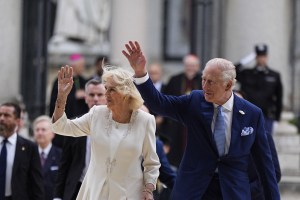
The seasonal card featured an image of Charles, 77, and Camilla, 78, strolling hand in hand while visiting Rome’s Villa Wolkonsky earlier this year. The image, taken by Chris Jackson, was snapped during the royal couple’s official state visit to Italy in April.

“Wishing you a very Happy Christmas and New Year,” the inside of the card read.

Why the Royal Family Doesn’t Exchange ‘Extravagant’ Gifts for Christmas

Photographer Jackson, 45, was especially pleased to take Charles and Camilla’s holiday card pic.

“What a great visit that was,” Jackson wrote via Instagram comment on Saturday. “Happy Christmas!!🎄 🇮🇹.”

Charles’ Christmas card is just one of his annual traditions. Every year, he leads his family — including Camilla, son Prince William and the monarch’s siblings — on a walk to Christmas Day church services at Sandringham Estate. That afternoon, Charles will deliver a sentimental holiday speech to the British people before settling in for an intimate celebration with his family.

“The celebration may carry a wistful tone,” a source exclusively told Us Weekly earlier this month, referring to Charles and daughter-in-law Princess Kate Middleton’s respective cancer battles. “However, it will also be a time of celebration, especially after Kate received the all-clear.”

Charles-and-Camilla-in-Italy-GettyImages-2242441621
King Charles III and Queen Camilla leave the Vatican in October. Aaron Chown / POOL / AFP

Charles and Kate, 43, were both diagnosed with undisclosed forms of cancer in 2024. While the king is still undergoing treatment, Kate revealed that she is in remission earlier this year.

“They all want to make the most of their time together,” the insider added of the family’s holiday plans. “Charles prioritizes duty, but he’s also a family man who knows his time is precious. He wants a special last Christmas in case it’s his last.”

The source further revealed that Charles will do “everything expected of him and more” regarding his public Christmas duties.

“Charles wants to have a traditional holiday with all the royals,” the source added to Us. “Every family Christmas is precious, but it’s especially so for him this year.”

Look Back at the Royal Family’s Christmas Cards Over the Years

Kate kicked off the festive season with the “Together at Christmas” carol concert she, once again, organized on Friday, December 5. Kate was joined by husband William, 43, and their three children at Westminster Abbey.

“At its heart, Christmas speaks of love taking form in the simplest, most human ways. Not in sentimental or grand gestures, but gentle ones. A moment of listening, a word of comfort, a friendly conversation, a helping hand, presence,” the Princess of Wales wrote in a letter to attendees. “These simple acts of care might seem small, but they contribute to the beautiful tapestry of life to which we all belong. Christmas is a time that reminds us how deeply our lives are woven together. Just as the roots of trees share strength beneath the soil, unseen but vital, so too do we. We are drawn by an instinctive pull towards belonging and connection.”

Charles, meanwhile, was absent from the carol service as he had official engagements in Germany that same week.


Discover more from The Maravi Post

Subscribe to get the latest posts sent to your email.

The Maravi Post

Bonn Climate Talks: Why World Needs to go Further, Faster, and Fairer

Climate Change, Climate Change Finance, Conferences, COP30, Environment, Featured, Headlines, TerraViva United Nations | Analysis

Climate Change

The June Climate Talks, SB62 under the UNFCCC, in Bonn 16-26 June, Photo Credit: UN Climate Chang/Lara Murillo

The June Climate Talks, SB62 under the UNFCCC, in Bonn 16-26 June, Photo Credit: UN Climate Chang/Lara Murillo

SRINAGAR & BONN, Jul 11 2025 (IPS) – This 62nd meeting of the Subsidiary Bodies (SB62) from June 16 to 26, 2025 revealed the persistent complexities and political tensions that continue to challenge multilateral climate governance. 


The United Nations Framework Convention on Climate Change (UNFCCC) convened its 62nd meeting of the Subsidiary Bodies (SB62) from June 16 to 26, 2025 – a critical juncture in the global climate negotiation process ahead of the 30th Conference of the Parties (COP30) set for November in Belém, Brazil.

Often referred to as a “mini-COP”, SB62 serves as a mid-year platform where negotiators and technical experts advance discussions on implementing the Paris Agreement and lay the groundwork for decisions at the COP.

While some progress was made on adaptation and procedural issues, key areas such as climate finance, technology, and scientific assessments remained contentious. Interviews with climate experts Jennifer Chow of the Environmental Defence Fund and Meredith Ryder-Rude shed light on systemic challenges within the UNFCCC process and offered insights into pathways for more effective climate action.

Jennifer Chow of the Environmental Defense Fund

Jennifer Chow of the Environmental Defense Fund

Deadlock That Foreshadowed the Tense and Fractious Atmosphere

The Bonn conference brought together government delegations, UN agencies, intergovernmental organisations, Indigenous and youth representatives, and civil society observers. The Subsidiary Body for Implementation (SBI) focused on operational matters including finance, capacity-building, and gender equality, while the Subsidiary Body for Scientific and Technological Advice (SBSTA) addressed scientific guidance and technical issues such as carbon markets under Article 6 of the Paris Agreement.

Brazil, as COP30 host, fielded the largest delegation with 173 provisional attendees, signalling its intent to influence the upcoming COP agenda. The Brazilian COP presidency outlined three priorities: reinforcing multilateralism, connecting climate regime outcomes with people’s everyday lives, and accelerating Paris Agreement implementation through institutional reforms.

Yet the meeting’s opening was marked by a two-day delay in adopting the agenda, largely due to disagreements over including discussions on developed countries’ finance obligations under Article 9.1 of the Paris Agreement. This early procedural deadlock foreshadowed the tense and fractious atmosphere permeating the conference.

How Scientific Discussions Remained Politically Sensitive

Adaptation emerged as a focal point, with negotiators agreeing on a refined list of global adaptation indicators, including measures related to access to financing — a key demand from developing countries. Steps were also taken toward transitioning the Adaptation Fund to operate exclusively under the Paris Agreement framework and clarifying loss and damage reporting procedures.

Nonetheless, the broader finance discussions exposed deep divides. The collective quantified goal (NCQG) of USD 300 billion, established at COP29 in Baku, continues to be a source of dissatisfaction, especially among developing nations seeking more predictable and adequate funding. These finance issues cut across multiple agenda items, influencing adaptation, transparency, and just transition talks.

Scientific discussions remained politically sensitive. Although the parties agreed to “take note” of recent scientific reports from the World Meteorological Organisation, stronger language expressing concern about current warming trends was blocked by some countries. This reflected ongoing sensitivity around acknowledging the Paris Agreement’s 1.5°C temperature limit.

Streamlining, Trust, and Effective Finance Delivery

In an exclusive interview with Inter Press Service, Jennifer Chow, Senior Director for Climate-Resilient Food Systems at the Environmental Defense Fund, highlighted structural challenges impeding UNFCCC efficiency and effectiveness:

“As is true for other multilateral processes, it is nearly impossible to address a growing list of issues efficiently without a concerted effort to prioritise, simplify approaches, and partner with others who may not require budgetary support. I think this is more pertinent to focus on than funding fluctuations.”

Chow claimed that the proliferation of agenda items and ballooning delegation sizes have complicated negotiations. “There are too many agenda items—and delegations have ballooned as a result. The secretariat and bureau could closely examine the COP, CMA, and SB agendas, propose streamlining, and develop a list of agenda items to sunset over the next two years, as some issues may no longer require negotiation. In some areas, constituted bodies can take up the work. Closing agenda items does not have to equal a lack of ambition.”

She also pointed to the trust deficit within the process.

“We can focus on giving more time for areas of convergence and less ‘unlimited’ time on issues where there is no consensus. Additionally, we need to give more leadership roles to Small Island Developing States (SIDS) and Least Developed Countries (LDCs). We have conflated progress review and rule-making, and renegotiating matters that were already agreed upon can erode trust.”

On countries’ climate plans, Chow stressed the need to prioritise implementation. “A plan is a plan. Evidence of implementation and progress towards 2030 commitments should be highlighted just as much as new 2035 commitments. Let’s not lose sight of the critical decade and sprint to 2030. Stronger implementation now will result in more ambitious plans later.”

Environmental Defense Fund's expert Meredith Ryder-Rude

Environmental Defense Fund’s expert Meredith Ryder-Rude

Meredith Ryder-Rude, also from the Environmental Defense Fund, shed light on the reasons behind stalled adaptation finance negotiations and the challenges of ensuring funds reach vulnerable communities.

“The recent negotiations stalled because the sticking point has historically been disagreement over which funding sources can be ‘counted’ towards adaptation finance goals. There is no disagreement over the urgent need for dramatically higher adaptation finance, but political and ideological differences remain over what types of funding from developed countries are truly delivering adaptation outcomes.”

She explained the complexity of adaptation finance integration.

“Guidance directs countries to mainstream adaptation in development, economic, and financial planning. Given distrust between parties and the severe impacts and costs involved, finding middle ground is difficult. Developed country budgets are tight, and those controlling funds are often not closely involved in climate discussions or understanding of multilateral climate funds, creating a big gap to bridge.”

On improving the effectiveness of finance delivery, Ryder-Rude highlighted the importance of capacity building in recipient countries. “One of the most critical ways to ensure climate finance reaches vulnerable communities effectively is increasing absorptive and financial management capacity at the local level. Funding levels have remained largely static for decades. We focus much on unlocking more funding—the supply side—but more attention is needed on the demand side.”

She pointed to promising models emerging from developing countries. “National-level organisations serve as aggregators managing multimillion-dollar grants from multilaterals and disbursing smaller grants to local community groups. They mentor these groups to increase independence and ability to manage larger sums over time. Eventually, local organisations can manage funding directly with donors. We need more small grant programmes, more national aggregators familiar with local contexts, and generally more trusting, flexible financing—especially for adaptation.”

Empowering most vulnerable remains critical to the UNFCCC’s future effectiveness

Meanwhile, with the world approaching the COP30 in Belém, Brazil, the outcomes of SB62 reveal both the urgency and difficulty of advancing ambitious climate action. Key issues expected to dominate the COP agenda include operationalising the new collective quantified goal for climate finance, finalising rules for carbon markets under Article 6, and translating adaptation frameworks into real-world support.

Countries were expected to submit updated Nationally Determined Contributions (NDCs) aligned with the 1.5°C target; however, nearly 95 percent missed the informal February 2025 deadline, raising concerns about political will and transparency.

Brazil’s presidency faces scrutiny over inclusiveness and transparency, especially regarding its proposed Circle of Finance Ministers tasked with developing a new climate finance roadmap. Questions about Belém’s capacity to host an effective COP add another layer of complexity.

Geopolitical challenges—including the notable absence of a formal U.S. delegation due to previous administration policies—further underscore the fragility of global climate leadership. In this context, rebuilding trust, streamlining negotiating processes, and empowering the most vulnerable remain critical to the UNFCCC’s future effectiveness.

IPS UN Bureau Report

  Source