As Biodiversity Loss Grows, Rome Talks Urge Nations to Step Up Action

Biodiversity, Climate Change, Conferences, Editors’ Choice, Environment, Europe, Featured, Global, Green Economy, Headlines, Natural Resources, Sustainable Development Goals, TerraViva United Nations
Biodiversity

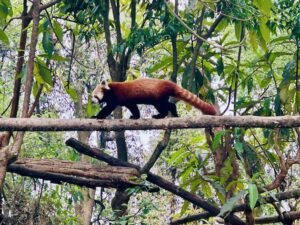
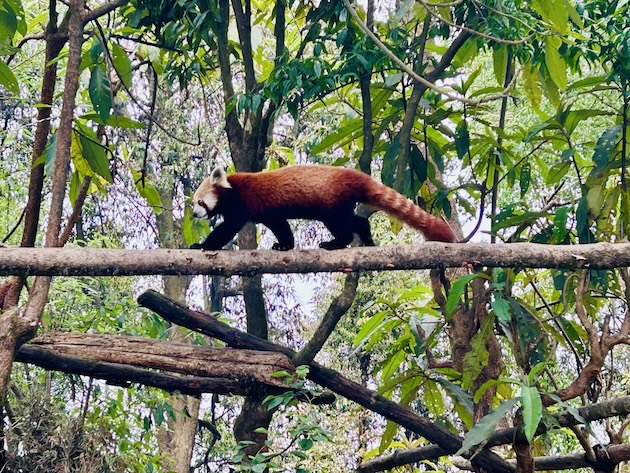
A red panda – labelled ‘endangered’ by the IUCN – at an animal sanctuary in the Indian state of West Bengal. As biodiversity loss accelerates, UNCBD is asking countries to take greater action to protect it. Credit: Stella Paul/IPS

A red panda – labelled ‘endangered’ by the IUCN – at an animal sanctuary in the Indian state of West Bengal. As biodiversity loss accelerates, UNCBD is asking countries to take greater action to protect it. Credit: Stella Paul/IPS

ROME & NEW DELHI, Feb 23 2026 (IPS) – Governments meeting in Rome last week acknowledged that global efforts to protect nature are still not moving fast enough, even as biodiversity loss continues to affect ecosystems, livelihoods, and economies worldwide.


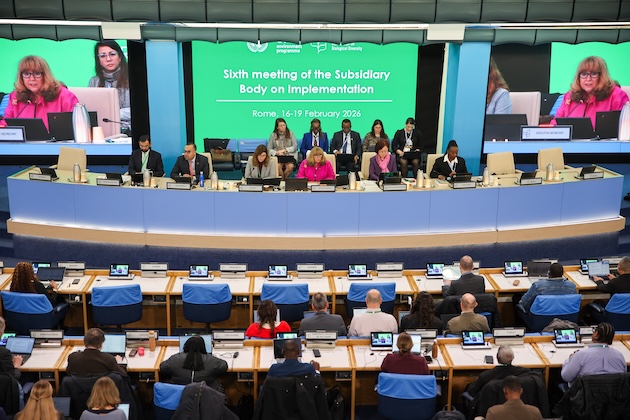
The warning came as the sixth meeting of the Subsidiary Body on Implementation (SBI-6) under the Convention on Biological Diversity (CBD) concluded after four days of negotiations focused on how countries are putting global biodiversity commitments into practice.

Held at the headquarters of the Food and Agriculture Organization of the United Nations (FAO), the meeting is the first major checkpoint in a year of intensive talks leading to the United Nations Biodiversity Conference (COP17) in October in Yerevan, Armenia. There, governments will carry out the first global review of progress under the Kunming-Montreal Global Biodiversity Framework.

From Promises to Practice

At the centre of discussions in Rome was the challenge of turning global promises into action on the ground. The Kunming-Montreal Global Biodiversity Framework (KMGBF), adopted in 2022, sets out 23 targets to be achieved by 2030, including protecting and restoring ecosystems, reducing pollution, cutting harmful subsidies, and ensuring fair sharing of benefits from genetic resources.

While most governments have formally endorsed the framework, SBI-6 revealed that implementation remains uneven. Negotiators worked through recommendations on biodiversity finance, national planning, gender equality, capacity-building, international cooperation, and access and benefit-sharing. Many of these were adopted without brackets, suggesting broad agreement.

“This has been a long week for all,” said Clarissa Souza Della Nina, Chair of the meeting, as she closed the afternoon plenary and announced that delegates would meet again in the evening. She noted that turning global ambitions into real action on the ground requires strong systems and institutions, and that this is not an easy process.

“The conclusion of SBI-6 marks an important early milestone in a very demanding year,” said Souza Della Nina, highlighting the efforts made by countries to work together and find common ground.

But behind the consensus language, discussions repeatedly returned to the same concern: global ambition is not yet being matched by national action.
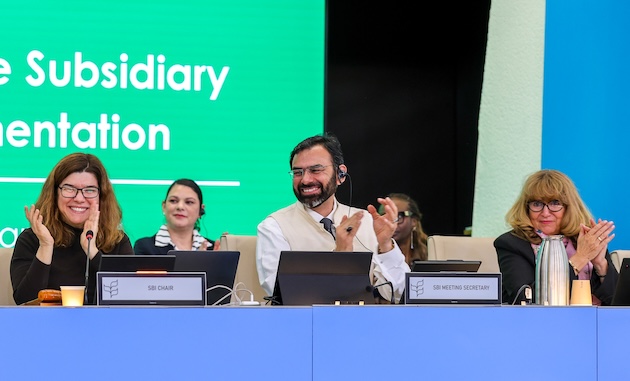
SBI 6 Chair Clarissa Souza Della Nina, Brazil; Asad Naqvi, SBI 6 Secretary; and CBD Executive Secretary Astrid Schomaker celebrating the first conference room paper being approved. Credit: IISD/ENB, Mike Muzurakis

SBI 6 Chair Clarissa Souza Della Nina, Brazil; Asad Naqvi, SBI 6 Secretary; and CBD Executive Secretary Astrid Schomaker celebrate the first conference room paper being approved. Credit: IISD/ENB, Mike Muzurakis

National Plans Show Mixed Progress

A key input to the Rome meeting was an analysis by the CBD Secretariat of national biodiversity strategies and targets submitted so far. These national plans are the main way countries translate the global framework into domestic policies.

The analysis covered 51 National Biodiversity Strategies and Action Plans (NBSAPs) and 130 sets of national targets. It found that while progress is being made, many plans fall short of the scale of change required.

About 75 percent of Parties have submitted national targets, but fewer have updated their full national strategies. Even among submitted plans, several global targets are only partially addressed. Social and economic aspects of biodiversity loss — including links to livelihoods, equity, and development — tend to receive less attention than conservation measures.

“These findings show clearly where we stand,” said Astrid Schomaker, Executive Secretary of the CBD. “They also show that countries still have the opportunity to raise ambition and speed up action before the global review.”

The first global review of progress under the KMGBF will take place at COP17. A major source of information for that review will be the seventh National Reports, which countries are required to submit by 28 February 2026.

By the end of SBI-6, the European Union, Lesotho, Uganda, and Switzerland had submitted their reports. Several other countries said they were close to completion, while others cited difficulties related to limited staff, technical challenges, or delays in accessing funds.

Delegates stressed that timely reporting is essential, not only for transparency but also to ensure that the global review reflects the realities faced by countries at different levels of development.

Gender and Inclusion Lag Behind

Another issue that drew attention in Rome was the limited integration of gender equality into biodiversity action. Under the global framework, countries have committed to ensuring the full and meaningful participation of women and girls, including those from indigenous peoples and local communities.

Yet the Secretariat’s analysis showed that only around 40 percent of national targets refer to gender-related issues, and only about 20 percent address women’s rights to land and natural resources. Even fewer countries reported involving women’s organisations in the preparation of national biodiversity plans.

For many participants, this gap was a reminder that biodiversity loss is not only an environmental issue but also a social one.

“Without addressing inequality, we will not succeed in protecting nature,” said Gillian Guthrie, a delegate from Jamaica, during the discussions, urging governments still updating their plans to take a more inclusive approach.

Money and Capacity Remain Major Hurdles

Financing biodiversity action was another recurring theme. Although the most detailed negotiations on biodiversity finance are scheduled for later this year, talks in Rome were informed by new studies on funding needs, the relationship between debt and biodiversity spending, and opportunities to better align biodiversity and climate finance.

Developing countries repeatedly pointed to limited financial resources, lack of access to technology, and institutional constraints as barriers to implementation. These challenges were reflected in the meeting itself, where several delegations consisted of a single representative struggling to follow multiple negotiating tracks.

The CBD Secretariat thanked donor countries that contributed to a special trust fund to support participation and called on others to do the same. Without broader support, delegates warned, global biodiversity decision-making risks leaving some voices unheard.

A decisive year ahead

The recommendations adopted at SBI-6 will now be forwarded to COP17, where governments will assess whether collective action so far is enough to meet the biodiversity targets set for 2030.

For many participants, the Rome meeting served as both a progress report and a warning. While cooperation is improving and more countries are engaging with the global framework, biodiversity loss continues to affect food systems, health, and economic stability, particularly in the Global South.

As delegates left Rome, the message was clear: the coming months will be critical. Whether the world can move from commitments to meaningful action will be tested in Yerevan, Armenia — and the stakes, many warned, could not be higher.

Below are some of the highlights of the 4-day meeting:

  • The sixth meeting of the Subsidiary Body (SBI-6) on Implementation under the Convention on Biological Diversity began the first global review of how countries are acting to protect nature.
  • An official analysis of national biodiversity plans showed progress but also revealed wide gaps between global goals and what many countries have committed to do at home.
  • Around three-quarters of countries have submitted national biodiversity targets, but far fewer have updated full national strategies or addressed social and economic aspects of biodiversity loss.
  • Gender equality and the participation of women, Indigenous Peoples, and local communities remain weak in many national plans, despite being central to the global biodiversity agreement.
  • Developing countries highlighted ongoing challenges linked to limited funding, lack of technical capacity, and difficulty accessing resources needed to implement biodiversity actions.
  • The outcomes from Rome will shape how global progress on biodiversity is measured and reviewed, setting the tone for accountability and action in the run-up to 2030.

IPS UN Bureau Report
 

From Pledges to Proof: UN Biodiversity Meeting Begins First Global Review of Nature Action

Biodiversity, Climate Action, Conferences, Development & Aid, Editors’ Choice, Environment, Featured, Gender, Global, Headlines, Indigenous Rights, Natural Resources, Sustainable Development Goals, TerraViva United Nations

Biodiversity

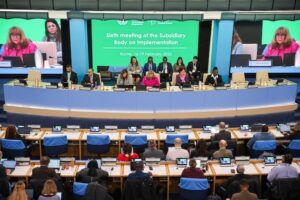
The 6th meeting of the Subsidiary Body of Implementation (SBI-6) is in progress in Rome. Credit: Mike Muzurakis | IISD/ENB

The 6th meeting of the Subsidiary Body of Implementation (SBI-6) is in progress in Rome. Credit: Mike Muzurakis | IISD/ENB |

ROME & DELHI, Feb 17 2026 (IPS) – Governments convened in Rome on Monday (February 16) for a critical round of UN biodiversity negotiations, launching the world’s first global review of how countries are acting to protect nature.


The sixth meeting of the Subsidiary Body on Implementation (SBI-6) of the Convention on Biological Diversity opened at the headquarters of the Food and Agriculture Organization (FAO), drawing government negotiators, technical experts and civil society observers from around the world. It will continue until February 19.

Although considered a technical gathering, the four-day session is expected to play a decisive role in shaping how progress under the Kunming–Montreal Global Biodiversity Framework will be assessed and whether political promises can be translated into measurable, on-the-ground action.

“This is a moment to move from commitments to delivery,” said Clarissa Souza Della Nina of Brazil, Chair of the Subsidiary Body on Implementation. “The task before us is to help countries accelerate action to halt and reverse biodiversity loss.”

Clarissa Souza Della Nina of Brazil, Chair of the Subsidiary Body on Implementation. Credit: Mike Muzurakis | IISD/ENB

Clarissa Souza Della Nina of Brazil, Chair of the Subsidiary Body on Implementation. Credit: Mike Muzurakis | IISD/ENB

A Global Stocktake for Nature

The Rome talks come two years after countries completed the first global stocktake under the Paris Agreement, which confirmed the world remains far off track on climate goals.

Now, a parallel exercise begins for biodiversity.

Under the CBD, governments will undertake the first global review of progress in implementing the Kunming–Montreal Global Biodiversity Framework (KMGBF), adopted in 2022. The framework includes 23 targets spanning conservation, finance, equity and economic transformation, with the overarching objective of halting and reversing biodiversity loss by 2030.

Biodiversity tracking is more complex than emissions accounting, but, according to CBD leadership, it is urgently needed.

“The time has come to make peace with nature… the implementation of the Kunming-Montreal Global Biodiversity Framework and the Paris Agreement in a synergistic fashion will make peace with nature within reach,” said Astrid Schomaker, Executive Secretary of the Convention on Biological Diversity.

Why Rome Matters

SBI-6 plays a central role in preparing for the upcoming global biodiversity review by examining implementation progress, highlighting gaps, and proposing ways to accelerate action. Negotiators will submit the outcomes directly to COP17 in Yerevan, Armenia, later this year.

“One year after COP16 concluded here in Rome, we must ensure these meetings deliver real progress. Submitting national reports on time is essential for a strong and credible global review in the race to 2030,” Schomaker said.

A major focus of SBI-6 is the Secretariat’s analysis of national biodiversity strategies and action plans submitted since 2022. But despite growing momentum, significant gaps persist. Many strategies still do not adequately integrate Indigenous Peoples, local communities, women, youth, or the private sector. Crucial targets relating to economic and social transformation — including sustainable consumption, equity and benefit sharing — remain underemphasised.

Inger Andersen, Executive Director of the United Nations Environment Programme (UNEP), underscored the stakes at the launch of the State of Finance for Nature 2026 report:

“Whether investments flow into nature’s destruction or into its protection will determine if we live in climate-vulnerable concrete jungles or in climate-resilient green cities,” she warned, stressing that financial and policy decisions made today will shape countries’ ability to meet biodiversity goals.

An indigenous woman and biodiversity defender from the Amazon is pictured holding a forest coconut. Women are asking for better implementation of article 23 of the KMGBF. Credit: Stella Paul/IPS

An indigenous woman and biodiversity defender from the Amazon is pictured holding a forest coconut. Women are asking for better implementation of article 23 of the KMGBF. Credit: Stella Paul/IPS

Gender, Finance and Capacity Challenges

Delegates are also reviewing progress under the CBD Gender Plan of Action (2023–2030). Early assessments show that only a quarter of countries involved women’s groups in shaping biodiversity strategies, and just 12 percent plan to do so in the future.

“Ensuring the full, effective and meaningful participation of women and other rights holders is fundamental to accountability, inclusivity and the effectiveness of biodiversity action, and to achieving the full ambition of the global framework,” the CBD Women’s Caucus stated in its official submission.

Finance remains another major point of discussion. While major funding decisions are expected later this year, Rome’s deliberations draw heavily on new research on biodiversity finance, sovereign debt, and the connections between climate and nature funding.

“If we want to mobilise the finance and resources that nature critically needs, business, finance and governments must confront the reality that persistent gaps in reliable data, incentives and institutional capacity are holding back meaningful action — and unless these barriers are addressed, many countries and sectors will continue to struggle to turn agreed goals into results,” said Matt Jones, Co-Chair of the IPBES Business and Biodiversity Assessment 2026.

Countdown to National Reports

The Rome meeting comes just weeks before countries must submit their Seventh National Reports under the CBD, due on 28 February 2026.

These national publications will serve as a principal source of information for the global biodiversity review, alongside national strategies and targets.

However, many countries remain unprepared to submit on time. On day one, Brazil, one of the most influential players in global biodiversity policy, stressed the need for flexibility.

“Ensuring the quality, consistency and internal validation of data and indicators requires additional time. In this context, Brazil suggests that SBI recommendations prioritise technical guidance, operational flexibility and targeted capacity-building support to enable high-quality reporting, rather than focusing solely on reinforcing deadlines,” the country’s delegate said.

A Test of Accountability

While SBI-6 is unlikely to produce headline-grabbing announcements, it will shape how global biodiversity action is evaluated over the next decade.

For Indigenous Peoples and local communities—who steward a significant share of the world’s remaining biodiversity—the meeting represents a critical test of whether rights, participation and lived realities will be meaningfully reflected in the global assessment process.

“This process must lead to accountability, not just documentation,” emphasised Pirawan Wongnithisathaporn, the Environment Program Officer at the Asia Indigenous Peoples Pact (AIPP), calling for tangible action rather than reporting alone.

SBI-6 will conclude on Thursday, February 19. Negotiations will continue at SBI-7 in August 2026 as governments move steadily toward the first global biodiversity review at COP17.

IPS UN Bureau Report


COP16 Agrees to Raise Funds to Protect Biodiversity

Biodiversity, Conferences, COP16, Editors’ Choice, Environment, Featured, Global, Headlines, TerraViva United Nations

COP16

COP16 President Susana Muhamad. Parties to the UN Biodiversity adopted decisions to implementation of the Global Biodiversity Framework. Photo credit: IISD Earth Negotiations Bulletin/Mike Muzurakis.

COP16 President Susana Muhamad. Parties to the UN Biodiversity adopted decisions to implementation of the Global Biodiversity Framework. Credit: IISD Earth Negotiations Bulletin/Mike Muzurakis.

BLOOMINGTON, U.S.A & ROME, Feb 28 2025 (IPS) – The second round of the UN Biodiversity Conference, COP16, concluded in the early hours of Friday, February 28 in Rome, with an agreement to raise the funds needed to protect biodiversity.


COP16 was suspended in Cali, Colombia, in 2024 without any major financial support decision to support biodiversity conservation. But in the second round of the conference in Rome, Italy, governments agreed on a financial strategy to address the action targets of the Kunming-Montreal Global Biodiversity Framework (KMGBF), which was adopted in 2022 with the aim of closing the biodiversity finance gap.

In a final document, all parties to the biodiversity convention agreed to mobilize resources to close the global biodiversity finance gap and achieve the target of mobilizing at least 200 billion dollars a year by 2030, including international flows of USD 20 billion per year by 2025. Which will be rising to USD 30 billion by 2030.

In the closing press briefing in the early hours of Friday, COP16 President Susana Muhamad said the Rome conference came to a successful end. “It was a remarkable achievement of being able to approve all the decisions, especially the most contentious, difficult decisions.” She said, “And not in a way that made the parties feel that they were compromising their main objectives.”

The agreement includes the commitment to establish permanent arrangements for the financial mechanism in accordance with Articles 21 and 39 of the Convention while working on improving existing financial instruments. It also includes a roadmap of the activities and decision-making milestones until 2030.

COP16 president Muhamad also said that the agreement between governments in Rome will help bring the agendas of biodiversity and climate change together. In November, Belem in the Amazon rainforest region of Brazil will be hosting the UN climate conference, COP30.

“The importance of these resolutions that have been approved in Cali and also here of the cooperation between the different conventions,” she said.

The biodiversity COP also adopted a Strategy for Resource Mobilization to mobilize the funds needed for implementation of the KMGBF. Which includes public finance from national and subnational governments, private and philanthropic resources, multilateral development banks, blended finance, and other approaches.

The Cali Fund

The Rome gathering of parties also agreed to establish a dedicated fund for fair and equitable sharing of benefits from the use of Digital Sequence Information on Genetic Research (DSI), known as the Cali Fund.

The fund was launched on 26 February 2025—at least 50 percent of its resources will be allocated to indigenous peoples and local communities, recognizing their role as custodians of biodiversity. Large companies and other major entities benefiting commercially from the use of DSI are expected to contribute a portion of their profits or revenues in sectors and subsectors highly dependent on the use of DSI.

Pharmaceuticals, cosmetics, plant and animal breeding, agricultural biotechnology, industrial biotechnology, laboratory equipment associated with the sequencing and use of digital sequence information on genetic resources, and information, scientific and technical services related to digital sequence information on genetic resources, including artificial intelligence. Academic, public databases, public research institutions and companies operating in the concerned sectors but not relying on DSI are exempt from contributions to the Cali Fund.

The fund is part of a multilateral mechanism on the fair and equitable sharing of benefits arising from the use of digital sequence information on genetic resources adopted at COP15 in December 2022 alongside the KMGBF.

IPS UN Bureau Report