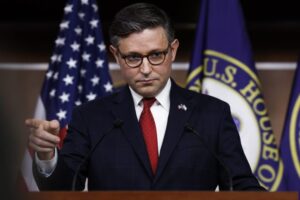
WASHINGTON, DC – NOVEMBER 14: U.S. Speaker of the House Mike Johnson (R-LA) speaks during a news conference after a weekly Republican conference meetingin the U.S. Capitol Building on November 14, 2023 in Washington, DC. During the news conference House Republican leadership spoke to reporters about a range of topics including the upcoming vote on a continuing resolution to fund the government through early 2024. (Photo by Anna Moneymaker/Getty Images)
Minnesota state law enforcement officials are working with the FBI to investigate the fatal shooting of a Minneapolis woman by an Immigrations and Customs Enforcement officer. U.S. forces boarded a tanker carrying sanctioned oil after a two-week chase across the Atlantic, as the Trump administration expands plans to take control of Venezuela’s oil sales indefinitely. And Health Secretary Robert F. Kennedy Jr.’s new dietary guidelines flip decades of advice, elevating meat and dairy and alarming many public health researchers.
Want more analysis of the most important news of the day, plus a little fun? Subscribe to the Up First newsletter.
Today’s episode of Up First was edited by Rebekah Metzler, Kelsey Snell, Kate Bartlett, Mohamad ElBardicy, and Alice Woelfle.
It was produced by Ziad Buchh, Nia Dumas and Christopher Thomas.
We get engineering support from David Greenburg. Our technical director is Stacey Abbott.
And our deputy Executive Producer is Kelley Dickens.
The CDC quietly rewrites its vaccine guidance online to suggest shots might cause autism, raising new questions about political influence over public health. President Trump unveils a 28-point Ukraine peace plan that leans on territorial concessions Kyiv has repeatedly rejected. And New York City mayor-elect Zohran Mamdani heads to the White House for a meeting with a president who has labeled him a radical threat.
Want more comprehensive analysis of the most important news of the day, plus a little fun? Subscribe to the Up First newsletter.
<
p class=”readrate”>Today’s episode of Up First was edited by Jane Greenhalgh, Rebekah Metzler, Megan Pratz, Mohamad ElBardicy, and Alice Woelfle.
<
p class=”readrate”>
<
p class=”readrate”>It was produced by Ziad Buchh, Nia Dumas and Christopher Thomas.
<
p class=”readrate”>
<
p class=”readrate”>We get engineering support from Stacey Abbott. And our technical director is Carleigh Strange.
<
p class=”readrate”>
<
p class=”readrate”>Our Executive Producer is Jay Shaylor
The secretariat of World Health Organization Framework Convention on Tobacco Control (WHO FCTC – the legally binding global tobacco treaty) had warned the governments to stay vigilant because tobacco industry is targeting the intergovernmental FCTC treaty negotiations starting on Monday, November 17th. FCTC is the first WHO corporate accountability and public health treaty ratified by 183 countries (including the European Union).
2025 marks 20 years since WHO FCTC came into force. Professor (Dr) Judith Mackay, Asian Consultancy on Tobacco Control of Hong Kong, WHO Senior Policy Advisor and Special Advisor, Global Centre for Good Governance in Tobacco Control (GGTC) underlined the importance of backbone Article 5.3 of the WHO FCTC, which obligates the ratifying governments to stop tobacco industry interference in public policy. “If a government, for example, introduces new tobacco pack warnings, then they have to tell the industry that ‘these are our new pack warnings. This is what you have to do. It is a directive.’ Tobacco industry is told what to do. But in terms of formulating the policy, they are out of it.”
We must not think that ‘tobacco industry is undefeatable’ because it is not
“Legally-binding global tobacco treaty (WHO FCTC) is a visionary treaty, not only because it includes FCTC Article 5.3 (to stop tobacco industry interference in public policy) and conflict of interest provisions, but also because it includes a remarkable provision (FCTC Article 19) on liability of tobacco industry. FCTC Article 19 empowers countries that have ratified the treaty to leverage upon it to advance legislations at the national level, either civil, criminal, administrative or other forms of liability laws, and hold tobacco industry accountable,” said Daniel Dorado Torres, a noted lawyer and Tobacco Campaign Director, Corporate Accountability.
“In the last 20 years since FCTC came into force, governments have developed several tools to enable revisiting of their national legislations to hold industry accountable. One such tool is FCTC Article 19 Civil Liability Toolkit. WHO FCTC Secretariat has also maintained an experts’ database so that governments that have ratified the treaty can receive consultative guidance as required on liability of tobacco corporations,” said Dorado.
World Conference on Tobacco Control 2025 also had adopted a strong Declaration on the need to advance liability of tobacco industries.
“At upcoming COP11 to WHO FCTC intergovernmental meet next month in Geneva, we hope that governments will adapt a report that provides more than 30 recommendations on how governments could use or extend their civil, criminal, administrative, human rights and other forms of liability to challenge industry’s abuses,” shared Dorado.
Agrees Dr Mackay: “FCTC Article 19 on liability has been instrumental in establishing legal defences in the face of a very aggressive industry. We have had some remarkable successes. For example, Uruguay defeated Philip MorrisInternational (biggest tobacco industry globally) in a legal challenge against Uruguay’s strong packaging regulations. Public health won before profits. We must not think that they are ‘undefeatable.’ They are, what in China we would call, paper tigers.”
But it has been a tough fight to protect public health against the tobacco industry. When Australia introduced plain packaging on all tobacco products in 2011, Australia had to fight 3 legal challenges against the tobacco industry: firstly, constitutional; secondly, with regards to bilateral trade agreement; and thirdly, related to World Trade Organization.
Tobacco industry (like Big Food or Big Oil) manoeuvres to hijack the political and legislative process.
Nepal continues to battle tobacco industry for protecting public health
“Because of tobacco industry interference, Nepal’s adoption of comprehensive tobacco control law got delayed. Eventually, Nepal enacted a comprehensive tobacco control law in 2010 with large graphic health warning that was 75% (largest at that time) and complete ban of tobacco advertising. Nepal had to battle tobacco industry in the court for almost three years before this law could be implemented in 2013,” said Dr Tara Singh Bam, Asia Pacific Director (Tobacco Control), Vital Strategies and Board Director of Asia Pacific Cities Alliance for Health and Development (APCAT).
In 2015, Nepal government increased the size of pictorial health warning from 75 to 90%. But it took almost seven years to win legal case against tobacco industry and implement it in 2022. “In 2025 Nepal government increased the size of pictorial health warnings to 100% (both sides of tobacco packs) – largest in the world. This is a milestone public health policy, but Nepal faced significant challenges from the tobacco industry. This had to be implemented from 1st August 2025 but due to tobacco industry lawsuit, its implementation is still pending,” said Dr Bam.
Blockers to progress at UNFCCC and FCTC are the same
“COP30 to UNFCCC and COP11 to FCTC are about corporations whose product and conduct, impacts people and our planet. Tobacco smoking causes death. Tobacco cultivation also harms our planet. Drivers of climate change are the big fossil fuel #BigOil industries that are causing climate change and impacting public health too. When governments globally try to regulate these abusive corporations, they are confronted with similar industry tactics, be it Big Oil or Big Tobacco,” said Akinbode Matthew Oluwafemi, Executive Director, Corporate Accountability and Public Participation Africa – CAPPA, Nigeria.
“These abusive industries do everything to avoid liability and stop UNFCCC and FCTC from getting implemented and achieve its original objectives. Governments go to intergovernmental meets of UNFCCC and WHO FCTC but find a number of industry representatives sitting at the table either by proxy or by direct representation. We need stringent policies enacted to ensure that abusive corporations like Big Tobacco or Big Nicotine and Big Oil cannot capture public policy,” said Bode.
Agrees Rachel Rose Jackson, Director: Climate Research & Policy, Corporate Accountability (United States) – Kick Big Polluters Out Coalition: “It is important to note that we do not see two intergovernmental meets of UNFCCC (on climate policy) and FCTC (on public health and tobacco control) as separate from each other, because, in fact, they are deeply intertwined – and so is climate and health justice.”
“Those who block critical necessary actions to address climate change or public health and broader systemic crisis are the same in both Treaty spaces (UNFCCC and FCTC) – abusive industry. They use the same playbook and same tactics and deceptive lies in both multilateral spaces in order to distract, delay, defeat or block progress. It is important to also underpin that solutions to advance accountability and liability are also the same. But unlike FCTC, which has Article 5.3 (to stop industry interference) and Article 19 (on liability), we never had such measures in UNFCCC despite it being negotiated for nearly three decades,” said Jackson.
“So, from the very conception of UNFCCC, Big Polluters have been deeply embedded in its development. This is why UNFCCC has failed entirely to galvanise the global action we urgently need to address the climate crisis. Like Big Tobacco, Big Polluters too have rigged the very system that is meant to address climate change. Last year alone more than 1700 fossil fuel lobbyists flooded the climate talks in Baku. Year after year we have seen some of the world’s largest Polluter corporations bankrolling these climate talks. It is no wonder why climate talks have failed year after year. And it is also a no wonder why meaningful science- and evidence-backed actions are failing to come out of climate talks,” added Rachel Rose Jackson. “Millions of lives and livelihoods are at stake.”
This is why over 450 organisations and networks collectively representing millions of people around the world, joined hands to launch Kick Big Polluters Out Coalition. “We have been campaigning and calling for strong measures on liability and accountability in the climate treaty space. We are demanding that ability of Big Polluters to write the rules of climate action must come to an end. No more corporate sponsorship. Full stop,” said Jackson.
Inspired by FCTC and FCTC Article 5.3, for the very first time, all non-governmental participants of climate treaty are publicly required to disclose who is paying for their participation and confirm that their objectives are aligned with UNFCCC and its associated instruments. “This is a huge victory because for the first time in 30 years anything is being done to address or even begin to acknowledge Big Polluters’ influence,” said Jackson.
Shobha Shukla, Bobby Ramakant – CNS (Citizen News Service)
(Shobha Shukla is the Founder Executive Director and Managing Editor of CNS (Citizen News Service) and SDG-3 Lead Discussant at UN Intergovernmental High Level Political Forum 2025. Bobby Ramakant works with CNS. Follow them on X: @Shobha1Shukla, @BobbyRamakant)
– Shared under Creative Commons (CC)
Share this:
Like this:
LikeLoading…
Discover more from The Maravi Post
Subscribe to get the latest posts sent to your email.
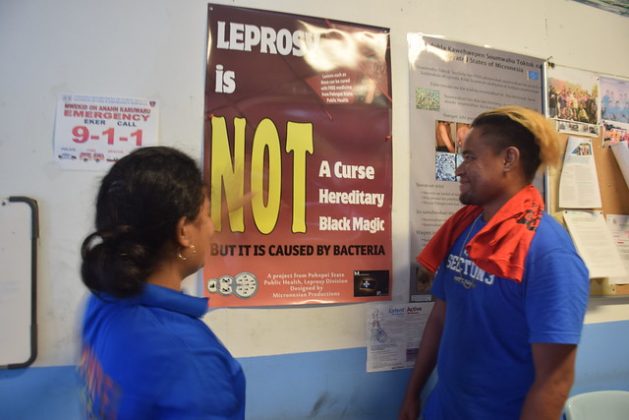
Dexter, a 25-year-old fisherman from Pohnpei in the Federated States of Micronesia, received treatment for Hansen’s disease, also known as leprosy, for over a year. He has been cured of the disease. Credit: Stella Paul/IPS
MANILA, Sep 9 2019 (IPS) – Increasing awareness of the continuing existence of Hansen’s Disease (leprosy) is critical to sustaining effective public health efforts against the disease, eliminating the social stigma associated with it, and halting its transmission.
That was the consensus reached by participants at the Global Forum of People’s Organisations on Hansen’s Disease in Manila on Sept. 9, following a lecture by Dr. Arturo Cunanan, the Chief Medical Officer of the Culion Sanitarium and General Hospital in the Philippines.The forum was organised by Japan’s Sasakawa Health Foundation (SHF) and The Nippon Foundation.
Cunanan noted that for several years, the number of new cases has plateaued at about 200,000 per year, a troubling statistic that he attributed in part to a lack of awareness among public health bodies as well as people affected by the disease.
The social stigma attached to leprosy is a barrier to early detection of the disease, which is the key to slowing its rate of transmission. Cunanan said that the average length of time between the onset of the disease and the beginning of treatment is about two years.
This happens because on the one hand, patients are unaware of medical help available to them, unwilling, or otherwise unable to seek treatment due to stigma; and on the other, a lack of expertise and resources on the part of public health departments due to a misunderstanding of the persistence of the disease.
Not a priority
“Many public health and government officials confuse elimination and eradication,” Cunanan told the forum participants. “They think that leprosy being eliminated as a public health problem means it has been eradicated, so they are surprised when they learn it still exists.”
What this has resulted in is a decline in the material and human resources available for combatting leprosy. “Leprosy will never be a priority” for government health programmes, Cunanan said. “There are more pressing problems, bigger emergencies.”
The Philippines is a good example. The disease is considered a minor problem, and the number of new cases each year is relatively low – there were 2,108 new cases in 2017, out of a national population of about 107 million – but has been relatively consistent year after year, “between 2,000 and about 3,000”.
Because of the mistaken belief that leprosy has either disappeared entirely or has become rare, medical expertise and programmes have disappeared from public health institutions. That in turn has degraded the supervision and monitoring needed to identify new cases and prevent the transmission of the disease, Cunanan explained.
Lucy Massao, a member of the Tanzania Leprosy Association (TLA), noted that the stigma and lack of understanding of leprosy among the public in her country was also reflected in the shortcomings of the public health framework.
“We at TLA really spend a lot of time trying to educate people, including the officials,” she said. “Many patients, the health officials refer to us, because they cannot offer much support except for the medications. But they are improving, through working with us.”
Role of people’s organisations
Public health authorities elsewhere are also gradually recognising the value of the organisations of people who have been affected by leprosy. “You are the best experts,” Cunanan told the forum participants, “Because you have first-hand experience.”
Organisation members can assist in early detection and outreach, Cunanan explained, and help public health authorities improve their services to leprosy patients.
In the Philippines, collaboration with people’s organisations such as Coalition of Leprosy Advocates of the Philippines has actually been included in official policy. Philippine Assistant Secretary of Health Dr. Maria Laxamana, who delivered the keynote address on the forum’s first day, noted that “intensified collaborative efforts among [government] agencies and with private partners” is a key objective of the government’s National Leprosy Control Programme.
Dr. V.R. Pemmaraju of the World Health Organisation’s (WHO) Global Leprosy Programme said that there has been a marked growth in talent and inclusiveness among people’s organisations, which is increasing their effectiveness in supporting and extending public health efforts towards leprosy.
“What we’re seeing, and you can see it at this forum, is that the groups are more global, include more women, and are more educated about the disease and the support needed,” Pemmaraju told IPS.
“This has been very good from the point of view of the WHO, because of the added social aspect of the Global Leprosy Partnership,” he explained. Where people’s organisations still need to develop is in working effectively with governments.
“They [the organisations] have the experience and knowledge about leprosy, but what I’ve seen is that most need more skills in negotiating and engaging with government officials,” Pemmaraju said. “There is still some gap in inclusion of people’s organisations in forming public health policy [related to leprosy], and developing those skills would help to reduce that.”
Pemmaraju is upbeat about the prospects of people’s organisations gaining a bigger voice in public health policy towards leprosy.
“In each of these meetings, I see the groups growing globally and gaining more influence,” Pemmaraju said. “With the engagement of the people’s organisations, we [the WHO] are optimistic that we can achieve our goal of ‘zero leprosy.’”