Organization of Islamic Cooperation (OIC) headquartered in Jeddah, Saudi Arabia
LOS ANGELES / WASHINGTON DC, Oct 21 2022 (IPS) – Eleven out of 57 members of the Organization of Islamic Cooperation (OIC) still sanction the death penalty for blasphemy and apostasy, silencing their citizens and emboldening violence by non-state actors.
For the past 70 years, Article 18 of the United Nations Declaration of Human Rights has condemned capital punishment for religious offenses, a global standard shared during our recent visit to the UN headquarters in New York.
As a prelude to the UN General Assembly (UNGA) high-level meetings in mid-September, we led the International Religious Freedom (IRF) Roundtable Campaign to Eliminate Blasphemy and Apostasy Laws, urging UN members to stand in strong support during two paramount resolutions calling for an end to the death penalty and extrajudicial killings.
We urge the insertion of language codifying the death penalty never being imposed as a sanction for non-violent conduct such as blasphemy and apostasy. The effort produced an encouraging response by Nigerian third committee officials who renewed their commitment to freedom of religion or belief by supporting embedded language in both the moratorium on the death penalty and a resolution on renouncing the death penalty for extrajudicial killings.
In the days that followed our visit, the world has witnessed the outrage of human rights activists and concerned global citizens with the death of Masha Amini, an Iranian Muslim woman who was arrested and subsequently died in the custody of Iranian morality police for a violation of the Islamic Republic of Iran’s compulsory hijab mandate.
Brutal cases like these will only cease when government officials in Iran, and other egregious human rights violators, listen to the cries of their people and uphold globally recognized human rights declarations. These include statutes supporting international religious freedom or belief, and the repeal of apostasy and blasphemy laws.
When most countries around the world and the majority of Muslim nations are taking concrete steps to abolish capital punishment for perceived religious offenses such as blasphemy and apostasy, some refuse to modernize their legislation, thus branding themselves as the worst violators of internationally recognized basic human rights.
This staunch obsession with upholding persecutory laws and implementing the harshest of punishments, violates religious freedoms – the right to life and the right to freedom of religion or belief. This misinterpretation of scripture is an abuse of Islam, tarnishing the image of Muslims around the world and a disregard to Gods mercy, a belief that transcends faith orientation.
The multidisciplinary and multifaith delegation from the International Religious Freedom (IRF) Campaign urged UN members, including: Luxemburg, Canada, and Sri Lanka, to raise their voices loudly in favor of embedded international religious freedom language in two resolutions which will come up for a vote during the UNGA in November.
Penholders Australia and Costa Rica are calling for a moratorium on the death penalty which is only supported by the IRF Campaign with the addition of specific language ensuring the death penalty never be imposed for non-violent conduct such as apostasy or blasphemy.
Likewise, Finland, as penholder for the UNGA resolution on extrajudicial executions, is being asked by global advocates to add language on freedom of religion or belief, emphasizing the necessity for States to take effective measures to repeal laws currently allowing the death penalty for religious offences, such as criminalization of conversion and expression of religion or belief as a preventative measure.
Article 18 of the United Nations Declaration of Human Rights is clear – everyone has the right to freedom of religion or belief. Yet, 11 States today maintain the death penalty for apostasy and blasphemy. We raise the voices of the voiceless, such as Pakistani woman Aneeqa Ateeq who was sentenced to death for blasphemy in January 2022 after being manipulated into a religious debate online by a man who she romantically refused.
Also, an 83-year-old Somali man, Hassan Tohow Fidow, who was sentenced to death for blasphemy by an al-Shabaab militant court and subsequently horrifically executed by firing squad; and a 22-year-old Nigerian Islamic gospel singer Yahaya Sharif-Aminu who was sentenced to death for blasphemy because one of his songs allegedly praised an Imam higher than the Prophet.
As an outcome of our UN advocacy, we pray that the 11 Muslim member states—Afghanistan, Brunei, Iran, Maldives, Mauritania, Nigeria, Pakistan, Qatar, Saudi Arabia, Somalia, and Yemen– join in the common-sense repeal of the death penalty for blasphemy and apostasy as a great step toward becoming civilized nations.
The majority of OIC member nations who do not sanction the death penalty for religious offenses should be regarded as examples of modernity and humanity and their path to restore and uphold basic human rights should be replicated.
The Qur’an says, “There shall be no compulsion in religion; the right way has become distinct from the wrong way.” (Qur’an 2:256). Likewise, we read passages like 18:26:, “And say, ‘The truth is from your Lord. Whoever wills – let him believe. And whoever wills – let him disbelieve,” and “whoever among you renounces their own faith and dies a disbeliever, their deeds will become void in this life and in the Hereafter (Qur’an 2:217).”
The holy book, which serves as a moral compass for the laws in OIC member nations, upholds the right to freedom of religion or belief which has been recognized by the OIC majority.
As has been recently witnessed in Iran, when civil society activates around globally recognized human rights, the world takes note. The OIC asserts its purpose “to preserve and promote the foundational Islamic values of peace, compassion, tolerance, equality, justice and human dignity” and “to promote human rights and fundamental freedoms, good governance, rule of law, democracy, and accountability”.
To that end, with the passage of both critical UN resolutions, OIC members will face the controversial and politically sensitive task of calling out other OIC colleagues who continue to violate human rights by imposing the death sentence upon individuals for exercising their right to freedom of thought, conscience, and religion.
We assert that it is a societal problem as much as it is a reflection of the deficiency of democratic values and principles.
Embedding international religious freedom language in both resolutions calling for the repeal of the death penalty will be strengthened with the strong support of the 46 OIC nations and other human rights champion nations in the days ahead.
We are encouraged by Saudi Arabian scholar, Dr. Mohammad Al-Issa of the Muslim World Alliance, who travels the world sharing the unanimously approved Charter of Makkah – a document affirming differences among people and beliefs as part of God’s will and wisdom.
Our collective voice must be unwavering in its call and commitment to repeal the death penalty for blasphemy and apostasy as a primary step towards upholding theologies of love and compassion, building toward human flourishing.
Dr. Christine M. Sequenzia, MDiv is co-chair IRF Campaign to Eliminate Blasphemy and Apostasy Laws; Soraya M. Deen, Esq. is lawyer, community organizer, founder, Muslim Women Speakers, and co-chair International Religious Freedom (IRF) Women’s Working Group
ISLAMABAD, Pakistan, Apr 7 2022 (IPS) – The retrenchment of American power in the Middle East and the larger Muslim world, coupled with the war in Ukraine, has provided a geopolitical breather for China. Beijing is effectively deploying this to make strategic inroads into the region, given this vacuum and focus on Europe.
The recent invitation to Chinese Foreign Minister Wang Yi to address the Organisation of Islamic Cooperation (OIC) conference in Islamabad is a ‘historic first,’ and a significant breakthrough for Chinese diplomacy. For the first time, the foreign minister of the Peoples Republic of China was invited to address the most representative platform of the 57-member body representing the 1.5 billion Muslims.
During his speech at the OIC conference in Islamabad on the 22nd March 2022, Foreign Minister Wang Yi talked about the “long standing relationship between China and the Muslim world” and reaffirmed that China would continue supporting Muslim countries in their quest for political independence and economic development.
Historically, China has always been etched in the Muslim consciousness as a country with a great civilisation based on knowledge, learning and development. For example, there is a famous saying of the Holy Prophet Mohammad (Peace Be Upon Him), 1,400 years ago, which urged Muslims to “seek knowledge, even if you have to go to China,” implying that although China was physically far away from Arabia, it was a land of learning.
Soon after the end of the Cold War in the 1990s, a professor of the prestigious American university Harvard, Prof. Samuel Huntington, talked of a ‘clash of civilisations’ in which he implied that Western civilization would be at odds with both the Islamic and the Confucian civilisations. Interestingly, he also talked of a united front of the Islamic and Confucian civilisations.
During his speech at the conference on Dialogue among Civilisations, held in Beijing in May 2019, Chinese President Xi Jinping mentioned the contribution of the Islamic civilisation to “enrich the Chinese civilisation” and also referred to the Holy Mosque in Makkah (Mecca) as well as the travels to China of the Muslim explorer, Ibn Batuta, who wrote favourably on China and the Chinese people.
China has a longstanding relationship with the Muslim world. After the Chinese revolution in 1949, Pakistan was the first country in the Muslim world to recognise the People’s Republic of China in May 1950. The first institutional interaction between China and the Muslim countries took place at the 1955 Afro-Asian Summit in Bandung, Indonesia.
It was hosted by the world’s largest Muslim country, Indonesia and Pakistan and China were among the countries attending this historic summit. China shares a border with 14 countries, five of which are members of the OIC and none of these have border disputes with China.
In January 1965, when the Palestine Liberation Organisation (PLO), was formed, China was among the first countries who recognised it. And in the 1960s and early 70s, China also provided material support and aid to various Muslim countries that were facing economic and political pressures, including Pakistan, Nigeria, Indonesia, South Yemen and Egypt.
As a permanent member of the United Nations Security Council, China also has been in the forefront of countries that have a proactive approach to the Muslim world. China, for example, presented a Middle East peace plan and it was unveiled during visits to China in May 2013 by the President of the Palestinian Authority, Mehmood Abbas, and the Prime Minister of Israel, Benjamin Netanyahu.
During his meeting with the two leaders, President Xi Jinping presented the 4-point peace plan that called for an independent Palestine State alongside Israel, based on the 1967 borders, with East Jerusalem as its capital. While recognising Israel’s right to exist in security, the Chinese peace plan also called for an end to building Jewish settlements in the occupied territories of Palestine, cessation of violence against civilians and termination of the Israel blockade of Gaza.
The peace plan also called for resolving the issue of Palestinian prisoners in Israeli jails and sought more humanitarian assistance for the Palestinians, while underlining that these are “necessary for the resumption of peace talks between Israel and Palestinian Authority.”
China also has been principled on the issue of Syria urging an end to both interference in Syrian affairs and an end to the Syrian civil war. In January 2022, China invited Syria to be part of the Belt & Road Initiative (BRI).
China today is the largest importer of crude oil in the world and almost 50% of that oil comes from the Muslim countries of the Middle East, especially Saudi Arabia, Iran and the UAE. Saudi Arabia has also invited President Xi Jinping to visit the Kingdom and there have been media reports that China and Saudi Arabia are engaged in discussions to have their oil trade done partially in Yuan or the RMB, the Chinese currency.
Defence cooperation between China and the Muslim world is also expanding and the Chinese advanced jetfighter J10C is now in use in countries like Pakistan and the UAE. In January 2022, China and Iran signed a comprehensive Strategic Accord which will run for 25 years, worth well over $400 billion dollars.
The centre piece of China’s relationship with the Muslim world today is the BRI. Interestingly, the BRI was launched in two phases by President Xi Jinping, with two important speeches in two different Muslim countries. In September 2013, during the speech in Astana, capital of Kazakhstan, President Xi Jinping announced the launch of the Silk Road Economic Belt.
During another speech in Jakarta, capital of Indonesia, in November 2013, President Xi Jinping announced the launch of the Maritime Silk Road, both pillars of the BRI. And during his speech at the OIC conference on the 22nd March, Foreign Minister Wang Yi said that “China is investing over 400 billion dollars in nearly 600 projects across the Muslim world under the BRI.”
He underlined that “China is ready to work with Islamic countries to promote a multi-polar world, democracy in international relations and diversity of human civilisation, and make unremitting efforts to build a community with a shared future for mankind”. On the issue of Palestine and Kashmir, Wang Yi said that “China shares the same aspirations as the OIC, seeking a comprehensive and just settlement of these disputes.”
Another example of close ties between China and the Muslim world was the February 2022 Beijing Winter Olympics, where a majority of Muslim countries like Pakistan, Egypt, Saudi Arabia, UAE and Qatar had a high level of representation, despite the boycott called by certain Western countries. Also, only last week, on the 30th March, China hosted an important conference, the Meeting of Foreign Ministers of Afghanistan’s Neighboring Countries, which was well attended.
China has also received support from Muslim countries on the issue of Xinjiang at the UN Human Rights Council. In fact, in July 2019, when a group of 22 nations led by the West sent a letter to the UN Human Rights Council criticising China on Xinjiang, not a single Muslim country was a signatory of that letter, while another group of 37 countries submitted a letter on the same issue defending Chinese policies.
These countries included all the six Gulf countries plus Pakistan, Algeria, Syria, Egypt, Eritrea, Nigeria, Somalia, and Sudan — all Muslim countries.
Given the changing geopolitical scenario, where there is a shift in the global balance of economic and political power, away from West and toward the East, followed by calls for a New Cold War, China’s thrust for cooperation and connectivity, given the common threat of the Coronavirus pandemic and the need for connectivity through BRI, has a broad resonance in the Muslim world.
The Muslim countries see their relations with China as a strategic bond to promote stability, security and economic development in the Muslim world and the BRI has become the principal vehicle in the promotion of such an approach.
In the coming years, China’s partnership with the Muslim world is likely to be strengthened, given the mutuality of interests and the convergence of worldviews in upholding a world order based on International Law, the UN Charter and the Five Principles of Peaceful Coexistence.
Ironically, thirty years after enunciating the Huntington thesis on the ‘clash of civilisations,’ which talked of the Islamic and Confucian Civilisations co-existence with each other but possible confrontation with Western Civilisation, recent developments may be pointers to a self-fulfilling prophecy!
Chairman of the Senate Defence Committee Pakistani, Senator Mushahid Hussain was Bureau Chief in Islamabad of Inter Press Service (IPS) during 1987-1997 & later in 2014. He launched the first Public Hearings on Environment & Climate Change in the Pakistan Parliament. As Senator, he chairs the Senate Sub Committee on ‘Green and Clean Islamabad’ which has launched a campaign to ban plastic use in the Pakistani capital.
Sri Lankan Buddhist monks at the UN General Assembly session commemorating Vesak. Credit: Sri Lanka’s Permanent Mission to the United Nations
LONDON, Feb 3 2022 (IPS) – Driven by unprecedented hardship to pass round the begging bowl, Sri Lanka has become the centre of a tussle between Asia’s two superpowers.
There was a time in Asia’s predominantly Buddhist countries when saffron-robed monks walked from house to house in the mornings, standing outside in silence as lay people served up freshly cooked food into their ‘alms bowls’. The food was then taken to the temples, where it was shared among the monks.
That religious tradition has now largely given to other ways of serving alms to monks.
Today, governments and their aggrandising acolytes have converted this respected and virtuous tradition into one of begging richer nations to rescue them from economic deprivation, brought on largely by failed promises and disjointed and ill-conceived foreign and national policies.
This ‘begging bowl’ mentality in search of ‘alms’ is more likely to succeed if a nation is strategically-located in an area of big power contestation. Sri Lanka is just that, situated in the Indian Ocean and only a few nautical miles from the vital international sea lanes carrying goods from West to East and vice versa.
The country’s economy has been caught in a real bind. Buffeted by the Covid pandemic on the one hand and, on the other, ego-inflating economic and fiscal policies introduced by the new president Gotabaya Rajapaksa shortly before the country was pounded by the pandemic, Sri Lanka now has to beg or borrow to keep its head above water.
By December, Sri Lanka’s parlous foreign reserves situation had dropped to a perilous $1.2 billion – enough for three weeks of imports. The foreign debt obligation of $500 million that needed to be met last month was only the beginning. Another $1 billion is due in July. The total pay-off in 2022 will amount to some $7 billion.
Meanwhile the pandemic has virtually killed tourism, one of the country’s main foreign exchange earners, driving the hospitality industry into free-fall. If this was not bad enough, the Central Bank’s attempts to put a tight squeeze on incoming foreign currency led the country’s migrant labour remittances to drop drastically as overseas workers turned to the black market to earn real value for their money sent to families at home.
But nothing has had such widespread political repercussions as the government’s ill-advised policy of banning overnight chemical fertilisers last May, ahead of the country’s main agricultural season between October and April.
Its over-ambitious agenda of trying to turn Sri Lanka into the world’s first totally ‘green agriculture’ was laudable enough, but was botched when the sudden ban on chemical fertilisers and other agrochemicals – used by farmers for the last 50 years or so – left rice farming and other cultivations in disarray and farmers inevitably confused.
The government’s agenda of trying to turn Sri Lanka into the world’s first totally ‘green agriculture’ was botched.
While agricultural scientists and other experts warned of an impending food scarcity due to failed harvests and sparsely cultivated fields, the government ignored the warnings, sacking heads of the Agriculture Ministry and removing its qualified agricultural experts for spreading doom and gloom.
Against this backdrop of confused governance, probable food shortages due to poor harvests and slashing of imports and even essential medicines for lack of foreign currency, growing public unrest has seen even farmers take to the streets.
Consequently, a once-buoyant government confident of public popularity, especially among the Sinhala-Buddhist voters and the rural community, began to look beyond its faithful ally and ‘all weather’ friend China for ‘alms’ to pull it out of the morass.
China has already planted a large footprint in Sri Lanka, with massive infrastructure projects such as sea and airports in strategic areas, which allowed a monitoring of international sea lanes to make neighbouring India worry.
A major Chinese presence in Sri Lanka could endanger India’s security at a time when China continues to militarily pressurise India in the Himalayas.
From the early 1950s Sri Lanka, then called Ceylon, and China had established close ties. Despite threats of sanctions by the US, Colombo sold natural rubber to China – then involved in the Korean War –in exchange for rice, marking the beginning of the long standing ‘Rubber-Rice Pact’.
As long as China’s immediate concern was the Pacific theatre, where the US and its allies remained dominant, and China faced territorial disputes in the South China sea and elsewhere, India was not overly concerned with China-Sri Lanka bilateral ties.
But as soon as China began to expand into the Indian Ocean, challenging what India considered its sphere of influence, New Delhi’s concerns multiplied considerably, as did its disquiet over China’s growing influence over Colombo.
The 70th anniversary of that Sino-Ceylon agreement, which cemented bilateral relations at a time when the People’s Republic of China was not even a member of the UN, was commemorated last month when China’s Foreign Minister Wang Yi visited Colombo in early January during an influence-building visit to Africa, the Maldives and Sri Lanka.
This is the third high level visit by a Chinese official in little over a year, beginning with former foreign minister and Politburo member Yang Jiechi in October 2020, and followed last April by Chinese Defence Minister Gen. Wei Fenghe, a visible signal to India and US-led ‘Quad’ countries the importance that China attaches to its relations with Sri Lanka.
But Sri Lanka’s struggle against dwindling reserves, the need for foreign investment and expansion of trade relations at a time of economic hardship has shown the Rajapaksa regime that reliance on China alone will not suffice.
A more balanced foreign policy and an equidistant relationship between Asia’s two superpowers cannot remain at the level of diplomatic rhetoric. It is an imperative, given Sri Lanka’s geographical location in close proximity to India and the historical, cultural and ethnic ties with it huge neighbour.
Sri Lanka’s ambassador to Beijing, Dr Palitha Kohona, said recently that Colombo should not depend on China forever – a valid piece of advice Colombo should seriously consider.
India also cannot ignore that, security-wise, Sri Lanka lies in India’s underbelly, whose vulnerability was exposed during the Bangladesh Liberation War in 1971. So a major Chinese presence in Sri Lanka could endanger India’s own security at a time when China continues to militarily pressurise India in the Himalayas.
Last December Finance Minister Basil Rajapaksa’s hurried visit to New Delhi, even as his maiden budget was still being debated in parliament, was indicative of Sri Lanka’s anxiety to seek India’s economic and financial assistance, without depending solely on Beijing.
That visit led to the two countries agreeing on ‘four pillars’ of cooperation in the short term, including emergency support of a $1 billion line of credit for importing food and medicines and a currency swap to bolster Colombo’s dwindling foreign reserves.
Other assistance included investment in an oil tank farm for oil storage in northeastern Trincomalee, close to the vital natural harbour that served the British well during the Second World War.
An Indian company, the Adani Group, has already won a stake in the Colombo port, where it will engage in developing the western terminal while the Chinese build the eastern wing.
Meanwhile, Colombo is having talks with China for a new loan besides the $500 million loan and a $1.5 billion currency swap.
While the two major Indian Ocean powers tussle for supremacy in this vital maritime region, Sri Lanka is beginning to understand that it sometimes pays to dip one’s oars in troubled waters.
Source: Asian Affairs, a current affairs magazine.
Neville de Silva is a veteran Sri Lankan journalist who held senior roles in Hong Kong at The Standard and worked in London for Gemini News Service. He has been a correspondent for foreign media including the New York Times and Le Monde. More recently he was Sri Lanka’s deputy high commissioner in London
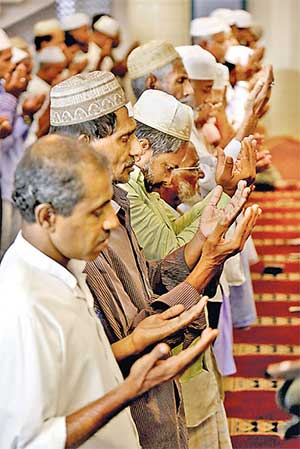
Muslims at a mosque in Sri Lanka. Credit: Financial Times, Sri Lanka
BRUSSELS, Jan 25 2022 (IPS) – On 28 October, President Gotabaya Rajapaksa appointed the militant Buddhist monk Galagoda Aththe Gnanasara to head a presidential task force on legal reforms, shocking many in Sri Lanka and beyond. Gnanasara is the public face of the country’s leading anti-Muslim campaign group, Bodu Bala Sena (Army of Buddhist Power, or BBS). He is widely accused of inciting inter-communal violence, including two deadly anti-Muslim pogroms in June 2014 and March 2018.
Convicted of contempt of court for a separate incident, Gnanasara was sentenced to six years in prison but received a presidential pardon from Rajapaksa’s predecessor, Maithripala Sirisena, in his final months in office. The act of clemency came after intensive lobbying by nationalist monks and an upsurge of anti-Muslim sentiment in the aftermath of the 2019 Easter bombings, a series of attacks on churches and tourist hotels carried out by a small group claiming allegiance to the Islamic State, or ISIS.
Observers across the Sri Lankan political spectrum, including some Buddhist nationalists, expressed dismay – at times, outrage – that the president could name someone whose disrespect for the law and hostility to non-Sinhala Buddhist minorities are a matter of public record to head a commission ostensibly designed to prevent “discrimination” and ensure “humanitarian values”. Critics have called the appointment “irrational” and even “incomprehensible”.
In fact, it is anything but. The Rajapaksa government is deeply unpopular, including among large sections of its core Sinhala Buddhist constituency, and desperate to divert public attention from its economic mismanagement.
There is thus a clear if deeply unfortunate logic for it to bring back to the fore the best-known proponent of a theme that was key to getting the president elected: fear of Muslims as a source of “religious extremism”.
While it was in one sense surprising to see the open affirmation of Rajapaksa’s active support for the controversial monk after many years of distancing himself from Gnanasara, tight links between Sri Lankan government officials and the Buddhist clergy are nothing new. The 1978 constitution gives Buddhism the “foremost place” in the country’s religious landscape and the state the duty to “protect” it.
There is nothing comforting in this history, however. The Sinhala Buddhist majoritarian nature of the Sri Lankan state – ie, the extent to which the state represents and enforces majority interests at the expense of the rights of other communities – has had disastrous effects on the country’s ethnic and religious minorities.
The state’s transition from being structurally discriminatory to openly hostile toward Tamils (who are Hindu or Christian) – a process fed by Sinhala politicians’ warnings about the threat the community allegedly posed – ultimately led to three decades of devastating civil war.
During that period, from 1983 to 2009, terrorist attacks by the Liberation Tigers of Tamil Eelam provided some objective grounds for Sinhalese fears, reinforcing the narrative that the majority community was under threat. Now, there is growing reason to fear that this pattern may be repeating itself in the Sri Lankan state’s interactions with its Muslim citizens.
Credit: Sunday Times, Sri Lanka
The Rise of Anti-Muslim Politics
In November 2019, Gotabaya Rajapaksa’s successful campaign for Sri Lanka’s presidency made much of the slogan “one country, one law”, which had gained popularity after the 2019 Easter bombings. Its ambiguity was useful: at one level, it could be interpreted as merely asking for uniform treatment of all citizens and resonated with voters angry at the impunity with which politicians and their powerful supporters are able to violate the law.
But its discriminatory implication was also obvious from the start, hinting at a need to “protect” the Buddhist nature of state and society by eliminating the separate rules and treatment that many Sinhalese believe Muslims use to gain economic and political advantages.
Many Sinhalese have for years held the view that Sri Lankan Muslims are more concerned with advancing their own interests than working for the larger national interest. Even during the civil war, when Muslims remained overwhelmingly loyal to the state and played a critical role in fighting the Tamil insurgency, one regularly heard complaints in Sinhalese (as well as Tamil) circles that they were exploiting the conflict for personal and collective economic benefit.
Because Muslim lawmakers held the balance of power in parliament between the two major Sinhala-dominated parties, they were commonly accused of using their “kingmaker” role to gain undue advantages for their co-religionists.
By the early 2000s, many Sinhalese had also begun to express discomfort at the increasing numbers of Muslims, especially women, wearing religious attire and the growing focus among Muslims on practices meant to demonstrate religious piety. Many interpreted this trend as Muslims deliberately distancing themselves from the majority.
With the arrival of BBS ultra-nationalists on the political scene in late 2012 – whose message was amplified by the smaller militant Sinhalese groups Sinhala Ravaya and Ravana Balakaya – the public portrayal of Sri Lankan Muslims rapidly took on more overtly hostile forms. (The decade earlier had seen organised Buddhist activism, at times violent, directed against the growing number of evangelical churches; pressure on Christian evangelicals continues today, though not on the scale of anti-Muslim campaigns.)
At the height of its influence, in 2013 and 2014, BBS dominated news coverage and helped set the political agenda through rallies, speeches and vigilante actions aimed at containing the threat Muslims’ alleged “extremism” posed to Sri Lanka’s Sinhala Buddhist character. The range of allegations promoted by BBS and like-minded organisations, often through online hate speech, was broad and shifting.
They claimed that population growth meant that Muslims would eventually overtake the Sinhalese majority; that Muslim-owned businesses were secretly distributing products to sterilise Sinhalese in order to keep their numbers down; and that the system of halal food labelling was encroaching on the religious rights of others and covertly funding Islamist militants.
More generally, conservative religious practices adopted by increasing numbers of Muslims in a quest for greater piety were read by ultra-nationalists as evidence of growing “extremism” that threatened other communities. These charges were based on either outright falsehoods or malicious misinterpretations of complex social and religious developments among Sri Lankan Muslims.
The anti-Muslim rhetoric helped set off inter-communal violence late in the presidency of Gotabaya’s brother Mahinda Rajapaksa (2005-2015). These years saw a series of attacks on Muslim-owned businesses (with many alleging that Sinhala business rivals were backing the attackers) and disruption of political meetings held by anyone daring to challenge the Buddhist militants, against the backdrop of mass rallies denouncing the alleged threat posed by Muslims’ “extremism”.
In a June 2014 speech in the town of Aluthgama, Gnanasara declared to a large crowd: “This country still has a Sinhala police. A Sinhala army. If a single Sinhalese is touched, that will be the end of them all [Muslims]”. Minutes later, hundreds of his supporters marched through a nearby Muslim neighbourhood, sparking two days of devastation that left three Muslims and one Tamil security guard dead. Sinhala rioters, many of them brought in from outside the area, targeted mosques and Muslim-owned shops and homes for arson and destruction. The police were widely accused of standing by or even assisting the rioters.
Despite government denials, many independent observers told Crisis Group at the time that the Mahinda Rajapaksa administration was actively supporting the BBS and other anti-Muslim campaigns. They suspected the government of executing an electoral strategy designed to consolidate the Sinhala vote behind the government, which projected itself as the defender of Sinhalese Buddhist identity. The appearance of Gotabaya Rajapaksa, then defence secretary, at a BBS event in March 2013, and his known connections with senior monks associated with the group, fuelled the speculation.
More tangible evidence of state backing lay in the fact that police gave BBS and like-minded groups permission to hold rallies at a time when government critics were not allowed to do so. Police took no apparent action, moreover, to prevent or investigate repeated vigilante raids on Muslim-owned shops or violent efforts to silence critics of militant Buddhist organisations.
Nor was anyone prosecuted for any of these crimes. Multiple sources told Crisis Group that Senior Deputy Inspector General of Police Anura Senanayake, who worked closely with Gotabaya at the time, led efforts to persuade victims not to press charges. Following Mahinda’s defeat in the January 2015 election, officials announced they had evidence of close ties between Buddhist militants and military intelligence units, confirming what Muslim community leaders had previously told Crisis Group.
With the 2015 election of President Maithripala Sirisena, representing a united opposition determined to end the Rajapaksas’ rule, the strategy of demonising Muslims for electoral ends seemed to have failed. Sirisena’s yahapaalanaya (good governance) coalition won in part through strong Muslim and Tamil backing based on its promises to end the BBS-led reign of terror.
But while the new administration stopped tacitly encouraging anti-Muslim violence and hate speech, it lacked the political courage – and possibly the necessary support within the police and intelligence agencies – to crack down on Buddhist militant groups.
After a brief lull in anti-Muslim activism, 2016 and 2017 saw a series of small attacks on Muslim businesses by unknown assailants, encouraged by sustained hate speech campaigns in traditional and social media, backed by effective local networks.
In February 2018, Buddhist militants in Ampara damaged a mosque and Muslim-owned shops as the police looked on, following social media rumours that a Muslim-owned restaurant had injected sterilising chemicals into Sinhala customers’ food. The following month, four days of anti-Muslim rioting shook the central hill district of Kandy, sparked by the death of a Sinhala man assaulted weeks earlier by four Muslim men.
Gnanasara visited the victim’s family and later joined other militant leaders to address a crowd of protesters just hours before the riots began. Videos later appeared to show local politicians from the Rajapaksa family’s party, the Sri Lanka Podujana Peramuna, taking part in the mayhem. Two people were killed, many injured, hundreds of Muslim-owned houses and shops destroyed, and at least a dozen mosques damaged. The violence was severe enough for President Sirisena to declare a state of emergency, during which the army eventually brought things under control.
President Sirisena, Prime Minister Ranil Wickremesinghe and senior ministers all condemned the violence and promised tough action in response. But despite hundreds of arrests, including of several prominent Buddhist activists, no one was held accountable for these incidents, which included well-documented attacks on Muslims by security forces, with eyewitnesses telling Crisis Group of numerous cases of complicity between the police and Buddhist rioters.
In August 2018, courts eventually convicted Gnanasara of contempt of court and criminal intimidation of a prominent Sinhala human rights activist. Many hailed his six-year sentence as a landmark, though Gnanasara has faced no jail time for attacks on or other actions against Muslims, and most of the slow-moving criminal cases against him in lower courts have now been dropped.
The partial victory over impunity was, however, short-lived. In 2019, in the aftermath of the horrific Easter Sunday suicide attacks, the Sri Lankan state for the first time adopted policies that directly discriminated against the Muslim minority. With tensions running high, President Sirisena’s government used the post-bombing state of emergency to prohibit the niqab, or full face covering, invoking national security concerns (the ban was rescinded in August 2019 when the emergency was lifted).
It also enacted new rules for government employees that, in effect, barred the full-length abaya, worn by many Muslim women teachers, especially in the Eastern Province (these were later withdrawn after being challenged by Sri Lanka’s Human Rights Commission). Anxious to salvage his sinking political fortunes as the November 2019 presidential election drew near, Sirisena then pardoned Gnanasara.
The nationalist monk immediately leapt into the political fray, joining his peers in protests demanding the resignation of Muslim ministers Rishad Bathiudeen and Azath Salley, accusing them – to date without convincing evidence – of involvement in the Easter attacks.
For many Sinhalese, especially Christians, as well as some Tamils, the Easter attacks seemed to confirm earlier warnings of a growing threat from “Islamic extremism”. Authorities responded to these fears in the attacks’ aftermath with what appeared to be the criminalisation of Muslims’ everyday practices.
Police arrested more than two thousand Muslims under emergency and terrorism laws, in all but a few cases with no evidence of links to the bombings or any threatening behaviour; they picked up many merely for having a Quran or other religious materials in Arabic script at home.
After the Easter bombings, the previously failed electoral strategy of shoring up Sinhala support through vilification of Muslims gained new traction. Gotabaya announced his candidacy just days after the attacks, promising to eradicate new forms of religiously motivated terrorism just as he had previously destroyed the Tamil Tigers when he was defence secretary.
At the polls, Gotabaya received overwhelming support from Sinhala voters, including many Catholics who had not previously backed him. The new president himself seemed to acknowledge the strategy’s success, declaring in his inaugural speech given in front of a Buddhist shrine: “I knew that I could win with only the votes of the Sinhala majority”.
Growing Tensions
Within months of taking office, Gotabaya deepened the state’s hostility toward Muslims on several fronts. His administration used COVID-19 lockdowns and ad hoc village-level quarantines to harass the community, which pro-government media outlets accused of spreading the virus. More damaging was the government’s decision on 1 April 2020 to ban burial of anyone even suspected of having died of the disease.
Announced the day after the first Muslim victim died, the decision was justified by a claim – quickly rejected by the World Health Organisation and Sri Lankan experts – that the virus could spread from interred remains through the groundwater. The policy, which stayed in place for nearly a year, had a profoundly cruel effect on Muslim families, who were forced to cremate their loved ones’ bodies against their religious convictions.
It was rescinded on 26 February, after a global advocacy campaign that sought to mobilise the Organisation of Islamic Cooperation and member states of the UN Human Rights Council, which was due to assess Sri Lanka’s human rights record weeks later. Even after the ban was lifted, however, Sri Lanka has allowed burials in only one remote location, heavily guarded by the military – a limitation that continues to impose hardships on Muslims, as well as the smaller number of Christians and Hindus who choose to bury their dead.
On 12 March, the government also announced new regulations for “deradicalisation” of those “holding violent extremist religious ideology”. Issued under the draconian Prevention of Terrorism Act, the rules allowed the defence ministry to detain anyone accused of causing “acts of violence or religious, racial or communal disharmony or feelings of ill will or hostility between different communities or racial or religious groups” for up to eighteen months, without any judicial process or oversight.
Human rights lawyers and Muslim leaders quickly filed suit in the Supreme Court, which in August put the measures on hold until it decides the case. Even if the court quashes the regulations, however, the government’s clear intention to establish a “deradicalisation” program leads some to believe it may enshrine similar powers in revisions to the counter-terrorism law it is presently preparing.
The regulations were issued without evidence that any significant number of Muslims in Sri Lanka posed a threat to security or would benefit from a program along the contemplated lines. They did, however, offer the government a face-saving way to release some of the hundreds of Muslims arrested after the Easter attacks who are still detained, in some cases without charge, by putting them into a “deradicalisation program”.
Holding large numbers of Muslims in special camps for another year or more, as the proposed deradicalisation program would do, however, would risk contributing to a collective sense of humiliation and anger that could itself push some toward “violent extremist religious ideology”. As Muslim activists regularly warn, the risk is particularly high as long as the government’s approach leaves no room for the possibility that Buddhists could promote their own forms of violent extremism.
Overlapping enquiries into the Easter bombings have, meanwhile, been politicised in ways that appear aimed at keeping alive fears of Muslims as a source of insecurity. As part of its broader attack on the independence of police and courts, Gotabaya’s government replaced the entire team looking into the bombings soon after coming to power, arrested the chief investigator, Shani Abeysekera, on what appear to be trumped-up charges, and demoted other officers. Another key investigator fled the country fearing arrest.
The administration has also refused to act on the key recommendations of a separate commission of enquiry – appointed by President Sirisena – into the bombings. These included, among others, prosecuting Sirisena, who is now a key government ally, and banning BBS, whose anti-Muslim incitement the commission found had contributed to the bombers’ turn to violence in a process of “reciprocal radicalisation”.
In what seems to be an attempt at maligning Muslim leaders, the Gotabaya administration also detained or charged a number of prominent Muslim personalities, seemingly without credible grounds. Ex-minister Bathiudeen faces terrorism and extremism charges – despite having been cleared of links to the Easter bombings by the presidential commission of enquiry.
On 2 December, a court released another Muslim lawmaker, Salley, after he had spent eight months in jail, citing lack of evidence. The prosecution of human rights lawyer and political activist Hejaaz Hizbullah for his supposed links to the Easter terrorist attacks also appears to be groundless, relying in part on coerced testimonies.
The government’s approach has angered Sri Lanka’s Catholic leadership, which has accused it, and the president himself, of covering up the “masterminds” behind the Easter bombings. Church leaders suggest that the government has been protecting Sirisena and refusing to follow up on evidence uncovered by the presidential commission that implies military intelligence officers had contact with some of the bombers before and on the day of the attack.
Backed by Pope Francis, Colombo’s archbishop Cardinal Malcolm Ranjith has called for an international investigation. Following an October online meeting that aired church criticisms, the police summoned one of the cardinal’s top advisers for three days of questioning.
A Dangerous Slogan
Stung by growing criticism of its handling of the Easter bombings investigation, and facing a grave economic crisis that has badly damaged its popular support, including among Sinhala Buddhists, the Rajapaksa government signalled with Gnanasara’s appointment that it is returning to the “one country, one law” agenda that helped get it elected.
Given the concept’s vagueness, however, and the deep contradiction between it and the explicit privileges that Buddhism enjoys under the constitution, no one is sure what Gnanasara’s task force will actually do. While it can, in principle, look into the practices of all religious and ethnic groups, few observers doubt that it will focus its attention on the Muslim minority.
It is expected to consider reforms to the madrasa education system – Muslim leaders have submitted proposals to the government – as well as government plans to regulate activities in mosques, monitor the import and translation of the Quran and other Arabic texts, ban the niqab and burqa, and outlaw cattle slaughter (an industry dominated by Muslims and often criticised by Buddhist activists).
Gnanasara’s task force also seems certain to weigh in on long-discussed changes to the Muslim Marriage and Divorce Act, a new version of which the cabinet approved in August. Over the past years, Muslims and others have bitterly debated possible reforms to the Act, with complicated overlap between human rights and feminist critiques of the legislation as patriarchal and oppressive and Buddhist nationalist criticisms of Muslims having their own marriage and family law.
Sri Lankan law enshrines distinct traditions of family law for Sinhalese in Kandy and Tamils in Jaffna, as well as for Muslims, but this Act has come in for particular criticism on account of allowing polygamy, setting no minimum age for marriage, requiring no explicit consent from the bride and establishing all-male courts to hear divorce cases.
It remains to be seen, however, how far the government will allow or encourage Gnanasara to go. On the one hand, Buddhist nationalists appear to see “one country, one law” as a call for “a single law” that gives pre-eminence to Buddhist institutions while denying those of other religions official recognition.
Some top officials clearly see things the same way: it was particularly revealing that Gnanasara’s appointment was followed three weeks later by a series of large-scale Buddhist religious ceremonies in the sacred city of Anuradhapura, featuring the president, cabinet and top military brass alongside the Mahanayakes, Sri Lanka’s most powerful Buddhist clerics.
The two days of ceremonies were grand displays of the government’s project of more fully integrating state, military and Buddhist clergy on the basis of an overtly Sinhala nationalist political vision. On the other hand, in a December meeting, Foreign Minister G.L. Peiris assured ambassadors from Muslim countries that Sri Lanka would “continue to retain” “personal laws specific to Muslim, Kandyan and Tamil communities”.
Moreover, to date, Colombo has carefully calibrated its anti-Muslim policies so as to keep the backing of its hardline Buddhist nationalist supporters and win a degree of international support for helping “counter violent extremism”, while maintaining good relations with economic and political allies in the Muslim world.
The government may as yet have no precise agenda for the task force, but given Gnanasara’s charisma and theatrical skills, he is a potentially powerful, and dangerous, asset for reframing political debate, deepening divisions between Tamils and Muslims and possibly even provoking a new round of anti-Muslim unrest. He has been central in propagating Buddhist nationalist ideology over the last decade.
There is little that those outside of Sri Lanka, concerned about the rule of law, religious harmony and political stability, can do directly to address these dynamics. Foreign partners of the Sri Lankan state, can, however, be more careful about not inadvertently strengthening them.
Following the Easter bombings, a range of new programming by foreign donors has focused on counter-terrorism, preventing “violent extremism” and building “social cohesion”. In the words of one activist, though, “There is a lot of foreign funding to the government for ‘countering violent extremism’ but it only targets one faith. … No one dares tell the government to ‘rehabilitate’ Gnanasara or other extremist monks”.
Until such programming finds – or creates – the space to name and challenge the violent history, rhetoric and exclusionary political projects of all communities, it is more likely to perpetuate, rather than resist, the anti-Muslim ideology that today poses the greatest risk of destabilising violence in a country that has yet to recover from decades of brutal civil war.
Family members of Priyantha Kumara, who died in the Sialkot mob attack, taking part in religious rites at his funeral.
COLOMBO, Si Lanka, Dec 13 2021 (IPS) – Every time, breaking news of a barbaric crime or terror act is reported from anywhere in the world, peace-loving Muslims the world over feel dejected and wish it had not been another tragedy that will make others glower at them with suspicion as though they too are complicit in the crime.
But often, what they dread is the case, for more than 90 percent of such inhumane and barbaric acts – like the Sialkot slaying of a Sri Lankan factory manager and the Easter Sunday massacres — are associated with Islamic extremism.
Last Friday’s lynching of factory Manager Priyantha Kumara Diyawadanage in Pakistan by an extremist mob will not be the last of such acts.
No amount of ‘We Are Sorry Sri Lanka’ placards, flowers and candles at makeshift memorials and political statements denouncing the crime can bring back his life that was cruelly brought to an end as a burnt offering on the altar of bigotry in an expression of savagery that has no place in civilized society.
However much Pakistanis who are humiliated by extremism dissociate themselves from the horrible act, however profound their apology is, however remorseful Pakistan Prime Minister Imran Khan, who decried the incident as Pakistan’s day of shame, is, the country will continue to be plagued by violent extremism unless and until extremism is rooted out by radical social reforms in line with the peaceful message of Islam.
The Priyantha Kumara lynching by a mob linked to an extremist outfit called Tehereek-e-Labbaik Pakistan, for tearing off a political poster that allegedly had some religious verses in Urdu warrants the immediate revocation of Pakistan’s blasphemy law or its amendment in keeping with the Islamic virtue of tolerance and magnanimity.
Research shows a higher prevalence of extremism in countries that have blasphemy laws than in countries that do not have such laws. Blasphemy laws are often misused to persecute the minorities or treat them as second-class citizens. Such laws are incompatible with the Islamic teaching which calls for protection of the minorities and non-interference in their worship.
If the Pakistan Government fails to make use of this heartrending incident as an opportunity to bring about radical reforms, it itself will be committing an act of blasphemy because its inaction allows the badly constructed law to distort and disgrace Islam.
Pakistan was carved out of the British Raj for the Muslims of the subcontinent. Its founder Muhammad Ali Jinnah promoted a theory of two nation two state, saying that the Muslims and Hindus were two different nations and belonged to two different civilizations and therefore needed to live in separate states.
The world’s first nation-state to be formed on the basis of religion, Pakistan, however, has never been a theocracy.
In a 2017 BBC interview, historian Ayesha Jalal pointed out that Jinnah envisaged Pakistan as a “homeland for India’s Muslims”, as opposed to an Islamic state. But she said that his theory had been used by Islamists “as an ideological device” to justify claims for Pakistan to be a theocratic state.
This is Pakistan’s existential crisis. While the extremists fight for the setting up of a theocracy, secular politicians skillfully make use of Islam and side with Islamists to swell their vote banks or to whip up nationalistic emotions against archrival India.
Perhaps, this was why Pakistan’s Defence Minister Pervez Khattak was seen belittling the gruesome murder of Priyantha Kumara, by calling it “youthful exuberance of Muslim youngsters” and “happens all the time”.
He reportedly added, “When the youth feel Islam has been attacked, they react to defend it.” This was while Premier Khan vowed to bring the murderous mob to justice and Pakistan police arrested more than 130 people.
If we play with fire, we get burnt. Pakistan has been burnt enough, yet it appears to have not learnt enough. Seven years ago this month, extremists carried out a gruesome school massacre in Peshawar. In this terror attack some 134 schoolchildren, aged between 8 and 18, and 16 staff members were brutally gunned down by the Pakistan Taliban. So why pamper the extremists?
In 2011, Pakistan’s Punjab Province Governor Salman Taseer was shot dead by a police guard over his opposition to the country’s blasphemy law that calls for death sentence to those who insult Islam or its holy personalities.
Taseer was also calling for the release of Asia Bibi, a Christian woman who was falsely accused by her neighbours of insulting the Prophet Muhammad. Taseer’s assassin was hailed as a hero by a large number of extremists who took to the street to celebrate the murder.
As a result of violent extremism, many non-Muslims find it difficult to accept the Muslims’ assertion that Islam is a religion of peace. What many do not understand is that there is little Islam in today’s world, although about 2 billion Muslims constitute one fourth of the world’s 8 billion population.
In Islam, jihad or holy war is not the norm, but a last resort exception to defend the oppressed. Vigilante justice has no place in Islam. The accused should be heard, Islam commands.
To whatever religion they belong, the problem with extremists is their ignorance of the teachings of the religion they are supposed to follow. As historian and comparative religions expert Karen Armstrong would say, “Terrorism has nothing to do with Muhammad, any more than the Crusades had anything to do with Jesus.”
Certainly, violence is not the answer to blasphemy. According to the Quran, the Prophet Muhammad was heaped the worst form of scorn. He was called a liar, a magician, a madman, and possessed. Garbage was thrown over his head and stone-throwing street urchins were set upon him.
Yet as commanded by God, he exercised beautiful patience — Sabran Jameelan — and when his companions sought permission to retaliate, he would teach them the virtues of patience and remind them that he was sent as a mercy to the whole world. He befriended his persecutors by practising the Quranic injunction which exhorts the Muslims to “repel that which is evil with that which is good (and virtuous)”.
Unfortunately, the verses on defensive wars the Prophet and the early Muslims were forced to fight were misinterpreted by latter day Muslim rulers and terrorists for political purposes. Glorification of violence in the name of Islam became the norm. Islam’s peaceful message was forgotten.
Also overlooked is the Quranic message against violence as explained in the story of angels who expressed their deep concern over bloodshed and mischief on earth when God wanted to create man. (Quran 2: 30.)
It appears that instead of Islam, some Muslims are following a violent creed and calling it Islam. The fake Islam is largely practised while the real Islam remains buried. The task before the Muslims is to search for the buried Islam, resurrect it and live it.
Ameen Izzadeen is the deputy editor of the Sunday Times, Sri Lanka. He also writes a weekly column for the Daily Mirror, Sri Lanka, on international politics and good governance issues; and is a visiting lecturer in journalism and international politics.
NEW DELHI, India, Feb 1 2021 (IPS) – A decade has passed since the end of Sri Lanka’s civil war between the government and the LTTE, where at least 100,000 people were killed in the over three-decade long conflict. Families of victims of enforced disappearances continue to seek justice, the government is yet to end impunity and put accountability for crimes under international law and human rights violation and abuses in its transitional justice process.
In a recent United Nations Human Rights Office of The High Commissioner report, UN High Commissioner for Human Rights Michelle Bachelet stressed that the failure to deal with the past continues to have devastating effects on tens of thousands of families in Sri Lanka, who are still waiting for justice, reparations – and the truth about the fate of their loved ones. The report warns that the failure of Sri Lanka to address past violations has significantly “ heightened the risk of human rights violations being repeated.”
“Sri Lanka’s current trajectory sets the scene for the recurrence of the policies and practices that gave rise to grave human rights violations.” The report also flags the pattern of intensified surveillance and harassment of civil society organizations, human rights defenders and victims, and a shrinking space for independent media.
“I see the OHCHR report as something that will give more oxygen to continue our many struggles, especially for truth and justice,” says Sri Lanka based human rights activist Shreen Saroor to IPS News. The report has articulated the lack of access to justice and the need for accountability very well. It is robust on militarisation and deep securitisation of Sri Lanka and calls for rigorous vetting and demilitarization with a warning of grave consequences if failed, says Shreen.
“Michelle Bachelet’s criticism on surveillance on CSOs and shrinking space for dissent and the abuses of Prevention of Terrorism Act (PTA) and International Covenant on Civil and Political Rights (ICCPR) Act are alarming. However in order to prevent another round of conflict, the report should emphasize more on the ongoing attacks against countries’ religious minorities,” says Shreen.
Earlier in december 2020, Muslims in Sri Lanka were outraged over the forced cremation of a 20-day-old COVID-19 victim against the family’s wishes. Sri Lanka has been flagged for ignoring the World Health Organization’s (WHO) guidelines which permits both burial and cremations.
In a country where minorities are marginalized and discriminated against, Muslims who fall victim to COVID-19 are unjustly prevented from being laid to rest in accordance with their religious beliefs and are forcibly cremated, said Amnesty International in a statement. Sri Lanka is one of the few countries in the world which has made cremations mandatory for people who have died or are suspected of having died from COVID-19. The rights group urged the Sri Lankan Government to not forget that “ it has a duty to ensure all people in Sri Lanka are treated equitably. COVID-19 does not discriminate on grounds of ethnic, political or religious differences, and nor should the Government of Sri Lanka.”
“Many of us who have witnessed continuous minority rights violations over three decades in Sri Lanka, it is important for OHCHR to take on the issue of growing Sinhala Buddhist majoritarianism and the extreme nationalism that has been mentioned in the OHCHR report.
“It is time for OHCHR to come up with an early prevention strategy, so that another bloody war or religious violence in this country is prevented,” says Shreen.
“The Sri Lankan government’s assault on justice increases the risk of human rights abuses today and in the future,” said John Fisher, Geneva Director at Human Rights Watch. “The UN Human Rights Council should adopt a resolution at its upcoming session that demonstrates to the Rajapaksa administration that the world won’t ignore its abuses and offers hope of justice to victims’ families, the report stated.
In 2018, just before and during the ongoing session of the UNHRC, Sri Lankan authorities made several announcements to signify their commitments to pledges made in the October 2015 resolution on justice and accountability for abuses during Sri Lanka’s civil war.
President Gotabaya Rajapaksha months into his tenure in November 2019, made several changes including replacing the 19th Amendment of the Sri Lankan Constitution, which was enacted to limit excessive executive power and facilitate independent institutions including the judiciary with the 20th Amendment, which consolidated power in the executive and nullified the independent commissions mainly Sri Lanka’s Human Rights Commissions and Office of the Missing Persons. “Rajapaksa appointed people implicated in war crimes and other serious violations to senior administration positions,” said Shreen.
Sri Lanka’s main Tamil political parties are now urging for an international probe, and in a joint letter addressed to members of the UN Human Rights Council said, “It is now time for Member States to acknowledge that there is no scope for a domestic process that can genuinely deal with accountability in Sri Lanka.”
According to this report, Sri Lanka is in discussion with India and other countries for support to counter the Core Group’s move which could lead to targeted sanctions, asset freezes and travel bans against alleged perpetrators of grave human rights violations and abuses in the March session of the UN Human Rights Council in Geneva.
The author is a journalist and filmmaker based out of New Delhi. She hosts a weekly online show called The Sania Farooqui Show where Muslim women from around the world are invited to share their views.