LILONGWE-(MaraviPost)-The country’s Second Vice President Enoch Chihana is appealing to corporate world to generously support former soldiers towards their welfare during this year’s Popy week.
Chihana made the appeal when he donated MK2.5 million towards the campaign at his private residence in the capital Lilongwe.
The Second Veep lauded the leadership of Veterans and Ex-service League of Malawi (Verom) under Henry Odilo for supporting the course.
Chihana therefore expressed gratitude for the Verom gesture by engaging his office on Popy Week events, “Humbled to meet people who matter in public”.
The Second Veep also expressed his heartfelt appreciation to General Odilo for presenting him with a poppy flower in honor of Malawi’s fallen heroes.
“This gesture, made during the Poppy Week commemorations, is a poignant expression of the sacrifices made by those who have laid down their lives for the nation.
“I am deeply touched by General Odilo’s thoughtful gesture,” said the 2nd VP.
He added, “His act of presenting me with a poppy flower is a beautiful way to pay tribute to our fallen heroes. It shows that their sacrifices will never be forgotten.”
The 2nd VP commended General Odilo for his spirit of patriotism and respect for those who have served the nation.
“We must continue to honor the memory of our fallen heroes by working towards a united and prosperous Malawi,” he added.
In his remarks, Verom President Odilo lauded Chihana for the timely support towards Popy Week fundraiser.
Odilo disclosed that the grouping targets MK300 million in this year’s edition.
He stated that the main event will be on Sunday, November 8, 2025.
Share this:
Like this:
LikeLoading…
Discover more from The Maravi Post
Subscribe to get the latest posts sent to your email.
President Trump’s designation of Nigeria as a country of particular concern comes at a time when this West African nation is grappling with enormous freedom of religion or belief (FORB) issues. Nigeria has clearly demonstrated its unwillingness and limited ability to tackle radical Islam and uphold the freedom of religion or belief of all its citizens. In his post on X, Trump stated that he was blacklisting Nigeria because radical Islamists had been killing and persecuting thousands of Christians in the country, and the government of Nigeria had done little to address the problem. Is this not a fact? A Country of Particular Concern is a designation by the US Secretary of State of a country that has engaged in severe violations of religious freedom. Let’s face it. There have been severe religious freedom violations in Nigeria, and the government has been a perpetrator or an enabler of these violations. So instead of engaging in subterfuge or in the game of distraction, denial, or minimization of the violations, Nigeria should see this designation as an opportunity and face up to its failures to tackle radical Islam in its state and non-state forms in the country. Nigeria should use this designation to confront and address lingering freedom of religion or belief (FORB) infractions. And there are many of them.
Unfortunately, Nigeria might not seize this opportunity as expected for the following reasons. First of all, radical Islam is indistinguishable from mainstream Islamic religion in the country. The distinction between extremist and moderate Islams is academic. It is not clear where Islam stops and radical Islam begins. Some muslims who describe themselves as moderates support that apostates and blasphemers be killed and homosexuals be exterminated. At independence, Nigeria inherited a radical form of Islam, which is a form of Islam that is promoted with force and violence. The post-independence Nigerian history has been marked by widespread religious violence, conflict, and bloodshed. So radical Islam constitutes a way of life, a religious norm in the country. Radical muslim preachers operate freely. They have their mosques and millions of followers in the country. Radical muslim clerics incite and perpetrate violence with impunity as a part of the everyday preaching and practice.
Also, as a result of pressures from the Islamic establishment, the Nigerian government has been reluctant to call out radical Islam and radical Islamists. There is no official acknowledgment of radical Islamic infractions and abuses. Boko Haram militants have been waging a campaign to implement sharia law and impose an Islamic state. But the Nigerian government prefers to misrepresent the jihadist intent and mission. It does not want to acknowledge the Islamic component, element, and motivation of Boko Haramists and their allies. State agencies describe them as insurgents and bandits, as common criminals. Yes, jihadists and Islamists are criminals. But they are criminals with an Islamic agenda.
In his response, the Nigerian President, Bola Tinubu, has pushed back on the designation. He described it as unreflective of “our national reality”. I mean, which national reality is President Tinubu talking about? Are radical Islamists not attacking and killing Christians in Nigeria? Is that not the national reality? Some people have argued that Trump sided with Christians, that jihadists are also killing muslims, and in fact they have killed more muslims than Christians. Incidentally, that reaction validates the position of Trump and the US government. It acknowledgments that radical Islam poses an existential threat to Nigeria and Nigerians.
In his statement, Tinubu further noted that Nigeria is a democracy governed by constitutional guarantees of religious liberty. But this guarantee is in principle not in practice; it is in theory not in fact. In practice, the government is in breach of this provision, and its responsibility to protect the FORB of all Nigerians. Nigerians who are born into muslim families cannot leave their faith. Nonmuslims cannot freely express their beliefs or practice their faith in Sharia-implementing states. Muslim mobs have attacked traditional religious worshippers. Many people have been accused, attacked, and murdered for blasphemy in Northern Nigeria. Muslim students murdered a christian lady Deborah Samuel in Sokoto. Muslim mobs killed Pastor Shuaibu in Kano, Ammaye, a food seller, in Niger state, and no one was brought to justice. Instead, Sharia governments have arrested, prosecuted, and jailed alleged blasphemers. These legal and judicial anomalies must stop.
The government of Nigeria should not waste money sending delegations to Washington DC to lobby the Trump administration. It should invest the resources in furthering religious liberty and bringing radical islamists to justice. President Tinubu should end the chislamic politics that focuses on appeasing leaders of these two main religions. His government should abolish blasphemy and apostasy laws, punish perpetrators of abuses linked to blasphemy and apostasy, including the ‘desecration’ of the Quran.
Nigeria should protect the FORB of all Nigerians, including traditional religious worshippers, religious dissenters, atheists, and nones.
Leo Igwe is a humanist and scholar of religion.
Share this:
Like this:
LikeLoading…
Discover more from The Maravi Post
Subscribe to get the latest posts sent to your email.
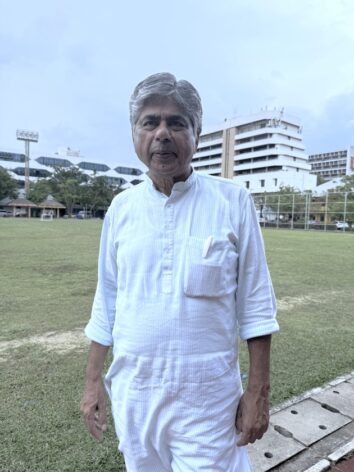
Rajagopal P.V. at the International Civil Society Week (ICSW2025) in Bangkok. Credit: Zofeen Ebrahim/IPS
BANGKOK, Nov 4 2025 (IPS) – “If nations can have defense ministries, why not peace ministries?” asks Rajagopal PV, the soft-spoken yet formidable founder of Ekta Parishad. “We are told to see issues through a gender lens—why not a peace lens? Why can’t we imagine a business model rooted in non-violence or an education system that teaches peace?”
Founded in 1989, Ekta Parishad—literally Forum for Unity—is a vast people’s movement of more than 250,000 landless poor, now recognized as one of India’s largest and most disciplined grassroots forces for justice.
To Rajagopal, these aren’t utopian dreams—they’re blueprints for a possible world.
Over the decades, Ekta Parishad has secured land rights for nearly half a million families, trained over 10,000 grassroots leaders, protected forests and water bodies, and helped shape key land reform laws and policies in India.
All this has been achieved not through anger, but through disciplined, nonviolent marches that stretch across hundreds of kilometers. Along the way, many leaders have walked beside him—among them, the current Prime Minister of Armenia.
In an age marked by deep disorder—where wealth concentrates in few hands, poverty spreads, and the planet itself trembles under human greed—the 77-year-old Gandhian remains unshaken in his belief that peace alone can redeem humanity.
“We must rescue peace from the clutches of poverty and all its evils,” he told IPS on the sidelines of the International Civil Society Week, standing on the football ground of Bangkok’s Thammasat University.
“And it can be done,” he insists—and his life is proof. In 1969, the centenary year of Mahatma Gandhi’s birth, the Government of India launched a unique exhibition on wheels, a ten-coach train carrying Gandhi’s life and message across the nation. Rajagopal was part of the team that curated and travelled with it.
“For an entire year, we journeyed from state to state. Thousands of schoolchildren would gather at railway platforms, their faces lit with curiosity, waiting to meet Gandhi through our displays,” he recalls.
Yet somewhere along those long railway tracks, Rajagopal began to feel that displaying Gandhi’s ideals wasn’t enough. “The exhibition was beautiful,” he says, “but what was the use of preaching non-violence if we couldn’t live it, breathe it, and bring it to life?”
That realization led him to one of the most daring experiments in peacebuilding India had ever seen—negotiating with the feared bandits of the Chambal valley. “It was 1970,” he recalls. “We moved cautiously, first meeting villagers on the periphery to build trust. Once we had their confidence, we sent word to the dacoits: we wanted to talk. With the government’s consent, we ventured into what we called a ‘peace zone’—often by night, walking for hours through deep ravines—to meet men the world only knew as outlaws.”
The dialogues continued for four years. Eventually, as many as 570 bandits laid down their arms before a photograph of Mahatma Gandhi—a sight India had never seen before. The government, in turn, promised they would not face the death penalty and would receive land and livestock to rebuild their lives. Rehabilitation took another four painstaking years, but it was a victory of conscience over fear.
“They didn’t just surrender their weapons—they surrendered their anger,” Rajagopal says quietly. “There was real repentance, and that takes time—but it lasts.” His commitment came at a cost. At his ashram—a spiritual retreat he had founded—he was threatened, beaten, and ordered to abandon his peace efforts. He talked them through to accepting his presence.
“Today that same region is heaven,” he smiles, his eyes crinkling with memory. “Fifty years ago, people trembled at sunset—terrified of the bandits. Today, you can travel at 2:00 pm in the night, where fear ruled once.”
The mass surrender may have looked like a triumph for the state, but Rajagopal urges people to look deeper. “It’s the invisible violence—poverty, injustice, and oppression—that breeds the visible one: dacoities, kidnappings, and killings,” he explains.
Though Rajagopal and his companions had ended one form of violence, the deeper, quieter kind—born of poverty and neglect—still festered. Until that was confronted, he knew, peace would remain incomplete.
Years of working alongside the poor had taught him one truth: non-violence needs structure. If India’s Indigenous and landless communities were to be heard, they had to be organized.
“We began training young people from dozens of villages,” he says. “They went door to door, teaching others not only about their rights—especially the right to land—but also how to claim them peacefully.”
With that foundation, a five-year plan took shape. Each village home chose one member to take part. Every day, the family set aside one rupee and a fistful of rice—a humble but powerful act of commitment.
They even created a “playbook” of possible scenarios—how to stay calm under provocation, how to respond to setbacks, and how to practice non-violence in thought and action. “In one of our marches, a truck ran over three of our people, killing them,” he recalls softly. “There was grief, but no retaliation. Instead, they sat in silence and meditated. That was our true test.”
In 2006, 500 marchers walked 350 kilometers from Gwalior to Delhi, demanding land rights. Nothing changed. But they didn’t stop.
A year later, in 2007, 25,000 people—many barefoot—set out again on the national highway. “Imagine that sight,” Rajagopal says, eyes gleaming. “Twenty-five thousand people walking for a month, powered only by hope.”
The march displayed not just India’s poverty but also its power—the quiet power of the poor united. It was among the most disciplined mobilizations the country had ever seen. “There was one leader for every hundred people,” Rajagopal explains. “We walked by day and slept on the highway by night. Those in charge of cooking went ahead each morning so that by sundown, a single meal was ready for all.”
In a later march, Rajagopal recalls, the government sent a large police force. “I was worried,” he admits. “I called the authorities to tell them this was a non-violent protest—we didn’t need protection. The officer replied, ‘They’re not there for you; they’re here to learn how disciplined movements should be.’”
Along the route, villages greeted them like family—offering bags of rice, water, and prayers. “There was never a shortage of food,” Rajagopal smiles. “When your cause is just, the world feeds you.”
By the time the march reached Delhi, the government announced a new land reform policy and housing rights and agreed to enact the Forest Rights Act.
The government dispersed the marchers with hollow promises and the reforms never happened.
So Ekta Parishad planned an even larger march—a Jan Satyagraha of 100,000 people in 2012.
“Halfway through, the government came running.”
Rajagopal’s face lights up as he recalls the event. “They agreed to our ten-point agenda and signed it in front of the people. That moment was historic—governments almost never do that; the Indian government certainly never does it!”
The agreement included land and housing rights, a national task force on land reform, the prime minister’s oversight of policy implementation, and fast-track courts to resolve land disputes.
Today, because of these long, barefoot marches, more than three million Indigenous people in India now have legal rights to land and housing. The struggle also gave birth to India’s Land Acquisition, Rehabilitation, and Resettlement Act—a landmark in people’s movements.
“The Act also safeguards fertile land,” Rajagopal explains. “Before the government can acquire any area, a social impact study must be done. And if farmland is taken, the owners receive four times its value in compensation.”
“The purpose of our marches,” Rajagopal says, “is not to fight the government, but to win it over. The government is not the enemy; injustice is. We must stand on the same side of the problem.”
For Rajagopal, peace is not a sentiment but a system—something that must be built, brick by brick, through dialogue and respect. “Non-violence,” he says, “isn’t passive. It’s active patience—listening, accepting differences, never policing thought.” The same principle, he believes, can heal families, neighborhoods, nations—and the world itself.
His next mission is to create a Youth Peace Force, ready to enter conflict zones and resolve disputes through dialogue. He has also launched the Peace Builders Forum, or Peace7, uniting seven countries—South Africa, Japan, Costa Rica, Switzerland, Canada, India, and Armenia. His dream is to expand it to Peace20, where, as he smiles, “wealth will never be a criterion for membership.”
Voters in New York, Virginia and New Jersey choose new leaders today, and a redistricting vote in California could reshape the balance of power in Congress. The Trump administration says it will restart SNAP benefits, but only partially, leaving millions of families uncertain about how they’ll eat this month. And aid groups warn of a deepening crisis in Sudan after a paramilitary force accused of genocide seized the last major city in Darfur, killing thousands of people and trapping many more without food or water.
Want more comprehensive analysis of the most important news of the day, plus a little fun? Subscribe to the Up First newsletter.
<
p class=”readrate”>Today’s episode of Up First was edited by Ben Swasey, Catherine Laidlaw, Kate Bartlett, Mohamad ElBardicy and Alice Woelfle.
<
p class=”readrate”>
<
p class=”readrate”>It was produced by Ziad Buchh, Nia Dumas and Christopher Thomas
<
p class=”readrate”>
<
p class=”readrate”>We get engineering support from Stacey Abbott. And our technical director is Carleigh Strange.
Luthando Holdings Limited owner Hendrix Laher in ACB radar for aiding foreigners to obtain Malawi Citizenship fraudulently
LILONGWE-(MaraviPost)-The High Court Judge Kenyatta Nyirenda has emphatically dismissed Luthando Holdings Limited, Hedrix Laner’s application against Director of Public Prosecution (DPP)’s March 2024 decision to discharge criminals’ changes on Paramount Holdings Limited and its directors.
Luthando Holdings owner Hedrix Laner sought high court review against DPP decision to discharge Paramount Holdings and Directors on case number 37 of 2025.
The Malawi Law Society (MLS) joined the case as Amicus Curia Corum while Luthando Limited and Laner and DPP are claimants and defendant respectively.
Despite a number of applications in the courts pursued privately, Judge Nyirenda is still amused with Luthando’s defiance on the matter.
Judge Nyirenda initial observation in the ruling, “Based on the wording of the Certificate of Discontinuance and the Order of Discontinuance, the challenged decision was effectively made on 3rd April 2024. There is nothing ongoing about the challenged decision. According to Order 19, rule 23(3), of the CPR, the Claimants had up to 4th July 2024 to commence judicial review proceedings challenging the Defendant’s decision to discontinue the case against the accused persons”.
In the 18 page ruling, Judge Nyirenda observes that, “I am completely baffled by the desperate attempt being made by the Claimants to muddy the waters by asserting that the court process in the Magistrate’s Court for discharge of the accused persons was on going.
“What the Claimants seek to be judicially reviewed is not the court process but the decision by the Defendant to discharge the Claimants: see paragraph 3 of this Ruling. By its very nature, a decision to discharge the Claimants cannot be ongoing. The material part of the Certificate of Discontnuance states as follows: “IT IS HEREBY CERTIFIED in exercise of the powers conferred by section 77 of the Criminal Procedure and Evidence Code that the State enters discontinuance of the aforementioned charges against the named accused persons”.
Reads the ruling in part. “It is not uninteresting to note that the Claimants have not addressed the point made by the Defendant that the law does not allow the Republic to recommence a matter outside the stipulated time limits. That the Claimants have not done so does not come to me with a sense of surprise. The arguments advanced by the Defendant are so formidable that they cannot be assailed. The Court has no option but to fully endorse the submissions set out in paragraphs 3.21 to 3.28 of the Defendant’s .
“It is commonplace that the application for judicial review was filed with this Court on 17th June 2025. This means that the Claimants delayed by more than eleven months. Needless to say, the Claimants made no application that they be allowed to bring these proceedings outside the period of three months prescribed by Order 19, rule 20(5), of the CPR. In the same vein, and perhaps more importantly, no reasons have been given for the inordinate delay in commencing the present proceedings. In view of the foregoing, I fully agree with the submissions by the Defendant that the application by the Claimants for judicial review of the challenged decision is time barred and this constitutes a valid ground for discharging the permission that was granted herein”.
Nyirenda adds, “Whether or not the remedies being sought by the Claimants are moot? It is the case of the Defendant that the remedies being sought by the Claimants are moot and thus the proceedings are an exercise in futility. Paragraphs 3.21 to 3.28 of the Defendant’s Skeleton Arguments are relevant and they will be reproduced. It is also to be noted that the submissions of both the Claimants and the Amicus Curiae proceed on the assumption that the Supreme Court of Appeal only has appellant jurisdiction and not original jurisdiction. With due respect, the assumption lacks merit.
“The Supreme Court of Appeal is a creature of section 104 of the Constitution which provides, in subsection (1), among other things, that the Supreme Court of Appeal shall have such jurisdiction and powers as may be conferred on it by the Constitution or by “any other law”. Order 1, rule 18, of the Supreme Court of Appeal Rules falls within the category of “any other law” envisaged by section 104 of the Constitution: see also Order II of the Supreme Court of Appeal Rules which makes provision for the procedure to be followed by the Supreme Court of Appeal when exercising its original jurisdiction”.
Judge Kenyatta rules with costs, “The long and short of it is that the accused persons were acquitted and cannot be tried again over the same case or facts. The law is the law: see the case of The State (On application of Lin Xiaoxiao & Others) v. The Director General –Immigration and Citizenship Services and the Attorney General, HC/LDR Judicial Review Cause No. 19 of 2020. In this regard, the remedies being sought by the Claimants are moot and the proceedings are clearly an exercise in futility.
“All in all, the application has failed the litmus test on two grounds, that is, the application is time-barred and the proceedings are an exercise in futility. Accordingly, the Application to Discharge Permission is granted. The general rule is that costs follow the event. An instructive authority is Order 31, rule 3(2), of the CPR. Having succeeded in his application, the Defendant must be awarded costs of this action. I so order Pronounced in Chambers this 17th day of October 2025 at Lilongwe in the Republic of Malawi”.
Meanwhile, embattled Luthando Holdings Limited Director Laner has appealed against the ruling in the Supreme Court against the ruling.
In a landmark ruling delivered on Friday, June 27, 2025, the court cleared Paramount Holdings directors—Prakash Virji Ghedia, Arvindkumar Atit Patel, and Suresh Khimji Jagatiya—alongside the company, of three criminal charges, including conspiracy to commit a felony and the alleged use of false documents to obtain a government tender.
Significantly, the court issued an order prohibiting the Director of Public Prosecutions (DPP) from pursuing any further charges related to the matter against the individuals or the company.
“The accused persons are hereby acquitted from criminal charges,” reads the court’s ruling in Criminal Case No. 868 of 2023. “The court hereby bars the state from bringing any charges against the accused persons on the same grounds.”
The charges, initially filed in July 2021, were based on a complaint by Hendrix Laher, director of Luthando Holdings Limited—a business competitor. Laher alleged that Paramount Holdings had submitted a forged Yamaha dealership certificate to win a motorcycle supply tender issued by JHPIEGO, an international health NGO.
Court documents reveal that both Paramount and Luthando Holdings had submitted bids to supply Yamaha motorcycles to several entities, including the Ministry of Education, Ministry of Health, Ministry of Local Government, Kamuzu University of Health Sciences, and JHPIEGO.
The tender was awarded to Paramount Holdings on July 7, 2020. Laher subsequently lodged a complaint with the Fiscal and Fraud Section of the Malawi Police Service.
However, the case unraveled when the complainant failed to appear in court on at least three occasions.
This lack of cooperation, coupled with an absence of credible evidence, led the Office of the DPP—first under Dr. Steven Kayuni, then under Masauko Edwin Chamkakala—to discontinue the matter.
A formal certificate of discontinuance was issued on March 19, 2024, under Section 77 of the Criminal Procedure and Evidence Code.
After the statutory six-month period passed, the court officially acquitted the accused and barred the state from reopening the case.
The ruling provides Paramount Holdings and its directors with full legal vindication, enabling them to continue participating in public and donor-funded tenders without restriction or blemish on their record.
In 2022, Yamaha Motor Corporation Japan formally appointed Paramount Holdings as the sole authorized distributor of Yamaha motorcycles and related products in Malawi.
The company has reportedly advertised Yamaha-branded products across Malawi—despite lacking any formal authorization from Yamaha Japan.
However, legal experts have criticized these actions as misleading and potentially fraudulent.
In a related civil case, Luthando Holdings and other companies are challenging Yamaha Japan’s exclusive dealership agreement with Paramount Holdings.
These firms are alleged to have bid for government tenders using documentation from Yamaha agents based in South Africa—raising questions about the legitimacy of such practices under Malawi’s procurement laws.
Share this:
Like this:
LikeLoading…
Discover more from The Maravi Post
Subscribe to get the latest posts sent to your email.
BLANTYRE-(MaraviPost)-A preliminary report by the Southern African Development Community (SADC) Electoral Observation Mission has concluded that Tanzania’s recent general election failed to meet democratic standards.
Led by former Malawian Speaker Richard Msowoya, the mission cited numerous irregularities, intimidation, and an uneven playing field that compromised the electoral process.
The report highlights several concerns, including the disqualification of opposition leaders, abductions, and restrictions on electoral justice and transparency.
The mission also criticized President Samia Suluhu’s role in appointing election commissioners, questioning their independence.
Additionally, the report notes the government’s decision to shut down the internet and impose media censorship, as well as the harassment of observers, further undermined the credibility of the election.
Despite these findings, President Samia Suluhu Hassan has been sworn in for another term, with nearly 98% of the vote.
The opposition has rejected the results, citing fabrication and manipulation.
The SADC report’s conclusions are likely to add fuel to the controversy surrounding the election, raising questions about the legitimacy of President Hassan’s mandate.
The international community has expressed concern over the election, with the African Union urging the government to uphold fundamental rights and freedoms.
The United Nations has also called for an investigation into reports of violence and excessive use of force.
Share this:
Like this:
LikeLoading…
Discover more from The Maravi Post
Subscribe to get the latest posts sent to your email.