As Nick Reiner prepares to make his first court appearance … TMZ has learned Rob and Michele had been dead for some time before their daughter made the grisly discovery Sunday. Law enforcement sources tell TMZ … When police arrived on the scene…
Share this:
Like this:
LikeLoading…
Discover more from The Maravi Post
Subscribe to get the latest posts sent to your email.
The hunt is officially on … FBI agents are hot on the trail of the Brown University shooting suspect … digging into one key lead — the snow itself — as they race for answers. Check out these news clips … FBI Director Kash Patel’s team was…
Share this:
Like this:
LikeLoading…
Discover more from The Maravi Post
Subscribe to get the latest posts sent to your email.
International Day of Persons with Disabilities in 2025
To celebrate the International Day of Persons with Disabilities in 2025, the leaders of organisations of persons with disabilities and developmental organisations across Zambia, Zimbabwe, and Malawi exhibited unity of purpose speaking with one voice to affirm that now is the time to act on the African Disability Protocol (ADP).
The ADP entered into being on 7 June 2024, establishing a legally binding framework to protect and enhance the rights of over 80 million persons with disabilities across the continent.
This milestone redirected responsibility from the continental level to individual national governments. The Protocol is now legally binding, and it is up to member states to ratify, adopt, and put it into action.
In a joint statement the leaders said across the three nations, they recognise that national policies and frameworks have made progress towards promoting disability inclusion.
However, they said millions of persons with disabilities still face barriers that prevent them from fully exercising their rights.
They called for the aligning of country efforts with the ADP is necessary for a full and enforceable approach to inclusion.
For example, the Protocol requires access to quality education at all levels, with reasonable accommodations and assistive technologies.
Yet today, countless children with disabilities in our countries remain out of school, not due to inability but because systems are designed without them in mind.
Read full statement below:
To mark the International Day of Persons with Disabilities in 2025, we – leaders of organisations of persons with disabilities and development organisations across Zambia, Zimbabwe, and Malawi – spoke with one voice to affirm that now is the time to act on the African Disability Protocol (ADP).
The ADP entered into force on 7 June 2024, establishing a legally binding framework to protect and promote the rights of over 80 million persons with disabilities across our continent.
This milestone shifted responsibility from the continental level to individual national governments. The Protocol is now legally binding, and it is up to member states to ratify, adopt, and put it into action.
Across our three nations, we recognise that national policies and frameworks have made progress towards promoting disability inclusion. However, millions of persons with disabilities still face barriers that prevent them from fully exercising their rights.
Aligning country efforts with the ADP is necessary for a full and enforceable approach to inclusion. For example, the Protocol requires access to quality education at all levels, with reasonable accommodations and assistive technologies.
Yet today, countless children with disabilities in our countries remain out of school, not due to inability but because systems are designed without them in mind.
The ADP calls to eliminate discrimination in employment and promote entrepreneurship for persons with disabilities. As it stands, unemployment rates among persons with disabilities remain high in parts of our region, perpetuating cycles of poverty and dependency that the Protocol could break. The Protocol guarantees the right to vote, contest for office, and participate in public affairs on an equal basis. Too many persons with disabilities in our countries remain excluded: their voices absent from decisions that affect their lives. These are not aspirations. They represent the difference between exclusion and inclusion, between poverty and productivity, between invisibility and citizenship.
Where things stand
In Zambia, years of advocacy have built momentum. The launch of the National Policy on Persons with Disabilities and Mainstreaming Guidelines in 2025 shows the government’s commitment to inclusion. However, without ratifying the ADP and submitting the required documents to the African Union, these efforts remain disconnected from the continent’s legal framework. We call on the Government of Zambia to complete ratification of the ADP without further delay.
Malawi has ratified the ADP, but the critical next step is to make it enforceable into law. The estimated 1.7 million people aged five and above who have a disability in Malawi deserve to fully enjoy the rights enshrined in the Protocol. We urge the Government of Malawi to prioritise this process and allocate resources for implementation.
In Zimbabwe, we stand at a historic moment. With a new Disability Act enacted in the month of November 2025. We call on the government to establish strong implementation mechanisms that ensure the law translates into real change.
These are not only administrative steps; they are life-changing decisions for millions of persons with disabilities. Every day of delay means more barriers to education, jobs, healthcare, and participation in public life that could have been removed.
We also call upon the Southern African Development Community (SADC), Common Market for Eastern and Southern Africa (COMESA), Pan-African Parliament (PAP), and the African Union to exercise leadership in this critical moment. These regional bodies must:
• Actively support member states through the ratification, domestication, and implementation process
• Develop and fund disability inclusion programmes aligned with their own treaties and charters
• Lead by example by embedding disability inclusion within their own Secretariats, demonstrating commitment through accessible policies, meaningful representation of persons with disabilities in decision-making, and barrier-free operations
The human cost of delay
Behind every statistic is a person. A child denied education. A graduate unable to find work despite being qualified. A voter turned away from a polling station. A pregnant woman unable to access maternal care because the facilities are inaccessible. The ADP provides a clear roadmap to challenging these barriers. Political will must now match political rhetoric.
We represent millions of persons with disabilities whose potential remains untapped, whose voices remain largely unheard, and whose rights remain mostly unrealised. But we also represent resilience, expertise, and a vision of an inclusive Africa where no one is left behind.
Our task: To the governments of Zambia, Malawi, and Zimbabwe, to all partners, and stakeholders: ratifying and implementing the African Disability Protocol is not about doing people with disabilities a favour. It’s an investment in inclusive development that benefits everyone. It upholds constitutional promises of equality. It’s the right and smart thing to do.
Nothing About Us Without Us.
Signed by:
The RAD-P consortium
– Sightsavers – Africa Disability Alliance (ADA) – National Association of Societies for the Care of the Handicapped (NASCOH) – Federation of Organizations of Disabled People in Zimbabwe (FODPZ) – Zambia Federation of Disability Organisations (ZAFOD) – Albinism Foundation of Zambia (AFZ) – Federation of Disability Organizations in Malawi (FEDOMA) – Disability HIV & AIDS Trust (DHAT)
and
U4ADP consortium
– Leonard Cheshire Disability Zimbabwe (LCDZ) – Development Aid from People-to-People ( DAPP) Zimbabwe – Development Aid from People-to-People (DAPP) Zambia – Chesire Homes Society of Zambia – Development Aid from People-to-People (DAPP) Malawi – Human Rights of Women and Girls with Disabilities in Malawi (WAG-Disability Rights)
Share this:
Like this:
LikeLoading…
Discover more from The Maravi Post
Subscribe to get the latest posts sent to your email.
Sydney Sweeney looked like a modern Marilyn Monroe at the Los Angeles premiere of “The Housemaid” Monday night, wearing a white halter neck dress that showcased her bodacious chest and flowed into a feathered hemline. Just look at the red carpet…
Share this:
Like this:
LikeLoading…
Discover more from The Maravi Post
Subscribe to get the latest posts sent to your email.
A new global synthesis report and refugee voices from East Africa and the Middle East warn that reductions in humanitarian footprints risks breaking the refugee protection system.
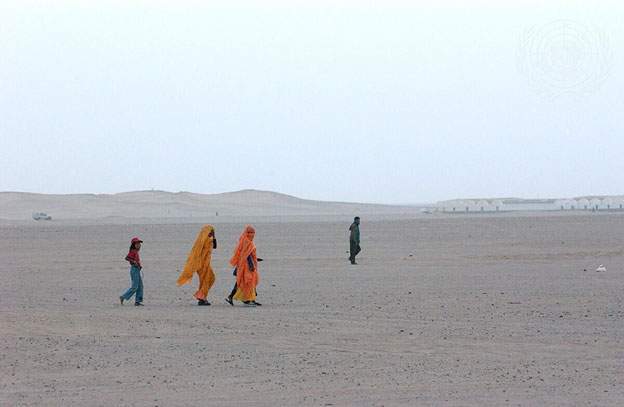
Sahrawi refugees walk near the Awserd Refugee Camp in the Tindouf Province of Algeria. Credit: UN Photo/Evan Schneider
SRINAGAR, India, Dec 16 2025 (IPS) – The global refugee system is entering a period of deep strain. The delivery of protection and assistance is undergoing a transformation due to funding cuts, institutional reforms, and shifting donor priorities.
Against this backdrop, a new Global Synthesis Report titled From the Ground Up highlights the many issues faced by refugees in the Middle East and Africa.
Regional Perspectives on Advancing the Global Compact on Refugees has highlighted a rare, refugee-centered assessment of what is working, what is failing, and what must change. The report draws on regional roundtables held in East Africa and the Middle East and North Africa, followed by a global consultation in Geneva, to feed into the 2025 Global Refugee Forum progress review
According to the report, refugee-led and community-based organizations are increasingly taking on responsibilities, but they are not receiving power, funding, or legal recognition. As international agencies scale back under what is being called the Humanitarian Reset and UN80 reforms, refugees are expected to fill widening gaps without the authority or resources required to do so safely and sustainably.
The East Africa roundtables, held in Kampala with participation from refugee organizations in Uganda, Kenya, and Ethiopia, highlight a region often praised for progressive refugee policies. Countries here host millions displaced by conflict, hunger, and climate stress from South Sudan, Sudan, Somalia, and the Democratic Republic of the Congo.
Laws and regional frameworks promise freedom of movement, inclusion in national systems, and meaningful participation. The lived reality, however, remains uneven.
Education emerged as a central concern. Refugee children are enrolling in schools at higher rates, especially where they have been integrated into government-aided systems. Yet access remains unequal. Refugee students struggle to have prior qualifications recognized.
Many are treated as international students at universities and charged higher fees. Refugee teachers, often qualified and experienced, receive lower pay than nationals or are excluded from formal recognition. Language barriers and lack of psychosocial support further undermine learning outcomes. Refugee-led groups are already stepping in with mentorship, counseling, and bursary support, but they do so with fragile funding and limited reach.
Documentation and freedom of movement form another critical fault line. Uganda is widely cited for its rapid issuance of refugee IDs and settlement-based approach. Kenya and Ethiopia have made progress through new refugee laws and policy reforms. Still, gaps between policy and practice persist. Refugees in urban areas remain undocumented in large numbers. Identity documents often have short validity, forcing repeated renewals.
Travel documents are difficult to obtain, especially in Ethiopia, limiting cross-border movement, livelihoods, and participation in regional or global policy forums. Without documentation, refugees face arrest, harassment, and exclusion from services. For refugee organizations, lack of legal registration means operating in constant uncertainty.
Access to justice, described in the report as one of the least discussed yet most pivotal issues, cuts across all others. Refugees cannot claim rights or seek redress without functioning justice pathways. Language barriers in courts, xenophobic profiling, and lack of legal aid remain common.
Refugee-led organizations already provide mediation, paralegal support, and court accompaniment, often acting as the first point of contact between communities and authorities. Yet their work is rarely formalized or funded at scale.
These findings came alive during a webinar held at the launch of the report, where refugee leaders from different regions spoke directly about their experiences. One participant from East Africa reflected on repeated engagement in international forums. This event was his third such process, following meetings in Uganda and Gambia. He noted that participation was no longer symbolic. Governments and institutions were beginning to listen more closely.
He pointed to concrete differences across countries. In Kenya, refugees do not require exit visas. In Ethiopia, they do. Sharing such comparisons, he argued, helps governments rethink restrictive practices and adapt lessons from neighbors.
From the Middle East and North Africa, the discussion shifted to documentation and access to justice. A Jordan-based lawyer explained that civil documentation is not mere paperwork. It is the foundation of rights and accountability. Without birth registration, children cannot access education.
Without legally recognized marriages, women and children remain unprotected. Many Syrian refugees arrived in Jordan without documents, having lost them during flight or lacking legal awareness. Over time, Jordan introduced measures such as fee waivers, legal aid, and even Sharia courts inside camps like Zaatari to facilitate birth and marriage registration. Civil society groups have provided thousands of consultations and legal representations, bridging gaps between refugees and state systems.
The webinar also highlighted language as a structural barrier. In Jordan, Arabic serves as a common language for Syrians, easing communication. In East Africa, linguistic diversity complicates access to justice and services. Uganda hosts South Sudanese, Sudanese, and Congolese refugees, each with distinct languages, while official processes operate in English and Kiswahili. Governments have made efforts to provide interpretation, but gaps remain, particularly in courts and police interactions.
In Ethiopia, where Amharic dominates official institutions, refugee organizations often rely on founders or leaders who speak the language fluently, limiting broader participation.
As the conversation turned to the future of the humanitarian system, the tone grew more urgent. Participants acknowledged that funding cuts have already halted programs and exposed vulnerabilities. One speaker stressed that legal aid and documentation cannot be seen as optional sectors.
Without sustained support, entire protection systems risk collapse. Empowerment, he argued, goes beyond providing lawyers. It means building refugees’ confidence and capacity to navigate legal systems themselves.
Another participant addressed donors and UN agencies directly. Localization, he said, will fail if refugee organizations are treated only as implementers of predesigned projects. Power must shift alongside responsibility.
Refugee organizations should help design programs, raise resources, and make decisions based on community priorities. Otherwise, localization becomes another layer of outsourcing rather than a genuine transfer of agency.
The speaker’s final intervention starkly highlighted the stakes involved. With funding shrinking and uncertainty growing, refugees may soon have no option but to rely on themselves. Investing in refugee-led organizations, the speaker said, is not a luxury. This represents the final line of hope for refugees on the ground.
The MENA roundtables echo many of these concerns but in a more restrictive political context. Civic space is tighter. Legal recognition for refugee organizations is often impossible or risky. In Jordan, refugees cannot legally register organizations. In Egypt, civil society laws limit advocacy.
In Türkiye, registration is technically possible but bureaucratically daunting. Despite this, refugee-led initiatives have multiplied, filling gaps in education, protection, and livelihoods as international actors retreat.
The report warns of a dangerous paradox. Localization is advancing by necessity, not design. International agencies withdraw. Local actors step in. Yet funding, decision-making, and protection remain centralized. Refugee organizations absorb risk without safeguards. Participation is often tokenistic. Refugees are present in meetings but absent from real influence.
LILONGWE-(MaraviPost)-Minister of Industrialisation, Business, Trade and Tourism, Dr. George Partridge, has urged Illovo Sugar Malawi to ensure that sugar is available to the public throughout the Christmas season and up to the next production cycle.
The Minister made these remarks during a high-level meeting this morning with Illovo Sugar Malawi’s management team and the Competition and Fair Trading Commission (CFTC) at the Ministry headquarters in Lilongwe.
Dr. Partridge emphasized that Malawians expect to find sugar on the shelves as they prepare for Christmas.
He reassured Illovo Sugar management of his full support as the government works to resolve the ongoing supply issues.
In response, Illovo Sugar Malawi’s Managing Director, Ronald Ngwira, assured the Minister that the company has sufficient reserves to sustain the country through the lean period.
Ngwira explained that production is temporarily halted due to wet fields that make cane cutting impossible, but with over 70,000 metric tonnes in storage, he is confident that the stock will last until production resumes in April.
Malawi consumes around 15,000 metric tonnes of sugar per month, and Ngwira believes that the current reserve should be enough to meet the country’s needs if domestic demand remains stable.
However, Ngwira highlighted some challenges impacting sugar availability on the market, including hoarding and smuggling by certain traders.
In response, Minister Partridge assured the meeting that his Ministry would collaborate with relevant authorities such as the Ministry of Local Government, the Ministry of Homeland Security, and the Malawi Revenue Authority (MRA) to investigate and take action against those involved in these illegal activities.
This joint effort aims to ensure that the sugar supply remains stable and that any malpractices are addressed swiftly.
Share this:
Like this:
LikeLoading…
Discover more from The Maravi Post
Subscribe to get the latest posts sent to your email.