Africa, Biodiversity, Conferences, Conservation, Development & Aid, Economy & Trade, Editors’ Choice, Environment, Europe, Featured, Global, Headlines, Natural Resources, Sustainable Development Goals, TerraViva United Nations, Trade & Investment
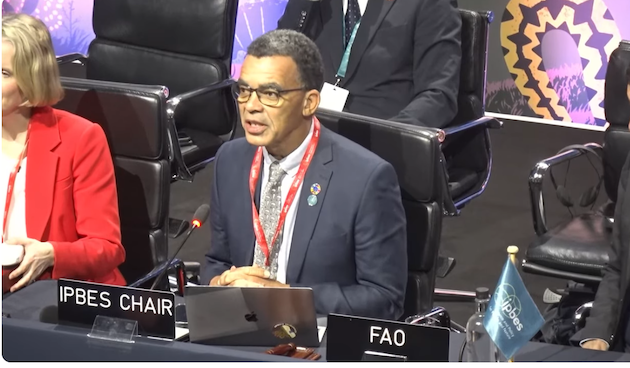
David Oburo, IPBES Chair. Credit: Busani Bafana/IPS
– British Monarch King Charles says science is the solution to protecting nature and halting global biodiversity loss, which is threatening humanity’s survival.
In a message to the 12th session of the Plenary of the Intergovernmental Science-Policy Platform on Biodiversity and Ecosystem Services (IPBES), which opened in Manchester, United Kingdom, this week, King Charles said nature is an important part of humanity but is under serious threat, which science can help tackle.
“We are witnessing an unprecedented, triple crisis of biodiversity loss, climate change, and pollution at a pace that far outstrips the planet’s ability to cope,” said King Charles in a message delivered by Emma Reynolds, United Kingdom Secretary of State for Environment, Food and Rural Affairs.
Science is the Solution
“The best available science can help inform decisions and actions to steward nature and, most importantly, to restore it for future generations, “ King Charles noted, pointing out that humanity has the knowledge to reverse the existential crisis and transition towards an economy that prospers in harmony with nature.
Delegates representing the more than 150 IPBES member governments, observers, Indigenous Peoples, local communities and scientists are meeting for the IPBES’ 12th Session, expected to approve a landmark new IPBES Business & Biodiversity Assessment. The report, a 3-year scientific assessment involving 80 expert authors from every region of the world, will become the accepted state of science on the impacts and dependencies of business on biodiversity and nature’s contributions to people. It will provide decision-makers with evidence and options for action to measure and better manage business relationships with nature.
The King lauded IPBES for bringing together the world’s leading scientists, indigenous and local knowledge, citizen science and government to share valuable knowledge through the Business and Biodiversity Report—the first of its kind.
“I pray with all my heart that it will help shape concrete action for years to come, including leveraging public and private finance to close by 2030 the annual global biodiversity gap of approximately USD 700 billion,” said King Charles.
IPBES Chair, Dr. David Obura, highlighted that the approval of the IPBES Business and Biodiversity Assessment is important just days after the World Economic Forum’s 2026 Global Risks Report again spotlighted biodiversity loss as the second most urgent long-term risk to business around the world.
“In transitioning and transforming, businesses should all experience the rewards of being sustainable and vibrant, benefiting small and large,” Obura emphasized. “The Business Biodiversity assessment synthesizes the many tools and pathways available to do this and provides critical support for businesses across all countries to work with nature and people and not to work against either or both.”
Addressing the same delegates, Emma Reynolds, UK Secretary of State for Environment, Food and Rural Affairs, highlighted the urgency of collective action, the critical role of science, and the opportunities for business in nature.
Reynolds noted there was momentum around the world as countries were restoring wetlands and forests, communities were reviving degraded landscapes and businesses were increasingly investing in nature after realizing that nature delivers real returns.
“The tide for nature is beginning to turn, but we cannot afford to slow down,” said Reynolds. “The window to halt diversity loss by 2030 is narrowing. We need to build on that momentum, and we need to do it now.”
Multilateralism, a must for protecting nature
Paying tribute to IPBES for supporting scientific research, Reynolds emphasized that the rest of the world must step forward when others are stepping back from international cooperation. This is to demonstrate that protecting and restoring nature was not just an environmental necessity but essential for global security and the economy.
“The UK’s commitment to multilateralism remains steadfast,” she said. “We believe that by working together, sharing knowledge, aligning policies, and holding one another accountable, we can halt and reverse the diversity loss by 2030,.“
In January 2026, the United States withdrew its participation in IPBES, alongside 65 international organizations and bodies, including the International Union for Conservation of Nature (IUCN), the UN Framework Convention on Climate Change (UNFCCC) and the Paris Agreement.
The United States was a founding member of IPBES, and since its establishment in 2012, scientists, policymakers, and stakeholders—including Indigenous Peoples and local communities—from the United States have been among the most engaged contributors to its work.
The approval of the Business and Biodiversity Assessment by IPBES government members this week will be multilateralism in action, she said, noting that the assessment would not be possible without the critical role of science.
Reynolds underscored the need to base sound policy on solid scientific evidence. Decisions made in negotiating rooms and capitals around the world must be guided by the best and most up-to-date science available. IPBES exists to provide exactly that.
Noting that the business depends on nature for raw materials, clean water, a stable climate, and food, Reynolds said companies that recognize their dependency on nature are proving that nature-positive investment works.
“Business as well as the government must act now to protect and restore nature… we have the science. We have the frameworks… What we need now is action.”
“Nature loss is now a systemic economic risk. That’s precisely why the assessment on business impact and dependencies is both urgent and necessary,” said Inger Andersen, executive director of the United Nations Environment Programme (UNEP).
“The first-ever business and diversity assessment will deliver authoritative evidence on how businesses depend on nature, how they impact it, and what that means for risk, for resilience, and for long-term value creation.”
Business and Biodiversity are linked
Underscoring that biodiversity loss is linked to the wider planetary crisis, Astrid Schomaker, executive secretary of the Convention on Biological Diversity, paid tribute to IPBES as a provider of science as a public good.
“IPBES has remained a ‘beacon of knowledge at a time when science and knowledge itself is under strain and when the voices of disinformation are sometimes louder than the facts,” said Schomaker, noting that ahead of the first global stocktake of progress in the implementation of the Kunming-Montreal Global Biodiversity Framework (KMGBF), the science provided by IPBES would be invaluable.
“The Business and Biodiversity assessment constitutes a win for everyone. Clarifying that biodiversity loss isn’t just an environmental issue; it’s a serious threat to economic systems, livelihoods, business profitability, and societal resilience. Biodiversity simply underpins and provides the stability we all need.”
Target 15 of the KMGBF, focuses on business reducing negative impacts on biodiversity and global businesses need to assess and disclose biodiversity-related impacts.
IPBES executive secretary, Dr. Luthando Dziba, said IPBES was on track to deliver, in the coming years, crucial knowledge and inspiration to support the implementation of current goals and targets of the KMGBF, and to provide the scientific foundation needed by the many processes now shaping the global agenda beyond 2030.
IPS UN Bureau Report