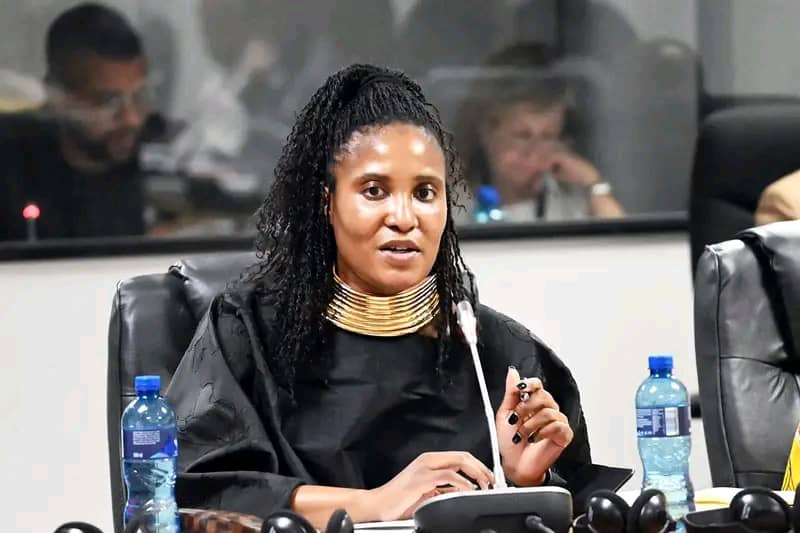
PRETORIA-(MaraviPost)-South African police have launched an investigation into serious allegations against Duduzile Zuma-Sambudla, the daughter of former President Jacob Zuma.
She is accused of allegedly deceiving 17 men into joining Russia’s war in Ukraine.
Reports indicate that the men were recruited under the pretense of serving as bodyguards for her father’s uMkhonto weSizwe (MK) party.
Her stepsister, Nkosazana Bongamini Zuma-Mncube, has claimed that the men were sent to Russia and subsequently deployed to the front lines of the conflict.
Duduzile Zuma-Sambudla has not publicly responded to the accusations at this time.
The 2021 riots in South Africa remain a separate legal matter for which she is already facing trial, reportedly for incitement of violence.
Earlier this month, the office of President Cyril Ramaphosa confirmed that it had received urgent requests for assistance from 17 South African men, aged between 20 and 39, who are trapped in the Donbas region of Ukraine.
The allegations have sparked national concern in South Africa over the recruitment of citizens for foreign conflicts under potentially false pretenses.
Police investigations are ongoing, and authorities are seeking to establish the full circumstances surrounding the men’s deployment and the role of Duduzile Zuma-Sambudla and her associates.
The situation has added to the scrutiny of Zuma-Sambudla’s activities and intensified discussions around accountability for the recruitment of citizens in international conflicts.
Share this:
Like this:
LikeLoading…
Discover more from The Maravi Post
Subscribe to get the latest posts sent to your email.
LILONGWE-(MaraviPost)-In a bid to expands access to clean energy to its customers, 265 Energy Limited has officially opened its new Gas Refilling Station at Area 25 in the capital Lilongwe.
256 Energy Limited Publicist Philip White told The Maravi Post that “The outlet is designed to make access to gas refills easier, faster, and more convenient for customers in Area 25 and surrounding locations.
“Located strategically to serve residential and commercial clients, the new Gas Refilling Station will cater to customers from Area 25, Area 49, Area 50, Area 51, and nearby communities ensuring reliable and accessible gas services closer to home”.
White adds, “At 265 Energy, we are committed to making clean and affordable energy easily accessible to all.
“The launch of this Gas Refilling Station reflects our ongoing effort to bring energy solutions closer to our customers while improving efficiency and service quality.”
He explains further, “The new outlet is equipped with an electric automatic pump, which significantly reduces refill waiting times for clients, ensuring a faster and smoother experience.
“In addition to refills, the site provides assistance with gas cylinder exchanges, safety checks, and basic user guidance for first-time customers, supported by trained personnel”.
White assures, “Apart from its reliable gas services, 265 Energy also provides cutting-edge solar energy solutions designed to keep homes and businesses powered during load shedding.
“Our solar systems are built for efficiency and durability, ensuring uninterrupted power for essential appliances including lighting, fridges, TVs, computers, air conditioners, and water pumps. Each installation is tailored to suit customers’ energy needs while helping them save on electricity costs”
265 Energy is one leading Malawian energy solutions provider specializing in solar systems, gas supply, and energy efficiency services.
The company is committed to promoting sustainable, affordable, and innovative energy solutions that empower communities and fuel economic growth across Malawi.
With the Area 25 outlet launched, 265 Energy now has three refilling centers in Lilongwe, along Kaunda Road opposite Gateway Mall, Golden Peacock Mall, and Area 25 before Msungwi market.
Additional branches are located in Blantyre (Trade Fair Grounds) and Mzuzu (Best Oil Katoto Filling Station).
Share this:
Like this:
LikeLoading…
Discover more from The Maravi Post
Subscribe to get the latest posts sent to your email.
DRC, Rwanda agree economic framework outline as part of peace deal
The Sheikh Tamim Bin Hamad Foundation (STBHF) expresses strong support for the historic peace framework initiated and hosted by the Emir of Qatar, His Highness Sheikh Tamim Bin Hamad Al-Thani, to end the bitter conflict in the Democratic Republic of Congo (DRC). At this crucial time, what the DRC and of course Africa needs urgently as a continent is total peace, culminating into political stability, democratic good governance, human rights, justice, freedom and dignity.
The peace framework was signed in Doha, the Qatari capital city, on 15th November, 2025 by the Government in Kinshasa and the M-23 rebel group. With this development, the STBHF urges both parties to sum-up great political courage, and exert further expeditious and systematic efforts, without recourse to violence, to resolve the hardcore political issues in order to achieve a lasting political settlement of decades of protracted conflict. The STBHF recognises the pivotal role played by the Emir of Qatar and the Qatari government in maintaining not only the ceasefire agreement, but also to ensure that a peace deal was signed, signaling hope to end Africa’s longest and devastating conflict in history.
The STBHF also takes this opportunity to urgently appeal to all citizens of the DRC, their political leaders and institutions to support a national consensus on the need for an end to the decades long conflict, which has devastated lives and destroyed the country’s infrastructure-based facilities and ruined its national economy. To this end, we encourage all member-states of the African Union (AU) to rally their support behind the DRC peace process with courage and vision, and ensure that no territory of Africa is used as a recruiting, or training or launching pad to continue the violence in the central African nation.
We urge the government in Kinshasa and the M23 rebel group militants to make every effort to promote an inclusive and comprehensive peace process, ending the untold suffering, misery and indignities associated with such a bitter conflict. Thus, we urge the two parties to take urgent action, on the premise that only the people of the DRC are best qualified, and not foreigners to be the architects of the destiny of their country.
And for the peace process to succeed, we call for sustainable support among Congolese people, given the complexity of the issues to be resolved. We know that the remaining negotiations will face significant challenges as they progress, but also, we believe with international financial assistance coming from peace and development partners, the people of the DRC will see tangible benefits of the entire process in their daily lives.
The STBHF recognizes restoring hope among the people of the DRC requires that all of them enjoy the benefits of the peace. The same also can be said that, building a national consensus for the difficult steps ahead in the DRC’s peace process require also great efforts to meet the social and humanitarian needs of war victims, including the poor, the unemployed, the internally displaced especially in the rural areas, the wounded, and women, children and the elderly people.
For lasting peace, the people of the DRC must unite to renounce violence and show their loyalty and respect for the principles of human rights, democracy, rule of law, and recognition of the rights of ethnic minorities. They must also focus on making ways to address justly the needs of all communities across the DRC, in order to combat poverty and foster social cohesion. Ending the violence is the only civilized and guaranteed step to remove the main barriers that militate against economic freedom, social progress and sustenance of the environment in the DRC. It is in this perspective that the STBHF is appealing to the Emir of Qatar to lead the global community to organize an international fundraising conference to help the reconstruction of the DRC, and to provide assistance to meet the immediate and priority needs of the people of the DRC. This is one of the many ways to help promote the peace process in the DRC.
While all areas of Eastern DRC have been seriously affected by the war, all the other regions have suffered the most extensive destruction and devastation. We commend the Emir of Qatar for his peace and development agenda across Africa, and pray that Allah Almighty continue to protect and guide him with vision, good health and long life.
We encourage all parties in the DRC’s peace process to collectively work towards providing the immediate needs of the war ravaged areas of their country, which continue to experience severe social-economic hardships and deprivation. We assure all parties to the peace process of our continued advocacy in promoting peace in the DRC. We stand ready also to launch a global campaign for immediate assistance to begin a process of resettling, rehabilitating internally displaced persons, addressing the needs of women and children and helping the population to restart their economic activities.
The STBHF explicitly condemns war and the application of war as an instrument to settle political differences, either at national, regional, continental or international level. We also adhere to cherished principles of peace and amity amongst member-states of the United Nations.
Naturally, the STBHF has had to counter various lies, hate messages and malicious attacks peddled in the mainstream media as well as the social media platform. We often dismiss these attacks as nothing but mere fake news or misinformation and disinformation campaigns intended to embarrass the Emir of Qatar and the Qatari people.
In a conflict regime, Qatar under the wise leadership of the authentic Emir, His Highness Sheikh Tamim Bin Hamad Al-Thani, advocates peaceful solutions based on international law, international humanitarian law and arbitration. With the Emir of Qatar now at the forefront of the peace process in the DRC, we warn against fake news designed to reverse progress in attempts to end the bitter conflict in the Central DRC.
Long live the great Emir of Qatar! Long live Qatar-Africa Solidarity!!
Signed:
Miss Zainab Sanko Chief Executive Director The Sheikh Tamim Bin Hamad Foundation (STBHF)
Share this:
Like this:
LikeLoading…
Discover more from The Maravi Post
Subscribe to get the latest posts sent to your email.
BLANTYRE-(MaraviPost)-FDH Bank plc has pumped K150 million into the Malawi University of Business and Applied Sciences (MUBAS) Endowment Fund to support needy students and enhance the university’s sustainability.
Speaking during the handover ceremony in Blantyre on Tuesday, FDH Bank Managing Director, Noel Mkulichi, said the Bank remains committed to empowering Malawi’s youth through education, innovation and entrepreneurship.
“It is always refreshing to be on a university campus where ideas fly freely, dreams stand tall, and future leaders are nurtured,” said Mkulichi.
He explained that the support aligns with the Bank’s sustainability programme, FDH Cares, and represents a long-term investment in human capital.
“We are committed to empowering growth in our community through our sustainability programme, FDH Cares, and education is one of our key pillars. This contribution is our act of doing good, an investment that will continue to yield impact long after today’s ceremony,” he said.
Mkulichi added that the donation builds on ongoing collaborations with MUBAS, including the Graduate Start-Ups Programme, which supports young entrepreneurs.
“Some say banks do not enjoy giving, but today we break that myth, this is not just giving; it is building, empowering, and investing in Malawi’s brightest minds.” he said.
He encouraged students to take full advantage of the opportunities the Endowment Fund creates.
“Work diligently, dream boldly, and step forward with courage,” he urged.
Receiving the donation, MUBAS Vice Chancellor, Professor Nancy Chitera, applauded FDH Bank for the timely contribution, noting that it advances the university towards its three-year target of raising K5 billion for the fund.
“This donation directly advances our goal of mobilising K5 billion for the Endowment Fund,” she said.
Chitera stressed that the fund reflects MUBAS’ commitment to ensuring no student withdraws due to financial hardship.
“We want every student to have access to accommodation, food allowances, e-resources, electronic gadgets and tuition support,” she explained.
She added that contributions to the MUBAS Endowment Fund represent a strategic investment in the nation’s future.
Share this:
Like this:
LikeLoading…
Discover more from The Maravi Post
Subscribe to get the latest posts sent to your email.
South Africa’s rising gospel powerhouse Musa Yende has firmly established herself as one of the most exciting new voices in the industry after winning Best Newcomer and Best Collaboration at the prestigious Crown Gospel Awards this past weekend.
Musa Yende’s Best Newcomer win celebrates a phenomenal breakout year marked by her soul-stirring vocal presence, inspiring storytelling, and unwavering commitment to ministry. Her music has quickly captured the hearts of listeners nationwide, positioning her as a standout talent in contemporary gospel.
Her win for Best Collaboration honours her impactful joint effort on “Amandla Amasha” with Brenden Praise a collaboration praised for its spiritual depth, musical synergy, and its ability to unite audiences in worship. The track has enjoyed strong radio support, social media traction, and widespread acclaim within the gospel community.
In response to her double victory, Musa Yende expressed heartfelt gratitude, saying:
“I am deeply humbled. These awards remind me of God’s grace and the power of staying true to one’s calling. Thank you to everyone who has supported my journey this is only the beginning.”
With two major awards now under her belt, Musa Yende continues to rise as a defining voice in gospel music. Audiences can expect more music, performances, and ministry-driven initiatives as she steps into the new year with renewed purpose and growing momentum.
Share this:
Like this:
LikeLoading…
Discover more from The Maravi Post
Subscribe to get the latest posts sent to your email.
These processes are all about people. We should never lose our humanity in the process. There should not be a ‘COP of the people’ pitted against a ‘COP of negotiators.’ We need to approach COP jointly as a conference of the people, by the people, and for people. —Yamide Dagnet, NRDC’s Senior Vice President, International
Yamide Dagnet, Senior Vice President, International at the Natural Resources Defense Council. Credit: Joyce Chimbi/IPS
BELÉM, Brazil, Nov 24 2025 (IPS) – As observers at the Conference of Parties closely monitored proceedings in Belém, many, such as Yamide Dagnet, approached the UN Climate Summit as an implementation COP. They are advocating for tangible signals to ignite crucial climate action before the climate crisis reaches irreversible levels.
For Dagnet, Senior Vice President International at the Natural Resources Defense Council (NRDC), it is an all hands-on deck situation where talks need to turn into action on the ground, which in turn must inform the acceleration expected from the negotiations.
“As COP focuses more on how we do things, we know the stakes will be more complex,” said Dagnet. “This is why the Paris Agreement set up improvement five-year-policy cycles, acknowledging that we might not get it right the first time, despite good intentions, and in view of possible unintended consequences and trade-offs.”
As a former negotiator now overseeing the international program at NRDC, an international nonprofit environmental organization that uses science, law, convening, and advocacy to mobilize a wide range of stakeholders to safeguard the Earth, Dagnet understands all too well how difficult the task ahead will be.
She points out that with increased geopolitical headwinds and development remaining front and center for countries around the globe, “we are not dealing just with a climate COP but a socio-economic COP.” To succeed, the multilateral process and climate action need to be designed in a way that is just, inclusive, and participatory.
Like many other observers, Dagnet believes that cooperation among nations and across regions is still moving in the right direction despite the United States’ withdrawal from the Paris Agreement.
“This COP was about diplomacy in action. Only one country has withdrawn from the Paris Agreement; the rest broadly remain on course. There are many issues that will make or break this conference, including the matter of scaling up finance for adaptation and for limiting loss and damage due to climate change. To manage these challenges, you need to measure, and to measure, you need to be guided by indicators, especially those that actually help us to move from just risk and vulnerability assessments to opportunity frameworks and value creation.”
But mobilization cannot be left to the government alone, she cautions.
“It requires support from multilateral and domestic financial institutions, as well as private capital investment. The private sector has for far too long seen climate finance for adaptation as an investment that brings no financial or economic returns. But the tide is changing. Insurance companies, asset managers, pension funds, commercial development, and small and medium companies realize it is an imperative to address adaptation. We need to amplify and demonstrate how there are a multitude of financial resources that could be saved through adaptation,” says Dagnet.
The need of the hour is to design investment as well as financial and insurance models that work for climate scenarios. Insurance business models are largely based on making money from what the company believes is unlikely to happen or happens rarely. Such is not the case when it comes to climate disasters, which there are going to be a lot more of.
A COP at the mouth of the Amazon and the proximity to the world’s largest tropical forest is not only symbolic but also provides the context to find new ways to value nature and attract funding to make nature and the people who depend on it, more resilient
Addressing whether the intense activism and lobbying at COP30 translated to shaping negotiation outcomes, Dagnet reminds us that the lobbyists from the fossil fuel industry have felt threatened by the Paris Agreement and are worried about the inevitable journey towards greener economies, something that challenges their business model.
Sonia Guajajara, Minister for Indigenous Peoples of Brazil attends the “Global March: The Answer is Us” during the 30th Conference of the Parties (COP30). Credit: Hermes Caruzo/COP30
Indigenous-led protests in Belem have consistently called for climate action and justice, as well as fossil fuel phase-outs and a halt to deforestation. Dagnet has frequent interactions with the Indigenous People, especially women, in Brazil. This includes Puyr Tembe, the first Indigenous woman to head a state secretariat in Pará; Joenia Wapichana, current president of the National Commission for the Defense of the Rights of Indigenous Peoples; Sonia Guajajara, who followed in Wapichana’s steps; and Indigenous leader Célia Xakriabá.
Dagnet stresses the importance of ensuring the protection of these environmental and human rights guardians. Add to that, she pushes for the need to amplify their stories, told in their own words with their voices. She believes that the world has a lot to learn from indigenous communities about living in harmony with nature and also about the increasing and complex threats they face that often cost them their lives.
Dagnet also highlights that climate talks and actions must be inclusive, and no one should be left behind, least of all women, local communities, and indigenous people, who want to be at the table rather than on the menu. “We need to engage with them in a meaningful way and move beyond tokenism,” she says.
NRDC has been integrating gender equity into its environmental initiatives, especially in India. Their multifaceted approach includes promoting women’s economic agency. Implemented through partnerships with organizations like Self-Employed Women’s Association (SEWA) in India, NRDC fosters women’s access to clean energy in rural communities, helping them replace diesel water pumps with solar-powered ones, enabling clean cooking through biogas plants, and providing access to clean transportation. “This has helped increase their household income, improve health, save time and money, and position them as clean-energy leaders in their communities,” says Dagnet.
More recently, NRDC has identified finance as the connecting thread to various complex issues driven by climate change. At COP30, NRDC launched the Fostering Investable National Planning and Implementation (FINI) for Adaptation and Resilience collaborative in partnership with the Atlantic Council’s Climate Resilience Center. FINI connects capital to climate solutions. It is a collaborative effort to unite 100 organizations, including governments, philanthropies, investors, civil society, and more, to develop pipelines of USD 1 trillion worth of investments by 2028 for adaptation and resilience projects that will support countries and communities on the frontlines of the climate crisis.
When all is said and done at COP, with the negotiations, diplomacy, lobbying, and activism, Dagnet says, “These processes are all about people. We should never lose our humanity in the process. There should not be a ‘COP of the people’ pitted against a ‘COP of negotiators.’ We need to approach COP jointly as a conference of the people, by the people, and for people.”