Religion & the Pandemic: A Call Beyond the Here & Now

Civil Society, Featured, Global, Headlines, Health, Human Rights, Humanitarian Emergencies, Inequity, Religion, TerraViva United Nations

Opinion

Prof. Azza Karam is Secretary General, Religions for Peace International
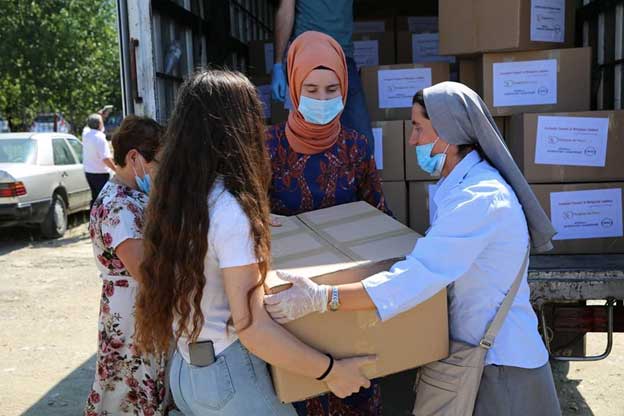
Religions for Peace Interreligious Council of Albania distributing Covid relief supplies from the Multi-religious Humanitarian Fund. Credit: Erzen Carja

NEW YORK, Aug 4 2020 (IPS) – — I have never been interested in religion or spirituality before, but I found myself tuning in to all sorts of on-line religion and spirituality related forums “in search of something.”


These are the words of a 30-something single young, middle class man (born into a Protestant-Catholic family background) in a European country.

The latter is known more for turning several churches into museums or shopping centers, prior to the Covid-19 pandemic. When people are afraid, lonely and alone – they tend to seek “something” beyond science.

A quarter of Americans say their faith has become stronger because of the pandemic, according to a Pew survey conducted during April 20-26, 2020, of 10,139 U.S. adults.

But this is to be contrasted with the experiences of those from an older generation (60+) in the southern hemisphere, like my own 85-year old Muslim father, who lives to pray. For him, the mosque has, over the last decade since my mother’s death, become both his spiritual hub and social club.

His cohort is differing ages of retirees, who, in spite of very different political perspectives in a Middle Eastern country reflecting the now normal of intense polarization, treasure their prayerful community spaces. This middle class (an endangered species to be sure) of retirees, share a sense of deep faith informing their social and political convictions.

For many of them, the lockdown was experienced primarily s an inability to go to the mosque, and thus as almost physically painful. None of them countenanced the idea of on-line prayers, that doesn’t make any sense, they maintained. Their sense of depression was almost palpable throughout the lockdown period, as was their joy at the reopening of some mosques.

The coronavirus presents barriers to caring for the sick and to performing certain death and burial rites which are core religious practices, and especially needed in a pandemic that has already claimed nearly hundreds of thousands of lives.

In Sri Lanka for example, public health measures for safe burial practices have already challenged traditional rites, wherein authorities mandated cremations for Covid-19-linked deaths, despite the fact that cremation is supposed to be forbidden in Islam.

Covid-19 also complicates Jewish and Muslim burial practices of washing and cloaking bodies before burial, given concerns about transmission. Innovative religious responses seeking to reconcile public health policies with traditional burial practices have been taking place.

In Israel, for example, bodies are wrapped in plastic before burial, and before that, ritual washing is completed while wearing full protective gear. Some Islamic scholars are providing exegesis and guidance on how the ritual of washing the body prior to burials, could be conducted safely whilst following Islamic principles.
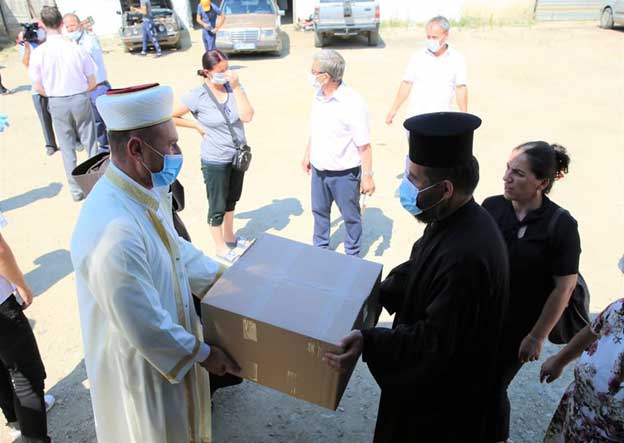
Religions for Peace Interreligious Council of Albania distributing Covid relief supplies from the Multi-religious Humanitarian Fund. Credit: Erzen Carja

This echoes what occurred during the Ebola crisis in West Africa. In fact, while COVID-19 differs from HIV/AIDS, Malaria, Tuberculosis, and Ebola, there are nevertheless some important similarities.

In cases of dealing with diseases where transmission affects large numbers of people, and vaccines and medication remain relatively hard to find and/or provide to all affected, beyond the health inequities which are underscored during such times, there are critical lapses by national and international authorities in acknowledging and supporting the role of religious leaders.

In fact, during previous outbreaks of HIV/AIDS (around the world), and of Ebola in Central and West Africa, the strengths of religious communities were rarely incorporated into public policy – until national and international secular authorities lose the plot.

In Religions for Peace (the only multi religious organization representing all religious institutions and communities around the world with 90 national and 6 regional Inter-Religious Councils/IRCs), a founding mantra is that caring for the most vulnerable is deeply embedded in all faith traditions.

As a result, religious institutions, communities, and faith-inspired/based NGOs (or FBOs as they are often referred to), have historically served as the original providers of essential social services. In fact, FBOs are the first responders in most humanitarian emergencies. Their work includes providing spiritual sustenance for sure, but also hunger relief, heath care, and shelter.

This is not only a feature of the developing world. Samaritan’s Purse set up a health center at the height of the pandemic in Central Park – an icon of New York city. Caritas, at one point, was feeding 5,000 people a day, in Geneva, Switzerland.

For 50 years, Religions for Peace worked to equip its IRCs (through the respective religious institutions and services) to seek peace through advocating for human rights (including the rights of Indigenous Peoples, as well as women, religious minorities, the disabled, elderly, and youth), mediating conflicts, providing emergency humanitarian relief, and contributing to sustainable development efforts (including health, nutrition, sanitation, education and environmental sustainability).

The defining feature of Religions for Peace IRCs is multi-religious collaboration. The main principles of this collaboration are representativity and subsidiarity. In the case of the former, each IRC earns Religions for Peace affiliation by ensuring its governance represents each and all of the nations religious institutions, and communities. In return, each IRC is guaranteed its independence to determine its national/regional priorities, and its modus operandi.

Half a century of collaboration with several United Nations entities at different moments in time, provides a comparative context to enable an assessment of how the UN works with some religious actors.

At the very least, this historical time-line of partnership efforts on peace and security, sustainable development and human rights, provides a learning context. It is with that in mind that we can say that UN efforts in seeking partnerships with faith-based NGOs in facing the Covid-19 implications, are noticeably on the increase relative to pre-Covid dynamics.

Entities like UNHCR, UNICEF, UNAIDS, WHO, and even non-operational entities like the Secretary-General’s own office, as well as UN Office of Genocide Prevention and Responsibility to Protect, have, respectively, issued statements specifically calling on religious leaders and actors to uphold their unique influences (noted above), sought religious input on and in Covid Guidance documents, and (are) hosting multiple consultations to strengthen myriad joint responses.

Working with multiple stakeholders, Religions for Peace research is revealing that while some religious charities are struggling to find resources to continue their services for communities, other FBOs are able to raise more resources for pandemic relief, than anticipated.

This is particularly the case for Hindu, Muslim and Buddhist organisations in countries in Asia, but also Muslim and Christian charities in Africa and the Middle East.

Almost 90% of Religions for Peace IRCs reported a 100% increase in engagement (asks) of their advocacy and messaging efforts from/by national governments, particularly as of May and June 2020 – as compared to this time last year.

This is evidenced through national campaigns during religious occasions and holidays, as well as local awareness raising efforts by religious leaders in particular, as opposed to faith-based NGOs.

Out of the Covid response efforts tracked by 25 Religions for Peace IRCs in 4 regions, thanks to the Multi-Religious Humanitarian Fund administered by RfP, multi-religious efforts are, on average, much harder to encourage than efforts administered by Ecumenical or single religion organisations.

A rough estimate shows that out of the nearly 100 humanitarian assistance projects being tracked by RfP in 40 countries in parts of Africa and Asia, only 1 percent involve multi-religious efforts. Several IRCs have also reported finding it harder to even advocate for multi religious collaboration to provide pandemic assistance (food and medicine packages) in conflict impacted countries (i.e. more than it normally is to seek to mediate some of the conflicts and/or work with governments in mediation efforts).

While it is now almost a cliche to call for more partnerships with religious, or faith-based actors, this is simply not good enough. FBOs, like many NGOs fully immersed in relief efforts, are finding several (good) excuses not to work together.

Faced with a global pandemic, even the FBOs – ostensibly inspired by religious calls for serving all, including the most vulnerable – are less keen on collaborating across their multiple differences (institutional, theological, structural, financial and political), as they continue to serve millions.

Is it enough to serve all who need regardless of religious affiliation (the current bar against which religious NGOs are often measured by the UN and other international entities), or should a pandemic inspire more, and better collaboration among multi-religious partners?

One can but wonder what the relative lack of religious NGO collaboration may foretell for social coexistence after the pandemic, not to mention what this lack of collaboration spells for the legitimacy of the so-called prophetic voice many of them speak of.
  Source

Modern Tools, Age-old Wisdom: on India-Sri Lanka Relations

Asia-Pacific, Civil Society, Featured, Global, Global Governance, Headlines, IPS UN: Inside the Glasshouse, Peace, TerraViva United Nations

Opinion

Prasad Kariyawasam was Sri Lanka’s one-time Foreign Secretary and High Commissioner to India

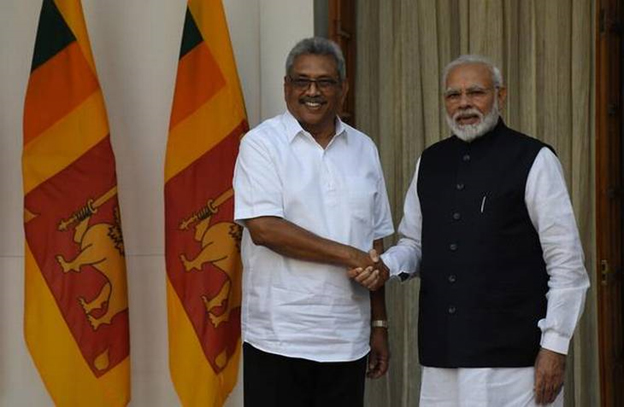
Indian Prime Minister Narendra Modi and Sri Lankan President Gotabaya Rajapaksa. Credit: V.V. Krishnan, the Hindu

COLOMBO, Sri Lanka, Jul 31 2020 (IPS) – The unique India-Sri Lanka relationship, de jure, is between equals as sovereign nations. But it’s asymmetric in terms of geographic size, population, military and economic power, on the one hand, and social indicators and geographical location, on the other. It is steeped in myth and legend, and influenced by religious, cultural and social affinities.


This is an opportune time for Sri Lanka and India to nourish the roots of the relationship using modern toolkits, but leveraging age-old wisdom and experience.

Historical ties

History reveals that the advent of Buddhism to Sri Lanka during the time of Emperor Ashoka was the result of cross-border discourse. For many centuries in the first millennia, the ancient capital city of Anuradhapura housed an international community which included traders from India, China, Rome, Arabia and Persia.

Later, Buddhist monks from Sri Lanka travelled to India, China, Cambodia and Java leaving behind inscriptions. Buddhist temples in Sri Lanka, to this day, contain shrines for Hindu deities. The colonial expansion of European maritime nations reshaped the Sri Lankan economy. Labour from south India was brought to Sri Lanka to work in plantations.

The Indian freedom struggle had its influence on Sri Lanka as well. There was cross-border support for the revival of culture, tradition, local languages, spiritual practices and philosophies, and education. Both countries transformed into modern nations with constitutional and institutionalised governance under colonial rule.

Most aspects of today’s globalisation existed in a different form in the pre-colonial era with free exchange of ideas, trade and intellectual discourse. However, process engineering by colonial powers for identification and categorisation of people was a factor in the emergence of separatist ideologies based on ethnicity, language and religion.

This mindset is now ingrained and accentuated in politics. Episodic instances of communal hostility are referenced often to suit tactical political gain. Around the world today, and not just in South Asia, policies and thinking are becoming communally exclusive, localised and inward-looking.

The COVID-19 pandemic hit the world against this backdrop, allowing some leaders an opportunity to double down on insular thinking, ostensibly for providing local communities with better economic and social prospects, and security.

Meanwhile, governance models favoured by nations keep vacillating between fundamental freedoms-based democratic systems and quasi democratic, socialist authoritarian systems.

In this regard, the people of Sri Lanka and India have been served well by long years of uninterrupted democratic governance. This has provided long-term stability for both countries and must not be vitiated.

Sri Lanka’s strategic location makes it apparent that not only economic fortunes but the security of both countries are inextricably linked. Therefore, it is heartening that India and Sri Lanka constantly strive for excellence in neighbourly relations, recognising that a calamity in one country can adversely impact the other.

Though robust partnerships with other countries must be sought in line with the non-alliance foreign policies of both countries, such efforts must be bounded by an atmosphere needed for peace, prosperity and stability.

Among others, freedom of navigation in the Indo-Pacific together with a rules-based international order and peaceful settlement of disputes are of common interest. While avoiding advocacy of zero-sum solutions on crucial issues, both countries must seek to harmonise strategic and other interests in line with common values and socioeconomic compulsions.

Addressing issues and imbalances

The socioeconomic development of Sri Lanka has remained linked to India. But there are many options available to address issues of imbalance and asymmetries. For instance, Sri Lanka can encourage Indian entrepreneurs to make Colombo another business hub for them, as logistical capacities and facilities for rest and recreation keep improving in Sri Lanka.

Integrating the two economies but with special and differential treatment for Sri Lanka due to economic asymmetries can be fast-tracked for this purpose. There is immense potential to accentuate or create complementariness, using locational and human resource potential, for harnessing benefits in the modern value chains.

Robust partnerships across the economic and social spectrum can promote people-to-people bonhomie. And engagement of legislatures is essential for promoting multiparty support.

With many countries receding into cocoons due to the pandemic, this is an opportunity for both countries to focus on the renewal and revitalisation of partnerships.

This article was originally published in the Hindu, the English-language daily owned by The Hindu Group and headquartered in Chennai, Tamil Nadu
https://www.thehindu.com/opinion/op-ed/modern-tools-age-old-wisdom/article32206425.ece

  Source

Are We Going from San Francisco?

Armed Conflicts, Conferences, Democracy, Economy & Trade, Featured, Global, Headlines, Human Rights, Peace, TerraViva United Nations

Opinion

SYDNEY and KUALA LUMPUR, Jun 30 2020 (IPS) – Seventy-five years ago, on 26 June 1945, before the Japanese surrender ending the Second World War, fifty nations gathered at San Francisco’s Opera House to sign the United Nations (UN) Charter.


UN Charter
Nations pledged “to practice tolerance and live together in peace …, and to ensure … that armed force shall not be used, save in the common interest, and to employ international machinery for the promotion of the economic and social advancement of all peoples”.

Anis Chowdhury

They sought “to save succeeding generations from the scourge of war, … and to reaffirm faith in fundamental human rights, in the dignity and worth of the human person, in the equal rights of men and women and of nations large and small, and to … promote social progress and better standards of life in larger freedom”.

The Charter’s contents reflected some contradictions inherent in framing an international organization recognizing national sovereignty as its organizing principle, and various other compromises, often influenced by the convening host nation.

Although the conduct of Member States often falls short of the UN’s lofty goals, its Charter was nonetheless a monumental achievement, providing the foundation for a rules-based international order.

San Francisco Conference
Forty-six Allied countries, including the four sponsors – the United States, the United Kingdom, the Soviet Union and China – were originally invited to the San Francisco Conference.

The conference itself invited four other States – the Byelorussian and Ukrainian Soviet Socialist Republics, newly-liberated Denmark and Argentina. Poland did not send a representative as its new government was still uncertain.

Of the fifty participating states, only four were African and nine Asian. Latin American countries, independent since the mid-19th century, were present and active in deliberations.

The Conference was not only one of the most significant international gatherings in history, but perhaps the longest ever. The two month long Conference was attended by 3,500 people, including 850 delegates, their advisers, staff and the secretariat, plus more than 2,500 from the media and other observers.

Jomo Kwame Sundaram

The Conference opened on April 25, 1945 with great fanfare, despite the sudden death of its principal architect and presumed host, US President Franklin Delano Roosevelt, on 12 April. The task of carrying on fell to his Vice-President Harry Truman who had become President.

Truman often quoted English poet Alfred Lord Tennyson’s Locksley Hall, carried in his wallet, bewildering colleagues, senators and staffers who doubted his commitment to international peace. Tennyson foresaw that nations, realizing they could destroy one another, might agree to form “the Parliament of Man”, to resolve disputes peacefully.

Clashes and compromises
Many serious differences of opinion triggered crises, even at the preparatory stage. For example, the Soviet Union proposed that all 16 Soviet republics should have UN membership to balance the influence of US allies: the US countered by proposing membership for all its 50 states!

A compromise was struck, allowing membership for the Soviet republics of Belarus and Ukraine; the Soviet Union then withdrew its opposition to Argentina, which had supported the Axis powers.

The most important deliberations concerned the UN Security Council (UNSC), initially composed of five permanent members (US, UK, USSR, China, France) and six elected members. The P5’s right to veto provoked a long and heated debate.

Others feared that when one of the P5 threatens the peace, the UNSC would be ineffectual. But the P5 collectively insisted that as the main responsibility for maintaining world peace would fall most heavily on them, the veto provision was vital.

Australia proposed that no permanent member should be allowed to veto when involved in a Chapter VII dispute over threats to peace. The US delegation blocked this and a Soviet proposal allowing P5 vetoes on procedural matters, e.g., discussion of disputes in which it may be involved.

While US officials saw the UN General Assembly (UNGA) primarily as a ‘talk shop’, the USSR tried to limit it from discussing sensitive political matters. However, recognizing its importance for legitimacy, the compromise reached permits the UNGA to discuss any issues “within the scope of the Charter”.

Colonialism was not supposed to be discussed at the Conference to avoid alienating the European imperial powers, whom the US needed to isolate the Soviet Union. But the handful of Asian and African countries attending wanted countries still under the colonial yoke to attain freedom and independence as soon as possible.

Although not on the original Conference agenda, after much debate, Chapters XI, XII and XIII provided some norms for colonial administration and pathways for decolonization. Nonetheless, these ambiguous, at best, pronouncements greatly disappointed anti-colonialists around the world.

US hegemonic from outset
Despite some compromises inherent in framing such an agreement, the UN Charter favoured the US. It promised to protect freedom of action and national sovereignty, as desired by the US, but contained no open-ended commitment to preserve other countries’ territorial integrity, like the League of Nations Covenant’s Article 10.

Article 2(7) placated American sovereigntists and nationalists, declaring: “Nothing contained in the present Charter shall authorize the United Nations to intervene in matters essentially within the domestic jurisdiction of any state.”

The US and the UK also got what they wanted for existing and new regional and plurilateral arrangements, including defence and mutual assistance organizations.

Some US officials were concerned the UN might threaten the Monroe Doctrine privileging the US in the Western hemisphere, while limiting its ability to intervene elsewhere. Some clever drafting of Chapter VIII provided blanket endorsement to regional organizations, also seen as reflecting the principle of subsidiarity.

Article 51 enshrined the principle of “self-defense against armed attack, either individual or collective”. Although not fully appreciated in 1945, such provisions later helped legitimize various US and other post-colonial security pacts in Europe, Asia and the Americas against the Soviet Union during the Cold War.

Conference participants also considered a proposal for compulsory jurisdiction for a World Court, but the US Secretary of State recognized this would jeopardize Senate ratification. Delegates compromised, agreeing to let countries decide whether to accept the International Court of Justice (ICJ)’s jurisdiction.

Unsurprisingly, the US has had an uneasy relationship with the ICJ from the outset, never submitting to its authority, and reacting negatively to Court decisions seen as adverse to the US.

From Truman to Trump
Presiding at the closing ceremony, Truman cautioned that the success of the new world body would depend on collective self-restraint. “We all have to recognize – no matter how great our strength – that we must deny ourselves the license to do as we please. This is the price each nation will have to pay for world peace.”

Truman is probably turning in his grave watching Trump’s jingoist ‘America First’ policy undermine the UN and multilateralism. Are multilateralism and the UN now doomed as Trump belies Tennyson’s hope and leads the US to up-end the Roosevelt-Truman legacy?


The Great Lockdown Through a Global Lens

Civil Society, Development & Aid, Editors’ Choice, Featured, Global, Global Governance, Headlines, IPS UN: Inside the Glasshouse, Poverty & SDGs, TerraViva United Nations

Opinion

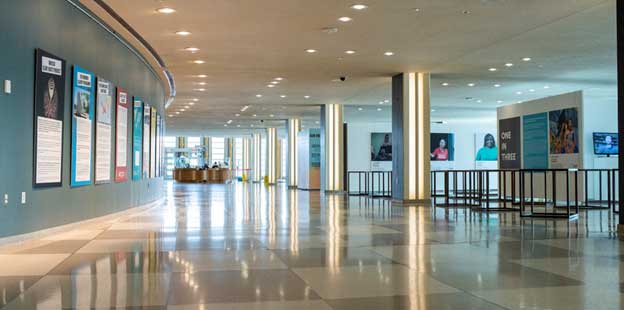
The empty corridors of a locked down UN Secretariat in New York. Credit: United Nations

WASHINGTON DC, Jun 17 2020 (IPS) – The Great Lockdown is expected to play out in three phases, first as countries enter the lockdown, then as they exit, and finally as they escape the lockdown when there is a medical solution to the pandemic.


Many countries are now in the second phase, as they reopen, with early signs of recovery, but risks of second waves of infections and re-imposition of lockdowns. Surveying the economic landscape, the sheer scale and severity of the Global Lockdown are striking.

Most tragically, this pandemic has already claimed hundreds of thousands of lives worldwide. The resulting economic crisis is unlike anything the world has seen before.

This is a truly global crisis. Past crises, as deep and severe as they were, remained confined to smaller segments of the world, from Latin America during the 1980s to Asia in the 1990s. Even the global financial crisis 10 years ago had more modest effects on global output.

For the first time since the Great Depression, both advanced and emerging market economies will be in recession in 2020. The forthcoming June World Economic Outlook Update is likely to show negative growth rates even worse than previously estimated. This crisis will have devastating consequences for the world’s poor.

Aside from its unprecedented scale, the Global Lockdown is playing out in ways that are very different from past crises. These unusual characteristics are emerging all over the world, irrespective of the size, geographic region, or production structure of economies.

First, this crisis has dealt a uniquely large blow to the services sector. In typical crises, the brunt is borne by manufacturing, reflecting a decline in investment, while the effect on services is generally muted as consumption demand is less affected.

This time is different. In the peak months of the lockdown the contraction in services has been even larger than in manufacturing, and it is seen in advanced and emerging market economies alike.

There are exceptions—like Sweden and Taiwan Province of China, which adopted a different approach to the health crisis, with limited government containment measures and a consequently proportionately smaller hit to services vis-à-vis manufacturing.

It is possible that with pent-up consumer demand there will be a quicker rebound, unlike after previous crises. However, this is not guaranteed in a health crisis as consumers may change spending behavior to minimize social interaction, and uncertainty can lead households to save more. In the case of China, one of the early exiters from lockdown, the recovery of the services sector lags manufacturing as such services as hospitality and travel struggle to regain demand.

Of particular concern is the long-term impact on economies that rely significantly on such services—for example, tourism-dependent economies.

Second, despite the large supply shocks unique to this crisis, except for food inflation, we have thus far seen, if anything, a decline in inflation and inflation expectations pretty much across the board in both advanced and emerging market economies.

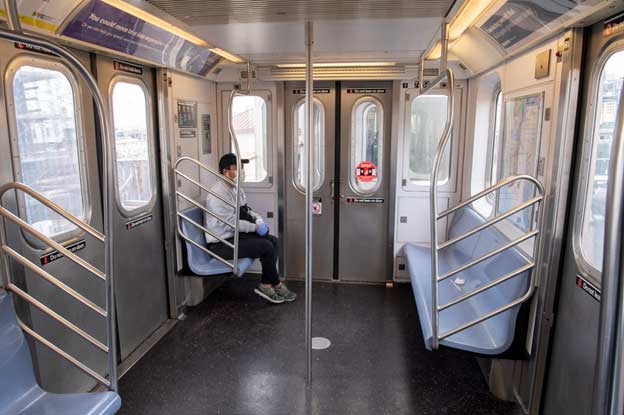
Scene in New York City Subway during COVID-19 Outbreak. Credit: United Nations

Despite the considerable conventional and unconventional monetary and fiscal support across the globe, aggregate demand remains subdued and is weighing on inflation, alongside lower commodity prices. With high unemployment projected to stay for a while, countries with monetary policy credibility will likely see small risks of spiraling inflation.

Third, we see striking divergence of financial markets from the real economy, with financial indicators pointing to stronger prospects of a recovery than real activity suggests. Despite the recent correction, the S&P 500 has recouped most of its losses since the start of the crisis; the FTSE emerging market index and Africa index are substantially improved; the Bovespa rose significantly despite the recent surge in infection rates in Brazil; portfolio flows to emerging and developing economies have stabilized.

With few exceptions, the rise in sovereign spreads and the depreciation of emerging market currencies are smaller than what we saw during the global financial crisis. This is notable considering the larger scale of the shock to emerging markets during the Great Lockdown.

This divergence may portend greater volatility in financial markets. Worse health and economic news can lead to sharp corrections. We will have more to say about this divergence in our forthcoming Global Financial Stability Report.

One likely factor behind this divergence is the stronger policy response during this crisis. Monetary policy has become accommodative across the board, with unprecedented support from major central banks, and monetary easing in emerging markets including through first time use of unconventional policies.

Discretionary fiscal policy has been sizable in advanced economies. Emerging markets have deployed smaller fiscal support, constrained to some extent by limited fiscal space. Furthermore, a unique challenge confronting emerging markets this time around is that the informal sector, typically a shock absorber, has not been able to play that role under containment policies and has instead required support.

We are now in the early stages of the second phase as many countries begin to ease containment policies and gradually permit the resumption of economic activity. But there remains profound uncertainty about the path of the recovery.

A key challenge in escaping the Great Lockdown will be to ensure adequate production and distribution of vaccines and treatments when they become available—and this will require a global effort. For individual countries, minimizing the health uncertainty by using the least economically disruptive approaches such as testing, tracing, and isolation, tailored to country-specific circumstances with clear communication about the path of policies, should remain a priority to strengthen confidence in the recovery.

As the recovery progresses, policies should support the reallocation of workers from shrinking sectors to sectors with stronger prospects.

The IMF, in coordination with other international organizations, will continue to do all it can to ensure adequate international liquidity, provide emergency financing, support the G20 debt service suspension initiative, and help countries maintain a manageable debt burden.

The IMF will also provide advice and support through surveillance and capacity development, to help disseminate best practices, as countries learn from each other during this unprecedented crisis.

  Source

Predicting COVID-19 Infection Fatality Rates Around the World

Civil Society, Development & Aid, Editors’ Choice, Featured, Global, Global Governance, Headlines, IPS UN: Inside the Glasshouse, Poverty & SDGs, TerraViva United Nations

Opinion

WASHINGTON DC, Jun 16 2020 (IPS) – The world saw more new confirmed COVID-19 cases last week than any week to date. And as the pandemic grows, its epicenter is moving from advanced economies to more developing countries, including Brazil, India, and South Africa.


How is the pandemic likely to evolve as it spreads to poorer countries?

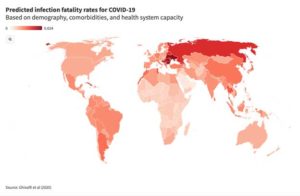
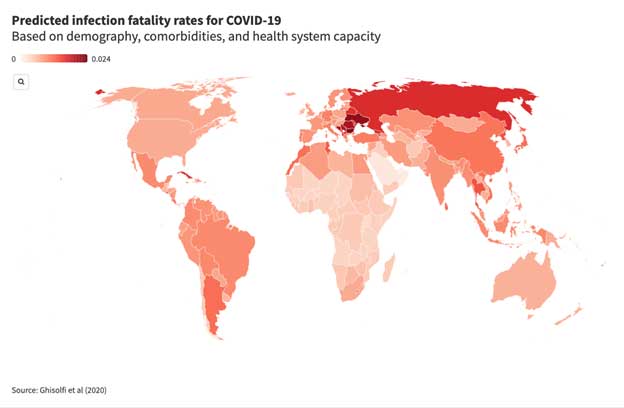
In a new working paper, we attempt to answer one piece of that question, predicting the infection fatality rate, or IFR, for COVID-19 for 187 countries based on demography, comorbidities, and the strength of health systems.

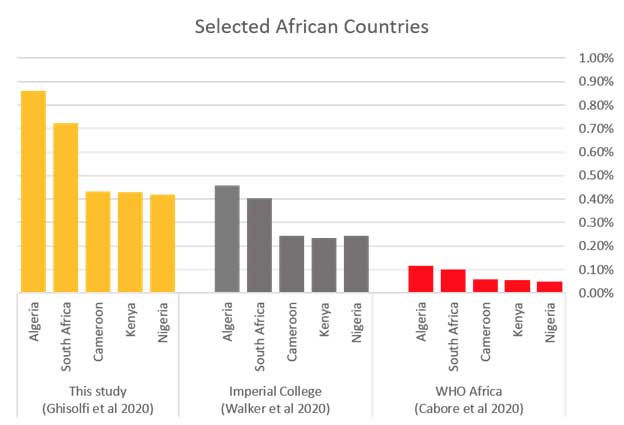
The IFR numbers we report are somewhat higher—sometimes dramatically so—than the figures given for many developing countries in earlier influential studies, including the Imperial College team’s scenarios for the global pandemic and a recent report by the WHO Africa bureau.

That difference can be chalked up to how we incorporate two factors: pre-existing health conditions, and the relative strength of health systems.

For many developing countries, comorbidities partially offset the advantages of youth

A recent study in Science by Salje et al., for instance, finds that with French-level healthcare, the probability of dying with COVID-19 rises roughly eight-fold when moving from the 60-69 age group to the 70 and above range. This is good news for developing countries, which generally have a much younger population than France.

Most previous forecasts of the COVID-19 infection fatality rate have incorporated this demographic advantage. However, they have generally not included the offsetting effect of cross-country differences in comorbidities.

Those comorbidities—such as diabetes, hypertension, and ischemic cardiovascular diseases— matter a lot. Data from Italy show that roughly 96 percent of COVID-19 fatalities report one or more relevant comorbidities.

Inverting that probability using Bayes’ rule and data on France’s IFR and comorbidity distribution, we find that the probability of dying from a COVID-19 infection for patients under 40 is roughly 134-times higher with a relevant comorbidity than without.

Developing countries generally have lower rates of relevant comorbidities compared to high-income countries (where the best measures of infection fatality rates come from). But whereas comorbidities are concentrated among the elderly in rich countries, some developing countries—such as South Africa—report a considerably higher share of these conditions among middle-aged people.

Future work would benefit from more careful treatment of comorbidities like HIV/AIDS that have higher prevalence in lower-income countries. But even a simple adjustment for comorbidities partially undermines many developing countries’ demographic advantages.

Evidence from other viral respiratory infections suggests a much bleaker scenario for COVID-19 in the developing world

So far, our estimates assume that an individual infected with COVID-19 in, say, Uganda has the same probability of dying as someone with the same sex, age, and number of comorbidities in France. Clearly that’s optimistic, given the overall capacity of Uganda’s health system relative to France’s. But exactly how optimistic?

To gauge how much fatality rates might vary with health system capacity, we draw on estimates of the infection fatality rate for another viral respiratory infection, namely influenza. We focus on children under five years old, to purge variation in age and comorbidities that typically begin later in life, and scale the odds ratio of dying from COVID-19 by the ratio of child influenza death rates across countries by income group.

Adjusting for health-system capacity in this way yields COVID-19 infection fatality rates that are considerably higher than previous estimates for the developing world. For the five countries in Sub-Saharan Africa with the largest confirmed COVID-19 epidemics to date, our results are roughly twice as high as those from Imperial College, which does not factor in comorbidities or health system strength beyond a simple capacity constraint on hospital beds.

And they are roughly eight times higher than forecasts from the WHO Africa, which do not adjust for health system capacity and only scale the IFR downward (never upward) due to comorbidities.

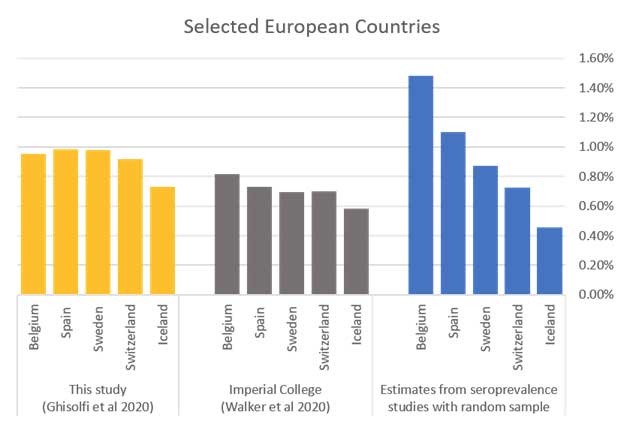
Comparing predicted COVID-19 infection fatality rates across studies

Our results are more in line with the Imperial College predictions for Europe, as shown in the bottom panel above. For the five European countries shown, we can also compare to a more “gold standard” benchmark, i.e., infection fatality rates calculated on the basis of seroprevalence studies of a random sample of the population (blue bars).

Both our results and the Imperial college results match these seroprevalence studies fairly well on average, but fail to explain much of the intra-European variance (some of which may be due to variance in how deaths are counted, e.g., Belgium’s fairly liberal definition of a COVID-19 death to include all unexplained nursing home deaths).

In short, our IFR estimates seem fairly plausible for Europe, where we have an independent reference point, and our results suggest that earlier predictions for developing countries that ignore health system capacity may be far too optimistic.

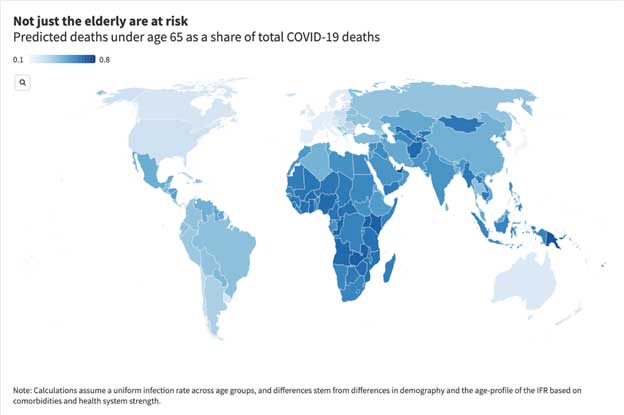
In line with recent news reports, it’s likely young people will make up a larger share of COVID-19 deaths in the developing world

In the United States to date, patients over 75 years old represent over 60 percent of COVID-19 deaths. In Italy, the number of fatalities above 70 is 85 percent.

Both demography and weak health systems explain why COVID-19 deaths are more concentrated among younger people in the developing world

Although predicted IFRs display a steep age gradient in all contexts, due to demographic differences the bulk of deaths in low- and lower-middle income countries is predicted to come from middle-aged patients (40-70).

Less obviously, differences in health system capacity are also likely to flatten the age gradient of COVID-19 deaths in developing countries. In Europe, data is consistent with the hypothesis that intensive care saves the lives of a higher proportion of young than elderly COVID-19 patients. Thus, when high-quality intensive care is lacking, the advantages of youth are more muted.

These estimates are far from the final word on this question. But we hope that our calculations provide an important cautionary note about developing countries’ demographic advantages in facing down COVID-19.

Planning for the ongoing pandemic response and calibration of containment policies should factor in the wide variation in predicted IFRs across contexts. Specifically, policymakers in low-income countries should be cognizant that any demographic advantages with respect to COVID-19 fatality rates are likely to be partially offset by disadvantages in terms of the age-distribution of comorbidities, and even more so by gaps in health system capacity.

*Justin Sandefur is a senior fellow at the Center for Global Development (CGD) ; Selene Ghisolfi is an economics post-doc at the Laboratory for Effective Anti-poverty Policies Bocconi, and a PhD student at the Institute for International Economic Studies, Stockholm University; Ingvild Almås is a professor of economics at the Institute for International Economic Studies, Stockholm University; Tillmann von Carnap is a PhD student at the Institute for International Economic Studies, Stockholm University; Jesse Heitner is a health economist at Aceso Global; and Tessa Bold is an associate professor at the Institute for International Economic Studies, Stockholm University.

  Source

How Cities Can Turn COVID-19 Crisis into an Opportunity to Build Better

Civil Society, Development & Aid, Editors’ Choice, Featured, Global, Global Governance, Headlines, IPS UN: Inside the Glasshouse, Poverty & SDGs, TerraViva United Nations

Opinion

Johnny Miller is a photographer, documentary maker and UN-Habitat Champion based in Cape Town South Africa.

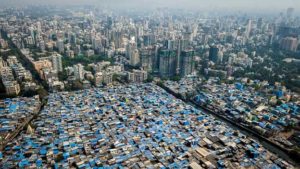
High rise apartments & green spaces contrast with the adjacent sprawling slum area in Mumbai, India. Credit: Johnny Miller

CAPE TOWN, South Africa, Jun 12 2020 (IPS) – From shocking death tolls to widespread job losses, there is no understating the severity of the COVID-19 pandemic’s impact on the world’s cities.

Health care systems, economies, and social lives have been upended by a virus for which the world was totally unprepared.


But even as cities struggle with basic needs like providing a safe environment for all, there is as an opportunity for long-lasting changes to make our cities both more prosperous and equitable and less vulnerable to future shocks such as highly contagious diseases.

Cities and local governments should be recognized for steps they are already taking to build public health, social, and economic resilience during this crisis. They are disinfecting public transport and are keeping public spaces clean.

They are mobilizing both professional and volunteer networks to source, make, and distribute personal protective equipment for frontline workers. They are making sure food reaches older persons who are self-isolating for their own safety and struggling families with children who are no longer going to school, being challenged equally by new ways of working such as home schooling and home office.

This unprecedented moment requires emergency action and social solidarity. We can seize on this brief window to “retro-fit” and make permanent improvements by both delivering the fundamentals of sustainable cities from the pre-pandemic era and adopting the measures that are likely to be necessary in the post-pandemic era.

Our future cities need to be resilient, sustainable, inclusive and equitable. They need to be forward-thinking, able to innovate and better positioned to withstand shocks and catastrophes like the Covid-19 pandemic.

To do this they will need to respect core human values of dignity and care, and invest in citizens’ health along with decent shelter, clean water, and free education. They will recognize that diversity is a strength, and that achieving equality of outcomes for all means safeguarding the rights of expression and culture.

Future cities must rethink and reorganize their built environment using the lenses of equity and access. COVID-19 has exposed the reality of profoundly divided populations. Regenerating neglected urban areas can bring healthy, sustainable benefits to local communities, which in turn increases city resilience as a whole.

Connecting communities with people-friendly parks, green spaces, and community-aligned infrastructure allows neighborhoods to prosper and thrive once more.

We see some cities embrace the “new normal’. Lyon has a plan to more permanently house 1,500 homeless people who were offered temporary shelter during France’s lockdown. Cities around the world have closed streets to cars in order to provide more space for pedestrians and cyclists.

Already, Seattle and Paris have said some of those changes will be made permanent. Bogota, one of South America’s most cycle-friendly cities and already a leader in sustainable transport, just dedicated over 70 more kilometers of bike lanes on top of the 550 that already exist.

With the disruption of global supply chains and long-distance air travel, it is possible that future cities will look and act more locally, with localized and self-sustaining networks of food production, green spaces, and even power generation.

By moving away from a reliance on overseas producers, we can unlock the true value of neglected assets and resources within communities which currently lie dormant.

At the same time, the cities of the future will be more reliant on digital technology and the wide utilization of the internet even as children learning from home eventually go back to school and knowledge workers connecting remotely will eventually return to spending more time in the offices again.

Even in the poorest regions of the world, city dwellers are beginning to rely on the internet for education, business, banking, and social relationships. COVID-19 has already opened our eyes to a world where only those with the freedom and privilege to be able to access the online world are the ones able to access all society has to offer.

The current crisis provides an opportunity for cities to ensure that digital services are available to everyone, but they need to take a proactive approach to digital technologies.

This could include investing in community broadband and free public wi-fi, providing digital literacy and skills to older people and marginalized communities and making websites and online platforms accessible to people with disabilities. Bridging the digital divide, already a pre-pandemic challenge, will be essential to building back better neighborhoods.

The good news is that many cities already see the benefits of resilient, inclusive societies, and some areas like Kerala state in India are weathering the COVID-19 storm well even without massive financial resources.

This is showing that focusing on public health delivery in a compassionate, equitable way, is just as important as economic stimulus to the recovery of a region once the pandemic is over.

The choices we make in the next year will define our societies for an entire generation and perhaps beyond. Let’s use this opportunity as a fulcrum to leverage the future that we know we can build together.

  Source