The Precipitous Barbarisation of Our Times

Civil Society, Crime & Justice, Democracy, Education, Featured, Global, Globalisation, Headlines, Human Rights, Inequity, Migration & Refugees, TerraViva United Nations

Opinion

ROME, Jul 23 2019 (IPS) – When all is said and done, it appears that Thomas Hobbes, the 17th century English philosopher who had a dire vision of man, was not totally wrong.

From the frivolous to the serious, in just a week we have had four items of news which would not happen in a normal world. An English porn beauty with 86,000 followers on social media has put bottles of the water she bathes in on sale at 30 pounds a bottle and has sold several thousand bottles.

Roberto Savio

A survey in Brazil found out that 7% of citizens believe that the earth is flat (40 percent of American schools teach that the world was created in a week, according to the Bible, so there cannot be ancient civilisations) Another survey, this time of members of the British Tory party, who seem likely to elect Boris Johnson as prime minister (not exactly a triumph of reason) are so in favour of a “hard” Brexit that they do not care if this means the exit of Scotland and the end of the United Kingdom. Finally, in order to win election, US president Donald Trump has made racism one of his banners and, in a country of immigrants, this has given him an increase of 5 points in opinion polls.

There are so many signs of barbarisation that they would fill a book… and, as Euripides famously wrote: Whom the gods would destroy, they first make mad.

It is not a popular task, but we have to look at the reality and observe that, in the most scientifically and technologically developed period of history, we are living in times of precipitous barbarisation.

Social inequality has become the basis for the new economy. People have now lowered their expectations and are prepared to work part-time in a precarious job, where young people (according to the International Labour Organisation) can hope for a retirement pension of 600 euro a month. This has been accepted by the political system. We even have a study from Spain according to which, in the present housing market, nearly 87% of people need 90% of their salary just to rent a house.

Today, for many, a salary means survival, not a dignified life. The new economy has developed the so-called gig economy: you work to distribute food, but you are a co-entrepreneur without any of the rights of an employee, for an amount that will never allow you to marry. Children have grown accustomed to look at phenomena such as poverty or war as natural. And now politics are not based on ideas but on how you can successfully exploit the guts of the people, waving banners against immigrants (when we are witnessing a rapid fall in the birth rate) and splintering countries between ”We” who represent the people and “You” enemy of the country. The United States is the best example, where Republicans consider Democrats enemies of the United States. And this brings us to a central question: have Trump, Italy’s Matteo Salvini, Brazil’s Jair Bolsonaro and company not been elected democratically? And they are the symptom or the cause of the “populocracy” which is replacing democracy?

It is not possible to offer a sociological or historical study here. Let us just use a bite: we have gone from the Gutenberg era into a new era – the Zuckerberg era.

Those who greeted the arrival of the Internet with enthusiasm also did so because it would democratise communication and therefore bring about greater participation. The hope was to see a world where horizontal communication would replace the vertical system of information which Gutenberg made possible. Information was, in fact, a support for states and business that used it to reach citizens, who had no recourse to feedback. With Internet, people could now speak directly throughout the world and the propaganda which accompanied its arrival was not considered relevant: it is not important to know, it is important to know where to find It. Well, we have all the statistics on how Internet has affected the general level of culture and dialogue.

The attention span of people has declined dramatically. The majority of Internet users do not stay on an item more than 15 seconds. In the last five years, book volumes have been shortened by 29 pages. Today, articles longer than 650 words are not accepted by columnists’ services. The last meeting of editors of international news agencies decided to lower the level of news from the level of 22 years to that of 17 years. In Europe, the percentage of people who buy at least one book a year now stands at 22% (in the United States it is now 10.5%). According to a recent study in Italy, only 40% of the population is able to read and understand a book. In the same country, 13% of libraries have closed in the last ten years. A very popular transmission in Spain was ”59 seconds” which saw a number of people debate round a table; at the 59th seconds their microphones would disappear. Today, the dream of a TV interviewer is that the person interviewed will give a shorter answer than the question. Newspapers are for people over forty. And there is a unanimous complaint about the level of students entering the university: not all are free from mistakes of orthography and syntax. And the list could continue practically ad infinitum.

The problem of barbarisation has major relevance for political participation. The Gutenberg generations were accustomed to dialogue and discussion. Today, 83% of Internet users (80% under the age of 21), do so only in the virtual world they carved out for themselves. People of Group A gather only with people of Group A. If they come across somebody from Group B, they insult each other. Politicians have been able to adjust rapidly to the system. The best example is Trump. All US newspapers together have a circulation of 60 million copies (ten million those of quality, both conservative and progressive). Trump has 60 million followers who take Trump’s tweets as information. The do not buy newspapers, and if they watch TV it is Fox, which is Trump’s amplifier. No wonder that over 80% of Trump’s voters would vote for him again. And the media, which have lost the ability to offer analysis and cover processes, not just events, take the easy path. Let us follow famous people and make the famous more famous. Analytical journalism is disappearing. In the United States it exists thanks to grants … in every European country, there are few quality papers left, and the largest circulation goes to tabloids which spare their readers the effort of thinking. The Daily Mirror in Britain and Bild in Germany are the best examples.

Internet has made everybody a communicator. This is a fantastic achievement. But in this increasing barbarisation, people also use the Internet for transmitting false information, stories based on fantasy, without any of the quality controls that the media world used to have. And artificial intelligence has been taking over, creating many false accounts, which now interfere in the electoral process, as was proven in the last US elections. We have to add to this that the algorithms used by the owners of the Internet aim to trap the attention of users in order to keep them as much as possible. This month, El Pais published a long study entitled “The toxic effects of YouTube”, where it shows how its algorithms push the viewer to items that are of fantasy, pseudoscientific and of great attraction.

This is due to the fact that the owners have become fabulously rich by transforming citizens into consumers. They find out our identity, and they sell it to companies for their marketing, and also for elections. Those owners have unprecedented wealth, never achieved in the real world: not only in that of production, but even in the world of finance, which has become a casino with no control. The entire world of production of services and goods, man-made, is now close to a trillion dollars a day; that same day, financial flows reach 40 trillion dollars. Jeff Bezos ‘s divorce gave his wife 38 billion dollars. That is equal to the annual average income of 20,000 dollars of 19 million people. No wonder that 80 individuals now possess the same wealth as 2.3 billion people (in 2008, they were 1,200 individuals).

According to historians, greed and fear are great engines of change in history. That was also true in the Gutenberg era. But now, they have triggered a combination of both in a short period of time. After the fall of the Berlin Wall, the doctrine of liberal globalisation arrived with such strength that Margaret Thatcher (who with Ronald Reagan ushered in the new vision of individual profits and elimination of social goods) famously talked of TINA: There Is No Alternative.

The entire political system, including Social Democrats, accepted riding a system of values based on greed and unfettered competition at individual level, at state level and at international level. It took twenty years to understand that the poor have become poorer, and the rich richer, and that states have lost much of their sovereignty to multinational corporations and the world of finance. It is worth noting that, in 2009, in order to save a corrupt and inefficient financial system, the world spent 12 trillion dollars (the United States alone, 4 trillion). Since that rescue, banks have paid the impressive amount of 800 billion dollars in penalties for illicit activities.

The financial crisis of 2009 has triggered a wave of fear. Let us not forget that until 2009, there were no sovereignist, populist, xenophobic parties anywhere, except for Le Pen in France. Soon old traps such as “in name of the nation” and “the defence of religion” were resurrected by politicians able to ride fear. A new scapegoat – immigrants – was found and populocrats are now undermining democracy everywhere.

Populocracy is the new wave. Former Italian prime minister Silvio Berlusconi ushered in a new language, and that language has now been updated by Salvini, Trump and so on. Twitter, Facebook and Instagram are the new medium and now the medium is the message. The old elite had not found a new language.

The Zuckerberg era is an era of greed and fear. Zuckerberg is now attempting to create a global currency, the Libra, to be used by his 2.3 billion users. Until now, states were the only entities able to emit money, a symbol of the nation. Zuckerberg’s currency is based entirely on the Internet and will have no control or regulations. In case of a default, we will have a world crisis without precedent. In the Gutenberg era, this was not possible.

But who has made able Jeff Bezos to give 38 billion dollars to a former wife? Who has elected Trump and Salvini and company, who speak on behalf of the nation and the people, and turn those who do not agree into enemies of the nation and the people, creating an unprecedented polarisation, accompanied by an orgy of revolt against science and knowledge, which have supported the elite, and must now be put aside for the good of people.

This process of barbarisation should not obscure an old proverb: every country has the government it deserves. It is called democracy. However, the traditional elite has no code of communication with the new era. The answer will come from citizen mobilization.

A young Swedish girl, Greta Thunberg, has done more with her stubbornness to raise awareness about impending climate change than the entire political system. Even Trump (albeit for electoral reasons) has now declared that climate change is important.

Today, there many “points of light“ appearing in the world. The elections in Istanbul are a good example, as are the mobilisation in Hong Kong, Sudan and Nicaragua, among many others. Let us hope we will reach a point where people will take the reins of the process and awake the world from the precipitous course of barbarisation. Even Thomas Hobbes concluded that humankind will always, soon or later, find the right path, and give itself good governance. He thought that an elite would always be able to lead the masses.

Well, elites are now the Greta Thunbergs of the world.

Publisher of OtherNews, Italian-Argentine Roberto Savio is an economist, journalist, communication expert, political commentator, activist for social and climate justice and advocate of an anti neoliberal global governance. Director for international relations of the European Center for Peace and Development.. He is co-founder of Inter Press Service (IPS) news agency and its President Emeritus.
 

It Takes Listening to Children to End Violence

Civil Society, Education, Featured, Global, Global Governance, Headlines, Human Rights, Inequity, IPS UN: Inside the Glasshouse, Poverty & SDGs, TerraViva United Nations

Opinion

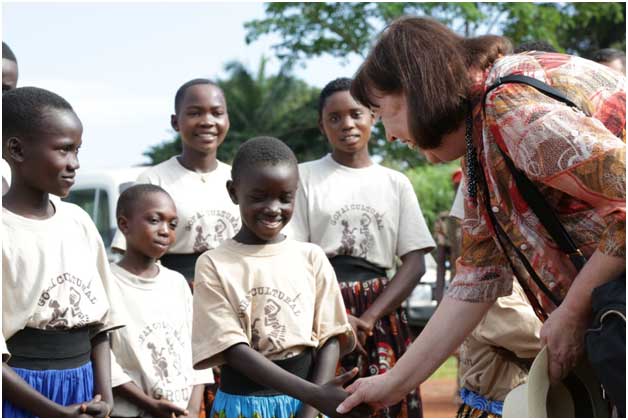
NEW YORK, Jul 22 2019 (IPS) – We see many challenges that affect children around the world. Child marriage, corporal punishment, voting ages, air pollution, teachers going on strike…


It’s been great to speak and have world leaders at the UN listen when we talk about these issues. It’s been clear that leaders are open to hearing from children and learning what kids have to say.

But even then, it doesn’t always seem like leaders are ready to move from talking to action. It’s weird that there are all these urgent issues to tackle, but leaders aren’t acting right away.

When we talked with [Special Representative of the Secretary-General on Violence against Children] Najat Maalla M’jid, she said she’s going to try and change this. She will push the United Nations to work to end violence against children. She also offered to listen to children’s ideas, recommendations, and solutions.

Governments must make changes to end violence and stop child marriage. And it’s really important for governments to listen to children’s voices and stop underestimating our abilities. Children can offer ideas too, and its children who are the next generation.

Last week, we learned that every country is connected together, and issues that affect one country often affect others as well. Even though countries have different languages, cultures, and ways of learning, many problems that affect children are the same.

Child marriage and sexual abuse affect children all over the world. Child marriage is a horrific form of violence. It violates girls’ rights and negatively affects their ability to access education and health.

In Lesotho and many other countries, girls are forced to marry due to poverty, property grabbing, sexual abuse, premarital pregnancies and neglect. The laws that protect children are not effectively implemented and enforced.

We also need to stop thinking that punishing kids by hitting them is an acceptable discipline method. Just like child marriage, we need to realise that psychological abuse and corporal punishment of students is a problem in many countries, and maybe by working all together it will be easier to stop it.

Often governments have put some good laws in place, but they don’t always work because people don’t know about them. Adults need to be told about the new laws, otherwise they’re going to keep breaking them and the violence is only going to continue.

Children and teachers, for instance, need to know that there are rules about how children can be treated in schools. Sometimes the laws don’t match up, and so old marriage laws need to be updated so they don’t have lower ages than child protection laws.

When children get involved, they can help. For example, many children are born and live their life without having a birth certificate. Many countries make it hard for them to access their basic rights or go to school without a birth certificate.

In one village in Indonesia, many children were rejected when they wanted to register at school because they did not have a birth certificate. Thankfully, the child parliament was able to work with the village government to get a birth certificate for all children.

They arranged a “mass birth certificate” campaign and finally, 100% of the children in the village have birth certificates.

Children can help create the necessary changes in communities, but we need to be informed in order to do so. Child parliaments and youth groups can help raise community awareness about child protection laws and give us a space to share about our experiences.

Before sessions, not many girls knew that child marriage is against the law. After our meetings, children are more aware and have a better understanding of violence.

Every child has a right to participate. We hope our examples show how the voices of children are important and can help. If the government wants the world free from violence, involve us.

The main target of ending violence against children is a child. Therefore, the voices of children should be heard. If violence against children is stopped, we will have a better life, and we need this now, not in the future.

*As a general rule, World Vision doesn’t share the last names of children under 18.


Finland’s Education System Leads Globally

Civil Society, Education, Featured, Global, Global Governance, Headlines, Human Rights, IPS UN: Inside the Glasshouse, TerraViva United Nations

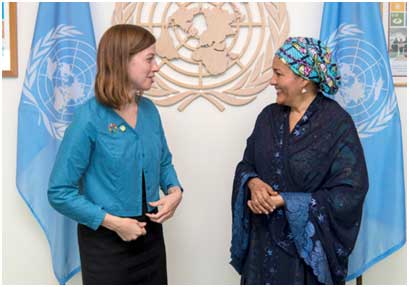
Deputy Secretary-General Amina Mohammed (right) meets with Li Andersson, Minister of Education of Finland.
18 July 2019. Credit: United Nations, New York

UNITED NATIONS, Jul 22 2019 (IPS) – Finland has garnered attention for its top-notch education, and the newly appointed Minister of Education for Finland is planning to continue with the success of her country’s education system through various and innovative approaches.


“In education, Finland has the lead according to many international comparisons,” Li Andersson, the newly appointed Minister of Education for Finland, said at a briefing at the Finnish consulate in New York on July 19.

Most recently, she pointed out, the London-based Economist ranked Finland as number one in delivering future-oriented skills through education.

“Thereby, Finland is best equipped to adapt education system to deliver skills for problem-solving and collaboration, as well as foster creativity, civic-awareness and participation,” she added.

The briefing was hosted by the Consulate General of Finland, with a guest speaker from Columbia University.

Andersson said investment in education is key to all of the successes “we have seen in Finnish society, so it is key for social cohesion, it is key for equality, and it is key for building economic progress and for economic growth.”

“The Finnish education system is one of the top performing education systems in the world,” she declared

Finland has been ranked as one of the happiest and successful countries in the world, and most recently having been ranked as the number one country for higher education by The Economist.

And in terms of data, in results released by the Programme for International Students Assessment (PISA), a test taken by pupils across the globe, Finland scored 550 points higher than any of their counterparts, including Sweden, Norway and the US, among others.

When asked whether the size of small schools that are abundant in Finland have anything to do with Finland’s success, Dr. Samuel Abrams, Director of the National Center for the Study of Privatization in Education at the Teachers College, Columbia University, told IPS: “I would not focus on the size of schools. That is not, as I said, a Finnish innovation”.

He said there has been a robust movement for small schools in the United States for a long time with many fine examples of excellent small public schools across the country.

“I merely brought up small schools as a part of the recipe for excellent schooling in Finland that may be threatened by financial pressure, generated in part by pension obligations”.

Because the pension obligations in an aging country like Finland are substantial, he said, budget cuts must be found. “Some of those budget cuts mean merging schools to achieve economies of scale.”

However, in terms of what other countries, such as the United States should learn from Finland, he had this to say: “We should follow Finland in testing only small samples of students rather than testing all students”.

“Our approach forces teachers to teach to the test. As we test all students in reading and math in grades 3-8, we generate undue stress for students, teachers, and parents alike”.

Moreover, he pointed out, “in focusing on reading and math, we crowd out time for history, science, music, art, crafts, and physical education. And students need those subjects as well as plenty of play for a well-rounded education.”

“Second, we should follow Finland in preparing teachers with high-quality master’s programs in pedagogical theory and practice.

Third, we should follow Finland in paying teachers well and giving them significant autonomy,” he added.

“Finally, we should follow Finland in funding our schools fairly. That means more money per student at schools in disadvantaged neighborhoods, not less. We base funding on property taxes, which means wealthy districts have significantly more money to spend per pupil than poor districts”.

None of this is rocket science. But that does not make it easy.

“We must follow in Finland’s path in altering the way we think about children and their future. This requires, one, thinking about child development through the eyes of the child, which means a well-rounded curriculum; two, reconceiving our social contract to ensure a high-quality education for all children; and three, esteeming teachers as pillars of the community.” Dr. Abrams concluded.

With that said, the education system in Finland has much room for improvement. “We see growing disparities in the learning results.” Andersson said, in terms of learning results.

“There is a difference between boys and girls and also some growing regional differences, and also a stronger difference where the pupils home background will affect the learning results more than before.”

“Inequality hampers growth and otherwise,” she added.

To combat these worrisome findings, Andersson and the Finnish government have set three main priorities to be tackled in the coming years.

“The first of these priorities is raising the educational level of the whole population.” Andersson said.

“We are also seeing a tendency where we are seeing the growing level of education has actually stopped.” She went on to cite that the generation of the 1970’s, and in Finland it is the current generation that has the highest level of education.

“The second priority of the government is reducing inequality gaps in education referring to what I said about earlier about the worrisome trends, and the third priority is focusing on continuous education…. learning should be something that we do all the time, and we should have the possibility to engage in all the time, no matter whether if we are working or outside working life or studying.”

For raising the level of education, Andersson plans on ensuring that all students have a degree on the upper secondary level and plans on raising the amounts of adults on the third educational level (post-secondary education) to 50% by 2030.

In order to implement this, Andersson intends on devising a Road Map, and a document that will reach Parliament.

She also highlighted the importance of addressing the equality gaps and strengthening the whole Finnish education system, from early childhood education to primary school.

She also intends on raising the compulsory education age to 18 years old. “16% of the overt generations in Finland are without a degree on the secondary level.” She noted.

“We know that the employment rate of people with only primary education backgrounds is around 40% at the moment, and that has been going down all the time.”

She cited the changing labor market, and how that calls for a change in the education system.

In terms of closing education gaps, Andersson cited a significant focus on early childhood development, as that is key.

Such actions to help assist this goal is to reduce group sizes for children over 3 years old and ensuring that every child has the right to at least 40 hours a week to early childhood education and care “no matter if their parents are working or unemployed.”

Andersson is also piloting a two- year preschool to see how it will affect participation rates in early childhood care, as well as to observe the effects it will have on learning results in primary education.

Furthermore, Andersson plans on providing support for maternity and childhood clinics.

For continuing education and the future of work, Andersson is unsure, as the labor market is drastically changing but noted that “It is clear that the knowledge requirement will grow.”

“Education is the best tool we have, and we should think of it as an investment not an expenditure.” She concluded.

She added that students should “just focus on things you’re motivated about, not too get too stressed, I think it is a shame there is a lot of pressure on the students now, with their stress with finances etc.”

But she offered encouragement and stated that students should “not think too much about what government is saying about how fast you should study and finally, “use the possibilities you have at the university”


6 African Country Musicians You Should Check Out – OkayAfrica

With Lil Nas X’s EP going straight to number on the American charts, it seems like country music revival is taking over 2019 and beyond, thanks to its unlikely fusion with trap music. It only makes sense that black people are reclaiming the genre, as country was actually partly created by black American artists and heavily influenced by gospel music.

On top of that, plenty of lesser known black artists and bands are making country, or country-infused, music. This is especially the case in Africa, where the genre has been around for a few decades and an increasing number of musicians are gaining momentum. By gaining popularity in Africa, country is coming back to its roots, as country guitar and the way of playing it was originally inspired by the banjo— an instrument that African slaves brought with them to America.

Country music has a strong appeal across the African continent for several reasons: the similarity with many African instruments and the recurring lyrics and themes about love, heartbreak and “the land.” At the heart of it, country music has an appeal to working class people all over the world who feel let down by the people that were supposed to help them.

Country music is played regularly on the radio in countries such as Kenya, Tanzania and Malawi but yet, the artists featured are overwhelmingly white and American. African country singers do not get the respect they deserve or are seen as anomalies. With the growing number of them making country music, here is a list of the ones you need to listen to right now.


Sir Elvis

[embedded content]

Elvis Othieno, also known as Sir Elvis, is a popular Kenyan musician who grew up with country-loving parents. Elvis is his real name (no, really) and he was born three months after the legendary singer died. Inspired by Gary Brooks and Hank Williams, he started making music while attending college. He wanted a unique name, while paying his dues, and picked his moniker to stir away from the obvious Elvis Presley reference. Sir Elvis has contributed largely to the popularity of country music in Kenya. Since Agriculture dominates the Kenyan economy, it’s no surprise that country music is especially popular in the nation’s farming areas.

Ogak Jay Oke

[embedded content]

Nigerian country singer Ogak Jay Oke, like most people on this list, was introduced early to country music through his religious upbringing and church ties. He’s pushing to make the genre more popular across Nigeria and is the president of the Country Music Club in his hometown of Port Harcourt. Inspired by Jim Reeves, Skeeter Davies and Don Williams, he released his first album, Another Day, in 2016. He recently released a new single “Here Comes the Bride,” an homage to his wife.

Jess Sah Bi & Peter One

[embedded content]

The Ivory Coast duo Jess Sah Bi & Peter One gained fame and recognition in Western Africa after the release of Our Garden Needs Its Flowers in 1985, an album that was influenced by country, disco and folk music. Their lyrics—sung in English, French and Gouro (a Mande language from Ivory Coast)—were pretty political, calling out inequality and social issues across African countries. One of the reasons behind their pan-African appeal was that they encouraged African people to stand together in unity and called for an end to apartheid. Their album was re-released in 2018 by Awesome Tapes From Africa, helping a new generation of music lovers to discover them.

​Esther Konkara

[embedded content]

Christian country singer Esther Konkara hails from Kenya and is heavily inspired by Dolly Parton. Themes such as love, financial hardships, heartbreaks and the striking descriptions of small towns are what drew her to country music. It makes sense, since she grew up in a small rural village herself. Her album Turi Ahotani was released in 2015 and she recently shared her new single, “Rimwe Ria Kuigana.” She took part in Kenya’s first ever country music festival, The Boots And Hats Festival, in 2015 and is now performing across the country.

Emma Ogosi

[embedded content]

One of the pioneers of country music in Nigeria, the singer Emma Ogosi released a country-disco album entitled Nobody Knows in 1981. Inspired by the thriving disco scene at the time as well as multiple country influences, he came up with a record that’s both groundbreaking and intimate. Ogosi was once married to popular Nigerian reggae artist Evi-Edna Ogholi. He was also a band member of The Expensive and a former air officer. When Evi-Edna fled Nigeria to Paris, he stayed. Despite the fact that he hasn’t released an album in years, the mysterious man still sings and is the head of the Performing Musicians Association of Nigeria.

Poor Charley Akka

[embedded content]

Nigerian act Poor Charley Okaa released his album Don’t Cry in 1983—a funk, soul and country infused EP. Very little is known about the musician and his music is notoriously hard to find. However, his song “Be in Your Arms” is one of the most famous Nigerian country music tracks and was featured on the album Like Nashville In Naija, a compilation featuring many country or country-inspired musicians from the West African nation.

Best-selling author in Rwanda

By Dr. Adrienne T. Hunter, DHA MS

I am an African-American scientist (of Sierra Leonean descent) who currently lives in Rwanda where I am currently an expat abroad with my family. I wish to share that I have just published my first book (already a Best-Seller) – a story about my global experiences in 12+ selected countries as a woman of color and scientist, having dealt with racial and disability discrimination as a U.S. federal employee/former Diplomat, my struggles being disabled in Africa (I have multiple sclerosis with 27 brain lesions and several on my spine), overcoming an attempted suicide, and other lessons-learned from my life and career globally. My story also shares how I had to break free from my strict religious upbringing and find my own spiritual and cultural freedom. My work has taken me to Malawi and Liberia as well as other countries around the world.

I have been empowering women and girls around the globe for most of my life and would like to ask if there is any interest in my book or an interview. I wish for my African brothers and sisters to keep striving no matter any limitations that may come their way. I am humbled to be here in Africa and the hospitality shown has really positively impacted my health and spirit. I am always happy to share the beauty of the continent and that we can overcome any obstacles in life. I am also the CEO/Founder of Cultivatics, Inc. – a digital health consulting firm. Thank you for any consideration and opportunity to share with your audience via interview or print.

Dr. Adrienne T. Hunter, DHA MS

+250 789896328 mobile
www.adriennethunter.com

How Governments Still Allow Violence Against Children

Civil Society, Development & Aid, Education, Featured, Global, Global Governance, Headlines, Human Rights, Inequity, IPS UN: Inside the Glasshouse, Poverty & SDGs, TerraViva United Nations

Opinion

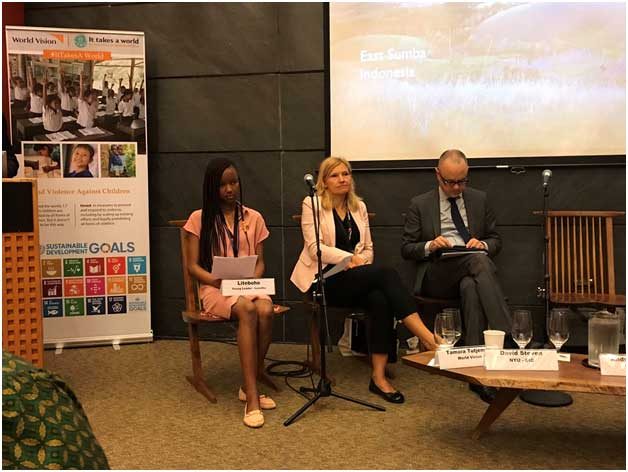
Tamara Tutnjevic Gorman is Policy Manager – Ending Violence against Children, World Vision

World Vision believes that it takes each and every one of us to end violence against children.

NEW YORK, Jul 16 2019 (IPS) – Despite what you might have heard, things are getting better, every year. We are making amazing progress on fighting diseases, reducing the preventable deaths of children, and investing huge amounts to advance medicine and knowledge and to create better living conditions.


However, this progress is too slow for some of the world’s most vulnerable children; those who have yet to experience the progress of the past 20 years. It’s hard to believe, but governments still allow violence against children to continue.

Approximately 1.7 billion children still experience some form of violence every year. To understand the reasons why, World Vision has investigated the commitments by 20 governments to address violence against children and has found that, while there has been tremendous progress in prohibiting violence, there are still too many gaps in legislation.

Cracks in laws, data, coordination, accountability and funding are becoming big gaps that ruin children’s lives and futures.

As a global community, we made exciting promises to end violence against all children 30 years ago when we adopted the United Nations Convention on the Rights of the Child. In those 30 years, we’ve developed laws and policies, come to better understanding about the complexity of violence and its forms, discovered and agreed to evidence-based solutions, and created a movement that has shone a spotlight on the issue.

We renewed our commitment to ending violence against children by committing to the Sustainable Development Goals four years ago. Yet, the inconsistent stats we have and self-reported data show that violence against children is not reducing at the pace necessary to meet the important target of ending all forms of violence against children.

This means today’s children, and their children, will live with violence’s life-long consequences – pushing them to life at the margins of society: severe health problems, difficulties acquiring an education and a decent job, and relationship issues. The lack of decisive action to end violence against children is simply not good enough.

Where legal bans exist, they do not yet cover all forms of violence. Ambitious declarations about National Plans of Action are not followed by the resources necessary to implement them. Fragmented initiatives are not enough to support victims, or more importantly, to ensure prevention.

There is some reporting on progress, but far too little new data to report on. And out of all the children experiencing violence, far too few have been consulted on the policies that affect their lives.

World Vision believes that it takes each and every one of us to end violence against children. A critical step in the right direction is for governments to make all forms of violence illegal and to put in place a comprehensive set of national laws and policies that provide for strong prevention and response measures.

The lack of commitment to zero tolerance is perhaps the most worrying. Government policies often turn a blind eye to socially or traditionally acceptable corporal punishment in schools, beating at home, child marriage and more.

Millions of children are unnecessarily drawn into a cycle of violence because of the failure to prevent it. When a child survives such violence and doesn’t get justice or appropriate support, the message they receive from authorities is that violence is permitted, or even condoned by those in power. This sends a powerful message that as society we have agreed to accept certain levels of violence.

Moreover, when families or communities experience crisis due to conflicts or natural disasters, the boundaries of what violence is considered acceptable tend to stretch. This makes it difficult to stop. Before we know it, violence can become a way of life. As a global community, we all must do more to plug the gaps that persist.

As governments at the High-Level Political Forum (July 16-19) present on progress so far and work on plans for the future, it is important that they address the seven cracks that have been identified in current efforts to end violence against children. This means they must commit to:

      1. Prohibiting all forms of violence against children in all settings.
      2. Investing in prevention programs and reporting mechanisms.
      3. Being a global champion for the prevention of violence against children.
      4. Increasing funding and transparency in budgets allocated to interventions to end violence against children.
      5. Prioritising and investing in regular data collection.
      6. Mandating, resourcing and planning for child consultations in policy development, reviews, monitoring and reporting.
      7. Increasing government delivery of community education and awareness campaigns.

    The 193 UN Member States have incredibly diverse energy, expertise and resources. We are calling for each and every one of them to join us and become champions for ending violence against children. It takes political leadership, and the time to drive action is now

    To read the full report Small Cracks, Big Gaps: How governments allow violence against children to persist click here.