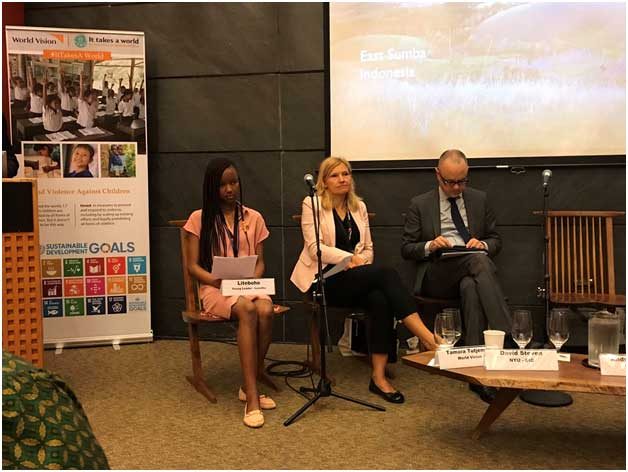
Tamara Tutnjevic Gorman is Policy Manager – Ending Violence against Children, World Vision
World Vision believes that it takes each and every one of us to end violence against children.
NEW YORK, Jul 16 2019 (IPS) – Despite what you might have heard, things are getting better, every year. We are making amazing progress on fighting diseases, reducing the preventable deaths of children, and investing huge amounts to advance medicine and knowledge and to create better living conditions.
However, this progress is too slow for some of the world’s most vulnerable children; those who have yet to experience the progress of the past 20 years. It’s hard to believe, but governments still allow violence against children to continue.
Approximately 1.7 billion children still experience some form of violence every year. To understand the reasons why, World Vision has investigated the commitments by 20 governments to address violence against children and has found that, while there has been tremendous progress in prohibiting violence, there are still too many gaps in legislation.
Cracks in laws, data, coordination, accountability and funding are becoming big gaps that ruin children’s lives and futures.
As a global community, we made exciting promises to end violence against all children 30 years ago when we adopted the United Nations Convention on the Rights of the Child. In those 30 years, we’ve developed laws and policies, come to better understanding about the complexity of violence and its forms, discovered and agreed to evidence-based solutions, and created a movement that has shone a spotlight on the issue.
We renewed our commitment to ending violence against children by committing to the Sustainable Development Goals four years ago. Yet, the inconsistent stats we have and self-reported data show that violence against children is not reducing at the pace necessary to meet the important target of ending all forms of violence against children.
This means today’s children, and their children, will live with violence’s life-long consequences – pushing them to life at the margins of society: severe health problems, difficulties acquiring an education and a decent job, and relationship issues. The lack of decisive action to end violence against children is simply not good enough.
Where legal bans exist, they do not yet cover all forms of violence. Ambitious declarations about National Plans of Action are not followed by the resources necessary to implement them. Fragmented initiatives are not enough to support victims, or more importantly, to ensure prevention.
There is some reporting on progress, but far too little new data to report on. And out of all the children experiencing violence, far too few have been consulted on the policies that affect their lives.
World Vision believes that it takes each and every one of us to end violence against children. A critical step in the right direction is for governments to make all forms of violence illegal and to put in place a comprehensive set of national laws and policies that provide for strong prevention and response measures.
The lack of commitment to zero tolerance is perhaps the most worrying. Government policies often turn a blind eye to socially or traditionally acceptable corporal punishment in schools, beating at home, child marriage and more.
Millions of children are unnecessarily drawn into a cycle of violence because of the failure to prevent it. When a child survives such violence and doesn’t get justice or appropriate support, the message they receive from authorities is that violence is permitted, or even condoned by those in power. This sends a powerful message that as society we have agreed to accept certain levels of violence.
Moreover, when families or communities experience crisis due to conflicts or natural disasters, the boundaries of what violence is considered acceptable tend to stretch. This makes it difficult to stop. Before we know it, violence can become a way of life. As a global community, we all must do more to plug the gaps that persist.
As governments at the High-Level Political Forum (July 16-19) present on progress so far and work on plans for the future, it is important that they address the seven cracks that have been identified in current efforts to end violence against children. This means they must commit to:
1. Prohibiting all forms of violence against children in all settings. 2. Investing in prevention programs and reporting mechanisms. 3. Being a global champion for the prevention of violence against children. 4. Increasing funding and transparency in budgets allocated to interventions to end violence against children. 5. Prioritising and investing in regular data collection. 6. Mandating, resourcing and planning for child consultations in policy development, reviews, monitoring and reporting. 7. Increasing government delivery of community education and awareness campaigns.
The 193 UN Member States have incredibly diverse energy, expertise and resources. We are calling for each and every one of them to join us and become champions for ending violence against children. It takes political leadership, and the time to drive action is now
To read the full report Small Cracks, Big Gaps: How governments allow violence against children to persist click here.
I remember the move when I donated my entire office and all of the furniture and equipment to the Obama campaign to launch the Minnesota Headquarters in 2007.
I proudly created and ran the “NFL Players for Obama” in 2008. I remember being able to recite the “Yes We Can” speech line by line. And I vividly remember watching eight years of focusing on countless core issues that had no real effect on blacks in America.
Yet I remained faithful and hopeful that the second term would bear more fruits for the poorest, sickest, and most uneducated segment of the U.S. population, our African Americans.
The Obama administration chose to pour food stamps on our most underserved with few effective programs to incentivize our impoverished to go to work. Obama ironically boasted about giving out more food stamps than any other president in U.S. history. You can’t make this up.
Obamacare was a noble effort, but the blatant lies told in order to pass it have been the catalyst which is leading to its demise today. Remember it was sold as a plan which would not increase your healthcare bill or limit your access.
I’m all for equal rights for gays and lesbians, but I think the large campaign donations hypnotized Obama to prioritize gay marriage over bringing quality education and criminal justice reform to the ancestors of our ailing former slave population. I’m sure both were important issues to him at some level, but in politics you have to prioritize as all presidents know they are on a short timeline.
The debate is still out there as to whether the Obama years brought the country farther from our Christian foundation.
I applaud President Obama for openly saying Jesus and quoting powerful scripture on many occasions. I was just a little bothered by his policies, which too often went against the word of God.
Obama stuck to his commitment to the LGBTQ community when he backed unprecedented legislation that expanded the sacred biblical “marriage” characterization to gay and transgender couples. I just think we could have given all Americans their deserved equal rights without challenging the biblical definition of marriage. Now homosexuality is on super speed in the black community where you see a surge in gay black males particularly in urban communities like Atlanta, LA, and throughout the south.
The CDC recently reported that 50% of black gay men will contract HIV, which is scary given the growing gay lifestyle promotion as a result of the Pride movement. Despite being only 12% of the population, blacks make up 43% of those infected with HIV in America. This epidemic can’t be ignored and we can’t deny the results of a culture that promotes sex and homosexuality as things that are publicly glorified.
The Trump administration wasted no time in enforcing other religious freedoms by reversing many of Obama policies which challenge Christian beliefs.
Under the Obama administration, HHS required employers pay for their employees’ contraception and abortion-inducing drugs, even if this violates the conscience of employers. The Obama administration exempted houses of worship, but religious-affiliated groups that objected still had to allow a third-party administrator to handle the contraception coverage. This has particularly hit the urban black community where fathers are too often missing and many youth are left to praise and idolize their favorite hip hop artist who too often promote behaviors not necessarily in line with “In God We Trust.”
As we witness liberals in America take a harder and harder stand that conservatism translates to racism, it’s so ironic to me that none of them have the courage to hold Obama accountable for long-standing racism displayed by his top two executives which he chose to accept.
His beloved VP Joe Biden was decimated in a recent 2020 Democratic Presidential debate by Senator Kamala Harris for his participation in busing during school segregation.
Not to mention, Biden was one of the authors and main advocates for the 1994 crime bill which decimated the black father by locking up young black men in droves for nonviolent crimes over the last 25 years.
Barack’s number three, Hillary Clinton, has an even sketchier past on race as she championed her husband to push the same evil crime bill that Joe Biden worked on. To make matters worst, Hillary and Bill worked together in Haiti during one of the most egregious misappropriations in modern history. As a result, the poorest black population in the Western Hemisphere fell deeper into extreme poverty despite an estimated $12 billion being pledged to the country, almost twice its annual GDP at the time.
Now I have to mention that the biggest eye sore of the Trump presidency was him appointing the lifelong racist Jess Sessions as Attorney General. Thank God he canned him as soon as he could, paving the way for the First Step Act.
First Step Act
I would have never imagined seeing Kim Kardashian and Kanye West in the White House discussing criminal justice policy.
Just like I would have never imagined seeing Alice Johnson given clemency and the long awaited Jack Johnson legacy receiving a presidential pardon.
These highly publicized cases were both denied by the Obama Administration over two consecutive terms as president. In less than two years in the Oval Office, President Trump continued his push for criminal justice reform by passing the First Step Act which targeted many shackled by the unfair and unjust sentencing laws which were instituted by the Bill Clinton 1994 Crime Bill.
It’s hard to imagine that President Trump, not Barack Obama, would pass the most comprehensive criminal justice reform bill in decades. Despite Barack Obama having Democratic control of all branches of government for his first two years, the priority just never seemed to be put on addressing the issues that were the most oppressive for underserved Blacks in America.
If you are wonder where you can find an influx of our black fathers, look no further than our jails and prisons. Though blacks make up a little over 12 percent of the U.S. population, blacks make up over 40 percent of those incarcerated. In a very short period of time, President Donald J. Trump took action against this injustice. As a result of the First Step Act, thousands of inmates across America have been released and had their sentences reduced.
Out of all of the beneficiaries of the First Step Act, 91% of the total inmates released have been Black Americans! Unfortunately you don’t see this headline on liberal media outlets as much as we should.
Funding for Historically Black Colleges and Universities
“Established by visionary leaders, America’s HBCUs have long played an integral role in our Nation’s history, providing Black Americans opportunities to learn and achieve their dreams.” –President Donald J. Trump
Historically Black Colleges and Universities (HBCU) have been at the backbone of educating blacks since the end of slavery.
During times when blacks were oppressed the most in America, brave African Americans risked their lives to establish institutions for blacks to receive a higher education. To my surprise, Trump appointed his Presidential Advisory Board on HBCU’s and signed an executive order to push funding in programs, passing HBCU legislation faster than any other President in American history. This included pushing to increase the annual budgets by 25% as well as supporting much needed work study programs for HBCU’s.
I have long called for “Reparations through Education” as a way to help bridge the gap caused by slavery.
In my opinion no black person in America who is an ancestor of the former slave population should have to pay for a state college or university in this country. It’s the least we can do.
Though this bill didn’t address the issue of reparations, it is a step in the right direction for the higher education of Blacks in America. And yes, the Trump Administration has done significantly more in his time as president for HBCU’s compared to the Obama Administration.
Jobs
Many forget that the primary focus of the Martin Luther King Jr. led civil rights marches where for “Jobs and Freedom.”
Since the end of slavery and throughout Jim Crow, blacks across America have fought for the right to earn a decent living. Nearly 50 years after MLK’s push for Jobs, President Trump started his campaign by touting himself as the greatest jobs president in history. Now he is actually producing some of the greatest jobs numbers ever recorded.
As a young Wall Street banker I paid very close attention to the monthly jobs numbers for African Americans. Now let’s give Trump credit where credit is due. African American unemployment has reached its lowest rate in modern history for both black men and women. This is actually the case for almost all ethnic groups in America.
The most impressive number of them all is the fact that almost 70% of working black women currently hold a white collar job, compared to just over 40% of black men.
The Tax plan and Jobs Act has help to stimulate this.
So clearly having a tax code that drops the corporate rate to 21% will have a huge impact on a growing number of African American families. Under the Obama tax code, these same entrepreneurs would pay nearly double this amount of taxes.
As many media outlets downplay the effects of the Trump Administration economic policies, the IRS tax filings won’t lie. And neither will the unemployment rate, which some skeptics say improved more under Obama verses President Trump. The key point that most who argue this choose to ignore is the fact that we are at full employment for first time in our nation’s history! It seems like it would be a little harder to lower unemployment when the economy already has reached a point where we’ve had more jobs than workers to fill them.
Welfare and Food Stamp
Food stamps and welfare have helped my immediate family in the past and still helps some of those closest to me.
This is a safety net for many Americans that helps make our nation as great as it is. But when you promote food stamp programs to healthy, able-bodied individuals as an alternative to work, there lies your problem.
While Obama was widely known as the “Food Stamp President,” his administration took unprecedented measures to make it simple for states to sign up their able-bodied residents for food stamps.
Immediately following the financial crises of 2008, our country was in desperate need of food stamps and other government assistance. But enrollment kept expanding even as the unemployment rate declined and the gross domestic product (GDP) started rising. In short, the economy returned to normal, but food stamp enrollment did not.
This took a toll on the black community and further incentivized many to depend on government assistance verses seeking employment.
President Trump fortunately took a new approach and has put his energy into helping able-bodied food stamp recipients to get back into the work force. This trend has worked well and the Trump Administration has seen nearly 5 million Americans come off of food stamps.
For example, once the city of Kansas City added a work requirement for food stamp recipients, it halved the average time people received assistance, from 14 to seven months. The share of those employed jumped from 18 percent to 36 percent, and wages increased from an average of $6,000 to $13,000. I’ll be the first to admit that welfare programs are never perfect and there will always be unfortunate cases where someone who really needs helps get left out. Black America deserves a safety net when needed, but we don’t deserve institutionalized oppression through promoting a dependency on government aid. We need jobs and freedom like MLK marched and died fighting for.
I’m sure that I’ll get a ton of backlash from many of my black peers and several of my liberal colleagues as well. It’s hard for a lot of people to look beyond their personal style preferences to embrace the amazingly effective Trump Administration policies.
It’s even more interesting to see so many people who will support a policy initiated by the political affiliation that they prefer, yet they lash out against the same policies when they’re pushed by the opposite political party. Just check your favorite politician’s perspectives on illegal immigration and criminal justice reform just a decade ago. Democrats have mastered this manipulation when it comes to winning the black vote, with most candidates not even needing to campaign to the black demographic. Democrats have been able to create a political correctness philosophy that has successfully lumped illegal immigration, minimum wage, LGBTQ rights and racism towards African Americans all into one blended issue. It’s comical really. The political party of slavery, Jim Crow, the 1994 Crime Bill, and welfare dumping has now branded themselves as the voice of social justice.
Well as a lifelong Democrat, I say enough is enough.
Jack Brewer possesses a unique combination of expertise in the fields of global economic development, sports, and finance through his roles as a successful entrepreneur, executive producer, news contributor, and humanitarian. Currently serving as the CEO and Portfolio Manager of The Brewer Group, Inc. as well as the Founder and Executive Director of The Jack Brewer Foundation (JBF Worldwide), active Shriner and Ambassador and National Spokesperson for the National Association of Police Athletic/ Activities Leagues, Inc. Other key roles include regular contributor to CNBC, Fox Business, and The American City Business Journals, Ambassador for Peace and Sport for the International Federation for Peace and Sustainable Development at the United Nations, Senior Advisor to former H.E. President Joyce Banda of the Republic of Malawi, and three time National Football League (NFL) Team Captain for the Minnesota Vikings, Philadelphia Eagles, and New York Giants. To read more of his reports — Click Here Now.
Paul Okumu is head of secretariat for the Africa Platform on Governance, Responsible Business and the Social Contract. He is also head of strategy at the Internet of Things Solutions Africa.
2.1 percent is the total amount of global funding that goes directly to civil society in the Global South. The remaining 97.9 percent is given directly to International Civil Society Organizations, who then sub contract 87 percent of the project delivery to Civil Society in the Global South to deliver on projects. Credit: Priyanka Borpujari/IPS
NAIROBI, Jul 12 2019 (IPS) – Many NGOs around the world are fighting inequality between the rich and the poor, between the policies that make rich countries richer, and poor countries poorer. So while Civil Society Organizations claim to be equal and are are fighting together to secure space for engagement and to work, the bigger NGOs should also ask themselves why they are unwilling to let others who are less resourced take up the space where their voice can be heard. Why are they unwilling to fight policies that keep rich NGOs richer?
Here are some numbers to show you why this is a battle no Global NGOs is willing to take on.
2.1%
The total amount of global funding that goes directly to civil society in the Global South. The remaining 97.9% is given directly to International Civil Society Organizations, who then sub contract 87% of the project delivery to Civil Society in the Global South to deliver on projects.
This is according to the UN Office for Coordination of Humanitarian Affairs, and analysis based on working statistics from the OECD Data on allocation of funds to Civil Society and the DAC and CRS Code list.
Despite attempts by Southern Civil Society Organizations to reverse this trend, Northern NGOs have had the standard response for the past ten years “We acknowledge its a problem, but its more complicated than you think.” (Read the latest debate here during the Humanitarian Summit in 2016.)
Attempts to change for Humanitarian NGOs under the Grand Bargain campaign, has hit a deadlock because of very curious reason- disagreement on who is “local”. These goes to demonstrate just how embedded the INGOs are with their Governments.in one classic study, it was found that “while Syrian humanitarian actors were responsible for delivering 75% of the humanitarian assistance in 2014, they received only 0.3% of the direct and 9.3% of the indirect cash funding available for the overall Syria response. Despite their crucial role, Syrian NGO’s struggled to get their most basic costs covered in the sub-contracting and partnership agreements they have with international agencies. While international actors are all committed to transparency, 30% of the known funding remains unknown in terms of which humanitarian actor actually received the funding.” (Read Full study here)
$21,500
The average annual Salary of a Chief Executive from the Global South. This is equivalent to the average salary of a Junior Project Officer from any civil society Organization from the Europe or North America (including those working in the Global South) and is 11.6 times less than the average salary of a Chief Executive of the Civil Society in the North.
This is according to data derived from IRS Returns of NGOs in the US (Charity Navigator), the Report of the Charity Pay Study by the Third Sector , UK, studies in pay gap between local and international staff by Massey University, studies by Science Direct, Pay studies in developing countries such as Kenya, and analysis of advertised salaries for locals and international staff posted on the UN information and recruitment website Relief Web.
Chief Executives of Southern Civil Society that are considered International in Scope earn just slightly over $35,000 in annual pay-with one exception, BRAC. BRAC is an exception in that while it is technically a Southern NGO, it is considered the largest NGO in the world, and the most well funded, with a vast catalogue of social enterprises, government of Bangladesh Funding and Foreign Government grants for its mainly MDG-type development agenda.
According to a study by Global to Local “The issue of large salary differences between local and international NGOs/agencies 22 have a direct negative impact on capacity and capacity building for local organisations – not least when it comes to crucial staff positions such as project and finance staff. Continuously building the capacity of their staff, just to see them leave for better-paid positions with INGO’s and UN agencies (their so-called partners) is an uphill battle for local actors. One that continues to keep them locked into an ‘underdog’ position vis-à-vis international actors. This kind of continuous “brain drain” is global.”
90%
Percentage of local staff out of the total humanitarian workers in Syria who die in line of duty, according to a study mainly. This is mainly because the poor pay means local actors cannot afford the security measures needed to keep them safe, but also because being their community they tend to be closer to the conflict and respond with greater passion because International NGO Staff are either not in the field, or restrict their movements to security zones in conflict countries.This trend is noted in several other conflict areas around the world
99.1%
These studies also show that a record 99.1 % of NGOs in the Global South (that is nearly all of them) are working on a sub-grant basis by the International NGOs, meaning they effectively do not have an agenda of their own and must conform to what is known in the Development Sector as “Shifts in Donor Interests”. Hence, less than 10% of local NGOs are truly local. The negative impact of this on legitimacy, independence and objectivity of local Civil Society Organizations have been analyzed and documented. When asked why they do not give directly to local NGOs, Foreign Governments (commonly known as Donors) have given these five reasons since 1999 (they keep repeating it…See here in this article by BOND, for example;
“· Lots of southern and smaller CSOs do not have the capacity to fill in all our forms, let alone spend our money effectively.
· We do not have the administrative capacity to give smaller amounts of money.
· We need to channel money through a few, trusted partners so that we can manage risk and comply with our own rules.
· We have strict anti-terror and anti-money laundering rules that make giving directly difficult.
· We are under domestic political pressure to fund through CSOs in our home country.“
17.3%
The number of NGOs from the Global South that have access and resources to attend Global Platforms such as UN Meetings, OECD Sessions, World Trade Organization meetings or World Bank Meetings. Most Global Platforms are still a preserve of Northern NGOs.
If you include attendance by Global South sub grantees who generally represent the voice and Agenda of the main International NGO sub granter, this figure falls to less than 3%, meaning Global Advocacy is still for and about a Northern Agenda. For example, over 3000 NGOs engaged with the Intergovernmental process leading the development of the Agenda 2030 for Sustainable Development (commonly known as the SDGs). Of these less than 100, or 3.3% were from the Global South.
And this was only possible because of the push by Southern Member states for ECOSOC to dedicate special funding for Civil Society Organizations from the Global South. Interestingly this concern was analyzedas way back as 1999 by the Global Policy Forum. The CARDOSO Report raised a similar concern, even offering proposals, way back in 2004.Civil Society Organizations in the Global South are still waiting to have it resolved!
$300,000
The size of a project beyond which most European Governments require Southern Civil Society Organization to receive funding through a European NGO, and must have a European Staff to oversee all or part of the leadership of the project, paid for by the grant, at European Rates. This not only significantly depletes the resources available to the Southern Civil Society to implement projects, but forces to recruit European staff with discrepancy pay while deliberately undermining the ability of local Organizations to build their capacity.
8
The number of Governments and Philanthropists that account for 87.6% of Total Funding to Civil Society around the world.This is according to OECD figures and figures from Philanthropic Organizations. Within the OECD, five countries account for nearly 70% of AID to Civil Society Organizations. In 2018 these were the US, Germany,the UK, Japan (mainly to its own NGOs), and, France (primarily to NGOs in its former colonies).
Critiques have raised concern that with so few Governments controlling such a large number of Civil Society Organizations,they are likely to exert undue influence over Policies and advocacy, especially in the knowledge of the fact that all AID is intended to achieve the ever shifting terms for what is essentially a 3D Agenda as a form of soft power (Development, Defense and Diplomacy). Over the last ten years, the concerns have heightened, with Northern Governments accused of hiding behind Aid to control and shape friendly economic and social policies under the new AID Tendering system known as Request for Proposals (RFPs).
11.1%
The total number of Civil Society from the Global South that can afford the $4000 Travel and Accommodation Budget needed to attend WEF (the individual fee of $75,000 and annual institutional fee of $675,000 is waived for Civil Society). Most Southern Organizations have budgets that are tied to specific projects, making it almost impossible to get the extra funding needed to attend advocacy spaces such as WEF
So while Civil Society Organizations are fighting together to secure space for Civil Society, we who are already inside should also ask ourselves why we are unwilling to let others who are less resourced take up the space where their voice can be heard.
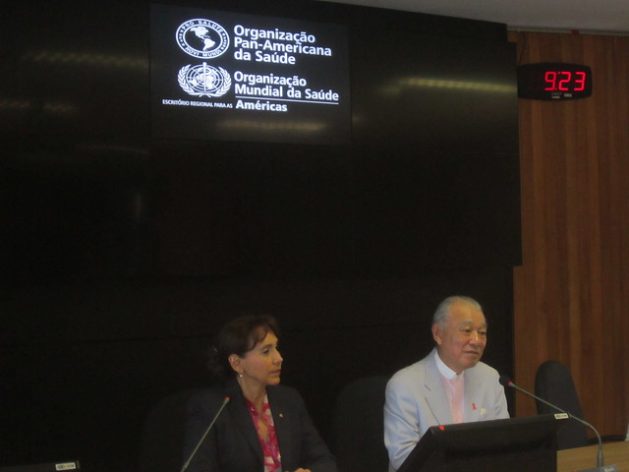
Nippon Foundation President Yohei Sasakawa and Socorro Gross, Pan American Health Organisation representative in Brazil, hold a press conference in Brasilia at the end of a 10-day visit to this country by the Japanese activist who is also World Health Organisation Goodwill Ambassador for Leprosy Elimination. Credit: Mario Osava/IPS
BRASILIA, Jul 11 2019 (IPS) – “The ambulance team refused to take my sick friend to the hospital because he had had Hanseniasis years before,” said Yohei Sasakawa, president of the Nippon Foundation, at one of the meetings held during his Jul. 1-10 visit to Brazil.
His friend was completely cured and had no visible effects of the disease, but in a small town everyone knows everything about their neighbours, he said.
This didn’t happen in a poor country, but in the U.S. state of Texas, only about 20 years ago, Sasakawa pointed out to underline the damage caused by the discrimination suffered by people affected by Hansen’s Disease, better known as leprosy, as well as those who have already been cured, and their families.
“The disease is curable, its social damage is not,” he said during a meeting with lawmaker Helder Salomão, chair of the Human Rights Commission in Brazil’s lower house of Congress, to ask for support in the fight against Hanseniasis, the official medical name for the disease in Brazil, where the use of the term leprosy has been banned because of the stereotypes and stigma surrounding it.
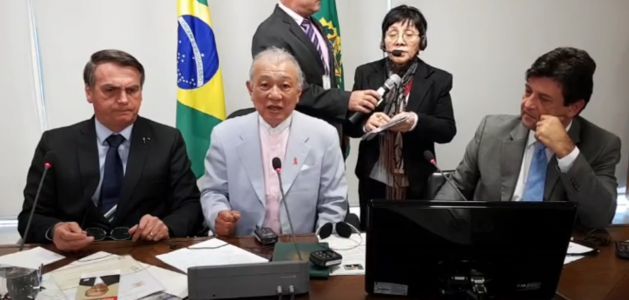
The highlight of the mission of Sasakawa, who is also a World Health Organisation (WHO) Goodwill Ambassador for Leprosy Elimination, was a meeting on Monday Jul. 8 with President Jair Bolsonaro, who posted a message on Facebook during the meeting, which had nearly 700,000 hits as of Thursday Jul. 11.
In the 13-and-a-half minute video, Bolsonaro, Sasakawa, Health Minister Luiz Mandetta and Women, Family and Human Rights Minister Damares Alves issued a call to the authorities, organisations and society as a whole to work together to eradicate the disease caused by the Mycobacterium Leprae bacillus.
A preliminary agreement emerged from the dialogues held by the Japanese activist with members of the different branches of power in Brasilia, to hold a national meeting in 2020 to step up the fight against Hanseniasis and the discrimination and stigma faced by those affected by it and their families.
The idea is a conference with a political dimension, with the participation of national authorities, state governors and mayors, as well as a technical dimension, said Carmelita Ribeiro Coriolano, coordinator of the Health Ministry’s Hanseniasis Programme. The Tokyo-based Nippon Foundation will sponsor the event.
Brazil has the second highest incidence of Hansen’s Disease in the world, with 27,875 new cases in 2017, accounting for 12.75 percent of the world total, according to WHO. Only India has more new cases.
The government established a National Strategy to Combat Hanseniasis, for the period 2019-2022, in line with the global strategy outlined by the WHO in 2016.
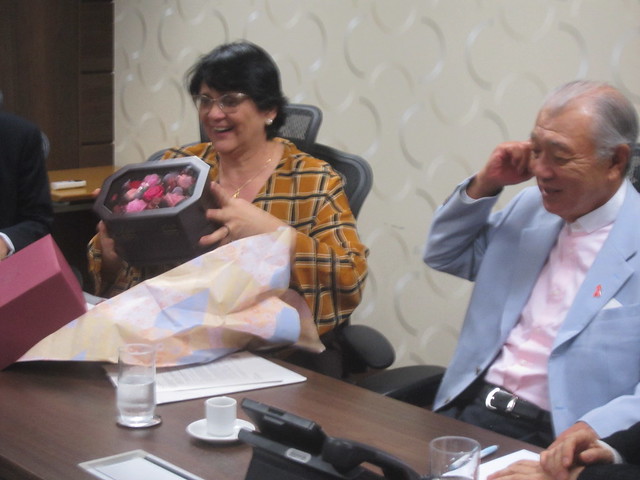
Brazilian Minister of Women, Family and Human Rights Damares Alves (L) receives a gift from Yohei Sasakawa, president of the Nippon Foundation, at the beginning of a meeting in Brasilia, in which the minister promised to strengthen assistance to those affected by Hansen’s Disease, including the payment of compensation to patients who were isolated in leprosariums or leper colonies in the past. Credit: Mario Osava/IPS
Extensive training of the different actors involved in the treatment of the disease and plans at the state and municipal levels, tailored to local conditions, guide the efforts against Hansen’s Disease, focusing particularly on reducing cases that cause serious physical damage to children and on eliminating stigma and discrimination.
Before his visit to Brasilia, Sasakawa, who has already come to Brazil more than 10 times as part of his mission against Hansen’s Disease, toured the states of Pará and Maranhão to discuss with regional and municipal authorities the obstacles and the advances made, in two of the regions with the highest prevalence rate.
“In Brazil there is no lack of courses and training; the health professionals are sensitive and give special attention to Hanseniasis,” said Faustino Pinto, national coordinator of the Movement for the Reintegration of People Affected by Hanseniasis (MORHAN), who accompanied the Nippon Foundation delegation in Brasilia.
“Promoting early diagnosis, to avoid serious physical damage, and providing better information to the public and physical rehabilitation to ensure a better working life for patients” are the most necessary measures, he told IPS.
Pinto’s case illustrates the shortcomings in the health services. He was not diagnosed as being affected with Hansen’s Disease until the age of 18, nine years after he felt the first symptoms. It took five years of treatment to cure him, and he has serious damage to his hands and joints.
His personal plight and the defence of the rights of the ill, former patients and their families were outlined in his Jun. 27 presentation in Geneva, during a special meeting on the disease, parallel to the 41st session of the Human Rights Council, the highest organ of the Office of the United Nations High Commissioner for Human Rights.
Pinto is an eloquent advocate of the use of Hanseniasis or Hansen’s Disease, rather than leprosy, a term historically burdened with religious prejudice and stigma, which aggravates the suffering of patients and their families, but continues to be used by WHO, for example.
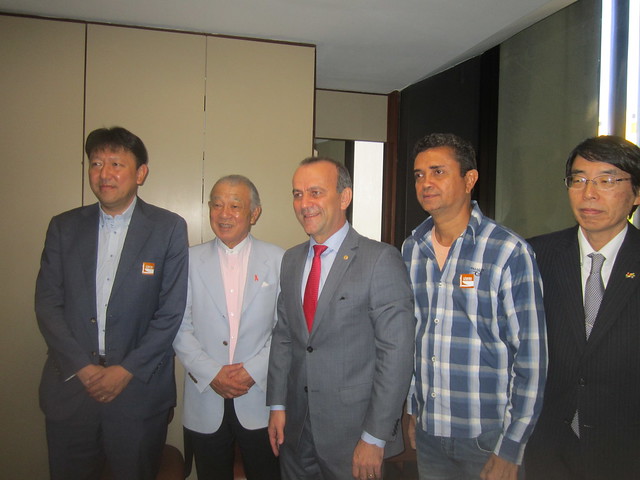
Yohei Sasakawa (2nd-L), president of the Nippon Foundation, accompanied by two members of his delegation, took part in a meeting with Congressman Helder Salomão (C), chair of the Human Rights Commission of the Brazilian Chamber of Deputies, who pledged to support initiatives to eliminate leprosy in his country. Faustino Pinto (2nd-R), national coordinator of the Movement for the Reintegration of Persons Affected by Hanseniasis (MORHAN), also participated. Credit: Mario Osava/IPS
Discrimination against people with the disease dates back to biblical times, when it was seen as a punishment from God, said Sasakawa during his meeting with Minister Damares Alves, a Baptist preacher who describes herself as “extremely Christian”.
In India there are 114 laws that discriminate against current or former Hansen’s Disease patients, banning them from public transport or public places, among other “absurdities”, he said.
In India, they argue that these are laws that are no longer applied, which justifies even less that they remain formally in force, he maintained during his meetings in Brasilia to which IPS had access.
Prejudice and misinformation not only subject those affected by the disease to exclusion and unnecessary suffering, but also make it difficult to eradicate the disease by keeping patients from seeking medical care, activists warn.
His over 40-year battle against Hansen’s Disease has led Sasakawa to the conclusion that it is crucial to fight against the stigma which is still rife in society.
He pressed the United Nations General Assembly to adopt in 2010 the Resolution for the Elimination of Discrimination against Persons Affected by Leprosy and their Families.
He said these attitudes and beliefs no longer make sense in the light of science, but persist nonetheless.
Treatment making isolation for patients unnecessary in order to avoid contagion has been available since the 1940s, but forced isolation in leprosariums and leper colonies officially continued in a number of countries for decades.
In Brazil, forced segregation officially lasted until 1976 and in practice until the following decade.
With multi-drug treatment or polychemotherapy, introduced in Brazil in 1982, the cure became faster and more effective.
Information is key to overcoming the problems surrounding this disease, according to Socorro Gross, the Pan American Health Organisation (PAHO) representative in Brazil who also held meetings with the Nippon Foundation delegation.
“Communication is essential, the media has a decisive role to play” to ward off atavistic fears and to clarify that there is a sure cure for Hansen’s Disease, that it is not very contagious and that it ceases to be so shortly after a patient begins to receive treatment, Gross, a Costa Rican doctor with more than 30 years of experience with PAHO in several Latin American countries, told IPS.
Mario Osava interviews YOHEI SASAKAWA, president of the Nippon Foundation
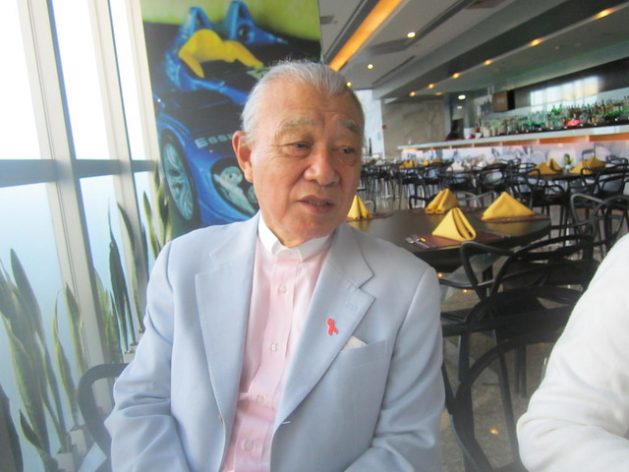
Yohei Sasakawa, president of the Nippon Foundation, is interviewed by IPS in the Brazilian capital, where he concluded a tour of the country aimed at promoting the elimination of Hansen’s Disease, better known as leprosy, and also the stigma that make it the “disease of silence.” Credit: Mario Osava/IPS
BRASILIA, Jul 10 2019 (IPS) – Yohei Sasakawa has dedicated half of his 80 years of life to combating the “disease of silence” and is still fighting the battle, as president of the Nippon Foundation and World Health Organisation (WHO) goodwill ambassador for elimination of leprosy, formally known as Hansen’s Disease.
His current emphasis is on combating the discrimination, prejudice and stigma that aggravate the suffering of people with leprosy, their families and even those who have already been cured. They also stand in the way of treatment, because people with the disease keep silent out of fear of hostility, he told IPS in an interview in the Brazilian capital.
“I travel around the world and speak out against the discrimination that marginalises those affected by the disease. But these are prejudices that have existed for 2,000 years; they cannot be overcome in two or three years. Many share my viewpoint and accompany me in the struggle. One day the discrimination will end. It is more difficult to cure the disease that plagues society than the illness itself. My effort is to hold a dialogue with presidents and ministers, people in positions of leadership, so that my message acquires political strength and can lead to a solution.”
Sasakawa visited Brazil Jul. 1 to 10, as part of his activism aimed at reducing the prevalence and social impacts of a disease stigmatised since biblical times. In Brasilia, he mobilised President Jair Bolsonaro, legislators and health and human rights officials to promote more intense efforts against the disease.
The idea of holding a national conference on Hansen’s Disease emerged from the meetings, with the political objective of disseminating knowledge and bolstering the disposition to eradicate prejudice, and the technical goal of improving strategies and efforts against the disease.
Brazil is second only to India with respect to the number of new infections diagnosed each year. The country implemented a National Strategy to Combat Hanseniasis from 2019 to 2022, with plans also at the level of municipalities and states, tailored to the specific local conditions.
The Tokyo-based Nippon Foundation is funding several projects and is preparing to support new initiatives in Brazil.
Brazil and Japan abolished the word leprosy from their medical terminology, due to the stigma surrounding it, and adopted the term Hanseniasis to refer to the disease caused by the Mycobacterium leprae bacillus. Sasakawa used this name during his interview with IPS, even though the WHO continues to employ the term leprosy.
IPS: Why did you choose as your mission the fight against Hansen’s Disease and the different kinds of harm it causes to patients and their families?
YOHEI SASAKAWA: It started with my father, the founder of the Nippon Foundation, who as a young man fell in love with a young woman who suddenly disappeared when she was taken far away and put in isolation. My father was appalled by the cruelty and, driven by a spirit of seeking justice, he started this movement. No one discussed the reason she was taken away, but I sincerely believe it was because she had Hanseniasis.
Later my father built hospitals in different places, including one in South Korea, where I accompanied him to the inauguration. On that occasion I noticed that my father touched the hands and legs of the patients, even though they had pus. He hugged them. That impressed me.
I was surprised for two reasons. It frightened me that my father so easily embraced people in those conditions. Besides, I wasn’t familiar with the disease yet. I saw people with a sick, unhealthy pallor. They were dead people who were still alive, the living dead, abandoned by their families.
I was filled with admiration for my father’s work and immediately decided that I should continue it.
IPS: What are the main difficulties in eradicating Hanseniasis?
YS: In general, when faced with a problem specialists and intellectuals come up with 10 reasons why it’s impossible to solve. I have the strong conviction that it is possible, and that’s why I address the problem in such a way that I can identify it and at the same time find a solution.
The people who find it difficult generally work in air-conditioned offices pushing around papers, studying the data. The most important thing is to have the firm conviction that the problem can be solved and then begin to take action.
The president of the Nippon Foundation, Yohei Sasakawa (C) is seen meeting with the president of Brazil, Jair Bolsonaro (L), in an IPS screen capture from the video that the president broadcast on Facebook to raise public awareness about the importance of eliminating Hansen’s Disease, better known as leprosy, and eradicating the prejudice faced by patients and their families. Credit: IPS
Since the 1980s more than 16 million people have been cured of Hansen’s Disease. Today, 200,000 patients a year are cured around the world.
IPS: What role do prejudice, stigma and discrimination play in the fight against this disease?
YS: That is a good question. After working for many years with the WHO, focusing mainly on curing the disease, I realised that many people who had already been cured could neither find work nor get married; they were still suffering the same conditions they faced when they were sick.
I concluded that Hanseniasis was like a two-wheeled motorcycle – the front one is the disease that can be cured and the back one is the prejudice, discrimination and stigma that surround it. If you don’t cure both wheels, no healing is possible.
In 2003, I submitted to the United Nations Commission on Human Rights a proposal to eliminate discrimination against Hanseniasis. After seven years of paperwork and procedures, the 193-member General Assembly unanimously approved a resolution to eradicate this problem that affects the carrier of the disease as well as those who have been cured, and their families.
But this does not mean that the problem has been solved, because prejudice and discrimination are the disease plaguing society.
People believe that Hanseniasis is a punishment from God, a curse, a hereditary evil. It’s hard to eradicate this judgment embedded in people’s minds. Even today there are many patients who have recovered and are totally healed, who cannot find a job or get married. In spite of the new laws, their conditions do not improve, because of the prejudice in people’s hearts.
In Japan, several generations of the family of someone who had the disease were unable to marry. This is no longer the case today.
That’s why I travel the world and speak out against the discrimination that marginalises those affected by the disease. But these are prejudices that have existed for 2,000 years; they cannot be overcome in two or three years.
Many share my viewpoint and accompany me in the struggle. One day the discrimination will end. It is more difficult to cure the disease that plagues society than the illness itself.
My effort is to hold a dialogue with presidents and ministers, people in positions of leadership, so that my message acquires political strength and can lead to a solution.
IPS: How did Japan manage to eradicate Hansen’s Disease?
YS: One way was the collective action of people who had the disease. Long-term media campaigns were conducted to spread knowledge about the disease. Movies, books and plays were also produced.
In Japan, Hanseniasis ceased to be the ‘disease of silence’. The nation apologised for the discrimination and compensated those affected. But in other countries, people affected by the disease have not yet come together to fight. Brazil, however, does have a very active movement.
YS: Morhan really stands out as a model. Organisations have been formed by patients in India and Ethiopia, but they still have limited political influence. The Nippon Foundation encourages such movements.
IPS: You’ve visited Brazil more than 10 times. Have you seen any progress on this tour of the states of Pará and Maranhão, in the north, and in Brasilia?
YS: On that trip we couldn’t visit patients’ homes and talk to them, but we did see that the national, regional and local governments are motivated. We will be able to expand our activities here. In any country, if the highest-level leaders, such as presidents and prime ministers, take the initiative, solutions can be accelerated.
We agreed to organise a national meeting, promoted by the Health Ministry and sponsored by the Nippon Foundation, if possible with the participation of President Jair Bolsonaro, to bolster action against Hanseniasis.
We believe that this would generate a strong current to reduce the prevalence of Hanseniasis to zero and also to eliminate discrimination and prejudice. If this happens, my visit could be considered very successful.
IPS: What would you emphasise about the results of your visit?
YS: The message that President Bolsonaro spread directly to the population through Facebook during our meeting, with his view addressed to all politicians, to his team and and to all government officials on the need to eliminate the disease. I feel as if I have obtained the support of a million people who will work with us.