A Rural Sanitation Model That Works

Asia-Pacific, Civil Society, Development & Aid, Headlines, Poverty & SDGs, Regional Categories, Water & Sanitation
Opinion

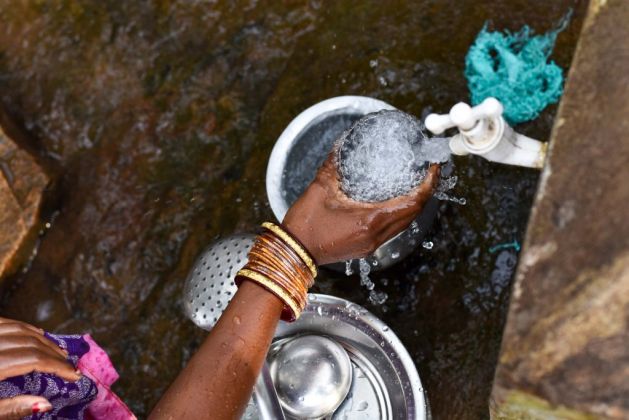
A woman collects the drinking water from the third tap in Simlipadar village in Thuamul Rampur, Kalahandi | Picture courtesy: Ajaya Behera

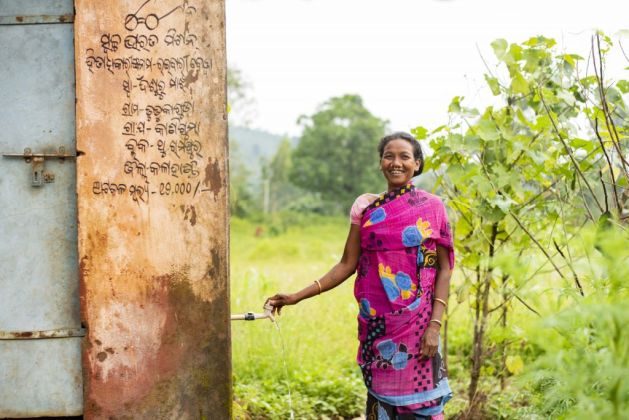
Raibari Bewa standing near the toilet, bathroom unit and collecting water from the third tap in Dudukaguda village, in Thuamul Rampur block, Kalahandi district of Odisha. On the walls, details of Swachh Bharat Mission benefits availed by her in Odia | Picture courtesy: Ajaya Behera

BHUBANESWAR, Odisha, India, Jul 30 2019 (IPS) – Research and experience across more than two decades in rural Odisha, India, show that an effective rural sanitation model requires both financial assistance and an integrated water supply.


There are studies and field reports that have analysed the Swachh Bharat Mission (SBM) in terms of coverage and use of toilets in rural India. The official government survey, the NARSS 2018-19, shows that 93 percent of rural households have access to a toilet and 96 percent of those having a toilet use them. Critiques of the survey point out the contradictions between NARSS and micro-level assessments in different parts of India. Other studies point out issues related to how comprehensive the approach to sanitation needs to be, if SBM is to truly address the large scale problems of ill-health, malnutrition, and poor quality of life caused by poor sanitation practices.

The Ministry of Drinking Water and Sanitation has already issued guidelines for follow-up components, such as the ‘Advisory on ODF Sustainability interventions‘. It is quite likely that with the Prime Minister and his government taking charge for the second term, the sustainability of the first generation SBM efforts will be given high priority. In this context, it is pertinent to throw light on some micro–level issues, based on more than two decades of experience in rural Odisha.

A rural sanitation model that works

Gram Vikas, the organisation I lead, started its work in rural sanitation in the year 1994. Our model of 100 percent coverage of all households in a village, all of them building and using household level toilets and a bathing room with piped water supply, has been recognised as a best practice nationally and globally.

Infrastructure alone is insufficient to sustain health benefits. Additional efforts are needed to motivate people to adopt safe sanitation practices…There are other aspects of personal hygiene and sanitation, including personal habits, disposal of child faeces, and menstrual hygiene; these need to be addressed by demonstrating workable models, accompanied by education

The integrated water, sanitation, and hygiene (WSH) intervention that we support rural communities with, is built on the following principles:

  • Participation of 100 percent of the habitation’s households; it is all, or none.
  • Cost sharing by the household, partially towards construction of the facilities, and fully for operations and maintenance.
  • Ownership and management by a village water and sanitation committee, consisting of representatives of all sections in the village.
  • A sanitation corpus fund built from a one-time contribution by all, towards providing cash incentives for future families in the village to build toilets and bathing rooms (ensuring 100 percent coverage at all times).
  • A maintenance fund through regular household fee collection, for maintenance of the piped water supply system.

In 25 years (up to March 2019), the Gram Vikas WSH model has been implemented in more than 1,400 villages, covering close to 90,000 households. The villages are financed primarily through the sanitation and rural drinking water schemes of the government, and Gram Vikas has mobilised private resources to fill in gaps.

What we learnt

Over the past two decades, working with rural communities of different types, we have realised that bringing about attitudinal and behaviour changes towards safe sanitation is not easy. When we began in the mid-1990s, saying that every house in the village will have toilets, bathing rooms, and piped water, most people laughed.

Between 1994 and 1999, we could cover only 30 villages—this resulted from our own efforts at motivating people, and not any felt desire on their part. Then started the gradual process of change—fathers of unmarried girls motivating future sons-in-laws’ village elders to take up the sanitation project; women taking the lead to convince their men to build toilets, and even stopping cooking for a day or two to make their husbands see reason; migrants who worked outside Odisha coming back to their own villages and motivating their parents, and so on.

When it comes to rural sanitation, government financial assistance matters  

Between 1999 and 2007, the government’s support to sanitation, as part of the then newly launched Total Sanitation Campaign, was INR 300 per household, for below poverty line families. Support for community-led, piped water supply projects came much later, in the form of Swajaldhara in 2003.

The prevalent thinking among policy makers in the early 2000s was that financial incentives were not necessary to promote rural sanitation. This was based on the limited success of the subsidy-led Central Rural Sanitation Programme, that ran between 1986 and 1998.

Financial incentives to rural households for building toilets is more than a subsidy, it’s about society meeting part of the costs of helping rural communities build a better life. To compare, urban dwellers who may have built their own household toilets, do not pay anything for removing the human waste from their premises; municipal governments ensure sewage lines and treatment plants. The cost of this (which is borne by the government) is not seen as a subsidy. And yet, the upfront payment made to rural households to help build toilets is looked down upon as wasteful expenditure.

In 2011, the policy moved to a higher level of financial incentives to rural households for constructing individual household latrines, mostly likely in recognition of the fact that rural households needed the financial incentive as motivation to change sanitation behaviours. But today, with statistics showing 93 percent or more coverage of toilets, the policy prescription is likely to move to the pre-2011 phase–big financial incentives are not needed for building rural household toilets.

Our experience has taught us that nothing can be further from the truth. First, actual coverage of usable toilets is likely much less than what the numbers show. Second, households will need support for repairs and upgradation of the already built latrines. In addition, there are two categories for whom the financial assistance must continue: those who, for various reasons, have not constructed latrines so far; and new households that have come up in villages that have already been declared open defecation free (ODF).

Availability of water in the toilet is critical to encouraging use and maintenance of the facility 

In most cases, where water is not available in proximity, the load on women to carry water has increased. A pour-flush latrine, the type mostly preferred, requires at least 12 litres of water per use. With 4-5 members in the household, the minimum daily requirement becomes about 60 litres, forcing women to collect at least three times the water they would otherwise collect. We have observed that without water in the household premises, women’s water carrying load increases to more than twice the pre-latrine times.

The addition of a bathing room, affords women more privacy, and a better way to keep themselves clean and hygienic. In most villages we have worked with, women especially, equate this part of their physical quality of life to what people in the city enjoy.

During the last few years, financial allocation for rural water supply has decreased. While the allocation to drinking water has reduced from 87 percent (2009-10) to 31 percent (2018-19), the allocation to rural sanitation has increased from 13 percent to 69 percent in the same period. This is definitely not a desirable situation, as noted by many.

Mainstreaming the community-owned and managed method of rural water supply will ensure equitable distribution 

Doing this, rather than pushing for large water supply projects across many villages, will give rural communities and local governments greater control over managing their resources and meeting the needs of every household in an equitable manner. The Swajal programme of the Ministry of Drinking Water and Sanitation, which talks about village level, community-based water projects, is a step in the right direction. Much greater push is needed by the central government to ensure that the state-level apparatus moves to a more enabling and empowering approach in addressing rural drinking water needs.
Research and experience across more than two decades in rural Odisha, India, show that an effective rural sanitation model requires both financial assistance and an integrated water supply.

A woman collects the drinking water from the third tap in Simlipadar village in Thuamul Rampur, Kalahandi | Picture courtesy: Ajaya Behera

Second generation challenges

The water and sanitation infrastructure, when first built, contributes to a substantial decrease in water-borne diseases in villages. These are borne out of several studies conducted in villages in Odisha.

After the initial round of benefits, we find that the infrastructure alone is insufficient to sustain health benefits. Additional efforts are needed to motivate people to adopt safe sanitation practices. The ensuing issues have been highlighted by many. For instance, changing long-standing beliefs and attitudes related to toilet use requires intensive hand holding, particularly for older people. There are other aspects of personal hygiene and sanitation, including personal habits, disposal of child faeces, and menstrual hygiene; these need to be addressed by demonstrating workable models, accompanied by education.

From Gram Vikas’ experience in Odisha, we have been able to enumerate several challenges that need to be addressed. Even when piped drinking water exists, households prefer to store drinking water. We have found that handling of stored drinking water is an area that needs better education.

Disposal of child faeces, especially by mothers who do not think the child’s faecal matter is harmful, is another area of concern. We are also coming across new forms of discrimination in households, where menstruating women are not allowed to use the toilets and bathrooms.

While issues related to personal hygiene and washing hands with soap are already quite widely discussed, the next set of challenges relate to safe disposal and/or managing liquid and solid waste at the household and community level.

A charter of demands

We hope that the next iteration of Swachh Bharat Mission will truly lead to a Swachh Bharat. Based on our experience, we would like to draw the following charter of demands:
.

1. Strengthen the ways of providing household sanitation infrastructure

  • Add a bathing room component to the design and costing provided in the national guidelines; increase financial support per household to INR 18,000 for new entrants; allow additional funding of INR 6,000 per household for those wanting to add a bathroom to their existing toilets. 
  • Create provisions for repair or upgradation of toilets built, till 2018; provide for additional assistance to households whose toilets were built by contractors without involvement of the household. 
  • Provide financial assistance for new households in villages already declared ODF. 
  • Correct errors in the baseline of deserving households. 

2. Integrate piped water supply with sanitation at the household level, and facilitate greater community control over rural drinking water projects

  • Enlarge the scope for Swajal scheme by allocating more funds. 
  • Where ground water availability challenges dictate building of larger projects, it will make sense to separate the pumping and supply, from household distribution of water. The former could be done centrally for a large number of villages, while the latter could be managed by the communities at their level.
  • Make individual householdlevel piped water supply the standard design principle for rural water supply projects. 
  • Build community capacities to manage groundwater resources and undertake watershed and springshed interventions. 
  • Integrate water quality management as a communitylevel initiative, by demystifying testing technologies, and creating wider network of testing laboratories. 

3. Deepen and integrate WSH interventions for better health and nutrition outcomes at the community-level

  • Incentivise states to achieve stronger schematic and financial convergence between National Health Mission and the Integrated Child Development Services at the intermediate and gram panchayat level.  

4. Create a multi-stakeholder institutional platform to deepen and sustain SBM across rural India

  • Incentivise states to enablPanchayati Raj Institutions to play a greater role in the SBM process.
  • Allow for more active participation of civil society organisations as facilitators and implementors, to support rural communitybased institutions to adopt sustainable sanitation interventions. Provide financial incentives to such organisations based on outputs and outcomes.

Liby Johnson is the executive director of Gram Vikas, Odisha

This story was originally published by India Development Review (IDR)

 

Power is a Privilege & a Responsibility: Q&A with Justin Trudeau, Prime Minister of Canada

Civil Society, Development & Aid, Editors’ Choice, Featured, Gender, Global, Global Governance, Headlines, Human Rights, IPS UN: Inside the Glasshouse, TerraViva United Nations

Opinion

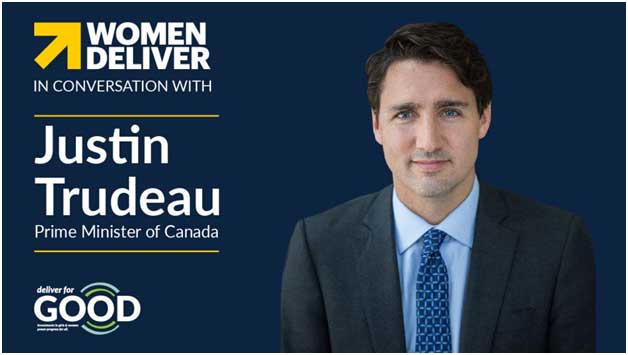
In a special conversation, Katja Iversen, President/CEO of Women Deliver speaks with Justin Trudeau, Prime Minister of Canada, about Canada’s role in taking action for gender equality at home and abroad and our collective and individual responsibility to share power to build a gender equal world.

NEW YORK, Jul 29 2019 (IPS) – It’s on all of us to make gender equality a reality – which means harnessing our collective power to build a gender equal world.

By empowering girls and women, realizing sexual and reproductive health and rights, tackling gender-based violence, and confronting the combinations of sexism, misogyny, racism, and colonialism, we can take steps towards true gender equality.


Coming off the heels of the Women Deliver 2019 Conference in Vancouver, we both explore the need to use – and share – power to deliver transformative change for girls and women.

Katja Iversen: At the Women Deliver 2019 Conference we focused on power, and how it can drive – or hinder – progress and change for girls and women, and therefore for all. How will you use your power?

Justin Trudeau: Power is a privilege and a responsibility. Ultimately, the best thing you can do with power is share it. As we saw at Women Deliver, grassroots advocates and activists are creating change on the ground. Young people, like Natasha Wang Mwansa, are not just the leaders of tomorrow, but the leaders of today.

We need to amplify the work they’re doing, pass them the microphone, and make sure there’s a seat at the table for people of diverse identities and perspectives.

Katja Iversen: In the lead up to and during the Women Deliver 2019 Conference, we have seen unprecedented energy and enthusiasm for advancing gender equality. How do we take that energy and commitment and turn it into action? From world leaders and business leaders to advocates and influencers, what is your call to action to keep up the momentum?

Justin Trudeau: At Women Deliver, we announced new steps forward on everything from funding for women’s health and women’s organizations, to support for women entrepreneurs and housing commitments that will benefit women.

We announced that Canada will increase our investment to $1.4 billion to support women and girls’ health globally, positioning us as a leading donor worldwide on comprehensive sexual and reproductive health rights. $700 million of this annual investment is dedicated to sexual and reproductive health rights.

We’re focusing on the most neglected areas of this field. This is a game changer. We welcome other leaders to join us.

Globally, and here at home, we are seeing attacks on women’s rights, whether it’s undermining a woman’s fundamental right to choose, or violence against Indigenous women and girls. We can’t take our foot off the pedal, not even for a moment.

There’s simply too much at stake. We all need to work together to move forward, and to build more sustainable, more inclusive movements. It’s on all of us to make gender equality a reality.

Katja Iversen: Over the last several years we have heard more world leaders and private sector executives make public statements about the importance of gender equality. This is certainly critical, commendable, and encouraging! But we also need to see these leaders “walk the talk” and move toward action.

This is something you have emphasized throughout your administration from appointing a gender equal cabinet to developing gender-responsive federal budgets – both of which are crucial for moving policies and programs to actual impact. What impact have these actions had in Canada and around the world and what will you do next to move the needle for girls and women?

Justin Trudeau: Our government has put gender equality at the heart of everything we do. This means grappling with interlocking issues like sexism and misogyny, racism and colonialism. These challenges are complex and layered.

We won’t always get it right, but we will always keep trying. We know that it’s time to put an end to violence against all women and transgender, non-binary, and two spirit people, which is why we launched the first ever national strategy on gender-based violence.

We know that advancing gender equality hinges on economic equality, too. We will continue to demand that women and men receive equal pay for work of equal value, that everyone has a safe place to live, and that parents can share equally in both the joys and the responsibilities of raising children.

That’s why we introduced historic proactive pay equity legislation, and created more flexible parental leave options. And it’s why we launched a housing strategy where a minimum of 25% specifically supports women, girls, and their families.

There is much more work to do, and Canada is in it for the long haul. We will keep fighting for gender equality and concrete change – not just when it is popular, but always.

Katja Iversen: From driving Canada’s first Feminist International Assistance Policy to establishing the first Gender Equality Advisory Council to a G7 Presidency, you have led the way for political leadership toward gender equality – with an emphasis on improving girls’ and women’s sexual and reproductive health and rights.

Why should world leaders like you prioritize gender equality and women’s right to decide on their own bodies on international agendas and what more do you plan to do? Please provide 1-2 specific examples.

Justin Trudeau: Women don’t have to imagine not being able to access healthcare when they need it. They don’t have to imagine being denied the right to choose what’s best for their health and their future. For far too many people, that’s their reality. And that’s unacceptable.

Governments need to stand with those on the frontlines as partners and as allies. Leaders should prioritize gender equality and women’s right over their own bodies because it makes our countries, our communities, our workplaces, our governments, and our families stronger.

When women are healthy, free to make decisions about their lives, and can equally participate in our economies, we all benefit.

Katja Iversen: From the hallways of power to the main stage of global convenings, what argument have you found to be most effective in converting more people – especially decision makers – to join you as gender equality champions?
Justin Trudeau: Gender equality is not only the right thing to do, but it is also the smart thing to do. It powers our economies, and changes our communities for the better. Everyone should be able to get behind that.

Katja Iversen: You have spoken about raising your sons with an awareness of power dynamics and to act as allies of girls and women. Part of this involves a shift in mindset, from the idea that boys and men are losing power to the idea that power is shared with girls and women, to the benefit of all.

Why is it so important to you and your wife – Mme Sophie Grégoire Trudeau, a Deliver for Good Influencer – to raise your sons as young feminists, and how have you encouraged them to be effective and supportive allies for gender equality?

Justin Trudeau: Sophie and I want to help our kids grow up to be strong allies and empathetic adults, who walk through the world with openness, compassion, and a commitment to justice. That’s why raising our kids as feminists is such a priority for us.

We want our daughter, Ella-Grace, to have the same opportunities as her brothers, Hadrien and Xavier. And we want our sons to escape the pressure to be ‘a particular kind of masculine’ that can be damaging to men and to the people around them.

We want all three of them to be confident in being themselves, to stand up for what is right, and to do so with pride. We try to instill in our children the notion that everyone should be treated equally, and that there’s work left to do so that everyone shares the same rights and freedoms. We hope our children learn that they have a responsibility – and the power – to shape our world for the better.


Is Civil Society Arguing Itself out of Political Space?

Active Citizens, Civil Society, Development & Aid, Global, Headlines, Regional Categories

Opinion

Felix Dodds is Adjunct Professor at the University of North Carolina and Associate fellow at the Tellus Institute

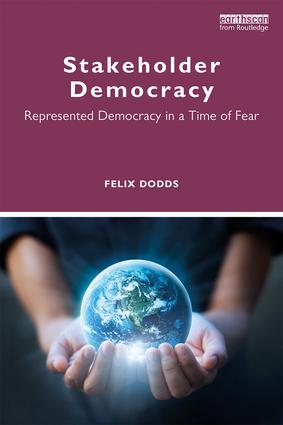
NEW YORK, Jul 29 2019 (IPS) – As some of you will know I have a new book out Stakeholder Democracy: Represented Democracy in a Time of Fear.  (other contributors to the book were:  Jan-Gustav Strandenaes, Carolina Duque Chopitea, Minu Hemmati, Susanne Salz, Bernd Lakemeier, Laura Schmitz, and Jana Borkenhagen). 


The book’s theory of change is very simple involving stakeholders in the decision making makes better-informed decisions and that those decisions are more likely to be implemented with those stakeholder’s support either singularly or in partnership.

The book places Stakeholder Democracy within the spectrum of Representative to Participatory Democracy.

It argues that we need to strengthen represented democracy in a time of fear through engaging stakeholders. It recognizes that in many places politicians are no longer believed but they need to make difficult decisions. To help them do this engaging with the support of stakeholders can help them to have the political courage to address climate change or the wave of new technologies coming or migration or the many other difficult issues we will be facing in the next ten years up to 2030.

Two discourses

Since around 1992 we have had two different political discourses in play that of stakeholders and that of civil society.

Under the leadership of Maurice Strong, Chip Lindner, and Nitin Desai the Earth Summit moved away from the old NGO discourse. This was that in the UN everyone who wasn’t a government or an intergovernmental organization was an NGO as far as the UN was concerned.

The Earth Summit changed that. Agenda 21 recognized 9 stakeholder groups in society who should be involved in policy development and in helping to deliver Agenda 21 and the Rio Conventions. These were:

  1. Women
  2. Children and Youth
  3. Indigenous Peoples
  4. Non-Governmental Organizations
  5. Local Authorities
  6. Workers and Trade Unions
  7. Business and Industry
  8. Scientific and Technological Community
  9. Farmers

By the way, these were enlarged in the development of the 2030 Agenda to include others such as older people and the disabled.

At the same time in the  World Social Summit (1995), the Financing for Development space (2002) and those around the Bretton Woods Institutions a different political discourse evolved that of civil society.

This discourse recognized only two different groups than government and intergovernmental bodies these two were industry and civil society. What did this mean?

Civil Society concept increases space for industry

We often hear in the civil society discourse of the increased space that industry has.

Well, the conceptual framework for civil society by its nature increases the space of industry from one of nine to one to two.

So let’s be clear the advocates for this by their own actions are giving up massive space for industry and reducing space for other stakeholders.

It also allows governments and intergovernmental organizations to just group anyone who isn’t industry into a catch-all group.

Who is Civil Society?

Well, there are many definitions out there and the book looks at some of them. But what it tends to be is a space dominated by NGOs…it does subjugate women, youth, community groups etc into this one space no longer having their individual and unique voices.

By doing this it dilutes the gender perspective – it reduces the voice of the next generation.

Civil Society also excludes a number of key stakeholders that includes academics and scientists, Indigenous Peoples – they are a “Peoples” and should, of course, have not to be subjugated to other views.

It excludes local and subnational government who is seen as a level of government but whose voices freedom found with their national government.

The book goes into examples where this course has resulted in the wrong people being at the table.

The Stakeholder discourse, on the other hand, requires an ongoing stakeholder mapping process to ensure the right people are at the table.

It gives them individual space to articulate for a gender perspective or youth a next-generation perspective. It enables new relevant stakeholders that have emerged over the last 25 years to be recognized and given space such as older people or people with disabilities.

Civil Society discourse is a lazy discourse

What amazes me is how groups that do not benefit from the civil society discourse seem to accept it without question.

I can only think it is because its easier than to argue for the individual voice of relevant stakeholders.

For governments and intergovernmental organizations, it makes their life much easier.

They don’t have to show what they are doing for engaging each of the stakeholders they leave it to a broad engagement with this catch-all group of civil society.

What it has done in many UN bodies that have adopted this reduces the staff support for stakeholders and increase it for industry – a good example of this is UNEP.

After all, now intergovernmental bodies would only be servicing two groups… resulting in the need for only a form of parity between civil society support and industry. Previously there needed to be evidence of support for women, youth, Indigenous Peoples etc.

You can hear from some of those lazy people the comments like…

“ahh how do you decide which stakeholder group you should be a member of”

They go on to say “what if you are a woman and a young person and work for an NGO.

Well, the engagement isn’t and shouldn’t be based on the individual it’s based on the organization in all cases. To be clear it should be based on what the organization’s policy priorities are. If the organization is focused on youth policies then it should engage with the youth caucus, if its work is gender then it should engage with the women’s stakeholder group and if it’s a mixture well work in a number of different stakeholder groups.

Who benefits from the Civil Society discourse?

I always like to look at who benefits to see if that has a bearing.

It’s clear that there is a number that benefit.

Governments and Intergovernmental organizations benefit as they don’t have to address the different voices and leave that coordination to whoever is organizing the civil society group.

Industry benefits as they gain a huge additional space vacated by key stakeholders one of 2 is so much better than one of 9 or more for them.

Also, large well organized northern-based NGOs benefit as they can assert a larger influence on one space than many.

So if you are happy with giving more space to industry, reducing space for women and youth and other key stakeholders, not recognizing Indigenous Peoples right for their own space, do not want academics and scientists to be able to represent their research then do continue to use the civil society concept but understand what you are doing.

You are actively taking part in reducing space for all other stakeholders.


Trump’s Vision for Africa: the 1960s

Since Trump's
Since Trump’s ‘Make America Great Again’ trope has become a racist mantra so too have merchandise bearing mottos like ‘Make Zimbabwe Rhodesia Again’ ‘Make Afrikaners Great Again’ and ‘Make Namibia German Again’
(Image by strategic-culture.org)
  Details   DMCA
– Advertisement –

Although Donald Trump can barely place a single country in Africa, his few utterances on the continent have yielded what can only be described as a nostalgia for the 1960s. It was a decade that saw three white minority-ruled governments ruling in South Africa, Rhodesia, and the South African territory of South-West Africa. All three white-ruled entities practiced varying degrees of apartheid. This was accomplished through economic, social, and political means.

In January 2018, when Trump referred to African nations as “shithole countries,” he was relishing the time when apartheid South Africa, Rhodesia, and South-West Africa were considered a pro-US bloc in southern Africa. The links between southern Africa’s exiled black African liberation political parties and movements to Communist- and Marxist-ruled nations, in the minds of Trump and his equally right-wing father, Fred Trump, Sr., made South Africa, Rhodesia, and South-West Africa model nations in the eyes of the Trumps.

Trump’s sympathies for the apartheid countries were crystal clear when, on August 22, 2018, Trump tweeted: “I have asked Secretary of State Pompeo to closely study the South Africa land and farm seizures and expropriations and the large scale killing of farmers. ‘South African Government is now seizing land from white farmers.'”

– Advertisement –

The South African government was keenly aware that Trump was using a trope from the apartheid era. White South African prime ministers, including John Vorster and P. W. Botha were fond of warning their own constituencies, as well as the West, that if blacks achieved majority rule in South Africa, white farmers would be massacred and their land expropriated. These were fear tactics, pure and simple. Mr. Trump, caught in some sort of time warp, continues to believe the apartheid propaganda.

In response to Trump’s tweet, the government of South African President Cyril Ramaphosa hit back at Trump: “South Africa totally rejects this narrow perception which only seeks to divide our nation and reminds us of our colonial past.” It turns out that Trump got his idea that the South African government was seizing land from white farmers from the disreputable Fox News. As for the claim that white farmers were being killed, that bit of bogus information came from a far-right group called AfriForum, consisting of mainly Afrikaners in South Africa and abroad.

The AfriForum disinformation about white-owned farms and farmers in South Africa was picked up by Trump through Fox News’s Tucker Carlson. Carlson’s father, Dick Carlson, was President Ronald Reagan’s chief propagandist as the director of the US Information Agency (USIA), since closed down. During 1985 and 1986, Dick Carlson ensured that a steady stream of right-wing propaganda emanated from the Voice of America, the anti-Cuban Radio Marti, and other platforms. This included support for apartheid South Africa. Other top Republicans involved in pro-South African propaganda included disgraced Republican Party lobbyist Jack Abramoff and Republican activist Lewis Lehrman. In 1985, USIA and the Voice of America, at Carlson’s direction, highlighted an anti-Communist summit meeting held in Jamba, Angola. The summit, called the “Jamboree in Jamba,” was attended by Abramoff, the Angolan UNITA rebel leader Jonas Savimbi, Nicaraguan Contra leader Adolfo Calero, Laotian Hmong leader Pa Kao Her, and Afghan Mujaheddin leader Abdul Rahim Wardak. Also present was Reagan National Security Council official Marine Lieutenant Colonel Oliver North, as well as South African and Israeli representatives. The South African Defense Force provided the security for the summit. Based on the success of the Jamba summit, the Republican right-wing even had hopes of restoring a proto-colonialist administration in Mozambique, the former Portuguese colony. By attempting to create a RENAMO-led government in Mozambique, the right hoped many Portuguese exiles could return to Mozambique to hold key positions in government and commerce. This, of course, was the same thinking behind the right’s support for Savimbi’s UNITA forces in Angola, also a former Portuguese colony.

– Advertisement –

One of the US groups backing the apartheid South African government was the Committee on the Present Danger, a fervently anti-Communist group. Extinct since the end of the Cold War, the Committee recently enjoyed a resurgence in Washington under the auspices of Trump’s former chief strategist Steve Bannon, Texas Republican Senator Ted Cruz, and former US House of Representatives Speaker Newt Gingrich.

In the 1980s, it was clear that far-right elements in the Reagan administration were trying to shore up white-rule in South Africa, prevent total black rule in South-West Africa, and roll back rule by Robert Mugabe in Zimbabwe the former Rhodesia. The racist right-wing in the United States had hoped to prevent Mugabe from coming to power in June 1979 by backing the creation of a post-minority rule country called Zimbabwe Rhodesia. The use of the name Rhodesia was a concession to the white minority in the country, which, upon unilateral independence in 1965, was headed by Prime Minister Ian Smith. Smith was a hero to the far-right elements in the United States, including the Ku Klux Klan. Smith and his allies in South Africa decided the best way to maintain the status quo was to form an alliance with Rhodesian tribes opposed to Mugabe, including Ndebele leaders like Joshua Nkomo.

The first Prime Minister of Zimbabwe Rhodesia was Bishop Abel Muzorewa, who, like Mugabe, was a member of the northern Shona tribe. Muzorewa was an opponent of Mugabe as were other officials in the short-lived Zimbabwe Rhodesia, sometimes called “Rhobabwe.” Smith continued in the government as a minister without portfolio. White Rhodesians continued to serve as ministers of finance, justice, agriculture, and finance. When Britain re-established control over Zimbabwe Rhodesia and changed its name to Southern Rhodesia in December 1979 the writing was on the wall for the white-black coalition government. In 1980, Mugabe became prime minister of Zimbabwe. In the subsequent years, many white Rhodesians fled to South Africa, the United States, Canada, and Australia.

In 2015, Dylan Roof, the US white supremacist who massacred African Americans in a Charleston, South Carolina church, appeared on a website called “The Last Rhodesian” wearing a jacket emblazoned with the flags of Rhodesia and apartheid South Africa. Rhodesian expats have also been involved with several racist groups around the world, including Australia, Canada, Britain, and New Zealand. Donald Trump has rekindled hope among these stubborn nostalgists for white rule in southern Africa that what once seemed impossible is now quite thinkable: white-dominated governments in Harare, Pretoria, and Windhoek.

A similar situation was attempted by promoters of white rule in South-West Africa. In 1977, the Democratic Turnhalle Alliance formed a de facto government in Windhoek led by Dirk Mudge. Mudge, an Afrikaner, governed with the support of South Africa and representatives from various ethnic groups, including the Ovaherero, Coloureds (mixed race), Tswana, Damara, a few Ovambo, Caprivians, Nama, Kavango, San, and White Afrikaners and Germans, the latter concentrated on the coast around Swakopmund. The United Nations refused to recognize the Turnhalle government, opting for the exiled South West African People’s Organization (SWAPO) of Sam Nujoma, which was heavily supported by a majority of the Ovambo people. The attempt by whites and their allies to prevent Nujoma from becoming president of independent Namibia ultimately failed.

Thanks to social media, a de facto alliance of exiled white Rhodesians, South Africans, Nyasalanders (now Malawi), and Namibians, along with racists in Europe, North America, and Australia, see with Trump as president of the United States and the equally racist Jair Bolsonaro as president of Brazil an opportunity for them to set the calendar back to the 1960s. Just as minority white leaders like Smith, Vorster, Botha, and Mudge attempted to seek alliances of convenience with various African ethnic groups to maintain ascendancy the Ndebele, Zulu, Venda, Tswana, Damara, and Ndau, among others Trump, Steve Bannon, former Ku Klux Klan leader David Duke, and about a dozen hard right Republican members of the US Congress are hoping to restore de facto white rule in southern Africa.

– Advertisement –

Since Trump’s “Make America Great Again” trope has become a racist mantra, so, too, have merchandise bearing mottos like “Make Zimbabwe Rhodesia Again,” “Make Afrikaners Great Again,” and “Make Namibia German Again.” Some whites with roots in Malawi, where the second largest city is Blantyre named after the town of Blantyre in South Lanarkshire, Scotland would not mind it if they again enjoyed high positions of influence in the country formerly known as Nyasaland. Some of the descendants of the 75,000 whites who formerly lived in Northern Rhodesia, now Zambia, also pine for the days when whites ruled the country. Afrikaner nationalists also recall with fondness the desire of apartheid South African Prime Minister Hendrik Verwoerd wanting to turn Bechuanaland (now Botswana), Basutoland (now Lesotho), and Swaziland (now eSwatini) into South African ruled dominions.

Creation of a South Atlantic Treaty Organization (SATO) has long been a goal of neo-conservatives like John Bolton, Trump’s National Security Adviser, and Elliott Abrams, Trump’s “special envoy” for Venezuela. In March 2019, Trump, restarting this goal of the Reagan and Richard Nixon administrations, said during the visit of Bolsonaro to the White House, “I also intend to designate Brazil as a major non-NATO ally, or even possiblyif you start thinking about itmaybe a NATO ally.”

Pleased with the 1970s success of Operation Condor, an intelligence alliance of Latin American military dictatorships that targeted for assassination and arrest leftists in South America and beyond, Secretary of State Henry Kissinger foresaw a military alliance of the Condor partners of Argentina, Brazil, Chile, and Uruguay, along with apartheid South Africa and the United States, as firmly extending US military control over the south Atlantic region. Kissinger’s plan for a SATO continued under Reagan. One Reagan administration policy paper was titled “The Security of the South Atlantic: Is It a Case for ‘SATO’South Atlantic Treaty Organization?” Just as with Trump and Bolsonaro today, in 1984, Reagan and Brazilian President João Figueiredo, Brazil’s last military dictator, had talks on the formation of SATO.

Next Page  1  |  2

Trump Orders Sweden to Release their US Rapper A$AP Rocky

US President Donald Trump has demanded that Sweden “give ASAP Rocky his freedom” in a series of tweets.

The musician, real name Rakim Myers, has been charged with assault causing actual bodily harm in Stockholm. He will remain in custody until a trial takes place.

Trump


Mr Trump said on Twitter that Sweden had “let our African American community down”.

ASAP was arrested on 3 July following a fight that was captured on video.

Two other men who were with them at the time have also been charged with assault. The musician says that his group was being followed by a group of men and he acted in self-defence.

A$AP Rocky

Donald Trump said last week that he had spoken to Swedish prime minister Stefan Lofven about ASAP’s case.

However on Thursday the president wrote that he was “very disappointed” in Mr Lofven for being “unable to act” and urged him to “treat Americans fairly”.

Trump’s intervention in the case comes after rapper Kanye West approached him to convince Sweden release the rapper.

Human Rights Watch Disappoints on Human Rights

Armed Conflicts, Civil Society, Crime & Justice, Global, Headlines, Human Rights, Migration & Refugees, Natural Resources, Peace, Press Freedom, TerraViva United Nations

Opinion

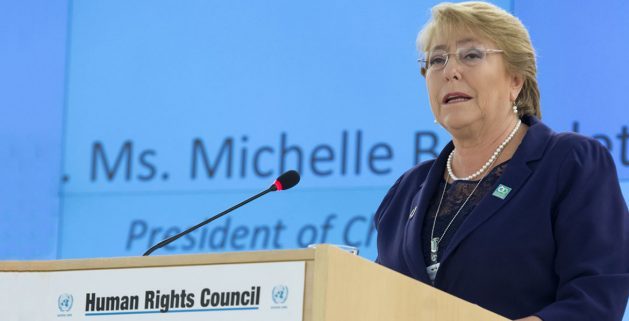
Michelle Bachelet, UN High Commissioner for Human Rights. Credit: Jean-Marc Ferré/UN Photo.

GENEVA, Jul 25 2019 (IPS) – On 22 July 2019, Kenneth Roth published an article in Publico, Lisbon, entitled: “UN Chief Guterres has disappointed on Human Rights”.


This essay lampooning Antonio Guterres is not a voice “against the tide” but very much mainstream – and demonstrably skewed. Major NGOs headquartered in rich advanced countries and enjoying generous funding from the Establishment may not always think “out of the box” and are as likely, as are the interest groups which support them, to politicize human rights and therefore to disappoint rights holders in smaller or weaker countries.

While they do contribute to exposing situations of human rights violations worldwide , they are not exempt from biases which reflect the structure of their central governing bodies or the cultural environment within which they operate. They cannot arrogate to themselves the sole legitimacy to speak in the name of the civil society of many countries , and when they claim to do so, they may disappoint rightsholders, particularly in the developing countries, whose priorities are frequently different from theirs.

Kenneth Roth’s bludgeoning of the UN Secretary General in this regard is yet another expression of grandstanding and even of a measure of arrogance. HRW’s criticism of China, Russia, Cuba, Nicaragua, Venezuela, would be more persuasive if the organisation addressed with the same intensity the egregious violations of human rights in many other countries

Sober analysis and stocktaking are necessary to determine whether and to what extent the priorities and agendas of NGOs’s like HRW are set by the overall interests of the established power-structures and multiple elites in many countries. Kenneth Roth’s article expressing disappointment at the human rights performance of Secretary General Antonio Guterres fails to identify the root causes of human rights violations.

His admonitions have little or no preventative value, and do not formulate constructive recommendations such as, for instance, the provision of advisory services and technical assistance to many countries that need it and have asked for it.

HRW’s “naming and shaming” strategy has been inconclusive at best because “naming and shaming” depends on the authority of the “namer” and the impartiality of the methodology. Kenneth Roth’s bludgeoning of the UN Secretary General in this regard is yet another expression of grandstanding and even of a measure of arrogance. HRW’s criticism of China, Russia, Cuba, Nicaragua, Venezuela, would be more persuasive if the organisation addressed with the same intensity the egregious violations of human rights in many other countries.

For instance, Mr. Roth does not mention the denial of the right of self-determination to millions of people, the retrogression in the enjoyment of economic, social and cultural rights (prohibited by the Covenant on Economic, Social and Cultural Rights), the looting of natural resources and degradation of the environment by transnational corporations and their neocolonial schemes, the impunity enjoyed by politicians who engage in aggressive wars and by paramilitaries and private security companies, the devastating human rights impact of blockades by source countries and economic sanctions on the populations of Gaza, Syria, Iran and Venezuela, which have caused and continue to cause tens of thousands of deaths.

The politicization or as we now witness with concern, the“weaponization” of human rights is taking the world on a slippery slope. When the Universal Declaration of Human Rights (UDHR)was adopted in 1948, Eleanor Roosevelt, Charles Malik, René Cassin and others spoke of human dignity and the inalienable rights of human beings, but article 29 of UDHR also reminded us that “everyone has duties to the community”.

Indeed, what is most necessary is global education in human rights, including the human right to peace, education in empathy and solidarity with others – compassion, not predatory competition in “the human rights industry” on a “holier than thou” ticket.

Meanwhile, Secretary-General Antonio Guterres should not be expected to act as a Human Rights NGO. This high office is not that of an unaccountable activist. It is neither that of a general that can blast any state at will nor is it a secretary that has to be subservient to the prevailing powers that be.

That high official must recognize the reality of the power balance that he cannot fundamentally alter but must strive with obduracy and at times courage to stretch the international community towards more compliance with the purposes and principles of the United Nations. Most importantly this means the promotion of peace through conflict-prevention, good offices, impartial mediation, disarmament and yes, human rights. When all diplomacy fails and only then may “naming and shaming” become an option. But it is a default option and a sign of diplomatic failure.

In the experience of both of us as Special Rapporteurs of the Human Rights Council, we have delivered on our mandates, not by openly challenging the authority of states or claiming to teach them lessons in human rights but by giving quiet diplomacy a chance .

This is how one of us together with another Independent Expert facilitated a lifting of the sanctions on Sudan and this is how we are again currently engaging with protagonists of other conflicts. We have succeeded in confidence-building and contributed to the release of detainees. Persevering and discrete advocacy bears fruit.

We want a SG that puts values above politics in human rights matters and this is, in our opinion, what Guterres is doing. We have a Secretary General that can speak for truth and can at least listen to the narratives of the smaller and weaker states who have no access to the world media and whose action is distorted by biased reporting.

Of course the murder of Khashoggi is a tragedy because beyond the tragic loss of a human life, it is the freedom of expression that is targeted. But Kenneth Roth does not mention the thousands of migrants whose lives end in the liquid graves of the oceans because saving them at sea is becoming a criminal offence in some « enlightened » nations.

Are there different values attached to life according to the « exploitability » of its loss for political aims? We do not think that the Secretary General should go down along this road, even if this may cause disappointment in some quarters.

We would be really concerned if the Secretary general were to follow the path of selective indignation advocated implicitly by Mr Roth, because he would lose the moral leadership that we all, people of good will, can identify with across the world. THAT would be a major disappointment.

We welcome in Antonio Guterres a Secretary General who does not hesitate to call a spade a spade, a SG who promotes peace and does not stoke conflict, who challenges unilateral economic sanctions, who supports the Right to Development1 and places the Secretariat of the United Nations in its service. We welcome a SG who, together with the new UN High Commissioner for Human Rights, Michelle Bachelet, are engaging all of humanity in the noble task – day by day – of implementing civil, cultural, economic, political and social rights in larger freedom – and in good faith.

Idriss Jazairy Special Rapporteur, UN Human Rights Council
Alfred de Zayas Former Independent Expert, UN Human Rights Council