Wiz Khalifa is facing a potential 9-month stint in Romanian prison for weed … but he’s hoping to find an alternate solution to a definitive sentence just handed down by that country’s government!!! Thursday, Romania’s Constanța Court of Appeal…
Share this:
Like this:
LikeLoading…
Discover more from The Maravi Post
Subscribe to get the latest posts sent to your email.
Puka Nacua is in a ton of hot water after his appearance on Adin Ross’ recent stream … with a well-known California politician ripping the Rams star as an “a***hole” for vowing to do an antisemitic touchdown dance on “Thursday Night Football.”…
Share this:
Like this:
LikeLoading…
Discover more from The Maravi Post
Subscribe to get the latest posts sent to your email.
BLANTYRE-(MaraviPost)-The ongoing investigation into the tragic murder of Dr. Victoria Bobe has sparked a heated debate about the conduct of the Malawi Police Service (MPS) and the role of the Malawi Law Society (MLS) in safeguarding suspects’ rights.
While the MLS has publicly criticized the police for taking the suspects to the crime scene, arguing this could prejudice the suspects’ right to a fair trial, prominent political and human rights commentator Mathieus Namukhoyo has offered a robust counter-narrative.
Namukhoyo’s perspective challenges the MLS’s stance and calls for a more balanced understanding of the investigative process.
Namukhoyo’s condemnation of the MLS statement stems from his belief that the police’s actions are part and parcel of standard investigative procedures.
He points out that it is a common and accepted practice for law enforcement to take suspects to the scene of a crime to verify statements and gather crucial evidence.
According to him, this is not an unprecedented occurrence; indeed, it has been a routine part of the police’s work, frequently covered by local media without any prior objections from the MLS.
This raises an important question about consistency and professionalism on the part of the MLS, which has remained silent on similar police activities in the past.
In his critique, Namukhoyo accuses the MLS of being selective and unprofessional in their approach.
He urges the society to respect the police’s role and allow them to carry out their duties without undue interference or public condemnation that could undermine the investigation.
From Namukhoyo’s viewpoint, the MLS’s recent statement is not only misplaced but also damaging, as it detracts from the seriousness of the investigation and could inadvertently embolden those who seek to obstruct justice.
Furthermore, Namukhoyo disputes the MLS’s concerns about the potential for an unfair trial stemming from the suspects’ exposure during the reenactment at the crime scene.
He highlights that Malawi’s judicial system has previously handled cases where suspects have been brought to crime scenes without compromising the fairness and integrity of the trial.
Courts have successfully assessed evidence and upheld the principle of presumed innocence despite such investigative tactics.
This historical context, Namukhoyo argues, weakens the MLS’s assertion that the police’s actions would prejudice judicial outcomes.
Namukhoyo’s stance invites a broader reflection on the delicate balance between transparency, investigative rigor, and human rights.
While protecting suspects’ rights is undeniably crucial, so too is ensuring that law enforcement agencies have the necessary tools and freedom to conduct thorough investigations.
He suggests that the MLS’s criticism risks overstepping by second-guessing police methods that are designed to strengthen the prosecution’s case and ultimately serve justice.
His perspective also touches on the role of public perception and media coverage in high-profile cases.
The police’s decision to reenact the crime scene with suspects present, though controversial, has been part of an effort to maintain transparency and accountability.
Namukhoyo appears to advocate for a more nuanced appreciation of how such transparency can coexist with respect for human rights, rather than viewing it through a lens of suspicion or mistrust.
In essence, Namukhoyo calls for professionalism and mutual respect between legal institutions and law enforcement.
He contends that the MLS should focus on constructive engagement and support rather than issuing statements that could undermine the police’s efforts.
His critique underscores the importance of institutional cooperation in the pursuit of justice, especially in sensitive cases like that of Dr. Bobe’s murder.
This debate highlights the ongoing tensions within Malawi’s justice system concerning investigative practices and suspects’ rights.
It also raises questions about the role and responsibilities of professional bodies like the MLS in navigating these complexities.
Namukhoyo’s challenge to the MLS serves as a reminder that safeguarding justice requires a careful balance, where the need for thorough investigation does not come at the expense of due process, nor does the protection of rights obstruct effective law enforcement.
As the investigation continues and more details emerge, it will be crucial for all stakeholders to engage in dialogue grounded in respect, professionalism, and a shared commitment to justice.
The case of Dr. Bobe tragically underscores the stakes involved, making it all the more important for institutions to work collaboratively rather than at cross purposes.
Ultimately, Namukhoyo’s analysis invites a reconsideration of how legal and law enforcement bodies can better coordinate their roles to ensure that justice is both done and seen to be done — without compromising the rights of any party involved.
His call for the MLS to “let the police do their work” is not a dismissal of human rights concerns but a plea for balanced and pragmatic cooperation in the pursuit of truth and justice.
Share this:
Like this:
LikeLoading…
Discover more from The Maravi Post
Subscribe to get the latest posts sent to your email.
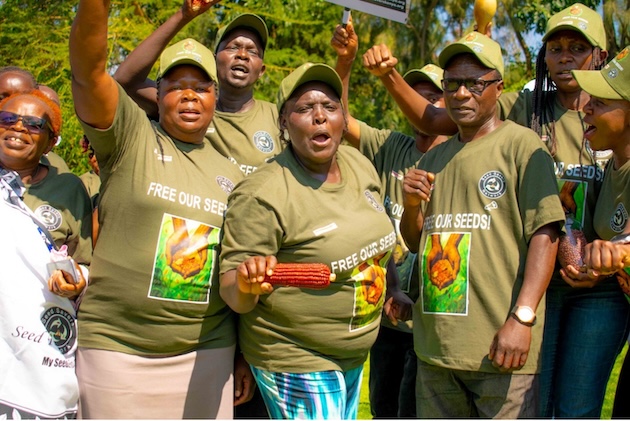
Farmers celebrate in Gilgil town in Kenya, after a court ruling that decriminalized the sharing of indigenous seeds. Credit: Jackson Okata/IPS
NAIROBI, Dec 18 2025 (IPS) – For years, smallholder farmers across Kenya have been engaged in a legal battle with the government over a law that criminalizes the practice of saving, sharing and exchanging indigenous seeds.
In 2022, a group of 15 Kenyan smallholder farmers petitioned the country’s High Court, seeking to compel the government to review sections of a law that bans the sharing and exchange of uncertified and unregistered seeds.
Kenya’s government enacted the law in 2012 to develop, promote, and regulate a modern and competitive seed industry, but farmers are calling for its review.
The informal farmer-managed seed system allows farmers to store a portion of their seeds after harvesting, which guarantees them seeds for the next planting season.
Victory for Farmers
In a decisive victory for food sovereignty and climate justice, the High Court on November 27, 2025, ruled in favor of smallholder farmers, declaring punitive sections of the Seed and Plant Varieties Act unconstitutional.
The judgment effectively decriminalizes the age-old practice of saving, sharing, and exchanging indigenous seeds, affirming that Farmer-Managed Seed Systems (FMSS) are a protected right, not a criminal activity.
Under the punitive law, farmers faced jail terms of up to two years and a fine of 1 million shillings (about 7,800 USD) for selling or exchanging unregistered seeds.
Farmer rights defenders had argued that the law gave control of the country’s food system to multinational corporations.
In her judgment, Justice Rhoda Rutto declared unconstitutional sections of the Act that gave seed inspectors sweeping powers to raid seed banks and seize seeds meant for the next harvest, made it illegal for farmers to process or sell seeds unless they were registered seed merchants, gave extensive proprietary rights to plant breeders and none to farmers, and made it illegal for farmers to save or share seeds from their harvest without prior knowledge of seed proprietors.
Samuel Wathome, a smallholder farmer who was a petitioner in the case, says that “just like his grandmother did, he can now freely save seeds for his grandchildren without fear of police or prison.”
According to Elizabeth Atieno, a Food Campaigner at Greenpeace Africa, the court ruling affirmed the long-known tradition of seed sovereignty.
“The court ruling removed shackles from Kenya’s farmers. This is not just a legal win; it is a victory for our culture, our resilience, and our future,” Atieno told IPS.
She added, “By validating indigenous seeds, the court has struck a blow against the corporate capture of our food system. We can finally say that in Kenya, feeding your community with climate-resilient, locally adapted seeds is no longer a crime.”
Protecting Biodiversity
According to Gideon Muya, Programs Officer, Biodiversity and Biosafety Association of Kenya, the judgment is a shield for the country’s biodiversity.
“Indigenous seeds are the library of life because they hold the genetic diversity we need to withstand droughts, pests, and a changing climate. The court has recognized that you cannot patent nature’s heritage. We have reclaimed the right to choose what we plant and what we eat, free from the coercion of commercial seed monopolies,” Muya told IPS.
Claire Nasike, an agroecologist, noted that the judgment indicates that the seed is life, and it is sovereign, and whoever controls it influences the lifeline of a generation.
Nasike observes that the ruling is a big boost for biodiversity, climate resilience and food sovereignty since indigenous seeds tend to be well adapted to local conditions like soil types, rainfall patterns, pests and disease traits that are often lost in uniform, certified commercial seeds.
“By enabling farmers to save, exchange and diversify their seed stock, communities can preserve genetic diversity, a key buffer against climate shocks like droughts and pests, as well as a safeguard for long-term food security.”
p dir=”ltr”>In a nationwide address, President Trump says the U.S. is poised for an economic boom and that high prices are falling rapidly. Four Republicans joined Democrats to force a vote on a three year extension of the enhanced healthcare subsidies. And, President Trump has ordered a ban on all sanctioned oil tankers going to and from Venezuela.
Want more analysis of the most important news of the day, plus a little fun? Subscribe to the Up First newsletter
<
p dir=”ltr”>Today’s episode of Up First was edited by Rebekah Metzler, Kelsey Snell, Andrew Sussman, Lisa Thomson and Alice Woelfle.
<
p dir=”ltr”>It was produced by Ziad Buchh, Nia Dumas and Christopher Thomas. We get engineering support from Stacey Abbott. Our technical director is Carleigh Strange.And our deputy Executive Producer is Kelley Dickens.
BLANTYRE-(MaraviPost)-National Bank of Malawi (NBM) plc has donated MK120 million worth of food and non-food items to health, education and social welfare institutions across the country in the first half of its annual ‘12 Days of Christmas’ initiative.
The donations are part of the Bank’s broader K250 million festive season package, which is running from December 5 to 22.
Under the initiative, each of the 12 participating service centres is making a K20 million donation every day, with a final K30 million package scheduled at the close of the campaign.
During half of this donation period, St Martin’s Health Centre in Mwanza received medical equipment and supplies to strengthen maternal and general health services from Mwanza Service Centre, while Wells of Joy Orphan Care in Blantyre benefited from food and livelihood-support items, including sewing machines and basic commodities courtesy of Chichiri Mall Service Centre.
In the education sector, schools in Chazunda and Mpemba in Blantyre, Mpapa and Dwangwa Primary in Kasungu, and Liwonde Secondary in Machinga benefited from desks, textbooks, teaching and learning materials, as well as sports equipment, aimed at improving learning environments and promoting holistic education through Top Mandala, Kasungu, and Liwonde Service Centres respectively.
Learners with visual impairments at Makande Primary School in Ngabu, Chikwawa, also received learning and nutritional support, including Perkins brailles and food items from Nchalo Service Centre.
NBM plc Marketing and Corporate Affairs Manager Akossa Hiwa said the initiative reflects the Bank’s appreciation for the communities that continue to support its growth.
“Every year, this initiative reminds us of the true meaning of the festive season, reaching out, sharing, and standing with those who need a helping hand.”
“We are deliberate in ensuring that our support responds to real needs on the ground and brings dignity and encouragement to the communities we serve,” said Hiwa.
Liwonde Secondary School learners’ representative, Faith Pasulani commended NBM plc saying the donation of desks had significantly improved learning conditions at the school.
“Previously, some learners were missing classes, especially during examinations, because they had to sit on the floor. This support has restored our dignity as learners,” said Pasulani.
Makande Primary School Head teacher, Francis Thomas said the donation had addressed a long-standing challenge at the school’s resource centre for visually impaired learners.
“We previously had only two working braillers for 24 learners. The additional brailles and food support will greatly improve both learning and welfare,” said Thomas.
NBM plc says the ‘12 Days of Christmas’ initiative remains one of its flagship CSR programmes, supporting national development through targeted investments in education, health and community wellbeing.
Share this:
Like this:
LikeLoading…
Discover more from The Maravi Post
Subscribe to get the latest posts sent to your email.