Multilateralism Reaching Breaking Point

Active Citizens, Armed Conflicts, Civil Society, Democracy, Featured, Global, Headlines, Health, Human Rights, TerraViva United Nations

Opinion

Multilateralism Reaching Breaking Point

Credit: Jonathan Ernst/Reuters via Gallo Images

BRUSSELS, Belgium, Feb 13 2026 (IPS) – The latest World Economic Forum made clear the current crisis of multilateralism. Over 60 heads of state and 800 corporate executives assembled in Davos under a ‘Spirit of Dialogue’ theme aimed at strengthening global cooperation, but it was preceded by a series of events pointing to a further unravelling of the international system.


On 3 January, Donald Trump launched an illegal military strike on Venezuela to abduct President Nicolás Maduro, which was widely condemned as a violation of international law. On 7 January, he signed an executive order withdrawing the USA from 66 international bodies and processes, including 31 UN entities, such as the UN Democracy Fund, the UN Framework Convention on Climate Change and UN Women. Then came the launch of Trump’s Board of Peace, evidently an attempt to supplant the UN Security Council. The country that helped build the multilateral system is walking away from the parts it doesn’t like and seeking to reshape the rest in its interests.

Trump’s approach to multilateralism is nakedly transactional. His administration engages with international processes only when they advance immediate US interests and withdraws from those that impose obligations. This disassociates multilateralism from its core principles: accountability over shared standards, equality among nations and universality. It encourages other states to follow suit.

This approach brings devastating financial impacts. US threats to defund international bodies have left institutions scrambling. UN development, human rights and peacekeeping programmes all depended heavily on US financial contributions. The World Health Organization faces shortfalls that threaten its ability to respond to health emergencies because the US government quit without paying its overdue contributions.

The USA’s closest allies aren’t safe. Trump threatened NATO member Denmark with 25 per cent tariffs unless it agreed to the USA’s purchase of Greenland, and suggested he might seize the territory by force. NATO’s Article 5 on collective defence – invoked only once, by the USA after 9/11 – lies in doubt. European states are reacting by seeking strategic autonomy, slashing development aid and reducing UN contributions while finding extra billions for military spending.

Problematic alternatives are looking to capitalise on crisis. At Davos, China positioned itself as the grown-up alternative to Trump, promoting its Friends of Global Governance initiative, a group of 43 mostly authoritarian states including Belarus, Nicaragua and North Korea.

The queue of heads of government meeting China’s leader Xi Jinping shows many states are pivoting this way. But it comes at a cost: in China’s vision of international cooperation, state sovereignty is paramount and there’s no room for international scrutiny of human rights or cooperation to promote democratic freedoms.

It’s the same story with the new Board of Peace. The body originated in a controversial November 2025 Security Council resolution establishing external governance for Gaza, but Trump clearly envisions a permanent, wider role for it. He chairs it in a personal capacity, with full power to veto decisions, set agendas and invite or dismiss members. Permanent membership costs US$1 billion, with the money’s destination unclear.

The Board’s draft charter makes no mention of human rights protections, contains no provisions for civil society participation and establishes no accountability mechanisms. Most members so far are autocratic states such as Belarus, Egypt and Saudi Arabia. Its credibility is further undermined by the fact that Israel has just joined, despite having made a mockery of international humanitarian law. More democratic states have declined invitations, mostly due to concerns about the body’s unclear relationship with the UN. Trump’s response was to threaten increased tariffs against France and withdraw Canada’s invitation. He has made clear he considers himself above international law, casting himself as a de facto world president able to resolve conflicts through personal power and pressure.

As the old order dissolves, civil society must play a critical role in defining what comes next. While the UN – particularly its Security Council, hamstrung by the use of veto powers by China, Russia and the USA – needs reform, it remains the only global framework built on formal equality and universal human rights. As the UN faces assault from those abandoning it or seeking to dilute its human rights mandate, civil society must mobilise to keep it anchored to its founding principles and challenge the hierarchies that exclude global south voices.

It falls on civil society to organise across borders to uphold international law, document violations of international humanitarian and human rights law and demand accountability. Not for the first time, civil society needs to win the argument that might doesn’t make right.

Samuel King is a researcher with the Horizon Europe-funded research project ENSURED: Shaping Cooperation for a World in Transition at CIVICUS: World Alliance for Citizen Participation.

For interviews or more information, please contact research@civicus.org

  Source

‘Like a scene out of a horror movie’: UN report warns of war crimes in Sudan’s El Fasher

Paramilitary forces in Sudan unleashed “a wave of intense violence…shocking in its scale and brutality” during their final offensive to capture the besieged city of El Fasher last October, committing atrocities that amount to war crimes and possible crimes against humanity, according to a report released on Friday by the UN human rights office, OHCHR. 

The Maravi Post

Tragedy strikes at caterpillar in Illinois: Workplace safety failures leave family devastated

ILLINOIS-(MaraviPost)-A devastating accident at Caterpillar’s Mapleton, Illinois, foundry has claimed the life of 39-year-old Steven Dierkes, who tragically fell into a vat of molten iron on his ninth day of employment.

The incident occurred as Dierkes was attempting to collect a sample from the molten metal, but lost his balance and plunged into the 11-foot-deep crucible.

The molten iron, heated to over 2,000 degrees Fahrenheit, instantly incinerated him, leaving behind a grieving family and sparking an investigation into the workplace safety failures that led to his death.

The Occupational Safety and Health Administration (OSHA) investigated the accident and found that the foundry lacked essential safety measures, including guardrails or fall protection systems around the molten iron vats.

OSHA proposed a fine of $145,027 against Caterpillar for these violations, raising questions about whether the penalty is sufficient given the severity of the incident.

Dierkes’ family, including his life partner, Jessica Sutter, and their three daughters, are left to pick up the pieces after his tragic loss.

His obituary described him as a “hard-working teddy bear of a man with calloused hands and a tender heart,” making his untimely death all the more heartbreaking.

The incident highlights the importance of prioritizing workplace safety and ensuring that employers are held accountable for protecting their employees.

As the family seeks justice and answers, the community rallies around them, mourning the loss of a loved one and a valued member of society.

The Maravi Post

‘Since the Coup, Factory Employers Have Increasingly Worked with the Military to Restrict Organising and Silence Workers’

Active Citizens, Asia-Pacific, Child Labour, Civil Society, Crime & Justice, Economy & Trade, Featured, Gender Violence, Headlines, Health, Human Rights, Labour, TerraViva United Nations

Jan 28 2026 (IPS) –  
CIVICUS speaks to the Business and Human Rights Centre (BHRC) about labour rights abuses in Myanmar’s garment industry since the 2021 military coup.


Myanmar’s garment sector, which employs hundreds of thousands of workers, is in deep crisis. Since the coup, labour protections have collapsed, independent unions have been dismantled and workers who try to organise face intimidation, dismissal and arrest. Inside factories, reports show multiple cases of child labour, forced overtime, harassment, poverty wages and unsafe conditions. At the same time, rising living costs and US tariffs are pushing many workers further into insecurity as factories close and layoffs become more common. Garment workers, most of them women, are trapped between exploitation, repression and a rapidly shrinking industry.


How have conditions inside Myanmar’s garment factories changed since the coup?

Our monitoring between February 2021 and October 2024 shows a sharp rise in both the number and severity of pre-existing labour rights abuses. Since the coup, factory employers have increasingly worked with the military to restrict organising and silence workers. This collaboration has led to threats, arrests and violent attacks against workers. In one case, security forces carried out joint military and police raids on the homes of workers who demanded unpaid wages and limits on overtime.

Factories have also expanded surveillance. Workers report invasive searches, phone confiscation and installation of CCTV inside factories, including near toilets. Employers also force workers to lie during audits. These practices aim to hide abuses and have exacerbated the abuses workers already faced.

What abuses do garment workers suffer in the workplace?

Factories force workers to meet extreme production targets through excessive and often unpaid overtime. Many workers must stay overnight until dawn, often without enough food, water or ventilation, leading to exhaustion and health problems. Managers threaten and abuse workers who refuse to work overtime or fail to meet targets. We have documented a case where supervisors denied workers food and water as punishment for not meeting targets.

Health and safety conditions have worsened. Workers report dirty, insufficient toilets, poor food quality and unsafe drinking water. They’ve also reported blocked emergency exits, inadequate ventilation and leaking roofs that put lives at risk. Factory-provided transport creates further dangers, as they are often overcrowded and suffer frequent road accidents. In one case, a major crash involving a worker shuttle left several workers badly hurt, including one who needed abdominal surgery.

Women workers face particularly severe abuses, including hair-pulling, physical assault, sexual harassment and verbal attacks. In one case, supervisors punched and kicked women workers and called them ‘dogs’.

What happen to workers who try to speak out or organise?

Workers who dare speak out face brutal reprisals. After the military declared 16 labour unions and labour rights organisations illegal, arrests, home raids and surveillance increased, particularly against union leaders and activists linked to the Civil Disobedience Movement. The movement began after the coup and brings together workers who refuse to cooperate with military rule through strikes and other forms of non-violent resistance.

Inside factories, employers threaten and dismiss union leaders on false grounds. In one case, a factory reopened and refused to reinstate union members and publicly humiliated them. Employers have also created Workplace Coordination Committees to replace independent unions, denying workers the right to choose their representatives and silencing their complaints. Prominent union leaders such as Myo Myo Aye have been arrested multiple times simply for continuing to organise.

What should international brands be doing in this context?

Under the United Nations Guiding Principles on Business and Human Rights, brands operating in conflict settings must carry out heightened, conflict-sensitive due diligence and demonstrate, with independent and verifiable evidence, that it works. In Myanmar’s current context, where surveillance and violent repression run through all the supply chain, this standard is exceptionally hard to meet.

Any brand that stays must deliver clear and demonstrable improvements in working conditions. Brands that can’t meet this threshold must carry out a responsible exit, working with workers and their representatives and taking steps to reduce harm, rather than adding to the instability garment workers already face under military rule.

GET IN TOUCH
Website
BlueSky
Facebook
LinkedIn
Twitter
YouTube

SEE ALSO
Myanmar’s junta tightens its grip CIVICUS Lens 12.Dec.2025
Historic wins and hard truths at International Labour Conference CIVICUS Lens 27.Jun.2025
Business and Human Rights Treaty: a decade of struggle for corporate accountability CIVICUS Lens 08.Mar.2025

  Source

Cuts Stall Clinical Trials, Scientists Warn US Risks Losing Its Research Edge

Civil Society, Democracy, Food Systems, Headlines, Health, North America, TerraViva United Nations

Opinion

Science, research, and scientific discoveries provide solutions to the pressing challenges our society faces and can improve people’s lives. Credit: Shutterstock - Science funding cuts are stalling clinical trials and disrupting research training in the US. Scientists argue the way forward is clearer communication, stronger public trust, and durable funding frameworks to protect innovation and lives

Science, research, and scientific discoveries provide solutions to the pressing challenges our society faces and can improve people’s lives. Credit: Shutterstock

URBANA, Illinois, US, Jan 27 2026 (IPS) – Scientists across the U.S., including me, are stressed after a year marked by several changes and challenges, including cuts to science funding that have stalled clinical trials and studies that could improve and save lives. Without funding, scientists worry about how they will support ongoing research and train America’s future workforce, including the next generation of innovators.


In the past, U.S. scientific research has greatly contributed to the country’s economic and military strength, helping the U.S. become a superpower. Through scientific research, several discoveries, innovations, scientific breakthroughs, and technologies, including artificial intelligence, have been realized.

These scientific advances have supported agricultural and healthcare advances, expanding U.S. life expectancy by almost 20 years. From vaccines to early disease detection to novel drugs, the returns on funding science are substantial.

We need science. Moments like the challenges of today call for reflection and offer opportunities to readjust, evolve, and move forward, including finding new ways to engage with the public and policymakers and to fund and conduct science creatively

Science, research, and scientific discoveries, after all, provide solutions to the pressing challenges our society faces and can improve people’s lives. Science guides us through these challenges, inspires us, and unites many curious minds.

We need science. Moments like the challenges of today call for reflection and offer opportunities to readjust, evolve, and move forward, including finding new ways to engage with the public and policymakers and to fund and conduct science creatively.

So how do we adjust? What actions can scientists take now?

First, scientists need to keep showing up and find creative ways to communicate science and the solutions being generated to the public, policymakers, and government administrators.

This includes unpacking how science solutions address the issues everyday people face, including their economic future, and how science advancements align with the challenges people face now.

Communicating science and research outcomes to the broader public, policymakers, and other stakeholders in the science enterprise is not easy. However, scientists have continued to develop creative ways to improve how we communicate science. Specifically, scientists are using multiple formats, including storytelling, infographics, animations, and interactive games and graphics.

These efforts must continue to expand, tapping into the many available ways to communicate science, including podcasts, blogs, social media, radio, TV, and op-eds.

To ensure maximum participation by scientists, universities and research institutions should find innovative ways to incentivize students and scientists to engage with the public and share their research.

Complementing these efforts, universities and research institutions, along with professional societies to which scientists belong, can continue to offer workshops and training to help scientists become better communicators.

For example, between 2008 and 2022, the American Association for the Advancement of Science offered several science communication workshops.

The Entomological Society of America, through its Science Policy and Advocacy initiative, trains and equips its members to advocate more effectively for entomology. Other science communication training opportunities include those offered by the Alan Alda Center for Communicating Science at Stony Brook University, The OpEd Project, the American Geophysical Union, ComSciCon, and COMPASS.

Alongside these efforts, professional societies have also recognized elected officials who have continued to champion the role of science in addressing persistent societal challenges. For example, in 2025, ESA recognized Senator Susan Collins of Maine as the society’s 2025 Champion of Entomology for her continued support for science and research funding and for introducing several bills that are still pending Senate and House votes.

Second, we need to continue strengthening public and policymakers’ trust in science by improving peer review processes and ensuring that science remains transparent, rigorous, and repeatable, and that the credibility of published science remains intact. In recent years, there has been a rapid increase in the number of paper mills producing fraudulent scientific papers. These science integrity challenges undermine scientific enterprises and create distrust among the public.

Strengthening public trust in science and scientists can take many forms, including convening town halls and public forums. Other creative ways include involving the public in citizen science research and fieldwork, allowing the public to be involved from the outset, including building the research project goals and a compelling justification for why the research question being addressed is important.

Engaging the public and involving them in shaping the scientific questions scientists pursue can not only strengthen public trust in science but also enrich outcomes by incorporating local or experiential knowledge. In doing so, public engagement helps ensure that the solutions generated by these shared projects address and solve challenges that are grounded, relevant, and meaningful to communities and the public we aim to serve.

For example, in my research on plant-microbe-insect interactions, which aims to help feed a growing population sustainably amid changing environments and to strengthen plant resilience against biotic and abiotic stressors such as insects, drought, and flooding, collaborating with farmers can directly shape the pests and crops I study and guide the questions I pursue. By doing so, the resulting research insights become responsive to the current agricultural challenges American farmers face.

Third and most importantly, there is an urgent need to develop a long-term vision and establish unbreakable funding frameworks for science to ensure that the gains we have made so far are preserved. Scientists, national academies of science, government administrators, elected officials, policymakers, the military, industry, NGOs, the public, think tanks, foundations, and all stakeholders in the science enterprise must work together to chart a new path forward.

Without bending back too far, scientists can stop, reflect, and find their path forward.

It is necessary to bring together all stakeholders in the science enterprise to create new science funding frameworks that are both acceptable and reasonable. Otherwise, the value of science and research, along with the gains made to date, could be lost.

It’s time for scientists to extend the olive branch, redouble our efforts to communicate science to society, and chart a path forward that brings everyone on board.

Esther Ngumbi, PhD is Assistant Professor, Department of Entomology, African American Studies Department, University of Illinois at Urbana-Champaign

  Source

World Enters ‘Era of Global Water Bankruptcy’

Civil Society, Development & Aid, Featured, Global, Headlines, Health, Humanitarian Emergencies, Sustainable Development Goals, TerraViva United Nations, Water & Sanitation

Opinion

Lead author Prof. Kaveh Madani

 
Flagship report calls for fundamental reset of global water agenda as irreversible damage pushes many basins beyond recovery.

UNITED NATIONS, Jan 21 2026 (IPS) – The world is already in the state of “water bankruptcy”. In many basins and aquifers, long-term overuse and degradation mean that past hydrological and ecological baselines cannot realistically be restored.


While not every basin or country is water-bankrupt, enough critical systems around the world have crossed these thresholds, and are interconnected through trade, migration, climate feedbacks, and geopolitical dependencies, that the global risk landscape is now fundamentally altered.

The familiar language of “water stress” and “water crisis” is no longer adequate. Stress describes high pressure that is still reversible. Crisis describes acute, time-bound shocks. Water bankruptcy must be recognized as a distinct post-crisis state, where accumulated damage and overshoot have undermined the system’s capacity to recover.

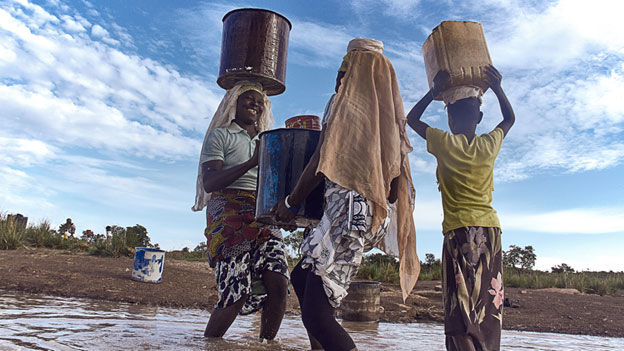
A group of women fetching water from a dam in Taha, Northern Region of Ghana. Credit: Evans Ahorsu. Source: UN University’s Institute for Water, Environment and Health

Water bankruptcy management must address insolvency and irreversibility. Unlike financial bankruptcy management, which deals only with insolvency, managing water bankruptcy is concerned with rebalancing demand and supply under conditions where returning to baseline conditions is no longer possible.

Anthropogenic drought is central to the world’s new water reality. Drought and water shortage are increasingly driven by human activities, over-allocation, groundwater depletion, land and soil degradation, deforestation, pollution, and climate change, rather than natural variability alone. Water bankruptcy is the outcome of long-term anthropogenic drought, not just bad luck with hydrological anomalies.

Water bankruptcy is about both quantity and quality. Declining stocks, polluted rivers, and degrading aquifers, and salinized soils mean that the truly usable fraction of available water is shrinking, even where total volumes may appear stable.

Managing water bankruptcy requires a shift from crisis management to bankruptcy management. The priority is no longer to “get back to normal”, but to prevent further irreversible damage, rebalance rights and claims within degraded carrying capacities, transform water-intensive sectors and development models, and support just transitions for those most affected.

Governance institutions must protect both water and its underlying natural capital. The existing institutions focus on protecting water as a good or service disregarding the natural capital that makes water available in the first place. Efforts to protect a product are ineffective when the processes that produce it are disrupted.

Recognizing water bankruptcy calls for developing legal and governance institutions that can effectively protect not only water but also the hydrological cycle and natural capital that make its production possible.

Water bankruptcy is a justice and security issue. The costs of overshoot and irreversibility fall disproportionately on smallholder farmers, rural and Indigenous communities, informal urban residents, women, youth, and downstream users, while benefits have often accrued to more powerful actors. How societies manage water bankruptcy will shape social cohesion, political stability, and peace.

Water bankruptcy management combines mitigation with adaptation. While water crisis management paradigms seek to return the system to normal conditions through mitigation efforts only, water bankruptcy management focuses on restoring what is possible and preventing further damages through mitigation combined with adaptation to new normals and constraints.

Water can serve as a bridge in a fragmented world. Water can align national priorities with international priorities and improve cooperation between and within nations. Roughly 70% of global freshwater withdrawals are used for agriculture, much of it by farmers in the Global South. Elevating water in global policy debates can help rebuild trust between South and North but also within nations, between rural and urban, left and right constituencies.

Water must be recognized as an upstream sector. Most national and international policy agendas treat water as a downstream impact sector where investments are focused on mitigating the imposed problems and externalities. The world must recognize water as an upstream opportunity sector where investments have long-term benefits for peace, stability, security, equity, economy, health, and the environment.

Water is an effective medium to fulfill the global environmental agenda. Investments in addressing water bankruptcy deliver major co-benefits for the global efforts to address its environmental problems while addressing the national security concerns of the UN member states.

Elevating water in the global policy agenda can renew international cooperation, increase the efficiency of environmental investments, and reaccelerate the halted progress of the three Rio Conventions to address climate change, biodiversity loss, and desertification.

A new global water agenda is urgently needed. Existing agendas and conventional water policies, focused mainly on WASH, incremental efficiency gains and generic IWRM guidelines, are not sufficient for the world’s current water reality. A fresh water agenda must be developed that takes Global Water Bankruptcy as a starting point and uses the 2026 and 2028 UN Water Conferences, the conclusion of the Water Action Decade in 2028, and the 2030 SDG 6 timeline as milestones for resetting how the world understands and governs water.

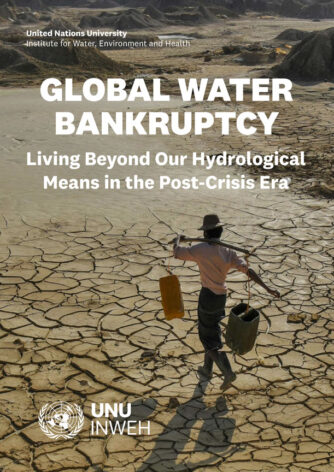
Global Water Bankruptcy: Living Beyond Our Hydrological Means in the Post-Crisis Era | UN University Institute for Water, Environment and Health (UNU-INWEH) (20 January) (press release)

Support Paper
Madani K. (2026) Water Bankruptcy: The Formal Definition, Water Resources Management, 40 (78) doi: 10.1007/s11269-025-04484-0)

IPS UN Bureau

  Source