The Climate Alarm Is Ringing – It’s Time to Stop Silencing It

Civil Society, Climate Action, Climate Change, Crime & Justice, Economy & Trade, Environment, Featured, Global, Headlines, TerraViva United Nations

Opinion

Credit: Last Generation Germany

LONDON, Apr 12 2024 (IPS) – The heat records keep tumbling – 2023 was the hottest year in recorded history. Extreme weather events keep mounting up. And yet the voices most strongly calling for action to prevent climate catastrophe are increasingly being silenced.


It’s a sad fact that climate campaigners in the global south – in many countries in Africa, Asia and Latin America – have long faced repression. People have been subjected to incarceration and violence all the way up to murder for resisting climate-harming extractive projects and environmental destruction. In comparison, climate activists in global north countries – including Europe and North America – for a long time enjoyed relative freedom, which they used to protest against their governments and the corporations headquartered in their countries that bear most of the responsibility for causing global warming.

But they no longer enjoy the full freedom to do so. As the latest State of Civil Society Report from global civil society alliance CIVICUS shows, several global north governments are increasingly making it harder for people to take part in climate protests. They’re using anti-protest laws, raids, arrests, jail sentences and violence to try to subdue voices calling for urgent action.

When it comes to the climate, delay is denial, because if action isn’t taken fast, it may be too late. This means the repression of activists demanding immediate action must be seen as a form of climate denial.

Examples are piling up. In Germany last year, authorities used laws intended to combat organised crime to raid the homes of young activists from the Last Generation climate movement, seize their laptops and freeze their bank accounts. The German police also used violence against activists trying to block a coalmine expansion. The imposition of restrictions on climate activism is one the key reasons the CIVICUS Monitor recently downgraded Germany’s civic space rating.

In Italy too, the government has served climate campaigners with criminal conspiracy indictments historically used against the mafia, and it has also introduced a law to criminalise non-violent action at key sites. The Dutch authorities have responded with mass arrests to roadblock protests demanding it fulfil its promise to end fossil fuel subsidies, which amount to around US$39.9 billion a year. Thousands have been detained and the police have used water cannon against protesters.

The UK government has passed a package of laws that criminalise disruptive and noisy protests, clearly targeted at the non-violent direct action used by climate campaigners. In January, the UN Special Rapporteur on environmental defenders, Michel Forst, condemned these new laws. Numerous climate activists have been jailed for peaceful protest actions that until recently would never have received a prison sentence. Meanwhile the UK government plans to grant over 100 new oil and gas licences. Several Australian states have also passed anti-protest laws that have been used to jail climate activists.

Global north states, apparently eager to do the bidding of the fossil fuel giants, can be expected to intensify this repression as the gap between the action needed and the lack of effort being taken becomes increasingly clear. They silence civil society because activists expose the hypocrisy behind the greenwash. As right-wing populists and nationalists who oppose climate action – and often spread climate disinformation – gain influence across the global north, climate activists can expect an even greater wave of vilification.

The impacts of repression are personal. They increase the costs and dangers of activism in an attempt to deter people from getting involved and sap collective energies. However, in response, campaigners are showing resilience. In Germany, frozen funds were quickly replaced with crowdsourced donations. In the Netherlands, attempts to repress roadblocks motivated more people to turn up to protest.

But the opportunity cost is steep. Energy that should be invested in advancing creative climate solutions is instead being spent in fending off restrictions. In the long-term, there’s a danger of attrition, depleting the ranks of climate activists. And without civil society, who will push to keep the climate crisis high on the political agenda?

Civil society has shown it can make a difference. While there was much to be unhappy about with the last global climate summit, COP28, the fact that for the first time states acknowledged the need to transition away from fossil fuel use came as a direct result of civil society’s decades-long advocacy. More institutions are committing to divest from fossil fuel investments due to campaigning pressure: 72 per cent of UK universities have now done so, because student activists demanded it.

And the growing field of climate litigation keeps paying off. A group of Swiss women just won a ruling at the European Court of Human Rights, which found that their government has violated their human rights by not doing enough to tackle climate change, a verdict that sets a strong precedent. Last year, courts in Belgium and Germany insisted on stronger actions to cut emissions following lawsuits brought by campaigners. More are sure to follow.

Civil society will strive to keep working on every front possible, through protest, advocacy and litigation, because the scale of the climate crisis demands a full spectrum of responses. States should stop trying to hold back the tide and put themselves on the right side of history. They must respect the right of everyone to protest and stop the denial they practise through repression.

Andrew Firmin is CIVICUS Editor-in-Chief, co-director and writer for CIVICUS Lens and co-author of the State of Civil Society Report.
  Source

Democracy’s Contested Territory

Armed Conflicts, Civil Society, Crime & Justice, Democracy, Featured, Global, Headlines, Human Rights, Press Freedom, TerraViva United Nations

Opinion

Credit: Luis Acosta/AFP via Getty Images

MONTEVIDEO, Uruguay, Mar 19 2024 (IPS) – This year more than half the world’s population has the chance to go to the polls. That might make it look like the most democratic year ever, but the reality is more troubling. Too many of those elections won’t give people a real say and won’t offer any opportunity for change.


2024’s bumper election year comes as a record number of countries are sliding towards authoritarianism, and global advances in democratisation achieved over more than three decades have been all but wiped out. In 2023, no authoritarian state became a democracy, and while some countries made marginal improvements in the quality of their democracies – by improving civic space, making inroads on corruption or strengthening institutions – many more experienced often serious declines.

Nearly three quarters of humanity now live under authoritarian regimes. Defending democracy and holding political leaders to account is becoming harder as civic space is shutting down. The proportion of people living in countries with closed civic space, 30.6 per cent, is the highest in years.

The latest State of Civil Society Report, from global civil society alliance CIVICUS, shows how conflict is exacerbating this regressive trend. In war-torn Sudan, hopes for democracy, repeatedly denied since the 2019 overthrow of dictator Omar al-Bashir, receded further as elections were made impossible by the civil war between the military and militia that erupted last April. Russia’s sustained assault on Ukraine brought intensified repression of domestic dissent, and there were no surprises in the recent non-competitive vote that maintained Vladimir Putin’s grip on power.

The ineffectiveness of civilian governments in dealing with jihadist insurgencies has also been the justification used by military leaders to take or retain power in Central and West Africa. As a result, rule by junta is in danger of becoming normalised after decades in which it appeared on the verge of extinction. A ‘coup belt’ now stretches coast to coast across Africa. None of the states that fell victim to military rule in recent years have returned to civilian government, and two more – Gabon and Niger –joined their ranks last year.

Authoritarian regimes that experienced mass protest movements in recent years, including Iran, Nicaragua and Venezuela, have regained their footing and hardened their grip. In states long characterised by autocratic rule, many civil society activists, journalists and political dissidents have sought safety in exile to continue their work. But they often didn’t find it, with repressive states – China, Turkey, Tajikistan, Egypt and Russia are the worst five abusers –increasingly using transnational repression against them.

Many elections are held with no competition. Last year several non-democratic states of various kinds – including Cambodia, the Central African Republic, Cuba, Eswatini, Uzbekistan and Zimbabwe – held votes in which autocratic power was never in question. Voting was ceremonial, its purpose to add a veneer of legitimacy to domination.

Many more regimes that combine democratic and authoritarian traits have been home to recent elections with less predetermined results, where there was at least some chance of the ruling party being defeated. But incumbent advantage was reflected in the fact that change rarely materialised, as seen in Nigeria, Paraguay, Sierra Leone and Turkey. The outlier was Maldives, where voters have a history of rejecting sitting presidents.

Some hybrid regimes, notably El Salvador, experienced further democratic backsliding through the erosion of freedoms and institutional checks and balances – a road typically travelled by populist authoritarians who claim to speak in the name of the people and insist they need to concentrate power to deal with crises.

When voters do have a genuine say, in free and fair elections, they’re increasingly rejecting mainstream parties and politicians. In a time of economic uncertainty and insecurity, many express disappointment with what democracy is offering them. Anti-rights political entrepreneurs are successfully exploiting their anxieties by scapegoating migrants and attacking women’s and LGBTQI+ people’s rights. Right-wing populists using such tactics recently took control of Argentina, came first in elections in the Netherlands and Switzerland and entered government in Finland. Even where they don’t take office, far-right forces often succeed in shifting the political centre by forcing others to compete on their terms. They’re expected to make big gains in the European Parliament elections in June 2024.

Polarisation is on the rise, fuelled by disinformation, conspiracy theories and hate speech. These are made so much easier by AI-powered technologies that are spreading and evolving faster than they can be regulated. The first elections of 2024, including those in Bangladesh and Indonesia, offered cautionary tales of the unprecedented levels of manipulation that AI can enable. We’re likely to see a lot more of this in 2024.

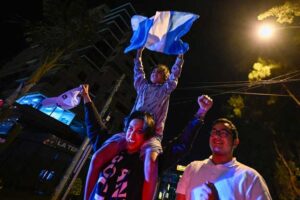
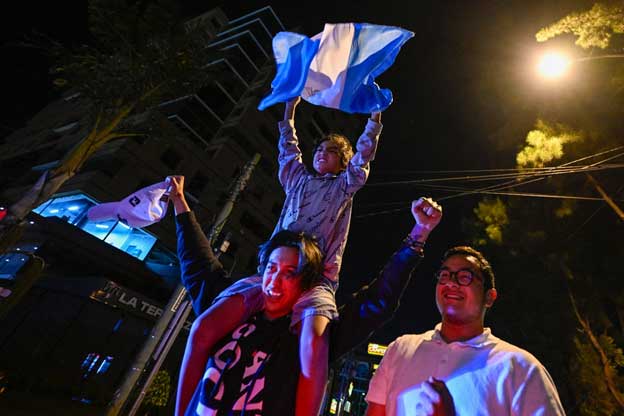
But our research findings support our hope, because they show movement isn’t all in one direction. In Guatemala, a new party born from mass anti-corruption protests was the unlikely 2023 election winner, and people mobilised in numbers to defend the result in the face of powerful political and economic elites. Despite China’s concerted attempts to derail Taiwan’s election, including through cyberattacks, people vindicated their right to have a say in their own future. In Poland, a unity government pledging to restore civic freedoms came to power after eight years of right-wing nationalist rule, offering new potential for civil society to partner in retrieving democratic values and respecting human rights. In Mexico, which is among the many countries going to the polls in 2024, people mobilised in numbers against the threat posed by a democratically elected leader seeking to override checks and balances. Given the dangers it may entail, civil society is pushing for transnational regulation of AI.

Things would be much worse were it not for civil society, which continues to mobilise against restrictions on freedoms, counter divisive rhetoric and strive for the integrity of electoral processes. Throughout 2024, civil society will keep pushing for elections to take place in free and fair conditions, for people to have the information they need, for votes to be properly counted, for losers to accept defeat and for winners to govern in the common good.

Inés M. Pousadela is CIVICUS Senior Research Specialist, co-director and writer for CIVICUS Lens and co-author of the State of Civil Society Report.

  Source

International Women’s Day, 2024Progress Hinges on Feminist Leadership

Civil Society, Democracy, Editors’ Choice, Featured, Gender, Global, Headlines, Human Rights, IPS UN: Inside the Glasshouse, TerraViva United Nations

Opinion

The following opinion piece is part of series to mark International Women’s Day, March 8.

PORT LOUIS, Mauritius, Mar 4 2024 (IPS) – Investing in inclusion requires more than electing and initiating women leaders. It requires a coordinated effort to change mindsets and systematically increase investments. This will allow feminist leaders, individually and collectively, to fully exercise their agency and counter targeted attacks on their safety and legitimacy.


A great deal of attention has been paid to the accomplishments of women in politics and society in recent years. Joan Carling, Francia Marquez, Maria Ressa, Amira Osman Hamed, and Narges Mohammadi have received global accolades for their vision and fearless activism.

Amid the pandemic, women leaders like Jacinda Ardern, Sanna Marin, Tsai Ing-Wen, and Angela Merkel outpaced their strongman counterparts by leading complex responses. During this period, the UN achieved gender parity in its senior leadership, including its national missions and peace operations, for the first time in history.

The leadership of women has been visible not just in institutions but also on the streets. Across the world, women human rights defenders have acted boldly for change despite severe restrictions. Movements such as #MeToo, #FreeSaudiWomen, #NiUnaMenos and #AbortoLegalYa are examples of women advancing systemic change for equality and justice. Women led peaceful demonstrations and civil disobedience actions as part of the Sudan uprising in 2018.

In 2022, the killing of Mahsa Amini sparked a large-scale and intersectional uprising for democracy. Across borders, Iranians demonstrated for ‘Women, Life, Freedom.’ They hit home the point our societies are incomplete if women are denied the right to participate in political, economic, and societal activities fully.

While the United States made headlines with its Supreme Court ruling restricting abortion rights in 2022, other countries like Ireland, San Marino, Colombia, and Mexico have turned the tide. They legalized abortion following years of struggling for their right to choose.

An uphill battle

Despite these achievements, there has been no respite in the attacks targeting women’s rights and their leadership. Civic space has never been worse since the launch of CIVICUS Monitor in 2018. 118 countries now face serious civic space restrictions. Only 2.1 percent of the world’s population lives in countries with open civic space. Intimidation, protest disruption, and detentions of protesters were the top violations documented in 2023.

These repressive strategies are extensively used to push back against women’s and LGBTQI+ people’s rights. Gender and sexuality remain at the centre of a culture war waged by a well-organised and funded international network of anti-rights forces leveraging these issues for political advantage.

South Korea’s national election in 2022 stands out as an example of how disinformation distorted the public and policy discourse against women’s rights. In his campaign, South Korea’s president-elect, Yoon Suk Yeol, actively legitimized the notion that moderate advances in gender equality were responsible for young men’s struggles in the current labour market. He pledged to abolish the Ministry for Gender Equality and Family and promised to increase punishments for the offence of making a false claim of sexual assault, a move likely aimed at making it harder for women to report real crimes.

But women are fighting back, in South Korea and elsewhere. Despite relentless anti-rights disinformation campaigns and owing to multi-year advocacy efforts, Indonesians passed a Sexual Violence Bill to criminalise forced marriage and sexual abuse and enhance protections for victims. In Spain, a new Law on the Guarantee of Sexual Freedom, based on the principle of consent, was passed to challenge widespread impunity for sexual and gender-based violence.

Women made up less than 34 percent of country negotiating teams at the COP27 climate conference, and only seven of the 110 world leaders were present. In response, gender equality was featured as a key theme during the COP28 climate conference last year.

A ‘Decision on Gender and Climate Change’, which lays the basis for future advancement of gender equality and women’s rights in future COP processes was adopted and 68 parties endorsed a Gender-Responsive Just Transitions & Climate Action Partnership, which includes a package of commitments on finance, data and equal opportunities.

Feminist leaders

In the recent past, several countries have elected or inaugurated their first-ever female political leaders. This includes Tanzania’s Samia Suluhu Hassan, Honduras’s Xiomara Castro, Slovenia’s Natasa Pirc Musar, and Peru’s Dina Boluarte. In Australia, a newly elected progressive government included a record number of women and brought the welcome promise of a U-turn on its predecessor’s policies of climate denial.

And yet, other contexts have provided a stark reminder that female leadership isn’t necessarily a victory for women, especially when feminist leadership principles aren’t at the fore. Examples include Hungary’s first female President, Katalin Novak, a close ally of authoritarian Prime Minister Viktor Orbán and a staunch supporter of his anti-gender policies. Italy’s first woman Prime Minister, Giorgia Meloni, has also, unfortunately, loudly touted anti-feminist values.

For generations, women have been subjected to rules they’ve had no role in making. Women’s movements all over the world have experienced the frustration of unsuccessfully calling for laws that benefit women. They have been struck down by the countries’ legislative bodies, made up mostly of men. Globally, women still have only three-quarters of the legal rights afforded to men. They continue to be grossly underrepresented in the places where decisions are made on issues that deeply affect them.

Invest in a feminist future

According to UN data, feminist organizations receive only 0.13% of official development assistance. Only five percent of government aid is focused on tackling violence against women and girls, with no country on track to eradicate intimate partner violence by 2030. If current trends continue, more than 340 million women and girls will still live in extreme poverty by 2030.

Close to one in four will experience moderate or severe food insecurity and as many as 236 million more women and girls will be food-insecure under a worst-case climate scenario. While progress has been made in girls’ education, women’s share of workplace management positions is estimated to remain below parity, even by 2050.

When CIVICUS interviewed Terry Ince from the CEDAW Committee of Trinidad and Tobago, she highlighted, “Women are running but not necessarily winning. To win, they would need financial and coordination support. It is not just about being in the room, but at the table, contributing, being listened to and having their ideas examined, pushed forward and implemented.”

There is a lot left to do to ensure greater representation at all levels. Only four women have been elected as president of the UN General Assembly in its 76-year history. The UN has never had a woman Secretary-General.

The 2024 International Women’s Day arrives with women heavily impacted by conflicts, crises, democratic erosion, and anti-rights regression. On the 8th of March, women will take to the streets in solidarity with those experiencing the brunt of regression. We collectively resist and take action and celebrate victories scored thanks to longstanding struggles.

The struggle for justice and progress will continue until we realize the dream of a healthier, safer and equitable world for all. To make this reality come true, we must invest in women and feminist future.

Lysa John is Secretary-General of CIVICUS, a global alliance of over 15,000 members working to strengthen citizen participation and defend civic freedoms. She has championed human rights and international mobilisation for over twenty-five years, starting her journey with grassroots organisations in India and subsequently spearheading trans-national campaigns for governance accountability. Her former roles include working as Global Campaign Director for Save the Children and Head of Outreach for the UN panel that drafted the blueprint for the Sustainable Development Goals. She can be reached through her LinkedIn page or X handle: @lysajohnSA.

IPS UN Bureau

  Source

Greece: Another First for LGBTQI+ Rights

Civil Society, Crime & Justice, Europe, Featured, Gender, Gender Identity, Headlines, Human Rights, LGBTQ, Religion, TerraViva United Nations

Opinion

Credit: Louisa Gouliamaki/Reuters via Gallo Images

MONTEVIDEO, Uruguay, Mar 1 2024 (IPS) – After almost two decades of civil society campaigning, Greece’s parliament has passed a law enabling same-sex couples to marry and adopt children. It’s the first majority-Orthodox Christian country to realise marriage equality.


Equal marriage is now recognised in 36 countries, with Estonia last year becoming the first post-Soviet state to join the ranks. These notable firsts have however been accompanied by regression elsewhere, including in the country with the world’s biggest Orthodox Christian population, Russia.

SAME-SEX MARRIAGE AROUND THE WORLD

A long campaign

Debate on the rights of Greek same-sex couples dates back to 2006. That year and again in 2008, the centre-left PASOK party submitted bills to recognise unmarried couples, including same-sex ones. Neither made it through parliament, and a cohabitation law was eventually passed that didn’t include same-sex couples.

In 2008, LGBTQI+ rights activists exploited a loophole in a law that didn’t specify that marriage must involve a man and a woman. Despite instant backlash and legal threats, the mayor of the island of Tilos, a gay tourist destination, held a civil wedding ceremony for two same-sex couples. Courts soon annulled these weddings, but they helped put the issue on the agenda.

In the run-up to the 2009 election, the Lesbian and Gay Community of Greece sent candidates a questionnaire on LGBTQI+ rights. PASOK, which won the election, said it supported same-sex registered partnerships. But in office it dragged its heels.

LGBTQI+ activists took to regional and international human rights systems. They submitted shadow reports to the UN Human Rights Council’s review of Greece’s human rights record. In 2009, four gay couples brought two cases to the European Court of Human Rights (ECHR), stating that the restriction of civil unions to heterosexual couples amounted to unjustified discrimination.

In November 2013, the ECHR ruled that there was indeed discrimination, ordering the state to provide compensation. Within days, the PASOK-led government announced it would introduce a bill to extend civil unions to same-sex couples.

But time dragged. A year on, the government again said it was considering the change, but soon after, parliament was dissolved and snap elections were called for early 2015. Amid public anger at economic austerity measures imposed in response to Greece’s debt crisis, left-wing party Syriza won power.

Political change

The pace quickened under the Syriza-led government, and after a long and contentious December 2015 parliamentary debate, same-sex couples gained civil partnership rights. They still weren’t able to adopt or exercise parental rights over non-biological children, but the change was a vital first step. A year on, parliament further amended the law to extend some of the same rights as marriage, including labour rights.

LGBTQI+ rights activists made more gains during Syriza’s four years in power. In 2017, parliament passed a gender identity law enabling people to change gender on official documents without undergoing any medical procedure and allowing trans people to affirm their gender from 15 years onwards. Almost the entire political opposition voted against, including Kyriakos Mitsotakis, leader of the centre-right New Democracy party and current prime minister.

In June 2019, Prime Minister Alexis Tsipras promised his government would legalise same-sex marriage if it won the upcoming election. But he was defeated by New Democracy and its bill was shelved. It renewed its promise ahead of the 2023 election, but again New Democracy won.

In a surprise move, an unlikely champion introduced a same-sex marriage bill in January 2024: Prime Minister Mitsotakis, having consolidated his hold over the political right, now sought to make inroads into socially progressive territory.

On 15 February, several prominent New Democracy parliamentarians abstained or voted against the bill but opposition parties on the left compensated. Syriza lawmakers voted overwhelmingly for.

The religious factor

But powerful forces still oppose equality. According to a 2018 survey, Greece is Europe’s fourth most religious country. Around half of adults consider themselves ‘highly religious’ and 59 per cent say they believe in God with ‘absolute certainty’. Up to 98 per cent identify as Greek Orthodox Christians. For many, belonging to the church goes beyond religion – it’s bound up in Greek identity.

The church has fiercely resisted every victory of the women’s and LGBTQI+ rights movements. It’s been particularly belligerent towards the gender identity law. Church authorities condemned it as ‘a satanic deed’ and shared the same conspiracy theories as far-right groups.

With public opinion evenly divided, the debate on same-sex marriage was deeply polarising. Parliamentary debates saw a barrage of abusive language and hate speech. Far-right politicians claimed the bill was ‘anti-Christian’ and warned it would enable paedophiles. Church representatives insisted homosexuality was a ‘mortal sin’. The church insisted the bill would destroy the family. Priests propagated disinformation and threatened excommunication.

What – and where – next

As Equaldex’s Equality Index shows, the new law is way ahead of prevailing public attitudes. Activists will need to do much more work to shift public opinion to prevent regression and keep moving forward. But they’re optimistic this latest victory will help further normalise the presence of LGBTQI+ people and bring more social acceptance of diversity.

It matters too outside Greece, which is ahead of the curve among Orthodox-majority states – and could offer an example to follow.

Belarus, Russia and Moldova are the Orthodox-majority countries with the most hostile environments for LGBTQI+ people. Belarus and Russia have closed civic space, making it next to impossible to advocate for rights, and Russia has further intensified its repression of LGBTQI+ people as a matter of national identity during its full-scale invasion of Ukraine.

But Moldova, along with several other of Greece’s Orthodox-majority neighbours – Bulgaria, Montenegro and Romania – have relatively enabling civic space and active LGBTQI+ movements seeking change.

Activists in Greece will keep pushing for social change to match legal progress. And activists in neighbouring states will keep campaigning, knowing that, sustained advocacy can pay off even in hostile contexts. They’ll keep trying to force open political windows of opportunity so decades-sought change can finally materialise.

Inés M. Pousadela is CIVICUS Senior Research Specialist, co-director and writer for CIVICUS Lens and co-author of the State of Civil Society Report.

  Source

Russia: Moments of Dissent after Two Years of War

Armed Conflicts, Civil Society, Crime & Justice, Europe, Featured, Headlines, Human Rights, Press Freedom, TerraViva United Nations

Opinion

Credit: Horacio Villalobos/Corbis via Getty Images

LONDON, Feb 26 2024 (IPS) – Russia’s full-scale invasion of Ukraine marked its second anniversary on 24 February. And while civil society is offering an immense voluntary effort in Ukraine, in Russia activists have faced intense constraints. The suspicious death of opposition leader Alexei Navalny is part of a great wave of repression. He’s the latest in a long list of people who’ve come to a sudden end after falling out with Vladmir Putin.


Putin is paying a backhanded compliment to the importance of civil society by suppressing it through every possible means. State-directed murder is the most extreme form of repression, but Putin has many more tricks up his sleeve. One is criminalisation of protests, seen when people showed up at improvised vigils to commemorate Navalny, laying flowers at informal memorials, knowing what would happen. Police arrested hundreds and the flowers quickly vanished.

An unrelenting assault

Human rights organisation OVD-Info reports that since the start of the full-scale invasion, the authorities have detained 19,855 people at anti-war protests, brought 894 criminal cases against anti-war activists and introduced 51 new repressive laws.

Among many other Russians jailed for symbolic acts of protest, Crimean artist Bohdan Zizu was handed a 15-year sentence last June for spray-painting a building in the colours of the Ukrainian flag. In November, artist Alexandra Skochilenko was sentenced to seven years for placing information about the war on supermarket price tags. Now people helping Ukrainian refugees living in Russia are being criminalised.

The government is also making it impossible for civil society and independent media organisations to keep working. Last August, the authorities declared independent TV channel Dozhd an ‘undesirable organisation’, in effect banning it from operating in Russia and criminalising anyone who shares its content. In August, courts ordered the closure of the Sakharov Center, a human rights organisation. Through similar means the authorities have forced several other organisations out of existence or into exile.

The state has also designated numerous people and organisations as ‘foreign agents’, a classification intended to stigmatise them as associated with espionage. In November, it added the Moscow Times to the list. The government has also doubled down on its attacks on LGBTQI+ people as part of its strategy to inflame narrow nationalist sentiments. And it keeps passing laws to further tighten civic space. Putin recently approved a law that allows the government to confiscate money and other assets from people who criticise the war.

The state is criminalising journalists as well. In March, it detained Wall Street Journal reporter Evan Gershkovich on spying charges, sending a signal that international journalists aren’t safe. The authorities are also holding Russian-US journalist Alsu Kurmasheva of Radio Free Europe, detained while paying a family visit to Russia. Putin is likely planning to use them as leverage for a prisoner swap. State authorities have put other journalists based outside Russia on wanted lists or charged them in absentia.

Meanwhile, Putin has pardoned real criminals for joining the fight. They include one of the people jailed for organising the 2006 assassination of pioneering investigative journalist Anna Politkovskaya.

It’s hard to hope for any let-up in the crackdown, at least as long as the war lasts. A non-competitive election will approve another term for Putin in March. No credible candidates are allowed to oppose him, and recently an anti-war politician who’d unexpectedly emerged to provide a focus for dissent was banned from standing. Last year the government amended laws to further restrict media coverage of the election, making it very hard to report on electoral fraud.

Weak or strong?

For a time last year Putin seemed weakened when his former ally Yevgeny Prigozhin rebelled, marching his Wagner Group mercenaries on Moscow. The two sides agreed a deal to end the dispute, and sure enough, two months later, Prigozhin died in a suspicious plane crash.

Putin has reasserted his authority. He may be gaining the upper hand in the war. Russia has greater firepower and is largely surviving attempts to isolate it financially, with repressive regimes such as China, India and Turkey picking up the slack in demand for its fossil fuels. It’s turned itself into a Soviet-style war economy, with state spending strongly focused on the military effort, although that can’t be long-term sustainable. Some of the world’s most authoritarian governments – Iran and North Korea – are also supplying weapons.

In comparison, Ukrainian forces are running out of ammunition. Support for Ukraine’s effort has come under greater strain due to political shifts in Europe and the breaking of political consensus in the USA, with Trump-affiliated Republicans working to block further military aid.

Putin may be riding high, but such is the level of state control it’s hard to get an accurate picture of how popular he is, and the election will offer no evidence. Given repression, protest levels may not tell the full story either – but some have still broken out, including those in response to Navalny’s death.

A vital current of dissent has formed around unhappiness with war losses. Last September, an independent poll suggested that support for the war was at a record low. Morale among Russian troops is reportedly poor and deserters have called on others to quit. Families of men serving in the military have held protests demanding the fighting ends.

Protesters have offered other recent moments of opposition. In November, people held a demonstration in Siberia against a local initiative to further restrict protests. In January, in Baymak in southern Russia, hundreds protested at the jailing of an activist. There’s also domestic unhappiness at high inflation.

Moments don’t make a movement, but they can offer inspiration that turns into one, and that often happens unexpectedly. Putin’s story is far from over. As with tyrants before, he’ll likely look invincible until just before he falls.

Andrew Firmin is CIVICUS Editor-in-Chief, co-director and writer for CIVICUS Lens and co-author of the State of Civil Society Report.
  Source

Pakistan’s Election Outcomes Leave Many Unhappy

Asia-Pacific, Civil Society, Crime & Justice, Economy & Trade, Featured, Headlines, Human Rights, Press Freedom, TerraViva United Nations

Opinion

Credit: Rebecca Conway/Getty Images

LONDON, Feb 22 2024 (IPS) – Pakistan’s 8 February election has resulted in an uneasy compromise that few wanted or expected. There’s little indication the outcome is going to reverse recent regression in civic freedoms.


Army calls the shots

Around 128 million people can vote in Pakistan, but it’s the army, the sixth-biggest in the world, that’s always had the upper hand. In recent decades, it’s preferred to exert its power by strongly influencing the civilian government rather than outright military rule. Prime ministers have allied with the military to win power and been forced out when disagreements set in. No prime minister has ever served a full term.

In April 2022, Prime Minister Imran Khan was ousted through a parliamentary vote of no-confidence. But it was common knowledge this was the military’s will. Khan, having cosied up to the generals to come to power in 2018, had publicly and vocally fallen out with them over economic and foreign policy. He had to go.

Khan’s fall from grace was swift. He survived an assassination attempt in November 2022. In December 2023, he was barred from running in the election. Just ahead of voting he was found guilty in three separate trials, with the longest sentence being 14 years. Bushara Bibi, Khan’s wife, was jailed too.

The army turned to a former foe, Nawaz Sharif, three times previously prime minister. After he last fell out of favour in 2017, he was forced out and found guilty of corruption. Yet for this election he’d evidently patched things up enough to become the army’s favoured anti-Khan candidate.

A catalogue of restrictions

But voters didn’t go along with the army’s choice. Candidates running as independents but affiliated with Khan’s Pakistan Tehreek-e-Insaf (PTI) party won the most seats, albeit short of an outright majority. Sharif’s Pakistan Muslim League-Nawaz (PML-N) came second, with the Pakistan People’s Party (PPP), its partner in the 2022 coalition of convenience that replaced Khan, third.

This was a shock result, given the obstacles placed in the PTI’s way. The government postponed the election from November to February so, it said, it could hold a census. The suspicion was that the move was to allow more time to prosecute Khan and lean on his party’s politicians to swap allegiances.

Sure enough, some PTI representatives were banned from standing and others faced harassment and violence seeking to persuade them to distance themselves from Khan. In the biggest blow, PTI candidates were banned from using Khan’s cricket bat symbol on ballot papers. Symbols are crucial for mobilising party support, since over 40 per cent of people are unable to read. PTI candidates were forced to run as independents.

There was never any prospect of equal space for campaigning. Last year, the media regulator applied a de facto ban on mentioning Khan’s name on TV. In August 2023, it directed TV channels not to give airtime to 11 people, among them Khan and journalists considered sympathetic towards him. As the election neared, the military interfered in the media on a daily basis, telling them which stories to run.

Given these constraints, and the near impossibility of holding physical rallies, PTI used online opportunities. Khan kept up a virtual presence through AI-generated videos. WhatsApp was used to inform PTI supporters which independent candidates to vote for.

But constraints came here too. When the PTI organised an online rally in December, authorities blocked access to major social media platforms and slowed the internet down. On election day, they imposed a full internet and mobile data shutdown for the first time in Pakistan’s electoral history. The authorities claimed they’d done so on security grounds – the Islamic State terrorist group carried out two deadly bombings the day before – but it made independent oversight of voting and counting much harder. Further restrictions on Twitter followed after the results were out.

This pressure on the PTI and its supporters came on top of the ongoing repression of civic freedoms by successive governments. Pakistani authorities have continued to criminalise, threaten and harass human rights activists, restrict online freedoms, intimidate journalists, censor media and violently repress peaceful protests, particularly by women’s rights activists and people from the Baloch and Pashtun ethnic groups.

Uncertainty ahead

Despite the highly unlevel playing field, results show that many took the opportunity the election offered to communicate discontent with military influence, a political establishment dominated by two families and the dire economic conditions. A youthful population has found something appealing in Khan’s fiery populist rhetoric.

But what’s resulted is something few voters likely wanted. The PML-N and PPP quickly announced a resumption of their coalition. The PML-N’s Shehbaz Sharif, Nawaz Sharif’s brother, is set to return as prime minister. It would appear to be a coalition united by little more than a determination to keep the PTI out of power, suggesting a weak and fractious government will result.

Strong opposition can be expected. PTI supporters aren’t accepting this quietly. The party claims rigged votes denied it more seats. Thousands have protested and numerous legal cases have been filed. Their claims were given credence when an official in Rawalpindi stepped forward to say he’d been involved in election rigging. One politician from a minor party also announced he was renouncing his seat because the vote had been rigged to exclude the PTI-backed candidate.

Khan is no democratic hero. When he was in power and enjoyed the military’s favour, he used the same tools of repression now being applied to him and his party. Civic space conditions worsened under Khan and there’s been no let-up since.

The bigger problem is a system where the military calls the shots, sets the parameters that elected governments must stay within and actively works to suppress dissent. With many young voters angry and wanting change, problems can only be building up for the future. It’s vital that civic space be opened up so people have peaceful means to express dissent, seek change and hold power to account.

Andrew Firmin is CIVICUS Editor-in-Chief, co-director and writer for CIVICUS Lens and co-author of the State of Civil Society Report.
  Source