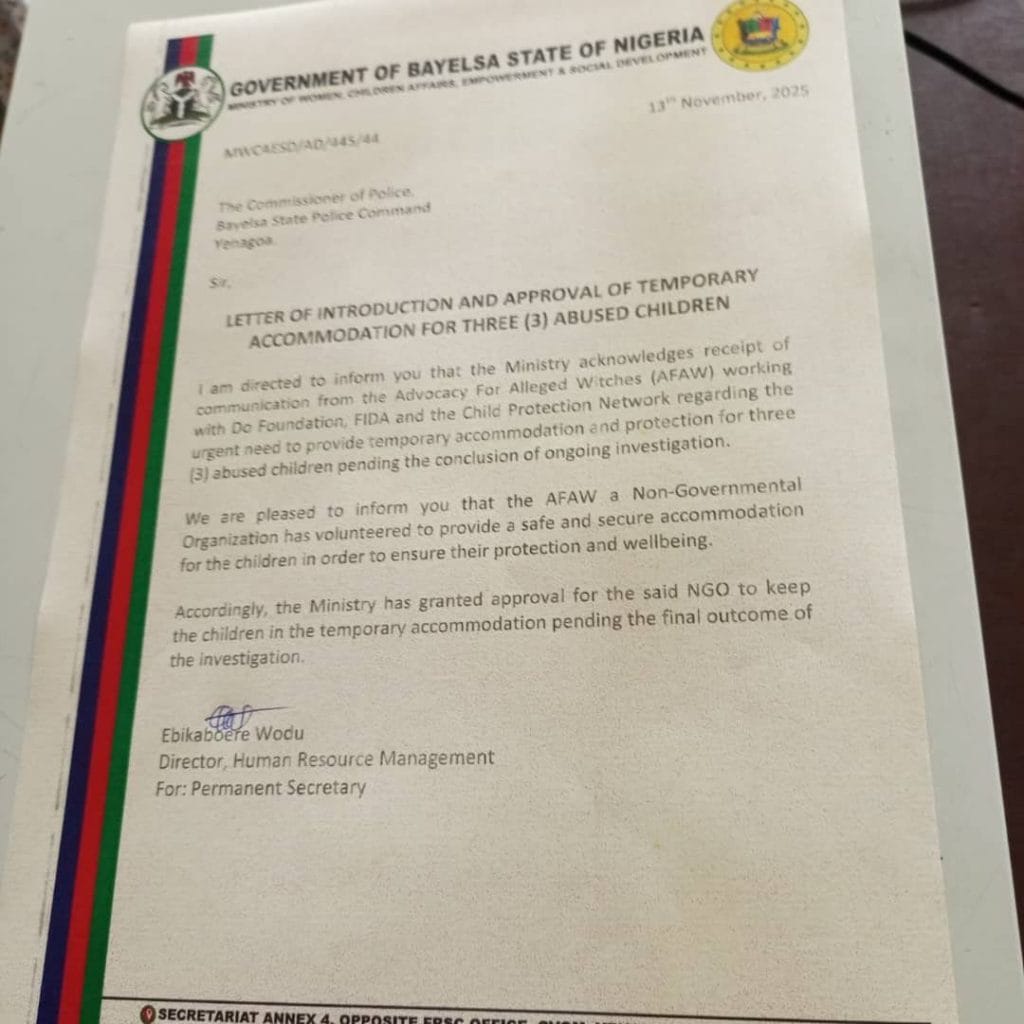


The Advocacy for Alleged Witches urges state and traditional authorities to take measures against harmful widowhood practices. This appeal has become necessary following an incident in Imo state where relatives tried to force a widow, Mrs Chika Ndubisi, to go through a harmful ritual in Awo-Omamma, in Oru East Local Government Area. The Advocacy for Alleged Witches commends the Imo state government for promptly intervening and ensuring that this widow, accused of killing her husband through magic, did not drink the water used in washing the corpse.
Some days ago, a local advocate drew the attention of the AfAW to this unfortunate development. AfAW quickly notified the police, the Imo state chapter of the International Federation of Women Lawyers, the National Human Rights Commission, and other civil society organizations. Today, we have it on authority that the state government successfully intervened and rescued the widow.
In some parts of southern Nigeria, women are subjected to harmful widowhood practices when their husbands pass away. They are often accused of being responsible for the death and forced to drink the water used in bathing the corpse to prove their innocence. This ritual leads to their death or health damage.
AfAW has recently intervened in similar cases. In Mbano, also in Imo state, AfAW is supporting a widow, Regina, who was subjected to a similar ritual. Luckily, Regina survived. In Ebonyi state, AfAW is assisting another widow, Nnennaya Donatus-Chukwu, who was subjected to similar abusive treatment. In this case, the police intervened and charged the perpetrators in court.
AfAW urges the public to be vigilant when people die, especially when men and husbands pass away in families and communities. People should alert authorities to any accusations of witchcraft or any attempt to force widows or females to go through this obnoxious ritual. Forcing widows to drink the water used in washing a corpse is a harmful traditional and cultural practice.
State authorities should strive to protect vulnerable women and widows in the region. The police and courts should diligently investigate and prosecute those involved in this horrific act. They should punish perpetrators to serve as a deterrent to others.
No to forcing widows to drink the water used in washing a corpse.
No to harmful widowhood practices in Nigeria. No to trial by ordeal.
Leo Igwe directs the Advocacy for Alleged Witches
Share this:
Like this:
LikeLoading…
Discover more from The Maravi Post
Subscribe to get the latest posts sent to your email.

Maung Sawyeddollah, Founder of the Rohingya Students Network, addresses the high-level conference of the General Assembly on the situation of Rohingya Muslims and other minorities in Myanmar Credit: UN Photo/Manuel Elías
UNITED NATIONS, Oct 1 2025 (IPS) – The international community convened for a high-level meeting at UN Headquarters, this time to mobilize political support for the ongoing issue of the persecution of the Rohingya Muslims and other minorities in Myanmar.
On Tuesday September 30, representatives from Rohingya advocacy groups, the UN system and member states convened at the General Assembly to address the ongoing challenges facing Rohingya Muslims and the broader context of the political and humanitarian situation in Myanmar.
UN President of the General Assembly Annalena Baerbock remarked that the conference was an opportunity to listen to stakeholders, notably civil society representatives with experience on the ground.
“Rohingya need the support of the international community, not just in words but in action,” she said.
Baerbock added there was an “urgent need for strengthened international solidarity and increased support,” and to make efforts to reach a political solution with unequivocal participation from the Rohingyas.
“The violence, the extreme deprivation and the massive violations of human rights have fueled a crisis of grave international concern. The international community must honor its responsibilities and act. We stand in solidarity with the Rohingya and all the people of Myanmar in their hour of greatest need,” said UN Human Rights Commissioner Volker Türk.
In the eight years since over 750,000 Rohingyas fled persecution and crossed the border into Bangladesh, the international community has had to deal with one of the most intense refugee situations in living memory. Attendees at the conference spoke on addressing the root causes that led to this protracted crisis—systematic oppression and persecution at the hands of Myanmar’s authorities and unrest in Rakhine State.
Muhammad Yunus, Chief Adviser of the interim Government of Bangladesh, addresses the high-level conference on the situation of Rohingya Muslims and other minorities in Myanmar. Credit: UN Photo/Manuel Elias
The military junta’s ascension in 2021 has only led to further unrest and instability in Myanmar and has made the likelihood of safe and sustained return far more precarious. Their persecution has only intensified as the Rohingya communities still residing in Rakhine find themselves caught in the middle of conflicts between the junta and other militant groups, including the Arakan Army.
At the opening of the conference, Rohingya refugee activists remarked that the systemic oppression predates the current crisis. “This is a historic occasion for Myanmar. But it is long overdue. Our people have suffered enough. For ethnic minorities—from Kachin to Rohingya—the suffering has spanned decades,” said Wai Wai Nu, founder and executive director of the Women’s Peace Network.
“It has already been more than eight years since the Rohingya Genocide was exposed. Where is the justice for the Rohingyas?” asked Maung Sawyeddollah, founder of the Rohingya Student Network.
For the United Nations, the Rohingya refugee crisis represents the dramatic impact of funding shortfalls on their humanitarian operations. UN Secretary-General António Guterres once said during his visit to the refugee camps in Bangladesh back in April that “Cox’s Bazar is Ground Zero for the impact of budget cuts”.
Funding cuts to agencies like UNICEF and the World Food Programme (WFP) have undermined their capacity to reach people in need. WFP has warned that their food assistance in the refugee camps will run out in two months unless they receive more funding. Yet as of now, the 2025 Rohingya Refugee Response Plan of USD 934.5 million is only funded at 38 percent.
Volker Türk, United Nations High Commissioner for Human Rights, addresses the high-level conference of the General Assembly on the situation of Rohingya Muslims and other minorities in Myanmar. Credit: UN Photo/Manuel Elias
“The humanitarian response in Bangladesh remains chronically underfunded, including in key areas like food and cooking fuel. The prospects for funding next year are grim. Unless further resources are forthcoming, despite the needs, we will be forced to make more cuts while striving to minimize the risk of losing lives: children dying of malnutrition or people dying at sea as more refugees embark on dangerous boat journeys,” said Filippo Grandi, UN High Commissioner for Refugees.
As the host country of over 1 million refugees since 2017, Bangladesh has borne the brunt of the situation. Chief Advisor Muhammad Yunus said that the country faces its own development challenges and systemic issues with crime, poverty and unemployment, and has struggled to support the refugee population even with the help of aid organizations. He made a call to pursue repatriations, the strategy to ensure the safe return of Rohingyas to Rakhine.
“As funding declines, the only peaceful option is to begin their repatriation. This will entail far fewer resources than continuing their international protection. The Rohingya have consistently pronounced their desire to go back home,” said Yunus. “The world cannot keep the Rohingya waiting any longer from returning home.”
Along with the UN, Myanmar and Bangladesh, neighboring and host countries also have a role to play. Regional blocs like the Association of Southeast Asian Nations (ASEAN) are also crucial in supporting the Rohingya population as well as leading dialogues with other stakeholders across the region.
“In my engagements with Myanmar stakeholders, I have emphasized that peace in Myanmar will remain elusive until inclusive dialogue between all Myanmar stakeholders takes place,” said Othman Hashim, the special envoy of the ASEAN Chair on Myanmar. “For actions within Myanmar, the crucial first step is stopping the hostilities and violence. Prolonged violence will only exacerbate the misery of the people of Myanmar, Rohingya and other minorities included.”
“Countries hosting refugees need sustained support. Cooperation with UNODC [UN Office of Drugs and Crime], UNHCR, and IOM [International Organization for Migration] must be deepened,” said Sugiono, Indonesia’s foreign minister.
Supporting the Rohingya beyond emergency and humanitarian needs would also require investing resources in education and employment opportunities. Involved parties were encouraged to support resettlement policies that would help communities secure livelihoods in the long-term, or to extend opportunities for longterm work, like in Thailand where they recently granted long-staying refugees the right to work legally in the country.
“Any initiative for the Rohingya without Rohingya in the camp, from decision making to nation-building is unsustainable and unjust. The UN must mobilize resources to empower Rohingya. We are not only victims; we have the potential to make a difference,” said Sawyeddollah.
As one of the few Rohingya representatives present that had previous lived in the camps in Cox’s Bazaar, Sawyeddollah described the challenges he faced in pursuing higher education when he applied to over 150 universities worldwide but did not get into any of them. He got into New York University with a scholarship, the first Rohingya refugee to attend. He reiterated that universities had the capacity to offer scholarships to Rohingya students, citing the example of the Asian University of Women (AUW) in Chittagong, Bangladesh, where it has been offering scholarships to Rohingya girls since at least 2018.
The conference called for actionable measures that would address several key areas in the Rohingya refugee situation. This includes scaling up funding for humanitarian aid in Bangladesh and Myanmar, and notably, pursuing justice and accountability under international law. Türk and other UN officials reiterated that resolving the instability and political tensions in Myanmar is crucial to resolving the refugee crisis.
Kyaw Moe Tun, Permanent Representative of the Republic of the Union of Myanmar to the UN, blamed the military junta for the country’s current state and called for member states to refuse supporting the junta politically or financially. “We can yield results only by acting together to end the military dictatorship, its unlawful coup, and its culture of impunity. At a time when human rights, justice and humanity are under critical attack, please help in our genuine endeavour to build a federal democratic union that rooted in these very principles.” IPS UN Bureau Report
Pavitra Nandagiri—one of the highest-ranking transgender spiritual leaders at Maha Kumbh, the largest religious gathering on earth in Prayagraj, India. Credit: Stella Paul/IPS
PRAYAGRAJ, India, Feb 18 2025 (IPS) – Despite a blazing sun and growing heat, Pavitra Nandagiri sits on a cot smiling. Clad in a saffron robe and headgear with her forehead painted with turmeric and vermillion, Nandagiri is a Mahamandaleshwar—one of the highest-ranking monks of the Kinnar Akhada (Transgender Arena) at the Maha Kumbh, the world’s largest religious gathering currently underway in northern India.
As a steady stream of visitors pours in to touch her feet, Nandagiri raises her right hand and touches their heads in a gesture of accepting their respect and blesses them.
Just a few hours ago, she had taken part in the special, ceremonial snan (bathing) in the Sangam—a place with mythological significance where three holy rivers—Ganga, Jamuna and Saraswati—are believed to have met. Taking a dip in the confluence of these rivers is considered by Hindus as the most sacred act of one’s lifetime.
The ceremonial bathing is led by the most important of the living Hindu saints and godmen who follow a strict order of hierarchy. On Wednesday morning (February 12), the fourth ceremonial bathing of the 45-day Maha Kumbh was held. Fifteen transgender spiritual leaders, including Nandagiri, marched along with the Naga Sadhus and Aghoris—the legendary saints with ash-covered bodies, matted hair, and minimalistic clothing. Together, they bathed in the river with the holy chant of “Har har Mahadev” (Hail Shiva) while saints of other sects waited for their turn.
A devotee prays at the Maha Kumbh Sangam, where three rivers are believed to have converged. While two of the rivers—Ganges and Yamuna—are visible, the third river, Saraswati, is said to be hidden underneath. Credit: Stella Paul/IPS
Later, inside the Kinnar Akhada, trans gurus receive visitors while some are seen performing some rituals and meditating along with Aghori ascetics. Asked how the partnership between the third highest order of the religious saints and the trans leaders came to be, Nandagiri says that it had been in the making since 2015 and culminated in a functioning collaboration during this year’s Maha Kumbh, which happens once every 12 years. She, however, does not share other details except that perhaps what brought together the two sects is their shared denouncement of worldly pleasure and embracing of a life free from its wealth and other complexities.
Transgender-Inclusive Kumbh: Conditions Apply
At the Kumbh, Akharas are organized into various sects, primarily categorized based on their philosophical orientation and the deity they worship. The two main sects are Shaiva Akharas, dedicated to Lord Shiva, and Vaishnava Akharas, devoted to Lord Vishnu. Each Akhara operates under a hierarchical structure, typically led by a Mahant (chief) or Acharya (spiritual leader) who oversees the spiritual and administrative functions.
The inclusion of the transgender Acharyas in the Kumbh, especially as a part of the highly revered Juna Akhada of the group of the Naga Sadhus, however, has not been completely free of controversies. Some have disputed their claim of embracing a minimalistic life and accused them of indulging in a game of power and authority considered unbefitting for true sainthood.
On January 24, the community ushered in a former film actress called Mamta Kulkarni as one of its top leaders, which led to protests by many both from within the trans community and leaders of other Hindu sects, who described it as a public relations stunt. Baba Ramdev—a well-known yoga guru—called it a violation of the Hindu religious ethos. Some gurus went as far as threatening to boycott the next Kumbh—to be held in 2037—if the Kinnar Akhada is not excluded from the ritual bathing.
Kalyani Nandagiri—another top-ranking trans guru who opposed the actress’s inclusion—was physically attacked by unidentified assailants on February 12.
A monk at the Transgender Arena within the Maha Kumbh. Credit: Stella Paul/IPS
Despite these deep divisions and acts of violence, Pavitra Nanndgiri remains hopeful of the community’s future.
“People say a lot of things; some wrongs also happen. But such small issues should not be highlighted much. We are here today, and we will be here then (in the next Kumbh),” she says, sounding more like a peace advocate.
A Different Picture
While inside the Kinnar Akhada, trans gurus are busy receiving and blessing visitors; outside, on the street, a small crowd of men is seen surrounding a young trans man dancing to the fast beats of music.
“This is Launda Naach,” says Ajeet Bahadur—a local theater artist. “It’s a common form of rural entertainment here, performed typically by cross-dressing trans men.”
The audience of Launda Naach is typically male. It is said to have started at a time when women were not allowed to dance in public because of orthodox social norms. However, today the moves of a Launda Naach performer are often sleazy and according to Ajeet Bahadur, the dancers are often sexually exploited, and their performance is rarely seen as art.
“Their lives are unbelievably miserable; there is little respect for their art, all eyes are on their bodies and exploitation and poverty are a constant part of their lives,” says Bahadur, who has studied the lives of Launda Naach performers for some time.
Aside from Launda Naach performers, thousands of other trans men and women in India struggle to earn a living. They are usually seen begging on the street and inside public transport, while many are also often accused of extorting money from small businesses such as shopkeepers in local markets. Not surprisingly, the presence of a trans person in India usually evokes a mix of fear and contempt instead of the deep respect that is on display in the Kinnar Akhada of the Kumbh. Will the elevated status of the gurus here lead to any change in the social status of the common trans people?
Priyanka Nandagiri, a transgender monk, says that it cannot be guaranteed. “Broadly, the transgender community in India is divided into two groups: the Sanatani and the Deredaar. We are the members of the Sanatani group who have always been immersed in religious activities, while the Deredaar are the ones who have chosen a different lifestyle, such as performing dances on the street and at social events like weddings, etc. So, we have always been following separate paths,” she explains.
Dwita Acharya and Mohini Acharya—two other trans monks—nod in agreement: “It will depend on what life they choose,” they say in unison.
”If they want to follow our path (the Sanatani), they will get that recognition but if they want to continue with their usual Deredaar lifestyle, then people will continue to view them accordingly.”
The Vijayanagar rulers constructed an earth-fill dam in 1530 AD to create Dhamapur Lake. There is now a campaign to save it. Credit: Rina Mukherji/IPS
PUNE, India, Oct 2 2024 (IPS) – Dhamapur is a small village in Malvan taluka of west Sindhudurg district, housing the famous Dhamapur Lake. The Vijayanagar kings constructed an earthfill dam in 1530 A.D., creating a man-made lake surrounded by hills on three sides. Canals connect it to the Karli river, irrigating lush paddies and farms that grow the red Sorti and Walay rice varieties typical to the region.
A Bhagwati temple constructed in the typical Konkan style stands on its banks. Small shrines to anthills flank this temple, which is devoted to Goddess Bhagwati. This is because all over the Konkan region, anthills are considered manifestations of the Earth Goddess and worshipped as Goddess Sateri. These are monuments to biodiversity and well-being; white ants or termites that build anthills are known to aerate the soil, help seed dispersal, and improve soil fertility. The worship of anthills is an old Vedic practice that continues to survive in and around the Konkan region of Maharashtra, Goa, and its neighborhood to this day.
The construction of the earthfill dam on Dhamapur Lake too spells of local ingenuity. Made up of porous laterite stone that is locally found here, every layer of stone is alternated with a layer of biomass made of twigs and branches.
This freshwater reservoir, used for irrigation and drinking water purposes, is one of Maharashtra’s oldest engineering marvels. Its waters and the Kalse-Dhamapur forests that flank it nurture a wide variety of unique floral and faunal species, making it a popular tourist destination.
But beauty apart, this man-made lake, which is geographically on higher ground as compared to the surrounding countryside, plays an important role in recharging the groundwater, acting as a sponge during the monsoons. Apart from serving as an important source of drinking water and irrigation, Dhamapur Lake nurtures an entire ecosystem. Its waters and surrounding forests harbour a wide variety of flora and fauna, some of which are endangered species. Its significance can be gauged from the fact that it was given the Word Heritage Irrigation Structure (WHIS) Award by the International Commission of Irrigation and Drainage (ICID) in 2020.
But in recent times, several encroachments have affected this extensive waterbody. Guest houses, wells, and walkways built in its floodplains to boost tourism have been eating into its extensive area, in scant regard to the flora and fauna that thrive in its pristine waters.
Fighting for Dhamapur Lake
In recent years, though, Dhamapur Lake has found a savior in Sachin Desai and his organisation, Syamantak Trust. Incidentally, Sachin Desai and his wife, Meenal, have an interesting background that illustrates their love for the natural world and India’s time-honored traditions.
Believers in home schooling, the Desais fought out with the authorities to home-school their daughter. Abandoning high-paying corporate jobs, these two professionals set up the University of Life on their ancestral property to familiarize youngsters with traditional bricklaying, carpentry and farming skills in 2007. To stem the migration from the region, they sought to inculcate love and respect for traditional practices, foods, and cuisine among youngsters. This was how the Syamantak Trust came into being.
In the years that followed, learners and youngsters who spent time at the University of Life went to use the knowledge they acquired to specialize in respective fields or venture into entrepreneurship, selling local products to tourists frequenting Dhamapur. Rohit Ajgaonkar, once a student at the University of Life, has become an active volunteer with Syamantak and runs a small eco-café in Dhamapur. Remarkable in its use of local materials, the eco-café has an array of local delicacies such as kashayam and jackfruit, wood apple, and mango ice creams.
Rohit and his mother, Rupali Ajgaonkar, also run a shop adjoining their eco-café, wherein they sell hand-pounded local masalas, mango and jackfruit toffee, local pickles, cashew butter, kokum syrups and kokum butter. Prathamesh Kalsekar, another student of the University of Life who is the son of a local farmer, is now doing his B.Sc. (Agriculture) at the Konkan Krishi Vidyapeeth. He has raised a private forest on his family land in Dhamapur, and now grows many local fruit and vegetable trees, bushes, and plants, particularly focusing on nutrient-rich wild varieties. He has also set up a nursery of saplings for distribution among local farmers.
The Bhagwati temple is on the banks of Dhamapur Lake. The temple is built in the typical Konkan style, wherein the deity is placed at one end in the sanctum sanctorum. The main section of the temple is reserved for the assembly of elders who meet and discuss matters related to the village. The temple is reminiscent of a bygone era when a place of worship also served as a place for the community to assemble and parley. Credit: Rina Mukherji/IPS
The Ongoing Battle to Save Dhamapur
These skills and respect for nature came in handy when Syamantak embarked on its mission to save Dhamapur and other waterbodies in Sindhudurg district through a community-led movement, following the construction of a skywalk undertaken by the authorities in 2014, and the running of diesel-run boats for tourists by the panchayat (village self-governing body). But this was easier said than done, notwithstanding the public zeal.
Desai and his volunteers realized that “Sindhudurg district has several wetlands and waterbodies. However, the authorities haven’t notified or demarcated any of them. This permits encroachments, a lot of them by government bodies.” In the case of Dhamapur Lake, the high flood line was ignored, and private parties encroached upon the peripheral areas of the lake. Even the state government’s Department of Agriculture had built a nursery and sunk a well on the floodplains of the lake.
Making use of the National Wetland Atlas prepared by the Space Applications Centre of the Indian Space Research Organization (ISRO) and the Maharashtra Remote Sensing Applications Centre in 2010, during the tenure of Minister of Environment & Forests Jairam Ramesh, Syamantak Trust approached the Western Zonal bench of the National Green Tribunal. Some residents of Sindhudurg district also filed an Environment Interest Litigation (EIL) to save the lake. At that time, the phytoplankton population had already decreased due to the construction of 35 pillars and the 500-meter-long cement concrete skywalk.
An Interim Order in 2018 by the Tribunal not only halted all further construction but saw every bit of concrete broken down and removed from the precincts of the lake. It also stopped the use of diesel boats on the lake . Furthermore, the state Public Works Department (PWD) was ordered to shell out Rs 1.5 crore for mitigation measures to be undertaken to reverse the damages caused by the construction of the 2.5 km skywalk and the use of diesel boats.
Meanwhile, following the formation of a 32-member Wetland Brief Documentation Committee as per an Order by the District Collector, the Syamantak Trust organized the local citizenry to document the flora and fauna of Dhamapur lake. They were soon joined by students from the local college of architecture, academicians, botanists, zoologists, and geographers from Mumbai and other parts of India, besides Dr Balkrishna Gavade and Dr Yogesh Koli, who lent their expertise for the study. Mapping Dhamapur helped the volunteers learn about the kind of biodiversity hotspot the Western Ghats region is, especially in the forested tracts around Dhamapur Lake.
Five months spent documenting the various wetland flora and fauna showed 35 species of birds belonging to 18 families to frequent the lake, such as the Eurasian Marsh Harrier, Indian Pond Heron, Lapwing, Kingfisher, and Small Bee-Eater. The lake was found to be particularly lush with phytoplankton and zooplankton species, which are the building blocks of a wetland ecosystem. The volunteers would also learn about how the Wax Dart butterfly was reported for the first time in Maharashtra, on the banks of Dhamapur lake.
Once Dhamapur was mapped, the volunteers went on to document a total of 57 wetlands and waterbodies in Sindhudurg district, including those as yet unlisted by the authorities. These included Vimleshwar in Devgad, Pat Lake in Kudal, and Jedgyachikond in Chaukul, among others.
The Uphill Struggle to Save Dhamapur Lake
The mapping and summary of violations were to come in handy when fighting to conserve Dhamapur Lake at the NGT. However, the community’s fight to have Dhamapur Lake recognized as a wetland has not borne fruit so far. “Our case was dismissed by the NGT in 2023 on the grounds that the lake does not qualify to be a wetland in keeping with the Wetlands (Conservation and Management) Rules 2017, since it was constructed for drinking water and agricultural purposes,” Desai tells IPS.
However, the Trust and its community volunteers have not given up yet. They have now approached the Supreme Court to demand
1) Demarcation of the Lake’s buffer zone and high flood line; and
2) Notification of the Lake by the state government in its gazette.
Once notified, the Lake, they feel, would be protected against further encroachment from public and private bodies alike.
Meanwhile, Syamantak Trust, along with members of the local community, continue to familiarize visiting students and persons from other parts of India with this unique water-body and its flora and fauna through eco-trails. As of this year, Syamantak Trust has begun hosting classical music concerts with the theme “Connect to Nature,” allowing music lovers to explore the vast repertoire of Hindustani classical music and its connection to the seasons and nature’s clock.
Currently, the Desais and their volunteers in the local community sincerely hope that once people in Dhamapur and beyond learn to appreciate and love nature, it will help them connect better with the lake and its entire ecosystem. This can be the best and only bulwark against the destructive march of climate change.
Students and youth groups in Bangladesh stand guard outside temples and churches to protect those from vandalism during unrest after the Awami League government ouster. Credit: Rafiqul Islam/IPS
DHAKA, Aug 28 2024 (IPS) – Immediately after the fall of the Sheikh Hasina government on August 5, 2024, following weeks of deadly demonstrations staged by students, people carried out attacks on the houses and temples of the Hindu community in Dacope of Khulna, about 225 kilometres from Dhaka. They particularly attacked and vandalized the houses of minorities believed to be involved in the politics of the ousted Awami League government.
At least 11 Hindu houses in Dacope were attacked and vandalized, with attackers claiming these were acts of political revenge.
But, in Dacope, local Muslim and Hindu students and the community soon joined together to guard the houses and temples of the minorities so that they would no longer be victimized due to the political changeover.
Beginning in mid-June 2024, peaceful student protests in Bangladesh turned violent, resulting in hundreds of people killed, including at least 32 children, and thousands injured. The protests were the result of the reinstatement of a quota system for the distribution of civil service positions.
The government resigned in response to the protests, and a civilian interim government took its place.
In other areas too, attacks were carried out on the offices of the Awami League (AL) and residences and establishments of the AL leaders and temples, churches and houses of minority communities across Bangladesh during unrest.
Nur Nabin Robin, a resident of Chattogram City, said many people from minority communities, including Hindus, Buddhist and ethnic people, live in the port city in harmony.
But when the Sheikh Hasina government fell on August 5, people of the minority communities began to feel insecure in Chattogram since attacks on minorities were reportedly being carried out in different parts of the country, he said.
“So, we patrolled in the city for two to three nights in groups and guarded the temples and houses of the minorities so that none could attack them. We also asked them to call us via mobile phone if they can sense any clue of attack on them,” Robin told IPS.
Their concerns were exacerbated because most police stations across the country ceased operating after the fall of the previous government.
General students and even madrasa students came forward to protect the houses and places of worship as the leaders of the Anti-Discrimination Student Movement asked supporters to guard temples and churches, responding to concerns voiced over reports of attacks on minority groups.
Jasim Uddin, a resident of Kuliarchar in Kishoreganj, told IPS that after the fall of Sheikh Hasina’s government, mobs torched and vandalized houses of many AL leaders in his locality, but members of the Hindu community remained safe during the political turmoil as local people voluntarily safeguarded their temples and properties.
While national monuments and government buildings in the capital, Dhaka, were looted, there were no reports of attacks on temples or churches there during the recent political turmoil.
In Dhaka, Muslim students were found guarding the Dhakeshwari National Temple, a Hindu place of worship. A Muslim was spotted offering prayers in front of Dhakeswari temple so nobody would attack the temple.
Professor Muhammad Yunus, Chief Adviser to the interim government of Bangladesh, visited Dhakeshwari National Temple on August 13, 2024, to express his solidarity with the Hindu community. During his visit, he called upon the minorities to keep patience and remain united.
Yunus condemned the attacks on minority communities in the country as “heinous.”
Religious harmony is the long tradition of Banglalees, while people from different religions—Islam, Hindu, Buddhist, Christian—have been living together from generation to generation.
“Over 90 percent people in Bangladesh do not believe in communalism. Attacks were carried out on minorities due to political reason or gaining personal interest. Those who carried out looting and vandalism were not involved in the student movement,” adviser to interim government Syeda Rizwana Hasan told a function recently in Dhaka.
She said madrasa students had safeguarded temples in many places of Bangladesh, which showed an example of the country’s religious harmony.
Barrister Sara Hossain, the honorary executive director of the Bangladesh Legal Aid and Services Trust (BLAST), said once miscreants carry out any attack on minorities, all should protect them.
CONCERN REMAINS
Following the fall of the Sheikh Hasina government, there was chaos across the country, with law enforcement officials retreating in many places for fear of retaliation.
According to a report of the Office of the High Commissioner for Human Rights (OHCHR) of the United Nations released on August 16, 2024, attacks were conducted against minorities, including Hindus, especially in the days immediately after the change of government.
The OHCHR report recognized the role of the student organizations and other ordinary people who were forming groups to protect the minorities.
It details some of the attacks against minorities, including Hindus, especially in the days immediately after the change of government. On August 5 and 6, Hindu houses and properties were reportedly attacked, vandalized and looted in 27 districts. A number of places of worship were also damaged, including an ISKCON temple in Meherpur, Khulna division, which was vandalized and set on fire.
On August 5 and 6, Hindu houses and properties were reportedly attacked, vandalized and looted in 27 districts, while many temples were also damaged, including an ISKCON temple in Meherpur, Khulna division, which was vandalized and set on fire.
The Bangladesh Hindu Buddhist Christian Unity Council (BHBCUC) claimed that around 200-300 Hindu homes and businesses were vandalized since August 5 last while 15-20 Hindu temples were damaged.